
Key facts at a glance
This guide is part of how to sell a house in Connecticut. It explains what a direct sale is under Connecticut law, what paperwork and protections it comes with, and how to compare a direct offer with what a listing would really net.
| Fact | Number or rule | Source |
|---|---|---|
| Who may conduct a Connecticut real estate closing | Only a Connecticut attorney | CGS 51-88a |
| Contract to sell real estate | Must be in writing and signed to be enforced | CGS 52-550(a)(4) |
| Condition report, direct sales included | Before the buyer signs, or a $500 credit at closing | CGS 20-327b, 20-327c |
| Conveyance tax on a $395,000 sale, most towns | $3,950 (0.75% state + 0.25% town) | CGS 12-494 |
| Connecticut median residential price, Oct 2024 to Sep 2025 | $395,000 | CT OPM sales data, data.ct.gov |
| Median days on market, Connecticut, September 2026 | 41 days, before 30 to 45 days to close (est.) | Realtor.com via FRED |
| Contracts that will be assigned, not closed, by the buyer | Regulated as wholesaling since July 1, 2026 | CGS 20-329aaa to 20-329hhh |
Why does a direct sale feel hard to trust?
A direct sale feels hard to trust because it removes the people and systems most sellers rely on: no listing agent, no MLS, no lender checking the buyer. Sellers at this stage often feel wary, exposed, unsure what they would be signing, worried about being taken advantage of, and quietly hopeful that a simpler way exists.
You may have a letter or a text in front of you that says “we buy houses, any condition, close in two weeks.” It sounds easy, and that is exactly what makes you nervous. Who protects you if there is no agent? What stops the buyer from walking away, or changing the price the day before closing?
Those are the right questions. The answer in Connecticut is better than most people expect, because the state builds certain protections into every sale, with or without an agent. The biggest one is that a Connecticut attorney must conduct the closing, and you are entitled to your own.
I am Jerryll Noorden. I buy houses in Connecticut directly, about ten a year since 2016, so I am one of the buyers this page is about. That is why I want you to understand the paperwork before you talk to anyone, including me. If you are weighing a direct offer against listing and want to know what you would be signing, this page is for you.
What is a direct sale of a house in Connecticut?
A direct sale of a house in Connecticut is a sale where you sign a purchase contract straight with the buyer who will take title, without a listing agent or the MLS, and close through Connecticut attorneys. The buyer is usually a cash buyer or investor, so there is typically no mortgage, no appraisal and no financing contingency in the contract.
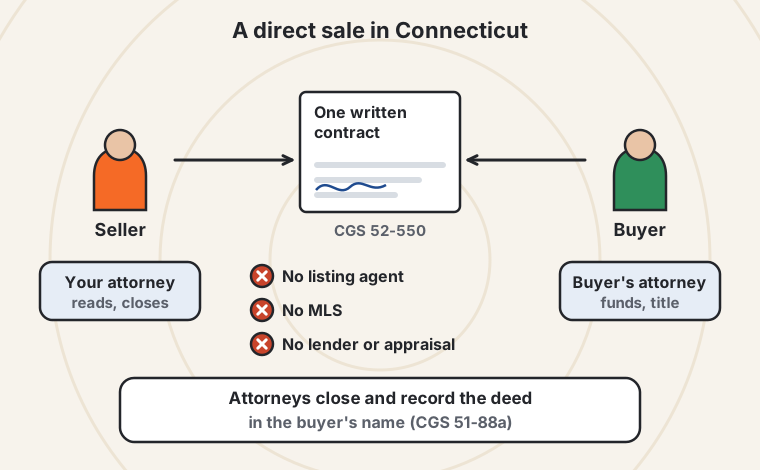
“Direct sale” is a plain-English term, not a legal category. It covers a few setups that look similar but are not the same:
- A direct sale to a cash buyer. A company or person buys the house with its own funds and closes in its own name. This is what we do, and what this page mostly describes.
- A sale by owner (FSBO). You sell without a listing agent, but usually to a regular buyer with a mortgage and their own agent. It is “direct” in that you represent yourself, but it keeps the lender, the appraisal and the mortgage contingency. Our three-way comparison of FSBO, an agent and a cash buyer runs the numbers on all three.
- A contract that will be assigned. Some “buyers” sign your contract and then sell the contract to someone else instead of closing. In Connecticut that is wholesaling, and since July 1, 2026 it has its own law, CGS 20-329aaa and following. It is not a direct sale in the sense used here. Our guide to wholesalers vs. realtors vs. cash buyers explains how to tell them apart.
The practical test is simple: ask “will you close and take title in your own name, with your own money?” A direct buyer says yes and can show proof of funds.
How is a direct sale different from listing with an agent?
A direct sale is different from listing with an agent in who you deal with, what can derail the deal and how long it takes. With an agent, you market the house on the MLS, accept a buyer who usually needs a mortgage, and close in about three months. In a direct sale, there is one buyer, no lender and no showings, and closing usually takes about two weeks.
| Point | Listing with an agent | Direct sale to a cash buyer |
|---|---|---|
| Who represents you | Your listing agent, plus your attorney | Your attorney |
| Marketing | MLS, photos, showings, open houses | None; one buyer looks once |
| Buyer’s financing | Usually a mortgage, with a financing contingency | Cash; no financing contingency |
| Appraisal | Required by the buyer’s lender | None |
| Inspection | Usually, with a chance to renegotiate | Sometimes a short walkthrough or due-diligence period |
| Repairs and cleaning | Usually expected | None; sold as-is |
| Commission | Negotiable (CGS 20-325b); often 4% to 6% total (est.) | None |
| Price | Usually the highest | Below the open-market price |
| Typical time | About 3 months | About 2 weeks, or a date you choose |
| Disclosures, attorney closing, conveyance tax | The same on both routes (CGS 20-327b, 51-88a, 12-494) | |
The full money comparison, with every line of cost on a real Connecticut house, is on our cash buyer vs. realtor page. This guide stays on the mechanics: the contract, the paperwork and the protections.
What is in the purchase contract for a direct sale?
The purchase contract for a direct sale in Connecticut is a written agreement signed by you and the buyer (CGS 52-550 makes an unwritten one unenforceable) that sets the price, the deposit and who holds it, the closing date, any inspection period, the as-is terms, what you may leave behind, and whether the buyer can assign the contract. Have your attorney read it before you sign.
Most direct buyers use their own short form. That is normal, but it means the clauses were written with the buyer in mind, so read these closely:
- Price and how it is paid. One fixed number, paid in funds at closing. No “price subject to inspection” language unless you agree to it.
- Deposit. How much, and who holds it. An attorney’s escrow account is the standard safe place. Be wary if no deposit is offered at all.
- No financing contingency. The contract should say the buyer is not relying on a loan. Ask for proof of funds, such as a recent bank statement or a letter from the bank.
- Inspection or due-diligence period. Some buyers want a few days to walk through with a contractor. Fine, but the period should be short and the contract should say what happens at the end of it.
- As-is clause. Says the buyer takes the house in its present condition and you make no repairs. It does not cancel the disclosure duties below.
- Personal property. What you can leave behind: furniture, a full basement, a car in the garage. Put it in writing.
- Closing date and possession. The date, and whether you can stay a few days or weeks after closing. If so, ask your attorney about a short written use-and-occupancy agreement.
- Assignment. Words like “and/or assigns” after the buyer’s name let them hand the contract to someone else. Our page on “and/or assigns” in a real estate contract explains what to ask. If you want a buyer who closes itself, strike it.
- Default. What happens if either side does not close. Usually the deposit is the seller’s remedy if the buyer walks away without a contract reason.
What paperwork does a Connecticut direct sale still need?
A Connecticut direct sale still needs the same core paperwork as any sale: the property condition report before the buyer signs or a $500 credit (CGS 20-327b, 20-327c), the lead paint disclosure for homes built before 1978, the smoke and carbon monoxide affidavit at closing (CGS 29-453), the deed, the conveyance tax return (Form OP-236) and a mortgage payoff, all handled through the attorneys.
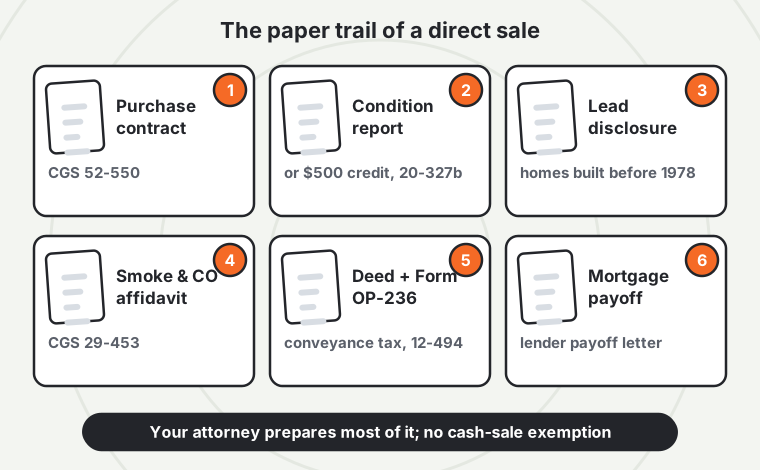
| Document | When | Who prepares it | Rule |
|---|---|---|---|
| Purchase contract | Before anything else | Buyer’s form, read by your attorney | CGS 52-550(a)(4) |
| Residential property condition report | Before the buyer signs the contract | You (the DCP form) | CGS 20-327b; $500 credit if not given, 20-327c |
| Lead-based paint disclosure and pamphlet | Before the contract, homes built before 1978 | You, with your attorney | EPA/HUD rule |
| Smoke and carbon monoxide affidavit | At closing | You sign; attorney drafts | CGS 29-453 |
| Deed and conveyance tax return (OP-236) | At closing | Your attorney | CGS 12-494 |
| Mortgage payoff and release | Ordered before closing | Your attorney | Lender payoff letter |
| Form 1099-S information | At closing | The closing attorney | IRS rules (exception for many main-home sales) |
The condition report is the one people most often assume a cash sale skips. It does not. The statute applies to “each person who offers residential property in the state for sale,” and its exemptions are listed: transfers between co-owners, certain family transfers, new construction, fiduciaries and government sellers, among others. A cash buyer is not on the list. Our Connecticut property condition disclosure guide walks through the form, and the documents checklist covers deeds, payoffs and authority papers.
What protections do you have in a direct sale without an agent?
The protections you have in a direct sale without an agent come from the law and the paperwork, not from a middleman: your own Connecticut attorney, a signed written contract, a deposit held in escrow, a closing that only an attorney may conduct (CGS 51-88a), and, if the buyer turns out to be a wholesaler, Connecticut’s wholesaler law. No real buyer needs your deed before the closing or charges you a fee.
Here is how each protection works in practice:
- Your attorney. You hire your own. They read the contract, run the title, get the payoff, prepare the deed and make sure funds arrive before the deed is released. Expect a flat fee of about $1,000 to $1,500 (est.). Some direct buyers offer to pay the seller’s attorney; it is still your attorney.
- The attorney-only closing. Since Public Act 19-88, no one but a Connecticut attorney may conduct a closing where money is paid to change ownership (CGS 51-88a). That keeps the money and the deed in the hands of licensed professionals.
- The written contract. The buyer cannot change the price or terms without your signature on an amendment. If they try to renegotiate the week of closing with no contract reason, you can say no.
- The deposit. Held by an attorney in escrow, it is what the buyer stands to lose if they walk away without a reason the contract allows.
- The wholesaler law. If the person you sign with plans to assign or sell the contract instead of buying, CGS 20-329aaa and following apply, with registration with the Department of Consumer Protection and required written disclosures. Our guide to selling your house to a wholesaler covers your rights.
And the warning signs, in one line each: anyone who asks for a fee, wants you to sign a deed before closing, avoids attorneys, will not show proof of funds or pushes a deadline you cannot meet. Our page on “we buy houses” scams and red flags has the full list, and our eight checks for a cash home buyer show how to verify one.
How long does a direct sale take in Connecticut?
A direct sale in Connecticut usually takes about two weeks from first call to closing, because there is no listing period, no lender and no appraisal; the time goes to the attorney’s title search and payoff. A listing usually takes about three months: a few weeks of prep, a median 41 days on the market in September 2026, and 30 to 45 days to close with a mortgage.
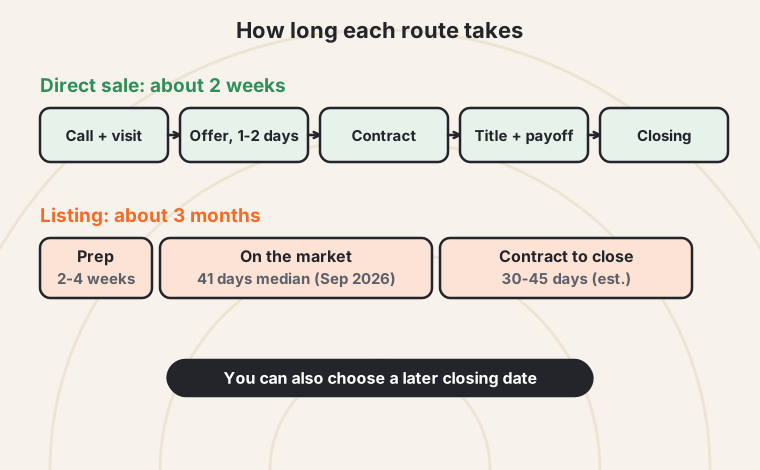
Call and a short visit, days 1 to 2
A quick conversation about the house and your timing, then a walkthrough, or photos if you prefer.
Written offer, within a day or two
Price, closing date, deposit and any inspection period, on paper. No deadline pressure; take it to your attorney.
Contract signed, condition report delivered
Your attorney reads the contract. You give the condition report before the buyer signs, or agree to the $500 credit.
Attorney work, about a week
Title search, mortgage payoff, any tax or lien payoffs, deed and conveyance tax forms.
Closing, about two weeks in
You sign the deed and affidavits; funds are wired to your attorney’s account and then to you. Or close later, on a date you pick.
Some things slow any sale, direct or not: probate, a divorce that has not settled who can sign, an old mortgage that was never released, or unpaid tax liens. Our Connecticut closing process guide explains each.
How do you compare a direct offer with a listing net?
To compare a direct offer with a listing net, subtract every cost from each: on the listing, the commission, conveyance tax, attorney, prep and the months of carrying costs; on the direct offer, the conveyance tax, attorney and about half a month of carrying costs. The difference is what you pay for speed and certainty. Then ask whether that is worth it to you.
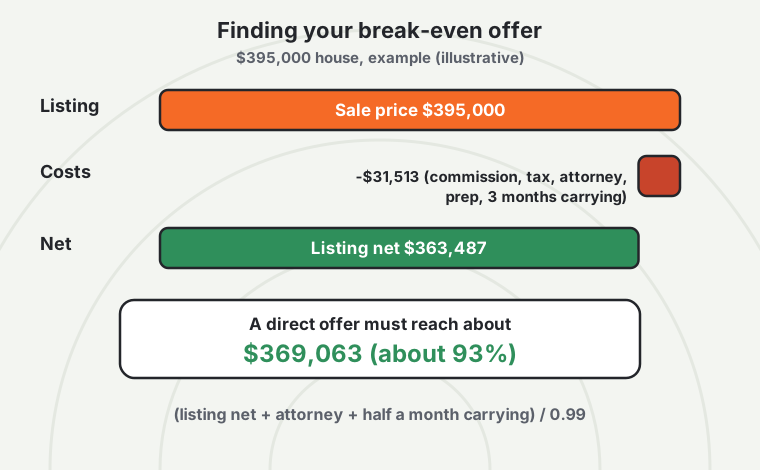
Example (illustrative). On a $395,000 move-in-ready house (the Connecticut median), with a 5% total commission (est.), 1% conveyance tax, a $1,200 attorney (est.), $2,500 of prep (est.) and three months of carrying costs at $1,371 a month (Wethersfield property tax at 39.98 mills plus $450 of insurance and utilities, est.), the listing nets about $363,487 before the mortgage payoff.
A direct offer would need to reach about $369,063 to match that, after its own 1% conveyance tax, $1,200 attorney and half a month of carrying costs. That is the break-even. Formula: (listing net + attorney + half a month of carrying) ÷ 0.99.
On a move-in-ready house like this one, most direct offers will be well below that line, often by tens of thousands. Our FSBO vs. agent vs. cash buyer guide shows a $316,000 example offer on the same house, which nets about $52,500 less. For a different Connecticut house with repairs, the cash buyer vs. realtor comparison shows the gap narrowing. Run your own numbers here:
How much would you walk away with?
Slide the numbers to match your house. It works in your browser; nothing is saved or sent.
Estimates for planning. Conveyance tax per CGS 12-494 (state 0.75% up to $800,000, 1.25% to $2.5M, 2.25% above, plus the town rate). Seller attorney about $1,200 to $1,500; flat-fee MLS about $400; listings include three months of taxes, insurance and utilities, a cash sale about two weeks. Your attorney gives you the final numbers.
Two adjustments make the comparison honest:
- Price the listing realistically. Use recent sales of similar houses in similar condition, not the best sale on the street. If the house needs work, either subtract the repair cost and an extra month, or use an as-is price.
- Price the risk. A financed buyer can fall through on the loan or the appraisal, and each restart costs another month or two. Our guide to comparing offers in Connecticut shows how to weigh “likely to close.”
When does a direct sale make more sense than hiring an agent?
A direct sale makes more sense than hiring an agent when the house needs repairs you cannot or will not pay for, when a financed buyer is unlikely to get a loan on it, when it is vacant or full of belongings, when tenants make showings impossible, or when you need a fixed closing date within weeks. In those cases the listing net is smaller, slower or less certain than it looks.
A few Connecticut-specific cases where direct often fits:
- An inherited house. Executors are exempt from the condition report, and a direct buyer can wait for the probate court’s authority to sell. See our inherited house page.
- A house with a crumbling foundation, an old buried oil tank or a failed septic. Lenders often will not finance them as they are. See our repairs page.
- A relocation with a start date. One closing date you control. See selling when relocating.
If a straight cash price is too low for you, there are other direct structures, such as a fix-and-list partnership or seller financing; our page on the ways we buy houses explains them and when they fit.
When should you hire an agent instead of selling direct?
You should hire an agent instead of selling direct when the house is in good shape, buyers with mortgages can finance it, and you have about three months. In our $395,000 example, listing nets about $52,500 more than a typical direct offer. That is too much to give up for speed you do not need.
We say this to sellers directly. If your house would sell well on the MLS and nothing forces your timing, list it with a good agent and negotiate the commission; every Connecticut listing agreement has to tell you the rate is “not fixed by law” (CGS 20-325b). Our commission guide shows what to negotiate. You can still get a direct offer first and keep it as a floor.

Read the buyer’s contract out loud with your attorney, one clause at a time. If a clause lets the buyer change the price after an inspection, assign the contract or delay closing without a cost, ask why. A buyer who plans to close as promised will not mind tightening those words.
Questions about a direct sale vs. an agent in Connecticut
What is a direct sale of a house?
A direct sale of a house is a sale where you contract straight with the buyer who will take title, with no listing agent and no MLS. In Connecticut it still closes through attorneys (CGS 51-88a), and the buyer is usually a cash buyer, so there is no mortgage or appraisal.
Is a direct sale legal in Connecticut?
Yes, a direct sale is legal in Connecticut. No law requires an agent. The contract must be in writing (CGS 52-550), the usual disclosures apply, and a Connecticut attorney must conduct the closing (CGS 51-88a).
Do I need a lawyer for a direct sale in Connecticut?
Yes, you need a lawyer for a direct sale in Connecticut, because only a Connecticut attorney may conduct a real estate closing (CGS 51-88a). Hire your own to read the contract before you sign; expect about $1,000 to $1,500 (est.).
Do I have to fill out the property condition report in a direct sale?
Yes, you have to give the property condition report in a direct sale in Connecticut, or credit the buyer $500 at closing (CGS 20-327b, 20-327c). There is no exemption for cash or as-is sales. Executors, administrators, trustees and conservators are exempt.
Can a direct buyer back out of the contract?
A direct buyer can back out only for a reason the contract allows, such as an inspection period, or by giving up the deposit. That is why the deposit amount, who holds it and the length of any inspection period matter. Have your attorney check them.
Who pays closing costs in a direct sale?
In a direct sale in Connecticut, the seller usually pays the conveyance tax and their own attorney, and the buyer pays its own costs. Some direct buyers offer to cover more; get any such promise written into the contract.
How fast can a direct sale close in Connecticut?
A direct sale can close in Connecticut in about two weeks, often less, because there is no lender or appraisal. Probate, divorce, liens or an unreleased old mortgage can add time, and you can always choose a later date.
Is a direct sale the same as selling to a wholesaler?
A direct sale is not the same as selling to a wholesaler. A direct buyer closes and takes title. A wholesaler signs a contract and assigns or resells it, which in Connecticut is regulated by CGS 20-329aaa and following since July 1, 2026.
Will I get less money in a direct sale than with an agent?
Yes, you will usually get a lower price in a direct sale than with an agent, especially on a move-in-ready house. The question is the net after commission, repairs and carrying costs, and whether speed and certainty are worth the difference to you.
How do I know if a direct offer is fair?
You know a direct offer is fair by comparing it with your realistic listing net and the break-even price, and by getting more than one offer. A fair buyer explains how they got their number. Our guide on why cash offers are lower shows the method.
Can I stay in the house after a direct sale closes?
You can often stay in the house for a short time after a direct sale closes if the buyer agrees. Put it in writing, usually as a use-and-occupancy agreement your attorney prepares, with the dates and any holdback.
Can I leave furniture and belongings in a direct sale?
Yes, you can usually leave furniture and belongings in a direct sale. Say so in the contract, so there is no argument at the final walkthrough. Take papers, photos and valuables first.
Related Connecticut guides
The direct-sale series
Choosing a route
We buy directly in towns across Connecticut, including Windsor, Wethersfield, Bloomfield, East Hartford and Hartford. For the whole process, see how to sell a house in Connecticut.
Plain-English information, not legal advice. Contract terms vary; have a Connecticut real estate attorney read any contract before you sign.
See the house together.
Pick a time that works.
Choose a time for us to walk through the property with you, or ask for a quick call first. We confirm every request personally.
Tuesday, January 13
No open times in the next few weeks. Please call us.
We will confirm by email. Nothing is booked until we do.
View my requestSources (checked on October 27, 2026)
- CGS § 51-88a (real estate closings conducted only by Connecticut attorneys; P.A. 19-88).
- CGS § 52-550 (statute of frauds: agreements to sell real property in writing).
- CGS §§ 20-325b, 20-327b, 20-327c (commission notice; residential condition report and exemptions; $500 credit).
- CGS § 29-453 (smoke and carbon monoxide affidavit).
- CGS § 12-494 (conveyance tax).
- CGS §§ 20-329aaa to 20-329hhh (real estate wholesalers, 2026 Supplement, effective July 1, 2026).
- EPA and HUD lead-based paint disclosure rule.
- IRS Instructions for Form 1099-S.
- Connecticut OPM, Real Estate Sales (data.ct.gov): median residential price October 2024 to September 2025.
- Realtor.com median days on market in Connecticut (FRED).
- Connecticut OPM mill rates.

Who wrote this
Jerryll Noorden
Jerryll has bought and sold Connecticut houses since 2016 and has sat at more closing tables than he can count, on both sides. Before real estate he was a robotics scientist at NASA, IHMC and IIT. He wrote this guide because the national sites that rank for it skip the Connecticut rules that cost sellers money. When listing or selling it yourself would get you more than a cash offer, he says so.
This guide explains Connecticut rules in plain English. It is not legal or tax advice. Laws change; for your sale, talk to a Connecticut real estate attorney and a tax professional.
