
- Downsizing your home in Connecticut is four decisions, not one: where you will live next, what you keep, when you move, and how you sell. Make them in that order; the selling steps themselves are in our guide to how to sell a house in Connecticut.
- You do not have to empty the house to sell it. With an as-is buyer you take what you want and leave the rest; with a listing, the contract decides how clean the house must be.
- Most long-time owners pay no federal tax on the sale: up to $250,000 of gain is excluded ($500,000 for a married couple), and time in a licensed care facility can count toward the residence test (IRS Publication 523).
- If you stay put, Connecticut’s circuit breaker can cut the property tax bill by up to $1,250 a year for couples and $1,000 for singles aged 65+ with income at or below $56,500 or $46,300 (CGS 12-170aa; 2025 income).
- If long-term care is on the horizon, talk to an elder law attorney before you sell or give anything away. Connecticut Medicaid looks back 60 months at transfers.
- Be careful with anyone who rushes you. Never wire money on an emailed instruction, never sign a deed before closing, and bring a family member or your attorney into every decision.
How do you downsize your home in Connecticut?
To downsize your home in Connecticut, first choose where you will live next (a smaller house or condo, a 55+ community, an apartment, family, or assisted living), then sort what you will keep, set a move date, and pick the way to sell that fits it: list with an agent, list after a cleanout, or sell as-is to a buyer who lets you leave belongings behind. Check taxes and, if care is coming, Medicaid rules before you sign.
This guide is part of our guide to how to sell a house in Connecticut, written for older homeowners and for the adult children helping them. If you are moving for a new job or to be near family out of state, our page on selling a house when you are relocating covers the logistics of selling from a distance. If the house needs work you do not want to take on, see selling a house that needs repairs.
The old version of this page was a short list of cleanup tips for Canton homeowners. Those tips are still here, in the section on what to keep. Around them is the rest of what a downsizing seller needs: where people actually go, how to time the move, the tax rules that favor long-time owners, the long-term care cautions, how to avoid the people who prey on older sellers, and an honest comparison of the ways to sell.
Why does downsizing feel so hard, even when you know it is the right move?
Downsizing feels hard, even when you know it is the right move, because you are leaving more than a building. You are sorting decades of memories, admitting the house has become more work than help, and worrying about money, independence and being taken advantage of. Adult children carry their own guilt and worry. Those feelings are normal, and none of them mean you are doing it wrong.
Picture a four-bedroom colonial in Canton, bought when the kids were small. The bedrooms upstairs have been empty for twenty years. The oil tank gets filled every few weeks all winter. The driveway needs plowing, the gutters need cleaning, and the stairs to the laundry in the basement get a little steeper every year. The house is full: the dining room set from your parents, the kids’ trophies, the workbench, the attic nobody has opened since 2009.
People in that spot tell us they feel:
- Sad. This is where the holidays happened, where the height marks are on the kitchen door frame. Selling it can feel like ending a chapter of your life.
- Overwhelmed. Forty years of belongings, and no idea where to start. The cleanout alone feels bigger than the move.
- Afraid of losing control. Downsizing can feel like the first step toward other people making decisions for you.
- Guilty. Parents worry about being a burden. Adult children worry they are pushing too hard, or not helping enough, or living too far away to help at all.
- Worried about money. Will the sale cover the new place? What about taxes? What if care costs more than expected?
- Wary. You have heard the stories about people who talk older homeowners into bad deals, and every “we buy houses” postcard makes you more suspicious.
- Quietly relieved. Part of you is ready for one floor, no lawn and a smaller heating bill.
This page is for you, and for the son or daughter reading it on your behalf. Nothing here requires you to decide quickly. Take what helps, ask your family and your attorney about the rest, and move at the speed that feels right.
How do you decide what to keep when you downsize?
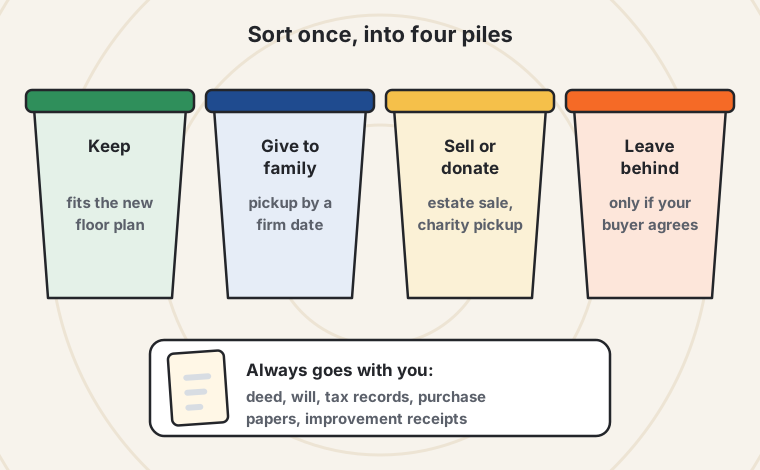
To decide what to keep when you downsize, start with the floor plan of your next home and keep only what fits it and what you use or love. Offer family heirlooms first and set a deadline for pickup, photograph things you cannot take, keep important papers safe, then sell, donate or leave the rest. Work one room at a time, starting with the rooms you use least.
A simple order of work
- Measure the new place. Get the floor plan, or measure it. Decide which bed, which sofa, which table fit. This makes most of the hard decisions for you.
- Set aside the papers first. Your deed, will, powers of attorney, insurance policies, tax returns, the closing statement from when you bought the house, and receipts for major improvements. The last two matter for taxes on the sale.
- Family round. Make a list or take photos of things children and grandchildren might want, and give a firm date to claim and collect them. Things not collected by the date go to the next pile.
- Start where it is easiest. The guest room, the linen closet, the garage. Leave photographs and letters for last, when you have momentum.
- Photograph what you cannot keep. A picture of the piano or the workbench keeps the memory without the square footage.
- Sell, donate or leave. Estate sale companies sell contents for a share of the proceeds (est.); charities pick up some furniture; junk haulers charge by the load. If you sell the house as-is, you can simply leave what is left.
Even when a buyer lets you leave everything, take or properly dispose of: personal papers and anything with account or Social Security numbers, prescription medicines, firearms and ammunition (transfer them lawfully), cash and jewelry hidden in drawers, and family photos. Ask your town’s transfer station about paint, chemicals and propane tanks.
For a room-by-room approach to a full house, see handling all your stuff when you move. The same cleanout decisions come up for families clearing a parent’s home after a death; our guide on preparing an inherited house for sale in Connecticut covers that side.
Where do Connecticut seniors move when they downsize?
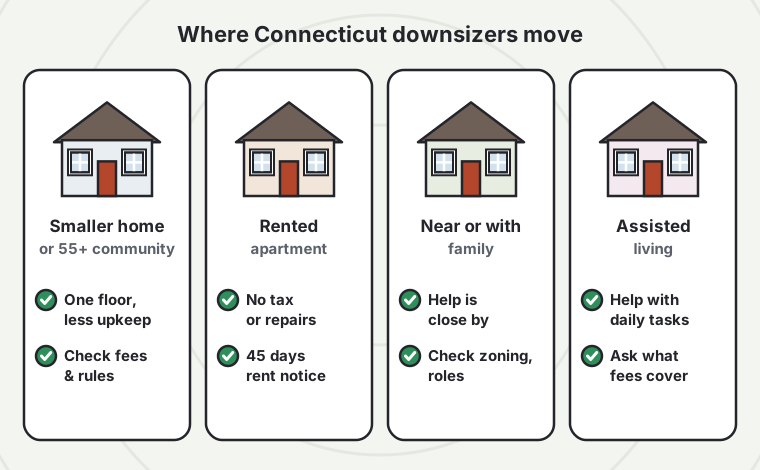
Connecticut seniors who downsize usually move to a smaller house or condo, a 55+ community, a rented apartment, a home near or with family, or an assisted living or continuing care community. The right choice depends on health, how much help you need now and may need later, where your family lives, and how much the sale of your house will bring. Visit at least two options before you sell.
| Where | Good for | Check before you commit |
|---|---|---|
| Smaller house or condo | Independent owners who want less space, one floor and less upkeep | Stairs, condo fees and special assessments, distance to doctors and family |
| 55+ community | Independent owners who want neighbors their age and outside maintenance done | Federal law lets “housing for older persons” limit residents if at least 80% of occupied units have someone 55 or older (HUD); check fees, rules and resale |
| Rented apartment | Freedom from maintenance and property tax; flexibility | Rent increases need 45 days’ notice (CGS 47a-4e); older renters may qualify for the state renters’ rebate (CGS 12-170d) |
| Near or with family | Help close by; shared costs | Who owns what, house rules, and whether an in-law apartment is allowed by your town’s zoning |
| Assisted living | Help with daily activities while living in your own apartment | Connecticut licenses assisted living services; what the monthly fee covers; what happens if care needs grow |
| Continuing care community | Independent living now, with care on the same campus later | Entrance fees, refund terms and the contract; have an attorney read it |
If you are not sure how much help will be needed, ask your doctor, and contact your regional Area Agency on Aging through the Connecticut Department of Aging and Disability Services. They can explain local options and programs at no cost.
Downsizing in Canton and the Farmington Valley
Canton is a good example of why so many long-time owners downsize. By town data, its homes are large (2,295 square feet and 3.4 bedrooms on average for single-family homes), mostly colonials, capes and ranches, and 75% heat with oil. Plenty of Farmington Valley owners stay close: a condo in Avon or Simsbury, an apartment in Farmington, or a one-floor home near Collinsville. The numbers below show what nearby homes sold for.
| Town | Homes sold | Median sale price | Mill rate (FY 2027) | Town conveyance tax |
|---|---|---|---|---|
| Canton | 170 | $442,000 | 33.2 | 0.25% |
| Avon | 298 | $515,000 | 31.8 | 0.25% |
| Simsbury | 371 | $474,900 | 33.67 | 0.25% |
| Farmington | 408 | $436,000 | 27.36 | 0.25% |
How do you time the sale of your house with your move?
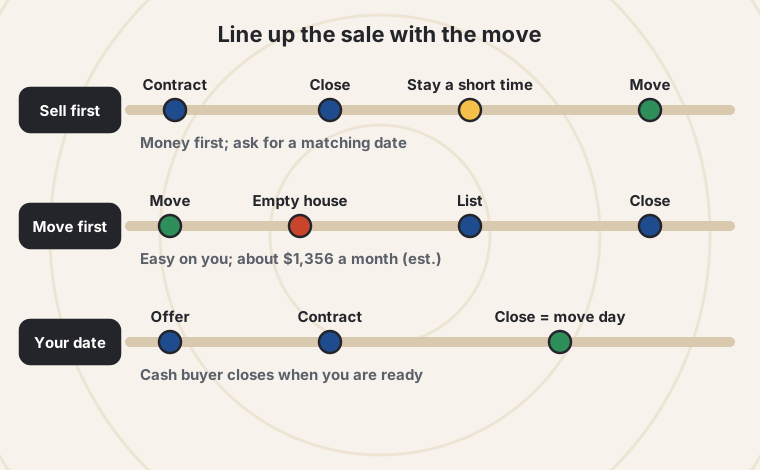
You time the sale of your house with your move by picking the move date first, then choosing a sale route that closes on or after it. You can sell first and stay a short time after closing, move first and sell the empty house, use a bridge loan, or sell to a buyer who closes on the day you choose. Moving first is easiest on you but means paying taxes, heat and insurance on an empty house.
The four ways to line it up
- Sell first, then move. You have the money in hand before you commit to the new place. The risk is a closing date that comes before you are ready. Ask for a closing date that matches your move, or a short period of occupancy after closing written into the contract (your attorney drafts it, usually with a holdback from your proceeds).
- Move first, then sell. Easiest physically: you move at your own pace, then clean out and list. The cost is carrying an empty house. In Canton, a $442,000 house at a 33.2 mill rate carries about $10,272 a year in property tax ($856 a month), plus heat, electricity and insurance, estimated at $500 a month, so about $1,356 a month (est.). Vacant houses also need a check on your insurance; many policies change when a house is unoccupied. Our guide to moving before your house sells covers this.
- Bridge loan or home equity line. Lets you buy the next home before selling. It adds a loan payment and an approval process; ask your bank and do the math before you sign.
- A buyer who closes on your date. A cash buyer can usually close in about two weeks or wait until your move date, with no financing to fall through. The trade-off is a lower price than a well-prepared listing, as the example below shows.
If an assisted living apartment opens up suddenly, the move date may not be yours to choose. That is the situation where a flexible closing date matters most. Our resource on selling when you need to relocate in Connecticut walks through selling on a deadline.
Know where you stand,
on your own time.
Watch what homes around you sell for and how fast, so when you are ready, you already know your options.
Follow your numbers as the market moves, and decide when the timing is right.
Do you have to clean out the house before you sell it?
You do not have to clean out the house before you sell it in Connecticut. What you must leave depends on the contract: most listing contracts expect the house empty and “broom clean” at closing, while an as-is buyer can agree in writing that you take what you want and leave the rest. Either way, you still owe the buyer honest answers on the property condition report (CGS 20-327b).
A full cleanout of a long-occupied house is often the single biggest job in downsizing. For a large house, the estate sale, donations, junk removal and a final cleaning can take weeks and cost several thousand dollars (est.; it depends on the volume and whether anything needs special disposal). Then come the repairs and paint a listing usually needs.
| Task | Listing the house | Selling as-is to a cash buyer |
|---|---|---|
| Empty the house | Usually yes, by closing | Take what you want; leave the rest |
| Clean for showings | Yes, and keep it ready | No showings beyond one walkthrough |
| Repairs and paint | Often, to compete and pass inspection | No |
| Property condition report | Yes (or $500 credit) | Yes (or $500 credit) |
| Smoke and CO affidavit (one- or two-family) | Yes (no credit option) | Yes (no credit option) |
| Lead paint disclosure (built before 1978) | Yes | Yes |
The as-is route is explained in full in our guide to selling a house as-is in Connecticut. If repairs are the part that worries you, see selling a house that needs repairs.
Which taxes and Connecticut rules matter when you sell a house to downsize?
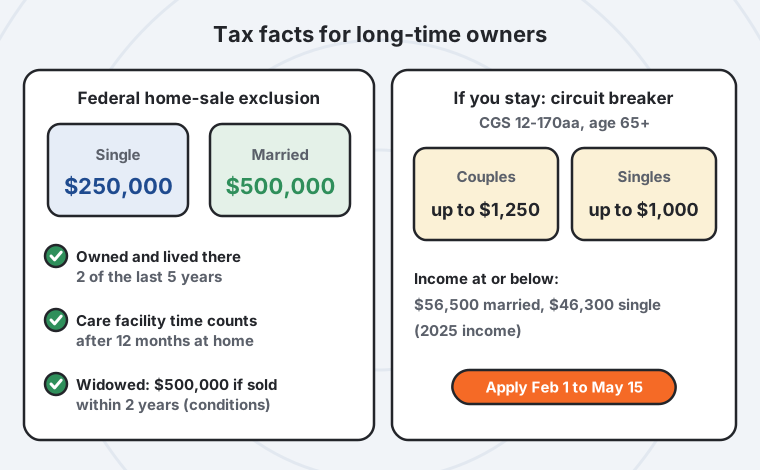
The taxes and Connecticut rules that matter when you sell a house to downsize are the federal home-sale exclusion ($250,000 of gain, $500,000 for married couples, IRS Publication 523), Connecticut’s income tax on any gain that is not excluded, the conveyance tax (CGS 12-494), the seller disclosures (CGS 20-327b, 29-453), the circuit breaker property tax credit if you stay or buy again (CGS 12-170aa), and Medicaid transfer rules if care is likely.
| Rule | What it means for you | Source |
|---|---|---|
| Home-sale exclusion | Exclude up to $250,000 of gain ($500,000 married filing jointly) if you owned and lived in the home for 2 of the last 5 years. | IRS Publication 523 |
| Care facility rule | If you became unable to care for yourself and lived in the home at least 12 months of the last 5 years, time in a licensed care facility counts toward the residence test. | IRS Publication 523 |
| Surviving spouse | A widow or widower can generally still claim up to $500,000 if the sale happens within 2 years of the spouse’s death and the other conditions are met. | IRS Publication 523 |
| Connecticut income tax | Connecticut taxes gains as income (top rate 6.99%); a gain excluded on your federal return generally does not reach Connecticut income. | DRS; CGS chapter 229 |
| Conveyance tax | Seller pays 0.75% to the state (up to $800,000) plus the town’s 0.25% or 0.50%: 1.00% in Canton. | CGS 12-494 |
| Property condition report | Give it before the buyer signs, or credit $500. | CGS 20-327b, 20-327c |
| Smoke and CO affidavit | Signed at closing for one- and two-family homes and condos (no credit option since PA 23-164). | CGS 29-453 |
| Circuit breaker credit | Age 65+ (or surviving spouse 50+), Connecticut resident a year, income at or below $56,500 married or $46,300 single (2025 income): up to $1,250 or $1,000 off the tax bill. Apply to the assessor February 1 to May 15. | CGS 12-170aa; OPM; OLR 2026-R-0027 |
| Renters’ rebate | Older and disabled renters with limited income may get a partial refund of rent and utilities. | CGS 12-170d |
| Medicaid transfers | Gifts or below-value transfers in the 60 months before applying for long-term care Medicaid can cause a penalty period. | CT DSS |
Example: how the exclusion works for a long-time Canton owner (illustrative)
Suppose a couple bought their Canton house in 1985 for $110,000 and spent $40,000 on improvements over the years (a new roof, a kitchen, windows), for a basis of $150,000. They sell for $442,000, Canton’s median, and pay $28,020 in selling costs (a 5% commission of $22,100 (est.), $4,420 conveyance tax and $1,500 for the attorney (est.)). Their gain is $442,000 − $28,020 − $150,000 = $263,980.
- Married, filing jointly: the whole $263,980 is under the $500,000 exclusion. No federal tax.
- Widowed, selling within two years of the spouse’s death: generally the same $500,000 limit applies if the conditions in Publication 523 are met.
- Single: $13,980 is above the $250,000 exclusion and is taxable.
Two more points for long-time owners. Keep the improvement receipts: every documented dollar of improvement lowers the gain. And if a spouse has died, part of the home’s basis may have been stepped up to its value at the date of death, which can shrink the gain further. Ask your tax preparer; our guide to taxes when selling a house in Connecticut has more.
If you decide to age in place, check whether you qualify for the circuit breaker credit: apply to your town assessor between February 1 and May 15. Many towns, including in the Farmington Valley, also offer their own local relief for older homeowners; ask the assessor what your town offers.
How does selling your house affect Medicaid and long-term care planning?
Selling your house can affect Medicaid and long-term care planning because it turns a home, which Medicaid often treats differently, into cash, which generally counts as an asset. Connecticut also looks back 60 months at gifts and below-value transfers when someone applies for long-term care Medicaid. If care may be needed in the next five years, talk to an elder law attorney before you sell, give the house to family, or sell well under market value.
This is general information only, and the rules are detailed. The points families most often miss:
- The look-back. The Connecticut Department of Social Services reviews transfers made in the 60 months before a long-term care Medicaid application. Giving the house or money to children, or selling for much less than it is worth, can create a period when Medicaid will not pay for care.
- Selling at fair value is not a gift. A sale at a fair price is generally not a penalized transfer. But if the price is far below market, ask an elder law attorney whether the difference could be treated as a transfer. That includes a sale to a cash buyer at a discount; get advice and keep the offers and appraisals that show how the price was set.
- The money from the sale counts. Proceeds sitting in the bank are generally countable assets. How they are spent or set aside matters, and that is a conversation for the attorney.
- Spouses have protections. When one spouse needs care and the other stays at home, special rules protect part of the couple’s assets. Plan before the house is sold.
Start with the Department of Social Services’ long-term care information and a Connecticut elder law attorney. Do not rely on a buyer, an agent or a website, including this one, for Medicaid advice.
How much will you walk away with when you sell to downsize?
How much you walk away with when you sell to downsize is the price minus the commission (if you list), the conveyance tax (1.00% in Canton), your attorney, cleanout and repair costs, the months of carrying costs if the house sits empty, and your mortgage payoff if any. Listing usually brings a higher price; selling as-is saves the cleanout, the repairs and the carrying costs. Compare both with real numbers.
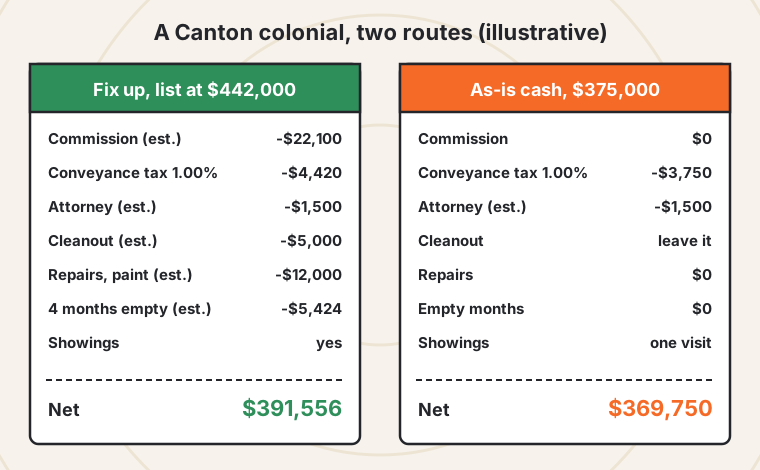
Worked example: a Canton colonial, two routes (illustrative)
| Line | Clean out, fix up and list | Sell as-is, leave what you do not want |
|---|---|---|
| Price | $442,000 (Canton median) | $375,000 (illustrative offer) |
| Agent commission | −$22,100 (5%, est.) | $0 |
| Conveyance tax (0.75% state + 0.25% Canton) | −$4,420 | −$3,750 |
| Seller’s attorney | −$1,500 (est.) | −$1,500 (est.) |
| Cleanout, junk removal, final cleaning | −$5,000 (est.) | $0 |
| Paint, repairs, staging | −$12,000 (est.) | $0 |
| Carrying an empty house for 4 months ($856 tax + $500 heat, utilities, insurance a month) | −$5,424 (est.) | $0 (close on your move date) |
| Net before any mortgage payoff | $391,556 | $369,750 |
| Your work | Weeks of sorting, contractors, showings | Take what you want; one walkthrough |
The honest reading: in this example, doing the work and listing puts about $21,800 more in your pocket. If you have the energy, the help and the time, that is real money. If the cleanout, the contractors and months of showings are more than you or your family can take on, or a care placement will not wait, the as-is route trades that money for an easier, faster move. Put your own numbers into the calculator:
How much would you walk away with?
Slide the numbers to match your house. It works in your browser; nothing is saved or sent.
Estimates for planning. Conveyance tax per CGS 12-494 (state 0.75% up to $800,000, 1.25% to $2.5M, 2.25% above, plus the town rate). Seller attorney about $1,200 to $1,500; flat-fee MLS about $400; listings include three months of taxes, insurance and utilities, a cash sale about two weeks. Your attorney gives you the final numbers.
Should you hire a senior move manager?
You should consider hiring a senior move manager if you live alone, your children live far away, or the sorting feels impossible to start. A senior move manager plans the move, helps decide what fits the new home, arranges estate sales, donations and movers, and sets up the new place. They charge for their time, so get a written estimate and references, and keep decisions about money and the house sale in your own hands.
What a good move manager does:
- Measures the new home and makes a furniture plan, so you know what fits before you sort.
- Works through the house with you, room by room, at a pace you can manage.
- Coordinates the estate sale company, charity pickups, junk removal and movers.
- Unpacks and sets up the new home so it feels like yours on the first night.
How to choose one: ask for a written estimate and what is included, proof of insurance, and two or three references from recent clients. Ask whether they take payments or referral fees from estate sale companies, movers or real estate agents they recommend. A move manager should never ask you to sign over the house, give them access to your bank accounts, or sell your belongings without a written agreement. For moving companies, see when to call a mover in Connecticut.
How do you protect an older homeowner from scams when selling a house?
You protect an older homeowner from scams when selling a house by involving a trusted family member and a Connecticut attorney in every step, never wiring money or changing payment details based on an email or call, never signing a deed or power of attorney before the closing table, and walking away from anyone who rushes, asks for upfront fees or discourages a second opinion. Report suspected fraud to the Connecticut Department of Consumer Protection and the FTC.
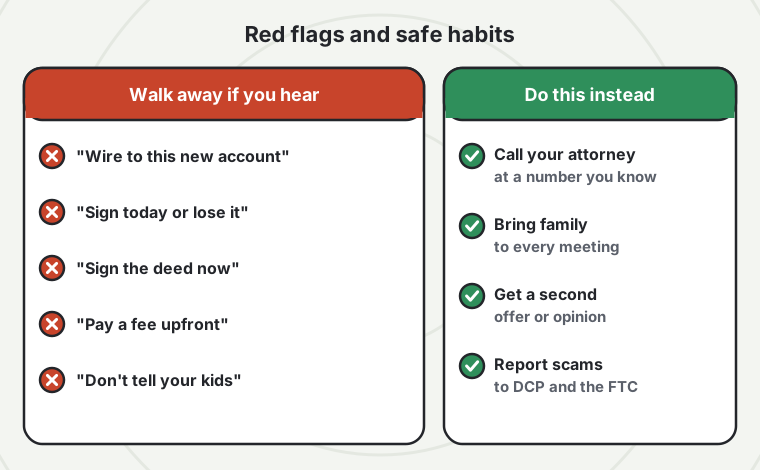
Red flags
- “The wiring instructions have changed.” The FTC warns about fake emails, supposedly from a closing professional, that announce a last-minute change and ask for money to be wired to a new account. Call your attorney at a number you already know before any money moves.
- Pressure to sign today. An offer that “expires tonight” is a pressure tactic. A real offer can wait for your attorney and your family.
- Signing the deed or a power of attorney early. In Connecticut, the deed is signed at closing, conducted by attorneys. Nobody legitimate needs it sooner.
- Upfront fees. Buyers do not charge sellers fees to buy a house.
- “Don’t tell your kids.” Anyone who discourages you from involving family or an attorney is protecting themselves, not you.
- A price that is far too good, or far too low. Get a second opinion: another offer, an agent’s market analysis or an appraisal.
Where to report it
Report suspected scams to the Connecticut Department of Consumer Protection and to the FTC at ReportFraud.ftc.gov. The Connecticut Department of Banking’s SeniorSafe program trains bank staff to spot financial exploitation of older customers; if something seems wrong with an account, tell your bank. Our checklist on how to check a cash home buyer in Connecticut lists what to verify before you sign anything.
If a parent may sign papers they do not fully understand, talk with a Connecticut attorney about a durable power of attorney while your parent can still make that choice, and ask to be included in conversations with buyers and agents. Your parent stays in charge; you are a second set of eyes.
What are your honest options for selling a house to downsize in Connecticut?
Your honest options for selling a house to downsize in Connecticut are to list it with an agent after cleaning and preparing it, list it as-is, sell it to a family member, sell it as-is to a cash buyer who lets you leave belongings, or stay and adapt the house. Listing a prepared house usually brings the highest price; selling as-is is easier and faster. The right one depends on your energy, your help, your timeline and the house.
Prepare and list
Highest price, usuallyBest when you have time, help with the cleanout and a house in decent shape.
- Reaches the most buyers
- Commission, cleanout and repairs
- Showings and months of waiting
List as-is
Market price, less workGood for a house that needs updating in a town where buyers compete.
- Buyers may still ask for repairs after inspection
- The house usually still has to be emptied
- Financing can fall through
Sell as-is for cash
About 2 weeks, or your dateFits when the cleanout, repairs or timing are more than you can take on.
- Leave what you do not want
- No repairs, no showings, no fees
- Price is below a prepared listing
Stay and adapt
No moveMakes sense if the house still works with some changes and help.
- Grab bars, a first-floor bedroom, help with chores
- Circuit breaker and local tax relief may help
- The upkeep and costs stay with you
When you should NOT sell your house to a cash buyer
- Your house is in good shape and you have time and help. List it. The example above shows why.
- Long-term care Medicaid is likely in the next five years and you have not talked to an elder law attorney about the price and the proceeds.
- A family member wants to buy it at a fair price, with an attorney on each side.
- You feel rushed. If anyone, including us, makes you feel you must decide quickly, stop and wait.
To compare the routes in more depth, see cash buyer vs. realtor in Connecticut and the cost to sell a house in Connecticut.
How does a downsizing sale with us work?
A downsizing sale with us works in five steps: a phone call with you and anyone you want on the line, one unhurried walkthrough, a written offer that does not expire while you and your family think it over, a review of the contract by your own Connecticut attorney, and a closing on the date that fits your move, typically about two weeks out or later. You take what you want and leave the rest.
A call, with family welcome
Tell us about the house and your move. Include your son, daughter or attorney on the call if you like. There is no obligation, and nothing to sign.
One walkthrough
We see the house once, as it is. No cleaning, no tidying, no judgment about the attic or the basement.
A written offer, with time to decide
We explain how we got to the number. The offer does not expire while you decide, and if listing would clearly net you more, we will say so.
Your attorney reviews everything
Connecticut closings are conducted by attorneys. Yours reads the contract, including the clause that lets you leave belongings behind. We charge no fees.
Close on your move date
Typically about two weeks from a signed contract, or later if your new home is not ready. Take what you want; we handle everything you leave, at no cost to you.

The families who have the easiest downsizing move do one thing early: they decide where Mom or Dad is going to live before anyone talks about selling. Once the next home is chosen, the move date, what fits and how much money is needed all fall into place, and the sale becomes a detail instead of the whole worry. If you are the adult child, let your parent make the choices they can make. They will feel better about the move, and so will you.
If you want a number to compare, call me, Jerryll Noorden, at (203) 529-4712. I have bought Connecticut houses since 2016, including in the Farmington Valley. Your family and your attorney are welcome at every step.
See the house together.
Pick a time that works.
Choose a time for us to walk through the property with you, or ask for a quick call first. We confirm every request personally.
Tuesday, January 13
No open times in the next few weeks. Please call us.
We will confirm by email. Nothing is booked until we do.
View my requestQuestions Connecticut homeowners ask about downsizing
What is the first step in downsizing your home?
The first step in downsizing your home is deciding where you will live next. The next home sets your move date, what furniture fits and how much money you need from the sale. Sorting belongings and choosing how to sell come after that.
Can I sell my house and leave everything in it?
Yes, you can sell your house and leave everything in it if the buyer agrees in the contract. Cash buyers who buy as-is often allow it. Most buyers who use a mortgage expect the house empty at closing. Take personal papers, medicines, firearms and valuables with you.
Do seniors pay capital gains tax when they sell their house?
Seniors usually do not pay capital gains tax when they sell their main home if the gain is under $250,000, or $500,000 for a married couple, and they owned and lived in it for 2 of the last 5 years. There is no age-based exemption; the exclusion applies to everyone (IRS Publication 523).
Does time in assisted living or a nursing home count toward the 2-year rule?
Time in assisted living or a nursing home can count toward the 2-year residence rule if you became unable to care for yourself, lived in the home at least 12 months of the 5 years before the sale, and the facility is licensed to care for people with your condition (IRS Publication 523).
Can a widow still claim the $500,000 exclusion?
A widow or widower can generally still claim the $500,000 exclusion if the house is sold within 2 years of the spouse’s death and the couple met the ownership and use tests before the death, among other conditions in IRS Publication 523. Check with a tax preparer.
What property tax relief is there for seniors in Connecticut?
Connecticut’s circuit breaker program gives homeowners aged 65 or older (or a surviving spouse aged 50 or older) up to $1,250 a year for couples or $1,000 for singles off the property tax bill if income is at or below $56,500 or $46,300 (2025 income). Apply to the assessor between February 1 and May 15. Many towns add local relief.
Will selling my house affect my Medicaid eligibility?
Selling your house can affect Medicaid eligibility, because the proceeds generally count as assets, and gifts or below-value transfers in the 60 months before a long-term care application can cause a penalty. Talk to a Connecticut elder law attorney before you sell or transfer the house.
Should I give my house to my children instead of selling it?
You should not give your house to your children without advice. A gift can create a Medicaid penalty if you need long-term care within 60 months, and your children may lose the tax advantages of inheriting it. An elder law attorney and a tax preparer can compare the options.
How long does it take to sell a house and move to assisted living?
Selling a house and moving to assisted living can take a few weeks to several months. A listing typically means preparing the house, showings and a financed buyer’s timeline; a cash sale can close in about two weeks or on the move date. Assisted living openings sometimes set the date for you.
What does a senior move manager cost?
A senior move manager usually charges by the hour or by the project, and the cost depends on the size of the house and how much help you need. Get a written estimate, ask what is included and whether they receive referral fees, and check references.
Do I need a lawyer to sell my house in Connecticut?
Yes, in practice you need a lawyer to sell your house in Connecticut, because closings must be conducted by attorneys (CGS 51-88a). The buyer and the seller usually each have their own. Your attorney also protects you against wire fraud and pressure tactics.
What should I not throw away when downsizing?
When downsizing, do not throw away your deed, will, powers of attorney, insurance policies, recent tax returns, the closing statement from when you bought the house and receipts for improvements. The last two help lower the taxable gain on the sale.
How do I know if a cash home buyer is legitimate?
You know a cash home buyer is legitimate if they give you a written offer, charge no fees, close through Connecticut attorneys, let you take time and get other opinions, and can show proof of funds. Walk away from anyone who rushes you, asks for money upfront or wants the deed before closing.
Is it better to rent or buy when downsizing?
Whether it is better to rent or buy when downsizing depends on your health, how long you expect to stay and your finances. Renting avoids property tax, maintenance and a future sale; buying a smaller home keeps your housing costs more predictable and builds equity. Many people rent first to try a new area.
Related Connecticut guides
Moving
The house
We buy houses across the Farmington Valley and beyond, including in Canton, Avon, Simsbury, Farmington, West Hartford and Bristol. For the full process, see how to sell a house in Connecticut, and if you are moving away, how we help relocating sellers.
Plain-English information, not legal, tax or Medicaid advice. Talk to a Connecticut attorney, an elder law attorney and a tax professional about your situation.
Sources
- IRS Publication 523, Selling Your Home (exclusion, care facility rule, surviving spouse, basis and records).
- CGS § 12-170aa and § 12-170d (circuit breaker tax relief for elderly and disabled homeowners; renters’ rebate).
- Office of Policy and Management, Homeowners Elderly/Disabled Circuit Breaker Tax Relief Program (benefit amounts, filing period).
- OLR Report 2026-R-0027, Mandatory Property Tax Relief for Homeowners (2026 income limits).
- CGS § 12-494 (conveyance tax) and OLR Report 2020-R-0020 (town rates).
- CGS § 20-327b and § 20-327c (residential condition report; $500 credit).
- CGS § 29-453 (smoke and carbon monoxide affidavit).
- CGS § 47a-4e (notice of rent increases).
- EPA and HUD lead-based paint disclosure rule.
- HUD, Fair Housing Act overview (housing for older persons exemption).
- Connecticut Department of Social Services, Long Term Care Issues and Medicaid (transfer of assets and look-back).
- Connecticut Department of Aging and Disability Services (Area Agencies on Aging and programs for older adults).
- FTC consumer advice (closing and wire-fraud warning) and ReportFraud.ftc.gov.
- Connecticut Department of Consumer Protection (scam warnings and complaints) and Connecticut Department of Banking, SeniorSafe.
- Town data: Connecticut OPM sales data (Oct 2024 to Sep 2025), fiscal 2027 mill rates, 2025 parcel CAMA data.

Who wrote this
Jerryll Noorden
Jerryll has bought and sold Connecticut houses since 2016 and has sat at more closing tables than he can count, on both sides. Before real estate he was a robotics scientist at NASA, IHMC and IIT. He wrote this guide because the national sites that rank for it skip the Connecticut rules that cost sellers money. When listing or selling it yourself would get you more than a cash offer, he says so.
This guide explains Connecticut rules in plain English. It is not legal or tax advice. Laws change; for your sale, talk to a Connecticut real estate attorney and a tax professional.
