
Key facts at a glance
This page is part of our guide to how to sell a house in Connecticut. It answers one question for executors in Vernon, Rockville and Talcottville: how to sell an estate house in the crumbling-foundation belt, what you must and need not disclose, whether to test, and what the state repair program does for an estate.
| Fact | Number | Source |
|---|---|---|
| Probate court for a Vernon resident | Ellington Probate Court, PD-12 (Ellington and Vernon), at 32 Park Place, Vernon | CGS 45a-2; ctprobate.gov |
| Vernon’s crumbling-foundation status | “Affected” town on the CRCOG list used for real estate disclosures | CRCOG map, updated Sep 28, 2023 |
| Vernon single-family homes built 1983 or later | 747 of 6,019 (12.4%) | 2025 parcel CAMA data, our query |
| Vernon single-family homes built before 1978 | 4,970 of 6,019 (82.6%) | 2025 parcel CAMA data, our query |
| Vernon median single-family sale price | $322,500 (388 residential sales, Oct 2024-Sep 2025) | CT OPM Real Estate Sales, data.ct.gov |
| Vernon mill rate, fiscal 2027 | 36.31 mills (about $8,200 a year on $322,500) | CT OPM mill rates; CGS 12-62a |
| Condition report for an executor’s sale | Exempt | CGS 20-327b(b)(4) |
| CFSIC cap and last Type 1 application date | $205,000 per house; June 30, 2030 | CFSIC Guidelines, modified Sep 15, 2026 |
Why does an estate house in Vernon’s foundation belt feel so risky to sell?
An estate house in Vernon’s foundation belt feels risky to sell because you are responsible for a house you did not live in, in a town where one word, pyrrhotite, can scare off buyers and lenders. Executors here often feel exposed, afraid of a lawsuit, unsure whether to test, protective of their siblings’ inheritance, and suspicious of anyone offering to “take the problem off your hands”. Those are reasonable feelings.
Maybe it is your mother’s 1988 raised ranch off Route 30, with hairline cracks nobody mentioned, or a 1950s Cape in Rockville where you are not sure the question even applies. You do not want to be the executor who sold for half its value, or the one who got sued afterwards.
I am Jerryll Noorden. I have bought houses across Connecticut since 2016, about ten a year, including estate houses in the foundation towns. This page sorts out what the law actually requires of an executor, what testing buys you, what the state repair program does for an estate, and the Vernon numbers.
If you are the executor, administrator or an heir of a Vernon house and the foundation is on your mind, this page is for you.
How do you sell a probate house with a crumbling foundation in Vernon, CT?
You sell a probate house with a crumbling foundation in Vernon, CT the way any Connecticut estate sells, through the appointed executor and, if needed, a court order (CGS 45a-164), but with three extra decisions: what to tell buyers (executors are exempt from the condition report, not from honesty), whether to test the foundation before listing, and whether a CFSIC claim exists or can help. Those three decide who can buy and at what price.
The legal steps of a probate sale (power of sale, form PC-400, notice, lien releases) are on our page can a house be sold while in probate in Connecticut, and the whole foundation topic for regular owners is in our guide to selling a house with a crumbling foundation in Connecticut. This page is the overlap. For everything else, see our inherited house guide.
The local basics: a Vernon estate opens at the Ellington Probate Court (PD-12), which despite its name sits at 32 Park Place in Vernon (CGS 45a-2; ctprobate.gov). Hours: Monday, Wednesday and Thursday 8:00 to 4:30, Tuesday to 6:00, Friday to noon; (860) 872-0519.
What does an executor have to disclose about a Vernon foundation?
An executor selling a Vernon house does not have to complete Connecticut’s Residential Property Condition Report, because sales by executors and administrators are exempt (CGS 20-327b(b)(4)). The separate Residential Foundation Condition Report does not apply either; it covers only houses in CRCOG towns acquired by foreclosure, deed in lieu or a town (CGS 20-327b(g)-(h)). But the exemption covers the form, not misstatements, and a federal lead paint disclosure still applies to pre-1978 houses.
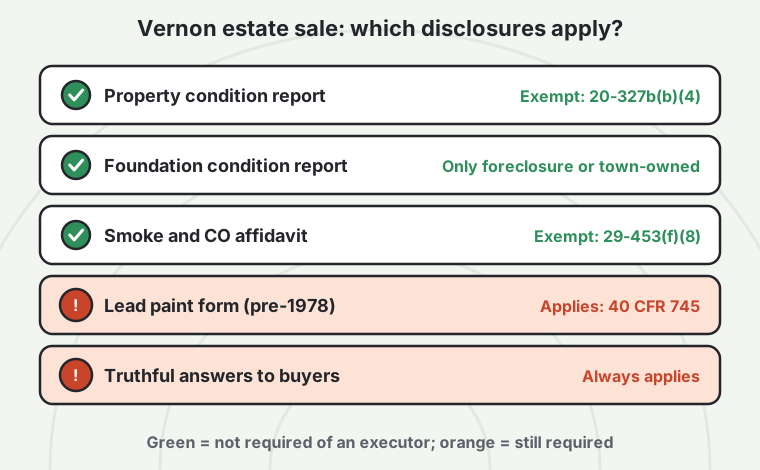
| Disclosure | Applies to an executor in Vernon? | Source |
|---|---|---|
| Residential Property Condition Report (includes the pyrrhotite questions) | No, exempt | CGS 20-327b(b)(4) |
| $500 credit for not delivering the report | No; it applies only to sellers required to deliver it | CGS 20-327c |
| Residential Foundation Condition Report | No; only foreclosure, deed-in-lieu and town-acquired houses in CRCOG towns | CGS 20-327b(g), (h) |
| Smoke and carbon monoxide affidavit | No, exempt | CGS 29-453(f)(8) |
| Federal lead-based paint disclosure (pre-1978 house) | Yes; estates are not on the exemption list | 40 CFR 745.101 |
| Truthful answers when a buyer asks | Yes; the form exemption is not permission to mislead | General law; ask your attorney |
The exemption exists because an executor usually never lived in the house. It runs out when you actually know something: if your father left an engineer’s foundation report in the desk, or the family knows a CFSIC claim was filed, a buyer who asks will get that answer from the claim records or the next engineer anyway. The safer course is usually to hand known reports to the buyer and let the price reflect them; ask your attorney.
The lead paint form matters more than people expect in Vernon: 82.6% of the town’s single-family homes were built before 1978 (2025 CAMA data).
Buyers will look at the foundation whatever you say: the state form invites them to have it inspected, and their own CFSIC eligibility depends on a test before the sale.
Should the estate test the foundation before selling a Vernon house?
Whether the estate should test the foundation before selling a Vernon house depends mainly on the year built. A house and additions built before 1983 are outside the concrete window, and testing rarely changes the sale; that is 87.6% of Vernon single-family homes. For a 1983-or-later house, a visual inspection by a Connecticut-licensed engineer usually pays for itself, because it keeps an owner-occupant buyer eligible for CFSIC.
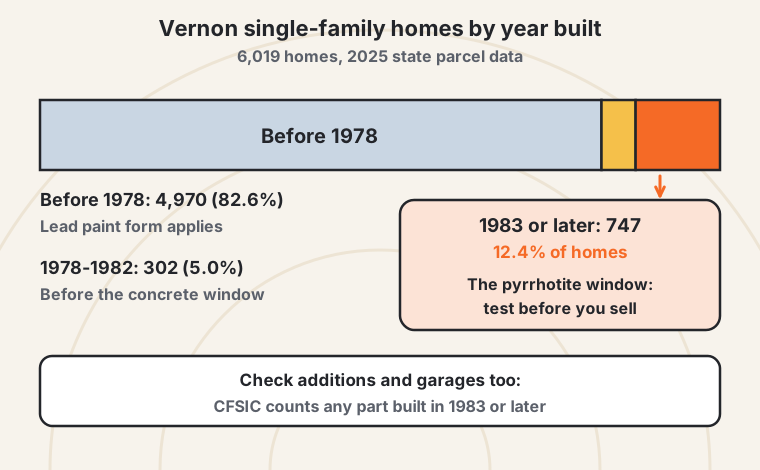
The problem concrete was poured from 1983 on, from a former plant in Stafford Springs. Most Vernon houses are older: the median single-family home was built in 1961, and only 747 of 6,019 single-family homes (12.4%) were built in 1983 or later (2025 CAMA data, main building year).
For a 1983-or-later house, here is the rule that tips the scale. CFSIC’s guidelines say that for any house purchased on or after February 1, 2019, a buyer who knows the building or an addition (including a garage) was built in 1983 or later can only apply to CFSIC later if the buyer or the seller tested for pyrrhotite, or had a visual exam by a Connecticut-licensed professional engineer or a CFSIC-certified home inspector, before the date of sale (CFSIC Guidelines, modified September 15, 2026). An estate that has the visual exam done hands the buyer that eligibility. A buyer who keeps a path to $205,000 of repair money pays more than one who does not.
- Visual exam: the engineer rates any deterioration; it is what CFSIC uses for its severity class.
- Core test: a lab tests concrete drilled from the wall for pyrrhotite. It answers the question for a clean-looking wall but costs more.
- Who pays: the estate, as an expense of administration. CRCOG runs a testing reimbursement program for qualifying homes; confirm the current terms with CRCOG before you book.
Once you have a report, plan to share it; a bad one is better learned before the contract than at the buyer’s inspection. The costs and severity classes are explained in our crumbling foundation guide.
Can an estate use CFSIC, the crumbling foundation program?
An estate can benefit from CFSIC mainly through the buyer. CFSIC’s guidelines say that when a person with an active, inactive or pending Type 1 claim dies and the heir decides to sell, the new owner can receive help only by signing a Twelve-Month Residency Agreement to live in the house for a year after the work. So a claim helps an owner-occupant buyer, not an investor: companies that buy distressed houses as a business cannot be CFSIC claimants.
| CFSIC rule | What it means for the estate |
|---|---|
| A claimant is the owner of the residential building | Whether the estate or the heirs should open a new claim is a question for the claims administrator before you file; call ESIS ProClaim |
| Death of a Type 1 claimant: a new owner must sign a Twelve-Month Residency Agreement | An existing claim can follow the house to a buyer who will live there 12 months after completion |
| Companies that buy distressed houses as a business cannot be claimants (except some condo cases) | A cash investor cannot use the claim; its offer prices in the full repair |
| Cap of $205,000 per house, less insurer payments | The size of the help an owner-occupant buyer may be giving up or gaining |
| Type 1 needs a severity class and an insurer’s denial or acceptance letter | Look for the homeowner’s insurer letter in your parent’s papers |
| Type 2 (reimbursement) applications must be active by 5:00 p.m., March 15, 2027; Type 1 applications accepted until June 30, 2030 | If your parent already paid for a replacement, ask about Type 2 now |
The honest conclusion: if your parent had an active Type 1 claim on a cracking 1980s house, an owner-occupant buyer who takes over the claim can often pay more than a cash buyer, because the state may pay for the foundation. If there is no claim, or the estate cannot wait, that value is mostly theoretical.
Why does buyer financing decide the price of a Vernon estate house with foundation cracks?
Buyer financing decides the price of a Vernon estate house with foundation cracks because most buyers need a mortgage, and lenders rely on appraisers who must report structural problems. A house with a clean engineer’s report or a replaced foundation finances normally. A house with visible, active deterioration and no claim often cannot be financed until it is repaired, which leaves cash buyers and a much lower price.
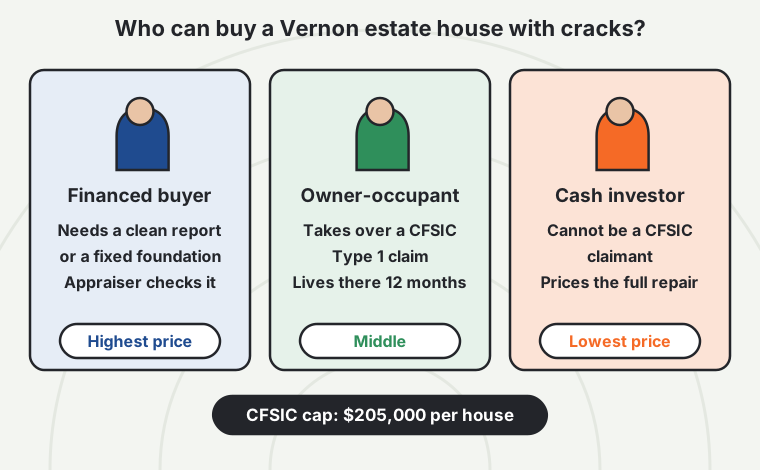
In short: a pre-1983 house without cracking, or a 1983-or-later house with a clean exam, sells normally; a positive core with no damage usually means a price discussion; visible cracking with a Type 1 claim suits an owner-occupant; visible cracking with no claim mostly leaves cash buyers.
The court approves the price, so present an appraisal that accounts for the foundation plus the engineer’s report as your evidence of value (Probate Court Rule 30.15(b)).
What does it cost to hold and sell a Vernon estate house?
Holding and selling a Vernon estate house at the town’s $322,500 single-family median costs about $1,108 a month (est.) while it is empty, including about $683 a month of property tax at the fiscal 2027 rate of 36.31 mills. At the sale, the estate pays $3,225 of conveyance tax (1%, CGS 12-494), and the probate fee on a $322,500 estate is $1,244 (CGS 45a-107).
Example (illustrative). A Vernon single-family house worth the town median of $322,500, no mortgage, as the whole estate. Built from public numbers, not an estate we handled.
| Item | Amount | How it is figured |
|---|---|---|
| Property tax | About $8,200 a year, $683 a month | $322,500 x 70% x 36.31 mills (OPM; CGS 12-62a) |
| Vacant-home insurance | $150 a month (est.) | Estimate; vacant policies vary |
| Oil heat, electric, water | $200 a month (est.) | Estimate; most Vernon homes heat with oil hot water |
| Lawn, snow, checks | $75 a month (est.) | Estimate |
| Carrying cost | About $1,108 a month (est.) | Sum of the four lines |
| Probate Court fee | $1,244 | $150 + 0.35% of the $312,500 above $10,000 (CGS 45a-107(b)) |
| Conveyance tax at closing | $3,225 | 0.75% state + 0.25% Vernon (CGS 12-494) |
The foundation adds a cost only the facts can size: a replacement without CFSIC help can run well into six figures, and every buyer subtracts that plus a margin for risk. To run your own net on a price, use the calculator:
How much would you walk away with?
Slide the numbers to match your house. It works in your browser; nothing is saved or sent.
Estimates for planning. Conveyance tax per CGS 12-494 (state 0.75% up to $800,000, 1.25% to $2.5M, 2.25% above, plus the town rate). Seller attorney about $1,200 to $1,500; flat-fee MLS about $400; listings include three months of taxes, insurance and utilities, a cash sale about two weeks. Your attorney gives you the final numbers.
Our guide to pricing a house in Vernon covers how to read recent sales, and income tax on the estate’s sale is in taxes on selling an inherited house.
What are the executor’s options, and when should a Vernon estate NOT sell to a cash buyer?
The executor’s options for a Vernon estate house with a foundation question are to list it with an engineer’s report, sell to an owner-occupant who takes over a CFSIC claim, sell to an heir at an appraised value, or sell as-is for cash. A Vernon estate should not sell to a cash buyer when the house predates 1983 and is sound, or when an active Type 1 claim and a willing owner-occupant buyer are in reach.
List with a report
Highest pricePre-1983 houses and clean 1983+ reports.
- Lead form for pre-1978 houses
- Buyer financing works
- Commission and months of carrying
Owner-occupant takes the claim
MiddleCracking house with an active Type 1 claim.
- Buyer signs a 12-month residency agreement
- CFSIC paperwork through your attorney
- Smaller pool, slower
Sell as-is for cash
Lowest priceVisible cracking, no claim, or no time.
- No lender, no appraisal
- No repairs or clean-out
- Buyer prices the full replacement
Cash buyers, me included, cannot use CFSIC on a house we buy as a business, so our number assumes we pay for any foundation work ourselves. That is the honest reason our offer on a cracking 1980s house is lower than what an owner-occupant with a transferred claim might pay; our page on why cash offers are lower walks through the rest of the math. A cash sale is the right call when the foundation is visibly failing and there is no claim, when the heirs need the estate closed, or when nobody can manage a long sale with an engineer, CFSIC and a court in the loop. Our inherited and probate house page explains how we buy estate houses and wait for the court. Never pay an upfront fee or sign a deed before closing (scam red flags).

Before you talk to any buyer, go through your parent’s files for three papers: any engineer’s foundation report, any letter from CFSIC or its claims administrator, and any letter from the homeowner’s insurer about the foundation. Those three pages decide which buyers can even consider the house. Without them, everyone prices the worst case.
What are the steps to sell a Vernon probate house in the foundation belt?
The steps to sell a Vernon probate house in the foundation belt are: open the estate at the Ellington Probate Court, check the year built of the house and any addition, gather any foundation, CFSIC and insurer papers, decide on a visual exam, confirm any CFSIC claim status, get a value that reflects the foundation, choose the buyer route, get court approval if the will has no power of sale, and close.
Open the estate in PD-12
File within 30 days of death (CGS 45a-283), on paper or by eFiling.
Check the year built
The assessor’s card shows the main house; ask about additions and garages. Before 1983 everywhere means the foundation is unlikely to be the issue.
Gather the three papers
Engineer’s report, CFSIC letters, insurer letter. Ask ESIS ProClaim about any claim in your parent’s name.
Decide on a visual exam
For a 1983-or-later house, a licensed engineer’s visual exam before the sale keeps an owner-occupant buyer CFSIC-eligible.
Value it with the foundation in mind
An appraisal plus the report is your evidence of fair value for the court (Probate Court Rule 30.15(b)).
Choose the buyer and disclose honestly
Share known reports, give the lead form for a pre-1978 house, and sign the contract subject to court approval if needed.
Close and transfer
Your attorney handles any CFSIC claim transfer with the original claimant’s counsel; proceeds go to the estate account.
If you would like a written as-is number on the Vernon house to set beside an agent’s opinion and the CFSIC route, our Vernon page is where to ask; how we buy inherited and probate houses explains the process. You can leave the contents, we wait for the court, and the offer does not expire on you.
See the house together.
Pick a time that works.
Choose a time for us to walk through the property with you, or ask for a quick call first. We confirm every request personally.
Tuesday, January 13
No open times in the next few weeks. Please call us.
We will confirm by email. Nothing is booked until we do.
View my requestQuestions Vernon executors ask about selling an estate house with a foundation problem
Does the Residential Foundation Condition Report apply to an estate sale in Vernon?
The Residential Foundation Condition Report does not apply to an ordinary estate sale in Vernon. It applies only to houses in CRCOG-listed towns acquired by foreclosure, a deed in lieu of foreclosure or a town (CGS 20-327b(g)-(h)).
Which probate court handles Vernon, CT?
The probate court that handles Vernon, CT is the Ellington Probate Court, district PD-12, at 32 Park Place in Vernon. It serves Ellington and Vernon (CGS 45a-2). Hours vary by day, with Tuesday until 6:00 and Friday until noon.
Is Vernon a crumbling foundation town?
Vernon is a crumbling foundation town: it is on CRCOG’s list of “affected” towns used for real estate disclosures. Most Vernon homes predate the problem concrete, though; only 12.4% of single-family homes were built in 1983 or later.
Should the estate pay for a foundation test before selling?
The estate should usually pay for a visual exam before selling only if the house or an addition was built in 1983 or later. CFSIC lets a buyer apply later only if the buyer or seller tested or had a visual exam before the sale.
Can a CFSIC claim pass to the buyer of an estate house?
A CFSIC Type 1 claim can pass to the buyer of an estate house if the foundation has not been replaced. CFSIC’s guidelines require the new owner to sign a Twelve-Month Residency Agreement, so the buyer must live there for a year after the work.
Can a cash investor use CFSIC on a house it buys?
A cash investor cannot use CFSIC on a house it buys. CFSIC’s guidelines say a company that purchases distressed residential properties as a business cannot qualify as a claimant, except in some condominium cases.
Will a mortgage lender finance a Vernon house with a cracked foundation?
A mortgage lender may not finance a Vernon house with visible foundation deterioration until it is repaired or an engineer explains it, because appraisers must report structural problems. Houses with a clean report or a positive core and no damage are often financeable.
Does the lead paint disclosure apply to a Vernon estate sale?
The federal lead paint disclosure applies to a Vernon estate sale when the house was built before 1978; estates are not exempt (40 CFR 745.101). That covers 82.6% of Vernon single-family homes.
Related guides
Probate and inherited houses
Foundation and other town estate guides
Towns in the foundation belt
For every step from first decision to closing, see how to sell a house in Connecticut.
Plain-English information, not legal advice. CFSIC rules change; confirm your claim status with CFSIC’s claims administrator and your attorney before you rely on it.
Sources (checked on October 27, 2026)
- Connecticut Probate Courts, Ellington Probate Court (PD-12): address, hours, towns served.
- CGS §§ 20-327b, 20-327c (condition reports, executor exemption, foundation report, $500 credit).
- CGS § 29-453 (smoke and CO affidavit exemptions).
- 40 CFR part 745, subpart F (lead-based paint disclosure; 745.101 exemptions).
- CFSIC Underwriting and Claims Management Program and Guidelines (modified effective September 15, 2026).
- Capitol Region Council of Governments, crumbling foundations (affected towns; testing reimbursement).
- Connecticut Probate Court Rules of Procedure, 2026 edition: section 30.15.
- CGS § 45a-2 (probate districts); CGS § 45a-107 (probate fees); CGS §§ 45a-164, 45a-283.
- CGS § 12-494 (conveyance tax).
- Connecticut OPM, Real Estate Sales (data.ct.gov) and 2025 parcel CAMA data: Vernon sales and year built.
- Connecticut OPM mill rates (Vernon, fiscal 2027).

Who wrote this
Jerryll Noorden
Jerryll has bought and sold Connecticut houses since 2016 and has sat at more closing tables than he can count, on both sides. Before real estate he was a robotics scientist at NASA, IHMC and IIT. He wrote this guide because the national sites that rank for it skip the Connecticut rules that cost sellers money. When listing or selling it yourself would get you more than a cash offer, he says so.
This guide explains Connecticut rules in plain English. It is not legal or tax advice. Laws change; for your sale, talk to a Connecticut real estate attorney and a tax professional.
