
- Order matters more than speed. Secure the house, find the papers, let the fiduciary list everything for the Probate Court inventory, let the family choose, and only then sell, donate, recycle and haul.
- Do not let anything of value leave before the inventory. Connecticut requires the executor or administrator to file an inventory of the estate, at fair market value, within two months of appointment (CGS 45a-341; form PC-2407).
- The house has to stay insured, heated and secured while you sort. The Probate Court’s own guide says dwellings should be “secured, protected from the elements and insured”.
- Connecticut has disposal rules. TVs and computers cannot go in the trash (CGS 22a-636), mattresses and leftover paint have free drop-off programs, and chemicals go to a household hazardous waste day.
- A professional cleanout typically runs $275 to $4,000 (est.), about $1,250 on average by one national cost guide; a packed house can cost more. The estate pays, not you personally.
- You do not have to empty the house to sell it. Take what matters to the family; a cash buyer can take the house with everything else inside.
How do you clean out an inherited house in Connecticut?
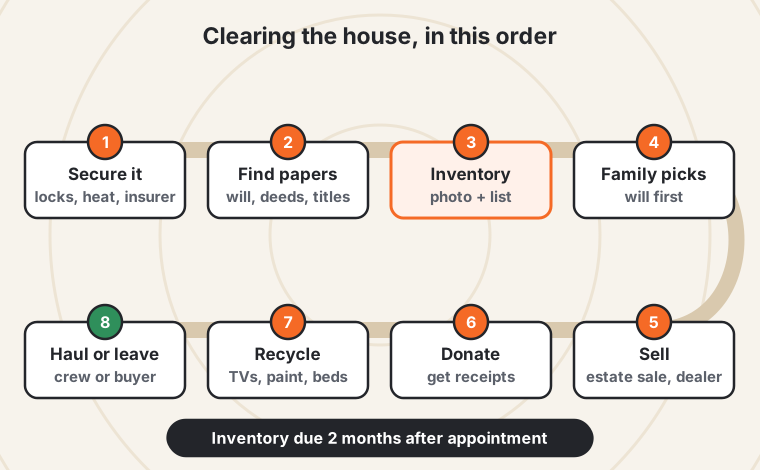
You clean out an inherited house in Connecticut in a set order: secure the house and keep it insured, find the will and financial papers, let the court-appointed executor or administrator photograph and list everything for the probate inventory, let the family take what they want, then sell, donate, recycle and haul the rest. Nothing of value should leave before the inventory, and the house does not have to be empty to sell.
This is the hands-on part of our guide to how to sell a house in Connecticut. If you need the probate basics first (who can sign, how long probate takes, the tax liens), start with inherited a house in Connecticut: what to do, then come back here. This page is about the rooms, the boxes and the decisions.
The short version of the order, which the rest of this page explains:
- Secure it. Lock it, keep the heat and power on, call the insurer.
- Find the papers. The will, deeds, account statements, titles, keys.
- Photograph and list. Every room, before anything moves. This feeds the probate inventory.
- Family picks. Specific gifts in the will first, then a fair method for the rest.
- Sell what has value. Estate sale, consignment, auction, dealer.
- Donate what is useful. Get receipts for the estate file.
- Recycle what the law says to recycle. Electronics, mattresses, paint, chemicals, medicines.
- Haul what is left, or leave it. Hire a crew, rent a dumpster, or sell the house with the contents.
Why does cleaning out a parent’s house feel so hard?
Cleaning out a parent’s house feels so hard because every object is a decision and many of them are memories. Grief makes decisions slower, the volume after decades in one house is overwhelming, throwing things away can feel like a betrayal, and relatives often disagree. That is normal, and it is the reason to follow an order instead of trying to finish in one weekend.
Maybe you opened the basement door, looked at forty years of boxes, paint cans and Christmas decorations, and closed it again. Maybe you are driving in from Massachusetts or New York every other Saturday, and each trip you fill two bags and feel like you got nowhere. Maybe you are the one sibling doing all of it while the others ask, from far away, when it will be done.
You might feel guilty putting your mother’s sweaters in a donation bag. You might be afraid of throwing out something important: a bond certificate in a book, the will in a coffee can, a ring in a sock drawer. You might be afraid a brother or sister will accuse you of taking things. And you might simply be tired.
In Connecticut there is a practical twist: many of these houses were owned for decades by one person and are full, older and heated by oil. In towns like Hamden, Norwich and New Britain, the median single-family house was built in the early 1950s, so the basement may also hold an oil tank, old paint and a workshop of chemicals.
This page is for you. Nobody who does this for a living is shocked by a full house, a hoarded house or a house that has sat for a year. You can keep what matters, let go of the rest without guilt, and you do not have to do the hauling yourself. Your parent left you a responsibility, not a test.
What Connecticut rules apply before you remove anything?
The Connecticut rules that apply before you remove anything are probate rules and disposal rules. Only the court-appointed executor or administrator controls the estate’s property; that fiduciary must file a sworn inventory at fair market value within two months of appointment and needs court approval to sell the house unless the will allows it. State law also bans electronics from the trash and sets up free mattress and paint drop-off.
| Rule | What it means for the cleanout | Source |
|---|---|---|
| File the will within 30 days | Whoever has the original will delivers it to the Probate Court where your parent lived, usually with the petition (PC-200). | Probate Court User Guide, Step 1 and Question 7 |
| The fiduciary takes possession | The executor or administrator gathers the estate’s property, notifies utilities and keeps any dwelling “secured, protected from the elements and insured”. | Probate Court User Guide, Step 2 |
| Inventory within two months | A sworn list of the estate’s property at fair market value, filed within two months after the fiduciary qualifies (extendable for cause to four months). Form PC-2407. | CGS 45a-341(a)-(b) |
| What goes on the inventory | Real estate, accounts, vehicles, household furnishings and personal effects. Furnishings need not be itemized unless of particular value; valuables are itemized; items left to someone in the will are listed individually. | Probate Court User Guide, Step 4 |
| Missing the inventory deadline | The court may cite the fiduciary and remove them if the inventory is not filed. | CGS 45a-342 |
| Selling personal property | The fiduciary may turn personal property that is not specifically left to someone into cash. A fiduciary who is not the named executor or close family must first send the inventory and a notice of sale; heirs have 5 days to object. | CGS 45a-341(c); User Guide, Step 5 |
| Selling the house | Needs Probate Court authority (after notice and a hearing) unless the will gives a power of sale. The inventory must describe the real estate first. | CGS 45a-164; 45a-341(e) |
| Firearms | Can only go to people legally eligible to receive them; some need extra approvals. Do not just move or sell them. | Probate Court User Guide, Question 15 |
| TVs and computers | No one may knowingly put a covered electronic device in a solid waste facility. Up to seven devices at a time are recycled free. | CGS 22a-636; 22a-635(b) |
| Mattresses | The state’s mattress stewardship program must offer free, convenient drop-off statewide (Bye Bye Mattress). | CGS 22a-905a |
| Leftover paint | A paint stewardship program (PaintCare) takes latex and oil paint at drop-off sites. | CGS 22a-904a; DEEP |
| Chemicals, pesticides, solvents | Household hazardous waste collection days, run by towns and regions, mostly spring to fall. | DEEP household hazardous waste program |
| Medicines | Prescription drug drop boxes, mostly at police stations; do not flush. | Department of Consumer Protection |
| A neglected empty house | Towns with a blight ordinance can fine up to $250 a day for blight at a vacant property, after written notice and a chance to fix it. | CGS 7-148(c)(7)(H)(xv) |
Until the Probate Court appoints an executor (named in the will) or an administrator (no will), nobody has legal authority over your parent’s belongings. Heirs can protect the house, but should not divide or sell things yet. If the house is in your parent’s name alone, a probate estate is needed; Connecticut’s small-estate affidavit is not available when the person owned Connecticut real estate in their sole name (CGS 45a-273). Details: our probate guide and can a house be sold while in probate.
What should you not remove before the probate inventory?
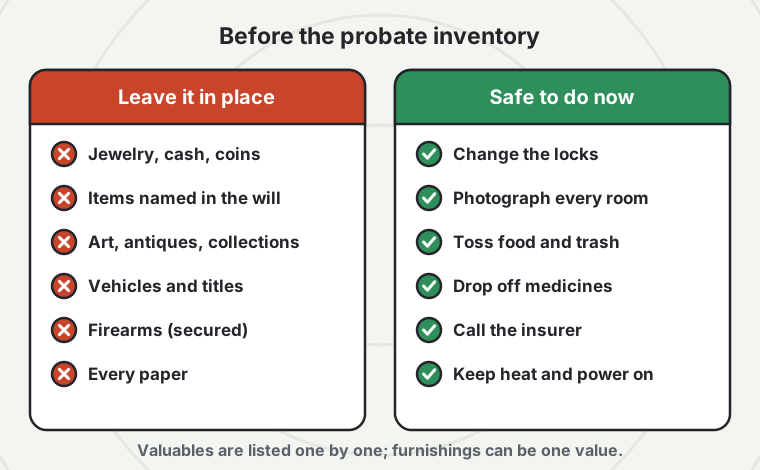
Before the probate inventory you should not remove, give away, sell or throw out anything of value: jewelry, cash, coins, art, antiques, guns, vehicles, collections, tools of real value, anything the will leaves to a specific person, and every financial or legal paper. You can and should lock the house, photograph every room, take perishables and trash out, and move small valuables to a safe place with a written list.
The inventory is not a formality. It is the list the court, the heirs and the tax return all rely on. It is filed under penalty of false statement (CGS 45a-341), and the probate fee is based partly on it. If a ring or a coin collection disappears before it is listed, the fiduciary is the one who has to explain it.
Leave in place until it is listed
- Anything named in the will. “My piano to Susan” means the piano is listed separately and goes to Susan, not to whoever gets there first.
- Jewelry, watches, cash, coins, stamps, silver. Photograph, count, list, and move to a locked place with a witness.
- Art, antiques, collections, quality furniture. These may need an appraisal; the inventory values everything at fair market value at the date of death.
- Vehicles, boats, trailers. They are titled property and go on the inventory.
- Firearms. Leave them secured and ask the estate’s attorney; transfers are regulated.
- All papers. Do not shred anything until the estate is closed.
Safe to do right away
- Change or rekey the locks and keep a list of who has keys
- Photograph or video every room, closet, the attic, basement and garage
- Throw out food, perishables and ordinary household trash
- Take out medicines and dispose of them at a drug drop box
- Call the homeowner’s insurance company about the death and the vacancy
- Keep heat and electricity on; forward the mail to the fiduciary
- Move small valuables to a safe place, with a signed list and a witness
- Start a notebook or spreadsheet of what you find and where
A walk-through video on your phone, room by room, with drawers and closets open, takes an hour. It protects you if a sibling later asks where something went, it helps value the household contents for the inventory, and it lets out-of-state relatives choose items without driving in.
How do you secure an empty inherited house while you sort it?
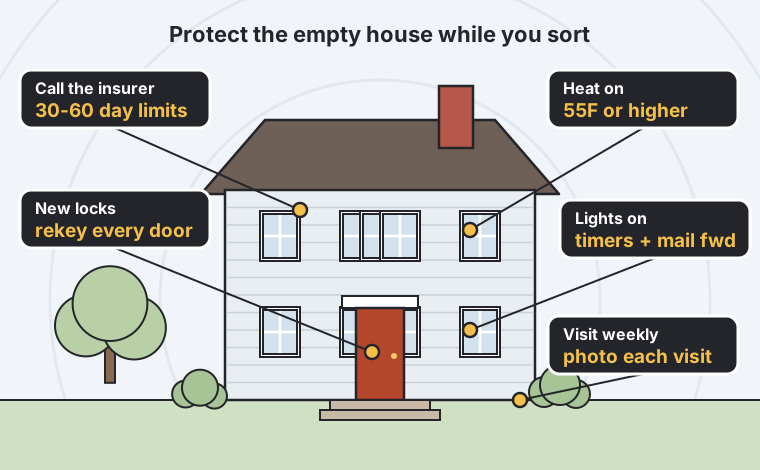
You secure an empty inherited house while you sort it by calling the insurer about the death and the vacancy, keeping the heat on or winterizing, keeping the power on for the sump pump and alarm, changing the locks, forwarding the mail, keeping the yard and walks tidy, and checking inside at least weekly. Utility accounts and bills move to the estate, and the estate pays them.
Insurance on a vacant house
Call the homeowner’s insurance company the week of the death. Tell them the owner died, who the fiduciary is, and that the house is empty. Many standard homeowners policies limit or exclude some coverage (often vandalism, glass breakage and freeze damage) once a house has been vacant for a set period, commonly 30 to 60 consecutive days; the exact rule is in your policy. Ask in writing how long coverage continues, whether a vacancy endorsement is available, and, if not, get a vacant-dwelling policy. It usually costs more than ordinary homeowners coverage, but a frozen pipe or a fire in an uninsured house can wipe out the estate. Do not cancel the policy to save money.
Utilities
- Heat: keep it on through the Connecticut winter, at 55°F or higher (a commonly cited minimum; follow your insurer’s terms), with the oil tank kept above a quarter or the gas account in the estate’s name. If the house will not be heated, have a plumber drain and winterize it and shut the main water valve.
- Electricity: keep it on. The sump pump, the boiler controls, an alarm and lights on timers all need it.
- Water: if the house is heated and checked weekly, leave it on for showings and cleaning; otherwise shut the main.
- Phone, cable, internet: cancel unless they run the alarm or a smart thermostat.
Security and appearance
Rekey the locks: you do not know who has keys after decades. Put lamps on timers, forward the mail, cancel newspapers, keep the lawn mowed and the walk shoveled. An obviously empty house attracts break-ins, and in a town with a blight ordinance a neglected one can attract fines of up to $250 a day after notice (CGS 7-148(c)(7)(H)(xv)). Visit weekly, or pay a neighbor or a property checker, and photograph each visit.
All of this costs money every month. To see the full monthly bill for an empty house in your town, read our worksheet on the carrying costs of a vacant house in Connecticut. The longer the cleanout takes, the bigger that number gets, which is why many families end up choosing a faster route. More on protecting an empty house on our selling a vacant house page.
Where do you look for papers, valuables and keepsakes?
You look for papers, valuables and keepsakes everywhere a careful person of that generation would hide them: desks and file boxes, the freezer, books, coat pockets, purses, under drawer liners and mattresses, in coffee cans, tool boxes, the attic and the basement ceiling. Look for the will, deeds, account statements, titles, tax returns, insurance policies, safe deposit box keys and the oil company account before anything is thrown out.
The papers to find first
| Paper | Why it matters |
|---|---|
| The original will and any codicils | Must go to the Probate Court within 30 days of the death |
| Deed, mortgage or reverse mortgage statements, home equity line | Who owns the house and what is owed on it |
| Bank, brokerage, retirement and annuity statements | Assets for the inventory; beneficiary-designated accounts pass outside probate |
| Life insurance policies | Only policies payable to the estate go on the inventory |
| Recent tax returns, property tax bills, 1099s | Final returns; they also reveal accounts you did not know about |
| Vehicle titles | Titled property for the inventory |
| Safe deposit box key and bank name | The Probate Court can authorize opening it to look for a will (User Guide, Question 9) |
| Oil company, utility, alarm and lawn accounts | Bills the estate keeps paying; oil left in the tank is usually credited at closing |
| Receipts for a new roof, boiler, septic or tank removal | Buyers ask; they also help price the house |
Where people actually hide things
Go slowly in the first pass. Cash and valuables turn up inside books and Bibles, in envelopes taped under drawers, in the freezer, in coat pockets, purses and shoe boxes, in coffee cans and tool boxes, and inside holiday decorations. Shake out every book before it goes in a donation box.
Keepsakes: keep the story, not the storage unit
You do not need to keep everything to keep the memory. Some families let each person pick a few meaningful items first, in turns. Others photograph the things nobody can store (the hutch, the workbench, the sewing room) before they go. Scanning letters and photos means every sibling gets a copy. Anything specifically left in the will goes to that person first; for the rest, a simple method such as taking turns, or counting an item’s value against that heir’s share, avoids most fights. Agree the method in writing before anyone starts picking.
Where do the belongings go: estate sale, donation, recycling or the dump?
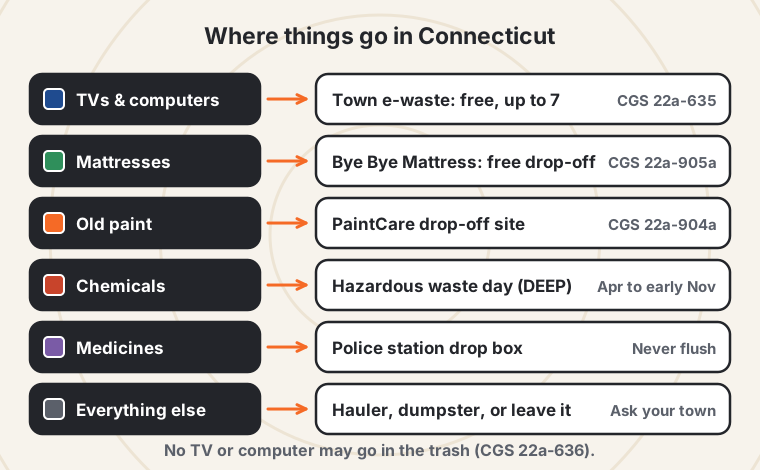
The belongings go to four places: things with real value to an estate sale, auction, dealer or consignment shop; useful everyday items to donation; electronics, mattresses, paint, chemicals and medicines to the recycling or collection programs Connecticut law sets up; and only what is left to a hauler or a dumpster. In Connecticut, televisions and computers cannot go in the trash at all.
Estate sale, auction, dealer or consignment
An estate sale company runs a public sale inside the house, prices everything, and keeps a commission, commonly 30% to 40% of the sale (est., national cost guides). It works best when there is enough of value (good furniture, collectibles, tools, a full kitchen) to cover the commission and still leave money for the estate. Ask for a written contract that says what happens to unsold items and whether they leave the house broom-clean. For single valuable items (art, jewelry, a coin collection) an appraiser and a specialist dealer or auction house usually do better. Remember the 5-day notice rule if the fiduciary is not the named executor or close family (CGS 45a-341(c)).
Donation
Clothing, linens, kitchenware, books and furniture in good shape can go to charities and thrift stores; many pick up furniture. Ask for a receipt and keep it in the estate file. Call first: many no longer take mattresses, cribs, large TVs or upholstered furniture with damage.
What Connecticut makes you recycle or bring to a collection
| Item | Where it goes | Rule |
|---|---|---|
| TVs, computers, laptops, monitors | Your town’s electronics collection or transfer station, or an approved recycler; free for up to seven at a time | CGS 22a-635(b), 22a-636 |
| Mattresses and box springs | Bye Bye Mattress drop-off sites and many town transfer stations, free | CGS 22a-905a |
| Latex and oil paint, stains, varnish | PaintCare drop-off sites (often paint and hardware stores) | CGS 22a-904a |
| Pesticides, solvents, pool chemicals, oil-based cleaners | Household hazardous waste collection day for your town or region | DEEP HHW program |
| Prescription and over-the-counter medicines | A drug drop box, mostly in police station lobbies | DCP drop box program |
| Appliances, scrap metal | Town transfer station or scrap dealer (refrigerants must be removed properly) | Check your town |
| Propane cylinders | Exchange cages, the supplier or a town collection | Check your town |
Household hazardous waste days run mostly from April to early November, and each town belongs to a regional program. If your parent’s town is not listed on DEEP’s schedule, call the town’s public works department.
Haul or dumpster
Everything nobody wants goes with a junk-removal crew (they load) or into a rented dumpster (you load). Many towns require a permit to put a dumpster on a street, and some homeowner associations restrict them; check first. Crews sort out some recyclables and donations, but ask them in writing how they handle electronics, mattresses and paint.
An oil tank, a buried tank, asbestos pipe wrap or a heating system is part of the house, not the contents. Do not let a cleanout crew cut, drain or remove them. Those are licensed jobs, and buyers will ask about them; see oil tanks, septic, wells and radon when selling a Connecticut house.
How much does an estate cleanout cost in Connecticut?
An estate cleanout in Connecticut typically costs a few hundred to a few thousand dollars: one national cost guide puts the average at about $1,250, with most people spending $275 to $4,000 (est.). A full truckload of junk removal runs roughly $410 to $820 and a dumpster about $294 to $480 a week (est.). A packed house of 40 years can cost more, and the estate pays.
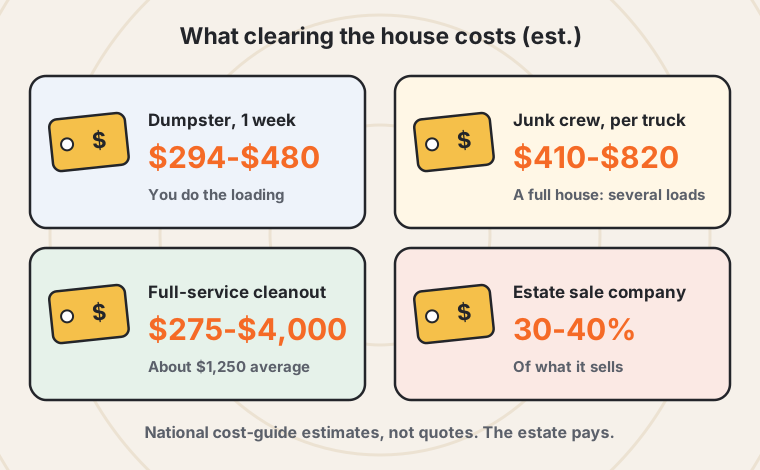
| Option | Typical cost (est.) | Who does the work | Best for |
|---|---|---|---|
| Dumpster rental, you load | $294 to $480 a week, plus extra weeks or weight | You and family | Lots of trash, plenty of helpers, nearby family |
| Junk-removal crew | $410 to $820 per full truckload; a full house can take several | The crew loads and hauls | A few rooms, garage, basement |
| Full-service estate cleanout | $275 to $4,000 typical; about $1,250 average; more for a packed house | The company sorts, donates, hauls | Out-of-state heirs, no time |
| Estate sale company | 30% to 40% of sale proceeds; cleanout of unsold items may cost extra | The company prices and sells | Houses with real furniture, collections, tools |
| Sell the house with contents | $0 cleanout cost; reflected in a lower price | The buyer | Packed or hoarded houses, deadlines, family far away |
Who pays? Reasonable costs of protecting and clearing estate property are estate administration expenses. The fiduciary pays them from the estate account and keeps the receipts. If you pay out of pocket, keep every receipt and ask the estate’s attorney about reimbursement. Do not mix estate money with your own; the Probate Court guide says the fiduciary must keep them completely separate.
Worked example: the real cost of a slow cleanout
Example (illustrative), built only from public numbers. Mom’s single-family house in Hamden, valued near the town’s single-family median of $355,000. Hamden’s fiscal 2027 mill rate is 53.67. The family plans three months to clear it, then list.
| Item | Input | Cost |
|---|---|---|
| Property tax, 3 months | $355,000 × 70% × 53.67 ÷ 1,000 ÷ 12 = $1,111 a month | $3,334 |
| Insurance, heat, electricity, upkeep, 3 months | $600 a month (est.) | $1,800 |
| Full-service cleanout | Top of the typical range (est.) | $4,000 |
| Total before any repairs or selling costs | $9,134 |
The same three months of property tax in other towns, at each town’s single-family median:
| Town | Median single-family price | Mill rate (FY 2027) | Property tax per month | Three months |
|---|---|---|---|---|
| Hamden | $355,000 | 53.67 | $1,111 | $3,334 |
| Manchester | $320,500 | 41.00 | $767 | $2,300 |
| Waterbury | $280,000 | 43.34 | $708 | $2,124 |
| New Britain | $285,000 | 39.18 | $651 | $1,954 |
| Groton | $372,500 | 25.29 | $550 | $1,649 |
| Norwich | $273,220 | 34.15 | $544 | $1,633 |
None of this means you should rush. It means the cleanout has a price per month, and it is worth knowing it before the family decides how to clear the house.
What should you fix and what should you leave?
You should fix only what is cheap, safe and clearly worth it before selling an inherited Connecticut house: a deep clean, working smoke and carbon monoxide detectors, broken glass, a leaking faucet, and anything that makes the house unsafe or uninsurable. Leave big-ticket work such as a roof, a boiler, an oil tank or a kitchen to the buyer unless the numbers clearly pay, because estate money and time are both limited.
Most houses that a parent owned for decades are sound but dated: an older boiler, an oil tank, original windows, a small electric panel, a 1970s kitchen. Repairs come out of the estate up front, every heir has to agree on the spending, and each month of contractor work adds carrying costs. As a rule:
- Usually worth it: cleaning, hauling, small repairs, fresh paint in a tired room, yard cleanup, working detectors.
- Sometimes worth it: flooring in one or two rooms, a cheap fix a lender would flag (a missing handrail, a broken window).
- Usually not worth it in an estate: kitchens, baths, roofs, heating systems, foundations, tank removal, unless an agent shows comparable sales that prove it.
Executors and administrators are exempt from Connecticut’s property condition disclosure form, but must not hide known defects; our probate guide explains. For the item-by-item math, see what to fix before selling a house in Connecticut and selling a house as-is in Connecticut.
Should you clear it out, hold an estate sale or sell it with everything inside?
Whether you should clear it out, hold an estate sale or sell with everything inside depends on what is in the house, how much time and help the family has, and the house’s condition. Clearing and listing usually brings the highest price for a house in good shape. An estate sale makes sense when the contents have real value. Selling with the contents inside is fastest and simplest, at a lower price.
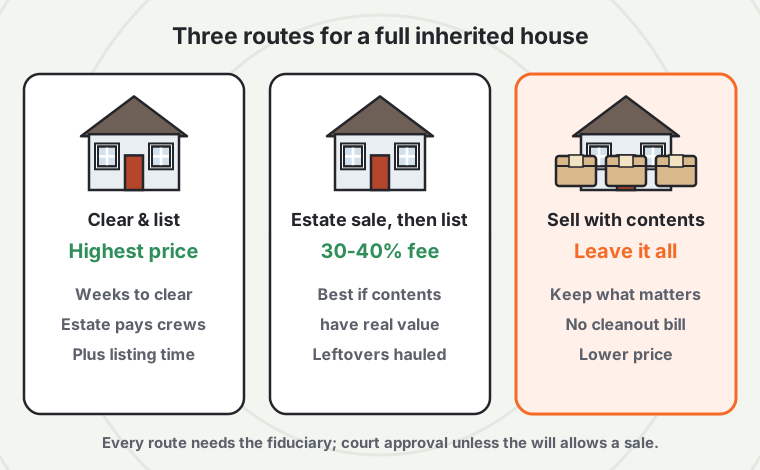
Clear it and list it
Highest priceFamily or a crew empties the house, light repairs, an agent lists it.
- Best for a house in good shape in a strong town
- Weeks to months of cleanout, plus listing time
- Estate pays cleanout, carrying costs and commission
Estate sale, then list
30% to 40% feeA company sells the contents inside the house, then you clear the rest and list.
- Best when furniture, collections or tools have real value
- Adds a few weeks; leftovers still need hauling
- Notice rules if the fiduciary is not family or the named executor
Sell it with the contents
Leave it allTake what matters to the family; a cash buyer takes the house and everything else.
- Best for packed or hoarded houses, repairs, family far away
- No cleanout bill, no showings, closing date you choose
- The price is below a cleaned, repaired retail sale
When you should NOT sell to a cash buyer
We buy houses for cash, so here is the honest version. If the house is in good shape, the family has the time and the help to clear it, and the heirs agree, listing it with a good agent will usually put more money in the estate than any cash offer. The same is true if the contents are worth a lot and an estate sale can pay for the cleanout. If that is your situation, we will tell you. A cash sale is for the families who want it done: a house too full to show, repairs nobody wants to fund, heirs in three states, or carrying costs piling up.
Compare both with real numbers in our cash buyer vs. realtor guide, and try the quick check below.
Is a cash sale right for you, or should you list?
Seven quick questions. There is no wrong answer, and we will tell you honestly if listing would leave you more.
- Does the house need repairs you would rather not pay for or manage?
- Do you need to close by a certain date, or within the next month or two?
- Would showings be hard: tenants, belongings, privacy, or you live out of state?
- Is there a complication: an estate or probate, a divorce, foreclosure, liens or back taxes?
- Could you comfortably cover the mortgage, taxes and utilities for three or more months?
- Is getting the highest possible price more important to you than speed and certainty?
- Would a buyer's bank lend on the house as it is (no major roof, foundation, oil tank or code issues)?
What are the steps to sell an inherited house with the contents inside?
The steps to sell an inherited house with the contents inside are: the family removes what it wants to keep, the fiduciary gets a written offer, the Probate Court approves the sale if the will does not already allow it, the attorneys handle title and the estate liens, and you close on a date that fits probate. Everything left in the house stays for the buyer. A typical cash closing takes about two weeks once the paperwork is ready.
Take what matters
Papers, photos, valuables, items named in the will, and whatever each heir wants. List and photograph everything first so the inventory is complete. Leave the rest: furniture, clothes, the basement, the garage.
Get a written number
Send the address and a few photos, or have us walk through with you or on video. You get a written offer you can take to the family and the estate’s attorney. It does not expire while you talk it over.
Get court authority to sell
If the will does not give the executor a power of sale, the fiduciary applies to the Probate Court; the court gives notice and holds a hearing (CGS 45a-164). We wait for it.
Attorneys clear the title
Connecticut closings are run by attorneys. The estate’s attorney handles the probate certificates and the release of the estate’s liens; you can use your own attorney for everything.
Close and walk away
You pick the date. Contents stay. We pay the closing costs we agree to in writing, there are no fees or commissions, and the estate gets the money through the closing attorney.

The families who struggle most are the ones who think the house must be empty before they can even ask what it is worth. Get the number first, while the house is still full. Then decide what is worth clearing. Walk through once with your phone recording every room, take the things that carry the memories, and give yourself permission to leave the rest.
I am Jerryll Noorden. I have bought Connecticut houses since 2016. You can reach me at (203) 529-4712. We never charge fees, we close through Connecticut attorneys, and nothing in your parent’s house will surprise us. If you would rather start without a call, send photos below; more on how we buy estate houses is on our sell an inherited house in Connecticut page, and the whole sale, start to finish, is in selling an inherited house.
Get your cash offer
without anyone coming over.
Want your offer faster, or rather not talk to anyone yet? Send a few phone photos of each room. We price the repairs from them, line by line, and send your cash offer back, so you see a real number before you ever meet us or pick up the phone.
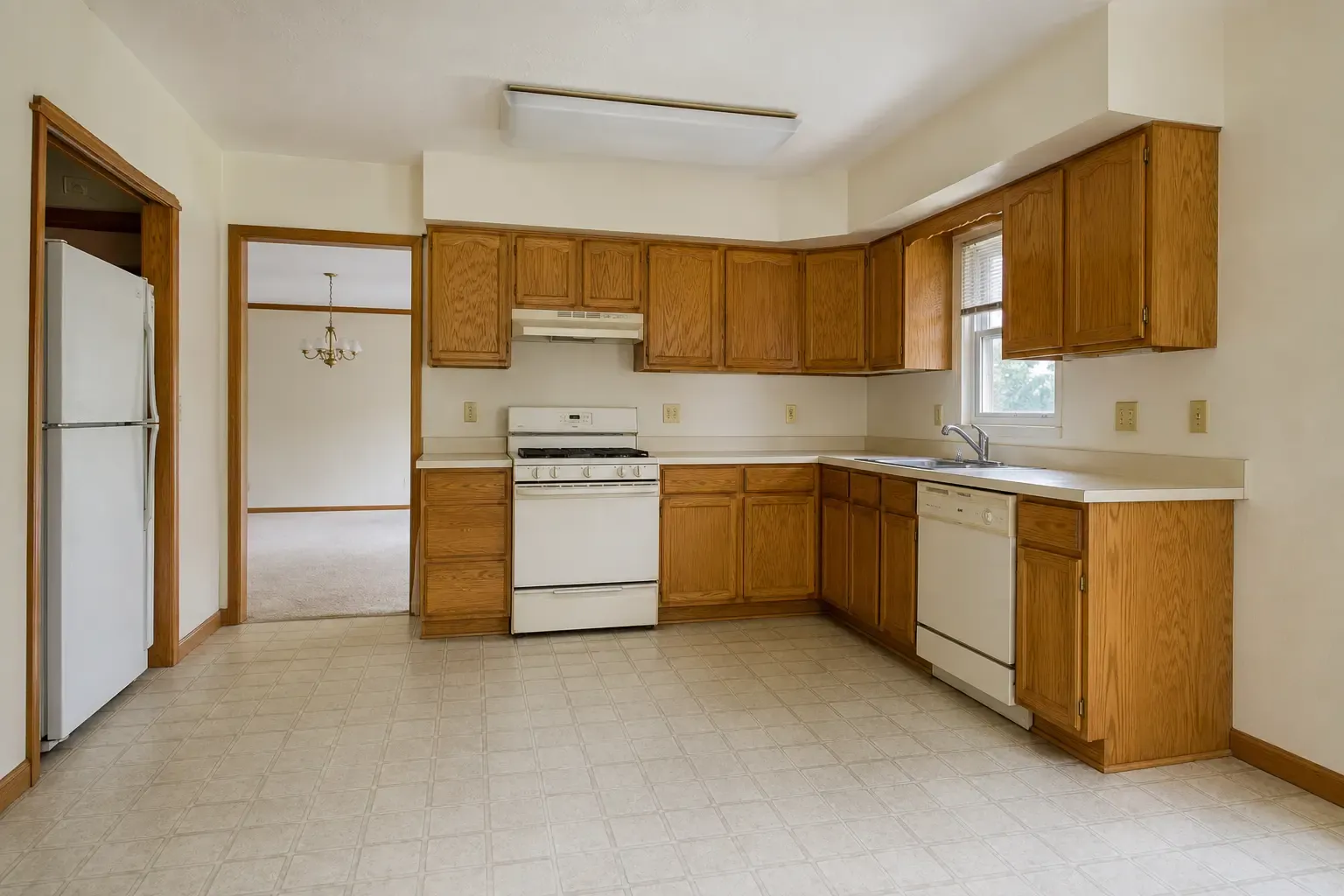 CabinetsFlooring
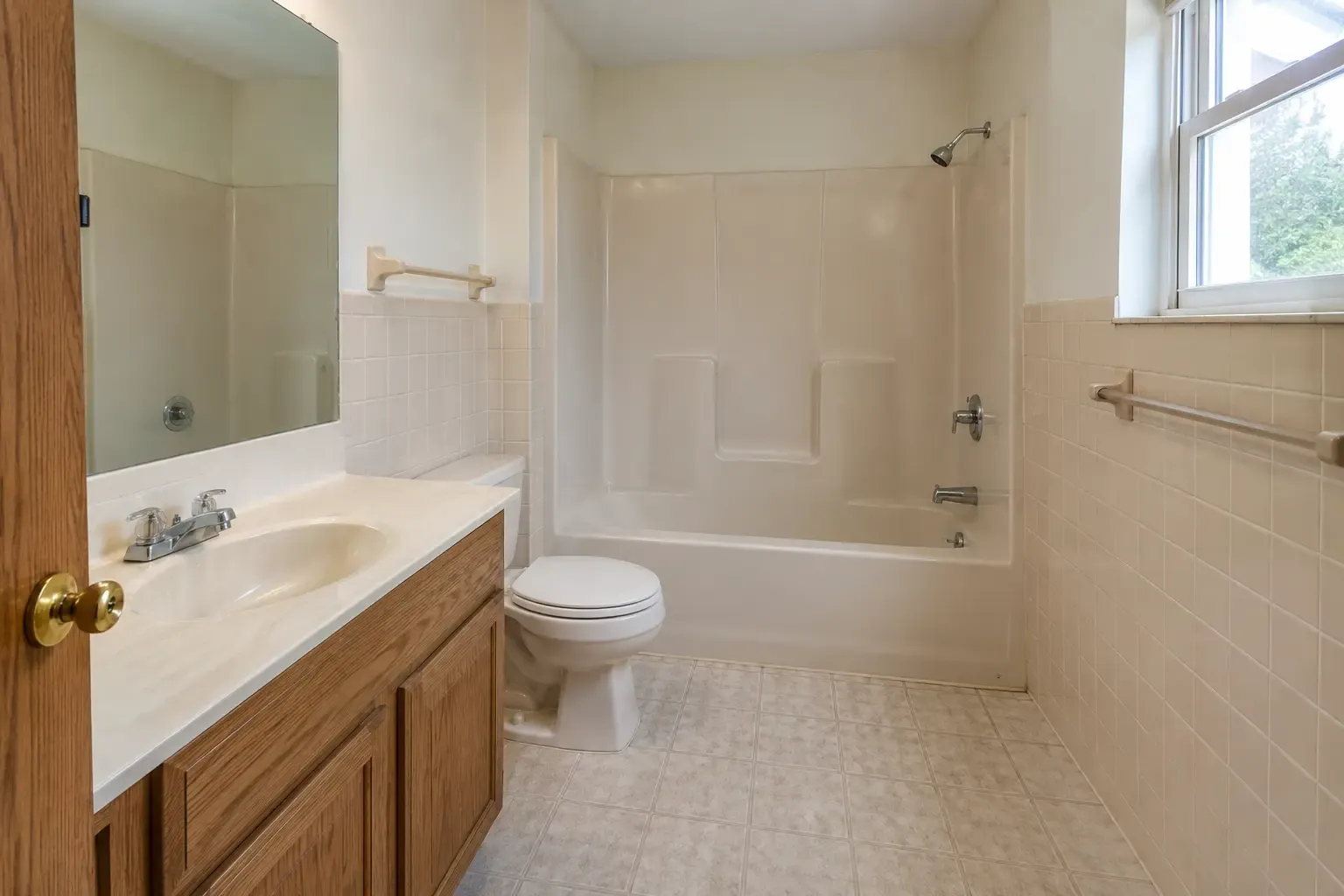 Tub & tile
 Floors
 Roof
We may bring in a partner buyer to close. Your price and terms don't change.
Questions families ask about cleaning out an inherited house
Can I clean out my parent’s house before probate?
You can protect your parent’s house before probate (lock it, throw out food and trash, keep it heated and insured), but you should not divide, sell or give away belongings until the Probate Court appoints an executor or administrator and the inventory is made. In Connecticut the fiduciary must file that inventory within two months of appointment (CGS 45a-341).
What should you not throw away when someone dies?
When someone dies, do not throw away the will, deeds, account statements, tax returns, insurance policies, vehicle titles, keys, safe deposit box information, or any receipts for the house. Keep them until the estate is closed. Check books, pockets, purses and the freezer for cash and valuables before anything goes out.
How much does it cost to clean out a house after a death?
Cleaning out a house after a death typically costs $275 to $4,000, about $1,250 on average, according to one national cost guide (est.). A packed house that needs several truckloads can cost more. An estate sale company instead keeps roughly 30% to 40% of what it sells (est.).
Who pays for cleaning out a deceased person’s house?
The estate pays for cleaning out a deceased person’s house. Reasonable cleanout, insurance, utility and tax costs are paid by the executor or administrator from the estate account. If an heir pays out of pocket, they should keep receipts and ask the estate’s attorney about reimbursement.
How long do you have to clean out a house after someone dies in Connecticut?
There is no fixed Connecticut deadline to clean out a house after someone dies, unless the person rented or a sale contract sets a date. The real limits are the inventory deadline (two months after the fiduciary’s appointment), the insurer’s vacancy rules and the monthly carrying costs.
Can family members take things from the house before probate?
Family members should not take things from the house before probate. Until an executor or administrator is appointed and the inventory is filed, the belongings are estate property. Items left to someone in the will go to that person through the estate; taking them early causes disputes and inventory problems.
Do I have to empty an inherited house before selling it?
You do not have to empty an inherited house before selling it. A buyer using an agent usually expects it empty and clean, but a cash buyer can buy the house with the contents inside. Take what matters to the family first and make sure everything is listed for the inventory.
How do I get rid of old TVs and computers in Connecticut?
You get rid of old TVs and computers in Connecticut through your town’s electronics collection, the transfer station or an approved recycler. State law bars putting them in the trash (CGS 22a-636), and recycling up to seven devices at a time is free (CGS 22a-635).
How do I dispose of a mattress in Connecticut?
You dispose of a mattress in Connecticut through the Bye Bye Mattress program, which offers free drop-off at participating sites and many town transfer stations under the state’s mattress stewardship law (CGS 22a-905a). Check your town’s transfer station rules before you go.
What do I do with old paint and chemicals in the basement?
Old latex and oil paint goes to a PaintCare drop-off site (CGS 22a-904a). Pesticides, solvents, pool chemicals and similar products go to your town’s or region’s household hazardous waste collection day, which DEEP lists by town; most run from spring to early November.
Do I need to keep insurance on an empty inherited house?
Yes, you need to keep insurance on an empty inherited house. Tell the insurer about the death and the vacancy right away, because many policies limit coverage after a house is vacant for a set period, often 30 to 60 days. Ask for a vacancy endorsement or a vacant-dwelling policy.
Do estate sale companies take a percentage?
Most estate sale companies take a percentage, commonly about 30% to 40% of the sale proceeds (est.), and some charge extra to clear unsold items. Get a written contract that states the commission, the sale dates, how money is paid to the estate and what condition the house is left in.
Will a cash buyer take the house with furniture and junk inside?
Yes, a cash buyer like us will take the house with furniture and junk inside. The family keeps what it wants, and everything else stays. The price reflects the cleanout and repairs the buyer takes on, so compare it with what listing would net after those costs.
Can the house be sold before the cleanout and probate are finished?
Yes, the house can be sold before the cleanout and probate are finished. The executor or administrator signs the contract and the deed, and if the will gives no power of sale, the Probate Court must approve the sale after notice and a hearing (CGS 45a-164).
Related Connecticut guides
Inherited houses
Money and the empty house
We buy inherited houses across Connecticut, including Hamden, Waterbury, New Britain, Manchester, Norwich and Groton. For the whole process from start to finish, see how to sell a house in Connecticut.
Plain-English information, not legal advice. Probate practice differs between courts; the estate’s Connecticut attorney and your Probate Court have the final word.
Sources
- CGS §§ 45a-341 and 45a-342 (inventory: fair market value, two months, notice of sale, penalty) and CGS § 45a-273 (small-estate affidavit not available for solely owned real estate).
- CGS § 45a-164 (Probate Court authority to sell real property).
- Probate Court User Guide: Administration of Decedents’ Estates (Office of the Probate Court Administrator, 2026): Steps 1 to 5, Questions 7, 9 and 15.
- Connecticut Probate Court forms (PC-200 petition, PC-251 notice for land records, PC-2407 inventory for decedents’ estates).
- CGS §§ 22a-629, 22a-635, 22a-636 (covered electronic devices: free recycling for seven or fewer; no disposal in solid waste facilities).
- CGS §§ 22a-904a and 22a-905a (paint stewardship; mattress stewardship with free statewide drop-off).
- DEEP household hazardous waste collection schedule.
- Department of Consumer Protection, drug drop boxes and safe medication disposal (2025).
- CGS § 7-148(c)(7)(H)(xv) (municipal blight ordinances; up to $250 a day at a vacant property).
- CGS § 12-62a (assessment at 70% of value) and Connecticut OPM sales data and fiscal 2027 mill rates on data.ct.gov, as shown on our town pages.
- Cost estimates (not primary sources, labelled est.): HomeAdvisor estate clean-out cost guide and estate liquidator guide (2025, national); truckload and dumpster ranges from other published national cost guides.
See the house together.
Pick a time that works.
Choose a time for us to walk through the property with you, or ask for a quick call first. We confirm every request personally.
Tuesday, January 13
No open times in the next few weeks. Please call us.
We will confirm by email. Nothing is booked until we do.
View my request
Who wrote this
Jerryll Noorden
Jerryll has bought and sold Connecticut houses since 2016 and has sat at more closing tables than he can count, on both sides. Before real estate he was a robotics scientist at NASA, IHMC and IIT. He wrote this guide because the national sites that rank for it skip the Connecticut rules that cost sellers money. When listing or selling it yourself would get you more than a cash offer, he says so.
This guide explains Connecticut rules in plain English. It is not legal or tax advice. Laws change; for your sale, talk to a Connecticut real estate attorney and a tax professional.
