
- Yes, a house can be sold during probate in Connecticut. You do not have to wait for the estate to close. You do have to wait for the Probate Court to appoint an executor or administrator, because only that person can sign the deed. (Part of our guide to how to sell a house in Connecticut.)
- Authority comes from one of two places: a power of sale in the will, or a Probate Court order after notice and a hearing (CGS 45a-164). The court’s form is the Petition to Sell or Mortgage Real Property, PC-400.
- If your parent owned the house alone, probate is needed. Connecticut’s small-estate affidavit is not available when the person who died owned Connecticut real estate in their name alone (CGS 45a-273).
- Two liens decide most closing dates: the probate fee lien (CGS 45a-107b) and the Connecticut estate tax lien (CGS 12-398). File the estate tax return early so the court can release them.
- Executors skip two seller forms: the property condition report and the smoke and CO affidavit do not apply to sales by executors and administrators (CGS 20-327b(b)(4), 29-453(f)(8)).
- A typical estate can sell from about month two or three, once the fiduciary has authority, not month twelve.
Can you sell a house in probate in Connecticut?
Yes, you can sell a house in probate in Connecticut once the Probate Court has appointed an executor or administrator. That fiduciary signs the deed, either under a power of sale in the will or with a court order approving the sale after notice to the heirs and a hearing (CGS 45a-164). Heirs cannot sell on their own while the house is in the estate, and the estate does not have to be closed first.
Our main inherited house guide covers the whole picture: keep or sell, taxes, clean-out, siblings. This page goes deep on one question only: the legal steps to sell the house while the estate is open, who signs, which forms, how long it takes, and what the buyer’s attorney needs before the closing.
Why does selling a parent’s house during probate feel so hard?
Selling a parent’s house during probate feels hard because you are grieving and doing legal work at the same time, you are responsible to your siblings and to a court, and you have probably been told you must wait a year. Most executors feel overwhelmed, afraid of doing it wrong, stuck with an empty house, guilty about selling, and skeptical of everyone who calls. All of that is normal.
Maybe you are the oldest child and your name is in the will. Maybe there was no will and your family expects you to “handle it”. You have a folder of death certificates, a bank asking for letters you do not have yet, and a house in Waterbury or Manchester that still has your mother’s coat on the hook. Every month the town tax bill comes anyway. Every winter night you wonder if the furnace is still running.
You may also feel something harder to say: that selling the house is a betrayal, or that selling it quickly looks greedy. It is not. An executor’s job is to protect the estate for everyone, and an empty house that slowly costs the heirs thousands of dollars is not protected. Selling it carefully, at a fair price, with the court’s blessing where needed, is the responsible thing to do.
And you are probably wary of anyone who wants to buy it. Good. This page will not ask you to trust us. It shows you the statutes, the court forms and the math, so you can check every claim yourself. If you are an executor, an administrator, or the family member everyone is looking at, this page is for you.
What are the Connecticut rules for selling a house in probate?
The Connecticut rules for selling a house in probate are mostly in the probate statutes: a fiduciary needs court authority to sell real estate unless the will grants it, the court may authorize a sale after notice and hearing if it serves the parties’ best interests (CGS 45a-164), the court decides whether the sale is public or private (CGS 45a-166), and specifically devised property needs the devisee’s consent (CGS 45a-428).
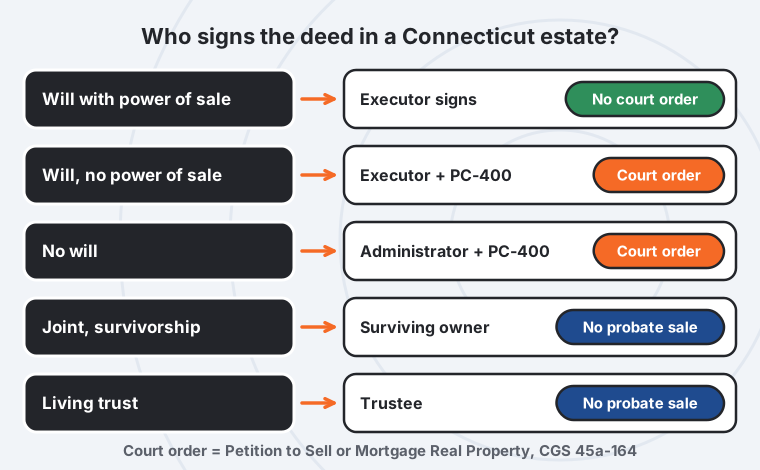
| Rule | What it means for the house | Source |
|---|---|---|
| Court-authorized sale | On the fiduciary’s written application, after the notice the court orders and a hearing, the court may authorize a sale “for the best interests of the parties in interest” | CGS 45a-164(a) |
| Who can apply | An executor, administrator, temporary administrator or trustee appointed by the court | CGS 45a-164(a) |
| Probate bond for the proceeds | The court may require a bond to cover the sale money unless one is already in force or is excused | CGS 45a-164(b), 45a-169 |
| Sale to the fiduciary | Allowed after a hearing; the notice must say the fiduciary is the buyer | CGS 45a-164(c) |
| Heirs who are minors or under a disability | The court appoints a guardian ad litem for the hearing unless a guardian or conservator already represents them | CGS 45a-164(d) |
| The order is final | The order and the sale bind everyone whose interests were represented | CGS 45a-164(e) |
| Public or private sale | The court directs which; for a private sale it may set the price and terms | CGS 45a-166(a) |
| Proceeds follow the will | Net proceeds are divided as the house itself would have been | CGS 45a-166(b) |
| House left to a named person | In a solvent estate it cannot be ordered sold without that person’s written consent | CGS 45a-428(b) |
| No small-estate shortcut | The affidavit is only for estates with no solely owned Connecticut real property | CGS 45a-273(a) |
| Liens on the house | The probate fee and the estate tax are liens on Connecticut real estate until paid or released | CGS 45a-107b, 12-398(d)-(e) |
| Seller disclosure forms | Executors and administrators are exempt from the condition report and the smoke and CO affidavit | CGS 20-327b(b)(4), 29-453(f)(8) |
Notice what is not in Connecticut law: a court auction where strangers overbid at the hearing, a required newspaper ad for every sale, or a rule that the house cannot be listed until the estate closes. Those come from other states. If a website describes a confirmation hearing with a 10% deposit and open bidding, it is not describing Connecticut. A public sale is possible here, but only if the court orders one.
Who has the authority to sell the house: the executor, the administrator or the heirs?
The authority to sell a house in a Connecticut estate belongs to the fiduciary the Probate Court appoints: the executor named in the will, or an administrator if there is no will. The heirs do not have authority while the house is in the estate. The fiduciary proves authority with a probate certificate, and needs either a power of sale in the will or a court order to sell.
Think of it as two keys. The first key is the appointment: until the court admits the will and appoints the executor, or appoints an administrator, nobody can sign anything binding, not even the person named in the will. The second key is authority to sell real estate.
| Situation | Who signs the deed | Court sale order needed? |
|---|---|---|
| Will names an executor and gives a power to sell real estate | The executor | Usually not; the will is the authority. Your attorney and the buyer’s title insurer read the exact wording. |
| Will names an executor, no power of sale | The executor | Yes: PC-400 petition, notice, hearing (CGS 45a-164) |
| No will | The administrator the court appoints | Yes: PC-400 petition, notice, hearing |
| Will leaves the house to a named person (specific devise) | The executor, if a sale is needed | Yes, and in a solvent estate that person must consent in writing (CGS 45a-428(b)) |
| Emergency before anyone is appointed | A temporary administrator, if the court appoints one | Yes; temporary administrators are listed in CGS 45a-164 |
| Joint owners with right of survivorship | The surviving owner | No probate sale; the estate tax lien still has to be released |
| House in a living trust | The trustee, under the trust | No probate sale; the estate tax lien still has to be released |
What “power of sale” means
Many wills say something like “I give my executor full power to sell any real or personal property, at public or private sale, without order of court.” That sentence is the power of sale. If it is there, the executor can usually sign a contract and close without a 45a-164 hearing, once appointed. If the will is silent, or only lets the executor sell “personal property”, you need the court order. Do not guess; the buyer’s title insurer will make its own reading, and a wrong guess costs weeks.
What the fiduciary owes the heirs
An executor or administrator must get a fair price and be able to show how it was set, keep the money in an estate account, keep the heirs informed and favor no one, including themselves. A fiduciary can buy the house, but only after a hearing whose notice says so (CGS 45a-164(c)).
Does the house even have to go through probate in Connecticut?
The house has to go through probate in Connecticut if the person who died owned it in their name alone. Connecticut’s small-estate affidavit can only be used when the decedent had no solely owned Connecticut real property and $40,000 or less of solely owned personal property (CGS 45a-273). A house held in joint survivorship or in a living trust passes outside probate, but its estate tax lien still has to be released.
This is the single most common surprise. Families hear that “small estates skip probate” and assume a modest house qualifies. It does not. The test in 45a-273 is not the value of the house; it is whether the decedent owned Connecticut real estate in their name alone. If they did, someone has to open a full estate (form PC-200 with the Probate Court for the district where the decedent lived) and be appointed before the house can be sold.
- Deed in your parent’s name alone: full probate estate. This page applies.
- Deed to “husband and wife” or to a parent and child as joint tenants with right of survivorship: the survivor owns it. No probate sale, but the Connecticut estate tax return still has to be filed and the lien released (the court’s Petition for Certificate Releasing Liens, PC-205B, is the usual route when no estate is opened; your attorney will confirm).
- Deed to a trustee of a living trust: the trustee sells under the trust. Same estate tax lien point.
- Owner died years ago and nobody opened an estate: the house is still in the deceased owner’s name. An estate has to be opened now; the liens may still be sitting on the title.
Pull the deed from the town clerk’s land records the week you start. It tells you which path you are on. Our documents guide shows where each record lives.
How do you get Probate Court approval to sell a house in Connecticut?
You get Probate Court approval to sell a house in Connecticut by having the appointed executor or administrator file the Petition to Sell or Mortgage Real Property (form PC-400) with the court handling the estate, describing the house, the buyer, the price and the terms. The court orders notice to the heirs, holds a hearing, and authorizes the sale if it finds it is in the best interests of the parties (CGS 45a-164).
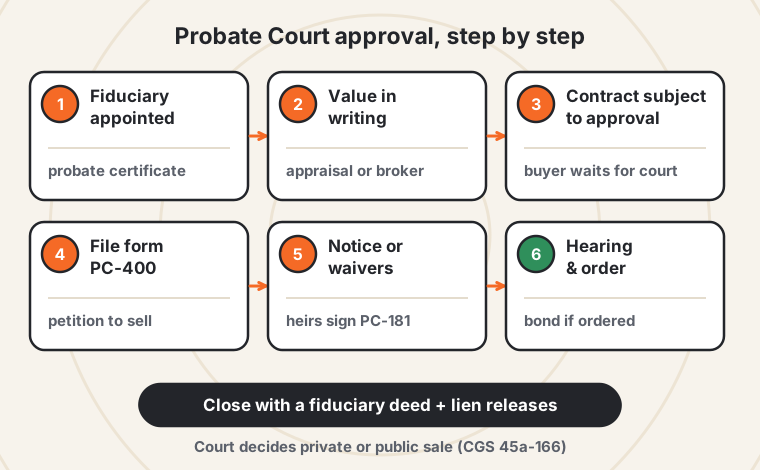
Get appointed and get your certificate
The court admits the will and appoints the executor, or appoints an administrator. Ask for several certified probate certificates; the buyer’s attorney, the bank and the town will each want one. The court’s user guide says appointment often takes two to four weeks after the petition is filed.
Check the will for a power of sale
If the will grants one, ask your attorney whether a court order is still useful (some families get one anyway when heirs are unhappy, because the order binds everyone under 45a-164(e)). If not, you need the PC-400 route below.
Put the value in writing
Start with the date-of-death value from the estate inventory (CGS 45a-341). For the petition, a recent appraisal or a broker’s opinion of value is the best protection. A price well below value invites objections; a price you can explain rarely draws one.
Sign the contract “subject to Probate Court approval”
Most fiduciaries find the buyer first, then petition. The contract should say the sale is subject to the court’s order and set a closing date that leaves room for notice and the hearing. A buyer who cannot wait for the court is the wrong buyer for an estate.
File form PC-400
The Petition to Sell or Mortgage Real Property describes the property, the proposed buyer, the price and terms, and whether the sale is private or public. It also asks about the estate’s other assets (relevant when the house was left to a specific person, under 45a-428). Attach the appraisal or opinion of value and the contract if your court asks for them.
Notice and waivers
The court decides who gets notice: heirs, beneficiaries, and sometimes creditors. Heirs who agree can sign a written waiver of notice and hearing (General Waiver, PC-181). With every waiver in hand, some courts can act quickly; with one objector, expect a real hearing. If an heir is a minor or under a disability, the court appoints a guardian ad litem (45a-164(d)).
The hearing and the order
The judge asks how the price was set and whether anyone objects. For a private sale the court may approve the price and terms you agreed, or set them (45a-166(a)). The order authorizes you to sign the deed and may require a probate bond for the proceeds (form PC-480) unless one is already in place or excused (45a-164(b), 45a-169).
Close and deposit
You sign a fiduciary’s deed. The attorneys record it with the probate certificate and the lien releases, and the net proceeds go into the estate account, to be distributed later as the will or the intestacy law directs (45a-166(b)).
Connecticut lets the court choose (CGS 45a-166). Almost every family house is sold privately: you find the buyer, the court approves the deal. A public sale with notice and bids is for unusual cases, such as an insolvent estate or a fight over value. If the court orders a public sale, the fiduciary can only be the buyer through the procedure in 45a-167.
The court’s mediation program (Motion and Agreement to Mediate, PC-1002) is worth knowing about if one heir objects. It is usually faster and cheaper than a contested hearing. For the family side of disagreements, see the heirs section of our inherited house guide.
Can you sell before the executor is appointed, or wait until after the estate is distributed?
You cannot sell before an executor or administrator is appointed, because nobody has authority to sign; at most you can collect offers, and in an emergency ask the court for a temporary administrator (CGS 45a-316). You can wait until after the estate is distributed, when the heirs receive title by a recorded certificate (CGS 45a-450) and sell together, but every heir must then sign and the sale usually comes months later.
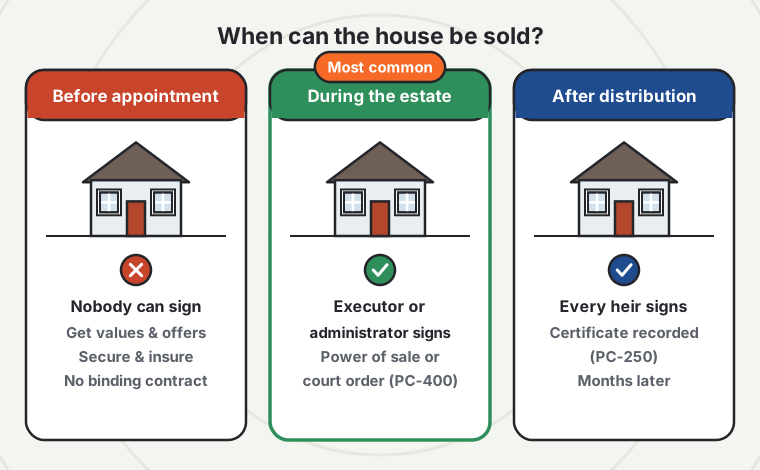
| When | Who signs | Good for | Watch out for |
|---|---|---|---|
| Before appointment | Nobody (unless a temporary administrator is appointed) | Getting values and offers in writing, securing and insuring the house | Do not sign a contract as “heir”; it is not binding on the estate |
| During the estate (most common) | The executor or administrator, with a power of sale or court order | Ending carrying costs early; one signer; the court’s order protects the fiduciary | The lien releases and, if needed, the hearing set the closing date |
| After distribution | Every heir who received title | Families who want to keep or rent first, or one heir buying out the others | Everyone must sign; any heir’s own creditors or divorce can complicate it; carrying costs continue for months |
Temporary administrator. If the house is at risk (a burst pipe, a vacant-property problem, a buyer who will walk) and the will is delayed or contested, an interested person can ask the court to appoint a temporary administrator to “hold and preserve” the estate (CGS 45a-316). A temporary administrator can apply for authority to sell under 45a-164. This is an attorney task, and the court requires a bond.
After distribution. When the house passes to the heirs, the fiduciary records a certificate of devise, descent or distribution (form PC-250) in the town’s land records within the time 45a-450 sets. From then on the heirs own it as co-owners and sell like any owners, with a regular deed. It works well when everyone agrees. It works badly when one heir stops answering the phone.
How long does it take to sell a house during probate in Connecticut?
Selling a house during probate in Connecticut usually becomes possible about two to three months after death: the petition is filed within 30 days, the fiduciary is often appointed two to four weeks later, and a sale can close once authority is in hand and the liens can be released. A court approval hearing, if needed, adds several weeks. The estate itself usually stays open nine to twelve months.
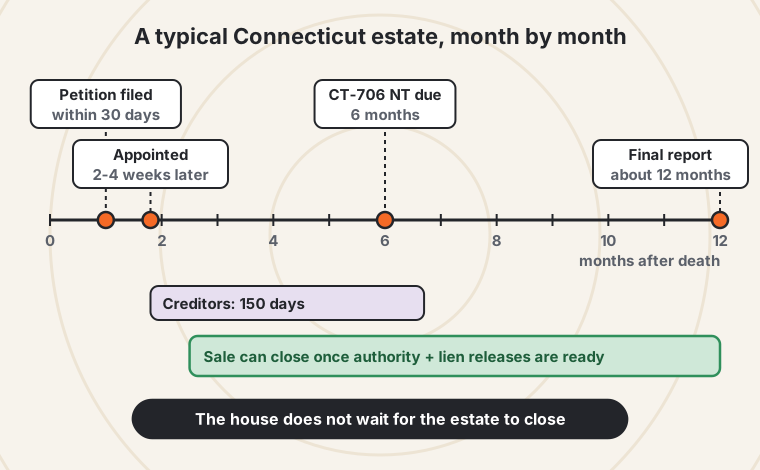
| Milestone | Typical timing | Source |
|---|---|---|
| File the will and petition (PC-200) | Within 30 days of death | Probate Court user guide; CGS 45a-283 |
| Fiduciary appointed | Often 2 to 4 weeks after filing | Probate Court user guide |
| Death and appointment recorded in each town with real estate | Within 2 months of qualifying | CGS 45a-322 |
| Inventory at date-of-death values | Within 2 months of appointment | CGS 45a-341 |
| PC-400 petition to court order | Several weeks (est.); faster with all heirs’ waivers | Varies by court; ask the clerk |
| Creditors’ claim period | 150 days from the first fiduciary’s appointment | CGS 45a-356 |
| Connecticut estate tax return (CT-706 NT for most) | 6 months from death | Probate Court user guide; CGS 12-392 |
| Cash sale once authority and releases are ready | About 2 weeks (our typical) | Our practice |
| Final financial report | Usually within 12 months of death | Probate Court user guide |
The things that actually slow a probate sale are rarely the buyer. They are: a will that is hard to find or contested, heirs who cannot be located, a hearing that gets continued because someone objects, and an estate tax return that was never filed, so the court cannot release the lien. You control the last one completely. For the general clock on Connecticut sales, see how long it takes to sell a house in Connecticut.
What does the buyer’s title attorney need before a probate sale can close?
Before a probate sale can close, the buyer’s title attorney needs the fiduciary’s probate certificate, the power of sale or the court’s sale order, a release of the probate fee lien (CGS 45a-107b), a release of the Connecticut estate tax lien (CGS 12-398), the recorded notice of the death and appointment, and a fiduciary’s deed. The seller’s attorney also files the conveyance tax return, Form OP-236.

| Item | Why it is needed | Where it comes from |
|---|---|---|
| Probate certificate (fiduciary’s certificate) | Proves who the executor or administrator is, and that the appointment is current | The Probate Court handling the estate |
| Power of sale, or the court’s order under 45a-164 | Proves authority to sell real estate | The will, or the court |
| Probate bond, if ordered | Covers the sale proceeds | A surety company; form PC-480 |
| Probate fee lien release | The court fee is a lien on Connecticut real estate in the fee basis until paid | The Probate Court, after payment (CGS 45a-107b) |
| Estate tax lien release | The Connecticut estate tax is a lien on real property transferred at death | The Probate Court for nontaxable estates after Form CT-706 NT; DRS for taxable estates (CGS 12-398(e)) |
| Certificate of death and appointment in the land records | Puts the death and the fiduciary on record in each town where the decedent owned real estate | Recorded by the fiduciary within 2 months of qualifying (CGS 45a-322) |
| Fiduciary’s deed | The deed an executor or administrator signs; it carries the fiduciary’s covenants, not a full warranty | Your attorney |
| Conveyance tax return, Form OP-236 | The seller pays the conveyance tax before the deed is recorded; estates attach Schedule A | Your attorney (DRS form) |
| Payoffs | Any mortgage, reverse mortgage, home equity line or town lien is paid from the proceeds | The lenders; the town tax collector |
What an executor does not have to provide
Executors, administrators, trustees and conservators are exempt from the Residential Property Condition Report (CGS 20-327b(b)(4)) and from the smoke and carbon monoxide detector affidavit (CGS 29-453(f)(8)). You were not living there; the law does not make you guess about the roof. A federal lead paint disclosure can still apply to a pre-1978 house; your attorney will tell you. You also do not owe anything for skipping the condition report, because the $500 credit only applies to sellers who are required to deliver it.
The estate tax return, in one paragraph
Every Connecticut estate files a Connecticut estate tax return, even when no tax is due. For deaths in 2026 Connecticut taxes only the part of an estate above the federal basic exclusion amount, which the IRS set at $15 million for 2026, at 12% (CGS 12-391). Most families file the short Form CT-706 NT with the Probate Court, and the court then issues the lien release. File it as soon as the values are known, not on the six-month deadline. Details are in our inherited house guide, and income tax on the sale is in taxes on selling an inherited house in Connecticut.
The settlement statement, payoffs and wiring steps are the same as any sale; our guide to the Connecticut closing process for sellers walks through them.
What does it cost to keep a probate house instead of selling it during the estate?
Keeping a probate house instead of selling it during the estate costs the heirs the town property tax, insurance, heat, utilities and upkeep every month it sits. On a Waterbury house at the town’s single-family median of $280,000, property tax alone is about $8,490 a year at the fiscal 2027 mill rate, and total carrying costs come to roughly $1,135 a month (est.). Selling at month three instead of month ten saves about $7,945 (est.).
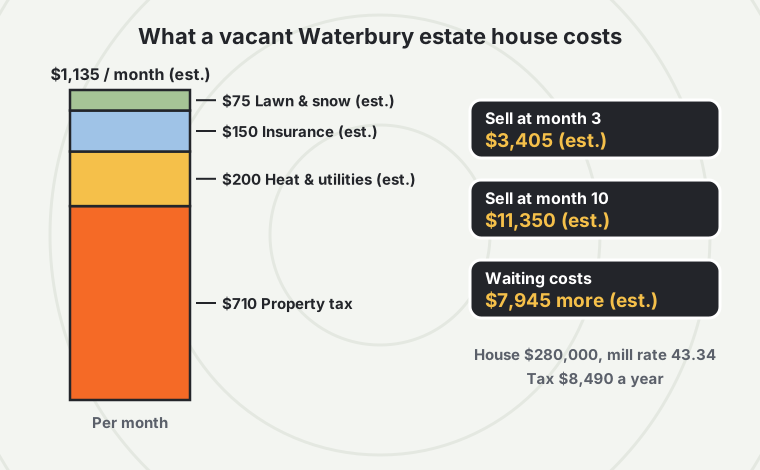
Here is a worked example built only from public numbers. It is illustrative, not a real estate we handled.
| Input (Waterbury) | Value | Source |
|---|---|---|
| House value at death | $280,000 | Waterbury single-family median, sales Oct 2024 to Sep 2025 (OPM via data.ct.gov) |
| Other estate assets | $20,000 in the bank | Assumed for the example |
| Mill rate | 43.34 (fiscal 2027) | OPM mill rates |
| Property tax | $8,490 a year, about $710 a month | $280,000 x 70% assessment x 43.34 mills |
| Vacant-home insurance | $150 a month (est.) | Estimate; vacant policies vary widely |
| Heat, electric, water | $200 a month (est.) | Estimate for a house kept at a low winter temperature |
| Lawn, snow, checks | $75 a month (est.) | Estimate |
| Carrying cost | about $1,135 a month (est.) | Sum of the above |
What settling and selling cost, either way
- Probate Court fee: the basis is $300,000, so the fee is $150 plus 0.35% of $290,000, which is $1,165 (CGS 45a-107(b)). It is the same whether you sell in month three or month ten.
- Conveyance tax on a $280,000 sale: 0.75% state ($2,100) plus Waterbury’s 0.50% town rate ($1,400), so $3,500, paid by the estate at closing (CGS 12-494).
- Carrying costs: about $3,405 (est.) to month three; about $11,350 (est.) to month ten. The difference, $7,945 (est.), comes out of the heirs’ shares.
For comparison, a Manchester house at that town’s single-family median of $320,500 carries about $9,200 a year in property tax at its 41.0 mill rate. If the house were the whole estate, the probate fee would be $1,237, and the conveyance tax at 1% (0.75% state plus 0.25% town) would be $3,205. Plug your own numbers into the calculator:
How much would you walk away with?
Slide the numbers to match your house. It works in your browser; nothing is saved or sent.
Estimates for planning. Conveyance tax per CGS 12-494 (state 0.75% up to $800,000, 1.25% to $2.5M, 2.25% above, plus the town rate). Seller attorney about $1,200 to $1,500; flat-fee MLS about $400; listings include three months of taxes, insurance and utilities, a cash sale about two weeks. Your attorney gives you the final numbers.
Our cost to sell a house in Connecticut guide breaks down every seller cost, and the conveyance tax by town page has every town’s rate.
Can an out-of-state executor sell a Connecticut house?
Yes, an out-of-state executor can sell a Connecticut house. Connecticut Probate Courts appoint nonresident fiduciaries; the court’s form for that is the Appointment of Probate Judge as Agent for Service by Non-Resident Fiduciary (PC-482), and the court may require a bond. Once appointed, the executor can sign the contract, the petition and the deed from home, with documents notarized where they live and sent to the Connecticut attorneys.
The out-of-state executor’s real problems are practical, not legal: the house is three hours or three states away, the lawn grows, the furnace needs checking, the insurer wants someone to visit, and every showing needs a person to open the door. A few things help:
- Hire a Connecticut probate attorney in or near the probate district. Most of the court work can be done by mail and e-filing through the attorney.
- Ask about remote hearings. Many courts allow remote attendance; ask the clerk when the PC-400 is filed.
- Secure the house once. Change the locks, set the heat, shut off water if it will sit through winter, and call the insurer about vacancy. See selling a vacant house in Connecticut.
- Sign at a distance. Connecticut closings are run by attorneys, and a seller who cannot attend usually signs the deed and affidavits before a notary at home in advance. Your attorney will send the exact package.
- Keep heirs informed by email with the same numbers: value, offers, costs. It prevents the long-distance misunderstandings that turn into objections at the hearing.
If the estate also owes income tax on a gain, or an heir lives outside Connecticut, the tax rules are in taxes on selling an inherited house.
What if the heirs disagree, or one heir wants to keep the house?
If the heirs disagree about a probate sale in Connecticut, they do not each get a veto: the executor or administrator can petition the court, the heirs can object at the hearing, and the court decides what is in the best interests of the parties (CGS 45a-164). An heir who wants the house can make an offer at a fair value. A house left by name to one person cannot be sold in a solvent estate without that person’s written consent (CGS 45a-428).
Most stand-offs end when everyone looks at the same three numbers: a fair value from an appraisal or recent sales, what a listing would net after repairs, commission and months of carrying costs, and a written cash offer. The court’s mediation program is a good middle step. The full family playbook, including buyouts and partition under the Uniform Partition of Heirs’ Property Act, is in our inherited house guide. If you are getting the house ready while the family decides, our sibling guide to preparing an inherited house for sale in Connecticut covers what is worth doing and what is not.

Estate sales almost never slip because of the buyer. They slip because the estate tax return was never filed, so there is no release of lien, or because one sibling hears the price for the first time at the hearing. File the CT-706 NT as soon as you have the values, and email every heir the price and how you got it before the petition goes in. A hearing with no surprises is usually a short one.
What are your options for selling a probate house, and when should you not sell to a cash buyer?
Your options for selling a probate house in Connecticut are to list it with an agent, sell it to an heir, distribute it and let the heirs sell later, or sell it as-is to a cash buyer. Listing usually brings the highest price for a house in good shape when the heirs can wait and pay carrying costs. A cash sale fits a house that needs work, is full of belongings, sits far away, or has heirs who want it settled.
List with an agent
Highest price, if it shows wellBest when the house is in good shape and someone can manage showings.
- Commission and repairs come out of the estate
- Buyer’s lender may require repairs
- Months of carrying costs while it sells
- Contract still “subject to court approval” if no power of sale
Sell to an heir
Keeps it in the familyBest when one heir wants it and can pay or borrow.
- Needs a fair value everyone accepts
- A fiduciary buyer needs a hearing (45a-164(c))
- Financing can take time
Sell as-is for cash
About 2 weeks once authority is readyBest when the house needs work, is full, is far away, or the family wants it done.
- No repairs, no clean-out, no showings
- Waits for the court order and lien releases
- Price is below a renovated-house price; that is the trade-off
When you should NOT sell to us
- The house is updated, clean and in a strong town, the heirs can carry it for a few months, and nobody minds showings. List it; you will likely net more.
- One heir wants the house and can pay a fair price. Sell to them.
- The heirs are not ready emotionally. Nothing on this page has a deadline except the court’s own.
- You have not had the house valued. Get an appraisal or a broker opinion first; you need it for the petition anyway.
Is a cash sale right for you, or should you list?
Seven quick questions. There is no wrong answer, and we will tell you honestly if listing would leave you more.
- Does the house need repairs you would rather not pay for or manage?
- Do you need to close by a certain date, or within the next month or two?
- Would showings be hard: tenants, belongings, privacy, or you live out of state?
- Is there a complication: an estate or probate, a divorce, foreclosure, liens or back taxes?
- Could you comfortably cover the mortgage, taxes and utilities for three or more months?
- Is getting the highest possible price more important to you than speed and certainty?
- Would a buyer's bank lend on the house as it is (no major roof, foundation, oil tank or code issues)?
For the general comparison, see cash buyer vs. realtor in Connecticut, and before you talk to any buyer, read how to check a cash home buyer.
How does selling a probate house to us work?
Selling a probate house to us works in five steps: you send the address, we see the house once, we put a written cash offer in your hands, your attorney uses it for the court petition if one is needed, and we close at a Connecticut attorney’s office about two weeks after the authority and lien releases are ready. You do not repair or clean anything, and the offer does not expire while the court works.
Send the address
A few lines about the estate: is there a will, has anyone been appointed, does anyone live there. No contract, no commitment.
One walkthrough
We see the house once, as it is. Leave the furniture, the basement, the attic. Nothing you show us changes how we treat you.
A written offer for the family and the court
One number, in writing, that every heir can read and your attorney can attach to the PC-400 petition with your appraisal. It does not expire while you decide or while the court schedules the hearing.
We wait for authority
The contract is subject to Probate Court approval when needed. We do not push you to skip the court, the waivers or the estate tax return. Your attorney reviews everything.
Close on the date you choose
Once the order and the releases are ready, we close in about two weeks, or later if you want. Take what you want from the house; leave the rest. The proceeds go to the estate account.
Want a number to bring to the family? Call me, Jerryll Noorden, at (203) 529-4712. I have been buying Connecticut houses since 2016, about ten a year, and estates are a big part of that. We never charge fees. We close through Connecticut attorneys. If listing the house would net your family more, I will tell you. You can also start on our inherited and probate house page.
Questions Connecticut executors ask about selling a house in probate
Can an executor sell a house without all beneficiaries agreeing in Connecticut?
Yes, an executor can sell a house without all beneficiaries agreeing in Connecticut, either under a power of sale in the will or with a Probate Court order. Without a power of sale, the beneficiaries get notice and can object at the hearing, and the court decides whether the sale is in the parties’ best interests (CGS 45a-164). A house specifically left to one person needs that person’s consent in a solvent estate (CGS 45a-428).
Can heirs sell a house before probate in Connecticut?
No, heirs cannot sell a house before probate in Connecticut if it was in the deceased owner’s name alone. Someone has to be appointed executor or administrator first, and that person signs the deed. Heirs can collect offers and values, but a contract signed by an heir does not bind the estate.
Do you need court approval to sell a house in probate in CT?
You need court approval to sell a house in probate in Connecticut unless the will gives the executor a power to sell real estate. The approval comes from a Petition to Sell or Mortgage Real Property (PC-400), notice to the heirs, and a hearing under CGS 45a-164. Administrators, where there is no will, always need the order.
How long does probate take in Connecticut before you can sell a house?
Probate in Connecticut usually allows a house sale about two to three months after death: the petition within 30 days, appointment often two to four weeks later, then a court order if needed and the lien releases. The estate itself usually stays open nine to twelve months, but the sale does not have to wait for it to close.
What is a fiduciary deed in Connecticut?
A fiduciary deed in Connecticut is the deed an executor, administrator, trustee or conservator signs to convey property they hold in that role. It is recorded with the probate certificate and, if one was needed, the court’s sale order. The fiduciary gives limited covenants, not a full warranty deed.
Does a house have to go through probate in Connecticut?
A house has to go through probate in Connecticut if the person who died owned it in their name alone, because the small-estate affidavit is not available when there is solely owned Connecticut real estate (CGS 45a-273). Houses in joint survivorship or in a living trust pass outside probate, but the estate tax lien still has to be released.
What form do you use to sell real estate in a Connecticut estate?
The form to sell real estate in a Connecticut estate is the Petition to Sell or Mortgage Real Property, PC-400, filed with the Probate Court handling the estate. Heirs who agree can sign a General Waiver (PC-181). If the court orders a bond for the proceeds, it is on form PC-480.
Can the executor sell the house to himself or a family member?
Yes, the executor can buy the house or sell it to a family member in Connecticut, but a sale to the fiduciary needs a court hearing and the notice must say the fiduciary is the buyer (CGS 45a-164(c)). Expect the court to look closely at the price, so get an appraisal.
Can an out-of-state executor sell a house in Connecticut?
Yes, an out-of-state executor can sell a house in Connecticut. The court appoints nonresident fiduciaries, using form PC-482 to make the probate judge their agent for service, and may require a bond. Most paperwork can be signed and notarized where the executor lives and handled through a Connecticut attorney.
Does the executor have to fill out the property condition disclosure?
No, an executor or administrator does not have to fill out the Connecticut property condition disclosure or the smoke and carbon monoxide affidavit; transfers by fiduciaries are exempt (CGS 20-327b(b)(4), 29-453(f)(8)). A pre-1978 house may still need the federal lead paint disclosure.
What liens have to be released before a probate sale closes?
Before a probate sale closes in Connecticut, the probate fee lien (CGS 45a-107b) and the Connecticut estate tax lien (CGS 12-398) must be released or provided for, along with any mortgage or town liens. For most estates the Probate Court issues both releases after the fee is paid and Form CT-706 NT is accepted.
Do I need a lawyer to sell a house in probate in Connecticut?
You are not strictly required to hire a lawyer for the probate court work, but a Connecticut attorney must conduct the real estate closing (CGS 51-88a), and most executors hire a probate attorney for the petition, the hearing and the lien releases. Probate Court staff can explain forms but cannot give legal advice.
Related Connecticut guides
Estates and inheritance
Paperwork and closing
We buy estate houses across the state, including Waterbury, Manchester, New Britain, Hartford, Bristol and Norwich. For the full selling process, see how to sell a house in Connecticut, and when you are ready, get an offer on an inherited house.
Plain-English information, not legal advice. Probate procedures differ between courts; talk to a Connecticut probate attorney about your estate.
Sources
- CGS chapter 801b: § 45a-107 (probate fees), § 45a-107b (probate fee lien and release), § 45a-164 (court-authorized sale by a fiduciary), § 45a-166 (public or private sale; distribution of proceeds), § 45a-169 (when no bond is required).
- CGS chapter 802b: § 45a-273 (small estates; no solely owned Connecticut real property), § 45a-316 (temporary administrator), § 45a-322 (death and appointment recorded in land records), § 45a-341 (inventory), § 45a-356 and § 45a-357 (creditors’ claims), § 45a-428 (sale of specifically devised real property), § 45a-450 (recording the descent or distribution of real property), § 45a-283 (executor to apply for probate within 30 days).
- CGS chapter 217: § 12-391 (Connecticut estate tax; exemption equal to the federal basic exclusion amount; 12% rate), § 12-398 (estate tax lien and certificate of release).
- CGS § 20-327b (property condition report; fiduciary exemption) and CGS § 29-453 (smoke and CO affidavit; fiduciary exemption).
- CGS § 12-494 (real estate conveyance tax).
- Connecticut Probate Courts, forms list: PC-200, PC-181, PC-205B, PC-250, PC-400, PC-480, PC-482, PC-1002; and the decedents’ estates user guides.
- IRS, What’s new: estate and gift tax (basic exclusion amount of $15,000,000 for 2026).
- Connecticut Open Data (OPM): town sales Oct 2024 to Sep 2025 and fiscal 2027 mill rates for Waterbury and Manchester.
See the house together.
Pick a time that works.
Choose a time for us to walk through the property with you, or ask for a quick call first. We confirm every request personally.
Tuesday, January 13
No open times in the next few weeks. Please call us.
We will confirm by email. Nothing is booked until we do.
View my request
Who wrote this
Jerryll Noorden
Jerryll has bought and sold Connecticut houses since 2016 and has sat at more closing tables than he can count, on both sides. Before real estate he was a robotics scientist at NASA, IHMC and IIT. He wrote this guide because the national sites that rank for it skip the Connecticut rules that cost sellers money. When listing or selling it yourself would get you more than a cash offer, he says so.
This guide explains Connecticut rules in plain English. It is not legal or tax advice. Laws change; for your sale, talk to a Connecticut real estate attorney and a tax professional.
