
- Most heirs owe little or no income tax when they sell an inherited Connecticut house soon after the death. The tax basis “steps up” to the house’s fair market value at the date of death (IRC 1014; IRS Publication 551). (Part of our guide to how to sell a house in Connecticut.)
- Any gain is long-term, however fast you sell. The IRS treats inherited property as held more than one year (IRS Publication 559). There is no reason to hold the house a year for tax reasons.
- Connecticut taxes a gain as ordinary income: 2% to 6.99% for individuals, a flat 6.99% when an estate or trust pays (CGS 12-700).
- Connecticut has no inheritance tax. Its estate tax applies only above the federal basic exclusion amount, $15 million for deaths in 2026, at 12%, and the estate pays it (CGS 12-391).
- A sale below the date-of-death value can create a deductible capital loss when the house was held for sale rather than personal use (IRS Publication 559).
- The tax that always shows up is the conveyance tax: 1% of the price in most towns, 1.25% in 16 cities, paid by the seller at closing (CGS 12-494).
What taxes do you pay when you sell an inherited house in Connecticut?
When you sell an inherited house in Connecticut, you pay the conveyance tax at closing and income tax only on any gain above the house’s value at the date of death. Because the basis steps up to that value (IRC 1014), a sale within a year or so usually produces little or no gain. Any gain is long-term, Connecticut taxes it as income up to 6.99%, and there is no Connecticut inheritance tax.
For probate, siblings and clean-out, start with our inherited house guide; for the general rules on any Connecticut sale, see taxes when selling a house in Connecticut. Here we go deep on the tax side of an inherited house only: the step-up, real Connecticut numbers, losses, who files which return, out-of-state and foreign heirs, and the records that protect you.
If you remember one sentence: your gain is the sale price, minus selling costs, minus the house’s value on the day your parent died. For most families that number is small, and sometimes it is below zero.
Why do taxes on an inherited house feel so frightening?
Taxes on an inherited house feel frightening because the numbers look enormous: a parent who paid $120,000 for a house now worth $520,000 seems to leave a $400,000 gain. Most heirs feel afraid of a big bill, confused by the jargon, anxious about being the one who files, suspicious of hidden costs, and a little guilty for thinking about money at all. The real rule is much kinder than it looks.
Maybe you are the executor, and your brother in Florida and your sister in Glastonbury both want to know “how much the government takes” before they agree to a price. Maybe someone at work told you to wait a year so you would not pay short-term capital gains. Maybe you found a national website quoting a Connecticut estate tax limit from three years ago and you are not sure what applies now.
And there is the guilt. It can feel wrong to sit at your mother’s kitchen table with a calculator. It is not wrong. Knowing the tax picture is part of taking care of what she left, and it usually ends an argument rather than starting one.
If you are an heir or an executor trying to understand what a sale will really cost the family, this page is for you. Nothing here is tax advice for your situation; it is the map you bring to your tax preparer so the conversation takes twenty minutes instead of two hours.
Which taxes apply to the sale of an inherited house in Connecticut?
The taxes that apply to the sale of an inherited house in Connecticut are the conveyance tax (always, paid by the seller), federal and Connecticut income tax on any gain above the stepped-up basis, and a property tax adjustment at closing. The Connecticut estate tax applies only to estates above $15 million in 2026. There is no inheritance tax, and the home-sale exclusion usually does not apply.
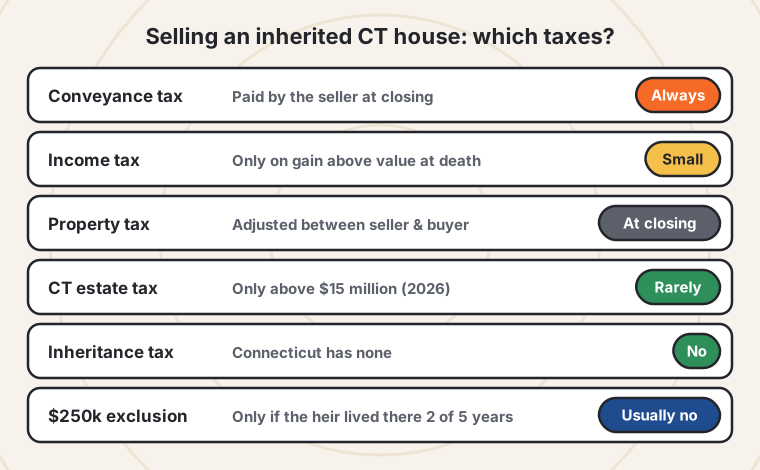
| Tax | Does it apply? | Rule | Source |
|---|---|---|---|
| Connecticut conveyance tax | Yes, on the sale | State 0.75% up to $800,000 (higher above), plus the town’s 0.25% or 0.50%; paid by the seller before the deed is recorded | CGS 12-494 |
| Federal income tax on the gain | Only on gain above the stepped-up basis | Basis is generally fair market value at the date of death; gain is always long-term | IRC 1014; IRS Pubs 551, 559 |
| Connecticut income tax on the gain | Only on a taxable gain | Taxed as income: 2% to 6.99% for individuals; 6.99% flat for estates and trusts | CGS 12-700 |
| Net investment income tax (federal) | Sometimes | 3.8% on investment income above thresholds; estates reach it at a much lower income than individuals | IRS, Net Investment Income Tax |
| Home-sale exclusion ($250,000 / $500,000) | Usually not | Only if the heir owned and lived in the house as a main home 2 of the last 5 years | IRS Pub 523 |
| Connecticut estate tax | Only above $15 million (2026) | 12% of the excess over the federal basic exclusion amount; paid by the estate | CGS 12-391 |
| Inheritance tax | No | Connecticut does not have one | CGS ch. 217 (estate tax only) |
| Property tax | Yes, until the sale | Adjusted between seller and buyer at closing; Connecticut towns bill in arrears | Closing custom; town tax collector |
| FIRPTA withholding | Only if a seller is a foreign person | Generally 15% of the amount realized, withheld by the buyer | IRS, FIRPTA withholding |
How does the stepped-up basis work on an inherited house?
The stepped-up basis on an inherited house means your tax starting point is the house’s fair market value on the date of death, not what your parent paid. IRS Publication 551 says the basis of inherited property is generally its fair market value at the date of death (or on the alternate valuation date if the estate elects it). The decades of growth while your parent owned it are never taxed as income.
The formula is short:
- Amount realized = sale price minus selling costs (conveyance tax, attorney fees, any commission).
- Basis = fair market value at the date of death, plus any improvements made after the death.
- Gain or loss = amount realized minus basis.
When the step-up is smaller, or does not happen
| How the heir got the house | Basis | Source |
|---|---|---|
| Inherited through the will or intestacy (owner’s name alone) | Full step-up to date-of-death value | IRS Pub 551 |
| House in the parent’s revocable living trust | Generally a full step-up; the trust property is part of the taxable estate | IRC 1014; ask your preparer |
| Surviving spouse, joint with right of survivorship | Half steps up; the survivor keeps the original basis in their own half | IRS Pub 551, qualified joint interest |
| Child or other non-spouse joint owner | Steps up only for the share included in the parent’s estate, generally by who paid for it | IRS Pub 551, surviving tenant |
| Parent deeded the house to the children while alive (a gift) | No step-up: the children take the parent’s old basis | IRS Pub 551, gifts |
| You gave the house to the parent within one year before death | No step-up: basis is the parent’s basis | IRS Pub 551, appreciated property |
The lifetime-gift row is the expensive one. Families sometimes “put the house in the kids’ names” years before a death to avoid probate. That can cost the children the step-up and turn a near-zero gain into a large one. If your parent is still living and considering it, talk to an estate attorney first.
How much tax would you owe? A worked West Hartford example
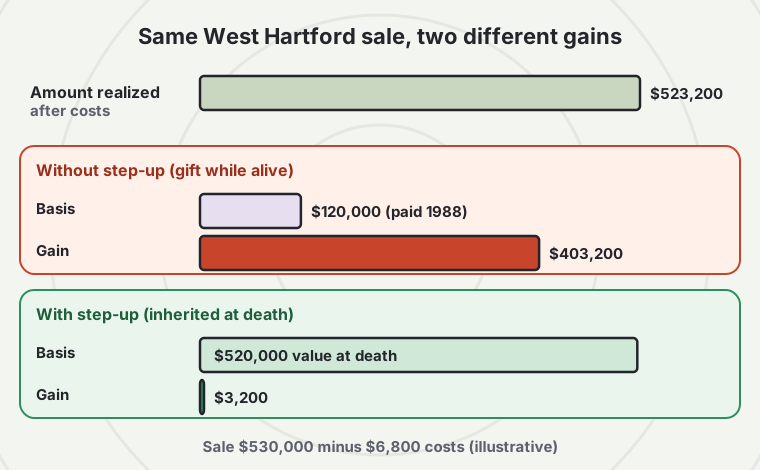
In this illustrative West Hartford example, an estate sells a house worth $520,000 at the date of death for $530,000, pays $5,300 in conveyance tax and about $1,500 in legal fees, and has a taxable gain of only $3,200. Federal and Connecticut income tax on that gain come to roughly $700 (est.). Without the step-up, the same sale would show a $403,200 gain and a tax bill near $108,800 (est.).
Built only from public numbers; not a real estate we handled.
| Line | With the step-up | Without it (lifetime gift) | Where the number comes from |
|---|---|---|---|
| Sale price | $530,000 | $530,000 | Assumed sale seven months after death (est.) |
| State conveyance tax, 0.75% | −$3,975 | −$3,975 | CGS 12-494 |
| West Hartford town conveyance tax, 0.25% | −$1,325 | −$1,325 | CGS 12-494 |
| Seller’s attorney | −$1,500 | −$1,500 | Estimate (est.) |
| Amount realized | $523,200 | $523,200 | |
| Basis | −$520,000 | −$120,000 | Date-of-death value = West Hartford single-family median, Oct 2024 to Sep 2025 (OPM); parent’s 1988 price assumed |
| Taxable gain | $3,200 | $403,200 | |
| Federal tax on the gain | about $480 at 15% (est.) | about $80,640 at 20% (est.) | Long-term rates; depends on total income |
| Connecticut tax on the gain | about $224 at 6.99% (est.) | about $28,184 at 6.99% (est.) | CGS 12-700 |
| Total income tax | about $704 (est.) | about $108,824 (est.) | Before any 3.8% net investment income tax |
Two things to notice. First, the conveyance tax is a selling cost: it lowers your gain. Second, if the house had been listed with a 5% commission (est.), the commission alone, about $26,500 on $530,000, would have turned the small gain into a loss. That loss may or may not be deductible; see the loss section below.
Want to see what your sale would net before any income tax? Try the calculator with your town and price:
How much would you walk away with?
Slide the numbers to match your house. It works in your browser; nothing is saved or sent.
Estimates for planning. Conveyance tax per CGS 12-494 (state 0.75% up to $800,000, 1.25% to $2.5M, 2.25% above, plus the town rate). Seller attorney about $1,200 to $1,500; flat-fee MLS about $400; listings include three months of taxes, insurance and utilities, a cash sale about two weeks. Your attorney gives you the final numbers.
Do you have to hold an inherited house for a year to avoid short-term capital gains?
No, you do not have to hold an inherited house for a year to avoid short-term capital gains. IRS Publication 559 says that if you sell inherited property that is a capital asset, the gain or loss is considered long term regardless of how long you held it. An estate that sells is likewise treated as having held the property more than one year. Selling in month three gets the same tax rate as selling in month thirteen.
This myth is expensive. A family that holds a West Hartford house for an extra twelve months “for taxes” pays about $17,020 in property tax alone at the town’s fiscal 2027 mill rate of 46.77, plus insurance, heat and upkeep, and gets no tax benefit for it. Worse, if prices rise while they wait, the extra appreciation above the date-of-death value is exactly the part that is taxable.
There are good reasons to wait: a sibling who wants to buy, a family that is not ready, a house that will sell for far more after cleaning out. Taxes are rarely one of them.
What if you sell the inherited house for less than it was worth at death?
If you sell an inherited house for less than its date-of-death value plus selling costs, you have a capital loss, and it is generally deductible if the house was held for sale or investment rather than personal use. IRS Publication 559 says a decedent’s residence that the estate intends to sell is a capital asset held for investment, even if nobody rented it. If a beneficiary lived in it rent-free, a loss is not deductible.
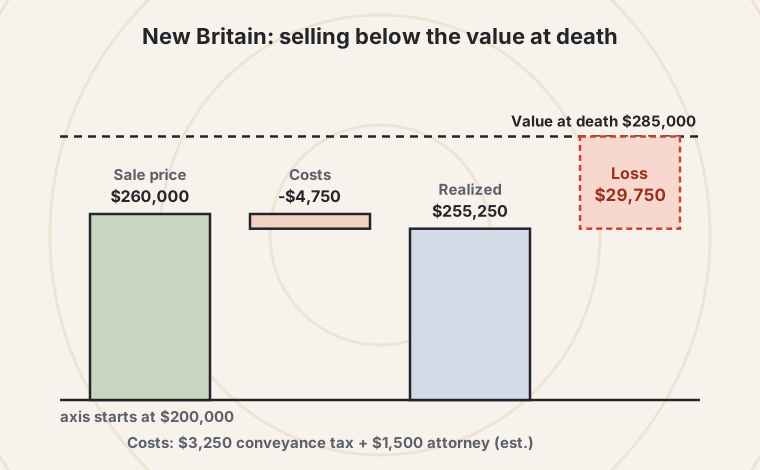
An illustrative New Britain example. The house was worth $285,000 at the date of death (the town’s single-family median for Oct 2024 to Sep 2025). It needs a roof, a furnace and a full clean-out, and the estate sells it as-is five months later for $260,000.
| Line | Amount |
|---|---|
| Sale price | $260,000 |
| State conveyance tax, 0.75% | −$1,950 |
| New Britain town conveyance tax, 0.50% | −$1,300 |
| Seller’s attorney (est.) | −$1,500 |
| Amount realized | $255,250 |
| Basis (date-of-death value) | −$285,000 |
| Capital loss | −$29,750 |
What happens to that loss
- If the estate sells and the loss cannot be used on the estate’s own return, an unused capital loss carryover in the estate’s final year passes to the beneficiaries who receive the estate’s property (IRS Publication 559). Two equal heirs would each get about $14,875 in this example.
- Each individual can use capital losses against capital gains, plus up to $3,000 a year ($1,500 if married filing separately) against other income, and carry the rest forward (IRS Topic 409).
- Do not let anyone live in it rent-free while it is for sale if you want the loss to count; Publication 559 treats that as personal use.
A quick arm’s-length sale is strong evidence of what the house was worth. If the estate inventory or appraisal says $285,000 but the house sold to an unrelated buyer for $260,000 three months later with no change in condition, the IRS can argue the date-of-death value was lower, which shrinks the loss. A written date-of-death appraisal that describes the condition (roof, furnace, oil tank, foundation) is what makes the number stick.
Who pays the tax on the sale: the estate or the heirs?
Who pays the tax on the sale depends on who owns the house when it is sold. If the executor sells during probate, the estate reports the sale on federal Form 1041 and, for a Connecticut estate, Form CT-1041, and pays any tax unless the gain is passed out to the beneficiaries. If the house is distributed first and the heirs sell, each heir reports their share on their own Form 1040 and Connecticut return.
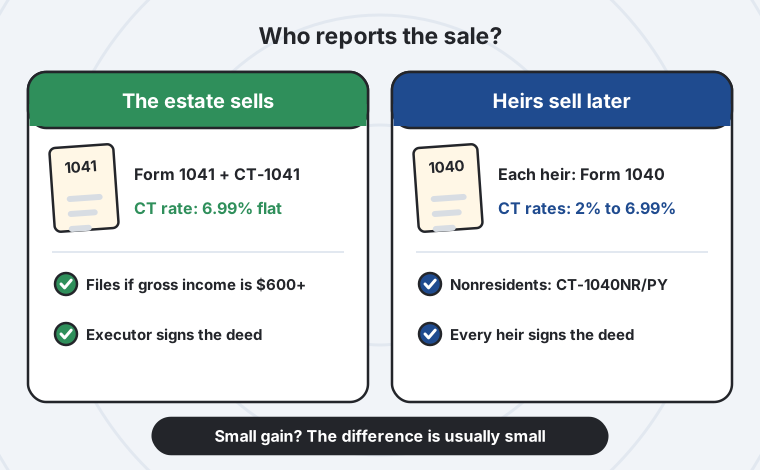
The estate sells (most common)
Form 1041 + CT-1041The executor signs the deed during probate and the money lands in the estate account.
- Estate files Form 1041 if gross income is $600 or more
- Connecticut taxes estate income at a flat 6.99%
- Federal brackets for estates are compressed: the top rates start at far lower income than for individuals
- Gain is passed to heirs (Schedule K-1) only in certain cases, such as when it is distributed or allocated to income
- Unused losses pass to heirs in the final year
The heirs sell after distribution
Each heir’s Form 1040The house is distributed (certificate of devise or distribution recorded), then the co-owners sell.
- Each heir reports their share of the price, costs and basis
- Each heir’s own federal and Connecticut brackets apply
- Nonresident heirs file Connecticut nonresident returns
- Every heir must sign the deed
- Sale usually happens months later, with more carrying costs
When the gain is small, as in most quick sales, the difference between the two paths is a few hundred dollars. When the gain is large (a house held for years after the death, or a high-value town), ask a tax preparer before closing whether distributing the gain to the heirs in the year of sale saves money. IRS Publication 559 lists the situations in which capital gains are included in distributable net income; that decision belongs to your preparer, not a website.
Whether the house can be sold during probate, and how, is covered step by step in can you sell a house in probate in Connecticut.
How does Connecticut tax the gain, and what about out-of-state or foreign heirs?
Connecticut taxes the gain on an inherited house as ordinary income: individual rates run from 2% to 6.99%, and estates and trusts pay a flat 6.99% (CGS 12-700). Out-of-state heirs still owe Connecticut tax on their share of a gain from Connecticut real estate (CGS 12-711(b)) and file Form CT-1040NR/PY. Heirs who are foreign persons face federal FIRPTA withholding, generally 15% of the amount realized.
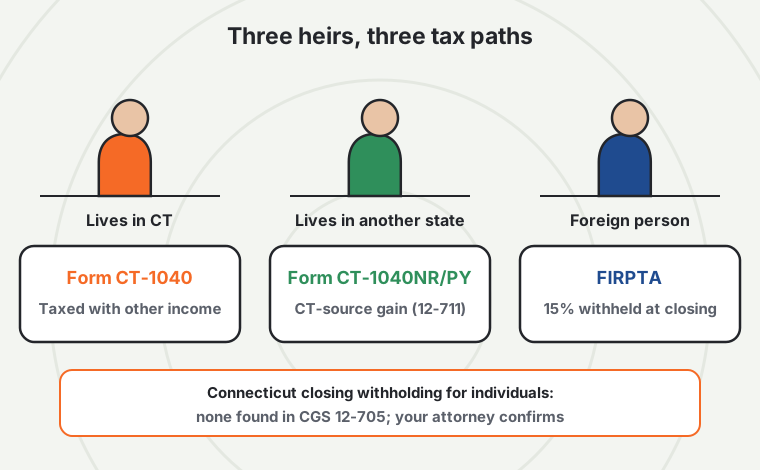
Connecticut residents
Connecticut starts from federal adjusted gross income, so a gain that is not taxable federally is generally not taxable in Connecticut either. A taxable gain is added to your other income and taxed at your Connecticut rate.
Heirs who live in another state
- You may owe Connecticut tax. Gain from “the ownership or disposition of any interest in real property in this state” is Connecticut-source income for a nonresident (CGS 12-711(b)). If your share of the gain is taxable, you file Form CT-1040NR/PY for that year.
- Connecticut computes it in two steps: the tax as if you were a resident, multiplied by the Connecticut share of your income (CGS 12-700(b)).
- Closing-table withholding: some states make the buyer hold back a percentage when an out-of-state person sells. In Connecticut’s income tax withholding statute (CGS 12-705) we found no such rule for individuals selling real estate. Your Connecticut closing attorney will confirm current practice.
- Your home state generally taxes the same gain and may give a credit for tax paid to Connecticut. Ask your preparer.
Heirs who are foreign persons
If any seller is a foreign person for U.S. tax purposes, the federal FIRPTA rules generally require the buyer to withhold 15% of the amount realized and send it to the IRS, unless an exception or a reduced rate applies. When an estate is the seller, the question is whether the estate is foreign. Raise FIRPTA with your attorney at the start; a withholding certificate that reduces the amount takes time. The general mechanics are in our Connecticut seller tax guide.
Does Connecticut have an estate tax or an inheritance tax in 2026?
Connecticut has an estate tax but no inheritance tax in 2026. For people who die on or after January 1, 2023, Connecticut taxes only the part of an estate above the federal basic exclusion amount, at 12% (CGS 12-391). The IRS set that amount at $15 million for 2026. The estate pays the tax, not the heirs, and every estate still files a Connecticut return so the lien on the house can be released.
- Who owes it: almost no one. An estate of a house, a retirement account and some savings is nowhere near $15 million.
- Who files: every Connecticut estate. Most file the short Form CT-706 NT with the Probate Court within six months of death; taxable estates file Form CT-706/709 with the Department of Revenue Services.
- Why it matters for the sale: the estate tax is a lien on Connecticut real estate transferred at death (CGS 12-398). The buyer’s attorney will not close until the Probate Court (or DRS, for a taxable estate) issues the release. File early.
- Federal estate tax: the same $15 million federal threshold for 2026. A federal estate tax return triggers the basis-consistency rules (Form 8971), which require heirs to use the estate tax value as their basis; most estates never file one.
- Old numbers online: national sites still quote Connecticut limits from 2023 or earlier. Since 2023 the Connecticut exemption simply follows the federal amount.
The probate fee, which is separate from the estate tax and is also a lien on the house, is explained in our inherited house guide.
What other taxes come out of the sale: the conveyance tax and property tax?
The other taxes that come out of an inherited house sale in Connecticut are the real estate conveyance tax, which the seller (the estate or the heirs) pays at closing at 0.75% state plus 0.25% or 0.50% town on most homes, and a property tax adjustment, because Connecticut towns bill in arrears and the seller usually credits the buyer for taxes that have built up but are not yet due.
| Town (examples) | Single-family median | Town rate | Conveyance tax at the median | Property tax per month (est.) |
|---|---|---|---|---|
| West Hartford | $520,000 | 0.25% | $5,200 | $1,420 |
| New Britain | $285,000 | 0.50% | $3,563 | $650 |
| Manchester | $320,500 | 0.25% | $3,205 | $770 |
| New Haven | $329,450 | 0.50% | $4,118 | $770 |
| Groton | $372,500 | 0.25% | $3,725 | $550 |
- A deed from the estate to the heirs for no money generally owes no conveyance tax, because deeds with consideration under $2,000 are exempt (CGS 12-498(a)(10)). The tax hits the sale to the outside buyer.
- Estates attach Schedule A to the conveyance tax return, Form OP-236, listing the beneficiaries. Your attorney prepares it.
- Property tax is a monthly cost of waiting. Every month the house sits, the estate pays it, and at closing the seller usually credits the buyer for tax that has built up but is not yet due. Whether any of it is deductible on the estate’s return is a question for your preparer. Our conveyance tax by town page has every town’s rate, and the proration method is in taxes when selling a house in Connecticut.
Can you use the $250,000 home-sale exclusion on an inherited house?
You can use the $250,000 home-sale exclusion ($500,000 for a married couple) on an inherited house only if you owned it and lived in it as your main home for at least 2 of the 5 years before the sale (IRS Publication 523). Most heirs never lived there, so the exclusion does not apply; the stepped-up basis does the work instead. An heir who moves in and stays two years may qualify later.
The exclusion and the step-up are different tools. The step-up wipes out the growth during your parent’s lifetime. The exclusion shelters growth during your ownership, if the house was your home. An heir who moves in, lives there two years and then sells can use both: basis at the date-of-death value, and up to $250,000 of gain after that excluded. But living there rent-free also means a later loss is not deductible, so decide with your preparer.
A surviving spouse is a special case: the spouse’s half usually keeps its original basis, the deceased spouse’s half steps up, and the surviving spouse may qualify for the $500,000 exclusion if they sell within two years of the death and meet the other tests (IRS Publication 523).
How do you prove the basis and keep the right records?
You prove the basis of an inherited house with a written appraisal of its fair market value at the date of death, backed by the probate inventory value and, where one exists, the estate tax return. Keep that appraisal, the settlement statement from the sale, receipts for any improvements after the death, and the Probate Court papers. Those few documents answer every question the IRS or DRS can ask.
Order a date-of-death appraisal
A licensed Connecticut appraiser can value the house “as of” the date of death even months later. Ask them to describe the condition: roof, heating system, oil tank, septic, foundation. It is your best defense of the basis, and the executor needs a value for the inventory anyway (CGS 45a-341).
Match the inventory
The probate inventory lists the house at its fair market value at the date of death. Use the same number on the tax returns unless there is a good reason not to.
Check for Form 8971
If a federal estate tax return was filed, the executor gives heirs a Schedule A (Form 8971) showing the estate tax value, and heirs generally must use it as their basis (IRS Publication 551).
Track every selling cost
The settlement statement shows the conveyance tax, attorney fees, any commission and the property tax adjustment. All of the selling costs reduce the gain.
Keep improvement receipts
Money spent on real improvements after the death (a new roof, not routine cleaning) adds to the basis.
Give your preparer one folder
Appraisal, inventory, settlement statement, Form 1099-S if one was issued, K-1 if the estate passed out gain or loss, and the probate decree of distribution.

The families who worry most about taxes are usually the ones who will owe the least. What actually costs heirs money is waiting a year for a tax reason that does not exist, while the town tax, the insurance and the oil bill keep coming. Get the date-of-death appraisal done in the first month, give the number to your tax preparer, and then decide on timing for family reasons, not tax myths.
What are your options for selling the inherited house, and when should you not sell to a cash buyer?
Your options for selling an inherited house in Connecticut are to list it with an agent, sell it to one of the heirs, keep or rent it, or sell it as-is to a cash buyer. Taxes rarely decide between them, because the step-up makes the gain small either way. Listing usually brings the most money for a house in good condition; a cash sale fits a house that needs work, is full of belongings, or belongs to heirs far away.
List with an agent
Most money, if it shows wellBest for an updated house the family can carry for a few months.
- Commission and repairs reduce the gain, sometimes to a loss
- Months of property tax and insurance
- Buyer’s lender may require repairs
Keep or rent it
Basis starts at the date-of-death valueBest when an heir wants the house or the rent makes sense.
- Rental depreciation starts from the stepped-up basis
- Later growth is taxable
- Co-owner heirs need a written agreement
Sell as-is for cash
About 2 weeks once probate allowsBest for a house that needs work, is full, or is far away.
- No repairs, no clean-out, no showings
- Close on the date you choose
- Price is below a renovated-house price; that is the trade-off
When you should NOT sell to us
- The house is in good shape, in demand, and the heirs can wait a few months. List it.
- One heir wants it at a fair price. Sell it to them.
- You expect a large taxable gain (for example, the house has been held for years since the death) and have not talked to a tax preparer about timing and who reports it. Do that first.
- Nobody has a date-of-death appraisal yet. Get one before you sign anything.
Is a cash sale right for you, or should you list?
Seven quick questions. There is no wrong answer, and we will tell you honestly if listing would leave you more.
- Does the house need repairs you would rather not pay for or manage?
- Do you need to close by a certain date, or within the next month or two?
- Would showings be hard: tenants, belongings, privacy, or you live out of state?
- Is there a complication: an estate or probate, a divorce, foreclosure, liens or back taxes?
- Could you comfortably cover the mortgage, taxes and utilities for three or more months?
- Is getting the highest possible price more important to you than speed and certainty?
- Would a buyer's bank lend on the house as it is (no major roof, foundation, oil tank or code issues)?
How does selling an inherited house to us work?
Selling an inherited house to us works in five steps: send the address, we walk through once, you get a written cash offer that every heir can see, your attorney and tax preparer review it, and we close at a Connecticut attorney’s office in about two weeks once probate allows, or on the date you choose. You do not repair or clean anything, and the offer does not expire while the family decides.
Send the address
Tell us whether there is a will, whether an executor has been appointed, and whether anyone lives there.
One walkthrough
We see the house as it is. Leave the furniture and the basement; take only what you want.
A written number
One offer, in writing, for the family conversation, the tax preparer and, if needed, the Probate Court petition.
Your advisors check it
Your attorney reviews the contract; your preparer runs the tax numbers with your date-of-death appraisal. No pressure and no expiry.
Close when you are ready
Once the executor has authority and the liens can be released, we close in about two weeks, or later if that suits the family. The settlement statement shows every cost for your tax return.
Call me, Jerryll Noorden, at (203) 529-4712. I have bought Connecticut houses since 2016, about ten a year, many of them from estates. We never charge fees, we close through Connecticut attorneys, and if listing would net your family more, I will say so. You can also start on our inherited and probate house page.
Questions Connecticut heirs ask about taxes on an inherited house
Do I have to pay taxes when I sell a house I inherited in Connecticut?
You pay taxes when you sell a house you inherited in Connecticut only on any gain above its value at the date of death, plus the conveyance tax at closing. Because the basis steps up to the date-of-death value (IRC 1014), a sale within a year or so usually leaves little or no taxable gain.
Does Connecticut have an inheritance tax?
No, Connecticut does not have an inheritance tax. It has an estate tax, paid by the estate, that applies only to the part of an estate above the federal basic exclusion amount, $15 million for deaths in 2026, at 12% (CGS 12-391).
What is the Connecticut estate tax exemption for 2026?
The Connecticut estate tax exemption for 2026 is $15 million, because for deaths on or after January 1, 2023 Connecticut’s exemption equals the federal basic exclusion amount (CGS 12-391), which the IRS set at $15 million for 2026. Tax above it is 12%.
How is capital gains calculated on an inherited house?
Capital gains on an inherited house are calculated as the sale price, minus selling costs such as the conveyance tax and attorney fees, minus the basis, which is generally the fair market value at the date of death plus later improvements (IRS Publication 551).
How long do I have to keep an inherited house to avoid short-term capital gains?
You do not have to keep an inherited house any minimum time to avoid short-term capital gains. Gain or loss on inherited property is long-term regardless of how long you held it (IRS Publication 559).
Who pays the capital gains tax, the estate or the beneficiaries?
The estate pays the capital gains tax if the executor sells the house and the gain stays in the estate, reporting it on Form 1041 and Form CT-1041. If the gain is distributed or allocated to the beneficiaries, or if the heirs sell after distribution, the heirs report it on their own returns.
Can I deduct a loss on the sale of an inherited house?
You can generally deduct a loss on the sale of an inherited house as a capital loss if it was held for sale or investment, not personal use (IRS Publication 559). Individuals can use up to $3,000 a year of net capital loss against other income and carry the rest forward (IRS Topic 409).
Do I need an appraisal when I inherit a house in Connecticut?
You should get an appraisal when you inherit a house in Connecticut. A date-of-death appraisal proves your stepped-up basis for income tax, and the executor needs a fair market value for the probate inventory (CGS 45a-341).
Can I use the $250,000 exclusion on an inherited house?
You can use the $250,000 exclusion on an inherited house only if you owned and lived in it as your main home for at least 2 of the 5 years before the sale (IRS Publication 523). Most heirs do not qualify and rely on the stepped-up basis instead.
Do nonresidents pay Connecticut tax on an inherited house sale?
Yes, nonresidents pay Connecticut tax on their share of a taxable gain from selling an inherited Connecticut house, because gain from Connecticut real property is Connecticut-source income (CGS 12-711(b)). They file Form CT-1040NR/PY.
Is Connecticut tax withheld when an out-of-state heir sells?
We found no Connecticut statute requiring state income tax to be withheld at closing when an out-of-state individual sells a Connecticut house (CGS 12-705 covers wages and other payments). The heir pays with their nonresident return. Foreign sellers face federal FIRPTA withholding, generally 15%.
What if my parent put the house in my name before they died?
If your parent put the house in your name before they died, it was a gift, and you generally take your parent’s original basis instead of a stepped-up basis (IRS Publication 551). That can mean a much larger taxable gain when you sell.
What if I owned the house jointly with my parent?
If you owned the house jointly with your parent, only the share included in your parent’s estate gets a stepped-up basis, generally based on who paid for it; your own share keeps its original basis (IRS Publication 551). A surviving spouse’s half steps up automatically.
Who pays the conveyance tax on an inherited house sale?
The seller pays the conveyance tax on an inherited house sale in Connecticut: the estate if the executor sells, or the heirs if they sell after distribution. It is 0.75% state plus 0.25% or 0.50% town on most homes (CGS 12-494), and it reduces your taxable gain.
Does the estate have to file an income tax return if it sells the house?
Yes, an estate generally has to file Form 1041 if it has gross income of $600 or more in the year, which a house sale with any gain can trigger (IRS Publication 559). A Connecticut resident estate also files Form CT-1041.
Related Connecticut guides
Estates and inheritance
Taxes and costs
We buy inherited houses across Connecticut, including West Hartford, New Britain, Manchester, New Haven, Groton and Waterbury. For the full selling process, see how to sell a house in Connecticut.
Plain-English information, not tax or legal advice. Tax results depend on your whole return; ask a tax professional before you sign.
Sources
- IRS Publication 551, Basis of Assets (inherited property; surviving tenants; qualified joint interests; gifts; Form 8971 basis).
- IRS Publication 559, Survivors, Executors, and Administrators (sale of a decedent’s residence; holding period; Form 1041 filing threshold; capital gains in distributable net income; unused losses passed to beneficiaries).
- IRS Publication 523, Selling Your Home (home-sale exclusion).
- IRS Topic 409, Capital gains and losses ($3,000 loss limit and carryover).
- IRS, Net Investment Income Tax and IRS, FIRPTA withholding.
- IRS, What’s new: estate and gift tax (basic exclusion amount $15,000,000 for 2026).
- CGS chapter 229: § 12-700 (income tax rates, including 6.99% for trusts and estates; nonresident computation), § 12-705 (withholding), § 12-711(b) (nonresident income from Connecticut real property).
- CGS chapter 217: § 12-391 (estate tax; exemption equal to the federal basic exclusion amount; 12%), § 12-392 (due six months after death), § 12-398 (estate tax lien and release).
- CGS chapter 223: § 12-494 (conveyance tax rates), § 12-498 (exemptions).
- CGS § 45a-341 (estate inventory at fair market value).
- Connecticut DRS, nonresident and part-year resident tax information (Form CT-1040NR/PY).
- Connecticut Open Data (OPM): town sales Oct 2024 to Sep 2025 and fiscal 2027 mill rates.
See the house together.
Pick a time that works.
Choose a time for us to walk through the property with you, or ask for a quick call first. We confirm every request personally.
Tuesday, January 13
No open times in the next few weeks. Please call us.
We will confirm by email. Nothing is booked until we do.
View my request
Who wrote this
Jerryll Noorden
Jerryll has bought and sold Connecticut houses since 2016 and has sat at more closing tables than he can count, on both sides. Before real estate he was a robotics scientist at NASA, IHMC and IIT. He wrote this guide because the national sites that rank for it skip the Connecticut rules that cost sellers money. When listing or selling it yourself would get you more than a cash offer, he says so.
This guide explains Connecticut rules in plain English. It is not legal or tax advice. Laws change; for your sale, talk to a Connecticut real estate attorney and a tax professional.
