
Key facts at a glance
This page is part of our guide to how to sell a house in Connecticut. It answers one local question: how a house in a Farmington estate gets sold through the Farmington Regional Probate Court, from the petition to the closing, with Farmington’s own numbers.
| Fact | Number | Source |
|---|---|---|
| Probate court for a Farmington resident | Farmington Regional Probate Court, district PD-10 (Burlington, Farmington, Plainville) | CGS 45a-2; ctprobate.gov court locator |
| Court address and hours | One Monteith Drive, Main Floor, Farmington; Mon-Fri 8:30-4:30 | ctprobate.gov |
| Minimum notice before a probate hearing | At least 7 days, unless the court directs otherwise | Probate Court Rules, section 8.5(c) |
| Streamline notice in estates | At least 10 days to ask for a hearing; if nobody asks, the court may approve without one | Probate Court Rules, section 8.6 |
| Farmington median single-family sale price | $520,000 (408 residential sales, Oct 2024-Sep 2025) | CT OPM Real Estate Sales, data.ct.gov |
| Farmington mill rate, fiscal 2027 | 27.36 mills (about $9,960 a year on a $520,000 house) | CT OPM mill rates; CGS 12-62a |
| Probate fee on a $550,000 estate | $1,990 | CGS 45a-107(b) |
| Conveyance tax on a $520,000 Farmington sale | $5,200 (0.75% state + 0.25% town) | CGS 12-494 |
Why does selling a house through the Farmington probate court feel so daunting?
Selling a house through the Farmington probate court feels daunting because you are grieving, you have never filed anything with a court, and you are responsible to your siblings and to a judge at the same time. Most executors in this spot feel overwhelmed, afraid of a misstep, worried the house is sitting empty, a little guilty, and wary of everyone who calls about it. All of that is normal.
Maybe it is your father’s colonial off Route 4, or your aunt’s ranch in Unionville. The heat is on low, the mail is piling up at the post office, and the first property tax bill in your name as executor is due in January.
I am Jerryll Noorden. I have bought houses across Connecticut since 2016, about ten a year, and estate houses are a big share of them. This page gives you the court, the filing, the scheduling rules and the Farmington numbers, so you can see the whole road before you take the first step.
If you are the executor or administrator of an estate with a house in Farmington, Burlington or Plainville, this page is for you.
How do you sell a house through the Farmington probate court?
You sell a house through the Farmington probate court by getting appointed executor or administrator at the Farmington Regional Probate Court (PD-10), signing a contract “subject to Probate Court approval”, and filing a petition to sell (form PC-400) with the contract, the inventory and the deed, plus evidence of value. The court gives notice to the heirs, approves the sale if it is in the estate’s best interests (CGS 45a-164), and you close with a fiduciary deed.
If the will already gives the executor a power of sale, a court order may not be needed at all; your attorney and the buyer’s title insurer will read the exact wording. The full statewide walkthrough of who signs, the PC-400, the liens and what the buyer’s attorney needs is on our page can a house be sold while in probate in Connecticut. This page stays local.
For the bigger picture (keep or sell, taxes, clean-out, family), start with our inherited house guide for Connecticut.
Which probate court handles an estate with a house in Farmington?
The probate court that handles an estate with a house in Farmington is usually the Farmington Regional Probate Court, district PD-10, which serves Burlington, Farmington and Plainville under CGS 45a-2. The rule is where the person who died lived, not where the house is. If your mother lived in Farmington, the estate opens there. If she lived in Avon and owned a Farmington rental, it opens in Avon’s district.
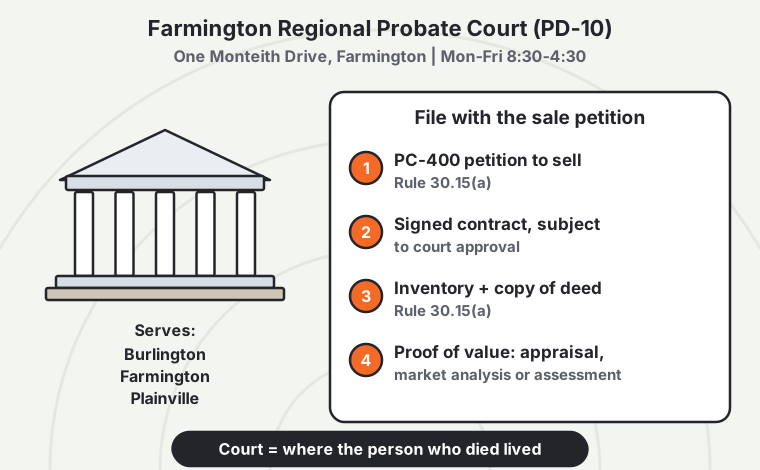
The details, as listed on the Connecticut Probate Courts court locator today:
- Name: Farmington Regional Probate Court (PD-10).
- Towns: Burlington, Farmington (including Unionville) and Plainville.
- Address: One Monteith Drive, Main Floor, Farmington, CT 06032.
- Hours: Monday to Friday, 8:30 to 4:30. Phone (860) 675-2360.
A local practice point that saves trips: Connecticut’s probate eFiling system is open to self-represented parties as well as attorneys, so filers can start a case, file papers and view the court file online, and the statewide Case Lookup tool shows decedent estates opened since January 5, 2011, with the fiduciary’s name (ctprobate.gov).
What does the Farmington probate court need before it approves a house sale?
Before it approves a house sale, the Farmington probate court needs the executor’s or administrator’s petition to sell (PC-400), a copy of the signed contract, an inventory listing the house with a copy of the deed (if not already filed), and evidence of fair market value. Under Probate Court Rule 30.15 the court may ask for a comparative market analysis, an appraisal, the town assessment or other value proof, and may ask for a return of claims.
In plain English, from the statewide Probate Court Rules (2026 edition), which Farmington applies:
| What the court wants | What it means for a Farmington house | Rule or statute |
|---|---|---|
| Petition to sell by private sale | Form PC-400, signed by the fiduciary | Rule 30.15(a); CGS 45a-164 |
| Copy of the contract of sale | Find the buyer first, then petition; the contract says “subject to Probate Court approval” | Rule 30.15(a) |
| Inventory with a copy of the deed | The inventory at date-of-death value, due within two months of appointment | Rule 30.15(a); CGS 45a-341 |
| Evidence of fair market value | A broker’s market analysis, an appraisal or the Farmington assessment; with a $520,000 median, an appraisal is cheap protection | Rule 30.15(b) |
| Return of claims, if asked | A list of creditor claims, so the court knows the estate can pay its debts | Rule 30.15(c) |
| No newspaper notice by default | Publication only if the court decides the public must be told | Rule 30.15(d) |
One part of Rule 30.15 surprises families: if someone else tells the court they will pay more than the contract price, the court may deny the petition and order a public sale, or take other action in the estate’s best interests (section 30.15(g)). It is not an auction; it is a reason to back your price with an appraisal and recent Farmington sales.
In Farmington the value question matters more than in most towns, because the range is wide: the median single-family sale was $520,000, but about one in four single-family sales cleared $800,000 in the last year of state data (CT OPM). Price the house you have, not the town median.
How is the probate hearing scheduled, and how long does approval take in Farmington?
The probate hearing is scheduled by the court after the petition is filed, and approval usually takes a few weeks (est.). Statewide rules require notice at least 7 days before a hearing. In decedents’ estates the court must normally use “streamline notice” instead: heirs get at least 10 days to ask for a hearing, and if nobody asks, the court may approve without one. If every party signs a waiver, the court may excuse notice altogether.
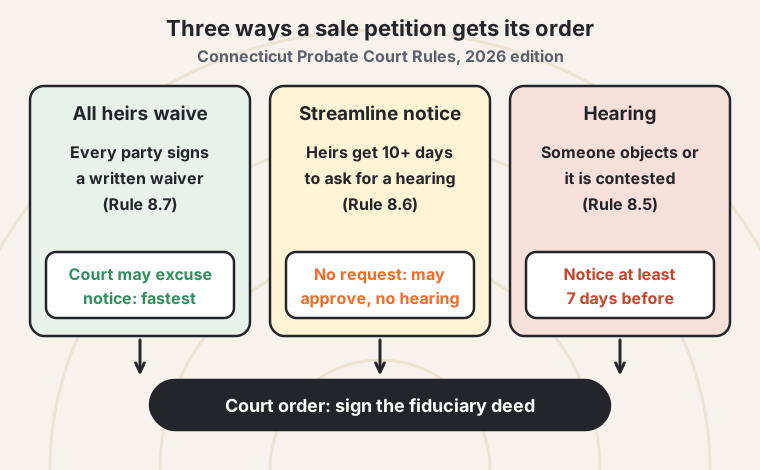
Here is how the rules play out once your PC-400 is on file at One Monteith Drive:
- Every heir agrees. Each party can file a written waiver of notice (Rule 8.7). If all parties waive, the court may excuse notice of the hearing on the sale petition (Rule 30.15(e)). This is the fastest path. If a will leaves anything to a charity, the Attorney General must join the waivers.
- Nobody objects, but not everyone signed. In estates the court must use the streamline notice procedure (Rule 8.6(g)). Each person entitled to notice gets a letter saying they may request a hearing by a stated date, at least 10 days later. If no request arrives, the court may approve the sale without a hearing.
- Someone objects, or the matter is contested. The court schedules a hearing and sends notice at least 7 days before it (Rule 8.5(c)). If an heir is a minor or cannot be located, the court may appoint a guardian ad litem (CGS 45a-164(d); Rule 8.8), which adds time.
Can you attend from home? On request, the court may allow participation by electronic means (Probate Court Rule 66.1). Ask when you file.
No Farmington-specific calendar is published; plan on several weeks from filing to order (est.), and call the clerk at (860) 675-2360 to ask where the petition stands. For the full estate clock, from the petition within 30 days of death to the final account, see our Connecticut probate timeline.
Ask your attorney for three clauses: the sale is “subject to Probate Court approval”; the closing date floats to a set number of days after the order; and the buyer agrees to wait through a hearing if one is requested. A buyer who cannot live with those three is the wrong buyer for an estate.
What does it cost to settle and sell an estate house in Farmington?
Settling and selling an estate house in Farmington costs, on a $520,000 house in a $550,000 estate, a probate fee of $1,990 (CGS 45a-107), $5,200 of conveyance tax at closing (CGS 12-494), attorney fees, and about $1,255 a month (est.) to keep the house while it is empty. The carrying cost is the number you control: selling at month three instead of month nine saves about $7,530 (est.).
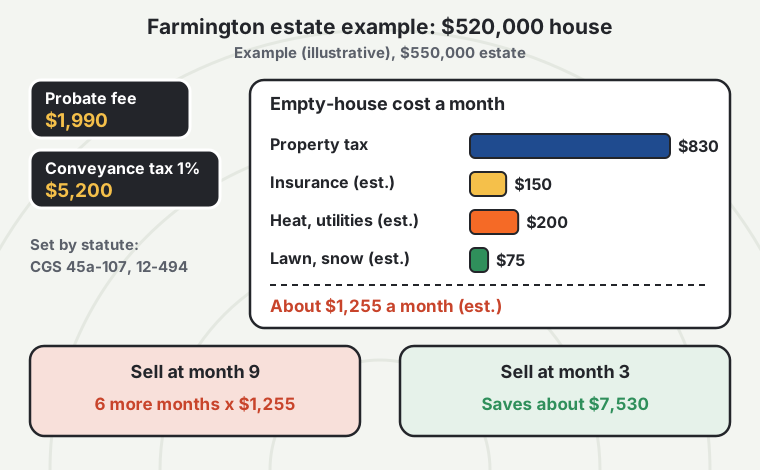
Example (illustrative). A Farmington single-family house worth the town median of $520,000, no mortgage, and $30,000 in the bank, so the probate fee basis is $550,000. Built from public numbers, not a real estate we handled.
| Item | Amount | How it is figured |
|---|---|---|
| Probate Court fee | $1,990 | $1,865 + 0.25% of the $50,000 above $500,000 (CGS 45a-107(b)) |
| Conveyance tax at closing | $5,200 | 0.75% state + 0.25% Farmington on $520,000 (CGS 12-494) |
| Property tax | About $9,960 a year, $830 a month | $520,000 x 70% x 27.36 mills (CGS 12-62a; OPM) |
| Vacant-home insurance | $150 a month (est.) | Estimate; vacant policies vary |
| Heat, electric, water | $200 a month (est.) | Estimate; 45% of Farmington homes heat with oil |
| Lawn, snow, checks | $75 a month (est.) | Estimate |
| Carrying cost | About $1,255 a month (est.) | Sum of the four lines above |
| Sell at month 3 vs month 9 | About $7,530 saved (est.) | 6 months x $1,255 |
Farmington taxes are due July 1 and January 1 and are prorated at closing. Our Farmington closing-cost net sheet shows that tax adjustment line by line, and the vacant-house carrying-cost worksheet helps you build your own monthly number. To run your own net, use the calculator:
How much would you walk away with?
Slide the numbers to match your house. It works in your browser; nothing is saved or sent.
Estimates for planning. Conveyance tax per CGS 12-494 (state 0.75% up to $800,000, 1.25% to $2.5M, 2.25% above, plus the town rate). Seller attorney about $1,200 to $1,500; flat-fee MLS about $400; listings include three months of taxes, insurance and utilities, a cash sale about two weeks. Your attorney gives you the final numbers.
Two things an executor does not pay for: estates sold by an executor or administrator are exempt from the property condition report and from the smoke and carbon monoxide affidavit (CGS 20-327b(b)(4), 29-453(f)(8)). A federal lead paint disclosure still applies to a house built before 1978, and 25% of Farmington homes were built before 1960. Income tax on any gain over the stepped-up value is covered in taxes on selling an inherited house.
When should a Farmington executor NOT sell to a cash buyer?
A Farmington executor should not sell to a cash buyer when the house is in good condition, the estate can carry it for three or four months, and no heir needs the money quickly. On a move-in-ready Farmington colonial, an open-market sale almost always nets the heirs more, and an executor’s duty is to get a fair price, not the fastest one.
Cash buyers, me included, price in repairs, risk and resale costs; our page on why cash offers are lower shows the math. If the house needs nothing, list it, and get two agents’ written opinions to file with the petition. A cash sale earns its place when the house needs a roof, a kitchen and a clean-out the estate cannot fund, when it will sit empty through a Farmington winter, or when heirs out of state want one signature and one date; our inherited and probate house page explains how we buy estate houses and wait for the court. An heir can also buy at an appraised value, though a fiduciary buying needs a hearing (CGS 45a-164(c)), and if the family cannot agree, see what to do when heirs disagree. Whoever you talk to, never pay an upfront fee and never sign a deed before the closing; our scam red flags guide lists the warning signs.

The estate sales that move quickly are the ones where the executor emails every heir the price and how it was set before the petition is filed, with the appraisal attached, and asks them to sign the waiver at the same time. Most delays I see are not the buyer or the court. They are one sibling hearing the number for the first time in a notice letter.
What are the steps to sell a probate house in Farmington, start to finish?
The steps to sell a probate house in Farmington are: open the estate at the Farmington Regional Probate Court, secure and insure the house, value it in writing, sign a contract subject to court approval, file the PC-400 with the contract, inventory, deed and value proof, collect heirs’ waivers, get the order and the lien releases, and close with a fiduciary deed. A cash closing can follow about two weeks after the order (our typical).
Open the estate in PD-10
File the will and petition within 30 days of death (CGS 45a-283), on paper or by eFiling.
Secure the house
Change the locks, set the heat, tell the insurer it is vacant, and forward the mail. See selling a vacant house in Connecticut.
Value it in writing
An appraisal or a broker’s market analysis based on recent Farmington sales of similar houses. This is your Rule 30.15(b) evidence.
Sign a contract subject to court approval
With the three clauses in the tip box above.
File the PC-400 and collect waivers
Attach the contract, the inventory with a copy of the deed, and the value evidence. Send each heir the numbers and a waiver to sign.
Get the order and the releases
Streamline notice or a hearing, then the order. File the Connecticut estate tax return (CT-706 NT for most estates) early so the court can release the estate tax lien, and pay the probate fee so its lien is released (CGS 12-398, 45a-107b).
Close
Sign the fiduciary deed; proceeds go to the estate account.
If you would like a written as-is number to file next to an agent’s opinion, our Farmington page is where to ask, and our page on selling an inherited or probate house shows how it works. We wait for the court, you can leave the contents, and the offer does not expire on you.
See the house together.
Pick a time that works.
Choose a time for us to walk through the property with you, or ask for a quick call first. We confirm every request personally.
Tuesday, January 13
No open times in the next few weeks. Please call us.
We will confirm by email. Nothing is booked until we do.
View my requestQuestions Farmington executors ask about selling a probate house
Which probate court handles Farmington, CT?
The probate court that handles Farmington, CT is the Farmington Regional Probate Court, district PD-10, at One Monteith Drive in Farmington. It also serves Burlington and Plainville (CGS 45a-2). The estate opens in the district where the person who died lived.
Do I need court approval to sell a house in a Farmington estate?
You need Farmington probate court approval to sell a house in an estate unless the will gives the executor a power of sale. Without one, the executor or administrator files a PC-400 petition and the court approves the sale if it is in the estate’s best interests (CGS 45a-164).
Will there be a hearing on the sale?
There may not be a hearing on the sale. In estates, the court normally uses streamline notice: heirs get at least 10 days to request a hearing, and if nobody does, the court may approve without one (Probate Court Rule 8.6). If all parties waive notice, the court may excuse it.
How long does Farmington probate court approval take?
Farmington probate court approval usually takes several weeks from filing (est.), faster when every heir signs a waiver and slower if someone objects. Hearing notice must go out at least 7 days ahead. Ask the clerk at (860) 675-2360 where your petition stands.
How much is the probate fee on a Farmington estate?
The probate fee on a Farmington estate depends on the estate’s value, not the town. On a $550,000 estate it is $1,990: $1,865 plus 0.25% of the amount above $500,000 (CGS 45a-107). On a $300,000 estate it is $1,165.
Can I file papers with the Farmington probate court online?
You can file papers with the Farmington probate court online through the statewide eFiling system, which is open to attorneys, self-represented parties and any party to a case. Filers can start a case, file documents, receive notices and view the court file (ctprobate.gov).
Does an executor fill out the property condition report?
An executor does not fill out the Connecticut property condition report; sales by executors and administrators are exempt (CGS 20-327b(b)(4)), as is the smoke and carbon monoxide affidavit (CGS 29-453(f)(8)). The federal lead paint disclosure still applies to pre-1978 houses.
Do I have to empty the house before I sell it?
You do not have to empty a Farmington estate house before you sell it if the buyer agrees to take it with the contents. Keep valuables and papers out of the sale, and do not give away items before the inventory. Our clean-out guide explains what to keep.
Related guides
Probate and inherited houses
Other town estate guides
Towns in the PD-10 area
For every step from first decision to closing, see how to sell a house in Connecticut.
Plain-English information, not legal advice. Probate practice varies by case; your attorney and the Farmington Regional Probate Court are the final word on your estate.
Sources (checked on October 27, 2026)
- Connecticut Probate Courts, Farmington Regional Probate Court (PD-10): address, hours, towns served.
- Connecticut Probate Courts, court locator.
- Connecticut Probate Court Rules of Procedure, 2026 edition: sections 8.5, 8.6, 8.7, 30.15 and 66.1.
- Connecticut Probate Courts, eFiling and Case Lookup.
- CGS § 45a-2 (probate districts).
- CGS §§ 45a-107, 45a-107b (probate fees and fee lien).
- CGS §§ 45a-164, 45a-283, 45a-341 (sale of real property, will filing, inventory).
- CGS § 12-494 (conveyance tax); CGS § 12-398 (estate tax lien).
- CGS § 20-327b (condition report exemptions); CGS § 29-453 (smoke and CO affidavit).
- Connecticut OPM, Real Estate Sales (data.ct.gov): Farmington sales Oct 2024-Sep 2025.
- Connecticut OPM mill rates (Farmington, fiscal 2027).

Who wrote this
Jerryll Noorden
Jerryll has bought and sold Connecticut houses since 2016 and has sat at more closing tables than he can count, on both sides. Before real estate he was a robotics scientist at NASA, IHMC and IIT. He wrote this guide because the national sites that rank for it skip the Connecticut rules that cost sellers money. When listing or selling it yourself would get you more than a cash offer, he says so.
This guide explains Connecticut rules in plain English. It is not legal or tax advice. Laws change; for your sale, talk to a Connecticut real estate attorney and a tax professional.
