
- A simple Connecticut estate usually takes about 9 to 12 months. The Probate Court’s own guide expects the final financial report usually within 12 months of death. Contested or complicated estates take longer. (Part of our guide to how to sell a house in Connecticut.)
- Five fixed clocks set the pace: the petition within 30 days of death (CGS 45a-283), the inventory within 2 months of appointment (45a-341), the 150-day creditor period (45a-356), the estate tax return 6 months after death (12-392) and the final report.
- With a will or without one, the clocks are the same. No will usually adds a few weeks (a bond, a full list of heirs) and always means a court order to sell the house.
- A house in your parent’s name alone means a full estate. The $40,000 small-estate affidavit cannot be used when the person who died solely owned Connecticut real estate (CGS 45a-273).
- The house does not have to wait for the estate to close. Once the executor or administrator has authority, it can usually be sold from about month two or three.
- Waiting costs money. In our Naugatuck example, an empty house costs about $1,235 a month (est.): about $11,115 more if it sells in month 12 instead of month 3 (est.).
How long does probate take in Connecticut?
Probate in Connecticut usually takes about 9 to 12 months for a straightforward estate, with or without a will. The petition is due within 30 days of death, the executor or administrator is often appointed two to four weeks later, creditors get 150 days, the estate tax return is due six months after death, and the court expects the final financial report usually within 12 months. Disputes, missing heirs or a taxable estate can push it to 18 months or more.
That is the honest range, and it surprises people in both directions. Some families expect it to be over in a few weeks, because “Mom didn’t have much”. Others have heard that probate drags on for years. In Connecticut, most estates fall in between, and the length is driven less by the court than by a handful of statutory clocks and by how quickly the family does its part.
This page goes deeper than the short “how long” section in our main guide to an inherited house in Connecticut. Here you get each stage, what the court actually needs from you at each one, what speeds it up and what slows it down, the small-estate shortcut and why a house usually rules it out, and what the house costs you while the clock runs. We use the Naugatuck Probate District as the local example. If your real question is whether the house can be sold before the estate closes, the short answer is yes, and our page on selling a house while it is in probate in Connecticut covers that step by step.
Plan on about a year for the estate, about two to three months before the house can be sold, and about two weeks for a cash closing once the executor or administrator has authority and the lien releases are ready.
Why does waiting on probate feel so hard?
Waiting on probate feels hard because you are grieving while a court sets the pace, bills keep arriving for a house nobody lives in, and nobody can tell you an exact date. Most executors and heirs feel some mix of overwhelmed, impatient, guilty about being impatient, afraid of making a legal mistake, stuck between siblings, and suspicious of the strangers who suddenly want to buy the house. Every one of those feelings is normal.
Maybe the funeral was a few weeks ago. You have a stack of death certificates, a folder of bills addressed to your mother, and a bank that keeps asking for “letters” you do not have yet. The house on a quiet street in Naugatuck still has her calendar on the fridge. The town tax bill comes anyway. So does the oil delivery. Your brother asks every Sunday when the house will be sold, and you do not know what to tell him.
There is also a quieter feeling: guilt for wanting it over. You may worry that asking “how long will this take?” sounds cold, as if you were rushing your parent out of the house. It is not cold. An estate that drifts costs the heirs real money every month, and an executor’s job is to protect the estate for everyone. Wanting a clear timeline is part of doing that job well.
And you are right to be careful about who you listen to. Some of what is written about probate online describes other states: court auctions, newspaper ads, a mandatory year of waiting. Connecticut works differently. This page shows you the statutes and the court’s own guide so you can check every date yourself. If you are an executor, an administrator, or the family member everyone has turned to, this page is for you.
What are the stages of probate in Connecticut, and how long does each one take?
The stages of probate in Connecticut are: file the will and petition (within 30 days of death), notice and appointment (often 2 to 4 weeks later), the newspaper notice to creditors (within 14 days of appointment), recording in the land records and the inventory (both within 2 months), the 150-day creditor period, the estate tax return (6 months after death), the final financial report (usually within 12 months), then distribution and closing.

| # | Stage | What happens | Deadline or typical time | Rule |
|---|---|---|---|---|
| 1 | Petition | File the original will (if any), a death certificate and the Petition/Administration or Probate of Will (PC-200) with the court for the district where the person lived. List every heir and beneficiary and send them copies. | Within 30 days of death | CGS 45a-283 (executor named in a will); Probate Court user guide, Step 1 |
| 2 | Notice or waivers, then the hearing | The court holds a hearing, accepts written waivers from everyone entitled to notice, or uses a “streamline” notice that lets anyone request a hearing by a set date. | Part of the 2 to 4 weeks below | User guide, Step 1 |
| 3 | Appointment and bond | The court admits the will and appoints the executor, or appoints an administrator if there is no will. It usually requires a probate bond unless the will excuses it, the estate is small, or all heirs waive it. | Often 2 to 4 weeks after filing | User guide, Step 1 and Question 14; Probate Court Rule 35 |
| 4 | Notice to creditors | The court publishes a newspaper notice telling creditors where to present claims. | Within 14 days of appointment | User guide, Step 6; CGS 45a-354 |
| 5 | Land records | The fiduciary records a certificate of the death and appointment (Notice for Land Records, PC-251) with the town clerk in each town where the person owned real estate. | Within 2 months of qualifying | CGS 45a-322 |
| 6 | Inventory | A list of everything in the person’s name alone at fair market value on the date of death, including the house. | Within 2 months of qualifying; the court may extend to 4 months | CGS 45a-341(b) |
| 7 | Raise cash, sell the house if needed | The fiduciary may sell personal property, but needs a Probate Court order to sell real estate unless the will authorizes it. | From appointment onward; a court order adds several weeks (est.) | CGS 45a-164; user guide, Step 5 |
| 8 | Creditor period | Creditors present claims. The fiduciary can send known creditors a notice with a bar date at least 90 days out, then files the Return of Claims (PC-237). | 150 days from the first fiduciary’s appointment; PC-237 within 60 days after | CGS 45a-356, 45a-357; user guide, Step 6 |
| 9 | Estate tax return | Every estate files one, tax or not. Most file Form CT-706 NT with the Probate Court; estates over the $15 million exemption (2026) file CT-706/709 with the Department of Revenue Services. | 6 months after death; the court may allow one extension of up to 6 months for CT-706 NT | CGS 12-392(a)(1), (b)(1); user guide, Step 7 |
| 10 | Probate fee | The court bills its fee, usually from the estate tax return. Unpaid fees bear interest. | Due 30 days after the invoice; interest 0.5% a month after that | CGS 45a-107; user guide, Question 18-19 |
| 11 | Final financial report or account | Most estates file the simpler Financial Report (PC-246). The court holds a hearing, accepts waivers (PC-244A) or uses streamline notice. | Usually within 12 months of death; a status update (PC-286) if the estate stays open past a year | User guide, Step 8 |
| 12 | Appeal period | Anyone aggrieved by a decree can appeal to the Superior Court. | Generally 30 days from when the decision was sent | User guide, Question 20 |
| 13 | Distribution | The court orders distribution. If the house itself passes to the heirs, a certificate of distribution is recorded in the land records. | Certificate recorded within 1 month | CGS 45a-450 |
| 14 | Closing the estate | If the court asks for it, the fiduciary files the Affidavit of Closing (PC-213), the last act. | Within 30 days after all assets are distributed | User guide, Step 10 |
Two things in that table are worth reading twice. First, nothing happens until the petition is filed: the 2-month, 150-day and 12-month clocks all run from appointment or death, so a family that waits three months to file has simply added three months. Second, the house is stage 7, not stage 14. You do not sell the house at the end. You sell it once someone has authority, and the money then waits in the estate account while the remaining stages finish.
What the fiduciary is doing in the background
Between those deadlines, the executor or administrator is opening an estate bank account, moving the person’s accounts into it, keeping the house insured and secured, paying ongoing bills from estate money (never mixing in their own), collecting mail, cancelling services and keeping records. The court’s guide is clear that no financial records should be thrown away until the final report is approved and the appeal period has passed. Good records are the single biggest thing that makes stage 11 quick.
How long does it take to settle an estate in Connecticut with a will, and without a will?
Settling an estate in Connecticut takes about the same 9 to 12 months with a will or without one, because the same statutory clocks apply. With a will, the named executor may have a power of sale and the will may excuse the bond. Without a will, an administrator is appointed, the heirs are set by the intestacy law, a bond is usually required unless the heirs waive it, and selling the house always needs a court order.
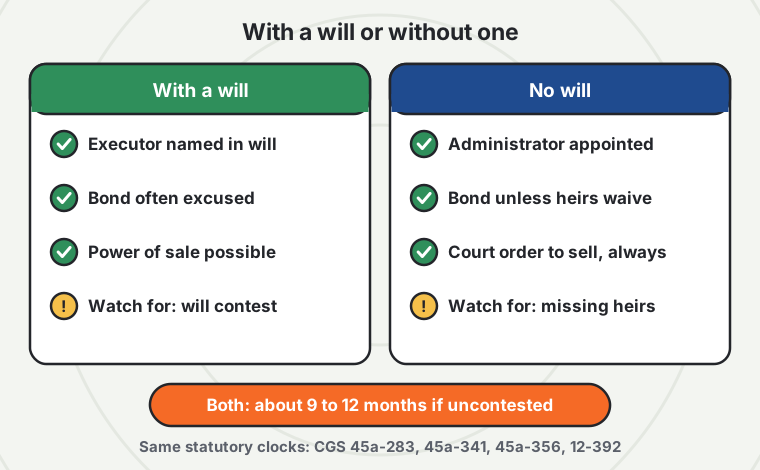
| With a will | Without a will (intestate) | |
|---|---|---|
| Who is appointed | The executor named in the will | An administrator chosen by the court, usually a spouse or adult child |
| Who inherits | The beneficiaries named in the will | Set by statute: for example, children share equally if there is no spouse (CGS 45a-437, 45a-438) |
| Probate bond | Often excused by the will | Usually required unless the estate is small or all heirs waive it (user guide; Rule 35) |
| Authority to sell the house | Under a power of sale in the will, or a court order | Always a court order after notice and a hearing (CGS 45a-164) |
| What can add time | Finding the original will; a will contest; a will that leaves the house to one person | Identifying and locating every heir; getting the bond in place |
| Typical length | About 9 to 12 months if uncontested | About 9 to 12 months if heirs cooperate; a few weeks more at the start (est.) |
When there is a will
The executor named in the will has a legal duty to apply for probate within 30 days of learning of the death, and can be fined up to $250 for neglecting it (CGS 45a-283). Anyone holding the original will must deliver it to the court within 30 days. If the original cannot be found, the process slows down while the court decides what to do with a copy, so search the house, the safe deposit box and the drafting attorney’s office first.
The biggest time saver in a will is a sentence giving the executor power to sell real estate without a court order. If it is there, the house sale can skip the petition-and-hearing step. If the will leaves the house to one named person, that person’s consent matters (CGS 45a-428), and the sale page linked above explains how.
When there is no will
Without a will, the petition still goes in on form PC-200, but it must list every heir the intestacy law recognizes. That is easy when there are three children and no spouse. It is slow when an heir has died and their children take their share, or when a half-sibling has not been heard from in years. The court needs addresses for notice, and an heir who cannot be found has to be dealt with before the court can act. Start the family tree on day one.
Administrators also need a court order to sell the house in every case. In practice that means a Petition to Sell or Mortgage Real Property (PC-400), notice to the heirs and a hearing, or the heirs’ written waivers. With cooperative heirs, it is a few extra weeks, not months.
What makes probate faster or slower in Connecticut?
Probate in Connecticut goes faster when the petition is filed promptly, every heir signs waivers, the will excuses the bond and grants a power of sale, values are documented early and the estate tax return is filed well before the six-month deadline. It goes slower with a missing or contested will, heirs who cannot be found or who object, minor heirs, a taxable or insolvent estate, real estate in another state, or a fiduciary who falls behind on filings.

| Factor | Effect | What you can do |
|---|---|---|
| Petition filed late | Every later clock starts later | File within 30 days (CGS 45a-283), even if not every paper is ready |
| All heirs sign waivers | The court can act without a formal hearing | Send heirs the papers early with a plain-English cover note |
| Will excuses the bond, or heirs waive it | No wait for a surety company | Ask heirs to waive bond on the petition (user guide, Step 1) |
| Power of sale in the will | No court order needed to sell the house | Have the attorney read the exact wording |
| Estate tax return filed early | Probate fee billed, lien release issued sooner | File CT-706 NT as soon as values are known, not on the 6-month deadline |
| Written notice to known creditors | Known claims are barred after a date at least 90 days out | Use PC-234 (CGS 45a-357); the 150-day period still applies to others |
| Will contest or an heir objects | Hearings, possibly appeals to Superior Court | Share numbers early; consider Probate Court mediation (PC-1002) |
| Heir missing, or a minor heir | Notice problems; a guardian ad litem may be appointed for a sale hearing (CGS 45a-164(d)) | Build the family list and addresses on day one |
| Estate over $15 million (2026) | CT-706/709 with DRS, possible audit, DRS releases the lien | Hire tax counsel early (CGS 12-391, 12-398) |
| More debts than assets | Insolvent-estate procedures and priority of claims | Do not pay heirs or creditors out of order; get legal advice |
| Real estate in another state | A second probate there (ancillary) | Open it in parallel, not after |
| Fiduciary falls behind | Status updates, interest on fees, frustrated heirs | Calendar every deadline in the stage table above |
Here is a pattern worth knowing. The estates that drag rarely drag because of one big problem. They drag because of three small ones that nobody fixed early: the petition went in late, the estate tax return waited for the deadline, and one sibling heard the house price for the first time at the hearing. Each is a few weeks. Together they are a season.
How long the scenarios usually run
| Scenario | Typical length | Why |
|---|---|---|
| Will, one executor, cooperative heirs, nontaxable estate | About 9 to 12 months | The 150-day period, the 6-month return and the final report set the pace |
| No will, heirs known and cooperative | About 9 to 12 months, a few weeks more at the start (est.) | Bond and heir list |
| One heir objects to the sale or the account | 12 to 18 months (est.) | Contested hearings; mediation can shorten it |
| Will contest, missing heirs or an appeal | 18 months to several years (est.) | Superior Court appeals, searches, rescheduled hearings |
| Taxable estate (over $15 million in 2026) | Often more than a year (est.) | DRS review and the DRS lien release |
Can you skip probate in Connecticut with the small-estate process?
You can skip a full probate estate in Connecticut with the small-estate affidavit only if the person who died had $40,000 or less of solely owned personal property and no solely owned Connecticut real estate (CGS 45a-273). If your parent owned the house in their name alone, the small-estate route is not available, no matter how modest the house, and a full estate has to be opened before anyone can sell it.
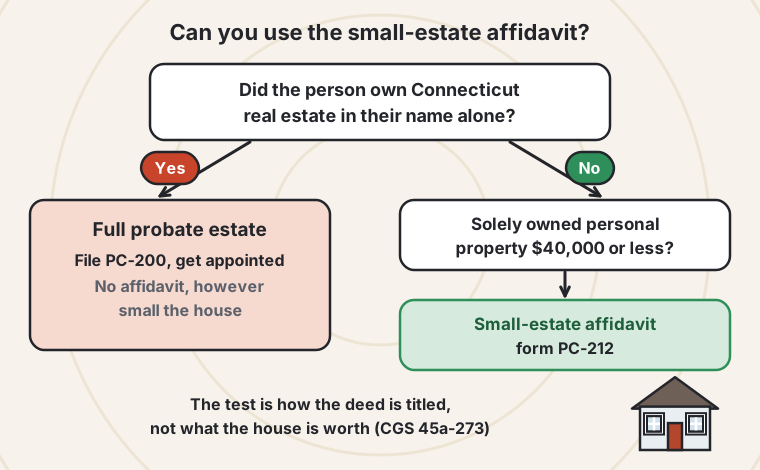
This is the most common misunderstanding we hear. “It’s a small estate, so it skips probate.” In Connecticut, small means two things together: personal property in the person’s name alone of $40,000 or less, and no Connecticut real estate in their name alone. A $180,000 ranch in the person’s sole name fails the second test. So does a vacant lot.
How the small-estate route works when it does apply
File the affidavit
A surviving spouse, or if none, next of kin, files the Affidavit in Lieu of Probate of Will/Administration (PC-212) with the court where the person lived, listing the solely owned assets and the debts, expenses and taxes (CGS 45a-273(a)-(b)).
The state is notified
The court sends a copy to the Department of Administrative Services and cannot issue its decree until 30 days after that (CGS 45a-273(c)).
The court authorizes transfers
The judge authorizes payment of the listed expenses and debts and the transfer of what is left, usually without a hearing.
The estate tax return is still filed
A Connecticut estate tax return is required even for a small estate (user guide, Question 6).
When the house passes outside probate
Some houses never enter the estate at all. A deed to two spouses or to a parent and child “as joint tenants with right of survivorship” passes to the survivor, and a house deeded to the trustee of a living trust stays with the trust. In those cases there is no executor’s sale. But the Connecticut estate tax return still has to be filed and the estate tax lien released before a buyer’s attorney will close; our probate sale guide explains the release. Check the deed at the Naugatuck town clerk (or your town’s) in the first week. It tells you which road you are on.
How does probate work for a house in Naugatuck?
Probate for a house in Naugatuck runs through the Naugatuck Probate Court, Probate District 21, which serves Beacon Falls, Middlebury, Naugatuck and Prospect (CGS 45a-2). If the owner lived in one of those towns, the estate is opened there. The same statewide clocks apply: petition within 30 days, inventory within two months of appointment, 150 days for creditors, the estate tax return at six months and the final report usually within a year.
The court is in Naugatuck at 150 Meadow Street, across the Green from Town Hall, according to the Probate Courts’ own announcement of its move. Call the clerk before you go; hours and procedures can change. If the person lived in Waterbury or Wolcott instead, the estate goes to the Waterbury district (District 20); Oxford and Southbury are in District 22 (CGS 45a-2). The district follows where the person lived, not where the house is, unless they lived out of state.
A worked Naugatuck example (illustrative)
This example is built only from public numbers. It is not a real estate we handled.
| Input | Value | Source |
|---|---|---|
| House value at death | $345,000 | Naugatuck single-family median, sales Oct 2024 to Sep 2025 (OPM via data.ct.gov) |
| Other estate assets | $25,000 in the bank | Assumed for the example |
| Mill rate | 40.44 (fiscal 2027) | OPM mill rates |
| Typical house | Built around 1969; 40% of Naugatuck single-family homes are pre-1960; 56% heat with oil | Town assessor data in our town facts |
| Will | Yes, naming the oldest child; no power of sale | Assumed |
Here is how the clocks fall if the death is on March 1 and the family moves promptly:
- By March 31: will and PC-200 filed with the Naugatuck Probate Court; heirs sign waivers of notice and of bond.
- Around mid to late April: executor appointed (the guide’s “two to four weeks”). Probate certificates ordered.
- Within 14 days of appointment: newspaper notice to creditors.
- By late June: PC-251 recorded with the Naugatuck town clerk; inventory filed with the house at $345,000.
- May to June: PC-400 petition to sell, with an appraisal and a signed contract “subject to Probate Court approval”; heirs’ waivers; court order (est.).
- By September 1: CT-706 NT filed (better: filed in June, as soon as values are known, so the lien release is not the last thing holding up the closing).
- About mid-September: the 150-day creditor period ends; Return of Claims within 60 days after.
- By the following March: Financial Report (PC-246) filed, waivers signed, distribution ordered.
What it costs to settle, either way
- Probate Court fee: the basis is $370,000, so the fee is $150 plus 0.35% of $360,000, which is $1,410 (CGS 45a-107(b)). It is the same whether the house sells in month 3 or month 12.
- Conveyance tax if the estate sells at $345,000: 0.75% state ($2,587.50) plus Naugatuck’s 0.25% town rate ($862.50), so $3,450, paid by the estate at closing (CGS 12-494). Naugatuck is not one of the towns with a 0.50% local rate; see the conveyance tax in every town.
- Attorney, appraisal, bond: vary with the estate; ask for written estimates. Bond is often waived by the heirs.
The fee and the conveyance tax do not change with time. What changes with time is the next section.
What does the house cost while probate is open?
While probate is open, the house costs the estate its property tax, insurance, heat, utilities and upkeep every month. On a Naugatuck house at the town’s $345,000 single-family median, property tax alone is about $9,770 a year, or $810 a month, at the fiscal 2027 mill rate of 40.44, and the total comes to roughly $1,235 a month (est.). Selling in month 3 instead of month 12 saves about $11,115 (est.).
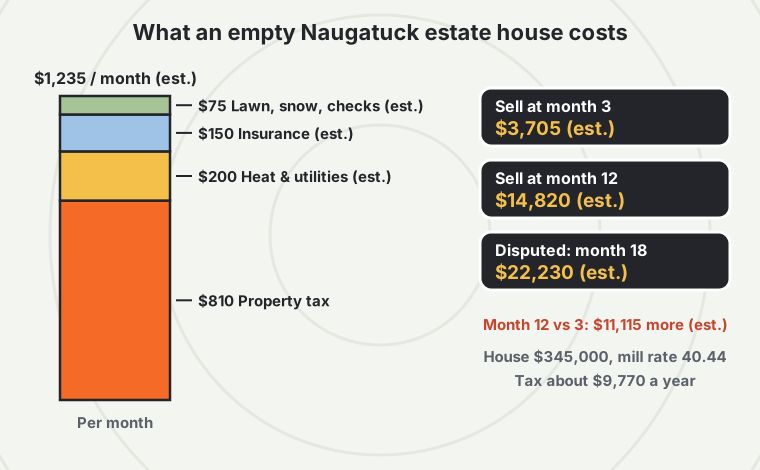
| Monthly cost (Naugatuck example) | Amount | Basis |
|---|---|---|
| Property tax | $810 | $345,000 × 70% assessment × 40.44 mills = about $9,770 a year |
| Vacant-home insurance | $150 (est.) | Estimate; vacant policies vary widely, get a quote |
| Heat, electric, water | $200 (est.) | Estimate for a house kept at a low winter temperature |
| Lawn, snow, weekly checks | $75 (est.) | Estimate |
| Total | about $1,235 (est.) | Sum of the above; no mortgage assumed |
| House sells in | Carrying cost to the estate | Compared with month 3 |
|---|---|---|
| Month 3 (soon after authority) | $3,705 (est.) | Baseline |
| Month 12 (when the estate closes) | $14,820 (est.) | $11,115 more (est.) |
| Month 18 (a disputed estate) | $22,230 (est.) | $18,525 more (est.) |
Those numbers come out of the heirs’ shares. With three children, the gap between month 3 and month 12 is about $3,705 each (est.). That is why the timing of the house matters more to most families than the timing of the estate. If there is a mortgage or a reverse mortgage, interest keeps running too; a reverse mortgage servicer will also expect the loan to be resolved within its own deadlines.
For a fuller monthly worksheet (oil, winterizing, vacancy insurance, the mortgage), see our guide to the carrying costs of a vacant house in Connecticut, and for an empty house in general, selling a vacant house in Connecticut. Plug your own numbers into the calculator:
How much would you walk away with?
Slide the numbers to match your house. It works in your browser; nothing is saved or sent.
Estimates for planning. Conveyance tax per CGS 12-494 (state 0.75% up to $800,000, 1.25% to $2.5M, 2.25% above, plus the town rate). Seller attorney about $1,200 to $1,500; flat-fee MLS about $400; listings include three months of taxes, insurance and utilities, a cash sale about two weeks. Your attorney gives you the final numbers.
Do you have to wait for probate to finish before selling the house?
You do not have to wait for probate to finish before selling the house in Connecticut. Once the court appoints the executor or administrator, that person can sell under a power of sale in the will or with a Probate Court order after notice and a hearing (CGS 45a-164). The sale proceeds go into the estate account and are distributed when the estate closes. In practice the house can usually sell from about month two or three.
We will not repeat the full sale process here; it has its own guide, can a house be sold while in probate in Connecticut, with the PC-400 petition, the hearing, the liens and what the buyer’s title attorney needs. Three timing points matter for this page:
- The sale cannot start before appointment. Until then nobody can sign anything binding. You can get the house valued and collect offers in writing.
- The court order is the step that varies most. With all heirs’ waivers, some courts act quickly; with an objection, plan for a real hearing.
- The lien releases often set the closing date. The probate fee lien (CGS 45a-107b) and the estate tax lien (CGS 12-398) have to be released. Filing the CT-706 NT early is the easiest way to keep them off the critical path.

When an estate closing slips, it is almost never the buyer. It is the estate tax return that nobody filed because the deadline was “months away”, so there is no lien release. If you remember one thing from this page: file the CT-706 NT as soon as you know the values. It costs nothing to file early, and it takes the longest wait out of your closing.
What are your options for the house while the estate is open, and when should you not sell to a cash buyer?
Your options for the house while a Connecticut estate is open are to hold it until the estate closes and distribute it to the heirs, to sell it to one of the heirs, to list it with an agent once the fiduciary has authority, or to sell it as-is to a cash buyer. Listing usually nets the most for a house in good shape; a cash sale fits a house that needs work, is full of belongings, or has heirs who want it settled.
Hold and distribute
Estate closes firstBest when an heir wants to keep or rent the house.
- Carrying costs for the whole estate, about a year
- Every heir who inherits must sign any later sale
- Certificate of distribution recorded (CGS 45a-450)
List with an agent
Often highest priceBest for an updated house the heirs can carry for a few months.
- Commission and any repairs come out of the estate
- Contract “subject to court approval” if no power of sale
- Showings and a cleared-out house
Sell as-is for cash
About 2 weeksOnce the authority and lien releases are ready.
- No repairs, no clean-out, no showings
- Leave the furniture and the basement as they are
- Price is below a renovated-house price; that is the trade-off
When you should NOT sell to us
- The house is updated and clean, the heirs can carry it a few months, and someone can handle showings. List it; you will likely net more.
- One heir wants the house and can pay a fair value. Sell to them; our guide to what to do when heirs disagree about selling an inherited house walks through a fair buyout.
- The family is not ready. Nothing on this page has a deadline except the court’s own clocks.
- You have not had the house valued yet. Get an appraisal or a broker’s opinion first; you need it for the inventory and any court petition anyway.
Is a cash sale right for you, or should you list?
Seven quick questions. There is no wrong answer, and we will tell you honestly if listing would leave you more.
- Does the house need repairs you would rather not pay for or manage?
- Do you need to close by a certain date, or within the next month or two?
- Would showings be hard: tenants, belongings, privacy, or you live out of state?
- Is there a complication: an estate or probate, a divorce, foreclosure, liens or back taxes?
- Could you comfortably cover the mortgage, taxes and utilities for three or more months?
- Is getting the highest possible price more important to you than speed and certainty?
- Would a buyer's bank lend on the house as it is (no major roof, foundation, oil tank or code issues)?
Before you talk to any buyer, read how to check a cash home buyer in Connecticut, and for the general comparison see cash buyer vs. realtor.
How does selling an estate house to us fit the probate timeline?
Selling an estate house to us fits the probate timeline in five steps: you tell us where the estate stands, we see the house once as it is, we put a written offer in your hands that does not expire while the court works, the contract waits for the court order and lien releases, and we close at a Connecticut attorney’s office about two weeks after they are ready. You do not repair, clean or empty anything.
Tell us where the estate is
Is there a will? Has anyone filed or been appointed? Does anyone live in the house? No contract, no commitment. If nobody has filed yet, the first step is the PC-200, not us.
One walkthrough
We see the house once, as it is. Leave the furniture, the attic, the basement. Nothing you show us changes how we treat you.
A written number for the family and the court
One offer in writing that every heir can read and your attorney can attach to the petition with your appraisal. It does not expire while the court schedules the hearing.
We wait for authority
The contract is subject to Probate Court approval when needed. We do not ask you to skip the court, the waivers or the estate tax return. Your attorney reviews everything.
Close on the date you choose
Once the order and the releases are ready, we close in about two weeks, or later if you prefer. Take what you want from the house; leave the rest. The proceeds go to the estate account.
I am Jerryll Noorden. I have been buying Connecticut houses since 2016, about ten a year, and many of them come from estates. We never charge fees, and we close through Connecticut attorneys. If listing the house would net your family more, I will tell you. Call (203) 529-4712, or start on our sell an inherited or probate house page.
See the house together.
Pick a time that works.
Choose a time for us to walk through the property with you, or ask for a quick call first. We confirm every request personally.
Tuesday, January 13
No open times in the next few weeks. Please call us.
We will confirm by email. Nothing is booked until we do.
View my requestQuestions Connecticut families ask about how long probate takes
How long does probate take in Connecticut?
Probate in Connecticut usually takes about 9 to 12 months for a straightforward estate. The Probate Court’s user guide expects the final financial report usually within 12 months of death. Creditors have 150 days from the first fiduciary’s appointment (CGS 45a-356) and the estate tax return is due six months after death (CGS 12-392). Contests, missing heirs or a taxable estate take longer.
How long does it take to settle an estate in Connecticut with a will?
Settling an estate in Connecticut with a will usually takes about 9 to 12 months if nobody contests it. The executor must apply for probate within 30 days (CGS 45a-283), is often appointed two to four weeks later, and may have a power of sale that lets the house be sold without a court order.
How long does it take to settle an estate in Connecticut without a will?
Settling an estate in Connecticut without a will also usually takes about 9 to 12 months when the heirs cooperate. Expect a few extra weeks at the start to list every heir under the intestacy law and to arrange a bond unless the heirs waive it, and a court order is always needed to sell the house (CGS 45a-164).
What is the Connecticut probate timeline, step by step?
The Connecticut probate timeline is: petition within 30 days of death, appointment often two to four weeks later, newspaper notice to creditors within 14 days of appointment, land records notice and inventory within two months (CGS 45a-322, 45a-341), 150 days for creditors, the estate tax return at six months, and the final financial report usually within 12 months, followed by distribution.
Can you sell a house before probate is finished in Connecticut?
Yes, you can sell a house before probate is finished in Connecticut once an executor or administrator is appointed. The fiduciary sells under a power of sale in the will or with a Probate Court order after notice and hearing (CGS 45a-164), and the proceeds wait in the estate account until distribution.
How long do creditors have to make a claim against an estate in Connecticut?
Creditors generally have 150 days from the appointment of the first fiduciary to present claims against a Connecticut estate (CGS 45a-356). The fiduciary can also give a known creditor written notice of a bar date at least 90 days away, after which that creditor’s claim is barred (CGS 45a-357).
When is the Connecticut estate tax return due?
The Connecticut estate tax return is due six months after the date of death (CGS 12-392). Most estates file Form CT-706 NT with the Probate Court; the court may allow one extension of up to six months if Form CT-706 NT EXT is filed before the due date. Estates over the $15 million exemption for 2026 file CT-706/709 with DRS.
How long does the executor have to file the inventory in Connecticut?
The executor or administrator has two months after qualifying to file the inventory in Connecticut, and the court may extend that to no more than four months for cause (CGS 45a-341(b)). The inventory lists solely owned property at fair market value on the date of death, including the house.
Does a house have to go through probate in Connecticut?
A house has to go through probate in Connecticut if the person who died owned it in their name alone, because the small-estate affidavit is only available when there is no solely owned Connecticut real estate and $40,000 or less of solely owned personal property (CGS 45a-273). Survivorship and trust property pass outside probate, but the estate tax lien must still be released.
How much does probate cost in Connecticut?
Probate in Connecticut costs a statutory court fee plus any attorney, bond and appraisal costs. For an estate between $10,000 and $500,000 the court fee is $150 plus 0.35% of the amount over $10,000 (CGS 45a-107(b)), so $1,410 on a $370,000 estate. Property passing to a surviving spouse counts at half.
What happens if the estate stays open longer than a year?
If a Connecticut estate stays open longer than a year, the executor or administrator files a Status Update (PC-286) within three months after the first anniversary of the appointment and then yearly, according to the Probate Court’s user guide. Nothing is wrong with a longer estate, but the court wants to know why.
Which probate court handles an estate in Naugatuck?
An estate of someone who lived in Naugatuck is handled by the Naugatuck Probate Court, Probate District 21, which also serves Beacon Falls, Middlebury and Prospect (CGS 45a-2). The court announced its move to 150 Meadow Street in Naugatuck; call ahead to confirm hours.
What slows down probate the most in Connecticut?
What slows down probate the most in Connecticut is people, not paperwork: a will contest, an heir who objects or cannot be found, a minor heir who needs a guardian ad litem, or a fiduciary who files late. A late estate tax return also delays the lien release and the probate fee, and unpaid fees bear interest.
Can the heirs speed up probate?
Yes, the heirs can speed up probate in Connecticut by signing written waivers of notice and hearing, waiving the probate bond, answering the fiduciary quickly, and agreeing on a value for the house. The Probate Court’s mediation program (form PC-1002, $350 per day) can resolve a disagreement faster than a contested hearing.
Related Connecticut guides
- Inherited a house in Connecticut: the full guide
- Can a house be sold while in probate in Connecticut?
- When heirs disagree about selling an inherited house
- Taxes on selling an inherited house
- Cleaning out an inherited house
- Documents you need to sell
- The cost to sell a house in Connecticut
- Sell an inherited or probate house
We buy estate houses across the Naugatuck Valley and the state, including Naugatuck, Beacon Falls, Waterbury, Wolcott, Oxford, Seymour and Cheshire. For the whole selling process, see how to sell a house in Connecticut and our complete Connecticut selling guide.
Plain-English information, not legal advice. Probate procedures and calendars differ between courts; talk to a Connecticut probate attorney about your estate.
Sources
- CGS chapter 802b: § 45a-273 (small estates), § 45a-283 (executor to apply within 30 days), § 45a-322 (death recorded in land records), § 45a-341 (inventory, 2 months, extendable to 4), § 45a-354 to 45a-357 (creditors’ notice and claims), § 45a-428 (specifically devised real property), § 45a-437 and 45a-438 (intestate shares), § 45a-450 (certificate of distribution).
- CGS chapter 801b: § 45a-107 (probate fees), § 45a-107b (probate fee lien), § 45a-164 (court-authorized sale of real property).
- CGS chapter 801: § 45a-2 (the 54 probate districts; District 21 Beacon Falls, Middlebury, Naugatuck and Prospect).
- CGS chapter 217: § 12-391 (estate tax exemption), § 12-392 (return and payment due six months after death), § 12-398 (estate tax lien).
- CGS § 12-494 (real estate conveyance tax).
- Probate Court User Guide: Administration of Decedents’ Estates (Office of the Probate Court Administrator): Steps 1 to 10, Questions 6, 11, 14 and 18 to 20.
- Connecticut Probate Courts, Probate Mediation (PC-1002; $350 per day).
- Connecticut Probate Courts: Naugatuck Probate Court moves to 150 Meadow Street (2022).
- Connecticut Open Data (OPM): Naugatuck sales Oct 2024 to Sep 2025 and the fiscal 2027 mill rate.

Who wrote this
Jerryll Noorden
Jerryll has bought and sold Connecticut houses since 2016 and has sat at more closing tables than he can count, on both sides. Before real estate he was a robotics scientist at NASA, IHMC and IIT. He wrote this guide because the national sites that rank for it skip the Connecticut rules that cost sellers money. When listing or selling it yourself would get you more than a cash offer, he says so.
This guide explains Connecticut rules in plain English. It is not legal or tax advice. Laws change; for your sale, talk to a Connecticut real estate attorney and a tax professional.
