
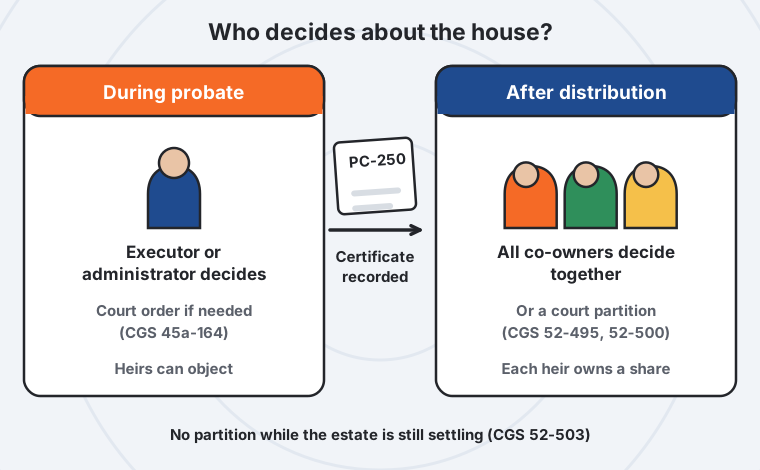
- Who decides depends on timing. While the house is in the estate, the executor or administrator decides, with the Probate Court’s approval where needed (CGS 45a-164). After distribution, the heirs own it together and every co-owner has a say. (Part of our guide to how to sell a house in Connecticut.)
- No single heir has a veto, and no single heir can sell the whole house alone. A co-owner who wants out can ask the Superior Court for partition (CGS 52-495, 52-500), but not while the house still belongs wholly to an estate in settlement (CGS 52-503).
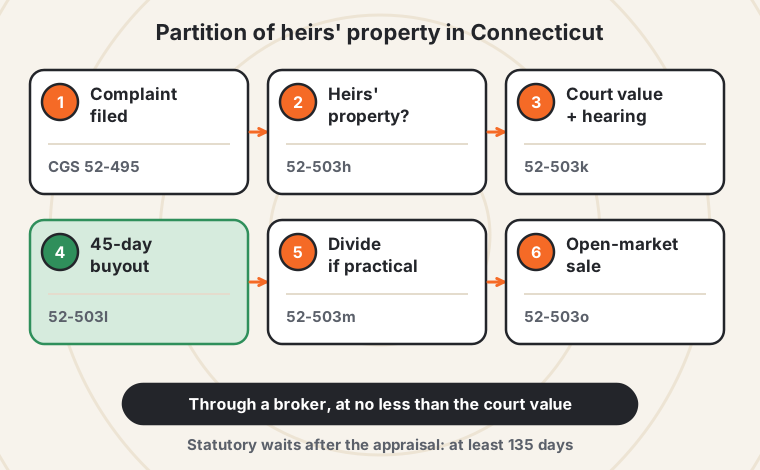
- Connecticut has adopted the Uniform Partition of Heirs’ Property Act (CGS 52-503f to 52-503r, for actions filed since October 1, 2015): a court-ordered appraisal, a 45-day right for the other heirs to buy out the one who wants a sale, and an open-market sale through a broker instead of a quick auction.
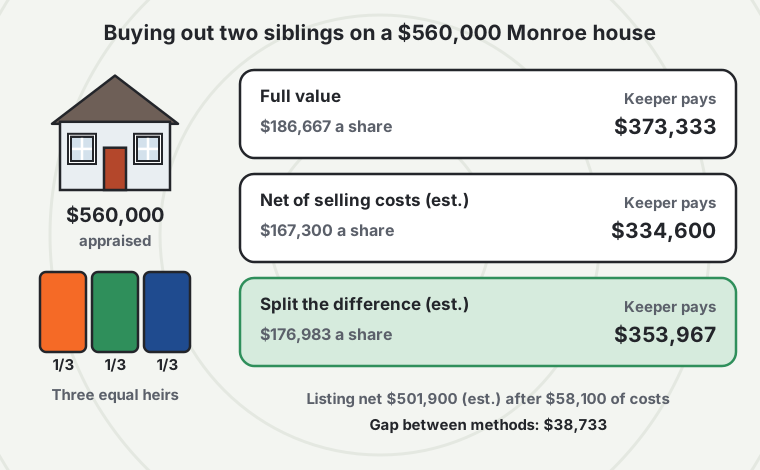
- A buyout is usually the cheapest fair answer. In our Monroe example, buying out two siblings on a $560,000 house costs $334,600 to $373,333 depending on whether selling costs are deducted (illustrative).
- A partition suit is the most expensive answer. Two lawyers, an appraisal, a court-appointed broker and a year or more of carrying costs (est.), all paid out of the house.
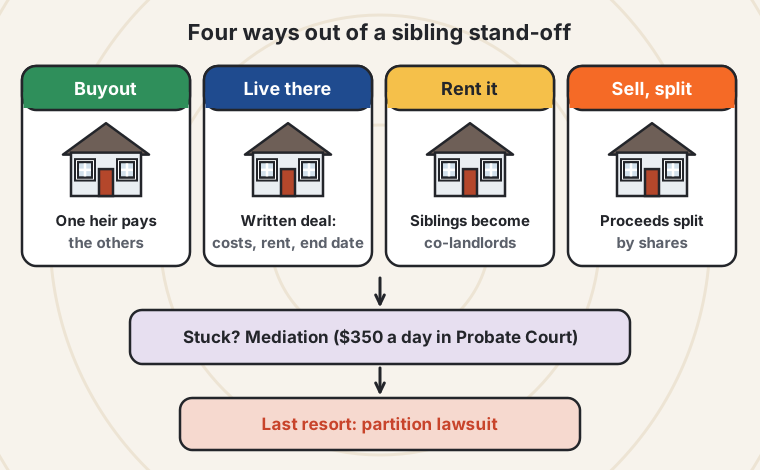
- Mediation and one written number end most stand-offs. The Probate Court’s mediation program costs $350 a day and is run by current or retired probate judges.
What happens when heirs disagree about selling an inherited house in Connecticut?
When heirs disagree about selling an inherited house in Connecticut, the answer depends on whether the estate is still open. During probate, the executor or administrator can ask the Probate Court to approve a sale and the court decides what is in everyone’s best interests (CGS 45a-164). After the house is distributed, the heirs own it together: they can agree on a buyout or a sale, try mediation, or any co-owner can ask the Superior Court for partition (CGS 52-495, 52-500).
That is the legal skeleton. The real problem is rarely legal. It is three people who love the same house in different ways, with different finances, different memories and, often, a long sibling history that the house has just reopened. One wants to keep it. One needs the money. One stopped answering the group text.
This page is about that problem: who actually gets to decide, the four realistic options with the math worked out, what the Connecticut partition statutes really say, what mediation and a lawsuit cost, and how to have the family conversation without wrecking the family. The broader question of whether to sell, keep or rent an inherited house at all is covered in our main guide to an inherited house in Connecticut; this page starts where that one ends, with the heirs not agreeing. Our Monroe example uses public town data from the Trumbull Probate District.
Why does disagreeing over a parent’s house hurt so much?
Disagreeing over a parent’s house hurts because the house is never only a house. It holds childhood, the parent you just lost, and every old role in the family: the responsible one, the one who stayed close and did the caregiving, the one who moved away. Most heirs in a stand-off feel some mix of grief, guilt, resentment, fear of being cheated, exhaustion and a quiet dread that the family will not survive the argument.
Maybe you are the sibling who lives twenty minutes from the house in Monroe. You drove your mother to appointments for three years. You know where the water shut-off is. Now your brother in North Carolina wants it sold “as fast as possible”, and part of you feels he has not earned an opinion. Or maybe you are the brother, carrying a mortgage of your own, and every month the house sits is money your family needs. Or you are the one in the middle, who just wants everyone to stop.
Name what you feel, because it is usually driving the argument more than the price is. Guilt: selling Mom’s house feels like letting her go a second time. Resentment: the caregiver feels owed; the others feel judged. Fear: of being lowballed by a sibling, a buyer, or the court. Exhaustion: the house is one more thing on top of grief. Old history: who was the favorite, who borrowed money, who never visited. None of that makes you a bad sibling. It makes you a normal one.
Here is something that helps: the person who left you the house almost certainly did not want it to become the thing that broke the family. Keeping the house and keeping the family are two different goals, and when you have to choose, the family usually matters more. If you are one of the heirs and you feel stuck, this page is for you.
Who decides whether to sell an inherited house in Connecticut: the executor or the heirs?
The executor or administrator decides whether to sell an inherited house in Connecticut while it is in the estate, under a power of sale in the will or with a Probate Court order after notice to the heirs and a hearing (CGS 45a-164). The heirs can object, but they do not each get a veto. Once the estate distributes the house, the heirs become co-owners, and from then on every co-owner must sign a sale or a court must order one.
| Stage | Who decides | How disagreement is resolved | Rule |
|---|---|---|---|
| During probate, will gives a power of sale | The executor | Heirs can complain to the court about the price or process; some executors ask for a court order anyway | The will; CGS 45a-164(e) (an order binds everyone represented) |
| During probate, no power of sale or no will | The executor or administrator, with a court order | Heirs get notice and can object at the hearing; the court rules on the parties’ best interests | CGS 45a-164 |
| House left by name to one person | That person, in a solvent estate | The house cannot be ordered sold without that person’s written consent | CGS 45a-428(b) |
| Parent owned only part of the house | The executor and the owners of most of the other interest may petition | The Probate Court can order partition or sale during the estate | CGS 45a-326 |
| During probate, a sibling wants to force partition | Not yet possible | No partition of property belonging wholly to an estate in settlement until it is ready for distribution | CGS 52-503 |
| After distribution | All co-owning heirs | Agreement, buyout, mediation, or a Superior Court partition action | CGS 45a-450; 52-495; 52-500; 52-503f to 52-503r |
This timing point is the most useful thing on the page, and families often miss it. A disagreement during probate is a disagreement with the executor, decided by the Probate Court. A disagreement after distribution is a disagreement between equal co-owners, decided by agreement or by the Superior Court. The second is slower and more expensive. So if the family is split, the estate stage is usually the best time to settle the house, while one person still has authority and a probate judge is already involved.
The full sale process during probate (the PC-400 petition, the hearing, the bond and lien releases) is in our guide to selling a house while it is in probate in Connecticut, and how long each stage of the estate takes is in how long probate takes in Connecticut. We will not repeat them here.
What the executor owes the heirs who disagree
An executor is a fiduciary: they must act for all the heirs, get a fair price, be able to show how it was set and favor no one, including themselves. If the executor is also the sibling who wants to buy the house, the court must hold a hearing and the notice must say the fiduciary is the buyer (CGS 45a-164(c)). That is a protection for the other heirs, not an insult to the executor. An appraisal is the executor’s best friend here.
What are the options when siblings disagree about an inherited house?
The options when siblings disagree about an inherited house are: one heir buys out the others; one heir lives there and pays rent or the carrying costs under a written agreement; the heirs keep it together as a rental; or everyone sells and splits the proceeds by their shares. If none of those can be agreed, mediation comes next, and a court partition action is the last resort.
| Option | Works when | Watch out for |
|---|---|---|
| Buyout | One heir truly wants the house and can pay or borrow the others’ shares | Agreeing on value; whether selling costs are deducted; financing time; a fiduciary buyer needs a hearing (CGS 45a-164(c)) |
| One heir lives there | An heir needs the house now and the others can wait for their money | Who pays taxes, insurance and repairs; whether the others get rent; an end date. Put it in writing. |
| Rent it together | The house is rentable and someone is willing to manage it | Landlord duties, vacancy, repairs, splitting decisions; it turns siblings into business partners |
| Sell and split | Nobody can or wants to carry the house | Agreeing on the route (list or cash), the price and the timing; proceeds split by shares, which may not be equal |
| Mediation | The heirs are stuck on numbers or feelings, not law | Everyone must agree to take part; it is voluntary |
| Partition action | A co-owner refuses everything and will not negotiate | Cost, time, court-set value and a court-run sale (CGS 52-495 to 52-503r) |
How do you buy out a sibling’s share of an inherited house in Connecticut?
To buy out a sibling’s share of an inherited house in Connecticut, the heirs agree on the house’s value (ideally by appraisal), decide whether to deduct the selling costs the family avoids, and the buying heir pays each other heir their fraction of that value, often with a mortgage. During probate the executor can sell to the heir with a court order; after distribution the others sign a deed to the buyer.
Example (illustrative): three siblings and a Monroe colonial
Mom left her Monroe house to her three children in equal shares. One daughter wants to keep it. The house appraises at the town’s single-family median. There is no mortgage. Every number below is either public town data or a labelled estimate.
| Line | Amount | Basis |
|---|---|---|
| Appraised value | $560,000 | Monroe single-family median, sales Oct 2023 to Sep 2024 (OPM via data.ct.gov) |
| Commission if listed | $28,000 (est.) | 5% of value, an estimate; commissions are negotiable |
| Conveyance tax if sold | $5,600 | 0.75% state ($4,200) + 0.25% Monroe ($1,400) (CGS 12-494) |
| Seller’s attorney | $1,500 (est.) | Estimate |
| Prep and repairs to list | $15,000 (est.) | Estimate for paint, clean-out and small repairs on a 1970s house |
| Carrying costs while listed, 4 months | $8,000 (est.) | About $2,000 a month (est.), from our Monroe carrying-cost worksheet without a mortgage |
| Net if the family sold | $501,900 (est.) | $560,000 minus $58,100 of estimated costs |
| Buyout method | Each one-third share | The keeper pays the other two | Feels fair to |
|---|---|---|---|
| Full appraised value | $186,667 | $373,333 | The sellers: they get paper value |
| Net of selling costs the family avoids | $167,300 (est.) | $334,600 (est.) | The keeper: she is not charged for a commission nobody pays |
| Split the difference | $176,983 (est.) | $353,967 (est.) | Often both: the savings are shared |
There is no single legally “right” method. Courts in a partition use the appraised value of the whole house times each share (CGS 52-503l(c)), with no discount for selling costs, which is worth knowing when you negotiate: a sibling who insists on full value is asking for what a court would likely give them. A sibling who wants a discount has a fair argument too, because the family really does avoid those costs. Splitting the difference is common for exactly that reason.
Making a buyout actually happen
Get one appraisal everyone accepts
Agree on the appraiser before anyone sees a number. A licensed appraiser’s report is what the court would use in a partition (CGS 52-503k), so it carries weight in the family too.
Agree the method in writing
Full value, net value, or the middle. Write down who pays the conveyance tax and attorney on the transfer, and who has paid the carrying costs so far (those can be credited).
Line up financing early
A keeper who needs a mortgage should talk to a lender first; the others will not wait forever. A cash-out mortgage after distribution is a common route.
Use the right paperwork for the stage
During probate: the executor sells to the heir with a court order, and if the executor is the buyer, the hearing notice must say so (CGS 45a-164(c)). After distribution: the other heirs deed their shares to the keeper.
Close with attorneys
A Connecticut attorney conducts the closing (CGS 51-88a). Check the tax side in our guide to taxes on selling an inherited house; the stepped-up basis usually keeps income tax small.
Can one heir live in the inherited house, or can the heirs rent it out together?
One heir can live in an inherited house in Connecticut if the others agree, ideally in a written agreement that says who pays the property tax, insurance and repairs, whether the occupying heir pays rent to the others, and when the arrangement ends. The heirs can also rent the house out together, but that makes them co-landlords who must agree on tenants, repairs and money. Both work best with a written plan and an exit date.
When one heir lives there
Co-owners each have a right to use the property, which is exactly why an unwritten arrangement turns sour. The sibling in the house feels at home. The siblings outside feel they are paying for someone else’s housing with their inheritance. Prevent that with a one-page agreement that covers:
- Who pays the carrying costs. In Monroe at the median, property tax alone is about $11,710 a year, about $976 a month, at the fiscal 2027 mill rate of 29.88.
- Whether the occupying heir pays the others rent for their share. A simple formula: fair market rent times the others’ combined share (two-thirds, with three equal heirs).
- Who pays for repairs, and who decides on anything over a set amount.
- An end date or trigger: a sale or buyout by a fixed date, or on any heir’s written request with notice.
- Credits at the end: who paid what, so the final split is fair.
That last point matters if things go wrong. In a partition of heirs’ property, the court weighs how much each co-owner contributed to taxes, insurance and upkeep, along with each one’s lawful use of the property and sentimental attachment (CGS 52-503n(a)(4) to (6)). Keep receipts.
When the heirs rent it out
Renting an inherited house turns siblings into business partners and landlords, with Connecticut’s landlord rules, vacancies and repair calls. It can work when the house is in rentable shape, the rent covers costs with room to spare, and one person is willing to manage it for a fee the others accept. If the house is already a rental, with tenants in place, read the truth about being a landlord in Connecticut and, for a two- to four-family building, selling a multi-family house in Connecticut. An occupied house can also be sold with the tenants in place; see selling a rental with tenants.
What is a partition action in Connecticut, and can one heir force a sale?
A partition action in Connecticut is a Superior Court lawsuit in which any co-owner asks the court to divide jointly owned property (CGS 52-495) or order it sold when a sale better promotes the owners’ interests (CGS 52-500). So yes, one heir can force the issue, but only after the estate is ready for distribution (CGS 52-503). For inherited family property, the Uniform Partition of Heirs’ Property Act gives the other heirs a court-set value and a right to buy out the heir who wants the sale first.
The general partition statutes
| Rule | What it means | Statute |
|---|---|---|
| Partition on complaint | A court of equity may order partition of real property held in joint tenancy or tenancy in common, on the complaint of any interested person, and may appoint a committee | CGS 52-495 |
| Sale instead of division | The court may order a sale when, in its opinion, a sale will better promote the owners’ interests; owners of a minimal interest can be paid just compensation | CGS 52-500(a) |
| Court controls the sale | The court may make any order needed to protect the parties and may appoint a committee to sell; proceeds, after the reasonable costs the court allows, are split by each owner’s interest | CGS 52-502 |
| Not during the estate | No partition or sale in lieu of partition of property belonging wholly to an estate in settlement until the estate is ready for distribution | CGS 52-503 |
| Decree recorded | Partition decrees are recorded in the land records | CGS 52-497 |
A single-family house in Monroe cannot sensibly be cut into three houses, so in practice “partition” of a family home almost always means a buyout or a sale. Under the older rules, that sale could be a quick court sale. For inherited property, Connecticut changed that.
Connecticut’s Uniform Partition of Heirs’ Property Act
Connecticut adopted the Uniform Partition of Heirs’ Property Act in 2015 (Public Act 15-234). It applies to partition actions filed on or after October 1, 2015 (CGS 52-503h(a)). When anyone files for partition, the court must first decide whether the house is “heirs’ property”. If it is, the Act’s steps replace the old ones, unless every co-owner has agreed otherwise in a written record.
| Step | What happens | Time rule | Statute |
|---|---|---|---|
| Is it heirs’ property? | Tenancy in common, no written agreement governing partition, at least one co-owner got title from a relative, and 20% or more of the interests or owners are relatives (or held by one who inherited from a relative) | Decided at the start | CGS 52-503g(5), 52-503h(b) |
| Value | The court orders an appraisal by a disinterested Connecticut-licensed appraiser, unless all co-owners agree on a value | Notice of the appraisal within 10 days; objections within 30 days; hearing no earlier than 30 days after notice | CGS 52-503k |
| Buyout right | Any co-owner who did not ask for a sale may buy out those who did, at the court value times their share | 45 days to elect; payment date at least 60 days after notice | CGS 52-503l |
| Division in kind | If shares remain, the court divides the land unless that would cause “manifest prejudice” to the co-owners as a group | After the buyout | CGS 52-503m |
| Factors | Whether it can practically be divided, value lost by dividing, how long the family has owned it, sentimental attachment, current lawful use, and who paid taxes, insurance and upkeep | No single factor decides | CGS 52-503n |
| Sale | An open-market sale through a Connecticut-licensed broker (agreed by the parties or court-appointed), at no less than the court value; sealed bids or auction only if more advantageous | Parties have 10 days to agree on a broker | CGS 52-503o |
| Credit for a co-owner buyer | A co-owner who buys at the sale gets a credit for their own share of the proceeds | At the sale | CGS 52-503o(f) |
Notice what the Act does for a family. The sibling who wants to keep the house gets a real, court-protected chance to buy at an appraised price. The sibling who wants out gets a fair value, and a sale through a broker at no less than that value instead of a fire sale. Even the statutory waiting periods after the appraisal add up to at least 135 days (a 30-day minimum before the value hearing, a 45-day election window and at least 60 days to pay), before the time it takes to file, serve, appraise and schedule. The heirs can reach the same result in a kitchen in a week, for free.
How much does a partition action cost in Connecticut, and how long does it take?
A partition action in Connecticut typically costs each side its own attorney’s fees, commonly $10,000 to $30,000 or more for a contested case (est.), plus a court-ordered appraisal, any committee or broker commission set by the court, and months of carrying costs, all of which come out of the house’s value. An uncontested partition often takes 6 to 12 months and a contested one a year or two (est.). Connecticut publishes no official averages.
We could not find Connecticut statistics on partition costs or duration, so the figures below are estimates drawn from published national ranges and from the statutory steps above. Ask a Connecticut real estate litigator for a written estimate before you file anything. For our Monroe example, a contested partition might look like this:
| Cost (Monroe example, contested, 18 months) | Amount | Basis |
|---|---|---|
| Attorneys, three siblings | $30,000 to $90,000 (est.) | $10,000 to $30,000 each (est.), national ranges |
| Court-ordered appraisal | A few hundred to a few thousand dollars (est.) | CGS 52-503k |
| Broker’s commission on a court sale | Set by the court (CGS 52-503o); $28,000 at 5% (est.) | Estimate |
| Carrying costs, 18 months | $36,000 (est.) | About $2,000 a month (est.) |
| Conveyance tax on the sale | $5,600 | CGS 12-494 |
Add the middle of those ranges and a contested partition can consume well over $100,000 (est.) of a $560,000 house, most of it on lawyers and waiting, before anyone sees a dollar. That is not a reason to give in to an unreasonable sibling. It is a reason to put the number in front of everyone early. Often the sibling who threatens to sue has never seen it.
A partition complaint has real deadlines and procedure, and the heirs’ property rules change the outcome. If you are served, or thinking of filing, talk to a Connecticut attorney first. This page explains the framework; it is not legal advice for your family.
Can mediation help heirs who disagree about an inherited house?
Mediation can help heirs who disagree about an inherited house, and in Connecticut it is cheap and available early. The Probate Court Mediation Program uses current or retired probate judges as mediators, charges $350 per day or part of a day, and many mediations finish in one day. It starts with a motion and agreement to mediate (form PC-1002), and every party must agree to take part. Private mediation is also an option, especially after the estate closes.
Mediation works because most sibling fights over a house are not really about law. They are about value (“she’s lowballing us”), fairness (“I did the caregiving”), timing (“I need the money now”) and feelings (“Dad wanted it kept”). A neutral person who knows probate can separate those, and siblings often accept from a retired judge what they would never accept from each other.
- When the estate is open: the Probate Court program is the natural fit. Ask the court about PC-1002. A judge refers the case only after all parties agree.
- After distribution: the house is no longer before the Probate Court, so use a private mediator: often a retired probate judge or an experienced estate attorney. The mediator sets the fee.
- Bring numbers: the appraisal, the listing net, the carrying cost per month and any written offer. Mediation without numbers turns into therapy; mediation with numbers turns into a deal.
Mediation is voluntary and any party can withdraw. If an agreement is reached, it is written up, and in the Probate Court program it goes back to the court.
How does a written offer help the family conversation?
A written offer helps the family conversation because it replaces guesses with one concrete number everyone can see. Heirs who disagree usually disagree about what the house is worth and what each option really nets. Put three numbers side by side, a fair appraised value, what listing would net after repairs, commission and months of carrying costs, and a written as-is cash offer, and the decision usually becomes clear.
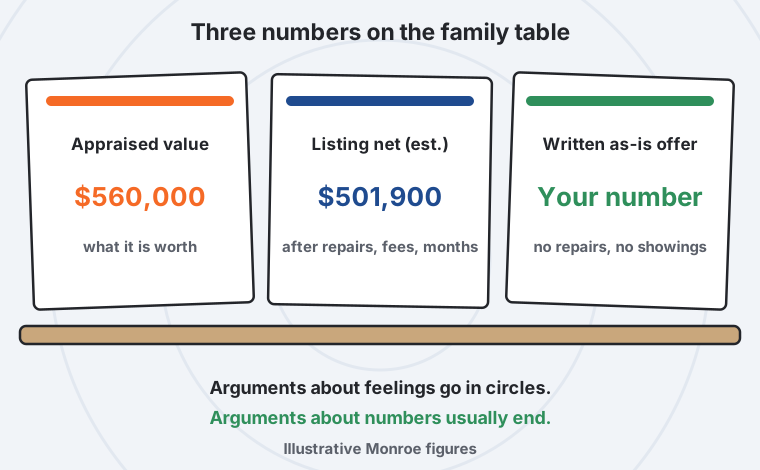
Most family arguments over a house run on hearsay. Someone saw a house down the street “go for six hundred”. Someone else heard that investors pay half. The executor is caught between them. A number on paper changes the conversation in three ways:
- It anchors the low end. If a buyer will pay a known amount as-is, with no repairs, no clean-out and no showings, nobody can claim the house is worth nothing, and nobody needs to fear a fire sale.
- It shows the trade-off honestly. Compared with the listing net, the cash number shows exactly what speed and certainty cost. Sometimes the gap is large and the family lists. Sometimes, after repairs, commission and months of carrying, it is smaller than anyone expected.
- It gives the keeper a benchmark. A sibling who wants the house can see what the others would get from a buyer and offer at least that.
A written offer is also what a Probate Court wants to see at a sale hearing, together with an appraisal, if the executor petitions to sell. Getting one costs nothing and commits nobody.

When siblings are stuck, the most useful thing I can do is often not buying the house. It is putting a clear number on paper, with no expiration date, that every heir can read in their own kitchen. Sometimes the family uses it to agree on a buyout between themselves, and that is a good outcome. Arguments about feelings go in circles; arguments about numbers usually end.
What does a disagreement over an inherited house cost in Monroe?
A disagreement over an inherited house in Monroe costs the heirs about $2,000 a month (est.) in carrying costs while it drags on, starting with about $976 a month of property tax on a house at the town’s $560,000 single-family median at the fiscal 2027 mill rate of 29.88. A year of stand-off is about $24,000 (est.), split among the heirs. Monroe estates are handled by the Trumbull Probate District (District 46), which serves Easton, Monroe and Trumbull (CGS 45a-2).
| Months of stand-off | Carrying cost (est.) | Each of three heirs (est.) |
|---|---|---|
| 3 | $6,000 | $2,000 |
| 6 | $12,000 | $4,000 |
| 12 | $24,000 | $8,000 |
| 18 (a contested partition) | $36,000 | $12,000 |
Monroe houses add their own reasons not to let a house sit. The median single-family home was built around 1970, and about 68% of houses heat with oil, so an empty winter means oil deliveries or a winterization. If the house is on a private well and septic, as our Monroe worksheet assumes, those need protecting too. The full monthly breakdown is in how to calculate the carrying costs of a vacant house in Connecticut. Our Monroe page is we buy houses in Monroe, CT.
If the heirs decide to sell, should they list it or sell for cash, and when should they not sell to us?
If the heirs decide to sell, they should list the house when it is in good shape, someone can manage showings and the family can carry it for a few months, because listing usually brings the highest price. A cash sale fits when the house needs work or is full of belongings, the heirs live far apart, or the family values a fixed date and an end to the argument over the last few dollars.
List it
Highest priceBest for a clean, updated house and heirs who can wait.
- Commission, prep and repairs come out first
- Months of carrying costs and showings
- Heirs must agree on price changes
One heir buys
Keeps it in the familyBest when one heir truly wants it and can pay.
- Needs an agreed appraisal and method
- Financing takes time
- Fiduciary buyer needs a hearing
Sell as-is for cash
About 2 weeksFrom a signed contract, once there is authority to sell.
- No repairs, no clean-out, no showings
- One number every heir can read
- Below a renovated price; that is the trade-off
When you should NOT sell to us
- One heir wants the house and can pay a fair price. A family buyout is better than any outside sale.
- The house is updated, the family can carry it, and everyone agrees on a listing price. List it; you will likely net more.
- The disagreement is really about grief, not money. Give it time, or try mediation first. Nothing on this page has a deadline.
- Nobody has had the house appraised. Do that first; every option above depends on it.
Is a cash sale right for you, or should you list?
Seven quick questions. There is no wrong answer, and we will tell you honestly if listing would leave you more.
- Does the house need repairs you would rather not pay for or manage?
- Do you need to close by a certain date, or within the next month or two?
- Would showings be hard: tenants, belongings, privacy, or you live out of state?
- Is there a complication: an estate or probate, a divorce, foreclosure, liens or back taxes?
- Could you comfortably cover the mortgage, taxes and utilities for three or more months?
- Is getting the highest possible price more important to you than speed and certainty?
- Would a buyer's bank lend on the house as it is (no major roof, foundation, oil tank or code issues)?
For the general comparison, see cash buyer vs. realtor in Connecticut, and before you speak with any buyer, how to check a cash home buyer.
How do we work with families who disagree about an inherited house?
We work with families who disagree about an inherited house by giving every heir the same information: one walkthrough, one written offer with no expiration date, sent to everyone the executor or the family names, and no pressure to choose us. If the heirs agree to sell, we close at a Connecticut attorney’s office about two weeks after there is authority to sell, on the date the family picks.
One call, one contact
The executor or the heirs tell us where things stand: is the estate open, who has authority, does anyone live there. No contract, no commitment.
One walkthrough
We see the house once, as it is. Any heir is welcome to be there. Leave the furniture and the basement as they are.
The same written number to every heir
One offer, in writing, sent to everyone you list, so nobody hears it secondhand. It does not expire while the family talks, mediates or waits for the court.
Use it however helps
Compare it with the appraisal and a listing, use it as a benchmark for a buyout, or attach it to a Probate Court petition. If the family keeps the house, that is a fine outcome.
Close when the family is ready
If you sell to us, we close in about two weeks once there is authority, or later if you prefer. Each heir’s share goes where the estate or the deed says.
I am Jerryll Noorden. I have bought houses in Connecticut since 2016, about ten a year, and family estates are a big part of that. We never charge fees, and we close through Connecticut attorneys. If listing or a family buyout would leave your family better off, I will say so. Call (203) 529-4712, or start on our sell an inherited house in Connecticut page.
See the house together.
Pick a time that works.
Choose a time for us to walk through the property with you, or ask for a quick call first. We confirm every request personally.
Tuesday, January 13
No open times in the next few weeks. Please call us.
We will confirm by email. Nothing is booked until we do.
View my requestQuestions Connecticut heirs ask when they disagree about selling
Can one sibling force the sale of an inherited house in Connecticut?
Yes, one sibling can ask a Connecticut court to force the sale of an inherited house through a partition action (CGS 52-495, 52-500), but only once the estate is ready for distribution (CGS 52-503). For family property, the Uniform Partition of Heirs’ Property Act first lets the other heirs buy out that sibling at a court-set value (CGS 52-503l).
Do all heirs have to agree to sell a house in Connecticut?
Not all heirs have to agree to sell a house in Connecticut while it is in the estate: the executor or administrator can sell under a power of sale or with a Probate Court order after the heirs get notice and a chance to object (CGS 45a-164). After distribution, all co-owners must sign a sale unless a court orders one in a partition action.
Has Connecticut adopted the Uniform Partition of Heirs’ Property Act?
Yes, Connecticut has adopted the Uniform Partition of Heirs’ Property Act, at CGS 52-503f to 52-503r (Public Act 15-234). It applies to partition actions filed on or after October 1, 2015, and requires a court-ordered appraisal, a buyout right for the other heirs, and normally an open-market sale through a broker.
How do I buy out my siblings’ share of an inherited house?
To buy out your siblings’ share of an inherited house, agree on an appraiser, agree whether selling costs are deducted, and pay each sibling their fraction of that value, often with a mortgage. During probate the executor sells to you with a court order; after distribution your siblings deed their shares to you. A Connecticut attorney handles the closing.
What is the difference between partition in kind and partition by sale?
Partition in kind divides the property into separate parcels, one per owner; partition by sale sells the whole property and splits the proceeds by share (CGS 52-500, 52-503g). Under Connecticut’s heirs’ property rules the court prefers division in kind unless it would cause manifest prejudice, but a single house usually cannot be divided, so a buyout or sale follows.
How long does a partition action take in Connecticut?
A partition action in Connecticut often takes 6 to 12 months if uncontested and a year or two if contested (est.); there are no official Connecticut averages. Under the heirs’ property rules, the waiting periods after the appraisal alone add at least 135 days: 30 days before the value hearing, a 45-day buyout election and at least 60 days to pay.
Who pays the costs of a partition action?
The costs of a partition action are generally paid out of the property: under CGS 52-502(b), sale proceeds are distributed by each owner’s share after the reasonable costs and expenses the court directs. Each side usually pays its own attorney, though courts can allocate some costs. Ask a Connecticut attorney before filing.
Can a co-owner live in an inherited house without paying rent?
A co-owner can generally live in an inherited house they co-own, because each co-owner has a right to use the property, but whether they owe the others rent is best settled in a written agreement. If the dispute reaches a partition, the court weighs who paid taxes, insurance and upkeep and each owner’s use of the property (CGS 52-503n).
What if one heir will not respond at all?
If one heir will not respond during probate, the executor can still petition the Probate Court to sell after notice to that heir (CGS 45a-164). After distribution, a silent co-owner can be named in a partition action; the court can order notice by publication, and under the heirs’ property rules a sign is posted on the property (CGS 52-503i).
Can the executor sell the inherited house to one of the heirs?
Yes, the executor can sell the inherited house to one of the heirs, at a fair price the court can approve. If the executor is the buyer, Connecticut requires a court hearing and the notice must say the fiduciary is the buyer (CGS 45a-164(c)), so an appraisal is essential.
What if the will left the house to one sibling?
If the will left the house to one sibling, it is that sibling’s house once the estate is settled, subject to the estate’s debts. In a solvent estate, the court cannot order a specifically devised house sold without that sibling’s written consent (CGS 45a-428(b)). The others can contest the will only on legal grounds, not because they disagree.
Is there mediation for family disputes over an estate in Connecticut?
Yes, the Connecticut Probate Courts run a mediation program for contested probate matters, with current or retired probate judges as mediators, at $350 per day or part of a day. It starts with form PC-1002 and every party must agree. After the estate closes, families can hire a private mediator.
Which probate court handles an estate in Monroe, CT?
An estate of someone who lived in Monroe is handled by the Trumbull Probate District, District 46, which serves Easton, Monroe and Trumbull (CGS 45a-2). Confirm the court’s current address and hours before you go.
Do we pay capital gains tax if we sell an inherited house we disagree about?
Usually little or no capital gains tax is due when heirs sell an inherited house, because the basis steps up to the value at death and the gain is only the increase since then. Months of disagreement do not change that, but they do add carrying costs. See our guide to taxes on selling an inherited house.
Related Connecticut guides
- Inherited a house in Connecticut: the full guide (sell, keep or rent)
- How long probate takes in Connecticut
- Can a house be sold while in probate?
- Taxes on selling an inherited house
- Cleaning out an inherited house
- Carrying costs of a vacant house
- Selling a house during a divorce (another kind of co-owner stand-off)
- Sell an inherited or probate house
We buy inherited houses in Monroe and the surrounding towns, including Easton, Trumbull, Shelton, Newtown, Stratford and Bridgeport. For the full process, see how to sell a house in Connecticut and our complete Connecticut selling guide.
Plain-English information, not legal advice. Partition and probate disputes turn on your deed, your will and the facts; talk to a Connecticut attorney.
Sources
- CGS chapter 919 (partition): § 52-495 (partition), § 52-497 (decrees recorded), § 52-500 (sale instead of division), § 52-502 (orders, committee, distribution of proceeds), § 52-503 (no partition during estate settlement), § 52-503f to 52-503r (Uniform Partition of Heirs’ Property Act, P.A. 15-234).
- CGS chapter 801b: § 45a-164 (court-authorized sale by a fiduciary; sale to the fiduciary).
- CGS chapter 802b: § 45a-326 (Probate Court partition of an undivided interest), § 45a-428 (specifically devised real property), § 45a-450 (certificate of distribution).
- CGS chapter 801: § 45a-2 (probate districts; District 46 Easton, Monroe and Trumbull).
- CGS § 12-494 (real estate conveyance tax); CGS § 51-88a (attorneys conduct closings).
- Connecticut Probate Courts, Probate Mediation (judges as mediators, $350 per day, form PC-1002).
- Probate Court User Guide: Administration of Decedents’ Estates (Office of the Probate Court Administrator).
- Connecticut Open Data (OPM): Monroe sales Oct 2023 to Sep 2024 and the fiscal 2027 mill rate.

Who wrote this
Jerryll Noorden
Jerryll has bought and sold Connecticut houses since 2016 and has sat at more closing tables than he can count, on both sides. Before real estate he was a robotics scientist at NASA, IHMC and IIT. He wrote this guide because the national sites that rank for it skip the Connecticut rules that cost sellers money. When listing or selling it yourself would get you more than a cash offer, he says so.
This guide explains Connecticut rules in plain English. It is not legal or tax advice. Laws change; for your sale, talk to a Connecticut real estate attorney and a tax professional.
