
Key facts at a glance
| Fact | Number or rule | Source |
|---|---|---|
| License for moving household goods for hire inside Connecticut | Certificate of public convenience and necessity from the CT Department of Transportation | CGS 13b-389 |
| What a Connecticut mover’s printed ads must show | Its CT DOT certificate number and any federal permit or registration number | CGS 13b-396a |
| Who sets in-state mover rates | Movers file rate schedules with CT DOT, which may set maximum and minimum rates | CGS 13b-393 |
| CT DOT phone for the certified-mover list | 860-594-2865 | CT DOT, household goods movers page |
| Basic mover liability if you choose released value | $0.60 per pound per article | FMCSA; CT DOT movers page |
| Most you pay at delivery on an interstate non-binding estimate | 110% of the estimate | 49 CFR 375.407 |
| Interstate damage claim deadlines | File within 9 months; mover answers within 120 days | FMCSA; 49 CFR 370.9 |
This page belongs to our guide on how to sell a house in Connecticut and to our relocation guide, which covers the house sale itself when you move. This page answers one narrower question: how to hire a mover you can trust, and how to time the truck to your closing.
What should you check before hiring movers in Connecticut?
Before hiring movers in Connecticut, check four things: the right license (a CT DOT certificate for a move inside Connecticut, or a USDOT number with FMCSA operating authority for a move out of state), a written quote after an in-home or video survey, the valuation coverage you are choosing, and a moving date that fits your closing and possession date. A mover that will not give you its license number is not one to hire.
Moving companies are easy to find and hard to judge. Online ads, lead sites and brokers all look like movers. The license check takes ten minutes and filters out most of the trouble. The quote and coverage checks protect you from the two most common disputes: a bill higher than expected, and a broken item paid at a few dollars.
- The company’s CT DOT certificate number (in-state) or USDOT and MC numbers (interstate), checked against the official lists.
- Whether you are talking to the actual mover or a broker who sells your job to someone else.
- A written estimate, after the mover has seen everything that will move, in person or by video.
- The type of quote: binding, not-to-exceed or non-binding.
- The valuation option, in writing, before you sign.
- Your closing date, your possession date, and a backup plan if either moves.
Why is choosing a mover so stressful when you are also selling a house?
Choosing a mover is stressful when you are also selling a house because you are handing everything you own to strangers, on a date that depends on a closing you do not fully control. Most people worry about two things at once: being overcharged or scammed, and the truck arriving on the wrong day for the closing.
People in your spot tell us they feel:
- Distrustful, after reading about movers who hold furniture hostage for more money.
- Squeezed, because the buyer wants the keys on one date and the new home is ready on another.
- Protective, of the dining table from a grandparent or the piano nobody plays but nobody will sell.
- Overwhelmed, by quotes that use different words for what looks like the same service.
- Relieved, once it is booked, if the mover, the date and the price are all in writing.
This page is for you if you want to hire well and line the move up with the sale. We do not move furniture and we do not refer movers; we buy houses, and we have seen how a bad moving day can sour a good closing.
Who licenses movers in Connecticut, and how do you check one?
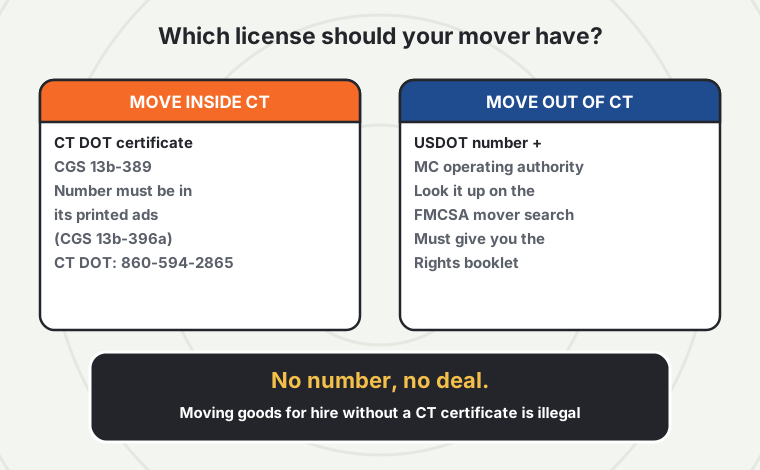
The Connecticut Department of Transportation licenses movers for moves within Connecticut: no one may move household goods for hire inside the state without a CT DOT certificate (CGS 13b-389). Moves across state lines are regulated by the federal Motor Carrier Safety Administration (FMCSA), which issues USDOT numbers and operating authority. Check an in-state mover on CT DOT’s certified-mover list and an interstate mover on FMCSA’s mover search.
| Your move | Who regulates | What the mover needs | How to check |
|---|---|---|---|
| From one Connecticut town to another | CT Department of Transportation | Household goods carrier certificate (or a motor contract carrier permit) (CGS 13b-389, 13b-398) | CT DOT’s list of household goods movers with a certificate; or call 860-594-2865 |
| From Connecticut to another state | FMCSA (U.S. DOT) | USDOT number and interstate operating authority (MC number) | FMCSA’s mover and complaint-history search on protectyourmove.gov |
| Labor only (you rent the truck) | Not a carrier if they do not transport | Ask about insurance; a helper crew does not drive your goods | Reviews and a written agreement |
Two Connecticut rules help you here. A mover’s printed ads must show its CT DOT certificate number and any federal number (CGS 13b-396a), so an ad without numbers is a warning. And holding yourself out as a household goods carrier without a certificate, with intent to defraud, is a crime (CGS 13b-389(b)).
The state’s Department of Consumer Protection also notes that interstate movers must give you the federal booklet “Your Rights and Responsibilities When You Move”, and that every mover must give you a bill of lading once your goods are loaded.
Should you hire movers or move yourself?
You should hire movers when you are moving a whole house, moving out of state, have heavy or valuable items, or have no one to help; moving yourself makes sense for a short in-state move with a small load and strong helpers. The real comparison is not the truck rental against the mover’s bill; it is your time, your back, and the risk to your closing date.
| Question | Points to movers | Points to doing it yourself |
|---|---|---|
| How far? | Out of state or several hours | Same town or nearby |
| How much? | A full house, a basement, a garage | An apartment’s worth |
| Heavy items? | Piano, safe, gun safe, big appliances | None |
| Who helps? | Nobody local | Two or three strong friends |
| Driving a large truck? | Never done it | Comfortable on highways and in cities |
| Closing date pressure? | Fixed date, little slack | Flexible, days of overlap |
A middle route works for many sellers: movers for the furniture and boxes, your own car for valuables, papers, medicine and the first-night box. And move less. Every item you sell, donate or recycle before the move is an item you do not pay to carry; our guide to what to do with your belongings when you move covers the Connecticut disposal rules.
What kinds of moving quotes are there?
There are three kinds of moving quotes: a binding estimate, which fixes the price for the items listed; a binding not-to-exceed estimate, where you pay the lower of the quote or the actual charges; and a non-binding estimate, where the final bill follows the actual weight or time. On an interstate non-binding estimate, you pay no more than 110% of the estimate at delivery (49 CFR 375.407).

For interstate moves, federal rules require the mover to survey your goods before giving a written estimate. The survey can be on site or virtual, by live or recorded video that clearly shows what will be moved (49 CFR 375.103, 375.401). You can waive the survey in writing, but you then lose the best protection against a surprise bill. For in-state moves, Connecticut movers charge from rate schedules filed with CT DOT (CGS 13b-393); CT DOT’s own consumer advice is to ask for a binding quote, because estimates can rise on moving day.
| Quote type | What you pay | Watch for |
|---|---|---|
| Binding | The quoted price, if you move what was listed | Extra items or services added on the day change the price |
| Binding not-to-exceed | The quote or the actual charges, whichever is lower | Not every mover offers it; get it in writing |
| Non-binding | Actual charges; interstate, up to 110% due at delivery, the rest billed later | Low quotes that grow; ask how the final weight is measured |
| Hourly (common in-state) | Crew time from the filed rate schedule | Travel time, minimums, stairs and long-carry charges |
Get two or three quotes for the same list of items, on the same quote type, so you are comparing like with like. A quote far below the others is not a bargain until you know why.
How much protection do you get if movers break something?
If movers break something, the protection you get depends on the valuation you chose. Basic released value pays only 60 cents per pound per article, so a 50-pound TV is worth $30 to the mover. Full value protection makes the mover repair, replace or pay the current value of the item, and costs extra. For interstate moves, full value is the default unless you sign for released value; file any claim in writing within nine months.

Do the math on your own things. A 120-pound dresser is worth $72 under released value, whatever it cost. A laptop or a painting weighs almost nothing. CT DOT’s movers page says the usual rate is $0.60 a pound and advises that any extra coverage appear on the contract before you sign.
- Choose the valuation in writing and read the deductible on any full value plan.
- List high-value items (worth more than about $100 a pound, by the federal rule of thumb) on the inventory, or the mover may limit what it pays for them.
- Ask your homeowners or renters insurer whether your policy covers goods in transit; some do, some do not.
- Carry jewelry, cash, papers, medicine and small electronics yourself.
- Note damage on the inventory and bill of lading at delivery, before you sign.
For interstate moves, the mover must pay, deny or make a firm offer on a written claim within 120 days (49 CFR 370.9). If you cannot agree, interstate movers must offer an arbitration program for disputes over loss and damage.
How do you spot a moving scam?
You spot a moving scam by the pattern: a price quoted by phone without a survey, a large deposit up front, no license number or one that does not check out, a company name that changes, and blank or incomplete paperwork on moving day. The worst cases end with goods held on a truck until you pay more than the quote. Every one of those signs can be checked before you book.
| Red flag | Why it matters | What to do |
|---|---|---|
| Quote by phone or web form, no survey | Nobody has seen what you own; the price will change | Insist on a site or video survey |
| Large cash deposit up front | Reputable movers rarely need much before the move | Pay a small deposit by credit card, or none |
| No license number, or it does not match | In Connecticut, ads must carry the CT DOT certificate number (CGS 13b-396a) | Check CT DOT’s list or FMCSA’s search |
| “We are the mover” but it is a broker | Your job may be sold to an unknown carrier | Ask who will actually load and drive |
| Blank lines in the paperwork | Prices and terms can be filled in later | Sign nothing incomplete |
| No rights booklet (interstate) | Federal law requires it | Ask for it; walk away if refused |
Complaints about interstate movers go to FMCSA’s National Consumer Complaint Database. For in-state movers, start with CT DOT, the agency that issues the certificate, and the Department of Consumer Protection. House scams follow the same pattern as moving scams, by the way; our page on house-buying scams and red flags covers that side.
How do you time the move to your closing and possession date?
You time the move to your closing by loading the truck one or two days before the closing, leaving the house empty and broom-clean for the buyer’s final walk-through, and handing over the keys at closing, when possession usually passes in Connecticut. If you need to stay a few days after closing, put it in the contract as a written use and occupancy agreement, never on a handshake.

Connecticut closings move. A lender’s appraisal, a title problem or a missing payoff letter can push a closing by days or weeks. Build the move around that risk:
- Book early. Reserve your date as soon as you have a signed contract, and ask the mover what a date change costs.
- Read the possession clause. Your contract says when the buyer gets the house; usually at closing. Your Connecticut closing process guide explains each step.
- Keep a buffer. Avoid a truck date that leaves no room if the closing moves a day or two. Ask whether storage-in-transit is available if your new home is not ready.
- Leave what the contract says. Fixtures stay; oil left in the tank is customarily reimbursed by the buyer at closing; smoke and carbon monoxide detectors must stay working for the affidavit you sign (CGS 29-453).
- Need more time? Ask your attorney for a use and occupancy agreement in the contract, with a daily rate and an escrow holdback if the buyer requires one.
A direct sale changes the timing. You pick the closing date, and you can leave behind what you do not want, so the truck only takes what you are keeping. Jerryll typically closes in about two weeks, sooner or later if you need it. See selling your Connecticut house when you relocate. If the move comes first and the house is still for sale, read what to do when you moved out but the house has not sold.
See the house together.
Pick a time that works.
Choose a time for us to walk through the property with you, or ask for a quick call first. We confirm every request personally.
Tuesday, January 13
No open times in the next few weeks. Please call us.
We will confirm by email. Nothing is booked until we do.
View my requestWhat should you do on moving day and delivery day?
On moving day, walk the house with the crew lead, check the inventory before you sign it, get the bill of lading, and keep your valuables with you. On delivery day, check every item against the inventory, write any damage or missing items on the paperwork before you sign, and photograph it. Connecticut and federal rules both require a bill of lading (CGS 13b-396; FMCSA).
- Confirm the crew is from the company you hired; match the name and numbers on the truck and paperwork.
- Read the bill of lading: pickup and delivery dates, price terms, valuation choice, your contact numbers.
- Keep a copy of the inventory with item numbers and condition notes.
- Do a last walk of every room, closet, the attic, the basement and the garage.
- Take meter photos and leave keys, codes and manuals for the buyer as your attorney directs.
- At delivery, write specific damage or missing items on the paperwork before signing, and photograph them.
When should you NOT sell your house to a cash buyer to make a move easier?
You should not sell your house to a cash buyer just to make the move easier if the house is in good shape, the market is active and your moving date allows a normal 30-to-45-day financed closing. A listing then usually nets more, and a careful mover booking plus a use and occupancy clause can solve the timing. A direct sale earns its lower price only when the date, repairs or a full house cost more than the difference.
A cash sale fits when the move date is fixed and close, when the house needs work you cannot do before you go, or when cleaning out decades of belongings would delay the move by weeks. Compare the nets on our cash buyer vs. realtor page, and read why cash offers are lower so you know what you are trading. If listing will net you clearly more and you have the time, list it.
Is a cash sale right for you, or should you list?
Seven quick questions. There is no wrong answer, and we will tell you honestly if listing would leave you more.
- Does the house need repairs you would rather not pay for or manage?
- Do you need to close by a certain date, or within the next month or two?
- Would showings be hard: tenants, belongings, privacy, or you live out of state?
- Is there a complication: an estate or probate, a divorce, foreclosure, liens or back taxes?
- Could you comfortably cover the mortgage, taxes and utilities for three or more months?
- Is getting the highest possible price more important to you than speed and certainty?
- Would a buyer's bank lend on the house as it is (no major roof, foundation, oil tank or code issues)?
Questions about hiring movers in Connecticut
Do movers need a license in Connecticut?
Yes, movers need a license in Connecticut. Anyone moving household goods for hire within the state needs a certificate from the Connecticut Department of Transportation (CGS 13b-389). Interstate movers need a USDOT number and federal operating authority from FMCSA.
How do I check if a Connecticut mover is licensed?
You check if a Connecticut mover is licensed on CT DOT’s list of household goods movers with a certificate, or by calling CT DOT at 860-594-2865. For interstate moves, look up the USDOT or MC number on FMCSA’s mover search. The mover’s ads must show its certificate number (CGS 13b-396a).
What is the difference between a binding and a non-binding moving estimate?
A binding moving estimate fixes the price for the items listed, while a non-binding estimate follows the actual weight or time. On an interstate non-binding estimate, you pay no more than 110% of the estimate at delivery, and any balance is billed later (49 CFR 375.407).
What does 60 cents per pound coverage mean?
Sixty cents per pound coverage means the mover pays only $0.60 for each pound of a lost or damaged item, whatever it is worth. A 50-pound TV is covered for $30. It is free released value protection; full value protection costs extra and covers repair, replacement or current value.
How long do I have to file a claim against an interstate mover?
You have nine months after delivery to file a written claim against an interstate mover. The mover must pay, deny or make a firm settlement offer within 120 days of receiving it (49 CFR 370.9). Note damage on the delivery paperwork first.
How far in advance should I book movers?
Book movers as soon as you have a signed sales contract and a closing date, and earlier for summer and month-end dates. Ask in writing what it costs to change the date, because Connecticut closings sometimes move by a few days.
Should I move out before or after closing?
You should move out before closing in most Connecticut sales, because possession usually passes to the buyer at closing and the buyer does a final walk-through first. If you need a few extra days, ask your attorney for a written use and occupancy agreement in the contract.
What is a use and occupancy agreement?
A use and occupancy agreement is a written deal that lets the seller stay in the house for a set time after closing, usually for a daily fee and sometimes with money held in escrow. Your Connecticut attorney drafts or reviews it; do not rely on a verbal promise.
Is a moving broker the same as a mover?
A moving broker is not the same as a mover. A broker arranges your move and passes it to a carrier that does the actual work. Ask who will load and drive, and check that company’s license, not only the broker’s.
How much deposit should a mover ask for?
A mover should ask for a small deposit, if any. A large deposit or cash payment before the move is a common scam warning sign. Pay by credit card where you can, and never sign a contract with blank lines.
Can I leave furniture behind when I sell my house?
You can leave furniture behind when you sell your house only if the buyer agrees in writing. Most listing buyers expect an empty, broom-clean house. A direct cash buyer usually lets you leave what you do not want, which can shrink the moving bill.
Related Connecticut guides
Moving
We buy houses all over the state; see where we buy houses in Connecticut. For every route, step and cost in one place, go back to how to sell a house in Connecticut.
Plain-English information, not legal advice. Confirm a mover’s license on the official lists and your contract terms with a Connecticut attorney.
Sources (checked on October 27, 2026)
- CGS chapter 245c, sections 13b-387 to 13b-396a (household goods carriers: certificate, rates, bills of lading, advertising).
- CT DOT, Household goods movers with a certificate to operate (list, phone, $0.60 per pound note, binding-quote advice).
- CT Department of Consumer Protection, Movers and moving.
- FMCSA, Protect Your Move (mover search, valuation, red flags, complaints).
- 49 CFR part 375 (surveys, estimates, 110% rule).
- 49 CFR 370.9 (120 days to resolve a claim).
- CGS 29-453 (smoke and carbon monoxide affidavit at closing).

Who wrote this
Jerryll Noorden
Jerryll has bought and sold Connecticut houses since 2016 and has sat at more closing tables than he can count, on both sides. Before real estate he was a robotics scientist at NASA, IHMC and IIT. He wrote this guide because the national sites that rank for it skip the Connecticut rules that cost sellers money. When listing or selling it yourself would get you more than a cash offer, he says so.
This guide explains Connecticut rules in plain English. It is not legal or tax advice. Laws change; for your sale, talk to a Connecticut real estate attorney and a tax professional.
