
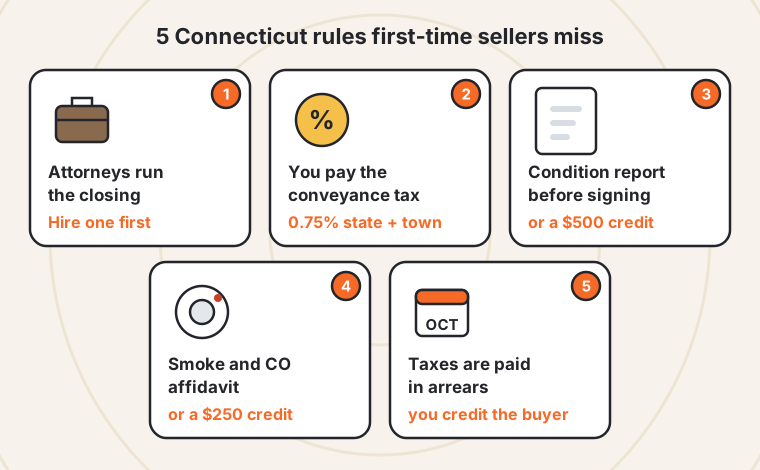
- Selling in Connecticut has its own rules. An attorney runs the closing, the seller pays the conveyance tax, and property taxes are settled in arrears, which usually means a charge to you at closing, not a refund.
- Two forms come with penalties if you skip them: the Residential Property Condition Report before the buyer signs (or a $500 credit) and the smoke and carbon monoxide affidavit at closing (or a $250 credit).
- The disclosure form changed on July 1, 2025. It now includes a flood section, and it asks foundation questions that matter in crumbling-foundation towns.
- Start about three months before you want to list if you can: attorney, title check, payoff, inspections and paperwork take longer than the listing itself.
- Compare offers on net, not price, and verify every buyer’s financing before you take the house off the market.
- Tick the boxes as you go. The checklist below saves your progress on this device.
Selling a house for the first time is a lot of small decisions with a few big ones hidden among them, and Connecticut adds rules that national checklists never mention. This page puts every step and every Connecticut rule in one place, in the order you will meet them, with links to our deeper guides where you need more. It is part of our guide on how to sell a house in Connecticut.
What should a first-time home seller in Connecticut know before selling?
A first-time home seller in Connecticut should know five things before selling: closings are run by attorneys, so you hire one; you pay the state and town conveyance tax; you must give the buyer the property condition report before they sign; you sign a smoke and carbon monoxide affidavit at closing; and property taxes are paid in arrears, so you usually credit the buyer at closing.
| What first-timers expect | What is true in Connecticut |
|---|---|
| “The agent handles the closing.” | Connecticut closings are handled by attorneys. In practice the buyer and the seller each have one, and the buyer’s lender requires one. |
| “Closing costs are the buyer’s problem.” | The seller pays the conveyance tax: 0.75% of the price to the state up to $800,000, plus 0.25% to most towns or 0.50% in 16 cities (CGS 12-494). |
| “I prepaid my taxes, so I get money back.” | Connecticut towns tax in arrears. At closing the attorneys split the tax by day, and the seller usually credits the buyer for the part not yet billed. |
| “Disclosure is optional if I sell as-is.” | The Residential Property Condition Report applies with or without an agent and as-is. Skip it and you credit the buyer $500 (CGS 20-327c). |
| “Smoke detectors are the buyer’s job.” | You sign an affidavit about smoke and carbon monoxide detectors at closing, or credit the buyer $250 (CGS 29-453). |
| “The buyer gets the oil in the tank.” | By Connecticut custom, the buyer reimburses you for the heating oil left in the tank. |
| “My agent’s fee covers everyone.” | Since August 17, 2024, buyers sign their own agreement with their agent, and many ask the seller to pay that fee in the offer. It is negotiable. |
How far ahead should you start getting ready to sell?
You should start getting ready to sell your Connecticut house about 90 days before you want to list if you can. That leaves time to hire an attorney, check title and your payoff, do the inspections Connecticut buyers ask about, make repairs and fill in the disclosure forms. Once listed, expect about one to two months on the market and 30 to 45 days from contract to closing with a mortgage buyer.
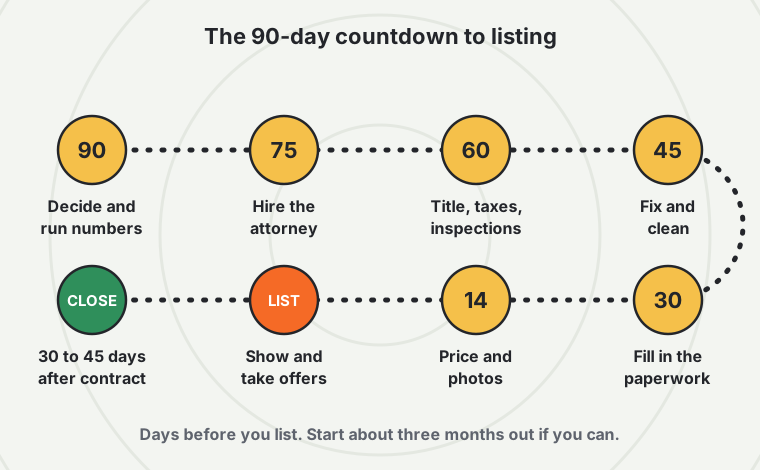
About 90 days out: decide and run the numbers
Decide why and when you are selling, where you will go, and which route fits: a listing agent, selling by owner, or a direct cash sale. Get a payoff estimate and estimate your net.
About 75 days out: build your team
Hire a Connecticut real estate attorney. Interview two or three listing agents if you will use one.
About 60 days out: check title, taxes and the house
Have your attorney check title. Ask the tax collector and water and sewer authority for balances. Order the inspections that matter in Connecticut: septic, well, radon, oil tank status.
About 45 days out: fix and clean
Repair what inspectors and lenders flag, deep clean, declutter and handle smoke and carbon monoxide detectors.
About 30 days out: paperwork
Fill in the Residential Property Condition Report, the lead paint disclosure if built before 1978, and the foundation report if your town is on the list. Gather receipts and permits.
About 14 days out: price and photos
Set the price from closed sales and book photos on a bright day.
List, show, compare offers, sign
Typical time on market in Connecticut ranged from about 28 days in spring 2026 to about 60 in January. Verify financing before you sign.
Contract to closing: 30 to 45 days
Inspection, appraisal, mortgage commitment, title search, payoff, walkthrough, closing.
The full clock for each route is in how long it takes to sell a house in Connecticut, and the best months to list, from state data, are in the best time to sell a house in Connecticut.
What should you decide before you sell your Connecticut house?
Before you sell your Connecticut house, decide why you are selling and by when, where you will live next, which route you will use (agent, by owner or direct cash sale), and the lowest net you will accept. Then check what you owe, estimate the costs, and confirm that everyone on the deed agrees to sell. These answers drive every later step.
- Write down why you are selling and the date you need to be out
- Decide where you will live next, and whether you must sell before you buy
- Ask your lender for a payoff estimate (include any home equity line)
- Look up your deed at the town clerk and list everyone on title
- Confirm every owner (spouse, co-owner, heirs) agrees and can sign
- Estimate your net: price minus payoff, commissions, conveyance tax, attorney, tax proration, repairs
- Decide your route: listing agent, flat-fee MLS, by owner, or a direct cash sale
- Pick your walk-away number before you see an offer
- If an owner has died, contact the Probate Court before anything else
- If you are behind on the mortgage, note any court dates and talk to your lender and an attorney now
Estimate your net in the calculator below. It includes Connecticut’s conveyance tax by town and the usual seller costs.
How much would you walk away with?
Slide the numbers to match your house. It works in your browser; nothing is saved or sent.
Estimates for planning. Conveyance tax per CGS 12-494 (state 0.75% up to $800,000, 1.25% to $2.5M, 2.25% above, plus the town rate). Seller attorney about $1,200 to $1,500; flat-fee MLS about $400; listings include three months of taxes, insurance and utilities, a cash sale about two weeks. Your attorney gives you the final numbers.
For every cost line in detail, see closing costs in Connecticut. If the house is inherited, start with selling an inherited house in Connecticut; if you are behind on payments, read selling a house in foreclosure first.
Who do you need on your team to sell a house in Connecticut?
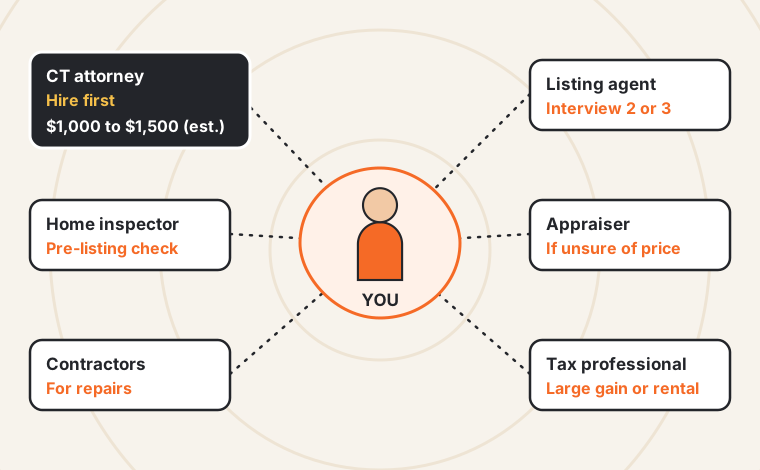
To sell a house in Connecticut you need a Connecticut real estate attorney, because attorneys run closings here, and usually a listing agent unless you sell by owner or directly to a cash buyer. You may also want a home inspector for a pre-listing inspection, a licensed appraiser if you are unsure of the price, and contractors for repairs. Hire the attorney first.
- Hire a Connecticut real estate attorney; get the fee in writing
- Interview two or three listing agents (if using one); ask for recent sales near you and a marketing plan
- Read the listing agreement: commission, length, cancellation terms, what you pay the buyer’s agent
- Decide whether to offer to pay a buyer’s agent, and how much
- Consider a pre-listing home inspection
- Consider a pre-listing appraisal if you are unsure of the price
- Line up a tax professional if you will have a large gain, a rental, or a second home
Ask friends who sold recently, your agent, or the Connecticut Bar Association’s lawyer referral service. Ask what the flat fee covers, who will attend the closing, and whether they handle title issues and payoffs. A straightforward sale often costs about $1,000 to $1,500 in attorney fees (est.).
Thinking of skipping the agent? Our guide to selling a house without an agent in Connecticut covers the ten steps and the savings honestly.
What should you check about your title, mortgage and taxes?
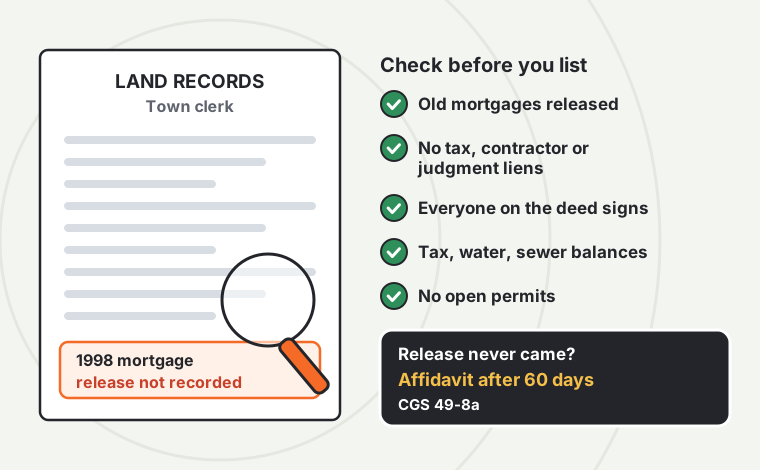
Before you list, check that your title is clean (every old mortgage released, no liens, everyone on the deed able to sign), get your mortgage payoff estimate, and check your property tax, water and sewer balances. Finding these early lets your attorney fix them while the house is on the market instead of delaying your closing.
- Ask your attorney for a quick title check before you list
- Confirm every mortgage you ever paid off was released on the land records
- Check for liens: unpaid taxes, contractor liens, judgment liens
- Get current balances from the tax collector and the water and sewer authority
- Ask the building department about any open permits
- Find your survey, deed and title insurance policy if you have them
- Locate receipts and permits for major work (roof, heating, septic, oil tank removal)
When you pay off a mortgage, the lender must release it on the land records. If the release never arrives, Connecticut law lets an attorney or title company record an affidavit after 60 days (CGS 49-8a), and the lender can owe damages (CGS 49-8). Old unreleased mortgages are one of the most common reasons Connecticut closings slip; find them before your buyer’s attorney does.
What disclosures and forms does a Connecticut seller need?
A Connecticut seller needs the Residential Property Condition Report (the version effective July 1, 2025) before the buyer signs, the federal lead paint disclosure for homes built before 1978, and at closing the smoke and carbon monoxide affidavit, the deed and the conveyance tax return (Form OP-236). Your attorney prepares most closing documents.
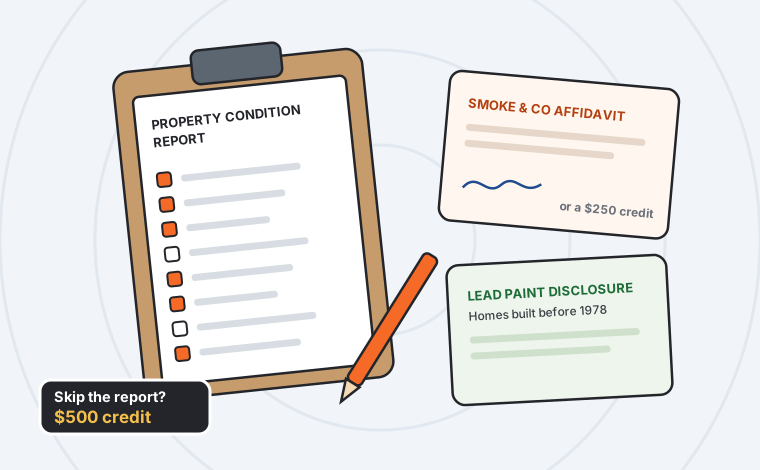
- Download the current Residential Property Condition Report from the Department of Consumer Protection
- Fill it in honestly, including the flood questions added in 2025; “unknown” only when you truly do not know
- Deliver it to the buyer before they sign a binder or contract (keep proof)
- In a crumbling-foundation town, answer the report’s foundation questions carefully (the separate foundation report is only for homes sold after a foreclosure, deed in lieu, or by a town)
- Built before 1978: complete the lead paint disclosure and give the EPA pamphlet
- Gather inspection reports, septic pumping records, well tests and radon results you have
- Gather the oil tank removal letter and lab results if a tank was removed
- Give your attorney your deed, payoff information and Social Security number for the 1099-S
- Plan for the smoke and carbon monoxide affidavit at closing
| Document | When | Rule |
|---|---|---|
| Residential Property Condition Report | Before the buyer signs | CGS 20-327b; $500 credit if not delivered (20-327c). New form effective July 1, 2025 (Public Act 25-33 added flood questions). |
| Residential Foundation Condition Report | Only for homes in crumbling-foundation towns sold after a foreclosure or deed in lieu, or by a town | Department of Consumer Protection form, CGS 20-327b(g)-(h). |
| Lead-based paint disclosure and EPA pamphlet | Before the contract, homes built before 1978 | Federal rule; the buyer gets a 10-day opportunity to test unless waived. |
| Smoke and carbon monoxide affidavit | Closing | CGS 29-453; $250 credit if not provided. |
| Deed | Closing | Prepared by your attorney; recorded at the town clerk. |
| Conveyance tax return (Form OP-236) | Closing | CGS 12-494; tax paid before the deed is recorded. |
| Non-foreign (FIRPTA) affidavit | Closing | Federal: if the seller is a foreign person, the buyer generally must withhold 15% of the amount realized. |
| Form 1099-S | Closing | Federal reporting of the sale, usually filed by the closing attorney. |
The full walk-through of the disclosure form is in our guide to the Connecticut property condition disclosure, and every document, with where to get it, is in the documents you need to sell a house in Connecticut.
How do you prepare a Connecticut house for sale?
To prepare a Connecticut house for sale, deep clean and declutter, fix what inspectors and lenders flag (leaks, broken heat, electrical hazards, missing handrails, peeling paint on older homes), make sure smoke and carbon monoxide detectors work, and find out the status of the Connecticut items buyers ask about: the oil tank, septic, well, radon and, in some towns, the foundation. Skip big remodels.
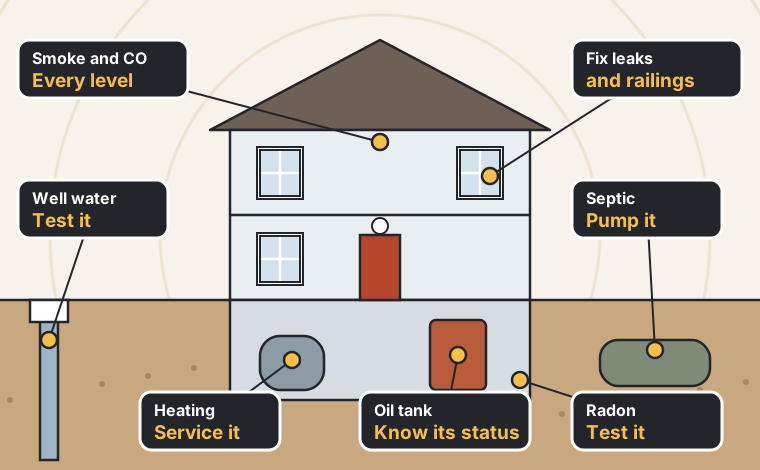
- Deep clean, including windows, carpets and the basement
- Declutter and remove personal photos; rent storage if needed
- Fix leaks, broken fixtures, doors, windows and loose railings
- Service the heating system and keep the receipt
- Install working smoke and carbon monoxide detectors
- Find out whether there is (or was) an underground oil tank; get removal paperwork if it was removed
- Pump and inspect the septic; keep the report
- Test the well water if you have one
- Test for radon
- Touch up or repaint in neutral colors where walls are marked or bold
- Clean up the yard, trim shrubs, clear gutters and walkways
- Get quotes for big items you will not fix (roof, foundation) so buyers see a number
Not sure which repairs pay back? See what to fix before selling a house in Connecticut, the low-cost list in cheap upgrades before selling, and the Connecticut inspection items in oil tanks, septic, wells and radon. In north-central and eastern Connecticut, read selling a house with a crumbling foundation.
Connecticut’s Department of Energy and Environmental Protection sets no deadline to remove a residential heating oil tank, but a leaking tank must be emptied and removed promptly, and many buyers, lenders and insurers want an old buried tank gone. Removal needs a trained contractor and often a town permit. Keep the contractor’s letter and the soil test results; buyers’ attorneys ask for them.
How should a first-time seller price and list a Connecticut house?
A first-time seller should price a Connecticut house from the closed sales of similar houses nearby in the last three to six months, adjusted honestly for size and condition, not from asking prices or online estimates. List with bright photos of every room and the systems buyers ask about, complete facts (heating fuel, sewer or septic, taxes, year built), and on SmartMLS so buyer agents see it.
- Pull 3 to 6 closed sales near you from the last 3 to 6 months
- Adjust honestly for size, condition, updates and lot
- Check your town’s median sale price and number of sales on our town page
- Consider a pre-listing appraisal if the comparables disagree
- Pick a price that fits buyers’ search bands (for example $349,900, not $359,900)
- Book photos on a bright day; include the heating system, panel and water heater
- Write a listing with facts buyers filter on and recent work with years
- Get on SmartMLS (through an agent or flat-fee service) and the major portals
- Put the disclosure forms where buyers’ agents can get them
Our town pages list each town’s median sale price, number of sales and mill rate from state records, for example Manchester, Milford, Glastonbury, Danbury and Wethersfield.
Not sure where to start on price?
Get a free Home Forecast: your likely sale price from recent sales near you, how long each route would take, and what you would net either way. It follows your market, so you can list when the timing is right.
Know where you stand,
on your own time.
Watch what homes around you sell for and how fast, so when you are ready, you already know your options.
Follow your numbers as the market moves, and decide when the timing is right.
How do you handle showings when selling for the first time?
To handle showings when selling for the first time, make the house easy to see (a lockbox and short-notice showings), leave during showings, keep valuables, medications and paperwork locked away, and keep the house clean and bright every day it is listed. Ask your agent for feedback after every showing; it is the best early warning that something needs to change.
- Allow short-notice showings and use a lockbox
- Leave the house during showings; take pets with you
- Lock away valuables, medications, mail and financial papers
- Keep lights on, blinds open, temperature comfortable
- Keep walks and driveway clear in winter
- Ask for buyer-agent feedback after each showing
- Do not discuss your reasons for selling or your lowest price with buyers
- Review showings and feedback with your agent after two weeks
If showings come and offers do not, see why won’t my house sell? for the Connecticut causes and fixes.
How should a first-time seller handle offers in Connecticut?
A first-time seller in Connecticut should compare offers on net, not price: subtract the buyer’s agent fee, credits, expected repairs, the conveyance tax, the attorney and carrying costs. Then weigh certainty: financing type, down payment, contingencies, appraisal gap coverage and deposit. Verify the buyer’s pre-approval with the lender, and let your attorney review the contract before you sign.
- Get every offer in writing, with a pre-approval letter or proof of funds
- Calculate each offer’s net, not just the price
- Check financing type and down payment (cash, conventional, FHA, VA)
- Check the mortgage commitment date and the inspection window
- Look for an appraisal gap clause if the price is above recent sales
- Call the lender to verify the pre-approval
- Confirm the deposit amount and that it goes into an attorney’s or broker’s escrow
- Make sure the buyer received the condition report before signing
- Have your attorney review or draft the contract
- Agree on a closing date that fits your move
The full method, with three offers compared line by line, is in how to compare offers on a house in Connecticut.
What happens between the contract and the closing for a Connecticut seller?
Between the contract and the closing, the Connecticut seller’s job is to keep the deal on track: give access for the inspection and appraisal, answer repair requests with your attorney, keep the house in the same condition, and get ready to move. Your attorney orders your payoff, prepares the deed and Form OP-236, and works out the tax proration and the oil adjustment, usually over 30 to 45 days.
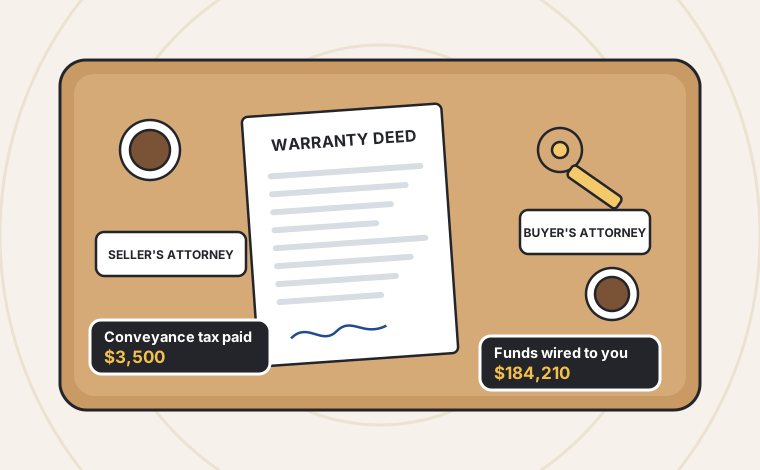
- Give access for the home inspection and any septic, well or radon tests
- Review the buyer’s repair or credit request with your attorney; respond in writing
- Give access for the appraisal
- Track the mortgage commitment date; ask your attorney to confirm it was met
- Book movers and plan your move-out date
- Schedule final water, sewer and oil readings for the closing day
- Keep the house heated, insured and maintained until closing
- Remove everything not included in the sale; leave keys, codes and manuals
- Check the projected closing statement from your attorney a few days early
- Be ready for the buyer’s final walkthrough, usually the day before or the day of closing
Step-by-step detail on each part is in the Connecticut closing process for sellers.
What happens at a Connecticut closing for the seller?
At a Connecticut closing, the seller signs the deed, the conveyance tax return (Form OP-236), the smoke and carbon monoxide affidavit and the closing statement; the buyer’s funds are wired; your attorney pays off your mortgage, the conveyance tax and any liens; the deed is recorded at the town clerk; and you receive the balance, usually the same day or the next business day.
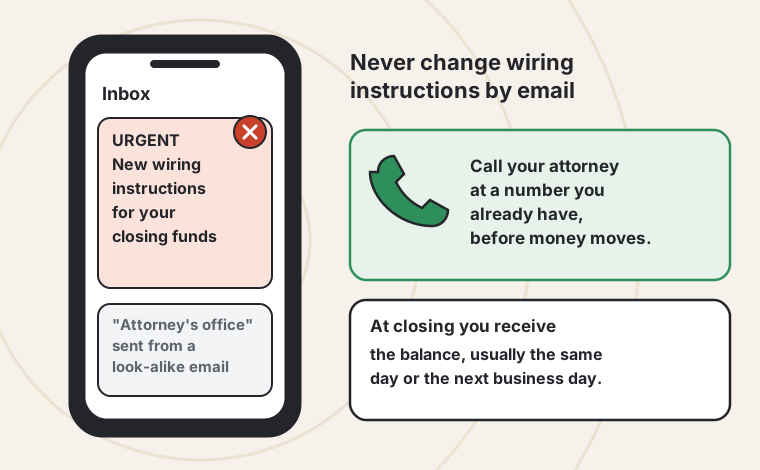
- Bring a photo ID and any documents your attorney asked for
- Review the closing statement: price, tax proration, oil adjustment, payoff, conveyance tax
- Sign the deed, Form OP-236 and the smoke and carbon monoxide affidavit
- Sign the non-foreign (FIRPTA) affidavit
- Hand over keys, garage openers and alarm codes
- Confirm how and when your proceeds will arrive (verify wiring instructions by phone with your attorney)
Scammers send fake emails that look like they come from attorneys with “updated” wiring instructions. Never change wiring instructions based on an email. Call your attorney at a number you already have before any money moves.
What should you do after you sell your house in Connecticut?
After you sell your house in Connecticut, cancel your homeowners insurance once the deed is recorded, close utility accounts, forward your mail, keep the closing statement and records of your purchase and improvements for taxes, and report the sale on your tax return if required. Most owners who lived in the home 2 of the last 5 years owe no federal tax on up to $250,000 of gain ($500,000 for a married couple).
- Confirm with your attorney that the deed was recorded and your mortgage paid off
- Cancel homeowners insurance after recording; ask for a refund of the unused premium
- Check for an escrow refund from your old lender
- Close or transfer electric, gas, water, internet and trash accounts
- Forward your mail and update your address with banks and agencies
- Keep the closing statement, the 1099-S and records of your purchase and improvements
- Check the home-sale exclusion (IRS Publication 523); talk to a tax professional if your gain is large or the house was a rental or second home
- Remember Connecticut taxes capital gains as income, at rates up to 6.99%
- Watch for the release of your mortgage on the land records
More on taxes in taxes when selling a house in Connecticut.
What are all the Connecticut rules for home sellers in one place?
All the Connecticut rules for home sellers fit in one table: the property condition report and $500 credit, the foundation report in listed towns, the federal lead paint rule, the smoke and carbon monoxide affidavit and $250 credit, the conveyance tax and Form OP-236, taxes assessed October 1 and paid in arrears, attorney-run closings, the oil adjustment, mortgage releases and probate authority for estates.
| Rule | What it requires | Source |
|---|---|---|
| Property condition disclosure | Give the Residential Property Condition Report before the buyer signs; credit $500 at closing if you do not | CGS 20-327b, 20-327c; DCP form effective July 1, 2025 (PA 25-33) |
| Foundation condition report | Only for homes in crumbling-foundation towns sold after a foreclosure or deed in lieu, or by a town | DCP Residential Foundation Condition Report; CGS 20-327b(g)-(h) |
| Lead-based paint | Homes built before 1978: disclose known lead paint, give the EPA pamphlet, allow a 10-day test opportunity | Federal (EPA/HUD) |
| Smoke and carbon monoxide | Sign the affidavit at closing (one- and two-family homes and condo units) or credit $250 | CGS 29-453 |
| Conveyance tax | Seller pays 0.75% state (more above $800,000) plus 0.25% or 0.50% town; Stamford has its own rate | CGS 12-494; OLR 2020-R-0020; Form OP-236 |
| Property tax | Towns assess property at 70% of value as of October 1; taxes paid in arrears and prorated at closing | CGS 12-62a; closing custom |
| Attorney closings | Closings handled by attorneys; buyer and seller each usually have one | Connecticut practice |
| Heating oil | Buyer reimburses the seller for oil left in the tank | Connecticut custom |
| Mortgage release | Lender must release a paid mortgage; affidavit possible after 60 days | CGS 49-8, 49-8a |
| Estates | A fiduciary sells; the Probate Court may need to authorize the sale | CGS 45a-164 |
| Residential oil tanks | No removal deadline; a leaking tank must be removed promptly | DEEP guidance |
| Buyer agent pay | Negotiable; no longer offered on the MLS | NAR settlement, effective Aug 17, 2024 |
| Federal tax | $250,000/$500,000 home-sale exclusion (2 of 5 years); FIRPTA withholding for foreign sellers; 1099-S reporting | IRS Publication 523; IRS FIRPTA |
| Connecticut income tax | Gains taxed as income, top rate 6.99% | Connecticut DRS |
What mistakes do first-time sellers make in Connecticut?
The mistakes first-time sellers make in Connecticut are pricing from hope instead of closed sales, hiring the attorney too late, skipping or rushing the property condition report, forgetting the conveyance tax and the property tax credit at closing, accepting an unverified buyer, ignoring the oil tank, septic or foundation until the inspection, and moving out before the house is insured and heated for vacancy.
- Pricing from hope. Use closed sales, not neighbors’ asking prices.
- Hiring the attorney last. Title problems need time.
- Skipping the disclosure form. $500 credit, nervous buyers, and no protection for known defects.
- Budgeting without the conveyance tax. It is 1% or more of the price on most homes.
- Expecting a tax refund. In Connecticut you usually credit the buyer.
- Trusting a pre-approval letter. Call the lender.
- Letting the inspection find the oil tank. Find it, and its paperwork, first.
- Changing wiring instructions by email. Always call your attorney.

First-time sellers worry most about the listing: the photos, the open house, the first offer. The part that actually goes wrong is usually quieter. It is the paperwork nobody started, the old mortgage nobody released, the oil tank nobody mentioned. If you do only three things early, hire the attorney, check the title and find out what is buried in the yard.
Is listing your house the right route for a first sale?
Listing your house is the right route for most first-time sellers in Connecticut whose house is in good shape and who have a few months: the open market usually brings the highest price. A direct cash sale can be the better route when the house needs major work, lenders will not finance it, you face a deadline (a move, an estate, a foreclosure), or the months of carrying costs and showings would eat the difference.
We buy houses for cash, so read this knowing that. If your house is ready and you have time, list it, and use this checklist. If you are not sure, the self-check below compares the routes in two minutes, and our cash buyer vs. realtor comparison shows the math side by side.
Is a cash sale right for you, or should you list?
Seven quick questions. There is no wrong answer, and we will tell you honestly if listing would leave you more.
- Does the house need repairs you would rather not pay for or manage?
- Do you need to close by a certain date, or within the next month or two?
- Would showings be hard: tenants, belongings, privacy, or you live out of state?
- Is there a complication: an estate or probate, a divorce, foreclosure, liens or back taxes?
- Could you comfortably cover the mortgage, taxes and utilities for three or more months?
- Is getting the highest possible price more important to you than speed and certainty?
- Would a buyer's bank lend on the house as it is (no major roof, foundation, oil tank or code issues)?
Questions first-time sellers in Connecticut ask
Do I need a lawyer to sell my house in Connecticut?
In practice, yes, you need a lawyer to sell your house in Connecticut. Closings are run by attorneys, the buyer’s lender requires one, and your attorney prepares the deed and conveyance tax return, orders your payoff and protects you in the contract. A simple sale often costs about $1,000 to $1,500 (est.).
What do I have to disclose when selling a house in Connecticut?
When selling a house in Connecticut you have to disclose what you know on the Residential Property Condition Report before the buyer signs, plus known lead paint for homes built before 1978 and, in listed towns, the foundation condition report. Skipping the condition report costs a $500 credit.
How much does it cost to sell a house in Connecticut?
Selling a house in Connecticut typically costs the commissions you agree to, the conveyance tax (about 1% to 1.25% on most homes), your attorney (about $1,000 to $1,500, est.), the property tax proration, any repairs or credits, and carrying costs. Use the calculator on this page for your numbers.
Who pays the conveyance tax in Connecticut?
The seller pays the conveyance tax in Connecticut: 0.75% of the price to the state up to $800,000 (more above that) plus 0.25% to most towns, or 0.50% in 16 cities, paid at closing before the deed is recorded (CGS 12-494).
Why do I owe property taxes at closing?
You owe property taxes at closing because Connecticut towns tax in arrears. The attorneys split the tax year by day, and the seller usually credits the buyer for the share of the time they owned the house that has not been billed or paid yet.
What is the smoke and carbon monoxide affidavit?
The smoke and carbon monoxide affidavit is a statement you sign at a Connecticut closing about the smoke and carbon monoxide detectors in a one- or two-family home or condo unit (CGS 29-453). If you do not provide it, you credit the buyer $250.
Should I get a home inspection before I sell?
A home inspection before you sell is not required in Connecticut, but it helps a first-time seller find and fix or disclose problems before the buyer’s inspector does. Septic, radon, well and oil tank checks are the Connecticut items most worth doing early.
Do I have to fix everything before selling?
No, you do not have to fix everything before selling in Connecticut. Fix safety items and anything a lender or inspector will flag, clean and declutter, and price or disclose the rest. Big remodels rarely pay back. You can also sell as-is, but you still complete the disclosure report.
How long does it take to sell a house in Connecticut for the first time?
Selling a house in Connecticut for the first time typically takes about two to four months with an agent: a few weeks of prep, about one to two months on the market depending on the season, and 30 to 45 days from contract to closing with a mortgage buyer.
Do I have to pay the buyer’s agent?
No, you do not have to pay the buyer’s agent in Connecticut. Since August 17, 2024, buyers sign their own agreement with their agent, and the fee is negotiable. Many buyers ask the seller to pay it in the offer, and you can accept, reduce or decline.
Will I pay capital gains tax when I sell my home?
Usually you will not pay capital gains tax when you sell your main home if you owned and lived in it for 2 of the last 5 years: up to $250,000 of gain ($500,000 for a married couple) is excluded from federal tax (IRS Publication 523). Gains above that are taxed federally and by Connecticut as income.
What happens to the oil left in my tank?
The oil left in your tank stays with the house, but by Connecticut custom the buyer reimburses you for it at closing, at the current price per gallon. Get a tank reading or a receipt from your oil company before closing.
When do I get my money after closing?
You usually get your money the day of closing or the next business day in Connecticut. Your attorney pays off your mortgage, the conveyance tax and other charges, then wires or hands you the balance. Confirm wiring instructions by phone, never by email.
Can I sell my house if my parent’s name is still on the deed?
If a parent who has died is still on the deed, the house usually has to go through the Connecticut Probate Court before it can be sold, unless title passed automatically to a surviving joint owner. A fiduciary then sells, sometimes with the court’s approval (CGS 45a-164).
Should I sell before I buy my next house?
Whether to sell before you buy depends on your finances. Selling first gives you cash and certainty but may mean a temporary move; buying first can mean two payments. Some buyers make offers contingent on selling their home, which sellers often see as weaker.
This checklist is the practical side of a bigger guide. For every route and every step explained, read how to sell a house in Connecticut.
Related Connecticut guides
Before you list
Money and process
Sources
- CGS § 20-327b and § 20-327c (property condition report; $500 credit) and the Department of Consumer Protection real estate page (Residential Property Condition Report and Residential Foundation Condition Report effective July 1, 2025).
- Public Act 25-33, §§ 3-4 (flood questions added to the condition report), and OLR Report 2025-R-0113, 2025 Acts Affecting Housing and Real Estate.
- CGS § 29-453 (smoke and carbon monoxide affidavit; $250 credit).
- CGS § 12-494 (conveyance tax), OLR Report 2020-R-0020 and DRS real estate forms (Form OP-236).
- CGS § 12-62a (October 1 assessment date; 70% assessment ratio).
- CGS § 49-8 and § 49-8a (mortgage releases).
- CGS § 45a-164 (Probate Court authorization to sell real property).
- EPA and HUD Lead-Based Paint Disclosure Rule.
- Connecticut DEEP, Residential Home Heating Oil Tanks FAQs.
- IRS Publication 523, Selling Your Home and IRS FIRPTA withholding; Connecticut Department of Revenue Services.
- NAR settlement practice changes, effective August 17, 2024.
- Realtor.com, Median Days on Market in Connecticut, via FRED.
- Connecticut Bar Association Lawyer Referral Service.
See the house together.
Pick a time that works.
Choose a time for us to walk through the property with you, or ask for a quick call first. We confirm every request personally.
Tuesday, January 13
No open times in the next few weeks. Please call us.
We will confirm by email. Nothing is booked until we do.
View my request
Who wrote this
Jerryll Noorden
Jerryll has bought and sold Connecticut houses since 2016 and has sat at more closing tables than he can count, on both sides. Before real estate he was a robotics scientist at NASA, IHMC and IIT. He wrote this guide because the national sites that rank for it skip the Connecticut rules that cost sellers money. When listing or selling it yourself would get you more than a cash offer, he says so.
This guide explains Connecticut rules in plain English. It is not legal or tax advice. Laws change; for your sale, talk to a Connecticut real estate attorney and a tax professional.
