
Key facts at a glance
This page is one chapter of our guide on how to sell a house in Connecticut. It is a worksheet: five questions, each with a blank to fill in, worked through with South Windsor numbers.
| Fact | Number | Source |
|---|---|---|
| South Windsor single-family sales, Oct 2024 to Sep 2025 | 237, median $460,000 | data.ct.gov sales file (OPM) |
| South Windsor condo sales, same period | 161, median $275,000 | data.ct.gov sales file (OPM) |
| Property tax on a $460,000 house, fiscal 2027 | About $11,917 a year ($993 a month) at 37.01 mills | OPM mill rates; CGS 12-62a |
| Conveyance tax on a $460,000 sale | $4,600 (0.75% state + 0.25% town) | CGS 12-494 |
| Hartford County median days on market, 2024 | 12 in May; 46 in January and December | Realtor.com via FRED |
| 30-year fixed mortgage rate, week of Oct 22, 2026 | 7.32% | Freddie Mac PMMS via FRED |
| Home-sale gain you can exclude from tax | $250,000 single; $500,000 married filing jointly | IRS Publication 523 |
Why does thinking about selling your South Windsor house feel so heavy?
Thinking about selling your South Windsor house feels heavy because one decision touches your money, your family, your schedule and your next home all at once, and most of the numbers are guesses until you write them down. Owners at this stage often feel unsure, a little guilty, overwhelmed by advice, wary of being sold to, and quietly hopeful that a change would make life easier.
Maybe the raised ranch off Avery Street is too much house now. Maybe the commute changed, a job offer came from out of state, or the monthly bills crept up while the kids grew up and left. Everyone has an opinion: the neighbor who sold last spring, the agent who left a card, the postcard that says “we buy houses”.
The way out of that fog is not more opinions. It is five questions with five blanks, filled in with your own numbers. This page is for you if you want to make the decision yourself, on paper, before anyone tries to make it for you.
I am Jerryll Noorden. I have bought houses in Connecticut since 2016, about ten a year. Buying houses is my business, so I will show you the worked numbers and tell you plainly where listing beats selling to someone like me. If you are still asking whether to sell at all, read should I sell my house in Connecticut? first; this page assumes you are seriously considering it.
What questions should you ask yourself before selling your house?
The questions to ask yourself before selling your house are five: what would I walk away with, what does staying cost me each month, what can I afford next, when do I need to be out, and which way of selling nets me the most for my situation. Each one has a number or a date for an answer, and together they show whether selling makes sense and how.

Print this or copy it into a note. Tick each line when you have a real number, not a guess:
- 1. Equity: what I would walk away with after payoff and costs = $ ______
- 2. Monthly cost of staying (mortgage, tax, insurance, heat, upkeep) = $ ______
- 3. Next-home budget (cash for down payment + monthly payment I can carry) = $ ______ down, $ ______ a month
- 4. Date I need to be out, and the latest date I could close = ______
- 5. Best route for me: list / sell by owner / sell as-is, and why = ______
Each section below explains one blank and fills it in for an example house at South Windsor’s single-family median of $460,000. The example owner is illustrative, built only from public numbers; replace every input with yours.
Question 1: How much would you walk away with if you sold your South Windsor house?
How much you would walk away with if you sold your South Windsor house is the sale price minus your mortgage payoff, the conveyance tax (1% total here, $4,600 on $460,000 under CGS 12-494), your attorney and any commissions. In our illustrative example, a $460,000 sale with a $210,000 payoff leaves about $220,900 before tax prorations and moving costs.
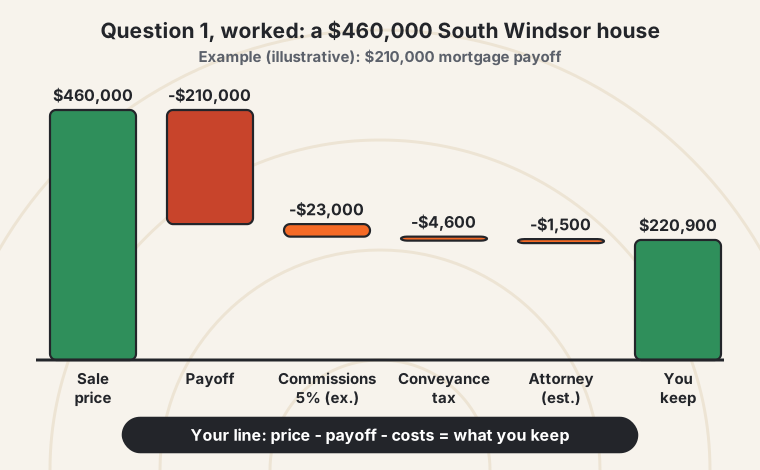
| Line | Example | Your number |
|---|---|---|
| Likely sale price | $460,000 (town single-family median) | $ ______ |
| Mortgage and home-equity payoff | -$210,000 (illustrative) | $ ______ |
| Commissions, if you list | -$23,000 (5% example) | $ ______ |
| Conveyance tax | -$4,600 ($3,450 state + $1,150 town) | $ ______ |
| Your attorney | -$1,500 (est.) | $ ______ |
| What you keep | $220,900 | $ ______ |
Two South Windsor points make this blank bigger than many owners expect. First, prices have climbed: the town’s single-family median was $291,000 for sales recorded October 2019 to September 2020 and $460,000 five years later (data.ct.gov). Second, if you lived there two of the last five years, up to $250,000 of gain ($500,000 for a married couple filing jointly) is tax-free (IRS Pub. 523). Most South Windsor owners selling a main home owe no income tax on the gain; our guide to taxes when selling a house in Connecticut covers the exceptions.
Not sure of the price? Do not use the highest sale on your street. Use three recent sales of houses like yours, and read how to price a house to sell, written for neighboring Vernon.
Question 2: What does staying in your South Windsor house cost each month?
What staying in your South Windsor house costs each month is your mortgage payment plus about $993 in property tax on a $460,000 house at 37.01 mills, plus insurance, heat, utilities and a repair allowance. Writing the true monthly total down matters because it is the number you compare with your next home, and because every month you wait to sell is a month you keep paying it.
| Monthly cost | Example | Your number |
|---|---|---|
| Mortgage principal and interest | From your statement | $ ______ |
| Property tax | $993 ($460,000 x 70% x 37.01 / 1,000 / 12) | $ ______ |
| Homeowners insurance | From your policy / 12 | $ ______ |
| Heat and utilities | Gas or oil bills / 12 | $ ______ |
| Repairs and upkeep allowance | Your choice of a yearly set-aside / 12 | $ ______ |
| Total to stay | $ ______ |
At 37.01 mills, tax is a big share of the monthly total even on a paid-off house. Heating is the other line that varies: in the town’s 2025 parcel data, 51% of houses heat with gas and 46% with oil, and oil prices in Connecticut rose sharply this fall (U.S. EIA).
The repair line is the honest one. South Windsor’s median house was built in 1969, so roofs, windows and heating systems are often on their second or third round. If you would have to spend real money in the next two years either way, put it here.
Question 3: What can you afford for your next home?
What you can afford for your next home depends on the cash you walk away with (question 1) and the monthly payment you can carry. At the 7.32% average 30-year rate in late October 2026, every $100,000 you borrow costs about $687 a month in principal and interest. A $275,000 South Windsor condo, the town’s median, with 20% down means a $220,000 loan at about $1,511 a month plus about $594 in tax.

Fill in this blank in two parts:
- Cash for the next home = what you keep from question 1, minus moving costs and a cushion. In the example, $220,900 easily covers $55,000 (20%) down on a $275,000 condo, with money left over.
- Monthly payment you can carry = your income budget, not the bank’s maximum. Divide the loan by $100,000 and multiply by about $687 at 7.32% for principal and interest, then add tax, insurance and any condo fee.
Rates are the trap. If your current mortgage is at 3%, trading it for 7.32% can make a smaller home cost more each month than your bigger one. Run the numbers both ways before you assume downsizing saves money. If you are moving out of state for work, the relocating sellers page explains how to time a sale around a start date.
Question 4: When do you need to be out, and how long will the sale take?
When you need to be out decides which way you can sell. A listed South Windsor house typically needs time to find a buyer, from a median of 12 days on market in May 2024 to 46 in January and December across Hartford County, plus 30 to 60 days from contract to closing for a buyer with a mortgage. A cash sale can close in about two weeks or on a later date you choose.
Write two dates in this blank: the date you must be out (a job start, a lease, a school year, a new home’s closing) and the latest date you could close. Then count backward:
| Route | Prep | Find a buyer | Contract to closing |
|---|---|---|---|
| List in spring | 2 to 6 weeks | 12 to 29 days (Hartford County, April to June 2024) | 30 to 60 days |
| List in winter | 2 to 6 weeks | About 46 days (Jan and Dec 2024) | 30 to 60 days |
| Sell as-is for cash | None | Days | About 2 weeks, or your date |
If you are buying and selling at the same time, the hardest part is the gap between the two closings. Your options are to sell first and rent, buy first with a contingency or bridge money, or sell with a later closing or a short stay after closing. Our guide to selling and moving with kids explains use-and-occupancy and rent-back agreements, and when to sell a house in Guilford shows how much the season moves a shoreline market.
Question 5: Which way of selling nets you the most?
The way of selling that nets you the most is usually a listing when the house is in good shape and you have time, a by-owner sale when you can handle the work and want to save the listing fee, and an as-is cash sale when repairs, timing or stress would eat the difference. Compare the three with your own numbers from questions 1 and 4, not with anyone’s promise.
List with an agent
Highest priceBest for an updated house and a flexible date.
- Most buyers see it
- Commissions, prep, showings
- 30 to 60 days to close after a contract
Sell by owner
Saves a feeBest if you can price, show and negotiate.
- No listing commission
- You do the marketing and showings
- Same disclosure and closing rules
Sell as-is for cash
About 2 weeksBest for repairs, a tight date or an estate.
- No repairs, no showings
- You choose the closing date
- Lower price than a fixed-up retail sale
Put your numbers into the calculator to see the gap between listing and selling as-is:
How much would you walk away with?
Slide the numbers to match your house. It works in your browser; nothing is saved or sent.
Estimates for planning. Conveyance tax per CGS 12-494 (state 0.75% up to $800,000, 1.25% to $2.5M, 2.25% above, plus the town rate). Seller attorney about $1,200 to $1,500; flat-fee MLS about $400; listings include three months of taxes, insurance and utilities, a cash sale about two weeks. Your attorney gives you the final numbers.
Then check your gut with the self-check:
Is a cash sale right for you, or should you list?
Seven quick questions. There is no wrong answer, and we will tell you honestly if listing would leave you more.
- Does the house need repairs you would rather not pay for or manage?
- Do you need to close by a certain date, or within the next month or two?
- Would showings be hard: tenants, belongings, privacy, or you live out of state?
- Is there a complication: an estate or probate, a divorce, foreclosure, liens or back taxes?
- Could you comfortably cover the mortgage, taxes and utilities for three or more months?
- Is getting the highest possible price more important to you than speed and certainty?
- Would a buyer's bank lend on the house as it is (no major roof, foundation, oil tank or code issues)?
For the full cost of a listing, read the costs of listing with an agent in Connecticut. If you are selling because of a divorce, our South Windsor divorce guide covers the extra steps.
When should you NOT sell your South Windsor house to a cash buyer?
You should not sell your South Windsor house to a cash buyer when it is in good condition, you can wait 60 to 90 days, and the gap between your listing net and a cash offer is bigger than the repairs, holding costs and stress you would save. For an updated colonial or ranch in a steady market like South Windsor, a spring listing will usually put more money in your pocket.
I buy houses, and I would tell an owner with a clean, updated house and no deadline to list it. A cash sale makes sense when question 2 shows months of carrying costs you cannot afford, when question 4 gives you a date a listing cannot meet, or when the house needs work you will not do. If a move is forcing the date, see our page for relocating sellers. Read why cash offers are lower so the number does not surprise you, and check any buyer against these red flags.

The owners who feel best at closing are the ones who knew their payoff, their monthly cost and their move-out date before they took any offer. Ten minutes with your mortgage statement and tax bill saves weeks of second-guessing.
How do you fill in the worksheet, step by step?
You fill in the worksheet by gathering four documents (mortgage payoff, tax bill, insurance policy and last year’s utility bills), pulling three recent sales of houses like yours, writing your must-be-out date, and getting two numbers for your house: a listing estimate and an as-is offer. Most owners can finish it in an evening and a phone call or two.
Gather four documents
Mortgage payoff letter, tax bill, insurance declarations page and twelve months of heat and utility bills.
Find your price
Three recent South Windsor sales like your house, from the state sales file or an agent.
Fill blanks 1 to 3
Equity, monthly cost and next-home budget, using the tables above.
Write your dates
The day you must be out and the latest day you could close.
Get two numbers
A listing estimate and a free written as-is offer with no deadline. Then choose.
If an as-is offer is one of your two numbers, our South Windsor page explains how we buy there. A typical closing with us takes about two weeks, on the date you pick.
See the house together.
Pick a time that works.
Choose a time for us to walk through the property with you, or ask for a quick call first. We confirm every request personally.
Tuesday, January 13
No open times in the next few weeks. Please call us.
We will confirm by email. Nothing is booked until we do.
View my requestQuestions to ask before selling your house: FAQ
What questions should I ask myself before selling my house?
The questions to ask yourself before selling your house are: what would I walk away with, what does staying cost each month, what can I afford next, when do I need to be out, and which way of selling nets me the most. Each answer is a number or a date you can write down.
How do I figure out my equity?
You figure out your equity by taking a realistic sale price, based on three recent sales of similar houses, and subtracting your mortgage and home-equity payoff, the conveyance tax, your attorney and any commissions. In South Windsor, a $460,000 sale with a $210,000 payoff leaves about $220,900 in our example.
What is the median home price in South Windsor, CT?
The median home price in South Windsor, CT was $460,000 for the 237 single-family sales recorded from October 2024 to September 2025, and $275,000 for the 161 condo sales (data.ct.gov). Five years earlier, the single-family median was $291,000.
How much are property taxes in South Windsor?
Property taxes in South Windsor are about $11,917 a year, or $993 a month, on a $460,000 house at the fiscal 2027 mill rate of 37.01. Connecticut assesses at 70% of market value (CGS 12-62a), so tax is value x 70% x 37.01 / 1,000.
What does it cost to sell a house in South Windsor?
It costs a South Windsor seller a 1% conveyance tax ($4,600 on $460,000, CGS 12-494), an attorney fee, and, if you list, commissions; a 5% example is $23,000 on $460,000. Commissions are negotiable. A cash sale usually has no commission, but the price is lower.
How long does it take to sell a house in South Windsor?
It takes about one to three months to sell a listed house in South Windsor: Hartford County’s median was 12 days on market in May 2024 and 46 in January and December, plus 30 to 60 days from contract to closing. A cash sale can close in about two weeks.
Should I sell my house before buying another?
You should sell your house before buying another if you need the equity for the down payment and cannot carry two payments. If you buy first, you need a sale contingency or bridge money. A later closing or a short stay after closing can bridge the gap.
Do I pay tax when I sell my house in Connecticut?
You pay the conveyance tax on every Connecticut sale, and income tax only on a gain above the home-sale exclusion: $250,000 single or $500,000 married filing jointly if you owned and lived there two of the last five years (IRS Pub. 523). Connecticut taxes any remaining gain as income.
Is it better to list or sell to a cash buyer?
It is better to list when your house is in good shape and you have time, because listing usually brings a higher price. It is better to sell to a cash buyer when repairs, a tight move date or carrying costs would cost more than the price difference.
Related guides
- Should I sell my house in Connecticut? The signs
- I’m relocating and need to sell my house in Connecticut
- Should I sell my house in Easton? The stay-or-sell math
- Selling a house and moving with kids
- Best time to sell a house in Connecticut
- We buy houses in South Windsor, CT
For every route, cost and step in one place, start with our guide on how to sell a house in Connecticut.
Sources (checked on October 27, 2026)
- CT Office of Policy and Management, Real Estate Sales (data.ct.gov dataset 5mzw-sjtu)
- 2025 Connecticut Parcel and CAMA Data (data.ct.gov)
- Mill Rates for FY 2014-2027, OPM (data.ct.gov)
- Freddie Mac 30-year fixed rate mortgage average (FRED)
- Realtor.com: median days on market, Hartford County (FRED)
- U.S. EIA, Connecticut weekly residential heating oil price
- CGS 12-494, real estate conveyance tax
- CGS 12-62a, assessment at 70% of value
- IRS Publication 523, Selling Your Home
This guide is general information, not legal, tax or financial advice. For your own sale, talk to a Connecticut real estate attorney.

Who wrote this
Jerryll Noorden
Jerryll has bought and sold Connecticut houses since 2016 and has sat at more closing tables than he can count, on both sides. Before real estate he was a robotics scientist at NASA, IHMC and IIT. He wrote this guide because the national sites that rank for it skip the Connecticut rules that cost sellers money. When listing or selling it yourself would get you more than a cash offer, he says so.
This guide explains Connecticut rules in plain English. It is not legal or tax advice. Laws change; for your sale, talk to a Connecticut real estate attorney and a tax professional.
