
Key facts at a glance
This page is one chapter of our guide to how to sell a house in Connecticut. It answers one question for one city: which mistakes cost Norwalk sellers the most money and time? These are not generic staging tips; each mistake below comes from a Norwalk number or a Connecticut rule that changed recently.
| Fact | Number | Source |
|---|---|---|
| Norwalk market sales of homes, Oct 2024 to Sep 2025 | 894 sales, median $608,250 | OPM Real Estate Sales dataset, data.ct.gov (our query) |
| Single-family median vs. condo median | $760,000 vs. $392,500 | Same query (473 single-family, 360 condo sales) |
| Share of sales at $800,000 or more | 28.1% | Same query |
| Conveyance tax | 1.25% up to $800,000; 1.75% on the part above | CGS 12-494 (0.50% city rate on the whole price) |
| Real estate tax rates, fiscal 2027, six city districts | 22.9816 to 24.6708 mills | OPM mill rate data (data.ct.gov) |
| New “Flood Risk Awareness” section on the disclosure report | Since July 1, 2025 | Public Act 25-33, sec. 3 (CGS 20-327b) |
| Condo resale certificate deadline for the association | 10 business days after request and fee | CGS 47-270 |
Why do Norwalk sellers worry so much about making a mistake, and is this page for you?
Norwalk sellers worry about making a mistake because the stakes are high: at a single-family median of $760,000, a small error in price, paperwork or timing can cost more than a year’s property taxes. This page is for Norwalk owners, of a house near the water, a colonial in West Norwalk or a condo near SoNo, who want to know the specific mistakes that cost sellers here, and how to avoid each one.
Maybe someone told you to stay under $800,000 “because of the tax.” Maybe your house took on water in a storm years ago and you are not sure what to say. Maybe your condo board is slow and you are afraid it will cost you the buyer. People in your spot usually feel anxious, a little overwhelmed by conflicting advice, worried about legal exposure, and determined not to leave money on the table.
I am Jerryll Noorden. I have bought houses in Connecticut since 2016, about ten a year. At Norwalk prices, listing usually nets more than a cash sale, and I will say so below.
What are the biggest mistakes when selling a house in Norwalk, CT?
The biggest mistakes when selling a house in Norwalk, CT are pricing around the $800,000 conveyance tier for the wrong reason, treating the new flood questions on the disclosure report as a box to tick, quoting buyers the wrong tax bill in a city with six tax districts, ordering condo documents too late, and ignoring the old-house questions (oil tanks, lead paint, permits) that come with a city whose typical house was built in 1955.
For the general mistakes that apply in any town, such as overpricing and weak photos, see our guide to why a house won’t sell in Connecticut.
Mistake 1: Should you price a Norwalk house just under $800,000 to avoid the tax?
You should not price a Norwalk house just under $800,000 to avoid the tax, because the higher state rate applies only to the part of the price above $800,000 (CGS 12-494): an $800,000 sale pays $10,000 in Norwalk conveyance tax and an $810,000 sale pays $10,175. The real reason $800,000 matters is buyers’ search filters, not the tax.

Norwalk’s 0.50% city rate applies to the whole price; the state’s 1.25% applies only above $800,000:
| Price | State | City (0.50%) | Total conveyance tax |
|---|---|---|---|
| $799,000 | $5,992.50 | $3,995 | $9,987.50 |
| $800,000 | $6,000 | $4,000 | $10,000 |
| $810,000 | $6,125 | $4,050 | $10,175 |
| $825,000 | $6,312.50 | $4,125 | $10,437.50 |
| $850,000 | $6,625 | $4,250 | $10,875 |
Cutting a $810,000 house to $799,000 to “save tax” gives up $11,000 of price to save $187.50. That is the mistake in one line.
The search filter is real, though. In the state’s records for October 2024 to September 2025, 13 Norwalk market sales closed at exactly $800,000, more than at any nearby price, and 28.1% of all sales were at $800,000 or more. Buyers search in round bands. A house that is honestly worth about $800,000 can be smart to list at $799,000 or $800,000 for visibility; a house worth $830,000 should be listed at its value. Our guide on pricing a house to sell in Connecticut covers the method, and our conveyance tax guide has every town’s rate.
Mistake 2: What do Norwalk sellers now have to disclose about flooding?
Norwalk sellers now have to answer a full “Flood Risk Awareness” section on the Property Condition Disclosure Report, added by Public Act 25-33 from July 1, 2025: whether the house is in a FEMA floodplain and which zone, any past federal or state flood assistance, whether a flood policy is in force, whether an elevation certificate exists, any flood claims, and any water penetration from seepage or a natural flood.
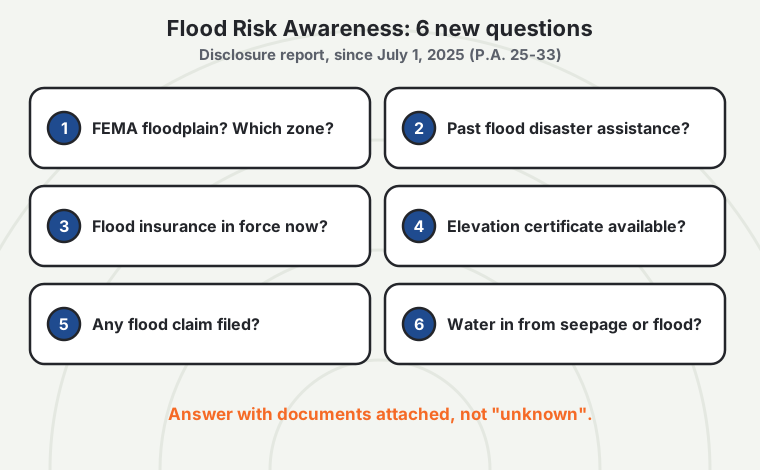
The report always asked whether the property is in a flood hazard area. The new section goes further, including whether you know of assistance paid to earlier owners, and the report now tells buyers that a property does not have to be in a flood zone to flood.
Lenders now warn buyers too: from July 1, 2026, a mortgage lender must give the buyer a signed written notice at least ten days before closing that standard homeowners policies do not cover flood (P.A. 25-33, sec. 2). And a house in a high-risk zone with a federally backed mortgage must carry flood insurance.
The mistake is answering “unknown” where you actually know, or answering correctly but with nothing attached. Pull your FEMA zone, any elevation certificate, your flood policy and its premium, and any claim history before you list. A buyer who sees the premium in week one negotiates; a buyer who discovers it in week five often walks. Leaving out the report entirely does not save you either: the buyer gets a $500 credit at closing (CGS 20-327c), and knowingly hiding a problem can still lead to a claim. Our disclosure guide covers the whole report.
Section 3 added the “Flood Risk Awareness” questions to the disclosure report in CGS 20-327b(d), effective July 1, 2025. Section 4 added a notice on flood insurance, flood maps and flood risk to the report’s “Important Information” section.
Mistake 3: Which Norwalk tax bill should you tell buyers about?
You should tell buyers the tax bill for your own Norwalk tax district, because the city has six real estate tax districts with fiscal 2027 rates from 22.9816 mills (Rowayton) to 24.6708 mills (the sewered main area). On a $760,000 house, that is a difference of about $900 a year. Quote the actual bill, not a citywide figure.

Norwalk sets different real estate rates by district, based on the services each area gets (such as sewer and refuse collection). The state’s mill rate file lists them for fiscal 2027:
| Norwalk district (OPM name) | Mills, fiscal 2027 | Tax on a $760,000 house (70% assessment) |
|---|---|---|
| 1st Downtown, 2nd South, 3rd East | 24.6275 | About $13,102 |
| 4th Sewered Main Area | 24.6708 | About $13,125 |
| 5th No Garbage Main Area | 24.2743 | About $12,914 |
| 6th Rowayton | 22.9816 | About $12,226 |
Some websites list a single Norwalk mill rate of 32. That is not a real estate rate, and using it would overstate a $760,000 house’s tax by about $4,000 a year. A wrong figure in your listing only creates confusion.
Taxes also matter at closing: Connecticut property tax is paid in arrears, so your attorney usually credits the buyer for the unpaid part of your ownership. Our closing-costs guide explains the proration.
Mistake 4: When should a Norwalk condo seller order the association documents?
A Norwalk condo seller should order the association’s resale certificate as soon as the unit is listed, because Connecticut law gives the association ten business days after your request and fee to produce it (CGS 47-270), and the buyer can void the contract until five business days after receiving it. With 40.3% of Norwalk’s home sales being condos, this is one of the most common delays in the city.
The certificate and documents go to the buyer before closing. They include the declaration, bylaws and rules, plus a certificate showing:
- Common charges, and anything unpaid or specially assessed on your unit.
- Capital expenditures over $1,000 approved for this year and next.
- Reserves and the current operating budget.
- Pending lawsuits against the association, and the insurance it carries.
- How many owners are 60 days or more behind, and recent association foreclosures.
- Any limits on renting the unit.
The statutory fee started at $185 and is adjusted over time (CGS 47-213). Read the certificate before the buyer does. A special assessment for a roof or seawall, a lawsuit, or a high number of delinquent owners can make a lender hesitate or a buyer renegotiate. If you know about it first, you can price for it or offer a credit. You are not liable for the association’s delay, but your closing date is.
Mistake 5: Which old-house questions trip up Norwalk sellers?
The old-house questions that trip up Norwalk sellers are the heating oil tank, lead paint and missing permits: the typical Norwalk house was built in 1955, 63% were built before 1960, and 69% heat with oil, so buyers’ inspectors ask about each one. A house built before 1978 also needs the federal lead-based paint disclosure before the buyer signs.
Gather these answers before you list:
- Oil tank. Where it is, how old it is, and whether an old buried tank was removed, with the paperwork. The disclosure report asks. Our guide to oil tanks, septic, wells and radon covers what buyers ask for.
- Lead paint. For a house built before 1978, give the federal lead disclosure form and the EPA pamphlet, and share any reports you have. Buyers get a chance to test.
- Permits. Finished basements, decks and additions often lack a closed permit. Check the city’s records now, not in the last week.
Our guide to what to fix before selling in Connecticut shows which of these to fix and which to price in.
Is listing or a cash sale the better choice for a Norwalk house?
Listing is usually the better choice for a Norwalk house in fair condition, because at a $760,000 single-family median even a few percent of price is worth far more than a few months of carrying costs. A cash sale fits a house with flood damage, a failing system, open permits or a hard deadline, where a financed buyer would struggle to close.
List with an agent
Highest net, usuallyBest for a house or condo in fair shape with clean paperwork.
- Biggest buyer pool
- Showings, inspection, appraisal
- Commission and 1.25% conveyance tax
Fix, then list
MiddleBest when one known issue would scare buyers.
- Close permits, remove a tank
- Costs time and cash up front
- Then list as above
Sell to a cash buyer
FastestBest for flood damage, big repairs or a fixed date.
- About 2 weeks, one visit
- No repairs; leave what you do not want
- Lower price than a retail sale
For the side-by-side math, see cash buyer vs. realtor in Connecticut, and for every route, our pillar on every way to sell a house in Connecticut.
How much would you walk away with?
Slide the numbers to match your house. It works in your browser; nothing is saved or sent.
Estimates for planning. Conveyance tax per CGS 12-494 (state 0.75% up to $800,000, 1.25% to $2.5M, 2.25% above, plus the town rate). Seller attorney about $1,200 to $1,500; flat-fee MLS about $400; listings include three months of taxes, insurance and utilities, a cash sale about two weeks. Your attorney gives you the final numbers.
When you should not sell to a cash buyer
Do not sell your Norwalk house to me, or to any cash buyer, if it is in decent condition, your paperwork is in order, and you can wait a few weeks for the right offer. At Norwalk prices the discount a cash buyer needs is large in dollars, and a well-prepared listing earns it back for you. We will say so on the phone. Our page on why cash offers are lower explains how any offer is built.
How do you avoid these mistakes when selling in Norwalk, step by step?
To avoid these mistakes when selling in Norwalk, set your price from comparable sales and buyers’ search bands rather than the tax tier, pull your flood zone and flood records, confirm your tax district and bill, order condo documents on listing day, and gather oil tank, lead and permit records before the first showing; then choose your route.
Price for buyers, not for the tax
Use recent Norwalk sales of your type of home. If you are near $800,000, decide on the search band, not the conveyance tax.
Build your flood file
FEMA zone, elevation certificate, flood policy and premium, and any claim or assistance history. Answer the six new questions with documents.
Confirm your tax district
Use your actual bill and district rate in the listing, and ask your attorney for the closing tax credit estimate.
Order condo documents on day one
Request the resale certificate when you list, read it before the buyer, and plan for anything it shows.
Answer the old-house questions
Oil tank records, the lead disclosure for a pre-1978 house, closed permits, and working detectors for the smoke and CO affidavit you sign at closing (CGS 29-453). Our documents checklist has the rest.
Get a cash number if a problem will not go away
If flood damage or an unfixable issue would stop a financed buyer, ask for a written cash offer as a floor. It is free, with no deadline; we usually close in about two weeks.
See the house together.
Pick a time that works.
Choose a time for us to walk through the property with you, or ask for a quick call first. We confirm every request personally.
Tuesday, January 13
No open times in the next few weeks. Please call us.
We will confirm by email. Nothing is booked until we do.
View my request
The Norwalk deals that wobble are rarely about price. They wobble when the buyer finds out something late: a flood premium, a special assessment, an open permit. Put the uncomfortable facts in the buyer’s hands on day one. A known problem gets negotiated; a surprise gets a buyer walking.
Questions Norwalk sellers ask
What is the conveyance tax when selling a house in Norwalk, CT?
The conveyance tax when selling a house in Norwalk, CT is 1.25% of the price up to $800,000 (0.75% state plus 0.50% city), and 1.75% on the part of the price above $800,000 (CGS 12-494). An $800,000 sale pays $10,000; an $850,000 sale pays $10,875.
Is there a tax cliff at $800,000 in Connecticut?
No, there is no tax cliff at $800,000 in Connecticut. The higher 1.25% state rate applies only to the portion of the price above $800,000, so each extra $10,000 above the line costs $50 more in state tax than it would below it.
Do I have to disclose flooding when selling my Norwalk house?
Yes, you have to disclose flooding when selling your Norwalk house. Since July 1, 2025, Connecticut’s disclosure report includes a Flood Risk Awareness section asking about the FEMA zone, past flood assistance, flood insurance, an elevation certificate, flood claims and water penetration (P.A. 25-33).
What if my Norwalk house is not in a flood zone but has had water in the basement?
If your Norwalk house is not in a flood zone but has had water in the basement, you still answer the report’s question about water penetration from seepage or a natural flood. The report itself tells buyers that a property does not have to be in a flood zone to flood.
What is the mill rate in Norwalk, CT?
The real estate mill rate in Norwalk, CT for fiscal 2027 depends on the district: 24.6275 in the 1st, 2nd and 3rd districts, 24.6708 in the 4th, 24.2743 in the 5th and 22.9816 in Rowayton (6th), according to the state’s mill rate data.
How long does a condo association have to provide the resale certificate in Connecticut?
A condo association in Connecticut has ten business days after the owner’s written request and payment of the fee to provide the resale certificate and documents (CGS 47-270). For a small extra fee it can be expedited to three business days.
Can a Norwalk condo buyer back out after getting the resale certificate?
Yes, a Norwalk condo buyer can void the contract until five business days after the resale certificate and documents are delivered, or seven if they are mailed, or until closing, whichever comes first (CGS 47-270).
What is the median home price in Norwalk, CT?
The median home price in Norwalk, CT was $608,250 for 894 market sales from October 2024 to September 2025 in the state’s records. Single-family houses had a median of $760,000 and condos $392,500.
Related Connecticut guides
Getting it right
Same question, other towns
Start with the big picture in how to sell a house in Connecticut. If your Norwalk house has a problem a financed buyer cannot take on, our Norwalk page explains how we buy there; we also buy in nearby Westport and Stamford.
Plain-English information, not legal or tax advice. Examples are illustrative and built from public numbers; amounts marked (est.) are estimates.
Sources (checked on October 27, 2026)
- Office of Policy and Management, Real Estate Sales dataset (data.ct.gov; Norwalk residential market sales recorded October 2023 to September 2025, queried October 27, 2026).
- Office of Policy and Management, mill rates by town and district (Norwalk districts, fiscal 2027).
- Public Act 25-33 (sections 2 to 4: lender flood notice; Flood Risk Awareness questions and flood notice on the disclosure report).
- CGS § 12-494 (conveyance tax rates and the $800,000 tier).
- Office of Legislative Research, 2020-R-0020 (towns with the 0.50% municipal rate).
- CGS § 12-62a (assessment at 70% of value).
- CGS § 20-327b and 20-327c (disclosure report; $500 credit).
- CGS § 47-270 (condo resale certificate).
- CGS § 29-453 (smoke and CO affidavit, as revised by P.A. 23-164).
- EPA, Lead-Based Paint Disclosure Rule (homes built before 1978).
- Year built, heating fuel and parcel data: our town data compiled from public parcel records.

Who wrote this
Jerryll Noorden
Jerryll has bought and sold Connecticut houses since 2016 and has sat at more closing tables than he can count, on both sides. Before real estate he was a robotics scientist at NASA, IHMC and IIT. He wrote this guide because the national sites that rank for it skip the Connecticut rules that cost sellers money. When listing or selling it yourself would get you more than a cash offer, he says so.
This guide explains Connecticut rules in plain English. It is not legal or tax advice. Laws change; for your sale, talk to a Connecticut real estate attorney and a tax professional.
