
Key facts at a glance
This page is one chapter of our guide to how to sell a house in Connecticut. It answers one question for Trumbull: which steps before the listing goes live shorten the sale the most? The numbers below are Trumbull’s own.
| Fact | Number | Source |
|---|---|---|
| Trumbull single-family median sale price, Oct 2024 to Sep 2025 | $635,000 | Town sales data from the state Real Estate Sales dataset (data.ct.gov) |
| Trumbull single-family market sales between $500,000 and $699,999 | 107 of 208 | data.ct.gov, recorded Oct 2024 to Sep 2025 (our query) |
| Fairfield County median days on market, May vs. January 2024 | 22 vs. 64 days | Realtor.com data via FRED (St. Louis Fed) |
| Property tax on the median house at the fiscal 2027 mill rate (37.42) | About $16,630 a year ($1,390 a month) | OPM mill rates; tax on 70% assessment (CGS 12-62a) |
| Median year built | 1962 (45% built before 1960) | Town parcel data |
| Credit to the buyer if you skip the condition report | $500 | CGS 20-327c |
| Smoke and CO affidavit at closing | Required; no credit option | CGS 29-453 (as revised by P.A. 23-164) |
Why does a quick, painless sale feel out of reach, and is this page for you?
A quick, painless sale feels out of reach because most of the delays in a Trumbull sale show up after you accept an offer, when the inspection, the paperwork and the attorneys meet a house nobody prepared for them. This page is for Trumbull owners who want the sale short and calm, and who are willing to do a few things before the listing goes live to get there.
Maybe you are moving for work and the start date is fixed. Maybe the house in Nichols or Long Hill was your parents’, and you live two states away. Maybe you sold a house once before and remember the week the deal almost fell apart over a radon number. Most sellers here feel rushed, a little overwhelmed by the list of things to do, worried about surprises, and wary of anyone promising “fast and easy.”
That last worry is healthy. A sale is not quick because someone says so. It is quick because the questions a buyer, an inspector, a lender and two attorneys will ask have answers before they ask them. That work is mostly paperwork and planning, and you can do most of it in two or three weeks.
I am Jerryll Noorden. I have bought houses in Connecticut since 2016, about ten a year. I buy for cash, but this page is mostly about doing a listing right, because for most Trumbull houses that is what nets the most.
Which pre-listing steps shorten a Trumbull sale the most?
The pre-listing steps that shorten a Trumbull sale the most are a pre-inspection, a price inside the band most buyers search in, an attorney hired before you list, the disclosure and smoke and CO paperwork ready on day one, and a house that shows well in the first two weeks. Each one removes a delay that otherwise appears after you have an offer, when it costs the most.
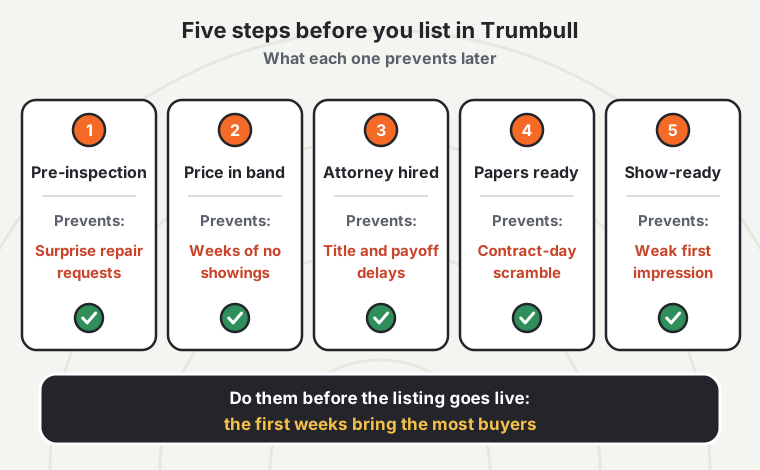
Here is why the order matters. A Connecticut sale with a mortgage buyer usually runs 30 to 45 days from contract to closing (our guide to how long it takes to sell in Connecticut has the full timeline). Inside that window there is an inspection period of a week or two, an appraisal, a loan commitment date, and title work. Every surprise in those weeks either reopens the price or pushes the date. The steps below take those surprises off the table early.
Should you get a pre-inspection before selling in Trumbull?
A pre-inspection is worth it for most Trumbull houses, because the median house was built in 1962 and the items buyers’ inspectors flag in houses that age (roofs, boilers, oil tanks, old wiring, radon, drainage) are the same ones that cause renegotiation. A pre-inspection usually costs a few hundred dollars (est.) and tells you what to fix, what to disclose and what to price in.
A Connecticut seller is not required to inspect anything; the law says the disclosure rules do not require the seller to arrange inspections or tests (CGS 20-327d). That is exactly why a pre-inspection is a choice that pays. You choose what to do with each finding:
- Fix it if it is cheap and would scare a buyer (a missing GFCI outlet, a dripping valve, a dead detector).
- Get a quote if it is big (a roof, a boiler). A written quote in the listing folder turns “unknown problem” into “known number,” and buyers negotiate less on known numbers.
- Disclose it. Once you know about a defect, it belongs in your disclosure report. Knowing early lets you price it in rather than fight over it.
About half of Trumbull houses heat with oil and about half with gas. With oil, find out where the tank is and its age; an underground tank is the one finding that can stop a buyer’s lender or insurer. Our guide to oil tanks, septic, wells and radon covers the tests and typical fixes, and our guide on what to fix before selling shows which repairs tend to pay back.
How do you price a Trumbull house inside the band buyers search in?
You price a Trumbull house inside the buyers’ band by finding where comparable Trumbull houses actually sold and setting the price just under the round number those buyers use as a search limit. In the state’s records, 107 of 208 Trumbull single-family market sales from October 2024 to September 2025 sold between $500,000 and $699,999, so small differences in price inside that range decide which searches your house shows up in.
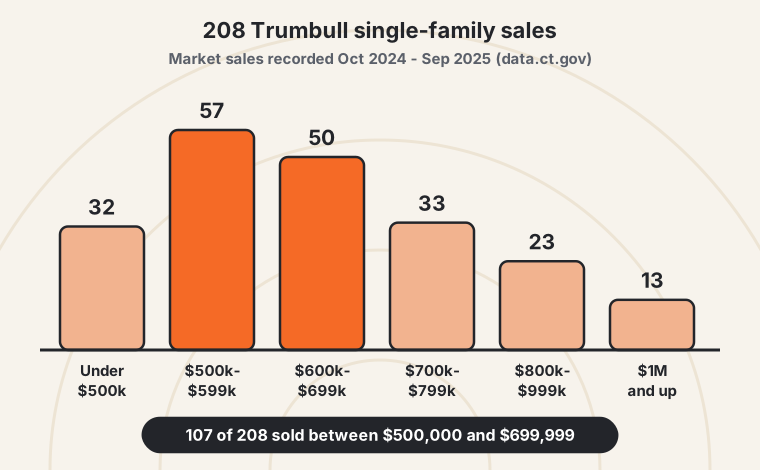
Buyers set alerts with round maximums: $600,000, $650,000, $700,000. A house priced at $609,000 misses everyone whose search stops at $600,000, and competes with $650,000 houses for everyone else. A house priced at $599,900 leads its band. That is the whole trick, and it costs nothing.
The state’s sales file does not show list prices or days on market, but it shows what sold and for how much. Pull the last six to twelve months of Trumbull sales of your style (the town is mostly colonials, ranches and capes), and pick the three to six closest matches. Our guide on how to price your house to sell in Connecticut shows how to download and filter the data. One note: our query counts 208 market single-family sales with a median of $620,000, while the town figure above ($635,000) is from a broader count of the same period. Both point to the same band.
Price is also the biggest speed lever after the first two weeks. A house priced right gets its showings in the first weeks, when every buyer already searching sees it. Fairfield County’s median days on market was 22 in May 2024 and 64 in January 2024 (Realtor.com via FRED), so a priced-right house in spring often goes fast, while an overpriced one in winter can sit for months.
Why should you hire your attorney before you list?
You should hire your attorney before you list because Connecticut closings are run by attorneys, and the issues that delay them (a missing mortgage release, an unpermitted addition, a lien, an estate that is not yet in your name) take weeks to fix. Found in the first week of listing, they cost nothing; found in the last week before closing, they move the date.
Your attorney can start before there is a buyer: order your mortgage payoff, check that old mortgages were released on the land records, look for liens, and confirm who has to sign the deed. If the house came from a parent, your attorney can tell you whether the estate has to go through probate first; our guide to selling a house in probate in Connecticut explains that path.
A seller’s attorney for a straightforward sale typically costs about $1,000 to $1,500 (est.). Our guide to the Connecticut closing process for sellers covers the rest of what the attorney does.
What paperwork should be ready on day one?
The paperwork to have ready on day one of a Trumbull listing is the Property Condition Disclosure Report, the smoke and carbon monoxide affidavit, the federal lead paint disclosure for a house built before 1978, oil tank and septic records if they apply, permits for any additions or finished basements, and your mortgage payoff details. With these in a folder, the contract stage starts with answers instead of questions.
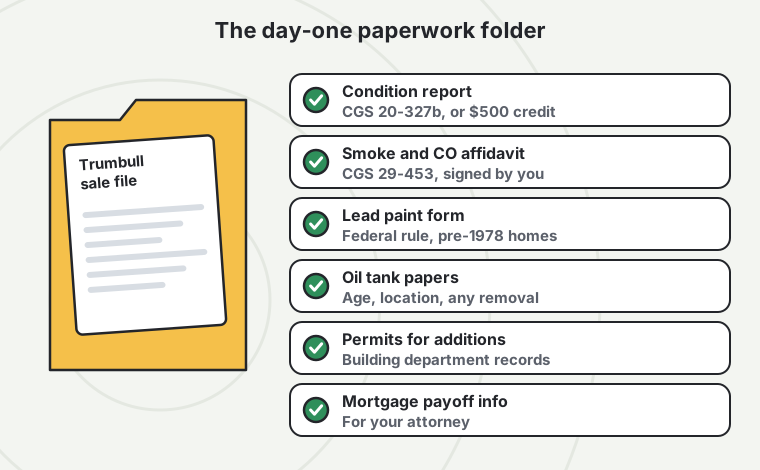
| Document | What it does | Rule |
|---|---|---|
| Property Condition Disclosure Report | Given to the buyer before they sign; skip it and you credit the buyer $500 at closing | CGS 20-327b, 20-327c |
| Smoke and CO affidavit | Signed by you, given at closing; the $250 credit option no longer exists | CGS 29-453 |
| Lead paint disclosure and pamphlet | For homes built before 1978; buyer gets a chance to test | Federal rule (EPA/HUD) |
| Oil tank and septic records | The disclosure report asks for tank removal paperwork and septic pumping dates | CGS 20-327b |
| Permits and certificates | Show that additions or finished basements were approved | Trumbull building department |
| Mortgage statement and payoff | Lets your attorney order the payoff early | Practice |
With a median build year of 1962, most Trumbull houses fall under the lead paint rule. Disclosing what you know and handing over the pamphlet takes ten minutes. Our documents checklist and our guide to the Connecticut property condition disclosure go line by line.
The current law asks for an affidavit that the house has working smoke detectors in or near each bedroom and carbon monoxide detection where there is a fuel-burning appliance, fireplace or attached garage (CGS 29-453). Test every unit before you list, so you can sign it without a last-minute hardware store run.
What does each extra month cost a Trumbull seller?
Each extra month costs a Trumbull seller about $1,840 on a median-priced house (est.): about $1,390 in property tax at the fiscal 2027 mill rate of 37.42, plus about $450 for insurance, heat and utilities (est.), before mortgage interest. Two months of delay add up to about $3,680 (est.), more than a pre-inspection and an attorney combined.
The math: $635,000 x 70% = a $444,500 assessment; at 37.42 mills that is about $16,630 a year, or $1,390 a month. Add about $450 a month (est.) for insurance, heat, electric and upkeep. That is why the steps above pay for themselves: each week they save is worth about $425 (est.).
How much would you walk away with?
Slide the numbers to match your house. It works in your browser; nothing is saved or sent.
Estimates for planning. Conveyance tax per CGS 12-494 (state 0.75% up to $800,000, 1.25% to $2.5M, 2.25% above, plus the town rate). Seller attorney about $1,200 to $1,500; flat-fee MLS about $400; listings include three months of taxes, insurance and utilities, a cash sale about two weeks. Your attorney gives you the final numbers.
When is a cash sale quicker, and when should you not sell to a cash buyer?
A cash sale is quicker when the house needs work that a mortgage buyer’s lender or inspector would balk at, when you need a fixed closing date, or when you cannot do the pre-listing steps at all. You should not sell to a cash buyer if your Trumbull house is in good shape and you can follow the steps on this page, because at Trumbull prices a well-run listing usually nets more.
Prepared listing
Highest netFor a house in decent shape and a seller who can do the five steps.
- Biggest buyer pool
- About 30 to 45 days contract to closing
- Commission and about 1% conveyance tax
Listing as-is
MiddleFor a dated house you do not want to fix.
- Price the work in up front
- Some lenders still balk
- Expect inspection haggling
Cash buyer
FastestFor a fixed date, a problem house or no time to prepare.
- About 2 weeks, one visit
- No repairs, no showings
- Lower price than a retail sale
Our page on cash buyer vs. realtor in Connecticut shows how to compare the two on net, not on headline price, and our pillar on every way to sell a house in Connecticut covers the rest. If you want to know why any cash offer is below retail, read why cash offers are lower.
Is a cash sale right for you, or should you list?
Seven quick questions. There is no wrong answer, and we will tell you honestly if listing would leave you more.
- Does the house need repairs you would rather not pay for or manage?
- Do you need to close by a certain date, or within the next month or two?
- Would showings be hard: tenants, belongings, privacy, or you live out of state?
- Is there a complication: an estate or probate, a divorce, foreclosure, liens or back taxes?
- Could you comfortably cover the mortgage, taxes and utilities for three or more months?
- Is getting the highest possible price more important to you than speed and certainty?
- Would a buyer's bank lend on the house as it is (no major roof, foundation, oil tank or code issues)?
How do you make a Trumbull sale quick and painless, step by step?
To make a Trumbull sale quick and painless, hire your attorney, book a pre-inspection, build the day-one paperwork folder, test the detectors, set a price inside the band, and go live when buyers are searching; if you cannot do those steps, get a cash number as a floor first.
Week 1: attorney and inspection
Hire your attorney and book a pre-inspection. Ask the attorney to order the payoff and check title.
Week 2: decide on each finding
Fix the cheap and scary items, get quotes on the big ones, and note everything you now know for the disclosure report.
Week 2: build the folder
Disclosure report, smoke and CO affidavit, lead paint form, oil tank and septic records, permits, payoff details.
Week 3: price and prepare
Pick your comparables, price under the round number, clean, and photograph.
Go live and answer fast
Hand the folder to every serious buyer’s agent. Fast answers keep a buyer from cooling off.
Or get a floor first
If time or condition rule out the steps above, ask for a written cash offer. It is free, it has no deadline, and it shows the floor under your other options.
See the house together.
Pick a time that works.
Choose a time for us to walk through the property with you, or ask for a quick call first. We confirm every request personally.
Tuesday, January 13
No open times in the next few weeks. Please call us.
We will confirm by email. Nothing is booked until we do.
View my requestQuestions Trumbull sellers ask about a quick sale
How can I sell my house quickly in Trumbull, CT?
You can sell your house quickly in Trumbull, CT by doing the slow parts before you list: a pre-inspection, an attorney hired early, the disclosure and smoke and CO paperwork ready, and a price just under the round number buyers search with. If you need a fixed date or the house needs work, a cash buyer can close in about two weeks for less.
Is a pre-listing inspection worth it in Connecticut?
A pre-listing inspection is usually worth it in Connecticut for older houses, because it lets you fix, quote or disclose problems before a buyer’s inspector finds them and reopens the price. Connecticut does not require sellers to inspect (CGS 20-327d), so it is your choice.
Do I have to disclose what a pre-inspection finds?
Yes, once a pre-inspection tells you about a defect, it is within your knowledge, and the Connecticut disclosure report asks about known problems (CGS 20-327b). The seller’s statements cover actual knowledge only (CGS 20-327e), which is why knowing early and disclosing clearly protects you.
When should I hire a real estate attorney to sell my house in Connecticut?
You should hire a real estate attorney before you list your house in Connecticut, so title, payoff, liens and permit questions are solved before a buyer is waiting. Attorneys run Connecticut closings, and a seller’s attorney for a simple sale typically costs about $1,000 to $1,500 (est.).
What happens if I do not give the buyer the disclosure report?
If you do not give the buyer the Property Condition Disclosure Report, the contract requires you to credit the buyer $500 at closing (CGS 20-327c). The credit does not excuse you from disclosing known defects that significantly affect value, health and safety, or the life of the house.
Can I pay $250 instead of the smoke detector affidavit?
No, you can no longer pay $250 instead of the smoke and carbon monoxide affidavit in Connecticut. The current CGS 29-453 requires the seller to sign and give the buyer the affidavit at closing.
What price range do most Trumbull houses sell in?
Most Trumbull single-family houses sell between $500,000 and $699,999: 107 of 208 market sales recorded October 2024 to September 2025 fell in that range in the state’s data, and the town median was $635,000.
How long does it take to sell a house in Trumbull?
Selling a house in Trumbull typically takes a few weeks to find a buyer in spring, longer in winter, plus about 30 to 45 days to close with a mortgage buyer. Fairfield County’s median days on market was 22 in May 2024 and 64 in January 2024 (Realtor.com via FRED).
Do I need the lead paint form if my Trumbull house was built in the 1960s?
Yes, a house built before 1978 needs the federal lead paint disclosure and the EPA pamphlet, and the buyer gets a chance to test for lead unless they waive it. With Trumbull’s median build year of 1962, most sellers in town need it.
Related Connecticut guides
Selling faster
Fewer hassles
Start with the big picture in how to sell a house in Connecticut. If you would rather have a cash number for your house, our Trumbull page explains how we buy there; we also buy in nearby Shelton, Monroe, Easton and Fairfield.
Plain-English information, not legal or tax advice. Examples are illustrative and built from public numbers; amounts marked (est.) are estimates.
Sources (checked on October 27, 2026)
- Office of Policy and Management, Real Estate Sales dataset (data.ct.gov; Trumbull single-family market sales recorded October 2024 to September 2025, queried October 27, 2026).
- Realtor.com, Median Days on Market in Fairfield County, CT (FRED, Federal Reserve Bank of St. Louis).
- Office of Policy and Management, mill rates by town (data.ct.gov).
- CGS § 12-62a (assessment at 70% of value).
- CGS § 12-494 (conveyance tax).
- CGS § 20-327b to 20-327e (disclosure report, $500 credit, no duty to inspect, actual knowledge).
- CGS § 29-453 (smoke and carbon monoxide affidavit, as revised by P.A. 23-164).
- EPA, lead-based paint disclosure for home sales.
- Town median, sales count, mill rate, year built and heating fuel: our town data compiled from public sales records (October 2024 to September 2025), fiscal 2027 mill rates and town parcel data.

Who wrote this
Jerryll Noorden
Jerryll has bought and sold Connecticut houses since 2016 and has sat at more closing tables than he can count, on both sides. Before real estate he was a robotics scientist at NASA, IHMC and IIT. He wrote this guide because the national sites that rank for it skip the Connecticut rules that cost sellers money. When listing or selling it yourself would get you more than a cash offer, he says so.
This guide explains Connecticut rules in plain English. It is not legal or tax advice. Laws change; for your sale, talk to a Connecticut real estate attorney and a tax professional.
