
- Price off recent comparable sales, not hopes. Start with closed sales of similar houses in your town from the last six to twelve months, then adjust for condition, size and location.
- The first two to three weeks carry the most buyer attention. That is when every buyer already searching in your range sees the house. A price that misses them is hard to win back.
- Your assessment is not your price. Connecticut assesses at 70% of value as of the last revaluation (CGS 12-62a). In Vernon’s recent single-family sales, the median sale was about 2.2 times the assessment (our calculation).
- Use the state’s free sales data. The data.ct.gov sales dataset lists every recorded sale with its price and assessment. In Vernon, 229 market single-family sales from October 2024 to September 2025 ranged from under $250,000 to over $400,000.
- Older Connecticut houses need honest condition adjustments. Vernon’s median house was built in 1961 and most are heated with oil. Price the roof, boiler, tank and foundation questions in, or buyers will do it for you.
- The $800,000 conveyance tax tier is not a cliff. The higher rate applies only to the part above $800,000: going from $800,000 to $810,000 adds $150 of tax.
How do you price your house to sell in Connecticut?
To price your house to sell in Connecticut, find three to six closed sales of similar houses in your town from the last six to twelve months, adjust them for differences in size, condition and location, and set your asking price inside the search band where those buyers are looking. Do not anchor on your assessment or an online estimate, and get the price right before the first two to three weeks on the market.
This guide is the pricing chapter of our guide to how to sell a house in Connecticut. We use Vernon as the local example because it shows every pricing problem a Connecticut seller can run into: a wide range of houses, mostly 1950s and 1960s ranches, colonials and capes, oil heat, a revaluation-era assessment that lags prices, and the crumbling-foundation question that hangs over the whole north-central part of the state.
The asking price is the most important decision you make when you list, more important than the photos, the season or the agent. It does three jobs at once:
- It decides who sees the house. Buyers search by price range. The wrong number puts you in front of the wrong buyers, or none.
- It tells buyers what to expect. A price far below similar houses says “something is wrong”; a price far above says “the owner is not serious”.
- It sets where negotiation starts. Offers, inspection credits and even the appraisal all start from this number.
The rest of this guide shows how to build the number yourself, step by step, with Connecticut public data, and how to price a house that needs work. If you are thinking about selling as-is instead, our guide to a cash buyer vs. a realtor in Connecticut lays out that choice.
Why does picking an asking price feel so hard?
Picking an asking price feels hard because it puts a number on years of your life, because the numbers you have (the assessment, an online estimate, a neighbor’s sale, an agent’s opinion) rarely agree, and because both mistakes hurt: price too low and you fear you gave money away; price too high and the house sits. Feeling torn is normal, and a clear method makes the choice much less personal.
If you have lived in a Vernon ranch since the 1980s, you know every repair, every room repainted for a child’s birthday, the garden you put in. It is natural to feel proud and protective, and to hear a low number as a judgment on the house, or on you.
Underneath, many sellers are anxious about losing money. Losing $10,000 feels much worse than gaining $10,000 feels good, so underpricing looks like the bigger risk. At the same time you may feel confused: the town says one thing, a website another, and an agent a third. And it is fair to feel suspicious of everyone, including the agent who quotes high to win the listing and the cash buyer (like us) who quotes low.
Some sellers are afraid of being stuck, because they watched a house down the street sit for months and sell for less after several cuts. And many are cautiously hopeful: if they could just see the real sales and the real math, they would trust their own number. This page is for you. Nothing here requires you to fix anything or decide anything today; it simply gives you the method professionals use, with your town’s own data.
Why do the first two to three weeks on the market matter so much?
The first two to three weeks on the market matter because that is when every buyer already looking in your price range sees the listing at once, gets alerts, and books showings. After that, new interest comes mostly from buyers who just started searching. A house priced right in that window collects its strongest offers then; a house priced wrong spends the window being skipped.

Think of the buyers in your price range as two groups. The first group has been looking for weeks or months: they are pre-approved, they have saved searches with alerts, and they have seen everything else on the market. When your house appears, they all see it in the first days. The second group trickles in over time, a few new buyers a week.
If your price is right, the first group is your best audience, because they can compare your house with everything they have already seen and recognize value. That is when multiple offers, if they come, usually come. If your price is too high, the first group looks, compares, and moves on. Later, when you cut the price, many of them have already bought something else, or remember the listing as “the overpriced one”.
How long a house typically sits, and when to worry, depends on the season and the market; those numbers, and what to do about a listing that has gone stale, are in our guide to why a house won’t sell in Connecticut. Seasonal timing is in the best time to sell a house in Connecticut. This guide is about getting the first number right, so you do not need either of those.
What happens when you overprice a house in Connecticut?
When you overprice a house in Connecticut, it drops out of the searches of the buyers it fits, gets compared with larger or newer houses it cannot beat, collects showings without offers, and usually needs a price cut. A financed buyer’s appraisal can also come in below an inflated contract price. Each month of waiting costs taxes, insurance, utilities and interest, so overpricing rarely ends with a higher sale.
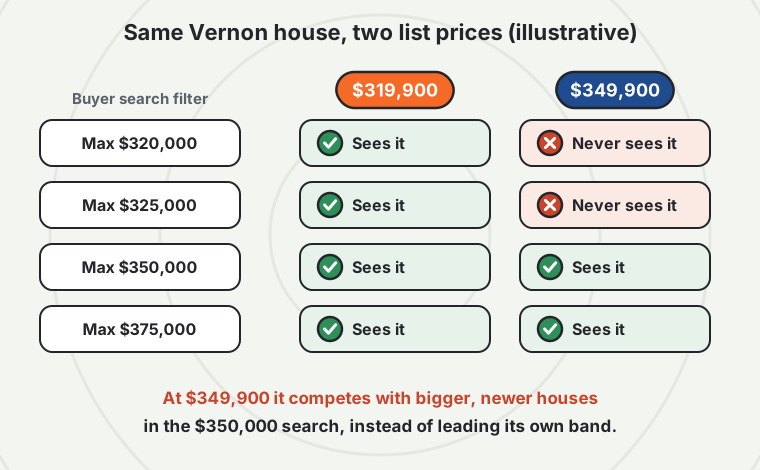
Search bands: the mechanics of being seen
Most buyers search with a maximum price, and they set it at round numbers: $300,000, $325,000, $350,000, $400,000. A house listed at $319,900 appears for a buyer whose limit is $320,000, $325,000 or $350,000. The same house at $349,900 disappears for the first two groups and lands in the $350,000 group, next to houses with a second bathroom, a newer kitchen or a bigger lot. It is now the weakest house in a stronger group, instead of a strong house in its own group.
This is why many agents price just under a round number, and why it matters which side of a band your comparable sales put you on. If the comps say $330,000, listing at $329,900 keeps you in the $330,000 and $350,000 searches; listing at $334,900 does little for the price and drops you from the $330,000 group.
Showings without offers, then the cut
An overpriced house often gets showings, because buyers are curious, but few offers. After a few weeks the listing agent suggests a reduction. Price cuts are normal and are not a disaster, but the timing works against you: you have spent your best weeks, paid the carrying costs, and the listing history shows the cut. In Vernon, carrying a house at the single-family median costs about $680 a month in property tax (town data) plus roughly $450 in insurance and utilities (est.), so about $1,130 a month before mortgage interest.
The appraisal backstop
Even if an eager buyer agrees to a high price, most buyers borrow. Their lender orders an appraisal based on comparable sales, the same sales you should have used to price the house. If the appraisal comes in below the contract price, the buyer has to bring more cash, renegotiate or walk away under the mortgage contingency. The gap math is in our guide to low appraisals in Connecticut. Pricing off the comps from day one avoids most of this.
And underpricing?
Pricing slightly below the comps is a legitimate strategy in a strong market, to draw several offers at once. It works when the house is in good condition and there are enough active buyers in your band. It is risky for a house with condition issues or in a slow season, when you may get one offer at your low price. If you price low on purpose, decide in advance how you will handle offers (a deadline, highest and best) and talk it through with your agent or attorney.
What is the difference between a CMA, an appraisal and your assessment?
A comparative market analysis (CMA) is an agent’s estimate of your likely sale price from recent comparable sales, used to set the asking price. An appraisal is a licensed or certified appraiser’s formal opinion of value, usually ordered by the buyer’s lender. Your assessment is the town’s tax value, 70% of market value as of the last revaluation (CGS 12-62a), and it is not meant to track today’s price.
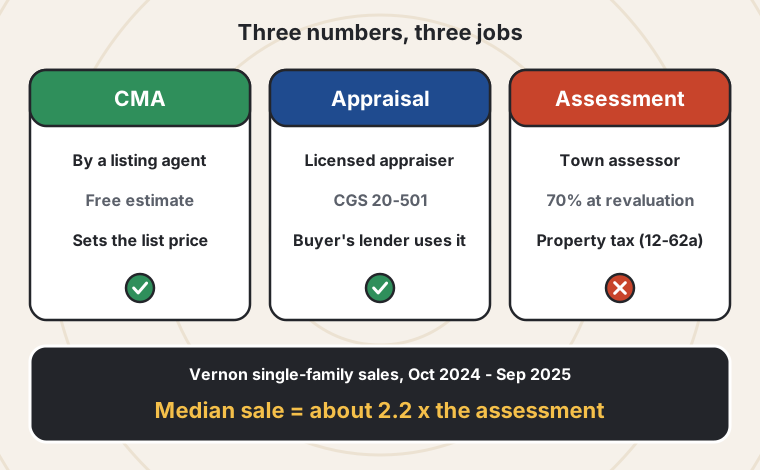
| Number | Who makes it | What it is for | How much to trust it for pricing |
|---|---|---|---|
| Comparative market analysis (CMA) | A listing agent, usually free | Setting the asking price | Good if the comps are truly similar and recent; ask to see them |
| Appraisal | A licensed or certified appraiser (CGS 20-501) | The buyer’s lender; also estates, divorces, pre-listing checks | Strong; it is what a financed buyer’s loan will be based on |
| Town assessment | Your town assessor | Property tax: 70% of value as of the last revaluation (CGS 12-62a) | Weak; it lags the market between revaluations |
| Online estimate | An automated model | A rough starting point | Weak for older or unusual houses; it cannot see condition inside |
| A cash offer | An investor or cash buyer | A firm as-is number | A floor check for a house needing work, not a retail value |
The assessment confuses more Connecticut sellers than anything else. It is set at 70% of market value as of your town’s last revaluation, and towns revalue at least every five years (CGS 12-62). Between revaluations, prices move and the assessment does not. Our guide to market value vs. assessed value in Connecticut explains how to read your assessment and when to appeal it.
Should you pay for a pre-listing appraisal?
Usually not for a typical house in a town with plenty of sales, where a good CMA does the same job. A pre-listing appraisal can be worth it when the house is unusual, when there are few recent sales nearby, when family members or an ex-spouse need a neutral number, or when you suspect condition will be an issue with a buyer’s lender. It also gives you something concrete to show if a buyer’s appraisal comes in low.
Which Connecticut rules and numbers affect your asking price?
The Connecticut rules that affect your asking price are the 70% assessment and five-year revaluation (CGS 12-62a, 12-62), the conveyance tax tiers you pay out of the price (CGS 12-494), the property condition report you must give buyers (CGS 20-327b, with a $500 credit if you skip it), the foundation report in crumbling-foundation towns for certain sellers, and the licensing of appraisers (CGS 20-501).
| Rule | What it says | How it touches your price | Source |
|---|---|---|---|
| Assessment at 70% | Property is assessed at 70% of its value as of the last revaluation | Divide by 0.70 only gives a value as of the revaluation date, not today | CGS 12-62a |
| Revaluation | Towns revalue at least every five years on a state schedule | The longer since revaluation, the further the assessment lags | CGS 12-62 |
| Conveyance tax | State 0.75% up to $800,000, 1.25% on the part from $800,000 to $2.5M, 2.25% above; town 0.25% (0.50% in some cities); paid by the seller | Comes out of your price; the tiers apply to the portion above each line, so they are not cliffs | CGS 12-494 |
| Property condition report | Sellers of one- to four-family homes give buyers the DCP report before the contract | Known defects you disclose are priced in; skipping it costs a $500 credit | CGS 20-327b, 20-327c |
| Foundation report | A separate DCP foundation report applies only to homes in listed crumbling-foundation towns sold after foreclosure or deed in lieu, or by a town; other sellers answer the main report’s foundation questions | In Vernon and nearby towns buyers expect the foundation question to be answered | CGS 20-327b(g)-(h) |
| Appraisers | Real estate appraisers must be licensed or certified by the state | A financed buyer’s loan is based on a licensed appraisal of the comps | CGS 20-501 |
| Lead paint | Homes built before 1978 need the federal lead disclosure and pamphlet | Most Vernon houses (median built 1961) need it; peeling paint becomes a lender issue | EPA/HUD lead disclosure rule |
In Vernon the conveyance tax is the standard 1.00% (0.75% state plus 0.25% town), so a $324,900 sale pays $3,249. Our guide to the Connecticut conveyance tax has every town’s rate.
How do you use Connecticut public data to price your house?
You can use Connecticut public data to price your house by downloading recent sales for your town from the state’s Real Estate Sales dataset on data.ct.gov, filtering to your property type and the last twelve months, removing non-market transfers, and comparing sale prices and assessments with your own. In Vernon, 229 market single-family sales from October 2024 to September 2025 show the range buyers actually paid.
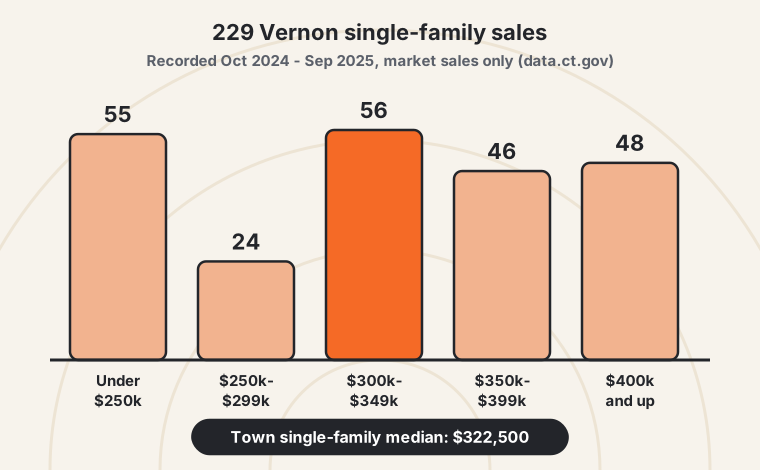
What the dataset is
The Office of Policy and Management publishes town-reported real estate sales of $2,000 or more as “Real Estate Sales 2001-2024 GL” on data.ct.gov. Each row has the town, address, date recorded, sale amount, assessed value, the sales ratio (assessment divided by price), property type, and a “non-use code” that flags sales that are not normal market sales, such as transfers between relatives, foreclosures or partial interests. It is free and you can filter it in your browser.
- Open the dataset on data.ct.gov and filter Town to yours.
- Filter Residential Type to your type (Single Family, Condo, Two Family, Three Family).
- Filter Date Recorded to the last twelve months (closings show up a little after they happen).
- Remove rows with a Non Use Code, which are not market sales.
- Look up the addresses that look like your house (same street or neighborhood, similar assessment) and read their listings or the town’s assessor card for size, age and style.
What it shows for Vernon
Our town data counts 388 Vernon sales from October 2024 to September 2025, with a median of $300,000 for all homes and $322,500 for single-family houses. When we pulled single-family sales for the same period from the state dataset and dropped the non-market transfers, 229 sales remained: 55 under $250,000, 24 from $250,000 to $299,999, 56 from $300,000 to $349,999, 46 from $350,000 to $399,999, and 48 at $400,000 or more. (Different filters give slightly different medians; the shape is the point.)
That spread is why a town median is a starting point, not your price. A 1,100 square foot ranch needing a roof and a renovated 2,200 square foot colonial are both “Vernon single-family”. You need the sales that look like yours.
The same dataset also shows how far assessments lag. In those Vernon sales, the median assessment was about 45% of the sale price, so the median sale was about 2.2 times the assessment (our calculation, est.). If your assessment is $150,000, dividing by 0.70 suggests about $214,000, which is what the house was worth at the last revaluation; recent Vernon sales suggest something closer to $335,000 for a typical house with that assessment. Use the ratio only as a sanity check, never as your price: it says nothing about your condition.
How Vernon compares with nearby towns
| Town | Sales | Median, all homes | Median, single-family | Median year built | Built before 1960 |
|---|---|---|---|---|---|
| Vernon | 388 | $300,000 | $322,500 | 1961 | 43% |
| Manchester | 724 | $315,000 | $320,500 | 1953 | 60% |
| East Hartford | 614 | $282,750 | $285,000 | n/a | n/a |
| Enfield | 659 | $310,000 | $311,000 | 1960 | 50% |
| Windsor | 393 | $340,000 | $350,000 | 1965 | 44% |
| South Windsor | 389 | $397,000 | $460,000 | 1969 | 30% |
| Glastonbury | 477 | $540,000 | $615,000 | 1975 | 28% |
How do you adjust the price for an older Connecticut house’s condition?
You adjust the price for an older Connecticut house by comparing it with sales of similar-age houses in similar condition, then subtracting realistic costs for the big items buyers and lenders will price in: roof, heating system, oil tank, electrical, windows, septic or well, and in some towns the foundation. Buyers usually discount a house by more than the repair cost, because of hassle and uncertainty, so be honest early.
Connecticut’s housing is old. Vernon’s median house was built in 1961 and 43% of its single-family houses predate 1960; in Manchester the median is 1953. Most Vernon houses heat with oil-fired hot water. A buyer touring a 1960s ranch will look at the age of the roof, the boiler and the oil tank before they look at the paint color.
| Item buyers price in | Typical cost (est.) | How to treat it in your price |
|---|---|---|
| Roof with a few years left, not leaking | $10,000 to $25,000 to replace | Compare with sales that had similar-age roofs, or price in part of it |
| Old boiler or furnace that works (20+ years) | $6,000 to $15,000 to replace | Usually priced in rather than replaced before sale |
| Old underground oil tank, no known leak | $1,500 to $4,000 removal with soil test | Many buyers, insurers and lenders want it gone; often worth doing |
| Fuse box or some older panels | $1,500 to $4,000 for a panel | Often fixed before listing, because insurers ask |
| Peeling paint on a pre-1978 house | $500 to $5,000 (lead-safe work) | Fix it if the buyer is likely to use FHA or VA |
| Dated kitchen or baths | $15,000 to $60,000+ kitchen; $10,000 to $30,000+ bath | Do not renovate to sell; price against other dated houses |
| Crumbling (pyrrhotite) foundation | $150,000 to $250,000+ replacement | A different market entirely; see the foundation section below |
The rule of thumb: fix cheap items that would show up on any inspection, leave big projects to the buyer, and make the price reflect them. Our guide to what to fix before selling a house in Connecticut sorts every common item into fix, disclose or price in. If the list is long, read selling a house that needs repairs in Connecticut before you spend anything.
Disclosure and price go together
Whatever you know about the condition goes on the property condition report (CGS 20-327b). That is good for pricing, not bad: a defect you disclose and price in at the start rarely kills a deal; a defect a buyer’s inspector finds after you priced the house as if it were perfect almost always becomes a renegotiation, often for more than the repair cost. Our guide to the Connecticut property condition disclosure goes through the form.
How does the crumbling-foundation issue affect pricing in Vernon?
The crumbling-foundation issue affects pricing in Vernon because the town is on the state’s list of affected towns, so careful buyers ask about the concrete, and some get a core test before they commit. A house with a tested, sound foundation or a replaced one prices against normal sales; a house with confirmed pyrrhotite damage sells into a much smaller, mostly cash market and needs separate advice.
Vernon sits in the north-central Connecticut “foundation belt”, where some foundation concrete poured from 1983 onward, from a now-closed plant in Stafford Springs, contains pyrrhotite and can crack and fail over time. One sale record in Vernon’s recent data even carries the non-use code “crumbling foundation assessment reduction”. For pricing, the practical points are:
- Know your house’s era. Many Vernon houses were built in the 1950s to 1970s, before the concrete in question was used (foundations or additions poured in 1983 or later are the ones to ask about). Your attorney or agent can help you find out when your foundation was poured.
- Answer the question before buyers ask it. If you have a core test or an engineer’s report, it supports a normal price. Buyers’ agents in the area may build a test into the contract.
- Do not hide visible cracking. It belongs on the condition report and changes the market for the house.
Everything else, from testing and the state’s repair program to selling a house with confirmed damage, is in our guide to selling a house with a crumbling foundation in Connecticut.
Does the $800,000 conveyance tax tier matter when you set your price?
The $800,000 conveyance tax tier matters much less than many sellers think, because Connecticut applies the higher 1.25% state rate only to the part of the price above $800,000 (CGS 12-494). In a 0.25% town, an $800,000 sale pays $8,000 of conveyance tax and an $810,000 sale pays $8,150, only $150 more. Do not cut your price below the line just to avoid it.
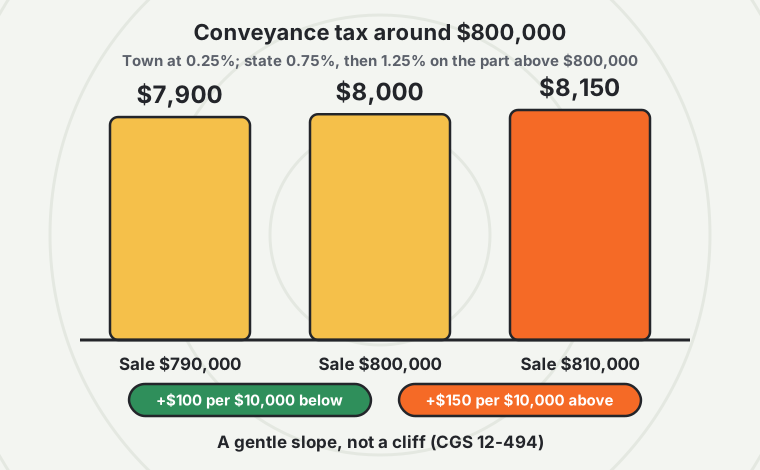
Here is the math in a town with the standard 0.25% town rate:
- At $790,000: 0.75% state ($5,925) + 0.25% town ($1,975) = $7,900.
- At $800,000: $6,000 state + $2,000 town = $8,000.
- At $810,000: $6,000 + 1.25% of $10,000 ($125) state + $2,025 town = $8,150.
Below $800,000 each extra $10,000 of price costs $100 of tax; above it, $150. That is a reason to understand your net, not a reason to price at $799,000 when the comps say $815,000. Search bands matter far more at that level: “up to $800,000” is a common buyer filter, so a house that is truly worth about $800,000 may still be smart to list just under it, for visibility rather than tax.
How do you price a house you are selling as-is?
To price a house you are selling as-is in Connecticut, start from what similar updated houses sold for, subtract a realistic range for the work a buyer must do, and then decide which buyers you are pricing for: financed buyers who can still get a loan on the house, or cash buyers and investors if lenders will not lend on it. Disclose what you know, and expect the price to reflect both the repairs and the buyer’s risk.
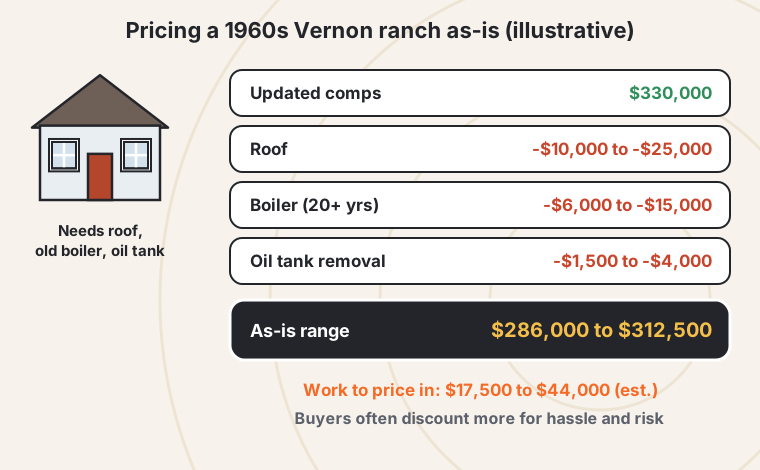
Example (illustrative): a 1960s Vernon ranch
Suppose sales of updated 1960s ranches near you point to $330,000. Yours is clean but needs a roof, has a 25-year-old boiler and an underground oil tank. Using the estimates in the table above:
| Line | Low (est.) | High (est.) |
|---|---|---|
| Updated comparable sales | $330,000 | $330,000 |
| Roof replacement | -$10,000 | -$25,000 |
| Boiler replacement | -$6,000 | -$15,000 |
| Oil tank removal with soil test | -$1,500 | -$4,000 |
| As-is range before any risk discount | $312,500 | $286,000 |
A financed buyer can still buy this house, since nothing here usually blocks a conventional loan, so you might list in the low $300,000s and expect inspection negotiations. If the house had a problem lenders will not finance (a failed septic, active water damage, no working heat, confirmed foundation failure), your realistic buyers are mostly cash buyers, and the price has to work for them. Our guide to selling a house as-is in Connecticut covers what “as-is” means legally and what you still must disclose.
Listing as-is vs. a cash offer: the honest math
Say you list the ranch as-is at $300,000 and it sells at that price after four months. You pay 5% commission ($15,000, est.), 1% conveyance tax ($3,000), an attorney ($1,200, est.) and four months of carrying costs (about $4,520, est.), and net about $276,280 before your mortgage payoff and before any inspection credit. A cash offer nets the offer minus the conveyance tax, the attorney and about two weeks of carrying costs, so it would need to be about $280,900 to match. If the listing would sell for more than $300,000, or faster, listing wins. If the house might not finance, or four months of carrying and showings is not realistic for you, the cash number may be the better net.
How much would you walk away with?
Slide the numbers to match your house. It works in your browser; nothing is saved or sent.
Estimates for planning. Conveyance tax per CGS 12-494 (state 0.75% up to $800,000, 1.25% to $2.5M, 2.25% above, plus the town rate). Seller attorney about $1,200 to $1,500; flat-fee MLS about $400; listings include three months of taxes, insurance and utilities, a cash sale about two weeks. Your attorney gives you the final numbers.
When is a cash offer the right price check?
A cash offer is the right price check when your house needs work that financed buyers or their lenders may balk at, when it is vacant and costing you every month, when you need a fixed closing date, or when you want a firm floor before deciding whether listing is worth the time. It is not a measure of retail value: a cash buyer prices in repairs, holding costs, resale costs and risk.
Most cash buyers who renovate and resell work backwards from the price the house would sell for after repairs. In our illustrative ranch, that could look like this: $330,000 after-repair value, minus $30,000 of repairs, minus about $23,100 to resell (7% for commissions, conveyance tax and closing, est.), minus about $8,000 of holding and financing costs while the work is done (est.), which leaves $268,900 before the buyer’s own margin and risk. That is why a cash offer on a house needing work is meaningfully below what the house would fetch when finished, and why, for a house in good condition, listing usually nets more.
We buy houses for cash, so read this knowing that. If your house is in decent shape and you have a few months, price it with the method above and list it; we will tell you the same thing on the phone. A cash offer earns its place as a check: a firm, no-repairs number you can hold up against a listing net. Our full comparison of a cash buyer vs. a realtor shows when each wins, and our guide to checking a cash home buyer shows how to make sure an offer is real.
Get your cash offer
without anyone coming over.
Want your offer faster, or rather not talk to anyone yet? Send a few phone photos of each room. We price the repairs from them, line by line, and send your cash offer back, so you see a real number before you ever meet us or pick up the phone.
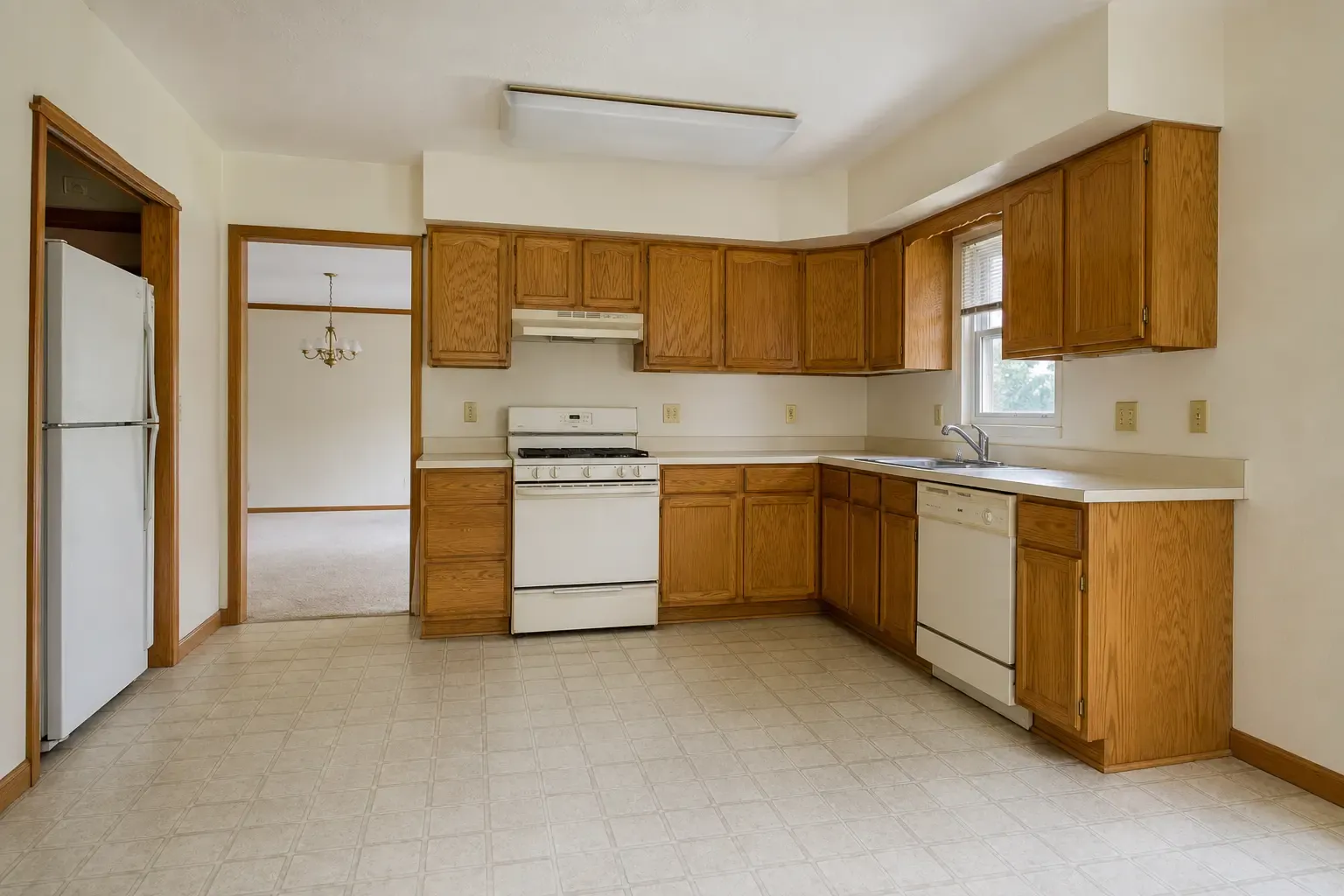 CabinetsFlooring
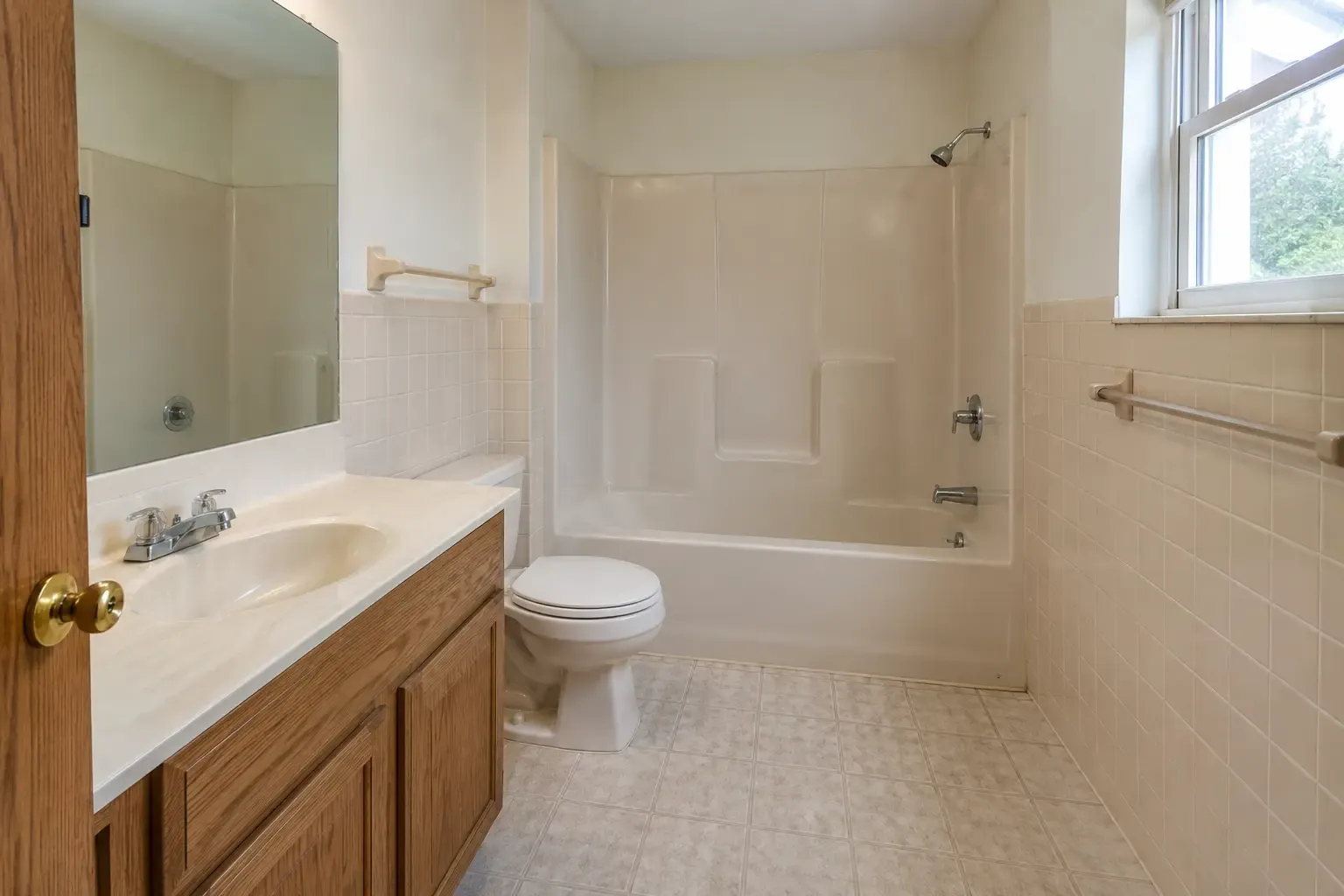 Tub & tile
 Floors
 Roof
We may bring in a partner buyer to close. Your price and terms don't change.
If you do list, remember the commission is part of your net too: our guide to the real estate commission in Connecticut shows how to negotiate it, and the closing costs guide lists every other cost.
How do you set your asking price, step by step?
To set your asking price in Connecticut, pull recent comparable sales from the state dataset or an agent’s CMA, pick the three to six closest matches, adjust each for size, condition and location, find the band your adjusted value falls in, set the price just inside that band, and check the net after commission, conveyance tax and carrying costs. If the house needs major work, add a cash offer as a floor check.
Collect the sales
Pull the last six to twelve months of market sales of your property type in your town from data.ct.gov, or ask two agents for a CMA and the list of comps behind it.
Pick the closest three to six
Same neighborhood or school area where possible, similar size (within about 20%), similar age and style, similar lot. Note each house’s condition from its listing photos.
Adjust for differences
Add or subtract for a second bathroom, a garage, finished basement, a new roof or kitchen, a busy road. Then subtract your own condition items using the table above, honestly.
Find your band and set the price
Look at where your adjusted value falls against common search limits ($300,000, $325,000, $350,000 and so on) and set the price just inside the band your buyers use.
Check the net and the timing
Run the price through the net calculator with your commission, the conveyance tax at your town’s rate and a few months of carrying costs. If the net does not work for you, decide now, not after three weeks on the market.
Get a firm floor if the house needs work
Ask for a written cash offer. With us it is a short call, a walkthrough (or photos first), a written number with no fees and no obligation, and a closing date you choose, typically about two weeks after you say yes. Compare it with your listing net and pick the better one.

The sellers who get the best result are the ones who price for the house they have, not the house it was when they bought it. Walk through your own house the way a buyer’s inspector would, write down every big-ticket item, and price against sales that had the same problems. If you would rather not deal with any of it, that is fine too; just compare the nets before you decide.
Know where you stand,
on your own time.
Watch what homes around you sell for and how fast, so when you are ready, you already know your options.
Follow your numbers as the market moves, and decide when the timing is right.
Questions Connecticut sellers ask about pricing a house
How do I determine the asking price for my house in Connecticut?
You determine the asking price for a house in Connecticut by comparing it with three to six recent sales of similar houses in your town, adjusting for size, condition and location, and setting the price inside the search band where those buyers look. You can pull the sales yourself from the state’s data.ct.gov sales dataset or ask agents for a CMA.
Should I price my house high and negotiate down?
Pricing a house high to leave room to negotiate usually backfires in Connecticut. It drops the house out of the searches of the buyers it fits, wastes the first weeks when interest is highest, and often ends in a price cut. Pricing near the comps and negotiating from there tends to bring more and better offers.
What happens if my house is overpriced?
If your house is overpriced, it gets fewer showings and offers, is compared with better houses in a higher price band, and usually needs a price cut. If a financed buyer agrees to the high price, their appraisal may come in low. Meanwhile you pay taxes, insurance and utilities each month it sits.
What is the difference between list price and sale price?
The list price is what you ask; the sale price is what the buyer pays at closing after negotiation, inspection credits and any appraisal issues. A well-priced house sells close to its list price; an overpriced one often sells well below its original list price after cuts.
Is a comparative market analysis as accurate as an appraisal?
A comparative market analysis can be close to an appraisal when it uses the same recent comparable sales, but it is an agent’s estimate, not a formal opinion of value. An appraisal is done by a state-licensed or certified appraiser (CGS 20-501), and it is what a financed buyer’s loan is based on. Ask any agent to show you the comps behind their CMA.
Is my assessed value the same as market value in Connecticut?
No, your assessed value is not your market value in Connecticut. Towns assess at 70% of value as of the last revaluation (CGS 12-62a) and revalue at least every five years (CGS 12-62), so the assessment lags prices. In Vernon’s recent single-family sales, the median sale was about 2.2 times the assessment (our calculation).
How much should I lower the price if my house needs work?
How much to lower the price for a house that needs work depends on what the work is. Subtract a realistic range for the big items (roof, heating, oil tank, electrical) and compare with sales of houses in similar condition. Buyers usually discount by more than the repair estimate because of hassle and uncertainty.
Should I get an appraisal before listing my house?
A pre-listing appraisal is usually not needed for a typical house in a Connecticut town with plenty of recent sales. It can help for an unusual house, a town with few comparable sales, an estate or divorce where people need a neutral number, or when you expect condition to be an issue with a buyer’s lender.
How accurate are online home value estimates in Connecticut?
Online home value estimates are rough for many Connecticut houses, because they cannot see inside and the housing stock is old and varied. They work best for typical houses in neighborhoods with many recent sales. Use them as a starting point and check them against actual comparable sales.
Does pricing just under a round number really matter?
Pricing just under a round number matters mainly because buyers search with round maximums such as $300,000, $325,000 or $350,000. A house at $324,900 appears in a $325,000 search; at $329,900 it does not. The goal is to be seen by the buyers your house fits.
When should I lower my asking price?
You should consider lowering your asking price when showings and feedback show buyers are passing over the house for price, usually within the first few weeks. When and how much to cut, and the cost of waiting, are covered in our guide to why a house won’t sell in Connecticut.
Do I have to fix my house before I price it?
No, you do not have to fix your house before you price it in Connecticut. You can price it as-is, as long as you disclose what you know on the property condition report. Fixing small, cheap items often pays; big projects are usually better priced in for the buyer.
Does the crumbling-foundation issue lower prices in Vernon?
The crumbling-foundation issue can lower prices for specific houses in Vernon, mainly those with concrete from the affected era or visible damage. Houses with a sound tested foundation, or older houses built before that concrete was used, generally price against normal sales. Have the question answered before you list.
Is a cash offer a good way to check my price?
A cash offer is a good floor check if your house needs work or you need a fixed date, because it is a firm, as-is number you can compare with your listing net. It is not a retail value: a cash buyer prices in repairs, holding and resale costs. For a house in good condition, listing usually nets more.
Related Connecticut guides
Price and value
Condition
Start with the big picture in how to sell a house in Connecticut. We buy houses in Vernon and nearby Manchester, East Hartford, Enfield, South Windsor, Windsor and Glastonbury, and across Connecticut.
Plain-English information, not legal or appraisal advice. Examples are illustrative and built from public numbers; amounts marked (est.) are estimates.
Sources
- Office of Policy and Management, Real Estate Sales 2001-2024 GL (data.ct.gov; Vernon single-family sales recorded October 2024 to September 2025, queried October 2026).
- CGS § 12-62 and 12-62a (revaluation; assessment at 70% of value).
- CGS § 12-494 (conveyance tax rates).
- CGS § 20-327b and 20-327c (property condition report, foundation report, $500 credit).
- CGS § 20-501 (licensing and certification of real estate appraisers).
- EPA, lead-based paint disclosure for home sales.
- Town medians, sales counts, mill rates and year built: our town data compiled from public sales records (October 2024 to September 2025), fiscal 2027 mill rates and town parcel data.

Who wrote this
Jerryll Noorden
Jerryll has bought and sold Connecticut houses since 2016 and has sat at more closing tables than he can count, on both sides. Before real estate he was a robotics scientist at NASA, IHMC and IIT. He wrote this guide because the national sites that rank for it skip the Connecticut rules that cost sellers money. When listing or selling it yourself would get you more than a cash offer, he says so.
This guide explains Connecticut rules in plain English. It is not legal or tax advice. Laws change; for your sale, talk to a Connecticut real estate attorney and a tax professional.
