
Key facts at a glance
This page is one chapter of our guide to how to sell a house in Connecticut. It answers one question for one town: how do you sell a Madison house faster, and how much does the season really matter? The numbers below come from the state’s own records.
| Fact | Number | Source |
|---|---|---|
| Madison single-family median sale price, Oct 2024 to Sep 2025 | $713,750 | Town sales data from the state Real Estate Sales dataset (data.ct.gov) |
| Share of Madison single-family closings recorded June to August | 33.3% | data.ct.gov, 1,901 market sales over 8 fiscal years (our query) |
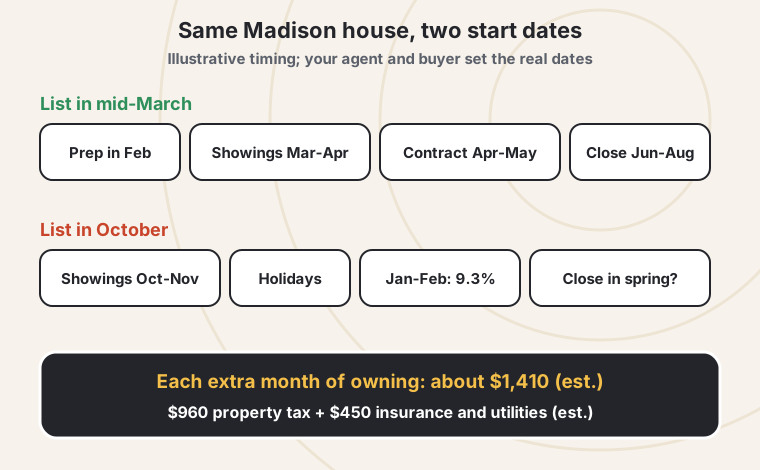
| Share recorded in January and February combined | 9.3% | Same query |
| New Haven County median days on market, May vs. January 2024 | 24 vs. 58 days | Realtor.com data via FRED (St. Louis Fed) |
| Property tax on the median house at the fiscal 2027 mill rate (23.06) | About $11,520 a year ($960 a month) | Mill rate: Town of Madison / OPM; tax on 70% assessment (CGS 12-62a) |
| Conveyance tax on a sale under $800,000 | 1% (0.75% state + 0.25% town) | CGS 12-494 |
| Typical Madison house | Built 1973; 64% heat with oil | Town parcel data |
Why does a slow sale in Madison feel so costly, and is this page for you?
A slow sale in Madison feels costly because every month you own the house you keep paying about $960 in property tax on a median-priced home, plus insurance, oil and upkeep, while you wait for buyers who mostly show up in spring and summer. This page is for Madison owners who need to sell sooner than the calendar wants, and who want honest levers, not generic staging tips.
Maybe you are already carrying two houses. Maybe it is your parents’ colonial off Route 79, and the oil bill just arrived for a house nobody lives in. Maybe it is October, and someone told you to “just wait for spring.” Most people here feel impatient, worried about money, unsure of the advice, and afraid the house will sit and look stale.
Those feelings are reasonable. Madison has a strong summer season, but the season is only one lever. The others are inside the house and your paperwork, and you control them.
I am Jerryll Noorden. I have bought houses in Connecticut since 2016, about ten a year. Sometimes the honest answer is that listing nets you more than selling to me. Each number below links to where it came from.
How fast do Madison houses sell, season by season?
Madison houses sell fastest in late spring and close most often in summer: 33.3% of Madison single-family closings in the state’s records were recorded in June, July and August, and only 9.3% in January and February. County data shows the same rhythm in days on market, with New Haven County at a median of 24 days in May 2024 and 58 days in January 2024.

We pulled Madison single-family market sales (no family transfers or other non-market sales) from the state’s Real Estate Sales dataset on data.ct.gov. The public file has complete Madison records for eight fiscal years between October 2015 and September 2025: 1,901 sales.
Two things stand out:
- The peak is a closing peak. A sale recorded in July was usually agreed in May or June and listed before that. So the summer peak in closings means a spring peak in listing and contracts.
- The trough is real but short. January (4.5%) and February (4.8%) are the slowest months by far. By March the share is already 7.1%.
The state file does not record days on market, so we use Realtor.com’s county figures on FRED: New Haven County ran from a median of 58 days in January 2024 to 24 in May, then back to 58 in December. Realtor.com’s county series for Connecticut stopped after December 2024, when Connecticut moved to planning regions, so 2024 is the latest full year. For the statewide picture and every month in detail, see our guide to the best time to sell a house in Connecticut; the full step-by-step timeline lives in how long it takes to sell a house in Connecticut. We do not repeat them here.
What does a slow month cost a Madison seller?
A slow month costs a Madison seller about $1,410 on a median-priced house (est.): roughly $960 in property tax at the fiscal 2027 mill rate of 23.06, plus about $450 for insurance, heat and utilities (est.), before any mortgage interest. Three extra months add up to about $4,230 (est.), which is the number to weigh against any price you might gain by waiting.
Here is the worked math, with every input labeled:
| Input | Amount | Basis |
|---|---|---|
| Median single-family price | $713,750 | Town sales data, Oct 2024 to Sep 2025 |
| Assessment (70% of value) | $499,625 | CGS 12-62a |
| Yearly property tax at 23.06 mills | About $11,520 | Fiscal 2027 mill rate |
| Monthly property tax | About $960 | Yearly tax / 12 |
| Insurance, heat, electric, upkeep | About $450 a month (est.) | Estimate; oil heat and a shoreline policy can run higher |
| Carrying cost per month | About $1,410 (est.) | Sum, before mortgage interest |
| Three extra months | About $4,230 (est.) | 3 x $1,410 |
A vacant house costs more: winter heat, someone checking on it, and a vacant-house insurance policy. Our carrying-cost worksheet walks through each line.
Now compare that with what waiting can earn. Our statewide analysis estimates a seasonal gain of about 2% to 4% for the same house sold in early summer instead of January (est., in the best-time guide). On $713,750 that would be roughly $14,000 to $28,000 (est.), far more than $4,230. That is why, for a house in good shape with no deadline, waiting for spring usually pays in Madison. The math flips when you have a deadline, a second mortgage, a vacant house in winter, or a house that needs work most summer buyers will not take on.
Which speed levers work best on a Madison house?
The speed levers that work best on a Madison house are timing the listing for mid-March, having the septic, oil tank and flood-zone answers on paper before the first showing, and pricing inside the band buyers search in. Madison homes have no public sewer, most heat with oil, and many sit near the water, so these three questions come up in nearly every sale and slow down the ones that cannot answer them.

- List by mid-March for a summer closing. Prep in February, go live in March or early April, and the contract usually lands in April or May. If you cannot make spring, early September is the next best window.
- Septic papers in hand. Local health officials have said Madison has no public sewers, so wastewater goes to septic systems. Connecticut’s Property Condition Disclosure Report asks for the septic service company and the date it was last pumped (CGS 20-327b). Pump it, keep the receipt, and consider having the system inspected before you list so a buyer’s inspection holds no surprise.
- An oil tank answer. With 64% of Madison houses on oil, buyers ask where the tank is, how old it is, and whether an old buried tank was removed. The disclosure report asks for the removal date and the company, and asks you to attach the paperwork. Find it before you list.
- A flood-zone answer. The report also asks whether the property is in a flood hazard area. If it is, get a flood insurance quote and any elevation certificate you have, so a buyer’s lender does not stall on it in week five.
- Priced in its band. Buyers search with round maximums. A price set to “test the market” drops out of the searches of the buyers it fits. Our guide on how to price your house to sell in Connecticut shows the method.
Decluttering, good photos and curb appeal still help. They matter less than the five levers, because clutter costs a few showings while an unanswered septic or tank question can cost the contract.
At closing you must give the buyer a signed affidavit that the house has working smoke and carbon monoxide detectors (CGS 29-453). The older option of paying the buyer a $250 credit instead was removed by Public Act 23-164, so check the detectors near every bedroom before you list.
What slows a Madison sale down after you get an offer?
What slows a Madison sale down after an offer is usually the inspection and the buyer’s loan: septic findings, an old oil tank, a roof or boiler near the end of its life, a flood insurance quote that surprises the buyer, or an appraisal that comes in below a price set in a hot month. Each of these can reopen the price or push back the closing date.
Most Madison buyers use a mortgage, so the contract has an inspection period, an appraisal and a loan commitment date. If the appraisal disagrees with a price set in a hot month, see our guide to a low appraisal when selling in Connecticut.
For roofs, boilers and other big items, our guide on what to fix before selling a house in Connecticut shows which repairs pay back. Fix what will stop a lender or scare an inspector, and price in the rest.
Which route is fastest for your Madison house?
The fastest route for a Madison house depends on its condition and your deadline: a well-kept house listed in spring often goes under contract within weeks and closes in about 30 to 45 days, while a house that needs work, is vacant in winter, or must close on a fixed date can sell to a cash buyer in about two weeks, at a lower price. Most Madison houses, at Madison prices, net more on the market.
List in spring
Highest netBest for a house in decent shape with no hard deadline.
- Biggest buyer pool
- Showings, inspection, appraisal
- Commission and about 1% conveyance tax
List now, priced to move
MiddleBest when you cannot wait for spring but the house shows well.
- Fewer buyers off-season
- Price sharply inside the band
- Same costs as a spring listing
Sell to a cash buyer
FastestBest for a dated, vacant or problem house, or a fixed date.
- About 2 weeks, one visit
- No repairs, leave what you do not want
- Lower price than a retail sale
If you want the side-by-side math, our page on cash buyer vs. realtor in Connecticut lays out what each route nets, and our pillar on every way to sell a house in Connecticut covers the other routes, from selling by owner to a lease option.
How much would you walk away with?
Slide the numbers to match your house. It works in your browser; nothing is saved or sent.
Estimates for planning. Conveyance tax per CGS 12-494 (state 0.75% up to $800,000, 1.25% to $2.5M, 2.25% above, plus the town rate). Seller attorney about $1,200 to $1,500; flat-fee MLS about $400; listings include three months of taxes, insurance and utilities, a cash sale about two weeks. Your attorney gives you the final numbers.
When you should not sell to a cash buyer
Do not sell your Madison house to me, or to any cash buyer, if it is in good condition, you can list by spring, and you can carry it for a few months. At a median of $713,750, even a few percent of price is more than a season of carrying costs. A cash buyer earns the discount by taking on repairs, risk and speed; if you do not need those, you are paying for something you do not use. We will say so on the phone. Our page on why cash offers are lower explains the math behind any offer.
How do you sell a Madison house faster, step by step?
To sell a Madison house faster, decide your deadline first, gather the septic, oil tank, flood and permit papers, hire your attorney early, price inside a search band, and list in mid-March or early September; if the deadline or the condition does not fit a listing, get a cash number as a floor before you decide.
Set your real deadline
Write down the date you need the money or need to stop paying for the house. That date decides whether spring is an option.
Gather the paperwork
Septic pumping receipts, oil tank details and any removal paperwork, flood zone and insurance information, permits for additions, and your mortgage statement. Our documents checklist has the full list.
Hire your attorney before you list
Connecticut closings are run by attorneys. Hiring one early lets title, payoff and permit questions get solved in March instead of in the week before closing.
Check the detectors and fill in the report
Test smoke and CO detectors for the affidavit, and complete the Property Condition Disclosure Report so it is ready for the first buyer.
Price inside the band and pick the date
Use recent Madison sales to set a price buyers actually search for, and go live in mid-March or early September.
Get a cash number as a floor
If the house needs work or the calendar is against you, ask for a written cash offer. It costs nothing, and it shows you the floor under every other option. We usually close in about two weeks.
See the house together.
Pick a time that works.
Choose a time for us to walk through the property with you, or ask for a quick call first. We confirm every request personally.
Tuesday, January 13
No open times in the next few weeks. Please call us.
We will confirm by email. Nothing is booked until we do.
View my request
The sales that drag on are rarely the ones with an ugly kitchen. They are the ones where nobody could find the septic receipt or say what happened to the old oil tank. Spend one afternoon finding those papers before you list. It is the cheapest speed you will ever buy.
Questions Madison sellers ask about selling faster
What is the fastest way to sell a house in Madison, CT?
The fastest way to sell a house in Madison, CT is a direct sale to a cash buyer, which can close in about two weeks with one visit and no repairs, at a lower price than a retail sale. The fastest way to sell at full market price is to list a well-prepared house in mid-March, priced inside a search band, with the septic, oil tank and flood answers ready.
What is the best month to list a house in Madison?
The best month to list a house in Madison is usually March or early April, so the contract lands in spring and the sale closes in June, July or August, which together hold 33.3% of Madison single-family closings in the state’s records. Early September is the next best window.
Do Madison houses sell in the winter?
Yes, Madison houses sell in the winter, but fewer of them: January and February together hold 9.3% of Madison single-family closings, and New Haven County’s median days on market was 58 in January 2024 against 24 in May 2024. Buyers in winter are fewer but often more serious.
How long do houses stay on the market in Madison?
Houses in Madison typically stay on the market for a few weeks in spring and about two months in midwinter, based on New Haven County’s median of 24 days in May 2024 and 58 days in January 2024 (Realtor.com via FRED). The state’s sales file does not track days on market for single towns, so treat the county figure as a guide.
Do I have to pump the septic before selling in Madison?
No Connecticut law requires you to pump the septic before selling, but the Property Condition Disclosure Report asks for the date it was last pumped and any problems (CGS 20-327b), and buyers’ inspectors usually look at it. Pumping and keeping the receipt is a cheap way to avoid a delay.
Does being in a flood zone slow down a Madison sale?
Being in a flood zone can slow down a Madison sale if the buyer’s lender requires flood insurance and the quote surprises the buyer late in the deal. The disclosure report asks whether the property is in a flood hazard area, so answer it up front and share an insurance quote early.
Is it worth waiting until spring to sell my Madison house?
Waiting until spring is usually worth it for a Madison house in good condition with no deadline, because a seasonal price gain of a few percent (est.) is larger than about $1,410 a month of carrying costs (est.). It is usually not worth it if the house is vacant, needs major work, or you are paying two mortgages.
Can I still use the $250 smoke detector credit in Connecticut?
No, you can no longer pay a $250 credit instead of the smoke and carbon monoxide affidavit in Connecticut. The current CGS 29-453, as revised by Public Act 23-164, requires the seller to give the buyer a signed affidavit at closing.
Related Connecticut guides
Selling faster
Fewer hassles
Start with the big picture in how to sell a house in Connecticut. If you would rather have a cash number for your Madison house, our Madison page explains how we buy there; we also buy in nearby Guilford and Branford.
Plain-English information, not legal or tax advice. Examples are illustrative and built from public numbers; amounts marked (est.) are estimates.
Sources (checked on October 27, 2026)
- Office of Policy and Management, Real Estate Sales dataset (data.ct.gov; Madison single-family market sales, fiscal years 2016-2018, 2020-2023 and 2025, queried October 27, 2026).
- Realtor.com, Market Hotness: Median Days on Market in New Haven County, CT (FRED, Federal Reserve Bank of St. Louis).
- Office of Policy and Management, mill rates by town (data.ct.gov).
- CGS § 12-62a (assessment at 70% of value).
- CGS § 12-494 (conveyance tax rates).
- CGS § 20-327b and 20-327c (Property Condition Disclosure Report; septic, oil tank and flood questions; $500 credit).
- CGS § 29-453 (smoke and carbon monoxide affidavit, as revised by P.A. 23-164).
- Town median, sales count, mill rate, year built and heating fuel: our town data compiled from public sales records (October 2024 to September 2025), fiscal 2027 mill rates and town parcel data.

Who wrote this
Jerryll Noorden
Jerryll has bought and sold Connecticut houses since 2016 and has sat at more closing tables than he can count, on both sides. Before real estate he was a robotics scientist at NASA, IHMC and IIT. He wrote this guide because the national sites that rank for it skip the Connecticut rules that cost sellers money. When listing or selling it yourself would get you more than a cash offer, he says so.
This guide explains Connecticut rules in plain English. It is not legal or tax advice. Laws change; for your sale, talk to a Connecticut real estate attorney and a tax professional.
