
Key facts at a glance
| Fact | Number | Source |
|---|---|---|
| Connecticut median single-family sale price (Oct 2024 to Sep 2025) | $425,000 (29,624 recorded sales) | OPM Real Estate Sales, data.ct.gov (our query) |
| Conveyance tax on that house in most towns (state 0.75% + town 0.25%) | $4,250 | CGS 12-494 |
| US sellers who used an agent / sold by owner | 91% / 5% | NAR 2025 Profile of Home Buyers and Sellers |
| Time to cancel a Connecticut wholesale contract, for any reason | 3 business days | CGS 20-329ccc |
| Longest closing date in a wholesale contract unless extended in writing | 90 days | CGS 20-329ccc |
| Credit to the buyer if you skip the condition report (sale or lease with option) | $500 | CGS 20-327b, 20-327c |
| Connecticut’s 12% interest cap on loans | Does not apply to a bona fide mortgage over $5,000 | CGS 37-4, 37-9(3) |
What are the ways to sell a house in Connecticut, compared?
The ways to sell a house in Connecticut, compared on the same $425,000 median house, rank like this: a private sale to someone you know and selling it yourself can net the most, a listing agent is close behind with less work, a fix-and-list partnership lands near a listing but takes longer, and a direct cash sale nets less but closes in about two weeks with almost no risk. Wholesale, seller-financed, rent-to-own and subject-to sales trade money, time and risk in different ways.
This page is part of our guide to how to sell a house in Connecticut. Most comparisons you will find online are written by someone who sells one of these routes, and they compare three options at most. Here every route sits on the same house, with the same inputs, and every input is labelled so you can swap in your own numbers.
A quick word on who is writing. I am Jerryll Noorden. I have bought houses in Connecticut since 2016, about ten a year. I buy houses for cash, so I have a stake in one of the rows below. That is exactly why the table shows the cash row losing on money when it does. If you want the full step-by-step for any one route, the Connecticut home-selling guide covers every step in order.
Why does choosing how to sell feel so hard?
Choosing how to sell feels hard because every option is explained by someone who profits from it, the numbers are never on the same house, and the risk of picking wrong feels permanent. Most owners at this point feel overwhelmed, suspicious and afraid of leaving money on the table. This page is for Connecticut owners who want to see every route side by side before they talk to anyone.
Maybe an agent told you the house will sell for a number that sounds great, and then you read about commission, repairs and months of showings. Maybe a postcard offered cash “in any condition” and you wondered how much less that really means. Maybe a relative swears by selling it yourself, and someone online says rent-to-own is the smart move.
Each of those people is half right. The trouble is that price is not what you keep. What you keep depends on the costs taken out, the months you keep paying for the house, and whether the sale actually closes. Those three things are what this page puts in one table.
You do not have to decide anything today. Read the table, find your row, and when you are ready, get two real numbers for your own house. Asking for a number commits you to nothing.
What house are we comparing, and where do the numbers come from?
We are comparing one Connecticut single-family house that would sell for $425,000, the state median for recorded single-family sales from October 2024 to September 2025, in a town with the standard 1.00% conveyance tax. Every route uses the same commission, attorney and carrying-cost inputs below, each labelled as sourced or estimated, so the only thing that changes from row to row is the route itself.
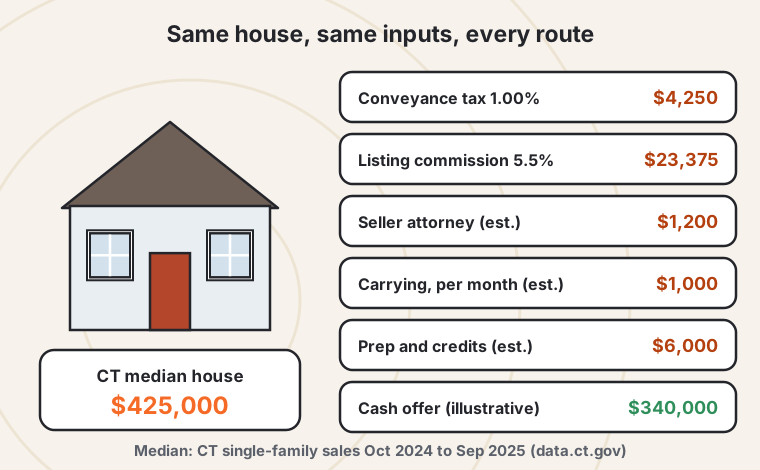
| Input | Value used | Where it comes from |
|---|---|---|
| Sale price if listed, ready for a buyer with a mortgage | $425,000 | CT single-family median, data.ct.gov (sourced) |
| Conveyance tax | 1.00% of the price ($4,250 at $425,000) | CGS 12-494: state 0.75% up to $800,000 plus town 0.25% (sourced) |
| Listing commission (both sides) | 5.5% ($23,375) | Commission is negotiable; 5% to 6% is a common range (est.); see our Connecticut commission guide |
| Buyer’s agent fee if you sell it yourself | 2.5% ($10,625) plus $400 flat-fee MLS | Estimate; you may also offer nothing |
| Prep, repairs and buyer credits on a listing | $6,000 | Estimate for a sound but lived-in house |
| Seller’s attorney | $1,200 | Estimate; Connecticut closings are attorney-run |
| Carrying cost per month | $1,000 | Estimate: about $744 property tax (30 mills on 70% of $425,000) plus about $256 insurance and utilities |
| Cash offer on this house | $340,000 (80% of value) | Illustrative; real offers depend on condition |
Two choices matter. First, every net is before your mortgage payoff, because that is the same in every row except subject-to. Second, the house is sound. If yours needs serious work, skip to what changes if the house needs work, because the ranking shifts.
The conveyance tax deserves one more line. If your town charges 0.50% (Bristol, Hartford, New Haven, Waterbury and twelve others) the tax on this house is $5,313 instead of $4,250. Our conveyance tax guide lists every town’s rate.
How do all the ways to sell compare on the same Connecticut house?
All the ways to sell compare like this on the same $425,000 Connecticut house: a private sale nets about $417,550, selling it yourself about $398,525, a fix-and-list partnership about $388,800, a listing agent about $386,175, a direct cash sale about $334,900 and a wholesale deal about $314,100. Seller financing, rent-to-own and subject-to pay you over time or not in cash at all, and an auction’s result is unknown until bidding ends.
| Route | Net to you (est.) | Time to your money | Certainty it closes | Your effort | Risk you keep after closing |
|---|---|---|---|---|---|
| Private sale to a tenant, neighbor or relative | $417,550 | 1 to 2 months | Medium: their loan must close | Medium | Low |
| Sell it yourself (FSBO) | $398,525, if you price and negotiate as well as an agent | 3 to 5 months | Medium: loan, appraisal, inspection | High | Low |
| Fix-and-list partnership (novation) | $388,800 | 4 to 6 months | Medium-low: depends on the resale | Low to medium | Market risk until it sells |
| Listing agent | $386,175 | 3 to 5 months | Medium: loan, appraisal, inspection | Medium | Low |
| Direct cash buyer | $334,900 | About 2 weeks | High | Very low | None |
| Wholesaler (contract assigned to a cash buyer) | $314,100 | Weeks, up to 90 days | Lower: the contract can end unsold | Low | None after closing |
| Auction (your choice, not foreclosure) | Unknown until bidding ends | 1 to 2 months (est.) | Medium to high once a bid is accepted | Low to medium | Low |
| Seller financing | $37,100 at closing, then $2,634.60 a month | Years | Depends on the buyer paying | Medium | High: default and foreclosure |
| Lease option (rent-to-own) | $10,000 option fee now; about $434,400 later if exercised | 1 to 3 years | Low: the option may never be used | Medium | High: you still own it |
| Subject-to (buyer takes over your payments) | Little cash; your loan is paid by the buyer | Weeks | Medium | Low | Highest: loan stays in your name |
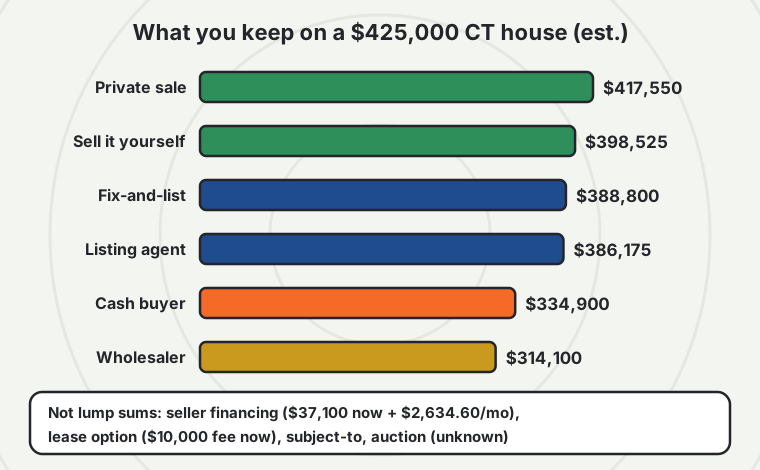
Here is how each lump-sum row was worked out, so you can check it:
- Listing agent: $425,000 minus $23,375 commission, $6,000 prep and credits, $4,250 conveyance tax, $1,200 attorney and four months of carrying costs ($4,000) = $386,175.
- Sell it yourself: $425,000 minus $10,625 buyer’s agent fee, $400 flat-fee MLS, $6,000 prep, $4,250 tax, $1,200 attorney and $4,000 carrying = $398,525. Our guide to selling without a realtor in Connecticut covers the work behind that number.
- Private sale: $425,000 minus $4,250 tax, $1,200 attorney and two months of carrying ($2,000) = $417,550. It assumes your buyer gets a mortgage at full price and no agent is involved.
- Direct cash buyer: $340,000 minus $3,400 tax (1.00% of the cash price), $1,200 attorney and half a month of carrying ($500) = $334,900.
- Wholesaler: the end buyer pays $340,000, the wholesaler keeps an illustrative $20,000 fee, so your contract says $320,000. Minus $3,200 tax, $1,200 attorney and six weeks of carrying ($1,500) = $314,100.
- Fix-and-list partnership: the partner spends $25,000 on updates and the house resells for $465,000 (est.). You receive an agreed $395,000, then pay your attorney ($1,200) and carry it five months ($5,000) = $388,800. The partner keeps what is left after commission, tax and repairs, about $14,775 in this example.
Which route leaves you the most money?
The route that leaves you the most money on a sound Connecticut house is usually a sale to a retail buyer with a mortgage: a private sale, selling it yourself or a listing agent. They win because they reach the full market price. Cash and wholesale routes start from a lower price, while seller financing and rent-to-own can bring a higher total only if the buyer keeps paying for years.
Three things decide the money, in this order:
- Who the buyer is. A family buying a home with a mortgage pays retail. An investor pays a price that leaves room for repairs, holding costs, resale costs and profit. Our page on why cash offers are lower walks through that investor math line by line.
- What comes out before you are paid. Commission is the biggest line on a listing ($23,375 here). The conveyance tax comes out in every route, but it is smaller when the price is smaller.
- How long you keep paying. Every month the house sits costs about $1,000 here. Four months is $4,000; a year would be $12,000.
Seller financing looks attractive on paper. At $440,000 with $44,000 down and $396,000 financed at 7% over 30 years (est.), you would collect $2,634.60 a month. After five years the buyer would still owe about $372,761, normally paid off by a balloon payment from a refinance. You would have earned about $134,837 in interest by then. The catch is that every dollar depends on one buyer paying for years. If they stop, you foreclose in court (CGS 49-24). The owner financing guide covers the federal rules and the protections you need.
Rent-to-own works the same way: the $10,000 option fee is yours now, and the $440,000 price (about $434,400 after tax and attorney) only arrives if the tenant-buyer exercises the option. Our lease option and rent-to-own guide explains what happens when they don’t.
When you compare offers, cross out the price and write the net next to it. A $425,000 listing and a $340,000 cash offer are not $85,000 apart on this house; after costs and months they are about $51,000 apart. On a house that needs work they can be closer, or further apart. Our seller closing costs guide lists every line.
Which route is fastest and most certain to close?
The fastest and most certain route to close is a direct sale to a cash buyer who has the money: no lender, no appraisal and no financing contingency, so it often closes in about two weeks. Listings and private sales take one to five months and can fail on the buyer’s loan, the appraisal or the inspection. Wholesale contracts can run up to 90 days and end if no buyer is found.
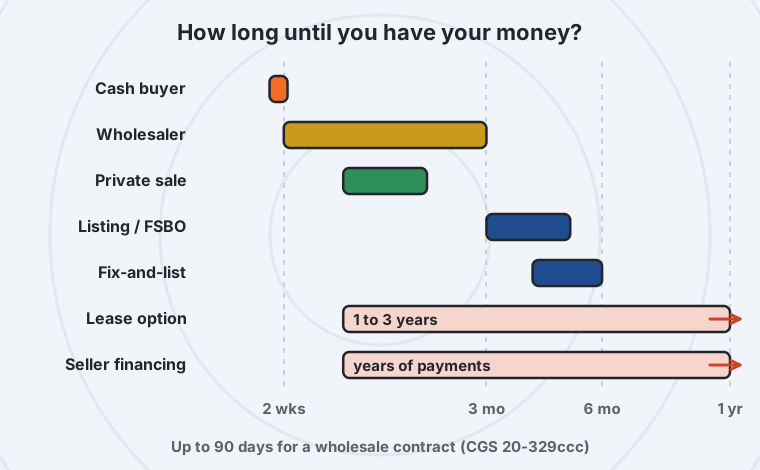
Certainty matters more than most people expect. A listing that goes under contract is not sold. The buyer’s lender orders an appraisal, the buyer inspects, and either can reopen the price or end the deal. When that happens you have lost weeks and must start over, and the carrying costs keep running. Our guide to how long it takes to sell a house in Connecticut shows each stage of that clock.
A wholesale contract has its own uncertainty. The wholesaler does not plan to buy; they plan to find a buyer. Connecticut now limits that: a wholesale contract must let you cancel within three business days and cannot set a closing more than 90 days out unless everyone agrees in writing, or it ends automatically (CGS 20-329ccc). Our page on wholesaler vs. realtor vs. cash buyer explains how to tell which one you are talking to.
A direct cash buyer is only certain if the money is real. Ask for proof of funds in the buyer’s own name and check that the contract does not say “and/or assigns”. We buy houses ourselves with our own funds or partner funding, and you can see proof before you sign.
How much work and risk does each route leave with you?
The work and risk each route leaves with you range from almost none in a direct cash sale to years of exposure in seller financing, rent-to-own and subject-to deals. Selling it yourself is the most work up front; a listing is moderate work; the creative routes are light work at closing but keep you tied to the house, the loan or the buyer afterwards.
| Route | What you do | What can still go wrong after you sign | Connecticut or federal rule |
|---|---|---|---|
| Listing agent | Prep, showings, negotiate repair requests | Buyer’s loan, appraisal or inspection fails | Condition report or $500 credit (CGS 20-327b, 20-327c) |
| Sell it yourself | Price, photos, marketing, showings, negotiation | Same as a listing, with no agent to catch problems | Same disclosures; attorney closes (CGS 51-88a) |
| Private sale | Agree a price, hire attorneys | Their loan fails; settle a tenant’s deposit and interest | Security deposit and interest (CGS 47a-21) |
| Direct cash buyer | One walkthrough, sign, pick a date | Little: no lender in the deal | Same conveyance tax (CGS 12-494) |
| Wholesaler | Sign, wait while they find a buyer | Contract ends unsold; delay | Registration, disclosure report, 3 days, 90 days (CGS 20-329aaa to 20-329hhh) |
| Fix-and-list partnership | Sign one agreement, keep paying until resale | Repairs run over; resale price falls | Wholesaler law may apply (CGS 20-329aaa) |
| Seller financing | Collect payments, keep insurance and taxes checked | Buyer stops paying; you foreclose | Foreclosure in court (CGS 49-24); federal limits (12 CFR 1026.36) |
| Lease option | Stay the owner and landlord | Option not used, rent stops, damage | Report before signing (CGS 20-327b); record over one year (CGS 47-19) |
| Subject-to | Deed the house, trust the buyer to pay your loan | Lender calls the loan; late payments on your credit | Due-on-sale clause enforceable (12 U.S.C. 1701j-3) |
Subject-to deserves a plain warning. The deed moves to the buyer but the mortgage stays in your name. If the buyer stops paying, it is your credit and, eventually, a Connecticut foreclosure against a house you no longer own. Read how subject-to works and the protections to insist on before you consider it.
For the creative routes in plain words, our sibling guide on creative ways to sell a house in Connecticut explains each one with its Connecticut rule and who it fits. This page sticks to the numbers.
What changes if the house needs work?
If the house needs work, the ranking changes: a buyer with a mortgage may not be able to buy it as it is, the listing price drops or you pay for repairs first, and the gap to a cash or fix-and-list offer narrows. Take the same $425,000 house needing $40,000 of repairs (est.). Fixing and listing nets about $349,175, listing as-is about $333,750, a fix-and-list partnership about $333,800, and an investor’s rule-of-thumb cash offer about $253,225.
| Route on the $40,000 fixer | Math (est.) | Net | Time |
|---|---|---|---|
| Fix it yourself, then list | $425,000 minus $40,000 repairs, $23,375 commission, $4,250 tax, $1,200 attorney, 7 months carrying ($7,000) | $349,175 | 6 to 8 months |
| Fix-and-list partnership | Agreed $340,000 to you, minus $1,200 attorney and 5 months carrying ($5,000) | $333,800 | 4 to 6 months |
| List as-is at $370,000 | Minus $20,350 commission, $3,700 tax, $1,200 attorney, $6,000 credits, 5 months carrying ($5,000) | $333,750 | 3 to 6 months |
| Cash buyer using the 70% rule | 70% of $425,000 minus $40,000 = $257,500; minus $2,575 tax, $1,200 attorney, $500 carrying | $253,225 | About 2 weeks |
Fixing and listing still nets the most, but only if you have $40,000, seven months and the stomach to manage contractors, and only if the repairs do not run over. Many owners have none of the three. That is where a partnership or an as-is listing earns its place, and where a cash sale buys you two weeks instead of seven months. Our guide to selling a house as-is in Connecticut covers what as-is means in a contract.
If you would rather see your own number than an illustration, our cash buyer vs. realtor comparison has a calculator with your town’s conveyance tax built in.
How much would you walk away with?
Slide the numbers to match your house. It works in your browser; nothing is saved or sent.
Estimates for planning. Conveyance tax per CGS 12-494 (state 0.75% up to $800,000, 1.25% to $2.5M, 2.25% above, plus the town rate). Seller attorney about $1,200 to $1,500; flat-fee MLS about $400; listings include three months of taxes, insurance and utilities, a cash sale about two weeks. Your attorney gives you the final numbers.
How do you decide which way to sell?
You decide which way to sell by answering four questions in order: do you have a hard deadline, can a buyer with a mortgage buy the house as it is, can you pay for repairs and wait, and do you need all your money at closing. The answers point you to one or two routes; then you get real numbers for those routes and compare the nets.
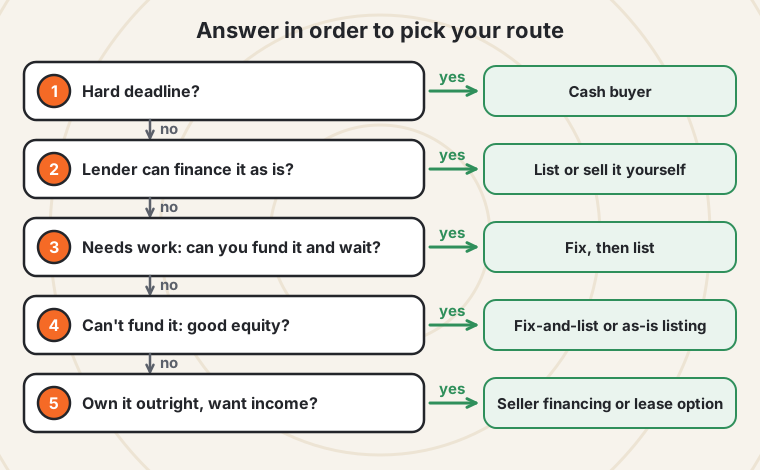
- Is there a hard deadline? A foreclosure Law Day, a probate deadline, a move date or two payments you cannot carry. If yes, start with a direct cash buyer, and still ask an agent what a fast listing would bring.
- Could a buyer’s lender approve the house as it is? No major roof, foundation, oil tank, heating or code problems. If yes, a listing or a sale by owner will usually net the most.
- If it needs work, can you fund it and wait? If yes, fix and list. If you have equity but not cash, ask about a fix-and-list partnership. If neither, compare an as-is listing with a cash offer.
- Do you need the whole price at closing? If you own the house outright and want income instead, seller financing or a lease option may fit. If you are behind on payments, read our foreclosure selling guide before any creative deal.
Still not sure? This two-minute self-check gives an honest answer, and says so when listing is the better fit.
Is a cash sale right for you, or should you list?
Seven quick questions. There is no wrong answer, and we will tell you honestly if listing would leave you more.
- Does the house need repairs you would rather not pay for or manage?
- Do you need to close by a certain date, or within the next month or two?
- Would showings be hard: tenants, belongings, privacy, or you live out of state?
- Is there a complication: an estate or probate, a divorce, foreclosure, liens or back taxes?
- Could you comfortably cover the mortgage, taxes and utilities for three or more months?
- Is getting the highest possible price more important to you than speed and certainty?
- Would a buyer's bank lend on the house as it is (no major roof, foundation, oil tank or code issues)?
When should you NOT sell to a cash buyer?
You should not sell to a cash buyer when the house is in good shape, a buyer with a mortgage can buy it as it is, you can wait three to five months and carry the costs, and the highest price matters more to you than speed. On the median house above, listing nets about $51,000 more than our illustrative cash offer. That is real money, and we will tell you so.
Also skip cash if:
- You already have a strong offer from a buyer with a mortgage commitment.
- A family member or tenant wants the house and can get a loan; a private sale saves the commission.
- Someone offering “cash” cannot show proof of funds in their own name, or the contract can be assigned. Our page on how to check a cash home buyer lists the checks.
Cash makes sense when the costs and risks of a listing eat the difference: repairs you cannot fund, a deadline, tenants, an estate, a house a lender will not finance, or simply a need to be done. Our service page on whether a cash buyer or a realtor nets more works through that trade-off on a Hartford house.
How do you compare real offers on your own house?
You compare real offers on your own house by getting at least two written numbers from different routes, converting each one to a net after every cost and month of carrying, weighing the chance each one actually closes, and choosing with your attorney. It usually takes one to two weeks and costs nothing.
Get a market value
Ask a local agent for a comparative market analysis based on closed sales near you in the last three to six months. Check your town’s median on its town page, for example our Bristol page, which shows recent sales and the mill rate.
Get a cash number in writing
Ask a direct buyer for a written offer and how they got to it. With us that takes a short walkthrough or a few photos, and the offer does not expire on you.
Write the net under every price
Subtract commission, conveyance tax at your town’s rate, attorney, repairs or credits, and the months of carrying. Use the calculator above or our guide on how to compare offers on a house in Connecticut.
Weigh certainty and risk
Mark each offer for financing, appraisal and inspection contingencies, an assignment clause, and anything you are still on the hook for after closing.
Decide with your attorney
A Connecticut attorney closes every sale. Show them the offers before you sign. Take as long as you need.
See the house together.
Pick a time that works.
Choose a time for us to walk through the property with you, or ask for a quick call first. We confirm every request personally.
Tuesday, January 13
No open times in the next few weeks. Please call us.
We will confirm by email. Nothing is booked until we do.
View my requestQuestions about comparing ways to sell a house in Connecticut
What is the best way to sell a house in Connecticut?
The best way to sell a house in Connecticut depends on its condition and your deadline. For a sound house and an owner who can wait, a listing or a sale by owner usually nets the most. For a house that needs work, a deadline or a complicated situation, a direct cash sale often leaves you better off after costs, months and risk.
How much less does a cash buyer pay than a listing in Connecticut?
How much less a cash buyer pays depends on the house. On our illustrative $425,000 sound house, a $340,000 cash offer netted about $51,000 less than a listing after commission, tax and carrying costs. On a house needing major repairs the gap in net can be smaller or larger; compare nets, not prices.
Is selling by owner worth it in Connecticut?
Selling by owner in Connecticut can be worth it if the house sells easily and you price and negotiate well; on our example it netted about $12,350 more than a listing because there was no listing commission. It is the most work of any route, and you still need an attorney for the closing.
What is the fastest way to sell a house in Connecticut?
The fastest way to sell a house in Connecticut is usually a direct cash sale, which can close in about two weeks because there is no lender or appraisal. A listing typically takes three to five months from preparation to closing.
Is selling to a wholesaler the same as selling to a cash buyer?
No, selling to a wholesaler is not the same as selling to a cash buyer. A wholesaler signs a contract and assigns it to a cash buyer for a fee, without taking title. Since July 1, 2026, Connecticut requires wholesalers to register and gives you three business days to cancel and a 90-day closing limit (CGS 20-329aaa to 20-329hhh).
Does seller financing get me more money?
Seller financing can get you more money in total, through a higher price and interest, but only if the buyer keeps paying. In our example you would receive $37,100 at closing and $2,634.60 a month, with the rest arriving years later. If the buyer defaults, you must foreclose in court.
Is rent-to-own a good way to sell a house in Connecticut?
Rent-to-own is a good way to sell only if you do not need your money for a year or more and can carry the house if the rent stops. You remain the owner, the option may never be used, and Connecticut requires a condition report before signing and recording for options (CGS 20-327b, 47-19).
Can I auction my house in Connecticut?
Yes, you can choose to auction your house in Connecticut through an auction firm or broker. It is different from a court-ordered foreclosure sale. You still owe the conveyance tax and normally the condition report, and the price is unknown until bidding ends, which is why our table gives no net for it.
Do I pay conveyance tax no matter how I sell?
Yes, you pay Connecticut conveyance tax no matter how you sell, whether you list, sell by owner, sell for cash or seller-finance. It is 0.75% state tax up to $800,000 plus the town rate, usually 0.25% or 0.50% (CGS 12-494), paid at closing.
Do I need an attorney for every type of sale in Connecticut?
Yes, in practice you need an attorney for every type of sale in Connecticut, because Connecticut closings are handled by attorneys. For seller financing, lease options and subject-to deals, have your own attorney draft or review every document.
Where did the $425,000 median come from?
The $425,000 median comes from our query of the state’s real estate sales data on data.ct.gov: 29,624 recorded single-family sales of $10,000 or more from October 1, 2024 to September 30, 2025. Your town’s median may be very different.
Related guides
- How to sell your house in Connecticut: how it works with us
- How do I sell my house in Connecticut? Every route, step and cost
- Creative ways to sell a house in Connecticut
- Realtor vs. investor in Bristol, CT: the net both ways
- All the ways we buy houses in Connecticut
- Novation (fix-and-list sales) explained
- Real estate commission in Connecticut
When you are ready to see your own numbers, start with how selling to us works, or call Jerryll at (203) 529-4712. No fee, no obligation, and if listing would leave you more, we will say so.
This guide explains Connecticut rules in plain English and is not legal or tax advice. Amounts marked (est.) are estimates; your attorney gives you the final numbers.
Sources (checked on October 27, 2026)
- Office of Policy and Management, Real Estate Sales (data.ct.gov dataset 5mzw-sjtu): single-family sales recorded October 2024 to September 2025, our query.
- CGS 12-494 (conveyance tax).
- CGS 20-327b and 20-327c (residential condition report, including leases with an option to buy; $500 credit).
- CGS 20-329aaa to 20-329hhh (real estate wholesalers, effective July 1, 2026; P.A. 25-168).
- CGS 47-19 (recording leases over one year or with an option to purchase).
- CGS 47a-21 (security deposits and interest).
- CGS 37-4 and 37-9 (interest cap and the exception for bona fide mortgages over $5,000).
- CGS 49-24 (foreclosure by strict foreclosure or by sale).
- CGS 51-88a (practice of law; attorney-run closings).
- 12 CFR 1026.36 (seller-financer exclusions).
- 12 U.S.C. 1701j-3 (due-on-sale clauses).
- National Association of Realtors, 2025 Profile of Home Buyers and Sellers (91% used an agent, 5% sold by owner).

Who wrote this
Jerryll Noorden
Jerryll has bought and sold Connecticut houses since 2016 and has sat at more closing tables than he can count, on both sides. Before real estate he was a robotics scientist at NASA, IHMC and IIT. He wrote this guide because the national sites that rank for it skip the Connecticut rules that cost sellers money. When listing or selling it yourself would get you more than a cash offer, he says so.
This guide explains Connecticut rules in plain English. It is not legal or tax advice. Laws change; for your sale, talk to a Connecticut real estate attorney and a tax professional.
