
Key facts at a glance
| Fact | Number | Source |
|---|---|---|
| Bristol median single-family sale price (Oct 2024 to Sep 2025) | $330,000 (613 recorded sales) | OPM Real Estate Sales, data.ct.gov (our query) |
| Conveyance tax a Bristol seller pays (state 0.75% + Bristol 0.50%) | 1.25%, or $4,125 on the median | CGS 12-494 |
| Bristol mill rate, fiscal 2027 | 35.3 mills (about $680 a month on the median house) | OPM mill rates, data.ct.gov |
| Typical year a Bristol single-family home was built | 1962 (46% before 1960) | 2025 CT Parcel and CAMA Data |
| Bristol single-family homes heated with oil | 76% (gas 13%) | 2025 CT Parcel and CAMA Data |
| Probate court for Bristol estates | Bristol-Plymouth Probate Court (PD-19) | Connecticut Probate Courts |
| Superior Court judicial district | New Britain | CGS 51-344(7) |
Realtor vs. investor in Bristol, CT: which leaves you more?
A realtor usually leaves you more in Bristol, CT when the house is ready for a buyer with a mortgage: on a $330,000 house at the Bristol median, listing nets about $297,605 against about $259,997 from an illustrative $265,000 cash offer. An investor can leave you better off on a Bristol fixer that a lender won’t finance, when you cannot pay for repairs, or when you need to be done in weeks.
This page is part of our guide to how to sell a house in Connecticut. It answers one question for one town: in Bristol, with Bristol’s prices, taxes and houses, what does each route actually leave you? If you want a Bristol cash offer instead of a comparison, our Bristol page is the place to start.
I am Jerryll Noorden. I have bought houses in Connecticut since 2016, about ten a year, and I am the investor in this comparison. So I will show you where I lose, because on a ready Bristol house, I do.
Why is the agent-or-investor choice so hard for Bristol owners?
The agent-or-investor choice is hard for Bristol owners because the two numbers they hear are far apart, both sides are selling something, and many Bristol houses are older capes and ranches with an oil tank, an aging roof or a dated kitchen that makes the real value unclear. Most owners feel torn, wary of being lowballed and worn down by the monthly cost. This page is for you if that is where you are.
Maybe it is your parents’ cape off Route 6 or a ranch in Forestville, and you have been paying the taxes and the oil since the house went quiet. Maybe an agent walked through and said “this will sell for the median”, then handed you a list of what to fix first. Maybe an investor’s postcard number made you laugh, or made you angry.
Both reactions are fair. The agent’s number is a price before costs. The investor’s number is a price after the investor’s costs. Neither one is what you keep. The rest of this page puts both on the same Bristol house and shows the math line by line, so you can decide with real numbers instead of a feeling.
What does Bristol’s housing stock mean for your sale?
Bristol’s housing stock means many sellers are selling an older house: the typical single-family home was built in 1962, 46% were built before 1960, and 76% heat with oil. Ranches (27%), capes (26%) and colonials (19%) make up most of the town. That age and that oil heat are what decide whether a buyer with a mortgage can buy your house as it is, and therefore whether an agent or an investor fits better.
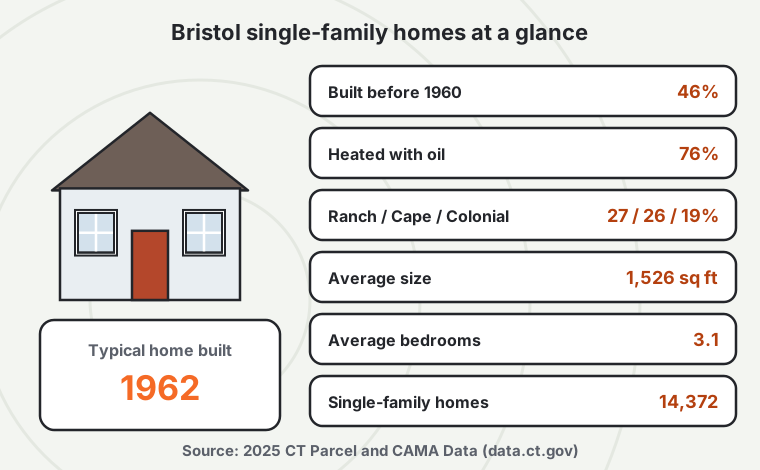
Bristol has about 14,372 single-family homes, averaging about 1,526 square feet and 3.1 bedrooms (2025 CAMA data). Here is what that stock means when you sell:
- Oil tanks. With three in four homes on oil, many buyers’ inspectors, insurers and lenders ask about the tank: its age, whether it is buried, and whether it leaks. An old buried tank can stall a financed sale until it is removed or tested.
- Lead paint. Almost every house built before 1978 needs the federal lead-based paint disclosure, and in Bristol that is most of the town.
- Original systems. A 1950s or 1960s house may still have an original boiler, older wiring or galvanized pipes. Those items show up in inspections and appraisals.
- Disclosure either way. Whether you list or sell to an investor, most Bristol sellers give the buyer the Residential Property Condition Report or credit $500 at closing (CGS 20-327b, 20-327c). An executor selling an estate house is exempt.
None of this makes a Bristol house hard to sell. It makes condition the first question. A ready house goes to the open market. A house with a failed tank, a 30-year-old roof and a 1960s kitchen is where the routes start to compete.
What would a ready Bristol house net with a realtor vs. an investor?
A ready Bristol house at the $330,000 median would net about $297,605 with a realtor after a 5.5% commission, $5,000 of prep and credits, Bristol’s 1.25% conveyance tax, a $1,200 attorney and four months of carrying costs. An illustrative $265,000 investor offer nets about $259,997 in roughly two weeks. Listing leaves about $37,600 more, if the buyer’s loan closes.
| Line | Realtor | Investor (cash) |
|---|---|---|
| Sale price | $330,000 (Bristol median) | $265,000 (illustrative, about 80%) |
| Commission (5.5%, est.) | −$18,150 | $0 |
| Prep, small repairs, buyer credits (est.) | −$5,000 | $0 |
| Conveyance tax, 1.25% (CGS 12-494) | −$4,125 | −$3,313 |
| Seller’s attorney (est.) | −$1,200 | −$1,200 |
| Carrying at $980 a month (est.) | −$3,920 (4 months) | −$490 (half a month) |
| You keep, before your mortgage payoff | $297,605 | $259,997 |
| Time | 3 to 5 months | About 2 weeks |
| Can it fall through? | Yes: loan, appraisal, inspection | Rarely: no lender |
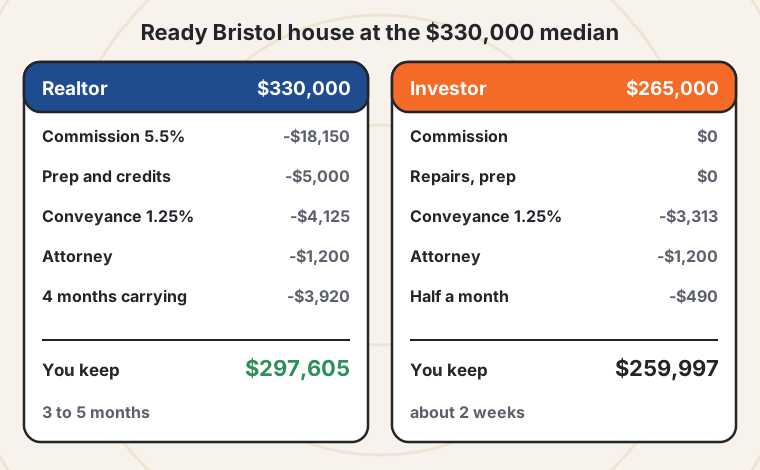
That is the honest result: on a ready Bristol house, the realtor wins by tens of thousands. The investor’s only advantages here are speed and certainty. If you can wait and the house will pass a lender’s appraisal and inspection, list it. Our Connecticut commission guide shows how to negotiate the fee down, which widens the gap further.
The one cost both routes share is the conveyance tax. Bristol is one of the Connecticut towns that charge 0.50% on top of the state’s 0.75%, so a Bristol seller pays 1.25% where most towns pay 1.00%. On the median, that is $4,125 instead of $3,300. The full town list is in our conveyance tax guide.
What about a Bristol fixer that needs $55,000 of work?
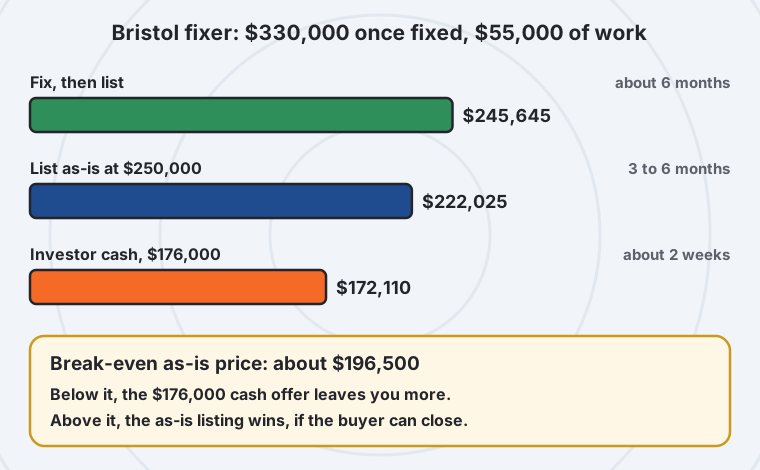
A Bristol fixer that needs $55,000 of work changes the comparison: fixing it and then listing nets about $245,645 after six months, listing it as-is at $250,000 nets about $222,025, and an investor’s rule-of-thumb cash offer of $176,000 nets about $172,110 in two weeks. Fixing still wins if you have the cash and time; the cash offer beats an as-is listing only if that listing would sell below about $196,500.
Take a 1950s Bristol cape that would sell for the median, $330,000, once updated. It needs a roof ($14,000), a boiler and oil tank replacement ($12,000), a kitchen and bath ($20,000), and floors, paint and electrical work ($9,000). That is $55,000 (all est.). Here are three honest ways to sell it:
| Route | Math (est.) | You keep | Time |
|---|---|---|---|
| Fix it, then list with an agent | $330,000 minus $55,000 repairs, $18,150 commission, $4,125 tax, $1,200 attorney, 6 months carrying ($5,880) | $245,645 | About 6 months |
| List as-is with an agent at $250,000 | Minus $13,750 commission, $3,125 tax, $1,200 attorney, $5,000 credits, 5 months carrying ($4,900) | $222,025 | 3 to 6 months |
| Sell to an investor for cash | 70% of $330,000 minus $55,000 = $176,000; minus $2,200 tax, $1,200 attorney, $490 carrying | $172,110 | About 2 weeks |
Three things this table does not show, and they matter more in Bristol than the numbers suggest:
- Fixing takes $55,000 you may not have, and repairs on a 60-year-old house often run over once walls and floors are opened. If they run $15,000 over, the fix-and-list number drops to about $230,645.
- The as-is listing depends on who can buy it. A buyer with a regular mortgage may not get a loan on a house with a failing roof or an old buried tank. That shrinks the buyer pool to cash buyers and renovation-loan buyers, which is why the as-is price is uncertain.
- The break-even is the useful number. If an agent tells you the house would sell as-is for less than about $196,500, the cash offer leaves you more, sooner. Above that, the as-is listing wins, if it closes.
Our page on why cash offers are so low explains the 70% rule and how to push an investor’s number up. If you own a fixer, our guide to selling a house that needs repairs in Connecticut covers what to fix, credit or leave.
When does an investor win in Bristol, and when does a realtor win?
An investor wins in Bristol when the house needs work you cannot or will not pay for, a lender won’t finance it as it is, you face a deadline such as a foreclosure Law Day, probate or a move, or the monthly cost of holding it is wearing you down. A realtor wins when the house is ready, a mortgage buyer can buy it as it is, and you can wait three to five months for the higher number.
A Bristol realtor fits if
More moneyUsually the higher net, if the buyer’s loan closes.
- The house is updated or close to it
- The roof, heat and oil tank will pass inspection
- You can carry about $980 a month for a few months
- You can keep it ready for showings
- Price matters more than speed
A Bristol investor fits if
About 2 weeksLower price, almost no risk, nothing to fix.
- It needs $30,000 or more of work you can’t fund
- A lender may not finance it as it is
- There is a deadline: Law Day, probate, a move, a divorce
- It is vacant and costing you every month
- You want to leave everything and be done
When you should NOT sell to an investor: if your Bristol house is in good shape and you have the time, do not sell it to me or anyone else for cash. List it. You will likely keep tens of thousands more, as the ready-house table shows. Our service page comparing a cash buyer and a realtor in Connecticut works through the same trade-off on a Hartford house.
If the house came to you through an estate, the executor or administrator is appointed by the Bristol-Plymouth Probate Court, and either route can go ahead once the fiduciary has authority. Our guide to selling an inherited house in Connecticut covers court approval and timing.
How do you check a Bristol investor or agent before you sign?
You check a Bristol investor or agent by looking them up before you sign: an agent’s license with the Connecticut Department of Consumer Protection, an investor’s company with the Secretary of the State, proof that the investor’s own money will close, and whether the contract can be assigned to someone else. In Connecticut, anyone who signs a contract to sell your house to a third party without buying it must be registered as a wholesaler (CGS 20-329bbb).
- Ask the investor whose name will be on the deed and for proof of funds in that name.
- Read the contract for “and/or assigns”. If it is there, ask why.
- Check that the closing is through a Connecticut attorney, never a “notary closing”.
- Never pay any fee to sell your house, to an investor or anyone else.
- Ask the agent for recent Bristol sales of houses like yours, not a price you want to hear.
- Ask each side, in writing, what you will net. Compare nets, not prices.
Our ten-minute checklist on how to check a cash home buyer in Connecticut has the links for each lookup.
How do you get both numbers for your Bristol house?
You get both numbers for your Bristol house by asking a local agent for a market analysis and an investor for a written cash offer in the same week, writing the net under each, and deciding with your attorney. It takes about one to two weeks and commits you to nothing. If you choose the cash route, closing typically takes about two weeks from first contact, or the date you pick.
Ask an agent for a market analysis
Recent Bristol sales of similar houses, a list price, and what they would fix first. Ask for their commission in writing.
Ask an investor for a written offer
A short walkthrough or a few phone photos is enough. Ask how they got to the number. Ours comes with the math shown and no expiry pressure.
Write the net under each
Subtract commission, Bristol’s 1.25% conveyance tax, attorney, repairs or credits and the months at about $980. The calculator below does it for you.
Compare against the break-even
On a fixer, compare the agent’s as-is price with the break-even, as in the example above. On a ready house, the listing will usually win.
Decide, then close with an attorney
A Connecticut attorney closes either way. Pick your date; leave behind what you do not want if you sell to us.
How much would you walk away with?
Slide the numbers to match your house. It works in your browser; nothing is saved or sent.
Estimates for planning. Conveyance tax per CGS 12-494 (state 0.75% up to $800,000, 1.25% to $2.5M, 2.25% above, plus the town rate). Seller attorney about $1,200 to $1,500; flat-fee MLS about $400; listings include three months of taxes, insurance and utilities, a cash sale about two weeks. Your attorney gives you the final numbers.
Questions about realtor vs. investor in Bristol, CT
Is it better to sell my Bristol house to an investor or with a realtor?
It is better to sell your Bristol house with a realtor when it is ready and you can wait, because listing usually nets more. It is better to sell to an investor when the house needs work you cannot fund, a lender won’t finance it, or you need a certain close in weeks.
What is the median home price in Bristol, CT?
The median single-family sale price in Bristol, CT was $330,000 for 613 recorded single-family sales from October 2024 to September 2025, based on our query of the state’s sales data on data.ct.gov.
How much is the conveyance tax when I sell in Bristol?
The conveyance tax when you sell in Bristol is 1.25% of the price on a home up to $800,000: 0.75% to the state and 0.50% to Bristol (CGS 12-494). On a $330,000 sale that is $4,125, paid by the seller at closing.
How much does it cost to hold an empty house in Bristol each month?
Holding an empty house in Bristol costs about $680 a month in property tax on a $330,000 house at the fiscal 2027 mill rate of 35.3, plus insurance, heat and utilities. We used about $980 a month in total as an estimate.
How much will an investor pay for my Bristol house?
An investor will usually pay less than a ready-to-sell market price, because they pay for repairs, holding costs, resale costs and risk. Many start from 70% of the after-repair value minus repairs; real offers vary. Always ask how the number was built.
Can I sell a Bristol house with an old oil tank?
Yes, you can sell a Bristol house with an old oil tank. A buyer with a mortgage may ask for it to be tested or removed first, while a cash buyer can take it as it is. Disclose what you know on the condition report.
Which probate court handles a Bristol estate?
The Bristol-Plymouth Probate Court (PD-19), at 240 Stafford Avenue in Bristol, handles estates of Bristol residents. Once it appoints an executor or administrator, that person can sell the house.
How fast can an investor close on a Bristol house?
An investor with the money can close on a Bristol house in about two weeks, because there is no lender or appraisal; you can also pick a later date. A listing usually takes three to five months.
Will you tell me if listing my Bristol house is better?
Yes. If your Bristol house would net you more with an agent, we will tell you, and you can use our written offer as a floor while you list.
Related guides
- We buy houses in Bristol, CT
- Every way to sell a house in Connecticut, compared
- Creative ways to sell a house in Connecticut
- How do I sell my house in Connecticut? Every route, step and cost
- Cash buyer vs. realtor in Connecticut
- Nearby towns: Plainville, Southington, Wolcott, New Britain, Farmington
Ready to see your own two numbers? Start with how selling to us works, or call Jerryll at (203) 529-4712. No repairs, no fee, leave what you don’t want, and if listing nets you more, we will say so.
This guide is not legal or tax advice. Amounts marked (est.) and examples marked illustrative are estimates; your attorney gives you the final numbers.
Sources (checked on October 27, 2026)
- Office of Policy and Management, Real Estate Sales (data.ct.gov dataset 5mzw-sjtu): Bristol single-family sales recorded October 2024 to September 2025, our query.
- OPM, Mill Rates for FY 2014-2027 (Bristol 35.3, fiscal 2027).
- 2025 Connecticut Parcel and CAMA Data (year built, style, heating fuel, size).
- CGS 12-494 (conveyance tax; Bristol’s 0.50% town rate).
- CGS 12-62a (assessment at 70% of value).
- CGS 20-327b and 20-327c (residential condition report; $500 credit; fiduciary exemption).
- CGS 20-329aaa to 20-329hhh (real estate wholesalers, effective July 1, 2026).
- CGS 51-344 (judicial district of New Britain includes Bristol).
- Connecticut Probate Courts (directory: Bristol-Plymouth Probate Court, PD-19).
- EPA, lead-based paint disclosure for home sales.

Who wrote this
Jerryll Noorden
Jerryll has bought and sold Connecticut houses since 2016 and has sat at more closing tables than he can count, on both sides. Before real estate he was a robotics scientist at NASA, IHMC and IIT. He wrote this guide because the national sites that rank for it skip the Connecticut rules that cost sellers money. When listing or selling it yourself would get you more than a cash offer, he says so.
This guide explains Connecticut rules in plain English. It is not legal or tax advice. Laws change; for your sale, talk to a Connecticut real estate attorney and a tax professional.
