
Key facts at a glance
| Fact | Number | Source |
|---|---|---|
| Leases that must be recorded (or a notice of lease) to bind later buyers and lenders | Over 1 year, or with an option to purchase | CGS 47-19 |
| Credit to the buyer if you skip the condition report on a sale or a lease with option to buy | $500 | CGS 20-327b, 20-327c |
| Connecticut’s general interest cap, which does not apply to a bona fide mortgage over $5,000 | 12% | CGS 37-4, 37-9(3) |
| Seller-financed sales a person, estate or trust can make under the federal one-property exclusion | 1 per 12 months | 12 CFR 1026.36(a)(5) |
| Time to cancel a Connecticut wholesale contract, for any reason | 3 business days | CGS 20-329ccc |
| Longest closing date in a wholesale contract unless extended in writing | 90 days | CGS 20-329ccc |
| Conveyance tax on a home up to $800,000, every route | 0.75% state + 0.25% or 0.50% town | CGS 12-494 |
What are the creative ways to sell a house in Connecticut?
The creative ways to sell a house in Connecticut are a lease option (rent-to-own), seller financing, a subject-to sale, a fix-and-list partnership (novation), an auction, a private sale to your tenant, and a direct cash sale. Each one solves a different problem a regular listing cannot, and each has its own Connecticut rule and its own risk. Most owners still end up listing or selling for cash, because the creative routes keep you tied to the house or the buyer for longer.
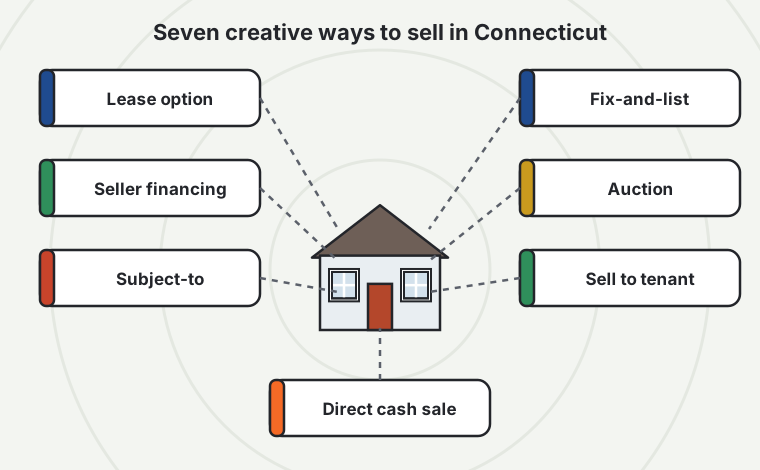
This page is part of our guide to how to sell a house in Connecticut. It is a short tour: one stop per route, with what it is, the Connecticut rule that matters, the main risk and who it fits. Each route has a full guide of its own, linked at its stop, so you can go deep only on the one that fits you.
I am Jerryll Noorden. I have bought Connecticut houses since 2016, about ten a year, and I have been offered, and have offered, most of these structures. I am not a lawyer, and nothing here is legal advice. If you want the money side, every route on the same house with the net, time and risk, our sibling guide compares all the ways to sell in one table.
Why look past a regular listing at all?
You look past a regular listing when it does not fit your situation: you owe close to what the house is worth, the house needs work you cannot pay for, you would rather have monthly income than a lump sum, your tenant wants to buy, or someone has already pitched you “creative terms” and you want to know what that means. This page is for Connecticut owners in any of those spots.
Maybe you ran the numbers and a listing leaves you with almost nothing after commission. Maybe you are a landlord whose long-time tenant keeps asking whether you would ever sell to them. Maybe an investor called and said “we can take over your payments” or “we’ll fix it up and split the profit”, and you are not sure whether that is clever or a trap.
Feeling wary is the right instinct. “Creative” can mean a real solution, and it can mean a deal where the risk quietly stays with you. The difference is almost always in two places: who holds the risk after you sign, and whether your own attorney read every page first.
And if you owe more than you would like to admit, you are in good company. Plenty of Connecticut owners bought or refinanced at the top and now owe close to the value. That is a math problem, not a personal failing, and several routes below exist exactly for it.
How does a lease option or rent-to-own sale work in Connecticut?
A lease option or rent-to-own sale in Connecticut works by leasing your house to someone who also gets the right, but not the duty, to buy it at a fixed price later. You stay the owner and keep paying the mortgage, taxes and insurance until they buy. Connecticut requires the residential condition report before the lease with option is signed (CGS 20-327b), and the lease or a notice of it must be recorded to bind third parties (CGS 47-19).
- What you get: an option fee up front, rent each month, and a sale later if the option is used.
- The Connecticut rule: condition report (or a $500 credit, CGS 20-327c) and recording under CGS 47-19.
- The main risk: the option is never used, the rent stops, or the house is damaged, and you are still the owner with the loan.
- Fits: owners who are current on the mortgage, do not need the sale money for a year or more, and could cover the payment if the rent stopped.
Read the full lease option and rent-to-own guide for sellers for the terms to insist on and what happens if the option expires.
How does seller financing work in Connecticut?
Seller financing in Connecticut works by deeding the house to the buyer at closing and taking a promissory note and a recorded mortgage for part of the price, so the buyer pays you monthly instead of a bank. Connecticut’s 12% interest cap does not apply to a bona fide mortgage over $5,000 (CGS 37-4, 37-9(3)), federal rules limit how many seller-financed sales you can make (12 CFR 1026.36), and if the buyer stops paying you foreclose in court (CGS 49-24).
- What you get: a down payment at closing, then principal and interest, often with a balloon payment after a few years.
- The Connecticut rule: record the mortgage in the town land records, pay conveyance tax on the full price at closing (CGS 12-494), and foreclose through the Superior Court if needed.
- The main risk: buyer default, an uninsured or neglected house, and a balloon the buyer cannot refinance.
- Fits: owners who own the house free and clear (or will pay their loan off at closing), want income, and can wait for their money.
If you still have a mortgage, most loans have a due-on-sale clause, so seller financing usually means paying your own loan off first. The full owner financing guide for Connecticut sellers works through real numbers, the tax treatment and the protections.
What does selling subject-to mean, and why is it risky?
Selling subject-to means deeding your house to a buyer who takes over your mortgage payments while the loan stays in your name. It is risky because most mortgages have a due-on-sale clause that federal law lets the lender enforce (12 U.S.C. 1701j-3), and if the buyer stops paying, the late payments and any foreclosure land on your credit, not theirs.
- What you get: relief from the payments, sometimes a little cash, and sometimes arrears caught up.
- The rule that matters: 12 U.S.C. 1701j-3 (due-on-sale). Its exceptions cover transfers to a spouse or child and certain living trusts, not sales to investors.
- The main risk: the lender calls the loan, or the buyer stops paying a loan that still carries your name.
- Fits: owners with little or no equity who must move now, will insist on a servicing company and their own attorney, and do not plan to apply for a new mortgage soon.
Of all the routes on this page, this is the one to slow down on. Our guide to subject-to real estate, the risks and the protections lists every safeguard to ask for in writing.
What is a fix-and-list partnership (novation)?
A fix-and-list partnership, often called a novation, is an agreement where an investor pays for and manages repairs, a licensed agent lists your house on the open market, you receive an agreed amount, and the investor is paid from the sale above it. You stay the owner until closing. In Connecticut, a novation where the investor never takes title may fall under the wholesaler law (CGS 20-329aaa), with its 90-day closing limit and three-day cancel right.
- What you get: often more than a straight cash offer on a dated house, without paying for the repairs yourself.
- The Connecticut rule: one written agreement your attorney has read; the wholesaler rules if they apply; contractors registered with the Department of Consumer Protection.
- The main risk: repairs run over, the resale price comes in low, or the house sits, while you keep carrying it.
- Fits: owners with good equity, a house that needs updating rather than rebuilding, and three to six months to wait.
Our step-by-step guide to novation and fix-and-list sales covers how the money is split and the clauses that protect you.
Can you auction a house in Connecticut?
Yes, you can choose to auction a house in Connecticut through an auction firm or real estate broker, setting a reserve (a minimum you will accept) or selling absolute to the highest bidder. A voluntary auction is not the same as a court-ordered foreclosure sale under CGS 49-24. You still owe the conveyance tax (CGS 12-494) and normally the condition report (CGS 20-327b), and the price is unknown until bidding ends.
- What you get: a fixed sale date and, usually, buyers who sign firm terms on the day.
- The main risk: too few bidders, so the price lands low (or below your reserve, so no sale), plus auction marketing costs you may pay even if it does not sell.
- Fits: unusual or hard-to-price property, estates that want a firm date and a public process, and owners who accept price uncertainty in exchange for a deadline.
Ask any auction company, in writing, who pays the buyer’s premium, what you owe if the house does not sell, and whether the terms let a winning bidder back out. Those three answers decide whether an auction is cheaper or more expensive than a listing.
Can you sell your house to your tenant in Connecticut?
Yes, you can sell your house to your tenant in Connecticut as a private sale: no showings, no listing commission, and a buyer who already knows the house. It is a normal sale with attorneys, the condition report (CGS 20-327b) and conveyance tax (CGS 12-494). At closing you settle the tenant’s security deposit and the interest Connecticut requires on it (CGS 47a-21). The usual hurdle is whether the tenant can get a mortgage.
- What you get: often a full price without commission, and no vacant months.
- The main risk: the tenant’s loan falls through and you have lost weeks; or the relationship sours if price talks go badly.
- Fits: landlords with a reliable tenant who has steady income and savings for a down payment.
If the tenant cannot get a loan yet, a lease option is the usual next idea, with all the risks above. If you would rather sell the rental with the tenant staying put, our guide on selling a rental with tenants in Connecticut covers that route.
Where does a plain cash sale fit among the creative routes?
A plain cash sale fits as the simplest of the alternatives: a buyer pays the whole price at closing, as-is, with no lender, and you keep no risk afterwards. It nets less than a retail sale because the buyer takes on repairs, holding costs and resale, but it often closes in about two weeks. Be careful to tell a real cash buyer from a wholesaler, who signs a contract only to assign it to someone else.
Connecticut now regulates wholesaling. Since July 1, 2026, anyone who contracts to sell your house to a third party without taking title must be registered with the Department of Consumer Protection, give you the state’s disclosure report (from October 1, 2026), let you cancel within three business days, and close within 90 days unless you agree in writing to extend (CGS 20-329aaa to 20-329hhh). Our guide to wholesalers, realtors and cash buyers explains how to tell them apart.
We buy houses ourselves, with our own money or partner funding, and close through a Connecticut attorney. If a straight cash price does not work for you, we also offer some of the routes above. Our page on all the ways we buy houses in Connecticut lists them. For the honest money comparison between cash and listing, read cash buyer vs. realtor in Connecticut.

The question I ask every owner who mentions a creative deal is simple: “If the other side stops doing what they promised, what happens to you?” With a cash sale, nothing; you were paid. With a lease option, seller financing or subject-to, the answer is a lot. That does not make them bad. It means the paperwork has to be right, and your own attorney has to read it.
Which creative route fits your situation?
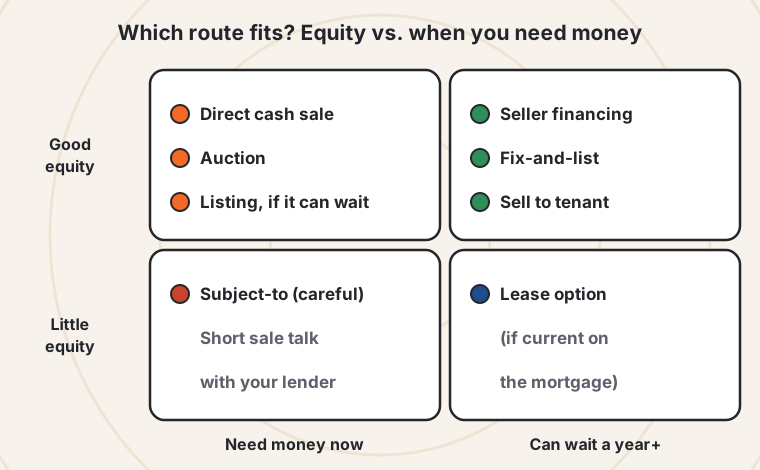
The creative route that fits your situation depends on three things: how much equity you have, whether you need your money now, and how much risk you can keep after you sign. The table below matches common Connecticut situations to the route that usually fits and the one to avoid.
| Your situation | Usually fits | Usually avoid | Why |
|---|---|---|---|
| House paid off, you want income, no rush | Seller financing | Subject-to | You become the bank; recorded mortgage protects you |
| Current on the loan, moving away, no need for cash for a year | Lease option | Auction | Rent covers the payment while you wait for the option |
| Owe close to the value, must move now | Subject-to (with protections) or a short sale with your lender | Seller financing | Little equity to carry; lender rules decide |
| Good equity, dated house, a few months to wait | Fix-and-list partnership | Lease option | Repairs lift the price; you share the upside |
| Hard-to-price or unusual property, need a firm date | Auction | Lease option | Bidding sets the price on a set day |
| Reliable tenant who wants to buy | Private sale to the tenant | Wholesaler | No commission, no showings |
| Needs major work, deadline, or just done | Direct cash sale | Lease option, seller financing | Paid in full, no risk kept |
| Behind on payments or facing a Law Day | Talk to a HUD counselor and your lender first; cash sale or listing if equity | Subject-to without an attorney | Foreclosure deadlines come first |
If you are behind on payments, read our guide to selling a house in foreclosure in Connecticut before any creative deal. Connecticut’s foreclosure mediation program and HUD-approved counselors are free, and a deadline like Law Day changes which routes are even possible.
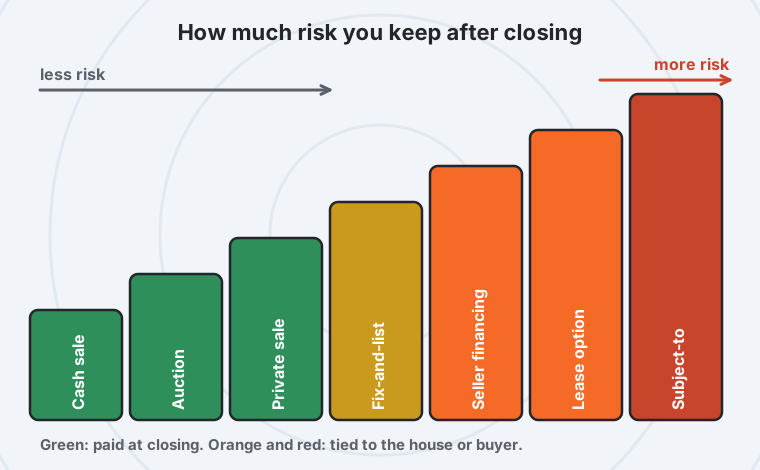
Who holds the risk after closing in each creative route?
Who holds the risk after closing depends on whether you were paid in full. In a cash sale, an auction or a private sale, the buyer holds it. In a fix-and-list partnership you hold market risk until the resale closes. In seller financing you hold the buyer’s payment risk for years. In a lease option you still own the house. In a subject-to sale you hold the loan itself, the most risk of all.
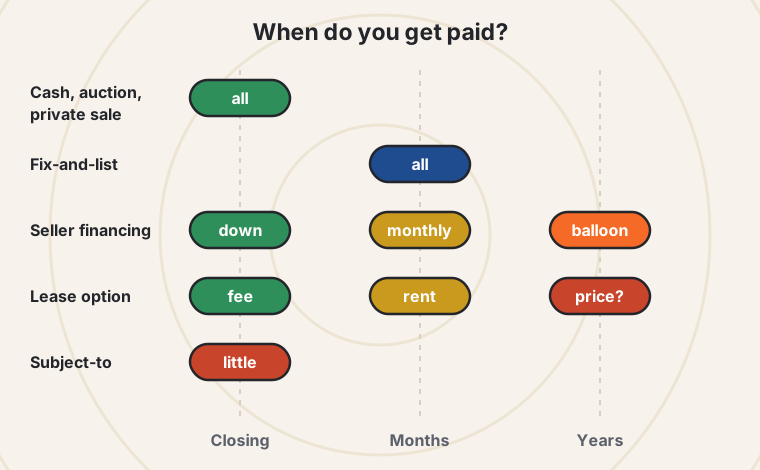
A second way to see the same thing is when you get paid. Cash, auction and private sales pay you at one closing. A fix-and-list partnership pays you when the house resells, months later. Seller financing pays a slice at closing and the rest over years. A lease option pays a fee now and the price only if the option is used. Subject-to often pays little or nothing, because its value to you is relief from the payment.
What Connecticut rules apply to every creative sale?
The Connecticut rules that apply to every creative sale are the same as any home sale: an attorney conducts the closing (CGS 51-88a), the seller pays the conveyance tax when the deed is recorded (CGS 12-494), most sellers of one- to four-family homes give the condition report or a $500 credit (CGS 20-327b, 20-327c), and homes built before 1978 need the federal lead paint disclosure.
- Get your own attorney. In creative deals the buyer’s attorney protects the buyer. Your attorney should draft or review the option, note, mortgage, servicing agreement or partnership agreement.
- Record what protects you. A seller-financing mortgage goes on the land records; a lease with option, or a notice of it, is recorded under CGS 47-19.
- Get everything in one written agreement. If a promise is not in writing, it is not part of the deal.
- Watch the tax. Seller financing may be reported as an installment sale (IRS Publication 537); ask a tax professional before you sign.
- Know the scams. Never sign over a deed to “save” a house from foreclosure without an attorney, and never pay an upfront fee to sell. Our page on we-buy-houses scams and red flags lists what regulators have found.
Whatever route you choose, the step-by-step order of a Connecticut sale, from disclosure to deed, is in the Connecticut home-selling guide.
When should you skip creative routes and just list or sell for cash?
You should skip creative routes and just list when the house is in good shape, a buyer with a mortgage can buy it, and you have a few months; a listing will usually net the most and leave you no risk. You should skip them and sell for cash when you need a clean, certain exit in weeks and want nothing left to manage. Creative routes earn their place only when neither of those fits.
And you should NOT sell to a cash buyer when a listing would clearly leave you more and you have the time to wait for it. On a sound house, listing usually wins on money, as our cash buyer vs. realtor comparison shows line by line. We will tell you that if it is true for your house. The full side-by-side numbers are in our comparison of every way to sell, and a Bristol example with real town data is in realtor vs. investor in Bristol, CT.
A word on the old “creative tactics” this page used to list: themed open houses, funny ads, drone photos, staging. Good marketing still matters when you list, but it changes how fast a house sells more than what it nets. If you are listing or selling it yourself, our guide on selling without a realtor in Connecticut covers photos, pricing and showings properly.
How do you test a creative offer safely?
You test a creative offer safely by getting it in writing, asking who holds each risk if something goes wrong, comparing it with a plain listing and a plain cash number, checking the other party, and having your own Connecticut attorney review it before you sign. Taking a week or two to do this costs nothing; signing too fast can cost years.
Get the offer in writing
Price, money at closing, monthly payments, dates, who pays taxes, insurance and repairs, and what happens if either side fails. A verbal pitch is not an offer.
Ask “what happens to me if they stop?”
For each promise the other side makes, write down what you would be left with if they broke it. If the answer is “my loan” or “a foreclosure”, you need written protections.
Put two plain numbers next to it
Get a listing estimate from an agent and a written cash offer. If a creative deal does not beat both after risk, skip it.
Check who you are dealing with
Look up the company with the Secretary of the State and, for wholesalers, the Department of Consumer Protection registration. Our checklist on how to check a cash home buyer in Connecticut takes ten minutes.
Have your own attorney review it
Then decide. No good offer expires while your attorney is reading it.
See the house together.
Pick a time that works.
Choose a time for us to walk through the property with you, or ask for a quick call first. We confirm every request personally.
Tuesday, January 13
No open times in the next few weeks. Please call us.
We will confirm by email. Nothing is booked until we do.
View my requestQuestions about creative ways to sell a house in Connecticut
What is the most creative way to sell a house in Connecticut?
The most creative way to sell a house in Connecticut is the one that solves your specific problem: a lease option if you can wait, seller financing if the house is paid off and you want income, a fix-and-list partnership if the house is dated, or a private sale if your tenant wants to buy. A plain listing or cash sale is often simpler.
Is rent-to-own legal in Connecticut?
Yes, rent-to-own is legal in Connecticut. The owner must give the residential condition report before the lease with option is signed (CGS 20-327b), and a lease with a purchase option, or a notice of it, must be recorded to bind third parties (CGS 47-19).
Can I offer seller financing if I still have a mortgage?
You usually cannot offer seller financing while you still have a mortgage without your lender’s consent, because most mortgages have a due-on-sale clause that federal law lets the lender enforce (12 U.S.C. 1701j-3). Most sellers pay their loan off at closing first.
What interest rate can I charge on seller financing in Connecticut?
Connecticut’s general 12% cap (CGS 37-4) does not apply to a bona fide mortgage of real property over $5,000 (CGS 37-9(3)), but federal rules and the buyer’s ability to repay still matter. Have your attorney set the rate and terms.
Is selling subject-to legal in Connecticut?
Selling subject-to is not illegal in Connecticut, but it usually breaches the due-on-sale clause in your mortgage, which lets the lender demand full payment. The loan stays in your name, so late payments and a foreclosure would affect you.
Does Connecticut’s wholesaler law apply to a novation?
Connecticut’s wholesaler law may apply to a novation where the investor contracts to facilitate the sale of your house to a third party without taking title (CGS 20-329aaa). If it applies, you get the disclosure report, three business days to cancel and a 90-day closing limit.
Can my tenant buy my house in Connecticut?
Yes, your tenant can buy your house in Connecticut in a normal private sale with attorneys, the condition report and conveyance tax. Settle the security deposit and required interest at closing (CGS 47a-21).
Can I auction my own house in Connecticut?
Yes, you can auction your house in Connecticut through an auction firm or broker, with or without a reserve price. It is separate from a court-ordered foreclosure sale, and you still pay the conveyance tax.
Do I pay conveyance tax in a creative sale?
Yes, you pay Connecticut conveyance tax in a creative sale when the deed is recorded, on the full price, including in seller-financed sales where you receive only a down payment at closing (CGS 12-494).
Do I need an attorney for a creative sale?
Yes, you need an attorney for a creative sale. Connecticut closings are conducted by attorneys (CGS 51-88a), and in creative deals you need your own attorney to draft or review every agreement that keeps you tied to the house or the buyer.
Do you buy houses with creative terms?
Yes, besides cash we sometimes offer seller financing, taking over payments or a lease with an option, always in writing and always with your attorney reviewing it. Most of the time a straight cash purchase is simpler, and if listing would net you more we say so.
Which creative route is safest for the seller?
The safest route for the seller is the one that pays you in full at closing: a cash sale, an auction with firm terms or a private sale. Among the routes that pay over time, seller financing with a large down payment and a recorded mortgage is usually safer than a lease option or a subject-to sale.
Related guides
- How selling your house to us works
- How do I sell my house in Connecticut? Every route, step and cost
- Ways to sell a house in Connecticut, compared
- Realtor vs. investor in Bristol, CT
- All the ways we buy houses in Connecticut
- Lease option and rent-to-own for sellers
- Subject-to real estate: how it works and the risks
- Novation: fix-and-list sales explained
- Is owner financing a good idea for the seller?
- We buy houses in Bristol, CT
When you want a plain number to set beside any creative offer, start with how selling to us works, or call Jerryll at (203) 529-4712. No fee, no obligation, and a written offer you can show your attorney.
This guide explains Connecticut rules in plain English and is not legal or tax advice. For any creative sale, talk to a Connecticut real estate attorney and a tax professional.
Sources (checked on October 27, 2026)
- CGS 47-19 (leases over one year or with an option to purchase; recording).
- CGS 20-327b and 20-327c (residential condition report for sales and leases with option to buy; $500 credit).
- CGS 37-4 and 37-9 (12% cap; exception for bona fide mortgages over $5,000).
- CGS 49-24 (foreclosure by strict foreclosure or by sale).
- CGS 20-329aaa to 20-329hhh (real estate wholesalers, effective July 1, 2026; P.A. 25-168).
- CGS 47a-21 (security deposits and interest).
- CGS 12-494 (conveyance tax).
- CGS 51-88a (real estate closings by attorneys).
- 12 CFR 1026.36(a)(4) and (a)(5) (seller-financer exclusions).
- 12 U.S.C. 1701j-3 (due-on-sale clauses).
- IRS Publication 537, Installment Sales.
- EPA, lead-based paint disclosure for home sales.

Who wrote this
Jerryll Noorden
Jerryll has bought and sold Connecticut houses since 2016 and has sat at more closing tables than he can count, on both sides. Before real estate he was a robotics scientist at NASA, IHMC and IIT. He wrote this guide because the national sites that rank for it skip the Connecticut rules that cost sellers money. When listing or selling it yourself would get you more than a cash offer, he says so.
This guide explains Connecticut rules in plain English. It is not legal or tax advice. Laws change; for your sale, talk to a Connecticut real estate attorney and a tax professional.
