
- You have more time than the letters make it feel. This page, part of our guide on how to sell a house in Connecticut, starts with keeping the house. Federal rules bar your servicer from starting a foreclosure until you are more than 120 days behind (12 CFR 1024.41(f)), and Connecticut foreclosures then go through Superior Court.
- Connecticut adds its own step. For most owner-occupied homes the lender must mail a notice giving you 60 days to meet with it or a counselor and to contact CHFA about emergency mortgage help before it can sue (CGS 8-265ee).
- The cheapest fix is the earliest one. At one or two payments behind, a repayment plan or forbearance is often enough. At four, you are usually looking at a modification, a reinstatement or a sale.
- Send a complete loss mitigation application before day 120. If your servicer gets it in time, it cannot file until it has decided and any appeal is over.
- Free help exists. Department of Banking foreclosure hotline 1-877-472-8313, HUD-approved counselors 1-800-569-4287, and CHFA’s Emergency Mortgage Assistance Program. Nobody legitimate charges you up front.
- Decide with one question: if the arrears vanished tomorrow, could you afford the payment every month from now on? If yes, fight to keep the house. If no, protect your equity by selling on your terms while you still have time.
What should you do if you are behind on mortgage payments in Connecticut?
If you are behind on mortgage payments in Connecticut, open every letter, call your servicer and ask for a loss mitigation application, call a free HUD-approved counselor or the Department of Banking hotline (1-877-472-8313), and send a complete application before you are 120 days behind. Your servicer cannot start a foreclosure before then (12 CFR 1024.41(f)), so the first four months are your best window to fix it.
This guide is for the early part of the problem: one, two, three or four payments behind, and no court papers yet. It is part of our larger guide on how to sell a house in Connecticut, but most of this page is about keeping your house, because for many people that is possible. If a marshal has already handed you a summons, skip to our full guide to foreclosure in Connecticut, Law Day and mediation; that is where the court rules live.
Here is the short version of what to do this week:
- Open every letter from your servicer and put them in one folder, newest on top
- Write down how many payments you have missed and the exact amount past due
- Call the servicer and ask for a loss mitigation application (note the date, the name, what was said)
- Call a HUD-approved housing counselor (1-800-569-4287) or the Department of Banking hotline (1-877-472-8313); both are free
- Write down the monthly payment you can truly afford, including taxes and insurance
- Gather pay stubs, two months of bank statements, last year’s tax return and a short hardship letter
- Send the complete application and keep proof of delivery
- If you have received the 60-day Connecticut notice, contact CHFA about the Emergency Mortgage Assistance Program
- Do not pay anyone up front and do not sign over your deed to anyone
Why is it so hard to make the first call when you are behind on your mortgage?
It is hard to make the first call when you are behind on your mortgage because each call makes the problem feel real, and most people feel ashamed, scared and confused by the vocabulary. Those feelings are normal. The first call is also the one that buys you the most time, because almost every option is easier at one or two payments behind than at five.
If you are reading this at night with a stack of envelopes you have not opened, this page is for you. Maybe you have always paid your bills, and now you are deciding each month whether the mortgage, the car or the electric bill comes first. Maybe hours got cut, a spouse left, someone got sick, or the escrow went up and the payment jumped. Maybe you have not told anyone, not even the person you live with.
What most people feel at this stage is a mix of things: ashamed that it happened, afraid of every envelope, frozen to the point of not answering the phone, confused by words like forbearance and loss mitigation, distrustful of the bank and of the strangers who start mailing offers, and somewhere underneath, hoping someone will explain it plainly. This page tries to do that.
A Connecticut detail that makes this worse: property taxes here are high. On a median single-family house in West Hartford (about $520,000 in state sales records from October 2024 to September 2025), the tax portion of the payment alone is about $1,420 a month at the fiscal 2027 mill rate of 46.77. When a town revalues or the escrow analysis comes back short, payments can jump by hundreds of dollars without anyone doing anything wrong.
Falling behind is common, and the system has steps built in for it. Servicers are required to contact you and tell you about your options. Connecticut makes lenders tell you about free counselors and state help before they can sue. None of that works if the letters stay closed.
What happens at 30, 60, 90 and 120 days behind on a Connecticut mortgage?
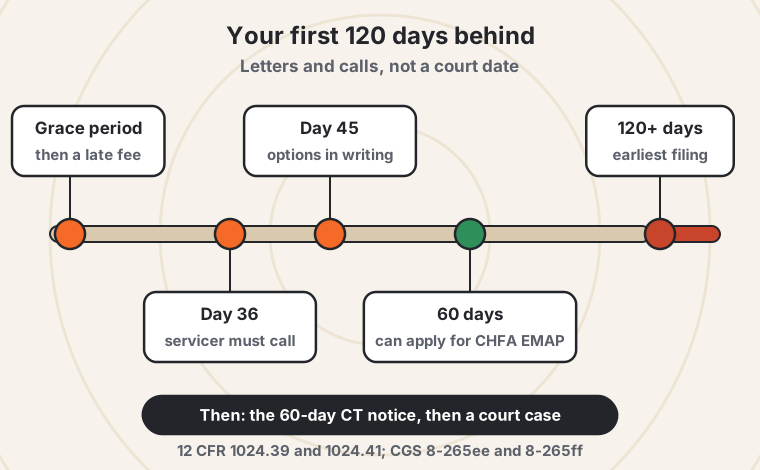
What happens at 30, 60, 90 and 120 days behind on a Connecticut mortgage follows federal and state rules: after the grace period you owe a late fee, by day 36 the servicer must try to reach you and by day 45 send your options in writing, around 60 days you can apply for CHFA emergency help, and only after 120 days can the servicer start a foreclosure, which in Connecticut is a court case.
| Days behind | What usually happens | The rule | What you should do |
|---|---|---|---|
| Day 1 to the end of the grace period | Payment is late but no fee yet | Your note sets the grace period and late fee; check the exact days and amount on your note | Pay if you can; if you cannot, call now while it is one payment |
| After the grace period | A late fee is added | Your note; Connecticut requires written notice of a late fee within 60 days unless it shows on your periodic statement (CGS 49-6c) | Ask whether the fee can be waived if you set up a plan |
| About 30 days | The missed payment can be reported to the credit bureaus as 30 days late | Federal Fair Credit Reporting Act allows accurate late reporting; servicer practice varies | Ask the servicer how it reports during a forbearance or plan |
| By day 36 | The servicer must try to reach you by phone or in person about options | 12 CFR 1024.39(a) (live contact), repeated each month you stay behind | Answer. Ask for the loss mitigation application and a named contact |
| By day 45 | A written notice listing loss mitigation options and how to apply | 12 CFR 1024.39(b); servicer must also assign personnel to help you (1024.40) | Read it; note the deadlines in it |
| About 60 days | A “notice of default” or intent to accelerate letter is common; you can now apply for CHFA’s Emergency Mortgage Assistance Program | Your mortgage’s cure notice; CGS 49-31r adds a court notice of community resources; EMAP eligibility at 60 days behind (CGS 8-265ff) | Read our notice of default explainer; call CHFA and a counselor |
| Before any lawsuit | For most owner-occupied homes, a certified-mail notice giving you 60 days to meet with the lender or a counselor and contact CHFA | CGS 8-265ee: the lender may not commence foreclosure before mailing it | Use the 60 days. This is the official last call before court |
| About 90 days | More letters; the arrears are now three payments plus fees | Same rules continue; a complete application now still beats the 120-day line | Send a complete application if you have not |
| More than 120 days | Earliest point the servicer can make the first foreclosure filing | 12 CFR 1024.41(f)(1); if a complete application is pending, it must wait for the decision (1024.41(f)(2)) | If papers come, see the foreclosure guide; court mediation has a 15-day deadline |
Two things on that timeline surprise people. First, nothing in the first 120 days is a court date. You will get letters and calls, not a hearing. Second, the clock does not reset by itself. Paying one month while staying three behind keeps you three behind. Servicers usually apply a partial payment to the oldest missed month or hold it in a “suspense” account until there is enough for a full payment, so ask what happens to any partial payment before you send it.
The 120-day rule applies to most first mortgages on a home you live in. It has narrow exceptions, for example a due-on-sale violation or when the servicer joins a foreclosure that another lienholder started. A second mortgage, a home equity line, the town (for unpaid taxes) or a condo association (for common charges, CGS 47-258) can follow different paths. If your problem is property taxes, see selling a house with tax liens in Connecticut.
Can the bank foreclose before you are 120 days behind in Connecticut?
The bank cannot foreclose before you are 120 days behind in Connecticut in almost every case, because federal Regulation X bars the servicer from making the first foreclosure filing until the loan is more than 120 days delinquent (12 CFR 1024.41(f)). Connecticut also requires the 60-day EMAP notice first for most owner-occupied homes, and then a court case, so actually losing the house takes much longer.
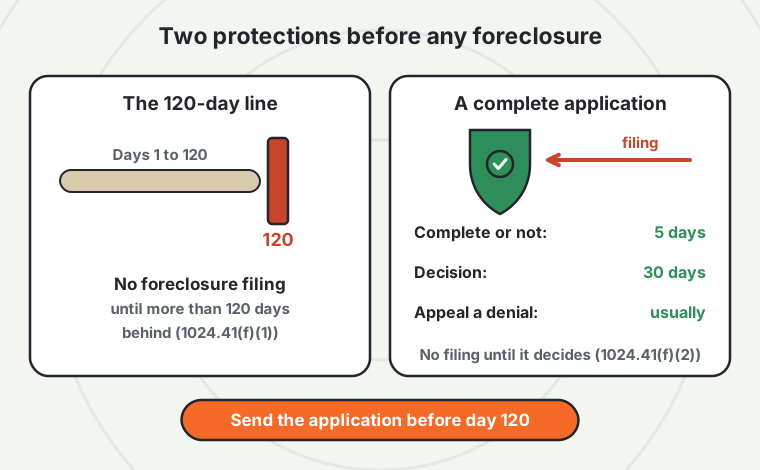
Regulation X is the federal rule for mortgage servicers, enforced by the Consumer Financial Protection Bureau. Three parts of it matter most to you right now:
- The 120-day line. The servicer “shall not make the first notice or filing” for foreclosure unless the loan is more than 120 days delinquent (12 CFR 1024.41(f)(1)). In Connecticut, that first filing is the writ, summons and complaint a state marshal serves on you.
- The application shield. If you send a complete loss mitigation application before that first filing, the servicer cannot file until it has told you in writing you are not eligible for any option and your appeal (if any) is finished, or you turned down the offers, or you failed to keep an agreement (12 CFR 1024.41(f)(2)).
- Deadlines on the servicer. It must tell you within 5 days (excluding weekends and holidays) whether your application is complete, and decide on a complete application within 30 days (12 CFR 1024.41(b)(2) and (c)(1)). If it denies a modification, you can usually appeal (1024.41(h)).
Connecticut then adds the EMAP notice. Before it can start a foreclosure on most owner-occupied homes, the lender must send you a notice by registered or certified mail. From the date of that notice you have 60 days to meet or talk with the lender, or meet a consumer credit counseling agency, and to contact the Connecticut Housing Finance Authority about emergency mortgage assistance (CGS 8-265ee(a)). The lender cannot commence the foreclosure before mailing it.
After that, a Connecticut foreclosure is a lawsuit in Superior Court, with a free court mediation program for owner-occupied homes and a deadline called Law Day at the end. That part is explained in our Connecticut foreclosure guide. The point for you today: you are not one missed payment away from losing the house. You are, however, a few months away from a court case, and every option gets harder once it starts.
Connecticut law requires your lender to give you a written payoff or reinstatement statement by the date you ask for, as long as that date is at least seven business days after it receives your written request. If it is late, it loses the interest that builds up after that date (CGS 49-10a). Ask for the reinstatement figure in writing so you know exactly what “caught up” costs.
What is loss mitigation, and how do you apply for it?
Loss mitigation is the servicer’s process for helping a borrower who is behind avoid foreclosure, through options such as a forbearance, a repayment plan, a payment deferral or a loan modification, or, if you cannot keep the house, a short sale or deed in lieu. You apply with one application package; a complete package triggers federal deadlines and protections.
Which options you are offered depends on who owns or insures your loan (Fannie Mae, Freddie Mac, FHA, VA, USDA, or a bank keeping the loan itself), your hardship and your income. You do not need to know the menu in advance. The application gets you evaluated “for all loss mitigation options available” (12 CFR 1024.41(c)).
Get the application and the checklist
Ask the servicer by phone and in writing, or download it from its website. Write down the date you asked. Ask who your assigned contact is.
Write a short hardship letter
One page: what happened, when, whether it is over or ongoing, and what payment you can afford now. Plain words beat long stories.
Gather the proof
Usually recent pay stubs or profit-and-loss statements, two months of bank statements, last year’s tax return, proof of other household income (child support, benefits, a roommate’s rent), and a monthly budget.
Send everything at once
Upload through the servicer’s portal or send by a method you can track. Keep a copy of every page.
Watch for the completeness letter
Within 5 days (excluding weekends and holidays) the servicer must say whether the package is complete or what is missing. Send missing items fast.
Get the decision and read it
On a complete package the servicer must decide within 30 days. If it offers a plan, read the terms before you accept. If it denies a modification, ask about the appeal.
Keep a log: every call with date, time, name and what was said. If something goes wrong, a written record is what counselors, attorneys and regulators work from. A free HUD-approved counselor can help you fill in the package and can often talk to the servicer for you.
Which option fits you: forbearance, a repayment plan or a loan modification?
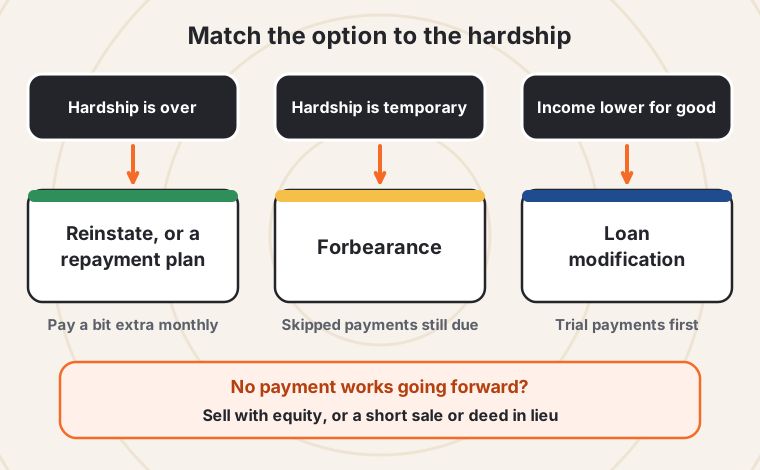
The option that fits you depends on your hardship: a repayment plan fits a hardship that is over, when you can pay a bit extra each month; a forbearance fits a temporary drop in income with a clear end date; a loan modification fits income that has recovered but cannot carry the old payment. If no payment works going forward, a sale, short sale or deed in lieu protects your credit and any equity.
| Option | What it does | Best when | Watch out for |
|---|---|---|---|
| Reinstatement | You pay everything past due, with fees, in one payment | You have the cash (tax refund, family help, a new job’s first checks) | Get the figure in writing (CGS 49-10a) and written confirmation afterwards |
| Repayment plan | Regular payment plus a slice of the arrears each month for a set period | The hardship is over and you can pay a bit extra | Missing a plan payment usually puts you back where you were |
| Forbearance | Payments paused or reduced for a set time | A temporary drop in income with a clear end date | The skipped payments still come due; get in writing what happens at the end (lump sum, plan, deferral or modification) |
| Payment deferral or partial claim | Missed payments moved to the end of the loan, or (FHA) into a separate no-interest lien due when you sell or pay off | You can make the regular payment again but cannot catch up | Availability depends on the loan type; the deferred amount is paid when you sell or refinance |
| Loan modification | Permanently changes the rate, term or balance so the payment fits your income; usually after trial payments | Income has stabilized lower than before | A small payment cut that adds arrears to the balance can leave you in a house you still cannot afford |
| CHFA EMAP | A state loan that brings the mortgage current and may help with payments for a time | A documented hardship beyond your control; you can sustain the house afterwards | Within available funds; eligibility rules (see the help section below) |
| Refinance | A new loan pays off the old one, including arrears | Real equity and credit that still qualifies | Hard once several late payments are on your report |
| Sell the house | A sale pays off the loan and the arrears; you keep the rest | You have equity and the house no longer fits your budget | Start while you have months, not weeks |
| Short sale or deed in lieu | The lender accepts less than it is owed, or takes the house back by agreement | You owe more than the house is worth | Ask for a written deficiency waiver; forgiven debt can be taxable |
The one question that decides it
Ask yourself honestly: if the arrears disappeared tomorrow, could you afford the payment, the taxes and the insurance every month from now on?
- Yes: work hard on the options that keep the house. Mediation, modifications and plans help many Connecticut homeowners.
- Not sure: apply for loss mitigation and work out what a sale would leave you. A parallel plan costs nothing, and hope without a backup is how people run out of time.
- No: a modification often only delays the same problem. Selling while you still have equity and time usually leaves you with more money and better credit than letting a foreclosure run.
If the honest answer is “no” and you owe more than the house is worth, read our comparisons of a short sale vs. foreclosure and giving the house back to the bank with a deed in lieu.
What free help is there for Connecticut homeowners who are behind on their mortgage?
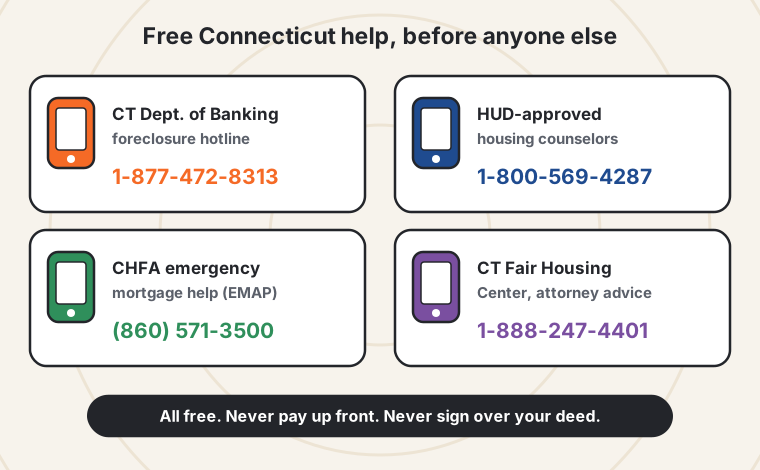
Free help for Connecticut homeowners who are behind on their mortgage includes the Department of Banking foreclosure hotline (1-877-472-8313), HUD-approved housing counselors (1-800-569-4287), the Connecticut Housing Finance Authority’s Emergency Mortgage Assistance Program, the Connecticut Fair Housing Center’s foreclosure advice line, and, once a lawsuit is filed, the court’s free foreclosure mediation program.
| Who | What they do | Contact |
|---|---|---|
| CT Department of Banking foreclosure hotline | Explains options, connects you with counselors, takes complaints about servicers and scams | 1-877-472-8313, weekdays 8 a.m. to 5 p.m. |
| HUD-approved housing counselors | Free budget review, help with the loss mitigation application, can talk to your servicer and prepare you for mediation | 1-800-569-4287 |
| CHFA Emergency Mortgage Assistance Program (EMAP) | A state loan to bring the mortgage current for a qualifying hardship | EMAP customer service (860) 571-3500; CHFA (860) 721-9501 or (877) 571-2432 |
| Connecticut Fair Housing Center | Short foreclosure advice appointments with an attorney | 1-888-247-4401 |
| Lawyer referral services | Low-cost first consultation with a Connecticut attorney | Through your county bar association (the Department of Banking lists numbers) |
| Judicial Branch Foreclosure Mediation Program | Free court mediation once a lawsuit is filed (owner-occupied 1-4 family homes) | jud.ct.gov/foreclosure; forms due within 15 days of the return date |
CHFA’s Emergency Mortgage Assistance Program, in plain terms
EMAP is run by the Connecticut Housing Finance Authority “within available funds” (CGS 8-265dd). You can apply if you have received the lender’s 60-day notice, are 60 days or more behind, or expect to be because of a hardship beyond your control, or if your mortgage is in forbearance (CGS 8-265ff). The Department of Banking describes the help as a 30-year, fixed-rate, fully amortizing loan. It is not a grant.
CHFA’s current program page lists these requirements:
- You are the borrower and you live in the house as your home.
- You can document a financial hardship beyond your control.
- If you received a notice to foreclose, you first tried to work it out with your lender.
- A generally favorable mortgage history in the two years before the hardship, with no more than four 30-day late payments.
- Household assets over $100,000 must go toward the delinquency.
- Total assistance cannot exceed 60 months, counting from when the delinquency began.
- You can reasonably keep up the payments afterwards.
Program rules and funding change, so call CHFA before you count on it. If your hardship is temporary and you can afford the house afterwards, EMAP is built for exactly your situation.
How do you avoid foreclosure rescue scams when you are behind on your mortgage?
You avoid foreclosure rescue scams by refusing anyone who wants money before helping, guarantees to stop a foreclosure, tells you to stop talking to your lender or to pay them instead, or asks you to sign over your deed and rent it back. In Connecticut, paid debt negotiation, including foreclosure rescue and short sale negotiation, needs a Department of Banking license unless the helper is your attorney (CGS 36a-671).
Once you are behind, your name can show up in public records and marketing lists, and the mail gets busy. The Department of Banking’s warnings come down to a few rules:
- No up-front fees. Federal rules ban most mortgage relief companies from collecting fees before you have a written offer from your lender that you accept (12 CFR 1015).
- Never sign your deed over to “save” the house. You may never get it back.
- Be wary of wire, cashier’s check or app-only payment requests. They are hard to reverse.
- Keep paying your lender, not a third party, and keep talking to your servicer and counselor.
- Check licenses on NMLS Consumer Access, and call the hotline (1-877-472-8313) if anything feels off.
A real home sale is different from a rescue: a written contract, a Connecticut attorney on your side, the lender paid at the closing table, and the balance wired to you. Our checklist on how to check a cash home buyer in Connecticut works on us or anyone else.
How much does falling behind cost, using a West Hartford example?
Falling behind costs more each month than the missed payment itself: in our West Hartford example, a $3,150 monthly payment plus a $60 late fee grows to $12,840 past due after four months, before inspection and legal fees. The same example shows about $247,160 of equity, which a sale before foreclosure protects and a strict foreclosure would wipe out.
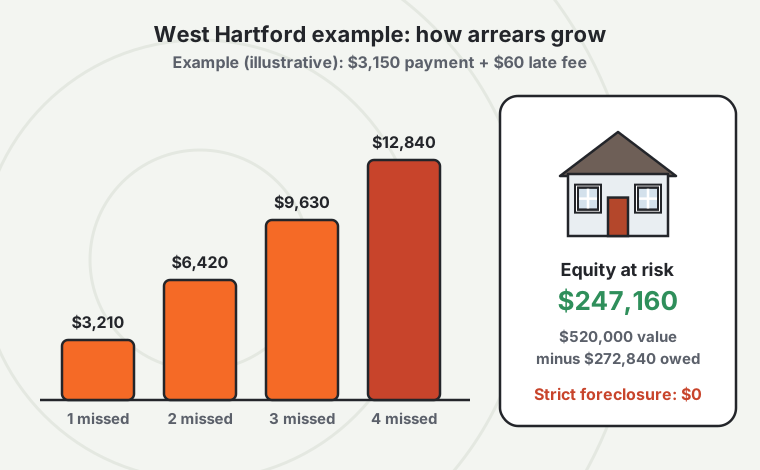
Example (illustrative). Built from public West Hartford numbers plus assumptions we label. Your figures will differ.
| Input | Amount | Source |
|---|---|---|
| House value | $520,000 | West Hartford single-family median, Oct 2024 to Sep 2025 (state sales records) |
| Property tax | about $17,020 a year, $1,420 a month | Mill rate 46.77 (fiscal 2027) on 70% of $520,000 |
| Principal and interest | $1,550 a month | Assumed |
| Homeowners insurance | $180 a month | Assumed |
| Total monthly payment | $3,150 | Sum of the three lines above |
| Late fee | $60 a month | Assumed; your note sets the real amount |
| Loan balance before the missed payments | $260,000 | Assumed |
How fast the arrears grow
| Payments missed | Past due (payments plus late fees) | Where you are on the federal clock |
|---|---|---|
| 1 | $3,210 | Servicer must try to reach you by day 36 |
| 2 | $6,420 | EMAP eligibility at 60 days behind |
| 3 | $9,630 | Still before the 120-day line |
| 4 | $12,840 | Past 120 days, a filing becomes possible |
At one payment behind, a two- or three-month repayment plan is realistic for many households. At four, few people can find $12,840 at once, which is why the early months matter so much.
What the equity looks like
In the example, the house is worth about $520,000 and the payoff after four missed payments is about $272,840 ($260,000 plus $12,840, ignoring interest). That is roughly $247,160 of equity. Here is what happens to it on three paths:
| Line | List with an agent | Sell for cash (illustrative price) | Strict foreclosure |
|---|---|---|---|
| Price | $520,000 | $460,000 (assumed) | No sale |
| Commission (5%, est.) | -$26,000 | $0 | n/a |
| Conveyance tax (0.75% state + 0.25% West Hartford) | -$5,200 | -$4,600 | n/a |
| Seller’s attorney (est.) | -$1,500 | -$1,500 | n/a |
| Payoff with arrears | -$272,840 | -$272,840 | Title passes to the lender |
| Three more months of payments while listed | -$9,450 | $0 (about 2 weeks to close) | n/a |
| To you (est.) | $205,010 | $181,060 | $0 |
Notice two things. With time and a house in good shape, listing nets more than a cash sale, in this example about $23,950 more. And either sale leaves you with a six-figure amount, while a strict foreclosure, the usual type in Connecticut, leaves you nothing above the debt (CGS 49-24). That is why “do nothing and see” is the most expensive choice. Use the calculator to run your own numbers.
How much would you walk away with?
Slide the numbers to match your house. It works in your browser; nothing is saved or sent.
Estimates for planning. Conveyance tax per CGS 12-494 (state 0.75% up to $800,000, 1.25% to $2.5M, 2.25% above, plus the town rate). Seller attorney about $1,200 to $1,500; flat-fee MLS about $400; listings include three months of taxes, insurance and utilities, a cash sale about two weeks. Your attorney gives you the final numbers.
Typical median prices and monthly property taxes in nearby towns, as a first check on your equity:
| Town | Single-family median | Mill rate (FY 2027) | Tax per month at the median | Town conveyance rate |
|---|---|---|---|---|
| West Hartford | $520,000 | 46.77 | $1,420 | 0.25% |
| Hartford | $260,000 | 69.95 | $1,060 | 0.50% |
| New Britain | $285,000 | 39.18 | $650 | 0.50% |
| East Hartford | $285,000 | 47.24 | $780 | 0.50% |
| Manchester | $320,500 | 41.00 | $770 | 0.25% |
| Bristol | $330,000 | 35.30 | $680 | 0.50% |
When does selling your house make sense if you are behind on your mortgage?
Selling your house makes sense if you are behind on your mortgage and you cannot afford the payment going forward, you have equity, and you would rather keep that equity than risk a foreclosure. You can sell at any point before a foreclosure judgment’s Law Day; the sale pays off the loan and the arrears, and you keep what is left. With no lawsuit filed yet, you still have time to list.
Selling is not failure. For many people it is the move that protects the most: the equity they built, their credit (a sale shows up as late payments, not a foreclosure), and their ability to choose where they go next. Our page on selling a house before foreclosure in Connecticut covers the selling side in detail.
Keep the house
Plan, forbear or modifyBest if your income can carry the house again.
- Repayment plan or forbearance for a short hardship
- Modification if income is lower for good
- EMAP if the hardship was beyond your control
List with an agent
Most money, more timeBest if you have equity, a house in decent shape and several months.
- Usually the highest net
- Showings, repairs, buyer financing
- Start now, while there is no lawsuit
Sell for cash
Speed and certaintyBest if time is short, the house needs work, or showings are hard.
- No repairs, no showings
- About 2 weeks, or your date
- Price below a full retail sale
Short sale or deed in lieu
If you owe more than it is worthLender approval needed.
- Ask for a deficiency waiver in writing
- Exempt from conveyance tax for a principal residence (CGS 12-498(a)(19)-(20))
- Forgiven debt can be taxable
When you should NOT sell to a cash buyer
- You can afford the house again with a plan or modification. Keep it.
- You have equity, time and a house in good shape. A well-priced listing will usually net more than any cash offer, including ours, as the West Hartford example shows.
- You are underwater. A cash buyer cannot pay more than the house is worth; a short sale with the lender’s approval is the route.
- Your hardship is temporary and EMAP or a forbearance can bridge it.
A cash sale earns its discount when the clock is short, the house needs repairs you cannot fund, showings would be hard, or a failed listing could cost you the whole equity. If you are not sure which side you are on, the two-minute self-check helps.
Is a cash sale right for you, or should you list?
Seven quick questions. There is no wrong answer, and we will tell you honestly if listing would leave you more.
- Does the house need repairs you would rather not pay for or manage?
- Do you need to close by a certain date, or within the next month or two?
- Would showings be hard: tenants, belongings, privacy, or you live out of state?
- Is there a complication: an estate or probate, a divorce, foreclosure, liens or back taxes?
- Could you comfortably cover the mortgage, taxes and utilities for three or more months?
- Is getting the highest possible price more important to you than speed and certainty?
- Would a buyer's bank lend on the house as it is (no major roof, foundation, oil tank or code issues)?
How does selling your house work when you are behind on payments?
Selling your house when you are behind on payments works like any Connecticut sale with one extra step: your attorney gets a written payoff from the lender that includes the arrears and fees, and the lender is paid from the sale at closing. With a cash buyer the closing is typically about two weeks after you accept; with a listing, expect months. Either way, tell your servicer you are selling.
Know your number
Ask the servicer for a written payoff statement (CGS 49-10a) and check for other liens: a home equity line, unpaid taxes or sewer charges. Compare the payoff with recent sales in your town.
Tell your servicer and counselor
Say you are selling and ask about a short pause while the sale closes. A signed contract helps that conversation. Keep your loss mitigation application going in parallel.
Pick the route that fits your time
Months before any lawsuit: get a listing price from an agent. Weeks, or a house that needs work: get a written cash offer and compare the net.
Sign a contract with your own attorney
Connecticut closings are run by attorneys. Yours reviews the contract, orders the payoff and handles the conveyance tax return.
Close and get paid
At closing the lender is paid in full, arrears and fees included, and the balance is wired to you. With us that is typically about two weeks after you accept, or on the date you choose.
Call the free help first: the Department of Banking hotline (1-877-472-8313) or a HUD-approved counselor (1-800-569-4287). Ask your servicer for a loss mitigation application, and if your hardship is temporary, ask CHFA about EMAP. If, after that, keeping the house does not add up, a sale on your terms protects your equity. Nobody legitimate charges you a fee for any of this, and nobody should ask for your deed outside a real closing with attorneys.

The hardest calls I get are from owners who waited until the week before Law Day. By then every option is squeezed, including listing. If you are two or three payments behind, you are early. Open the letters, call the counselor, send the application, and get a written number for a sale at the same time so you know your floor. Knowing both numbers is what lets you decide calmly.
If you want a number to compare with your servicer’s options, call me, Jerryll Noorden, at (203) 529-4712. I have bought Connecticut houses since 2016, in West Hartford and across the state. We never charge fees, there are no repairs or showings, you can leave behind what you do not want, your own attorney reviews everything, and our offer does not expire while you work on your options. If listing would leave you more, we will tell you.
See the house together.
Pick a time that works.
Choose a time for us to walk through the property with you, or ask for a quick call first. We confirm every request personally.
Tuesday, January 13
No open times in the next few weeks. Please call us.
We will confirm by email. Nothing is booked until we do.
View my requestQuestions Connecticut homeowners ask about falling behind on the mortgage
How many mortgage payments can you miss before foreclosure in Connecticut?
You can miss about four mortgage payments before a foreclosure can start in Connecticut, because federal Regulation X bars the servicer from making the first filing until you are more than 120 days behind (12 CFR 1024.41(f)). Connecticut then requires a court case, and for most owner-occupied homes a 60-day EMAP notice first, so losing the house takes much longer.
What happens if I am 3 months behind on my mortgage?
If you are three months behind on your mortgage, you owe three payments plus late fees, the late payments are likely on your credit report, and the servicer should already have contacted you about options. A foreclosure cannot be filed yet. Send a complete loss mitigation application now; if it arrives before the 120-day mark, the servicer must decide on it before filing.
Will my lender work with me if I am behind on payments?
Yes, most lenders will work with you if you are behind on payments, and federal rules require servicers to contact you, explain your loss mitigation options and evaluate a complete application within 30 days. What they offer depends on who owns or insures the loan and on your income. A HUD-approved counselor can help you apply.
What is the 120-day rule for foreclosure?
The 120-day rule for foreclosure is the federal Regulation X requirement that a mortgage servicer may not make the first notice or filing for foreclosure until the loan is more than 120 days delinquent, with narrow exceptions (12 CFR 1024.41(f)). It gives you about four months to apply for help.
Is calling my servicer going to speed up foreclosure?
No, calling your servicer does not speed up foreclosure. The 120-day rule applies whether you call or not, and a complete loss mitigation application sent before the first filing actually delays it until the servicer decides. Not calling is what usually hurts, because options shrink as arrears grow.
What is the difference between forbearance and a loan modification?
The difference between forbearance and a loan modification is that forbearance pauses or lowers payments for a set time and the skipped amount still comes due, while a modification permanently changes the loan’s rate, term or balance so the payment fits your income. Forbearance fits a temporary hardship; a modification fits lower income for good.
Does forbearance hurt your credit?
Whether forbearance hurts your credit depends on how the servicer reports it and on whether you were already behind. Ask the servicer in writing how the account will be reported during and after the forbearance, and check your credit reports for free at AnnualCreditReport.com.
What is CHFA’s Emergency Mortgage Assistance Program?
CHFA’s Emergency Mortgage Assistance Program is a Connecticut state loan that brings an owner-occupant’s mortgage current after a documented hardship beyond their control, such as job loss or illness. You can apply at 60 days behind, after the lender’s 60-day notice, or while in forbearance (CGS 8-265ff). It is a loan, not a grant, and depends on available funds.
Can I sell my house if I am behind on mortgage payments?
Yes, you can sell your house if you are behind on mortgage payments. The lender is paid from the sale at closing, including the arrears and fees, and you keep the rest. In Connecticut you can sell at any point until Law Day passes in a foreclosure, but starting before a lawsuit gives you the most choices.
Can I just catch up all at once?
Yes, you can usually catch up all at once by reinstating: paying all missed payments, late fees and any costs. Ask for a written reinstatement statement first; Connecticut requires the lender to provide one by your requested date if it is at least seven business days after your written request (CGS 49-10a). Get written confirmation once it is paid.
Should I stop paying my mortgage to qualify for help?
No, you should not stop paying your mortgage on purpose to qualify for help. Some programs require a hardship or a delinquency, but missed payments add fees, hurt your credit and move you toward the 120-day line. If you can see a problem coming, call your servicer and a counselor before you miss a payment.
Should I use my retirement savings to catch up?
Using retirement savings to catch up is a big decision: early withdrawals can be taxed and penalized, and in bankruptcy retirement accounts are generally protected while home equity above the exemption is not. Talk to a HUD-approved counselor or a tax professional first, especially if you may not be able to afford the house long term.
What happens if the bank files a foreclosure in Connecticut?
If the bank files a foreclosure in Connecticut, a state marshal serves you a summons and complaint with mediation forms attached. You have 15 days from the return date to file the appearance and mediation certificate. Read our full guide to foreclosure, Law Day and mediation in Connecticut for every step.
Who can I call for free mortgage help in Connecticut?
For free mortgage help in Connecticut, call the Department of Banking foreclosure hotline at 1-877-472-8313, a HUD-approved housing counselor at 1-800-569-4287, CHFA about EMAP at (860) 571-3500, or the Connecticut Fair Housing Center at 1-888-247-4401. None of them should ask you for money.
Related Connecticut guides
Foreclosure, step by step
If you cannot keep it
We buy houses in West Hartford, Hartford, New Britain, East Hartford, Newington, Wethersfield and towns across the state. For the full selling process, see how to sell a house in Connecticut, and for the selling side of a foreclosure, selling before foreclosure in Connecticut.
Plain-English information, not legal or financial advice. A HUD-approved counselor or a Connecticut attorney can tell you which options your loan and situation allow.
Sources
- 12 CFR 1024.41 (loss mitigation: 120-day rule, complete applications, 5-day and 30-day deadlines, appeals), 12 CFR 1024.39 (early intervention: day 36 and day 45) and 12 CFR 1024.40 (continuity of contact), Consumer Financial Protection Bureau.
- 12 CFR 1015 (Mortgage Assistance Relief Services; advance fee ban).
- CGS §§ 8-265dd, 8-265ee, 8-265ff (Emergency Mortgage Assistance Program; 60-day pre-foreclosure notice; eligibility).
- CGS chapter 846: § 49-6c (late fee notice), § 49-10a (payoff and reinstatement statements), § 49-24 (strict foreclosure and foreclosure by sale), § 49-31l (foreclosure mediation), § 49-31r (notice of community resources).
- CGS § 36a-671 (debt negotiation licensing).
- CGS §§ 12-494 and 12-498 (conveyance tax rates; exemptions for deeds in lieu and short sales).
- Connecticut Department of Banking, Avoiding Foreclosure (hotline, counselors, EMAP description, scam warnings).
- CHFA, Emergency Mortgage Assistance Program (eligibility, 60-month limit, asset rule, contact).
- Connecticut Judicial Branch, Foreclosure Mediation Program.
- Town sales (October 2024 to September 2025) and fiscal 2027 mill rates: Connecticut Office of Policy and Management, published on data.ct.gov.

Who wrote this
Jerryll Noorden
Jerryll has bought and sold Connecticut houses since 2016 and has sat at more closing tables than he can count, on both sides. Before real estate he was a robotics scientist at NASA, IHMC and IIT. He wrote this guide because the national sites that rank for it skip the Connecticut rules that cost sellers money. When listing or selling it yourself would get you more than a cash offer, he says so.
This guide explains Connecticut rules in plain English. It is not legal or tax advice. Laws change; for your sale, talk to a Connecticut real estate attorney and a tax professional.
