
- Yes, you can give your house back to the bank in Connecticut, but only if the lender agrees. The legal tool is a deed in lieu of foreclosure: you sign the house over, the lender releases the mortgage, and the foreclosure ends without a judgment. It is one of the exits covered in our guide on how to sell a house in Connecticut.
- Lenders say yes only in narrow cases: a real hardship, a house worth less than the debt, a title free of other liens, and usually a sale that has already been tried.
- Get the deficiency waiver in writing. A deed in lieu does not automatically cancel the rest of the debt. The agreement should say the deed is accepted in full satisfaction.
- No Connecticut conveyance tax on a deed in lieu of your principal residence (CGS 12-498(a)(19)). At the Westport median price that tax would be $24,500.
- Forgiven debt can be taxed. The federal main-home exclusion ended for most discharges after December 31, 2025; the insolvency exclusion still applies (IRS Form 982).
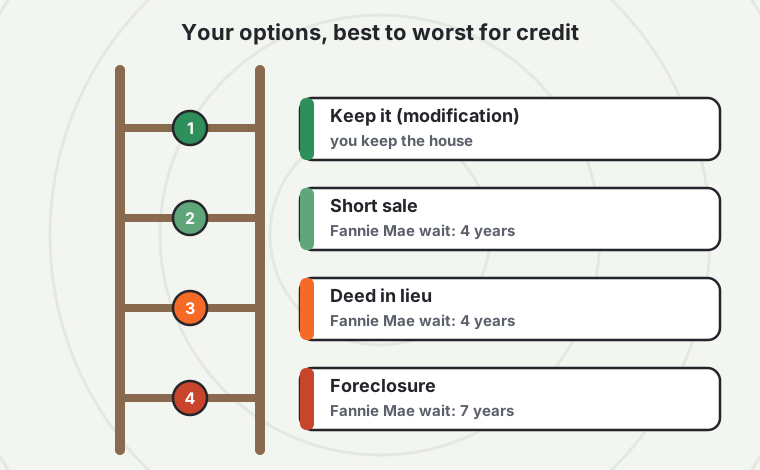
- Fannie Mae’s waiting period for a new mortgage is 4 years after a deed in lieu, versus 7 after a foreclosure.
- If you have equity, do not give the house back. Sell it before Law Day and keep the difference.
Can you give your house back to the bank in Connecticut?
You can give your house back to the bank in Connecticut through a deed in lieu of foreclosure, but only if the lender agrees to take it. You sign a deed transferring the house to the lender, and in exchange the lender releases the mortgage and ends or avoids the foreclosure. Lenders usually agree only when the house is worth less than the debt, the title has no other liens, and a sale has been tried first.
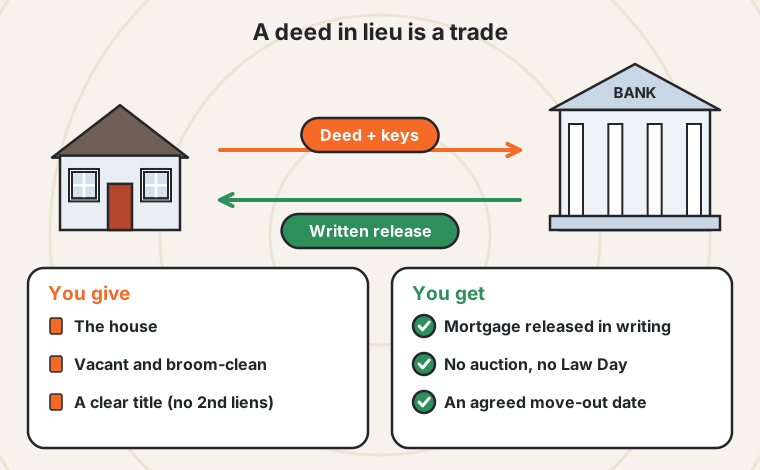
This guide is part of our guide on how to sell a house in Connecticut. It covers one narrow question in depth: can you hand the house back and walk away, what does the bank want before it says yes, and what does it cost you in Connecticut?
The most common misunderstanding is that you can simply mail the keys to the bank. You cannot. Until the lender accepts and records a deed, or a court finishes a foreclosure, you still own the house. You still owe the property taxes, the insurance, any condo or association fees, and you are still responsible if someone is hurt on the property. A vacant, abandoned house can even put you on a faster foreclosure track, because Connecticut lets the lender move for judgment and default at the same time for vacant property (CGS 49-31s). So “giving it back” really means negotiating a deed in lieu.
How the rest of a Connecticut foreclosure works, with Law Day and mediation, is in our Connecticut foreclosure guide. In one sentence: the lender sues, the court usually orders a strict foreclosure with a Law Day, and if no one pays the debt by then, the title passes to the lender with no sale.
Is it okay to want to just hand the keys back and be done?
It is okay to want to hand the keys back and be done. Wanting a clean exit after months of letters, calls and failed paperwork is a reasonable decision, not a moral failure. A deed in lieu exists for exactly this situation, and lenders, regulators and Connecticut law all treat it as a legitimate alternative to foreclosure. What matters is doing it in a way that actually ends the debt.
Maybe you applied for a modification twice and the servicer lost the paperwork. Maybe the house sat on the market as a short sale and nobody came. Maybe it is a job move, a divorce or an illness, and the payment was manageable until it suddenly was not. You may feel exhausted, embarrassed in front of neighbors, angry at the bank, afraid of a bill for the rest of the loan, and suspicious of every company that writes to you. In a town like Westport, where the median house sold for $1.9 million last year, the numbers involved can make the fear bigger, not smaller.
This page is for you if you are thinking “I just want to give it back”. We will show you what the bank will ask for, what you must get in writing, how Connecticut taxes it (in short, it does not), and when giving it back would be a costly mistake because you actually have equity.
Connecticut Department of Banking foreclosure hotline: 1-877-472-8313. HUD-approved housing counselors: 1-800-569-4287. Connecticut Housing Finance Authority (CHFA): 1-877-571-2432. Statewide Legal Services: 1-800-453-3320. If you have been served, the court’s Foreclosure Mediation Program is free and a deed in lieu can be negotiated there. None of these should ever charge you. Call one this week, even if you also call us.
What does a lender require before it accepts a deed in lieu?
Before it accepts a deed in lieu, a lender usually requires a documented financial hardship, proof that you cannot afford the loan even with a modification, a house worth less than the debt, a title free of second mortgages, judgment liens and tax liens (or those lienholders’ agreement to release), and often an attempt to sell, such as a short sale listing that did not close. Most also want the house empty and clean at handover.
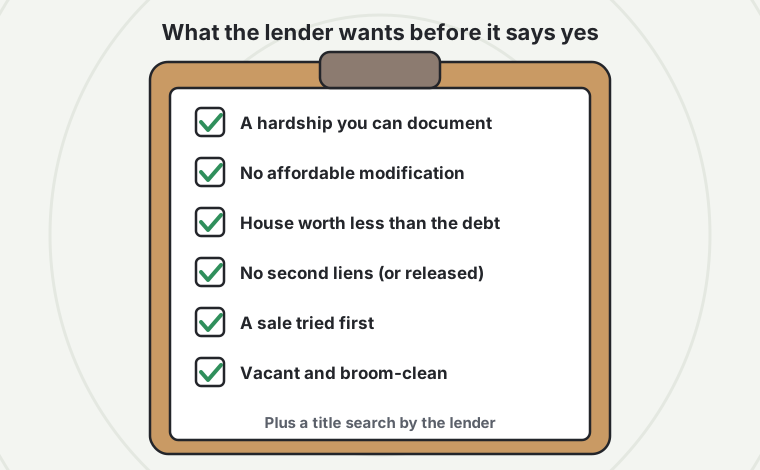
- A hardship you can document: job loss, lower income, divorce, illness, death of a co-borrower, a distant job transfer.
- You were reviewed for keeping the house first. Federal servicing rules make the servicer evaluate you for all the options it offers once it has a complete application (12 CFR 1024.41).
- The house is worth less than you owe, based on the lender’s own valuation.
- Clear title. The lender orders a title search. A second mortgage, home equity line, judgment lien, mechanic’s lien or unpaid property tax usually has to be released or paid.
- A sale was tried. Many lenders want to see a short sale listing that did not produce an acceptable offer, or will consider a deed in lieu only after a short sale review.
- Vacant and broom-clean at handover, unless the agreement allows otherwise, with keys, garage openers and codes.
- Your own attorney reviewing the deed in lieu agreement and the deed before you sign.
Fannie Mae, Freddie Mac and FHA loans
Most mortgages are owned or insured by one of three federal programs, and each has its own deed in lieu rules. Ask your servicer who owns or insures your loan; the answer changes what you can ask for.
| Loan type | What the program calls it | What to know |
|---|---|---|
| Fannie Mae | Mortgage Release (deed in lieu) | Requires delivering the house free of liens; Fannie Mae may pay a limited amount to junior lienholders to release; its borrower materials describe relocation assistance (Servicing Guide D2-3.3-02) |
| Freddie Mac | Deed in lieu of foreclosure | Similar structure: hardship, clear title, relocation assistance may be available; ask the servicer for the current terms |
| FHA (HUD) | Deed-in-Lieu (DIL), a “home disposition option” | Generally considered after a pre-foreclosure sale (short sale) has been tried; the house is conveyed vacant and free of personal property unless HUD approves otherwise; a capped payment to or for the borrower may be allowed (HUD Handbook 4000.1) |
| Portfolio or private lender | Deed in lieu | No program rules; everything is negotiated, including the deficiency waiver and any cash for moving |
If the bank says no, you still have choices: a modification, a short sale, a normal sale, bankruptcy, or letting the foreclosure run while you plan. Connecticut also has a court tool for underwater homes, explained in the next section.
What Connecticut laws apply to a deed in lieu of foreclosure?
The Connecticut laws that apply to a deed in lieu of foreclosure are the conveyance tax exemption for a deed in lieu of your principal residence (CGS 12-498(a)(19)), the deficiency and foreclosure-bar rules (CGS 49-1 and 49-14), the underwater-mortgage “judgment of loss mitigation” statutes (CGS 49-30p to 49-30w), the mediation program (CGS 49-31k to 49-31n), the debt negotiation license law (CGS 36a-671) and a foundation disclosure rule for the lender’s later resale (CGS 20-327b(g)-(h)).
| Rule | What it says, in plain English | Statute |
|---|---|---|
| Conveyance tax, principal residence | A deed in lieu of foreclosure that transfers your principal residence is exempt from the state and town conveyance tax | CGS 12-498(a)(19); DRS SN 2010(4) |
| Conveyance tax, other property | A deed of a property (not your principal residence) to a lender holding a mortgage delinquent for at least six months is taxed at the state’s 0.75% rate | CGS 12-494(b)(3) |
| Deficiency after a foreclosure | After a strict foreclosure, the lender has 30 days after redemption expires to seek a deficiency, measured against the court’s valuation | CGS 49-14 |
| Deficiency after a deed in lieu | No statute cancels it automatically; it depends on the agreement, so get a written waiver | Your deed in lieu agreement |
| Underwater homes | You and the lender can agree to transfer the house “in full or partial satisfaction” of the debt and ask the court for a judgment of loss mitigation, which clears junior interests that are parties to the case | CGS 49-30r, 49-30t |
| Mediation | Owner-occupants of one-to-four family homes (return dates through June 30, 2029) can use free court mediation; forms due within 15 days of the return date; mediation ends at the 3rd session or 7 months after the return date | CGS 49-31l, 49-31n |
| Paid negotiators | Anyone who charges you to negotiate with your lender needs a Department of Banking debt negotiation license, unless they are your attorney | CGS 36a-671, 36a-671c |
| Foundation report on resale | When the lender later sells a house it took by deed in lieu in a town CRCOG lists as affected by crumbling foundations, it must give buyers the Residential Foundation Condition Report | CGS 20-327b(g)-(h) |
If you owe more than the house is worth, Connecticut’s underwater-mortgage statutes let you and the lender sign a transfer agreement conveying the house to the lender in satisfaction of the debt, then have the court enter a “judgment of loss mitigation” (CGS 49-30r, 49-30t). It is voluntary for both sides. Its advantage over a plain deed in lieu is that the court judgment can clear junior interests that are parties to the action. Ask your attorney or the mediator about it if a second lien is blocking a deed in lieu.
Will you still owe money after a deed in lieu in Connecticut?
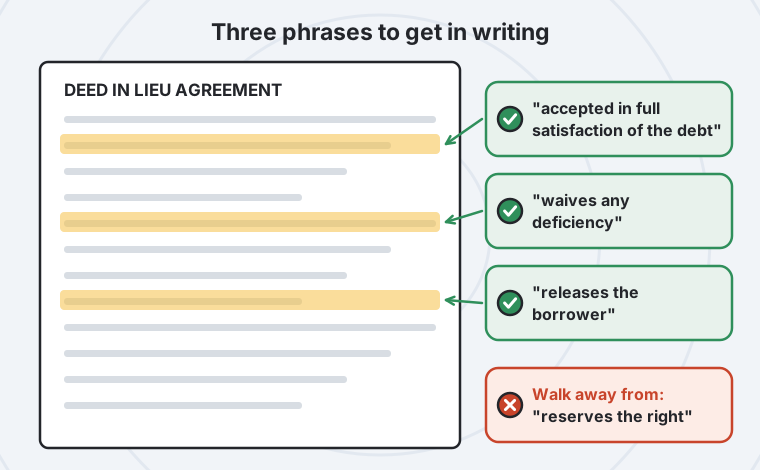
You can still owe money after a deed in lieu in Connecticut if the agreement does not say otherwise. A deed in lieu only transfers the house; whether the rest of the debt is forgiven depends on the written terms. Ask for language that the lender accepts the deed in full satisfaction of the debt and waives any deficiency, and have your own Connecticut attorney confirm it before you sign the deed.
In a Connecticut foreclosure, the lender’s right to chase the leftover debt is tightly limited: it has to ask the court within 30 days after the redemption period expires, the court sets its own value for the house, and the lender gets only the difference (CGS 49-14). Once the foreclosure is done, it cannot bring other suits on the debt (CGS 49-1). A deed in lieu sidesteps that court process. That is good if the agreement waives the deficiency, and risky if it does not, because then the shortfall is an ordinary debt.
What to ask for in writing
- The lender “accepts the deed in lieu in full satisfaction of the mortgage debt” and “waives any right to a deficiency”.
- The lender will release the mortgage of record and withdraw the foreclosure action.
- Who handles any second mortgage, home equity line or other lien, and that you are released from those too, if that is the deal.
- The move-out date, the condition the house must be in, and any relocation payment and when it is paid.
- How the lender will report the account to the credit bureaus.
“Lender reserves the right to pursue any remaining balance”, a request that you sign a new promissory note or make a “cash contribution”, or no mention of the deficiency at all. Do not sign until your attorney has negotiated it. A second lienholder’s release may also have conditions; read it as carefully as the first lender’s.
Do you pay taxes when you give your house back to the bank?
You may pay income tax when you give your house back to the bank, because a deed in lieu is treated as a sale of the house and any debt the lender cancels can be taxable income. The lender may send Form 1099-A and Form 1099-C. The federal exclusion for forgiven debt on a main home covered discharges through December 31, 2025; the insolvency exclusion still applies. Connecticut conveyance tax does not apply to a deed in lieu of your principal residence.
There are two federal pieces, and your tax preparer will need the paperwork for both:
- The transfer counts as a sale. For income tax, giving the house to the lender is treated like selling it. If the loan is recourse (you are personally liable), the “sale price” is generally the house’s fair market value; if non-recourse, it is the debt. A loss on your own home is not deductible. A gain may be covered by the home-sale exclusion of $250,000 ($500,000 for a married couple) if you meet the two-out-of-five-years test (IRS Publications 4681 and 523).
- Canceled debt can be income. On a recourse loan, the part of the debt above the house’s value that the lender forgives is canceled debt income, usually reported on Form 1099-C.
- The main-home exclusion has expired for most 2026 cases. Form 982’s qualified principal residence indebtedness exclusion covers discharges before January 1, 2026, or under a written arrangement made before that date. Check IRS.gov/Form982 for any later change in the law.
- Insolvency is the main relief now. If your total debts were larger than the value of everything you owned just before the cancellation, you can exclude canceled debt up to the amount of that insolvency. Bankruptcy discharges are also excluded.
Connecticut taxes any taxable federal gain as income. For the rest of the tax picture, see taxes when selling a house in Connecticut, and talk to a tax professional before you sign.
How much Connecticut conveyance tax does a deed in lieu save in Westport?
A deed in lieu of your principal residence in Westport saves the whole Connecticut conveyance tax, which at the town’s median sale price of $1,900,000 would be $24,500: $19,750 to the state and $4,750 to the town. The exemption in CGS 12-498(a)(19) covers both the state and the municipal tax. Because the state rate rises above $800,000, the saving is largest in high-price Fairfield County towns.
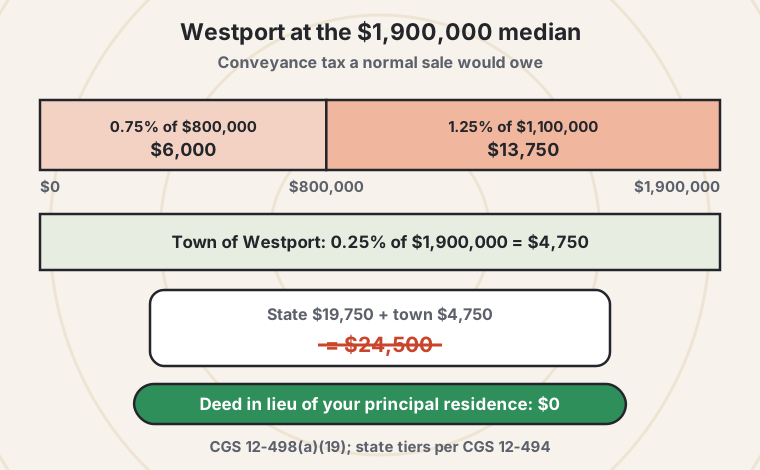
Connecticut’s state conveyance tax on residential property is tiered: 0.75% on the part of the price up to $800,000, 1.25% on the part from $800,000 to $2.5 million, and 2.25% above $2.5 million (CGS 12-494). Westport charges the standard 0.25% town rate. Here is how that works out at local median prices (sales October 2024 to September 2025):
| Town | Median sale price | State tax | Town tax | Total, normally | Deed in lieu of principal residence |
|---|---|---|---|---|---|
| Westport | $1,900,000 | $6,000 + $13,750 = $19,750 | 0.25% = $4,750 | $24,500 | $0 |
| Fairfield | $879,500 | $6,000 + $993.75 = $6,993.75 | 0.25% = $2,198.75 | $9,192.50 | $0 |
| Norwalk | $605,000 | 0.75% = $4,537.50 | 0.50% = $3,025 | $7,562.50 | $0 |
Two cautions. First, the exemption is for your principal residence. A deed in lieu of a rental, a second home or a beach house is not covered; a deed to a lender holding a mortgage delinquent at least six months is taxed at the 0.75% state rate instead of the tiers (CGS 12-494(b)(3)). Second, the tax saving is only a saving if you would otherwise be paying it. If you have equity, a normal sale pays the tax but leaves you far more money; see the comparison below. Every town’s rate is in our Connecticut conveyance tax guide.
How does a deed in lieu affect your credit and your next mortgage?
A deed in lieu affects your credit much like a short sale: it is reported as a negative event, it can stay on your report for up to 7 years, and it starts a waiting period for your next mortgage. Under Fannie Mae’s rules that wait is 4 years after a deed in lieu (2 with documented extenuating circumstances), compared with 7 years after a foreclosure.
| Event | Fannie Mae standard wait | With extenuating circumstances |
|---|---|---|
| Deed in lieu of foreclosure | 4 years | 2 years |
| Short sale (preforeclosure sale) | 4 years | 2 years |
| Foreclosure | 7 years | 3 years, with extra limits until year 7 |
No one can honestly tell you how many points your score will drop; it depends on your file. The months of missed payments before the deed usually do the most damage. Ask the lender, in writing, how it will report the account (for example “deed in lieu” or “settled for less than full balance”) and check your reports afterwards.
For a wider look at what comes after, see the consequences of foreclosure for Connecticut sellers.
What happens to a second mortgage or home equity line in a deed in lieu?
A second mortgage or home equity line does not disappear in a deed in lieu. The first lender takes the house subject to any lien it does not clear, so it usually refuses a deed in lieu unless the second lienholder releases its lien, sometimes for a small payment. Even after the lien is released, the second lender may still be owed the debt unless it also agrees in writing to forgive it.
This is the most common reason a deed in lieu fails, and it hits Fairfield County hard, where many owners took a home equity line on top of a large first mortgage. What can help:
- Ask early who holds every lien, and whether the first lender’s program allows a payment to junior lienholders (Fannie Mae’s does, up to a limit).
- Ask the second lender for a release and a waiver, not just a release of the lien.
- Use mediation or the court. In mediation, all parties can talk at once. Connecticut’s judgment of loss mitigation (CGS 49-30t) can clear junior interests that are parties to the case.
- Consider a short sale instead. Short sales also need the second lien released, but the buyer’s money gives the lenders something to divide.
Does the crumbling foundation report matter if you give your house back?
The crumbling foundation report matters only after you give your house back, and it is the lender’s job, not yours. When a lender sells a house it acquired by a deed in lieu in a town the Capitol Region Council of Governments lists as affected by crumbling foundations, it must give buyers the Residential Foundation Condition Report before they sign a contract (CGS 20-327b(g)-(h)). You should still tell the lender what you know about the foundation.
This rule was written because lenders and towns that take houses through foreclosure or a deed in lieu usually never lived in them, so they could not answer the normal disclosure questions. Instead of the full condition report, they must disclose what they actually know about pyrrhotite, foundation damage and repairs on a dedicated form. Every other seller in those towns answers the foundation questions on the standard Residential Property Condition Report.
Why it matters to you: if your house is in an affected town (many are in Tolland and Windham counties and parts of Hartford County) and the foundation is cracking, the lender’s valuation will reflect it, which can make a deed in lieu more likely to be approved, or make a short sale harder. If the foundation is the reason you cannot sell, read our guide to selling a house with a crumbling foundation in Connecticut first, including the separate conveyance tax exemption for pyrrhotite-damaged homes (CGS 12-498(a)(21)).
Is a deed in lieu better than a short sale or selling the house yourself?
A deed in lieu is better than a short sale only when no buyer can be found or the lender offers it first, because it is simpler but usually needs a failed sale attempt anyway. It is never better than selling the house yourself when you have equity: in a deed in lieu the lender keeps the house and every dollar of value above the debt, while a normal sale before Law Day pays the lender and gives the rest to you.
Deed in lieu
Hand it backBest when the house is underwater, a sale has failed and you want a clean, fast exit.
- No buyer, showings or contract
- No conveyance tax on a principal residence
- Fannie Mae wait: 4 years
- You keep nothing; need a written waiver
- Second liens often block it
Short sale
Sell for lessBest when the house is underwater, you have time, and a buyer can be found.
- You choose the buyer and date
- No conveyance tax on a principal residence that cannot cover the liens (CGS 12-498(a)(20))
- Fannie Mae wait: 4 years
- Needs lender approval; takes weeks to months
Normal sale (list or cash)
Keep your equityBest whenever the house is worth more than you owe.
- Lender paid in full; foreclosure ends
- No deficiency, no forgiven-debt tax
- No credit event beyond the late payments
- You pay normal conveyance tax and closing costs
- Must close before Law Day
Our separate guide compares the other two in detail: short sale vs. foreclosure in Connecticut.
Example (illustrative): a Westport house with equity
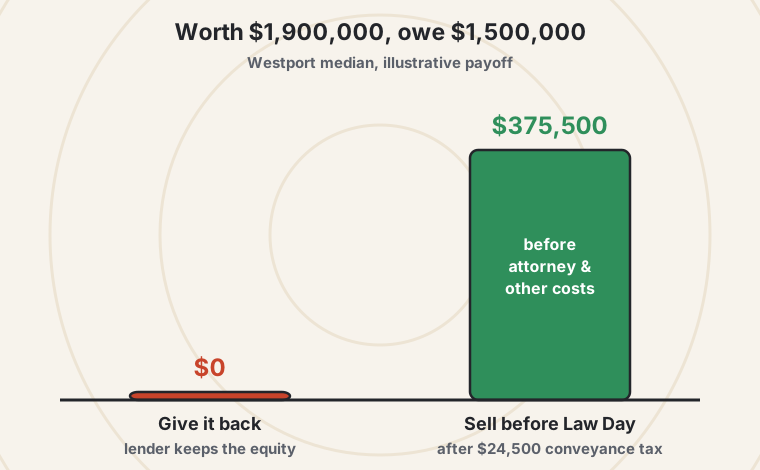
- Value: $1,900,000, the Westport median sale price (state sales data, October 2024 to September 2025).
- Owed on the mortgage, including arrears and fees: $1,500,000 (illustrative).
- Deed in lieu: the lender would not normally accept it, because there is equity. If it did, you would walk away with $0 and the lender would hold a house worth $400,000 more than the debt.
- Strict foreclosure: also $0 to you; you could ask the court for a foreclosure by sale (CGS 49-24) to protect a surplus.
- Sale before Law Day: $1,900,000 minus $1,500,000 minus $24,500 conveyance tax leaves $375,500 before your attorney, any commission and other closing costs.
Try your own numbers; enter a realistic price and your payoff:
How much would you walk away with?
Slide the numbers to match your house. It works in your browser; nothing is saved or sent.
Estimates for planning. Conveyance tax per CGS 12-494 (state 0.75% up to $800,000, 1.25% to $2.5M, 2.25% above, plus the town rate). Seller attorney about $1,200 to $1,500; flat-fee MLS about $400; listings include three months of taxes, insurance and utilities, a cash sale about two weeks. Your attorney gives you the final numbers.
Not sure what your house is worth today? Fairfield County prices moved a lot in the last few years. A quick value estimate helps you decide whether you are really underwater:
Know where you stand,
on your own time.
Watch what homes around you sell for and how fast, so when you are ready, you already know your options.
Follow your numbers as the market moves, and decide when the timing is right.
Can a cash buyer help instead of giving the house back?
A cash buyer can help instead of giving the house back when the house is worth more than what you owe, or close to it: a cash sale can close before Law Day, pay off the lender in full and leave the difference with you. A cash buyer cannot help much when the house is deeply underwater, because the lender still has to approve any price below the payoff. Then a short sale or deed in lieu is the honest answer.
We are Jerryll Noorden’s company. We buy about 10 Connecticut houses a year, and have since 2016, including in Fairfield County. We buy as-is, with no repairs and no cleaning out; you can leave behind whatever you do not want.
- If you have equity: a written cash offer, a closing date you choose (about two weeks is typical once the title is clear), your own Connecticut attorney at the closing, and the lender paid from the proceeds. No fees and no commission.
- If you are underwater: we can make an offer subject to the lender’s short sale approval, or tell you plainly that a listing, a deed in lieu or a counselor is the better route.
- What we never do: charge you anything, ask you to sign a deed to us outside a closing with attorneys, offer to “rent it back”, or tell you to stop talking to your lender, lawyer or counselor. Anyone who does is a red flag; call the Department of Banking at 1-877-472-8313.
When you should not sell to a cash buyer
- You have time before Law Day and a well-priced listing would net more, even after commission. In Westport, where houses are larger and buyers more plentiful, this is often the case.
- A modification or Connecticut’s Emergency Mortgage Assistance Program could let you keep the house and you want to.
- The house is far underwater; the lender will want market price, which a listing usually delivers.
- Anyone pressures you to sign today. A fair offer will still be fair next week.
Our page on selling your house before foreclosure in Connecticut explains how a sale before Law Day works step by step.
How do you do a deed in lieu of foreclosure in Connecticut, step by step?
To do a deed in lieu of foreclosure in Connecticut, you check your equity, apply to your servicer for loss mitigation with a hardship package, ask specifically for a deed in lieu (or a short sale first), clear or negotiate any second liens, get the written agreement with a deficiency waiver reviewed by your attorney, then move out and sign the deed on the agreed date.
Check whether you have equity
Compare a realistic sale price for your town with your payoff and every other lien. If the house is worth more than you owe, stop here and sell instead.
Apply for loss mitigation
Send the servicer a complete application: hardship letter, income, bank statements, tax returns and its financial form. Keep copies and proof of delivery. If you have been served, file the mediation forms within 15 days of the return date.
Ask for a deed in lieu by name
Ask whether the investor (Fannie Mae, Freddie Mac, FHA or a private owner) allows one, whether it requires a short sale listing first, and whether relocation assistance is available.
Deal with second liens
Get the second lender’s release and, ideally, a waiver of its debt. Ask whether the first lender will contribute to it.
Get the agreement and have your attorney review it
Check the full-satisfaction and deficiency waiver language, the move-out date, the condition required, any relocation payment, the credit reporting and the dismissal of the foreclosure.
Move out, hand over keys, sign the deed
Leave the house as agreed, take photos and meter readings, sign the deed and get copies of the recorded release. File the tax forms you receive the next year.

When someone tells me they want to give the house back, the first thing I ask is what they think it is worth and what they owe. More often than you would expect, the answer shows real equity, sometimes a lot of it, because the loan is older than the last run-up in prices. Giving that house back would be handing the bank a gift. Get a real value before you sign anything.
If you want a free written number for your house, or just want to talk through deed in lieu, short sale and sale options with someone local, book a time here. No cost, no obligation, and we will tell you if a counselor, an agent or a deed in lieu fits you better.
See the house together.
Pick a time that works.
Choose a time for us to walk through the property with you, or ask for a quick call first. We confirm every request personally.
Tuesday, January 13
No open times in the next few weeks. Please call us.
We will confirm by email. Nothing is booked until we do.
View my requestQuestions Connecticut homeowners ask about giving a house back to the bank
Can I just give my house back to the bank in Connecticut?
You can give your house back to the bank in Connecticut only through a deed in lieu of foreclosure that the lender agrees to. Simply moving out or mailing the keys does not transfer ownership; you would still own the house, owe taxes and insurance, and face the foreclosure. Ask your servicer for a deed in lieu review.
Is a deed in lieu better than foreclosure?
A deed in lieu is usually better than foreclosure: there is no foreclosure judgment, you agree a move-out date, there is no conveyance tax on a principal residence, and Fannie Mae’s waiting period for a new mortgage is 4 years instead of 7. It is only better if the agreement waives the deficiency, and never better if you have equity.
Will I owe money after a deed in lieu?
You may owe money after a deed in lieu if the agreement does not waive the deficiency, because the deed transfers the house but does not automatically cancel the rest of the debt. Get written language that the lender accepts the deed in full satisfaction and waives any deficiency, and the same from any second lender.
Can the bank refuse a deed in lieu?
The bank can refuse a deed in lieu, and many do when the house has other liens, when you have equity, when you could afford a modification, or when a sale has not been tried. If it refuses, ask about a short sale, a modification, Connecticut mediation, or the court’s judgment of loss mitigation for underwater homes (CGS 49-30r, 49-30t).
Do I pay taxes on a deed in lieu?
You may pay federal income tax on a deed in lieu if the lender cancels debt above the house’s value, reported on Form 1099-C, because the main-home exclusion covered discharges only through 2025 except under earlier written arrangements. The insolvency exclusion can still help. Connecticut conveyance tax does not apply to a deed in lieu of your principal residence.
Do I pay Connecticut conveyance tax on a deed in lieu?
You do not pay Connecticut conveyance tax on a deed in lieu of foreclosure that transfers your principal residence (CGS 12-498(a)(19)), and the exemption covers the state and town tax. For other property, a deed to a lender holding a mortgage delinquent at least six months is taxed at the state’s 0.75% rate (CGS 12-494(b)(3)).
How long after a deed in lieu can I buy another house?
After a deed in lieu you can generally get a Fannie Mae conventional mortgage after 4 years, or 2 years with documented extenuating circumstances, compared with 7 years after a foreclosure (Fannie Mae Selling Guide B3-5.3-07). FHA generally requires 3 years. Confirm with a loan officer for your situation.
How long does a deed in lieu take?
A deed in lieu usually takes from several weeks to a few months, because the servicer has to review your application, value the house, search the title and, often, see a short sale attempt first. Second liens add time. Start while your case is in mediation so it is done before any Law Day.
Can I get money for moving out in a deed in lieu?
You can sometimes get money for moving out in a deed in lieu. Fannie Mae, Freddie Mac and FHA programs allow some relocation assistance or a capped payment in certain cases, and private lenders may offer “cash for keys”. Ask for it, and make sure the amount and the date it is paid are in the written agreement.
What happens to my second mortgage in a deed in lieu?
Your second mortgage stays a lien and a debt unless the second lender releases it, which is why first lenders often refuse a deed in lieu when there is one. Ask the second lender for both a lien release and a waiver of its debt, and ask whether the first lender will contribute to the release.
Can I stay in the house after a deed in lieu?
You usually cannot stay in the house after a deed in lieu, because the lender expects it vacant at handover. Some programs allow a short agreed period or, rarely, a lease, and FHA requires vacant conveyance unless HUD approves otherwise. Negotiate your move-out date before you sign.
Does a deed in lieu stop a foreclosure in Connecticut?
A deed in lieu stops a foreclosure in Connecticut once the lender accepts and records the deed and withdraws the case, but applying for one does not pause the case by itself. Keep filing what the court requires, use mediation, and ask the court to move a Law Day if the agreement needs more time (CGS 49-15).
Should I give my house back if I have equity?
You should not give your house back if you have equity. In a deed in lieu, as in a strict foreclosure, the lender keeps the house and everything it is worth above the debt. Sell it before Law Day instead, by listing or to a cash buyer, so the lender is paid in full and the difference comes to you.
Who can help me negotiate a deed in lieu for free?
HUD-approved housing counselors (1-800-569-4287), the Connecticut Department of Banking hotline (1-877-472-8313), legal aid and the court’s Foreclosure Mediation Program can help you negotiate a deed in lieu for free. Anyone else charging you to negotiate with your lender needs a Connecticut debt negotiation license unless they are your attorney.
Related Connecticut guides
Foreclosure
Money and property
We buy houses across Connecticut, including Westport, Fairfield, Norwalk, Stamford, Bridgeport and Vernon. For the whole process, start with how to sell a house in Connecticut.
Plain-English information, not legal or tax advice. Reviewed by Jerryll Noorden, October 2026. Talk to a Connecticut attorney before you sign a deed in lieu agreement, and to a tax professional about canceled debt.
Sources
- CGS § 12-494 (conveyance tax tiers; (b)(3) deeds to a lender after six months’ delinquency) and § 12-498(a)(19), (a)(20), (a)(21) (exemptions), with DRS Special Notice 2010(4) (exemptions apply to state and municipal tax).
- Connecticut General Statutes, chapter 846: § 49-1, § 49-14 (deficiency), § 49-15, § 49-24, §§ 49-30p to 49-30w (underwater mortgages; transfer in satisfaction; judgment of loss mitigation), §§ 49-31k to 49-31n (foreclosure mediation), § 49-31s (vacant property).
- CGS § 20-327b(g)-(h) (Residential Foundation Condition Report for homes acquired by foreclosure or deed in lieu in CRCOG-listed towns).
- CGS §§ 36a-671 to 36a-671d (debt negotiation licensing).
- Connecticut Judicial Branch, Foreclosure Mediation Program and Department of Banking, Avoiding Foreclosure.
- Fannie Mae Selling Guide B3-5.3-07 (waiting periods) and Fannie Mae Servicing Guide (D2-3.3-02, Mortgage Release).
- HUD Single Family Housing Policy Handbook 4000.1 (FHA pre-foreclosure sale and deed-in-lieu).
- 12 CFR 1024.41 (loss mitigation review) and CFPB: If I can’t pay my mortgage loan, what are my options?
- IRS Instructions for Form 982, IRS Publication 4681 and IRS Publication 523.
- Town sales and medians: Connecticut Office of Policy and Management sales data on data.ct.gov (October 2024 to September 2025); town conveyance tax rates per OLR Report 2020-R-0020.

Who wrote this
Jerryll Noorden
Jerryll has bought and sold Connecticut houses since 2016 and has sat at more closing tables than he can count, on both sides. Before real estate he was a robotics scientist at NASA, IHMC and IIT. He wrote this guide because the national sites that rank for it skip the Connecticut rules that cost sellers money. When listing or selling it yourself would get you more than a cash offer, he says so.
This guide explains Connecticut rules in plain English. It is not legal or tax advice. Laws change; for your sale, talk to a Connecticut real estate attorney and a tax professional.
