
Key facts at a glance
This guide explains one word that causes a lot of fear: pre-foreclosure. It is part of our Connecticut foreclosure guide; if you decide to sell, our guide to how to sell a house in Connecticut covers every route and cost.
| Fact | Number | Source |
|---|---|---|
| Earliest a servicer can make the first foreclosure filing on your home | More than 120 days behind | 12 CFR 1024.41(f) |
| Notice before a Connecticut foreclosure can start: time to meet the lender or a counselor and contact CHFA | 60 days | CGS 8-265ee |
| Public notice of a foreclosure lawsuit on the town land records | Lis pendens, recorded when the case starts or later | CGS 52-325 |
| Auction notice in a strict foreclosure (the usual Connecticut type) | None; the court sets a Law Day instead | CGS 49-24, 49-19 |
| Bridgeport residential sales, Oct 2024 to Sep 2025 | 1,166 sales, median $374,500 (up 15%) | data.ct.gov sales dataset (OPM) |
| Bridgeport conveyance tax paid by the seller | 1.25% (0.75% state + 0.50% city) | CGS 12-494 |
| Bridgeport mill rate, fiscal 2027 (after the 2025 revaluation) | 27.95 (43.45 the year before) | City of Bridgeport adopted budget; CT OPM |
What does pre-foreclosure mean in Connecticut?
Pre-foreclosure in Connecticut means the stage when you are behind on your mortgage but the lender has not yet served you with a foreclosure lawsuit. Connecticut law does not use the word. Listing and data sites use it more loosely: they label a house “pre-foreclosure” once a foreclosure notice shows up in public records, which in Connecticut usually means the lawsuit has already started.
That gap between the two meanings is the most useful thing on this page. If you are a few months behind and nobody has knocked on your door with court papers, you are in true pre-foreclosure: nothing is public, and you have the widest set of options you will ever have. If a website already shows your house as pre-foreclosure, the case is most likely filed, and the deadlines in our first-15-days guide apply to you now.
Why does seeing your house labeled pre-foreclosure feel so exposing?
Seeing your house labeled pre-foreclosure feels exposing because something private, a money problem you may not have told your family about, suddenly looks public, and strangers start mailing you about it. That feeling is common and understandable. The label is a data tag, not a judgment, and it does not change your legal rights or your deadlines.
People in this spot often describe feeling embarrassed (the neighbors might see), watched (how do these buyers know?), angry at the letters, confused about how much time is left, and underneath it all afraid of losing the house. Some feel a strange relief that it is finally out in the open. If any of that is you, this page is for you. You will leave knowing what the label means, how much time it really signals, and what you can still do.
Why does Connecticut have no recorded notice of default or auction date?
Connecticut has no recorded notice of default or auction date because it forecloses through the courts, usually by strict foreclosure. The lender must sue you, the lawsuit is noted on the land records with a lis pendens (CGS 52-325), and the court sets a Law Day rather than an auction (CGS 49-24). Only the less common foreclosure by sale produces a public auction notice.
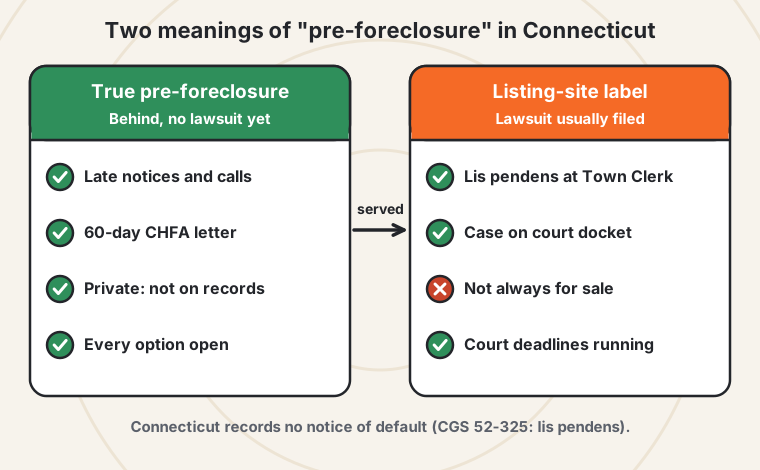
Many articles about pre-foreclosure are written for states like California or Texas, where a lender can foreclose without a court. There, a “notice of default” is recorded months before an auction, and the period in between is what people call pre-foreclosure. Connecticut works differently:
- Before the lawsuit, your lender sends letters: late notices, a federal early-intervention letter, a default or breach letter, and for most owner-occupied homes a certified notice giving you 60 days to meet with the lender or a counselor and contact CHFA (CGS 8-265ee). None of these go on the land records.
- When the lawsuit starts, a state marshal serves you with a writ, summons and complaint, and the lender’s attorney may record a lis pendens in the Town Clerk’s land records. From then on the case is public, both there and on the Judicial Branch website.
- At the end, most Connecticut cases end in a judgment of strict foreclosure with Law Days, not an auction. If the court orders a foreclosure by sale instead, a court-appointed committee advertises the sale, and that is the only “notice of sale” you will see here.
So the label you see online is built on a lis pendens or a court docket, not on a notice of default. Our Connecticut foreclosure guide covers the whole court process in one place.
How do listing sites decide a house is in pre-foreclosure?
Listing sites decide a house is in pre-foreclosure by pulling public records: in a judicial state like Connecticut, that means a recorded lis pendens or a foreclosure case on the court docket. They do not check whether you have caught up, are in mediation or have sold. The label can appear weeks after a filing and can stay up long after the problem is solved.
A few things follow from how these labels are made:
- The label does not mean the house is for sale. Major listing sites say so themselves; it only means a record was found.
- It can be out of date. If you reinstated the loan and the case was withdrawn, the label may linger until the data vendor refreshes. Ask the lender’s attorney to confirm the case is withdrawn and the lis pendens released on the land records.
- It does not change your rights. You still own the house, you can still sell it, and every court deadline still runs from your papers, not from a website.
- It does not show your equity or your balance. Any buyer who quotes you a number based on the listing alone is guessing.
Under CGS 52-325, a recorded lis pendens is notice to anyone who later buys or lends against the property that the lawsuit is pending, and binds them to its outcome. It does not stop you from selling. It means the buyer’s attorney will see it in the title search and make sure the foreclosing loan is paid off at closing, after which the case is withdrawn.
How long does pre-foreclosure last in Connecticut?
True pre-foreclosure in Connecticut lasts at least about four months, because a servicer generally cannot file until you are more than 120 days behind (12 CFR 1024.41(f)), and the 60-day CHFA notice must be mailed first (CGS 8-265ee). Many servicers wait longer. The listing-site version lasts as long as the court case, often a year or more (est.), with mediation alone pausing most motions for up to eight months (CGS 49-31l(f)).

| Window | Typical length | Rule or source |
|---|---|---|
| First missed payment to earliest filing | More than 120 days | 12 CFR 1024.41(f) |
| CHFA notice to earliest filing | 60 days | CGS 8-265ee |
| A complete loss mitigation application sent before day 120 | Generally blocks the first filing while it is reviewed | 12 CFR 1024.41(f)(2) |
| Return date to the end of mediation | Third session or 7 months, unless extended | CGS 49-31n |
| Pause on most motions while mediation runs | Up to 8 months from the return date | CGS 49-31l(f) |
| Judgment to Law Day | Set by the court in each case | CGS 49-19, Practice Book 23-17 |
For the full stage-by-stage calendar with what you can do at each step, see our decision map for avoiding foreclosure in Connecticut.
How are pre-foreclosure lists made, and why do you get so many mailers?
Pre-foreclosure lists are made by data companies that collect lis pendens filings from town land records and foreclosure cases from the court docket, match them to owner names and mailing addresses, and sell the lists to investors, agents, lenders, attorneys and, sadly, scammers. That is why the letters, postcards and texts usually start within weeks of a foreclosure filing.
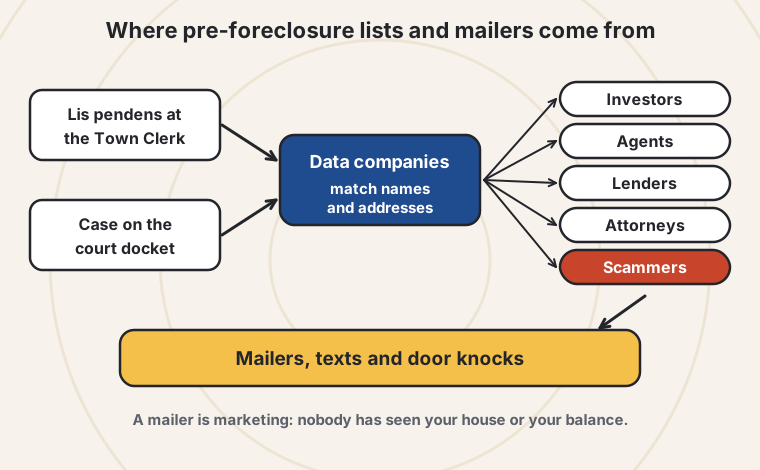
None of this is personal, and none of it means your lender is selling your information. Land records and court dockets are public in Connecticut. Our guide on why you keep getting offers to buy your house explains how to cut down the volume. Three points matter more than the volume:
- Mailers are not offers. A postcard with a number on it was printed before anyone saw your house.
- Urgency is a sales tactic. “Call within 48 hours” has nothing to do with your real deadlines, which come from the court.
- Anyone who asks for a fee or your deed before a closing is a red flag. Legitimate help is free, and a real sale closes through Connecticut attorneys with the payoff sent straight to your lender. Our scam red flags guide lists the patterns.
We buy houses ourselves; we do not sell your contract to someone else. If you want to understand the difference between buyers, our page on wholesalers, realtors and cash buyers lays it out.
Where can you get free help during pre-foreclosure?
You can get free help during pre-foreclosure from the Connecticut Department of Banking foreclosure hotline (1-877-472-8313), a HUD-approved housing counselor (1-800-569-4287), CHFA’s emergency mortgage assistance program, and legal aid. Once you are served, the court’s foreclosure mediation program is free for owner-occupied one-to-four family homes. Call them before you call any buyer, including us.
Department of Banking foreclosure hotline: 1-877-472-8313. HUD-approved housing counselors: 1-800-569-4287. Statewide Legal Services of Connecticut: 1-800-453-3320. Connecticut Fair Housing Center: 1-888-247-4401. CHFA emergency mortgage assistance if the hardship is temporary. In Bridgeport, the Judicial Branch’s Foreclosure Volunteer Attorney Program meets at the courthouse at 1061 Main Street on the 1st and 3rd Wednesday of the month, 2 to 4 p.m. (check in at the first-floor Public Information Desk; confirm at 860-263-2734). Nobody legitimate charges an upfront fee or asks you to sign your deed outside a closing.
What can you do during pre-foreclosure?
During pre-foreclosure you can catch up, set up a repayment plan or forbearance, apply for a loan modification, apply to CHFA for emergency help, list the house, sell it as-is, ask for a short sale, or offer a deed in lieu. Before the lawsuit, every option is open and private. After it is filed, mediation is added, and the clock starts to matter more.
| Option | Fits when | Read more |
|---|---|---|
| Reinstate or repayment plan | The hardship is over and you can pay the arrears over time | Behind on mortgage payments |
| Loan modification or forbearance | Your income is lower but steady | Behind on mortgage payments |
| Mediation (after you are served) | Owner-occupied home, you want a court mediator at the table | The first 15 days |
| List with an agent | You have equity, time and a house that shows well | Cash buyer vs. realtor |
| Sell as-is for cash | The house needs work or time is short, and you have equity | Sell before foreclosure |
| Short sale | You owe more than the house is worth | Short sale vs. foreclosure |
| Deed in lieu | You owe more and want to hand the house back | Deed in lieu |
If a modification or repayment plan gives you a payment you can afford, keep the house. If you have equity and several months before any lawsuit, listing usually nets more than any cash offer, including ours. If you owe more than the house is worth, a cash buyer cannot fix that; a short sale is the route. A cash sale fits when the house needs work, showings are not realistic, or the calendar is short. Our page on why cash offers are lower shows the math.
What does pre-foreclosure look like for a Bridgeport homeowner?
For a Bridgeport homeowner, pre-foreclosure looks like letters at home first; then, if the lender sues, a case in the Fairfield Judicial District at Bridgeport and a lis pendens in the Bridgeport Town Clerk’s land records. With a median sale of $374,500 and prices up 15% in a year, many Bridgeport owners who fall behind still have real equity worth protecting.

Example (illustrative), Bridgeport. A homeowner owes $250,000 on a house worth $374,500, the city’s median sale. They are five months behind. Each month adds about $2,011: $1,250 of interest at 6% (est.), $611 of property tax ($7,327 a year at the 27.95 mill rate on 70% of the value, est.) and $150 of insurance (est.). So the payoff is about $260,055 before any legal fees.
| Route | Price | Costs | Left for the owner (est.) |
|---|---|---|---|
| List with an agent (if there is time) | $374,500 | 5% commission $18,725 (est.), conveyance tax 1.25% $4,681, attorney $1,500 (est.) | $89,539 |
| Sell as-is for cash | $320,000 (assumption) | Conveyance tax $4,000, attorney $1,500 (est.) | $54,445 |
| Strict foreclosure after Law Day | None | Title passes to the lender | $0 |
The listing route wins by about $35,000 here, if there is time to prepare, show and close with a mortgage buyer. The cash route wins on time, condition and certainty. Both beat waiting by a wide margin, because every month adds about $2,000 to the payoff and every court step adds fees. Bridgeport is also a city of two- and three-family houses; if yours has tenants, our guide for Bridgeport multi-family owners behind on the mortgage covers rent roll math and non-paying tenants. To run your own numbers:
How much would you walk away with?
Slide the numbers to match your house. It works in your browser; nothing is saved or sent.
Estimates for planning. Conveyance tax per CGS 12-494 (state 0.75% up to $800,000, 1.25% to $2.5M, 2.25% above, plus the town rate). Seller attorney about $1,200 to $1,500; flat-fee MLS about $400; listings include three months of taxes, insurance and utilities, a cash sale about two weeks. Your attorney gives you the final numbers.
What should you do this week if your house is in pre-foreclosure?
This week, find out whether a lawsuit has actually been filed, call the free help, send your servicer a complete loss mitigation application if you want to keep the house, and get two numbers in writing if you might sell: a listing price opinion and a cash offer. Then decide with facts instead of mailers.
Check whether the case is filed
If you have not been served, you are in true pre-foreclosure. If you were served, find the return date; you have 15 days from it to file the appearance and mediation certificate (CGS 49-31l(c)).
Call the free help
Department of Banking 1-877-472-8313 or a HUD-approved counselor at 1-800-569-4287. In Bridgeport, the volunteer attorney program meets at 1061 Main Street twice a month.
Send a complete application
If you want to keep the house, send the servicer a complete loss mitigation application, ideally before day 120. Keep copies and a call log.
Get two numbers in writing
Ask a local agent for a written price opinion and a direct buyer for a written offer. Compare both against your payoff, using the calculator above.
Pick a route and a backup
If you sell to us, we buy the house as-is, you leave what you do not want, and we close through Connecticut attorneys, usually in about two weeks, with the payoff sent straight to your lender. Our offer does not expire under pressure.
See the house together.
Pick a time that works.
Choose a time for us to walk through the property with you, or ask for a quick call first. We confirm every request personally.
Tuesday, January 13
No open times in the next few weeks. Please call us.
We will confirm by email. Nothing is booked until we do.
View my requestYou can read how we handle foreclosure sales on our sell-before-foreclosure page, or ask for an offer through our Bridgeport page. We also buy in nearby Stratford, Fairfield and Trumbull.
Questions Connecticut homeowners ask about pre-foreclosure
What does pre-foreclosure mean on Zillow for a Connecticut house?
Pre-foreclosure on a listing site for a Connecticut house usually means a foreclosure-related public record was found, most often a lis pendens recorded when the lender’s lawsuit started. It does not mean the house is for sale, and it may be out of date if the owner caught up or sold.
Is pre-foreclosure the same as foreclosure?
No, pre-foreclosure is not the same as foreclosure. In true pre-foreclosure you are behind but no lawsuit has been served. Foreclosure in Connecticut is the court case itself, which ends in a judgment and a Law Day. You own the house, and can sell it, throughout both.
How long does pre-foreclosure last in Connecticut?
True pre-foreclosure in Connecticut lasts at least about four months, because servicers generally cannot file until you are more than 120 days behind and must mail a 60-day CHFA notice first. Once a case is filed, the court process often runs a year or more (est.).
Can I sell my house in pre-foreclosure?
Yes, you can sell your house in pre-foreclosure in Connecticut. The sale pays off the mortgage at closing, the lender withdraws any case, and the equity above the payoff and costs is yours. You need enough equity to cover the payoff, or the lender’s approval for a short sale.
Does Connecticut send a notice of default?
Connecticut does not record a notice of default the way non-judicial states do. Your lender sends letters, including a default notice under your mortgage and, for most owner-occupied homes, a certified 60-day notice under CGS 8-265ee, but the first public record is usually the lis pendens filed with the lawsuit.
Why do I keep getting letters from investors about my house?
You keep getting letters because data companies collect foreclosure filings from land records and court dockets and sell them as lists. Investors, agents and others then mail everyone on the list. Our guide on why you keep getting offers explains how to reduce them.
Will a pre-foreclosure hurt my credit?
Late payments are usually reported to the credit bureaus once you are about 30 days behind, so pre-foreclosure already affects your credit. A completed foreclosure does more damage than a sale that pays the loan in full. Our consequences guide compares the outcomes.
Can I remove the pre-foreclosure label from my house online?
You can ask the listing site to update the record, but the label usually comes from a data vendor. The lasting fix is on the land records: once the loan is reinstated or paid off and the case is withdrawn, ask the lender’s attorney to release the lis pendens.
Do I have to let investors who knock on my door inside?
No, you never have to let anyone inside or answer questions about your loan. You can take a name and phone number and check them later. A legitimate buyer will schedule a visit when you are ready and put any offer in writing.
Is there an auction in a Connecticut pre-foreclosure?
There is no auction in a Connecticut pre-foreclosure, and usually none at the end either, because most cases end in strict foreclosure with a Law Day. Only when a court orders a foreclosure by sale does a committee advertise a public auction.
What if my house is in Bridgeport and has tenants?
If your Bridgeport house has tenants, the same pre-foreclosure rules apply, and you can sell with the tenants in place. Leases and deposits transfer to the buyer. Our Bridgeport multi-family guide covers rent roll math and non-paying tenants.
Can a cash buyer stop my foreclosure?
A cash buyer can stop a Connecticut foreclosure only by buying the house and paying off the loan at a real closing before Law Day. No buyer can stop it by taking your deed, charging a fee or “negotiating” without a closing. That pattern is a scam.
Related Connecticut guides
Where you are
Plain-English information, not legal advice. A Connecticut attorney, a HUD-approved counselor or legal aid can tell you how these rules apply to your case.
Sources (checked on October 27, 2026)
- CGS chapter 904: § 52-325 (notice of lis pendens)
- CGS chapter 846: § 49-19 (law days), § 49-24 (strict foreclosure or sale), §§ 49-31k to 49-31n (mediation)
- CGS chapter 134: § 8-265ee (60-day notice, CHFA)
- CGS chapter 223: § 12-494 (conveyance tax)
- 12 CFR 1024.41 (loss mitigation, 120-day rule)
- Connecticut Judicial Branch, foreclosure mediation
- Judicial Branch, 2026-2027 Foreclosure Volunteer Attorney Program
- CT Department of Banking, Avoiding Foreclosure
- CHFA Emergency Mortgage Assistance Program
- Zillow, buying a pre-foreclosure property (how listing sites define the label)
- data.ct.gov Real Estate Sales (Bridgeport, Oct 2024 to Sep 2025)
- City of Bridgeport, adopted fiscal 2027 mill rate

Who wrote this
Jerryll Noorden
Jerryll has bought and sold Connecticut houses since 2016 and has sat at more closing tables than he can count, on both sides. Before real estate he was a robotics scientist at NASA, IHMC and IIT. He wrote this guide because the national sites that rank for it skip the Connecticut rules that cost sellers money. When listing or selling it yourself would get you more than a cash offer, he says so.
This guide explains Connecticut rules in plain English. It is not legal or tax advice. Laws change; for your sale, talk to a Connecticut real estate attorney and a tax professional.
