
- Law Day is a deadline, not a court date. In a Connecticut strict foreclosure, it is the last day you can redeem (pay the debt the court found). If nobody redeems, title passes to the lender for good. This page is part of our guide on how to sell a house in Connecticut.
- The owner gets the first law day. Each later lienholder (a second mortgage, a home equity line, a judgment lien) then gets its own day, the most junior first (CGS 49-19, Practice Book 23-17).
- Before Law Day passes, you still own the house. You can redeem, refinance, sell, or ask the court to open the judgment and set a new Law Day, for cause, by written motion (CGS 49-15(a)(1)). Filing a motion does not move the date on its own; the judge has to grant it in time.
- After title becomes absolute, the door almost closes. The judgment can only be opened by agreement of every appearing party, and only within four months of judgment or 30 days after title vested, whichever is later (CGS 49-15(a)(2)).
- Bankruptcy and appeals can reset law days, but only if filed in time: a bankruptcy petition automatically opens the judgment if filed before title becomes absolute (CGS 49-15(b)), and a timely appeal generally stays the judgment (Practice Book 61-11), with limits for repeat motions.
- A sale that closes before Law Day keeps your equity. In strict foreclosure, everything above the debt is lost when title passes. In our New Haven example (illustrative), that is the difference between about $91,000 and $0.
What is Law Day in a Connecticut foreclosure?
Law Day in a Connecticut foreclosure is the deadline, set by the judge in a judgment of strict foreclosure, by which the homeowner must redeem the property by paying the full debt, interest and costs the court found. If the owner and every later lienholder fail to redeem on their assigned law days, title becomes absolute in the foreclosing lender, and the judgment generally cannot be opened afterwards (CGS 49-15, 49-19, 49-24).
Connecticut is one of very few states that still forecloses most homes by strict foreclosure. There is no auction and no sheriff sale. The court decides how much you owe, then gives you a date. You keep the house if the debt is paid by then; you lose it, and any equity in it, if it is not. A court can order a foreclosure by sale instead, on a party’s written motion and at its discretion (CGS 49-24), but for most homeowners the judgment that matters is a Law Day.
This page goes deep on one stage only: from the judgment to the moment title passes. For the whole case, from the first missed payment through mediation, read our full guide to foreclosure in Connecticut. If you were only just served and have not reached judgment, start with what to do when you get foreclosure papers in Connecticut.
Three things about Law Day surprise almost everyone:
- You do not go anywhere on Law Day. It is not a hearing. Nothing happens in a courtroom. The day simply passes, or it does not.
- Catching up is not enough. After judgment, redeeming means paying the whole judgment debt plus what the court allowed, not just the missed payments, unless the lender agrees to something else.
- You do not need the cash yourself. If you sell the house and the closing happens before Law Day, the lender is paid from the sale and the case ends.
Why does a Law Day date feel so frightening, and what is still in your control?
A Law Day date feels frightening because it is the first deadline in the case that does not seem to move, it arrives after months when nothing seemed to happen, and the paperwork is written for lawyers. What is still in your control is a lot: until that day passes you own the house, and you can redeem, sell, negotiate, or ask the court for more time.
If you are reading a notice from the lender’s law firm with a date circled on it, if a New Haven docket number starting with NNH-CV is now part of your vocabulary, or if a stranger left a card in your door saying “we can stop your foreclosure”, this page is for you.
People at this stage usually feel several things at once. Panic, because the countdown is short and the rules about time and money are unclear. Shame, because the case is public and the letters from strangers prove it. Resignation (“the bank gets it anyway”). Distrust of the lender, the court and anyone who calls. Confusion, because most foreclosure articles online describe auctions that do not happen here. And underneath, a small, stubborn hope that there is still a way out.
That hope is reasonable. The thought to watch is the resigned one. “It’s over anyway” is the thought that lets Law Day pass with equity still in the house, and in a strict foreclosure that equity does not come back. Everything below is about what you can still do, in the order you will need it.
What happens at the judgment of strict foreclosure?
At the judgment of strict foreclosure, the court finds the debt (principal, interest, fees and costs), finds the value of the house from an appraisal, decides between strict foreclosure and a sale, and assigns a law day to the owner and to each later lienholder. The judgment also orders possession delivered to whoever ends up with title, with ejectment stayed until after the last law day.
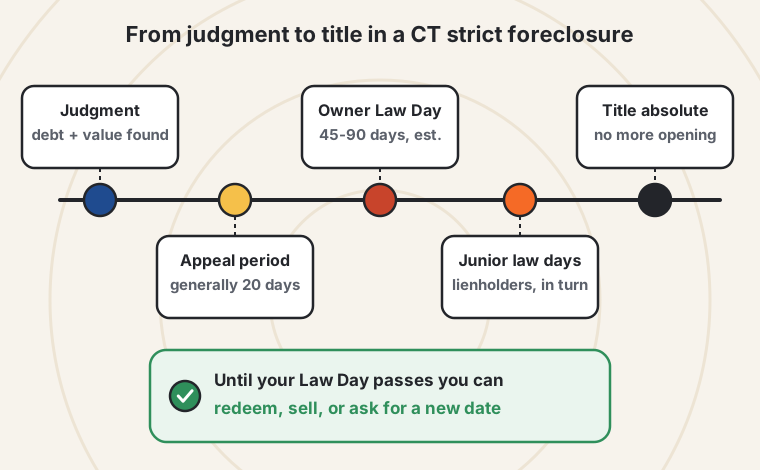
By the time a lender moves for judgment, the litigation pause for mediation (up to eight months from the return date, CGS 49-31l(f)) is usually over, or mediation never started. The lender then files a motion for judgment. A few rules shape what lands on your table:
- The appraisal. When the lender files its motion for judgment, it must serve every appearing defendant with a copy of the appraisal report (Practice Book 23-16). This is your first look at the value the court will use.
- The money claim. At least five days before the hearing, the lender must file and serve a preliminary statement of its monetary claim (Practice Book 23-18(b)). Read it line by line: principal, interest, late charges, escrow advances for taxes and insurance, property inspections, attorney’s fees.
- The law day list. A party asking for strict foreclosure must file, with the motion, a list of the order in which law days should be assigned (Practice Book 23-17(a)).
- Strict or sale. Any party can ask in writing for a foreclosure by sale instead (CGS 49-24). If your house is clearly worth more than the debt, that request, made before judgment, is how you ask the court to protect your equity through an auction.
Only parties who filed an appearance receive the court’s notices, including the judgment with its law days. If you never filed one, you may not get the date in the mail. Look the case up on the Judicial Branch website by name, docket number or, for cases with return dates on or after January 1, 2014, by property address (jud.ct.gov), or call the clerk.
| Step | What happens | Rule |
|---|---|---|
| Motion for judgment | Lender serves its appraisal on appearing defendants and files the law day list | Practice Book 23-16, 23-17(a) |
| Preliminary statement of debt | Filed and served at least 5 days before the hearing | Practice Book 23-18(b) |
| Judgment | Court finds the debt and the value; enters strict foreclosure, or a sale on written motion at its discretion | CGS 49-24 |
| Appeal period | Generally 20 days from notice of judgment; a timely appeal generally stays enforcement | Practice Book 63-1(a), 61-11(a) |
| Owner’s Law Day | Last day for the owner to redeem by paying the judgment debt and allowed costs | CGS 49-19; Practice Book 23-17(b) |
| Later law days | Each later lienholder may redeem on its own day and take title subject to earlier liens | CGS 49-19; Practice Book 23-17(b)(1) |
| Title absolute | If nobody redeems, title vests; the judgment can no longer be opened except by agreement within a short window | CGS 49-15(a) |
| Certificate and possession | Certificate of foreclosure recorded; ejectment no fewer than 5 business days after service of the execution | CGS 49-16, 49-22 |
How long between judgment and Law Day? There is no fixed number in the statutes. In practice judges often set the owner’s Law Day roughly 45 to 90 days after judgment, and sometimes just after the 20-day appeal period (est.). Your date is whatever your judgment says.
How does the court set Law Days for the owner and each lienholder?
The court sets Law Days in order: the owner of the equity gets the first law day, then each later lienholder gets its own day in reverse order of priority, so the most junior lien goes first after the owner. A lienholder that pays the debt on its day takes title, subject to any liens ahead of it (CGS 49-19, Practice Book 23-17).
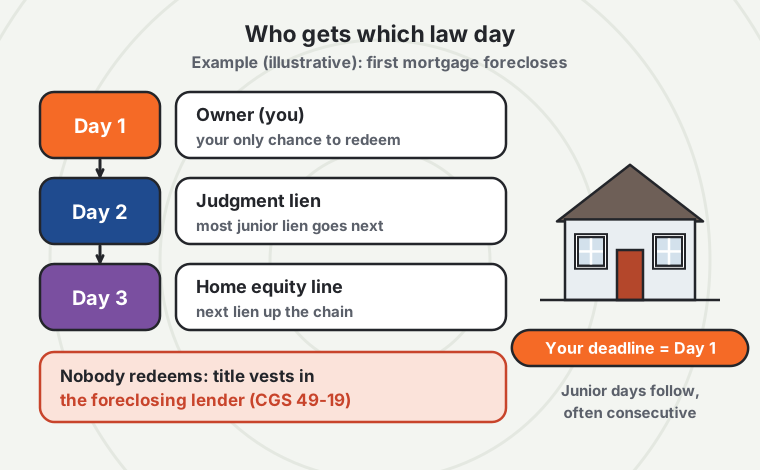
Here is how that plays out in an example (illustrative) New Haven house with three liens: the first mortgage that is foreclosing, a home equity line taken out later, and a judgment lien recorded after that by a credit card company.
- Owner’s Law Day. You can redeem by paying the first mortgage’s judgment debt and allowed costs. If you sell and close before this day, the first mortgage, the home equity line and the judgment lien are all paid from the sale, in order, and the case ends.
- Judgment lien’s day. If you do not redeem, the most junior party (here the judgment creditor) may pay off the foreclosing lender and take the title, subject to the liens ahead of it.
- Home equity line’s day. Then the next lienholder up the chain gets the same chance.
- Title vests. If nobody redeems, title becomes absolute in the foreclosing lender after the last law day, and the later liens are wiped off the property.
Junior law days usually fall on consecutive days after the owner’s (practice; your judgment controls). Two practical points follow:
- Your deadline is the first day, not the last. The later days belong to the lienholders. Once your day passes without redemption, your right to redeem is gone even though the case is not finished.
- Wiped off the house is not wiped out. When a junior lien is foreclosed off the property, the debt behind it may still exist. Ask your attorney whether a second-mortgage lender can still pursue you on its note. Our post on the consequences of foreclosure in Connecticut covers deficiencies and second mortgages.
Objections to the order of law days are only considered on a motion for determination of priorities filed before judgment (Practice Book 23-17(a)). After judgment, the order is set.
What does it mean to redeem, and how much does it cost?
To redeem in a Connecticut strict foreclosure means to pay, on or before your Law Day, all the sums the court found due to the foreclosing lender, including the costs the court allowed and the clerk taxed, plus interest that keeps running after judgment. Redeeming ends the foreclosure. Paying only the missed payments does not redeem once judgment has entered, unless the lender agrees.
The judgment itself describes redemption: on payment of all sums found due, including allowed costs, the title vests in whoever paid (Practice Book 23-17(b)(1)). For the owner, that means you keep the house free of that mortgage. In real life very few owners redeem with cash in hand. They redeem in one of three ways:
- A refinance that pays the judgment debt. Hard with a foreclosure on your record, but possible with enough equity and income.
- A sale that closes before Law Day. Legally this is a payoff at closing: the buyer’s money goes to the lender’s attorney, the mortgage is released, and the foreclosure is withdrawn.
- A deal with the lender (a reinstatement or a modification) that the lender agrees to, after which the judgment is opened and the case withdrawn or dismissed.
Get the exact number in writing. The judgment amount is a starting point. Per diem interest, the lender’s later costs and fees, and escrow advances usually add to it. Under CGS 49-10a, the lender must provide a written payoff or reinstatement statement on the date you ask for, as long as that date is at least seven business days after it receives your written request; if you are in default, your attorney can ask directly. If the lender misses the date, it loses interest that accrues after it until it delivers the statement (CGS 49-10a(b)).
Redemption has to reach the right place, in the right form, in time. Before Law Day, have your attorney confirm in writing with the plaintiff’s attorney the exact payoff, the wire or check instructions, and the latest time funds can arrive. Never wire money on the strength of an email alone; call the law firm at a number you look up yourself.
When does title become absolute, and can it ever be undone?
Title becomes absolute when the last assigned law day passes without anyone redeeming. From then on, a strict foreclosure judgment cannot be opened on a motion by one side. The only exception is an agreement of every party who appeared, made no more than four months after judgment or 30 days after title became absolute, whichever is later, that puts everyone back where they were (CGS 49-15(a)(2)).
The statute is blunt: no strict foreclosure judgment “shall be opened after the title has become absolute in any encumbrancer” except under that narrow agreement (CGS 49-15(a)(1)). In practice that agreement is rare. It needs the lender, every appearing defendant and anyone who acquired an interest afterwards to sign on. Do not plan around it.
Once title is absolute:
- The lender records a certificate of foreclosure on the town land records (CGS 49-16). In New Haven, that is the City Clerk’s land records.
- Your right to sell is gone, because you no longer own the house.
- If you are still living there, the lender can get an execution of ejectment. A state marshal can remove occupants no fewer than five business days after serving it (CGS 49-22).
- The lender has 30 days after the redemption period expires to move for a deficiency judgment if the house is worth less than the debt (CGS 49-14).
Those after-effects, including credit, taxes and mortgage waiting periods, are covered in our post on the consequences of foreclosure for Connecticut homeowners. The point here is simpler: everything you want to do has to happen, or be filed and granted, before your Law Day passes.
Can you get more time with a motion to open and extend Law Day?
You can ask for more time with a written motion to open the judgment and extend (reset) Law Day. Under CGS 49-15(a)(1), the court may open a strict foreclosure judgment, at its discretion, on the written motion of anyone with an interest and for cause shown, but never after title has become absolute. The motion must be heard and granted before Law Day; filing it does not move the date by itself.
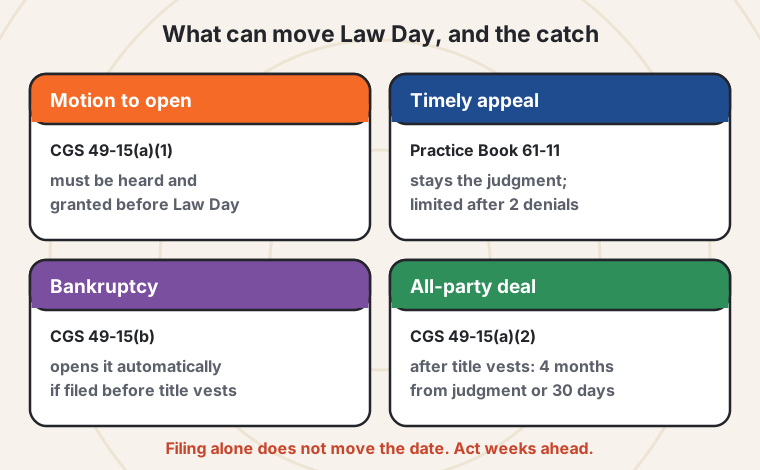
Lawyers call it a “motion to open and extend law days” or “motion to open and reset law days”. A few details matter:
- Timing. CGS 49-15 lets a strict foreclosure judgment be opened despite the usual four-month limit on opening civil judgments (CGS 52-212a; Practice Book 17-4), but only until title becomes absolute. File early enough that the court can hear it before your Law Day. A motion still pending when the day passes does not save you.
- Cause. The judge wants a concrete reason that more time will produce a result. Typical reasons: a signed purchase contract with a closing date, a written refinance commitment, a modification under review or approved, a short sale approval in progress, or a serious medical or family emergency.
- Cost. A filing fee applies unless waived (Practice Book 17-4(b)), and the court can attach terms about costs (CGS 49-15(a)(1)). Opening the judgment can also add interest and the lender’s fees to the debt.
- Objection. The lender’s attorney can object. A motion with a signed contract and a near closing date is far easier to agree to than a request for “more time”.
- Agreement. Often the cleanest route is to ask the lender’s attorney to agree, then file the motion as agreed. Lenders generally prefer being paid in full at a closing to taking a house.
Judges usually treat repeat motions with skepticism. One well-supported motion with documents attached beats three hopeful ones, and repeat motions also lose an appeal protection (next section).

If you are selling, the purchase contract is the strongest document you can attach to a motion to extend. Get it signed early, put a realistic closing date in it, and let your attorney talk to the lender’s attorney before filing. A date that the other side has agreed to is worth more than a perfect argument.
Does an appeal stop Law Day in Connecticut?
An appeal generally stops Law Day from taking effect while it is pending. Under Practice Book 61-11(a), proceedings to enforce a judgment are automatically stayed until the appeal period (generally 20 days, Practice Book 63-1) expires, and if a timely appeal is filed, until the appeal is decided. Law days that fall during the stay are usually reset afterwards. The protection is limited for owners who keep filing motions.
The appellate stay is powerful, which is why the rules limit it in strict foreclosures. Under Practice Book 61-11(g), once the owner has filed at least two motions to open (or similar motions) that the court denied, no automatic stay arises from the denial of a later contested motion unless the owner swears, in an affidavit with specific facts, that it was filed for good cause arising after the last ruling. Even then, the lender can ask the court to terminate the stay, and if the court does, it can set new law days with no automatic appellate stay.
Before you appeal, weigh four things with a Connecticut attorney:
- Is there a real legal issue? Appeals review legal errors; they are not a second chance to argue for more time.
- Timeliness. An untimely appeal does not create the automatic stay, and title can vest while you think you are protected (Connecticut Appellate Court decisions have held this; ask your attorney).
- The cost. Interest and the lender’s fees keep running and can shrink any equity a later sale would have saved. The court may also address payments for use and occupancy while the appeal is pending.
- The alternative. If the goal is time to sell, a motion to extend with a signed contract is cheaper and faster than an appeal.
What happens to Law Day if you file bankruptcy?
If you file bankruptcy before title becomes absolute, a Connecticut strict foreclosure judgment opens automatically, without anyone asking, and new law days must be set after the federal automatic stay ends; the rest of the judgment stands (CGS 49-15(b)). If you file after title has become absolute, it is too late: the statute does not open the judgment.
Two filing duties come with it. You must file a copy of the bankruptcy petition, or an affidavit with the filing date, with the clerk of the foreclosure court, and when the stay ends, an affidavit with the date it ended (CGS 49-15(b)). The federal automatic stay itself comes from 11 U.S.C. 362.
Whether bankruptcy helps depends on the chapter and your income: Chapter 13 can let you cure arrears over a plan while paying the regular mortgage; Chapter 7 usually only delays the foreclosure. A bankruptcy filed only to stop a Law Day, with no plan to cure or sell, often ends with the stay lifted and a new Law Day a few weeks later. Our foreclosure guide’s bankruptcy chapter covers repeat filings and the homestead exemption. Talk to a bankruptcy attorney before you file, not after.
Can you sell your house before Law Day?
Yes, you can sell your house before Law Day in Connecticut. Until your Law Day passes you still own it, so you can sign a contract and close; at closing the lender’s payoff (the judgment debt plus interest and allowed costs) is paid from the sale, any other liens are paid in order, the foreclosure is withdrawn, and whatever is left is yours. The closing has to happen before Law Day, or the court has to extend it first.
The foreclosure does not stop a sale, but it shapes it:
- The lis pendens. The lender recorded a notice of the lawsuit on the land records when the case started. Every buyer’s attorney will see it. It is cleared when the lender is paid and the case is withdrawn.
- The payoff. Your attorney orders a written payoff from the lender’s attorney (CGS 49-10a), which after judgment is usually the judgment debt plus per diem interest and fees since. Ask for it early and again close to closing.
- Other liens. Second mortgages, home equity lines, judgment liens and unpaid town taxes or sewer charges are all paid from the sale. If they add up to more than the price, you need a short sale, which requires the lenders’ approval. See short sale vs. foreclosure in Connecticut.
- The calendar. A financed buyer usually needs weeks for an appraisal, a mortgage commitment and title work. A cash buyer can often close in about two weeks. If the closing date lands after Law Day, your attorney asks the court to extend it, ideally with the lender’s agreement.
- Closing costs. In New Haven the conveyance tax is 1.25% of the price (0.75% state plus 0.50% town, CGS 12-494). Our guide to the cost to sell a house in Connecticut lists the rest.
There is also a court-supervised version, the foreclosure by market sale, in which the house is listed with a broker and the court approves the contract. It requires the first-mortgage lender’s motion and your consent (CGS 49-24, 49-24a to 49-24g) and is rarely used, but it is worth asking about if you have equity and time.
If you have equity and want the selling side in one place, our page on selling your house before foreclosure in Connecticut walks through it.
How much equity is at stake before Law Day? A New Haven example
The equity at stake before Law Day is everything the house is worth above the payoff and selling costs. In our New Haven example (illustrative), a house at the city’s single-family median of $329,450 with a $216,000 payoff leaves about $91,359 after a listing’s costs, about $68,875 after a cash sale at an assumed lower price, and $0 if Law Day passes in a strict foreclosure.
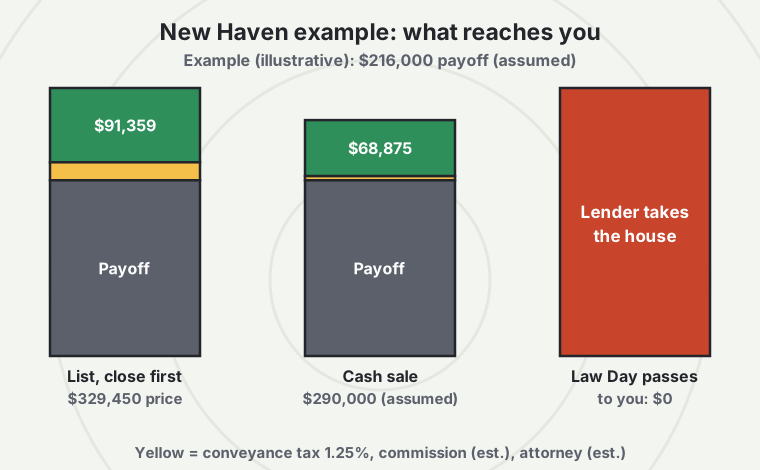
The inputs are labeled so you can swap in your own numbers. The town figures are public data; the payoff and the cash price are assumptions, not an offer.
| Line | List and close before Law Day | Cash sale before Law Day | Strict foreclosure |
|---|---|---|---|
| Price | $329,450 (New Haven single-family median) | $290,000 (assumed) | n/a |
| Conveyance tax, 1.25% (0.75% state + 0.50% New Haven) | -$4,118 | -$3,625 | n/a |
| Commission, 5% (est.) | -$16,473 | $0 | n/a |
| Seller’s attorney (est.) | -$1,500 | -$1,500 | n/a |
| Payoff: judgment debt, interest and fees (assumed) | -$216,000 | -$216,000 | Title passes to the lender |
| To you (est.) | $91,359 | $68,875 | $0 |
What the table does not show is time. The listing column assumes the house sells at the median, in condition, with a buyer whose financing closes before Law Day. If Law Day is six weeks away and the house needs work, that column carries real risk: a deal that falls through in week five can cost the whole $91,359. The cash column is smaller and more certain. Only you can weigh that trade, and the right answer changes with how much time you have.
The same math works for any town. New Haven property taxes alone run about $770 a month at the median, so every month of delay also adds to what is owed if the lender is paying taxes from escrow. Run your own numbers here:
How much would you walk away with?
Slide the numbers to match your house. It works in your browser; nothing is saved or sent.
Estimates for planning. Conveyance tax per CGS 12-494 (state 0.75% up to $800,000, 1.25% to $2.5M, 2.25% above, plus the town rate). Seller attorney about $1,200 to $1,500; flat-fee MLS about $400; listings include three months of taxes, insurance and utilities, a cash sale about two weeks. Your attorney gives you the final numbers.
Which option fits once Law Day is set?
Once Law Day is set, the option that fits depends on two questions: can you afford the house going forward, and is it worth more than you owe? If yes and yes, redeem through a refinance or a lender agreement. If you cannot keep it but have equity, sell before Law Day. If you owe more than it is worth, a short sale or deed in lieu usually beats letting Law Day pass.
Keep it: refinance or lender deal
RedeemBest when your income now covers the payment and the lender agrees or a refinance pays the debt.
- Ask for a reinstatement or modification in writing
- Motion to open and extend while it is processed
- Hardest after judgment; start immediately
Sell before Law Day
Keep the equityBest when you cannot keep the house and it is worth clearly more than the payoff.
- List if you have time and the house shows well
- Cash sale if Law Day is close or the house needs work
- Motion to extend if the closing lands after Law Day
Underwater: short sale or deed in lieu
Avoid the judgmentBest when the debt is more than the house is worth.
- Needs the lender’s approval
- Ask for a written deficiency waiver
- See deed in lieu in Connecticut
If a lender agreement or refinance lets you keep the house at a payment you can afford, keep it. If you have equity and enough time before Law Day for a listing to close, a well-priced listing usually nets more than any cash offer, including ours. If you owe more than the house is worth, a cash buyer cannot fix that; a short sale with the lender’s approval is the route. A cash sale earns its discount when Law Day is close, the house needs work, or a failed listing could cost you the whole equity.
Is a cash sale right for you, or should you list?
Seven quick questions. There is no wrong answer, and we will tell you honestly if listing would leave you more.
- Does the house need repairs you would rather not pay for or manage?
- Do you need to close by a certain date, or within the next month or two?
- Would showings be hard: tenants, belongings, privacy, or you live out of state?
- Is there a complication: an estate or probate, a divorce, foreclosure, liens or back taxes?
- Could you comfortably cover the mortgage, taxes and utilities for three or more months?
- Is getting the highest possible price more important to you than speed and certainty?
- Would a buyer's bank lend on the house as it is (no major roof, foundation, oil tank or code issues)?
What should you do in the weeks before Law Day?
In the weeks before Law Day, work backwards from the date: confirm it on the judgment or jud.ct.gov, get a written payoff, call free help and a Connecticut attorney, decide whether you will redeem, sell or let it go, and if you are selling, sign a contract early enough to close before Law Day or to support a motion to extend that the court can hear in time.
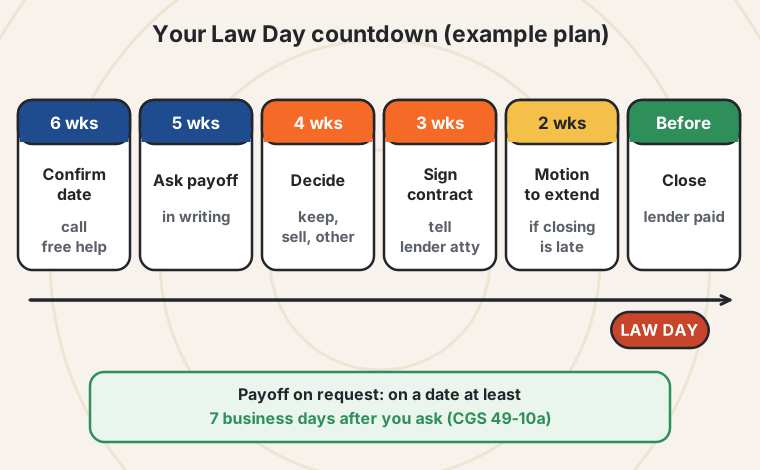
Confirm your Law Day and stage
Read the judgment, or look up the case on jud.ct.gov by name, docket number or address. Note the owner’s Law Day, the debt found, and every other party in the case. If you have not filed an appearance, file one now so you receive notices.
Call free help and a Connecticut attorney
The Department of Banking hotline, a HUD-approved counselor or legal aid can review your options at no cost (numbers below). A foreclosure or real estate attorney can tell you whether a motion to open, an appeal or a bankruptcy makes sense for you.
Get the written payoff
Ask in writing; under CGS 49-10a the lender must answer by the date you request if it is at least seven business days after it receives the request. Add other liens: second mortgage, home equity line, judgment liens, town taxes and sewer charges.
Decide, in writing, with dates
Redeem, sell, short sale, deed in lieu, or move out. Write the decision and the date it has to be done by on the fridge. Count back three weeks from Law Day and treat that as your real deadline.
If selling, sign early and tell the lender’s attorney
Your attorney sends the signed contract and asks for an agreed motion to extend if the closing could land after Law Day. File it so it is heard before Law Day.
Close before Law Day
The lender is paid at closing, the case is withdrawn, and the rest goes to you. With a cash buyer this is typically about two weeks after you accept, or on the date you need.
What happens after Law Day passes?
After Law Day passes and nobody redeems, title becomes absolute in the lender, the judgment can no longer be opened except by a narrow agreement of all parties, the lender records a certificate of foreclosure, and if you are still in the house it can get an execution of ejectment carried out by a state marshal no fewer than five business days after service (CGS 49-15, 49-16, 49-22).
The lender then has 30 days to move for a deficiency judgment if the house is worth less than the debt (CGS 49-14). Belongings removed by the marshal go to town storage, and the foreclosure stays on your credit report for seven years. Tenants in a foreclosed house have separate federal and state protections. The full list, with what each consequence costs and how to soften it, is in our post on the consequences of foreclosure in Connecticut.
Some lenders offer “cash for keys” to former owners who leave by a set date. It is a negotiation, not a right, and should be in writing.
Who can help before Law Day, and how does selling to us work?
Before Law Day, free help comes from the Connecticut Department of Banking foreclosure hotline, HUD-approved housing counselors, legal aid and the Judicial Branch; paid help should come from your own Connecticut attorney. If, after that, selling makes sense and you have equity, a cash sale with us is five simple steps and typically closes in about two weeks.
Call the Connecticut Department of Banking foreclosure hotline at 1-877-472-8313, or a HUD-approved housing counselor at 1-800-569-4287. Statewide Legal Services of Connecticut is at 1-800-453-3320, and the Connecticut Fair Housing Center offers foreclosure advice at 1-888-247-4401. Court forms and your case details are on jud.ct.gov. None of them should charge you. Paid foreclosure or short sale negotiation in Connecticut requires a Department of Banking license unless your attorney does it (CGS 36a-671), and nobody legitimate asks you to sign your deed over outside a closing with attorneys.
Scam signs close to Law Day: a fee before any result, a promise to “guarantee” a new Law Day, a request to deed the house to someone who will “rent it back” until you can buy it back, or advice to stop talking to your lender or attorney. Our guide on how to check a cash home buyer lists the checks to run on us or anyone else.
If keeping the house does not add up, here is how a sale before Law Day works with us:
Send the address and your Law Day
A few photos help. You get a written number, not a pitch.
Compare it
Against your payoff and against what a listing would net. If listing leaves you more and you have time, we will say so.
Sign with your own attorney
Your attorney orders the payoff, tells the lender’s attorney a sale is under contract, and asks the court to extend Law Day if needed.
Close before Law Day
Typically about two weeks after you accept, or on the date you need. No repairs, no showings, leave what you do not want.
Get paid
The lender is paid in full at closing, the foreclosure ends, and the rest is wired to you.
To talk it through, call me, Jerryll Noorden, at (203) 529-4712. I have bought Connecticut houses since 2016, about ten a year, in New Haven and across the state. We never charge fees, your own attorney reviews everything, and our offer does not expire while you look at your other options. More on how it works on our page about selling a house in foreclosure in Connecticut.
See the house together.
Pick a time that works.
Choose a time for us to walk through the property with you, or ask for a quick call first. We confirm every request personally.
Tuesday, January 13
No open times in the next few weeks. Please call us.
We will confirm by email. Nothing is booked until we do.
View my requestQuestions Connecticut homeowners ask about Law Day
What is Law Day in Connecticut?
Law Day in Connecticut is the deadline in a strict foreclosure judgment by which the owner must redeem by paying the debt, interest and allowed costs the court found. If the owner and every later lienholder fail to redeem on their days, title becomes absolute in the foreclosing lender (CGS 49-15, 49-19).
Do I have to go to court on my Law Day?
No, you do not have to go to court on your Law Day. It is a deadline, not a hearing. What matters is whether the debt is paid, or your sale closes, or the court has extended the date before it arrives.
How long after the judgment is Law Day?
How long after the judgment Law Day falls is up to the judge; no statute fixes it. In practice it is often roughly 45 to 90 days after judgment, sometimes just after the 20-day appeal period (est.). Your judgment states your date.
Can Law Day be extended in Connecticut?
Yes, Law Day can be extended in Connecticut if the court grants a written motion to open the judgment and set a new law day, for cause shown, before title becomes absolute (CGS 49-15(a)(1)). A signed sale contract, refinance commitment or lender agreement is the strongest cause. Filing alone does not move the date.
Can I sell my house before Law Day?
Yes, you can sell your house before Law Day. You still own it until title becomes absolute, so a sale that closes first pays the lender’s payoff from the proceeds, ends the foreclosure, and leaves the remaining equity to you.
What happens if my sale closes after Law Day?
If your sale would close after Law Day, it cannot close at all unless the court extends Law Day first, because title will have passed to the lender. Ask your attorney to file a motion to extend, ideally agreed by the lender’s attorney, early enough to be heard before Law Day.
How much do I need to pay to redeem?
To redeem you need to pay all sums the court found due, including allowed costs, plus interest and fees that accrue after judgment. Get the exact figure in a written payoff statement from the lender’s attorney; under CGS 49-10a it must be provided on a requested date at least seven business days after the request.
Does filing bankruptcy stop Law Day?
Filing bankruptcy stops Law Day only if you file before title becomes absolute. Then the strict foreclosure judgment opens automatically and new law days are set after the automatic stay ends; you must file a copy of the petition or an affidavit with the foreclosure court (CGS 49-15(b)).
Does an appeal stop Law Day?
A timely appeal generally stops Law Day from taking effect, because Practice Book 61-11 stays enforcement while the appeal is pending, and law days are usually reset afterwards. After two denied motions to open, later denials do not create an automatic stay without a sworn good-cause affidavit (Practice Book 61-11(g)).
Can a foreclosure be undone after Law Day?
A foreclosure can rarely be undone after Law Day. Once title is absolute, the judgment can be opened only by agreement of every appearing party, within four months of judgment or 30 days after title vested, whichever is later (CGS 49-15(a)(2)).
Who gets the house if a second mortgage redeems?
If a second mortgage or another later lienholder redeems on its law day by paying the foreclosing lender, it takes title to the house, subject to any liens that come ahead of it (CGS 49-19; Practice Book 23-17(b)(1)). The owner’s right to redeem ended on the owner’s day.
Can I stay in my house after Law Day?
You can stay only until the lender enforces possession. After title becomes absolute it can get an execution of ejectment, and a state marshal can remove occupants no fewer than five business days after serving it (CGS 49-22). A negotiated move-out date, sometimes with cash for keys, should be in writing.
How do I find my Law Day?
You find your Law Day in the judgment, which is mailed to parties who filed an appearance, or by looking up the case on jud.ct.gov by name, docket number or, for return dates on or after January 1, 2014, by property address. You can also call the clerk of the court named on your summons.
Which court handles a New Haven foreclosure?
A foreclosure on a house in the city of New Haven is usually filed in the Superior Court for the New Haven Judicial District, 235 Church Street, with docket numbers starting NNH-CV. Other New Haven County towns can belong to other judicial districts; your summons names the court.
Related Connecticut guides
The foreclosure case
Exits before Law Day
We buy houses in New Haven, Hamden, North Haven, Branford, Meriden, Waterbury, Bridgeport and towns across the state. For the full selling process, see how to sell a house in Connecticut.
Plain-English information, not legal advice. A Connecticut attorney, a HUD-approved counselor or legal aid can tell you how these rules apply to your case.
Sources
- CGS chapter 846 (revised to January 1, 2026): § 49-10a (payoff and reinstatement statements), § 49-14 (deficiency judgment), § 49-15 (opening strict foreclosure judgments; bankruptcy), § 49-16 (foreclosure certificate), § 49-19 (title to vest in redeeming encumbrancer), § 49-22 (ejectment), § 49-24 and §§ 49-24a to 49-24g (foreclosure by sale and by market sale), § 49-31l (mediation and litigation pause).
- Connecticut Practice Book, 2026 edition: §§ 17-4 (opening judgments; filing fee), 23-16 (appraisal), 23-17 (listing of law days; provisions of every strict foreclosure judgment), 23-18 (proof of debt), 61-11 (stay of execution, including (g) for strict foreclosure), 63-1 (time to appeal).
- CGS § 52-212a (four-month limit on opening civil judgments) and CGS § 12-494 (conveyance tax).
- 11 U.S.C. § 362 (bankruptcy automatic stay).
- Connecticut Judicial Branch, Foreclosure Mediation Program questions for homeowners (case look-up by name, docket number or address).
- Connecticut Judicial Branch, New Haven Judicial District courthouse (235 Church Street).
- Connecticut Department of Banking, Avoiding Foreclosure (hotline and scam warnings) and CGS § 36a-671 (debt negotiation licensing).
- Town sales (October 2024 to September 2025) and fiscal 2027 mill rates: Connecticut Office of Policy and Management, published on data.ct.gov.

Who wrote this
Jerryll Noorden
Jerryll has bought and sold Connecticut houses since 2016 and has sat at more closing tables than he can count, on both sides. Before real estate he was a robotics scientist at NASA, IHMC and IIT. He wrote this guide because the national sites that rank for it skip the Connecticut rules that cost sellers money. When listing or selling it yourself would get you more than a cash offer, he says so.
This guide explains Connecticut rules in plain English. It is not legal or tax advice. Laws change; for your sale, talk to a Connecticut real estate attorney and a tax professional.
