
Key facts at a glance
| Fact | Number | Source |
|---|---|---|
| Median cost of staging, national | $1,500 with a staging service; $500 when the listing agent stages | NAR 2025 Profile of Home Staging |
| Agents who saw staging raise the amount offered | 29% reported a 1% to 10% increase | NAR 2025 Profile of Home Staging |
| Buyers’ agents who say staging helps buyers picture the home as theirs | 83% | NAR 2025 Profile of Home Staging |
| Rooms buyers care most about seeing staged | Living room 37%, primary bedroom 34%, kitchen 23% | NAR 2025 Profile of Home Staging |
| Sellers’ agents who saw staging cut time on market | 49% (30% slightly, 19% greatly) | NAR 2025 Profile of Home Staging |
| Virtually staged photos in Connecticut’s main MLS | Must carry a “virtually staged” watermark; permanent features may not be removed | SmartMLS compliance guidance |
| Credit to the buyer if you skip the condition report | $500 at closing | CGS 20-327c |
This page is one chapter of our guide to how to sell a house in Connecticut. It answers one question: is staging worth it for your house, and if so, which kind, which rooms and for how much? If you are still deciding what to repair, start with what to fix before selling a house in Connecticut; staging comes after the repairs, not instead of them.
Does staging a house actually help it sell in Connecticut?
Staging a house does help it sell in Connecticut in most cases, but by less than the ads suggest. In the National Association of Realtors’ 2025 survey, 29% of agents saw staging raise offers by 1% to 10%, and 49% of sellers’ agents saw it shorten time on market. Those are agent opinions, not measured sale prices, so treat staging as a way to sell faster and cleaner, not a guaranteed price boost.
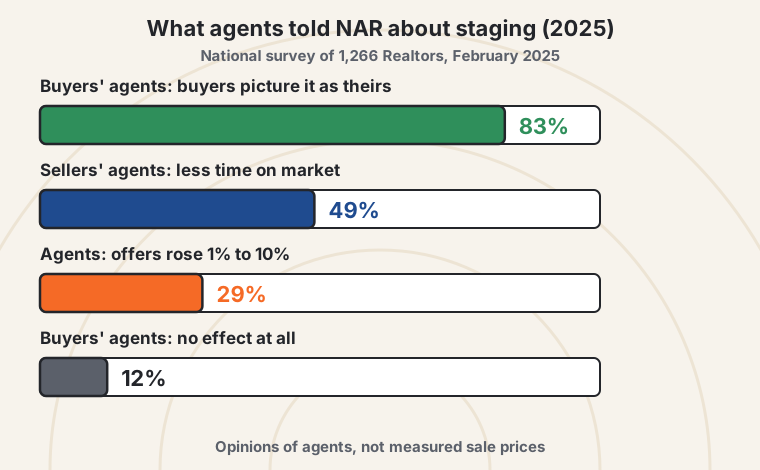
The numbers come from NAR’s 2025 Profile of Home Staging, a survey of 1,266 Realtors taken in February 2025. It is the most-quoted staging study in the country, and it is worth reading what it actually says:
- 83% of buyers’ agents said staging made it easier for a buyer to picture the home as their own.
- 60% of buyers’ agents said staging affected some buyers but not always; 26% said it affected most buyers; 12% said it had no effect.
- 29% of agents reported a 1% to 10% increase in the dollar value offered. Among buyers’ agents, 17% reported a 1% to 5% increase compared with similar unstaged homes.
- 49% of sellers’ agents said staging reduced time on market.
- 51% of sellers’ agents did not stage at all, but recommended decluttering or fixing faults instead.
Read that honestly and three things stand out. First, the strongest effect is on how buyers feel during the showing, not on the final price. Second, most of the “price” evidence is a range that starts at 1%. Third, half of agents get their results from the cheap part of staging: decluttering, cleaning and repairs. That is where your money goes first.
None of the survey is Connecticut-specific. There is no public Connecticut study of staged versus unstaged sale prices, so anyone quoting a precise Connecticut staging premium is guessing.
Why does staging your own home feel so hard?
Staging your own home feels hard because it asks you to make the place you live look like nobody lives there. You are told to box up family photos, move furniture you chose, and keep the house spotless while still cooking, working and raising kids in it. Many sellers also feel judged, and unsure whether the money and effort will come back.
Maybe you have lived in the house for 25 years and every room holds something. Maybe it is a parent’s house in Hamden, full of furniture nobody in the family wants. Maybe you watched staged homes on TV and now your own living room looks tired. NAR’s same survey found 58% of agents said buyers were disappointed by how real homes compared with the ones on TV. You are not imagining that pressure.
Sellers in this spot usually feel some mix of:
- Exposed: strangers will open closets and judge how you live.
- Overwhelmed: the to-do list never ends, and the house still has to work as a home.
- Skeptical: every stager says staging pays, and they are the ones being paid.
- Guilty: packing away a parent’s things or the kids’ drawings feels like erasing them.
- Anxious about money: you do not want to spend $3,000 and get nothing back.
This page is for you if you want a straight answer on what is worth doing. We will show what the data supports, what it costs, which rooms to do first, and when staging is the wrong move altogether, for example when the house needs repairs a buyer will price no matter how it is dressed.
When does staging pay, and when is it a waste of money?
Staging pays when buyers struggle to picture the house: when it is empty, oddly laid out, cluttered, or competing with similar listings in the same price range. Staging is a waste of money when the house needs major repairs, when the buyer will be an investor pricing the work, when it is rented and occupied by tenants, or when you have no time to keep it show-ready.
| Your situation | Staging verdict | Why |
|---|---|---|
| Vacant house, rooms echo in photos | Usually pays | Empty rooms look smaller and buyers cannot judge scale; 83% of buyers’ agents say staging helps buyers picture the home. |
| Odd layout (a dining room that could be an office, a 1950s Cape’s small upstairs) | Usually pays | Furniture answers the question “what is this room for?” before the buyer asks it. |
| Lived-in house in good repair | Light staging pays | Declutter, clean and rearrange; a consult or DIY is often enough. |
| Several similar listings nearby | Usually pays | Photos decide which houses buyers tour; 73% of buyers’ agents rate photos highly important. |
| House needs a roof, septic, oil tank or foundation work | Rarely pays | Buyers and their lenders price the repairs; furniture does not change an inspection report. |
| Tenants in place | Rarely possible | You cannot stage someone else’s home; see our guide to selling a rental with tenants. |
| You will sell as-is to an investor or cash buyer | Does not pay | An investor prices the house on its after-repair value and repair cost, not its decor. |
The repair row is the one most staging articles skip. If an inspector will write up the furnace, the roof or a wet basement, a buyer will ask for a credit no matter how good the living room looks. Our fix, credit or skip guide covers those calls. If the list is long, read selling a house that needs repairs in Connecticut before you spend anything on pillows.
What does staging cost in Connecticut: DIY, professional or virtual?
Staging in Connecticut costs from a few hundred dollars for do-it-yourself staging to several thousand for a professional who furnishes a vacant house. NAR puts the national median at $1,500 for a staging service and $500 when the agent stages. Virtual staging is the cheapest, usually priced per photo, but it only changes the pictures, not the house buyers walk into.
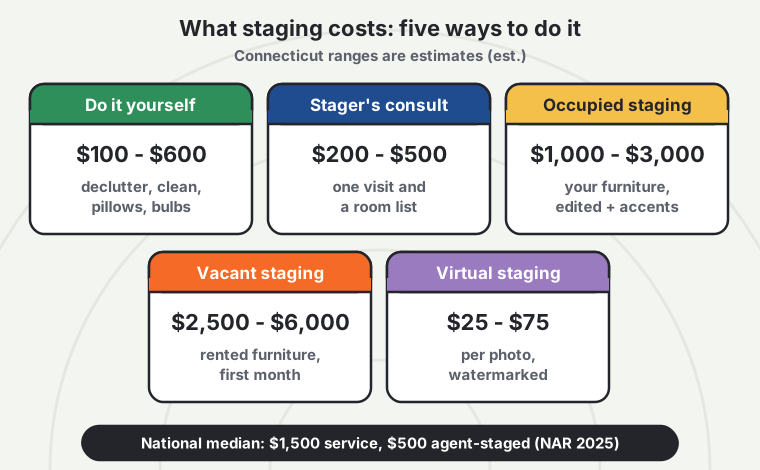
| Option | What you get | Typical cost | Best for |
|---|---|---|---|
| Do it yourself | Declutter, clean, rearrange, a few new pillows, towels, bulbs and plants | $100 to $600 (est.) | Lived-in houses in good shape |
| Stager’s consultation | One visit and a room-by-room list you carry out | $200 to $500 (est.) | Sellers who want an expert eye but will do the work |
| Occupied staging | Stager edits and rearranges your furniture, adds rented accessories and a few pieces | $1,000 to $3,000 (est.) | Dated or crowded houses with good bones |
| Vacant staging | Rented furniture for the main rooms, delivered and set up | $2,500 to $6,000 for the first month, then a monthly rental fee (est.) | Empty houses, estates, relocations |
| Virtual staging | Furniture added to listing photos by software or a designer | $25 to $75 per photo (est.) | Empty houses on a tight budget, paired with honest captions |
| National medians, for comparison | Staging service / agent-staged | $1,500 / $500 | NAR 2025 Profile of Home Staging |
Three money questions to ask before you sign anything:
- Who pays? In NAR’s survey, 23% of sellers’ agents offer to stage themselves and 17% said the seller pays before listing. Ask your agent first; staging is sometimes part of the listing.
- How long is the contract? Vacant staging is usually sold by the month. If the house sits for 90 days, the rental fee keeps running. Ask what the second and third months cost.
- Who is liable for damage? Rented furniture in an empty house is the stager’s property in your house. Check whether your homeowner’s policy still covers a vacant house and whether the stager carries insurance.
Before any of this, the cheap work comes first. Deep cleaning, decluttering, neutral paint and bright bulbs are on our list of 13 low-cost fixes before you sell, with prices. We will not repeat them here; staging starts where that list ends.
Which rooms should you stage first?
The rooms to stage first are the living room, the primary bedroom and the kitchen, in that order. Those are the three rooms buyers’ agents rated most important to see staged in NAR’s 2025 survey (37%, 34% and 23%). The entry and the front of the house come before all of them in practice, because they are the first photo and the first ten seconds of every showing.
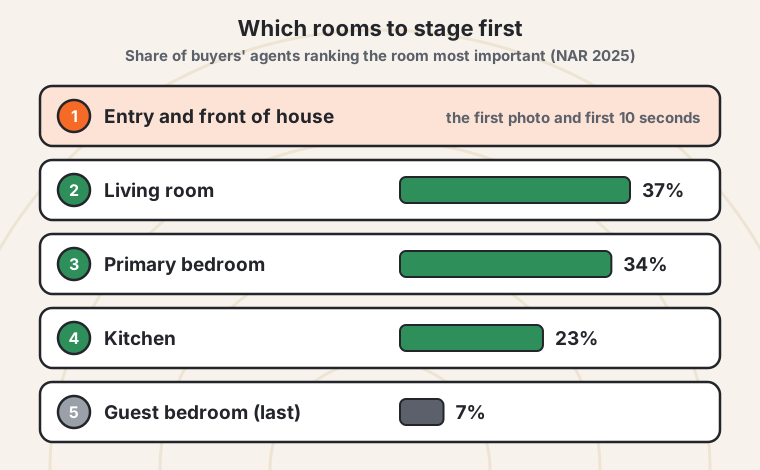
Here is what “staged” means in each room, kept to what buyers notice:
1. The front door and entry
Your listing’s first photo is almost always the front of the house, and the entry is where the showing starts. Clear the porch, add one healthy plant, replace a worn mat and make sure the door, lock and light work. The yard itself is covered in our curb-appeal pieces; Bloomfield owners can read curb appeal priced for Bloomfield.
2. The living room
Pull furniture off the walls into a conversation group, take out at least one large piece if the room feels crowded, and leave a clear walking path to the windows. One rug, one throw, two or three accessories per surface. Turn the TV off and hide the cables. If the room is empty, this is the one room worth renting furniture for.
3. The primary bedroom
Buyers look for a calm room that fits a bed and two night tables. Make the bed with plain, light bedding, clear the night tables, and edit the closet to half full so it looks roomy. Exercise equipment and desks go elsewhere.
4. The kitchen
Clear the counters to one or two items, empty the sink, take magnets off the fridge, and put away small appliances. In older Connecticut kitchens, clean grout and new cabinet pulls do more than any accessory. A bowl of fruit is enough decor.
5. Bathrooms and everything else
White towels, a new shower curtain, nothing on the counter. Guest bedrooms and kids’ rooms matter least: only 7% of buyers’ agents ranked the guest bedroom most important. Make them tidy and stop there.
How do you stage an occupied house versus a vacant one?
You stage an occupied house by editing what is already there: removing about a third of the furniture and most personal items, rearranging what is left, and keeping a daily reset routine for showings. You stage a vacant house by bringing furniture in, usually rented, for the main rooms only, and by keeping the empty house heated, lit and insured while it is on the market.
Occupied: subtract, then reset every day
- Rent a storage unit or a portable container for the furniture, boxes and seasonal items you pull out.
- Pack family photos, religious items, diplomas, kids’ art and collections; buyers need to picture their own.
- Clear every counter, the top of the fridge and the floor of every closet.
- Keep a “showing basket” for the things you use daily, so a 30-minute warning is enough.
- Plan where pets, kids and you go during showings; buyers stay longer in an empty house.
- Remove or lock away medications, jewelry, mail and anything with account numbers.
Vacant: furnish the three rooms that matter
Empty rooms photograph smaller than they are and feel cold. Most stagers furnish the living room, the primary bedroom and a dining or kitchen table, and leave the rest empty and clean. That matches what buyers care about.
A vacant Connecticut house brings its own costs: heat through the winter, lights on timers, lawn or snow care, and an insurance policy that may limit coverage once a house sits empty. Our guide to selling a vacant house in Connecticut covers the carrying costs and insurance questions. If the house is empty because it was inherited, cleaning out an inherited house comes before any staging.
Is virtual staging allowed in Connecticut, and when is it misleading?
Virtual staging is allowed in Connecticut listings as long as it is clearly labeled and does not misrepresent the house. Connecticut’s main MLS, SmartMLS, requires a watermark noting that a photo is virtually staged and prohibits removing permanent features such as power lines. The Realtor Code of Ethics also requires a true picture in images. Adding furniture is fine; hiding a crack or a cell tower is not.
Virtual staging is the cheapest way to fix the empty-room problem in photos. It is also the easiest way to disappoint a buyer who drives across the county and walks into a bare room. Use it carefully:
- Label every edited photo. SmartMLS requires a “virtually staged” stamp or watermark. Put an unedited photo of the same room next to it, even if your MLS does not require one.
- Add furniture only. Do not repaint walls, replace floors, remove stains, add a view, or green up a dead lawn. That stops being staging and starts being a misrepresentation.
- Licensees carry the risk too. Connecticut can fine or discipline a real estate licensee for a “material misrepresentation” (CGS 20-320). Your agent will push back on heavy edits, and should.
- Disclosure is separate. Whatever the photos show, the written condition report still has to list known problems (CGS 20-327b). Staging never replaces it.
Staging changes how a house looks, not what you must disclose. Most sellers of 1-4 family homes must give the buyer the Residential Property Condition Disclosure Report before the buyer signs; if you do not, you owe a $500 credit at closing (CGS 20-327b and 20-327c). See our Connecticut property condition disclosure guide.
Is a $3,000 staging job worth it on a Connecticut house?
A $3,000 staging job is worth it on a Connecticut house only if it lifts the price by roughly 1% on a $330,000 house, or about 0.6% on a $520,000 house, after commission and conveyance tax come off the extra dollars. That is the bottom of the 1% to 10% range agents reported. On cheaper houses the bar is higher, which is why light, do-it-yourself staging is usually the better bet there.
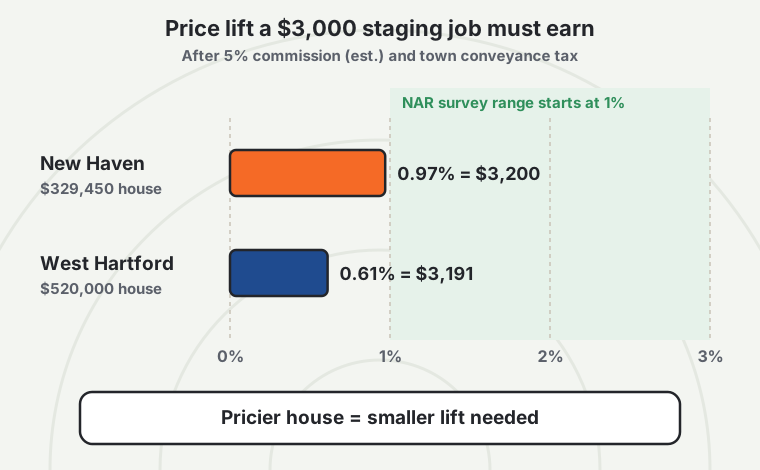
Example (illustrative). We used each town’s single-family median from the state’s sales records (Oct 2024 to Sep 2025), a 5% total commission (est.), and the conveyance tax for each town (CGS 12-494).
| Input or result | New Haven | West Hartford |
|---|---|---|
| Single-family median price | $329,450 | $520,000 |
| Conveyance tax (state 0.75% + town) | 1.25% (town 0.50%) | 1.00% (town 0.25%) |
| Commission (est.) | 5% | 5% |
| You keep of each extra dollar | 93.75 cents | 94 cents |
| Staging cost (occupied, est.) | $3,000 | $3,000 |
| Price lift needed to break even | About 0.97% ($3,200) | About 0.61% ($3,191) |
| Monthly property tax while you wait | About $768 (mill rate 39.962) | About $1,419 (mill rate 46.77) |
Two things change the answer. First, time: if staging saves even one month on the market, a West Hartford seller keeps about $1,419 in property tax alone, before utilities, insurance and mortgage interest. Second, the starting point: a clean, decluttered house gains less from a stager than a crowded or empty one. If you have already done the cheap work, the stager is selling you the last few percent.
To see what your house nets after every cost, plug in your own price:
How much would you walk away with?
Slide the numbers to match your house. It works in your browser; nothing is saved or sent.
Estimates for planning. Conveyance tax per CGS 12-494 (state 0.75% up to $800,000, 1.25% to $2.5M, 2.25% above, plus the town rate). Seller attorney about $1,200 to $1,500; flat-fee MLS about $400; listings include three months of taxes, insurance and utilities, a cash sale about two weeks. Your attorney gives you the final numbers.
What can staging not fix?
Staging cannot fix anything a home inspector, appraiser or lender will check. It does not change the age of the roof, a buried oil tank, a wet basement, radon levels, open permits or the condition report you sign. Buyers fall for the living room and then renegotiate over the inspection, so staging a house with known defects mostly delays the price conversation.
In Connecticut that matters more than in many states, because so much of the housing is old. In New Haven the median single-family house was built in 1930; in Hamden, 1952 (Connecticut parcel data). Older houses are where inspection reports run long. The order that works is:
- Safety and systems first: alarms, leaks, heat, electrical hazards. Our fix, credit or skip guide has the list.
- Cheap cosmetic fixes second: the 13 low-cost fixes.
- Staging last, to present the finished house.
If step 1 is a five-figure list, staging is the wrong conversation. Compare repairing and listing against selling as-is in our guide to selling a house as-is in Connecticut.
Should you stage, sell as-is, or sell to a cash buyer?
You should stage and list if the house is in good repair, you have four to eight weeks to prepare and show it, and you want the highest price. You should sell as-is, to a cash buyer or an investor, if the house needs major repairs, is far away or full of belongings, or you cannot live through showings. Each route trades effort and time against price.
Stage and list
Top priceBest when the house is sound and you can keep it show-ready.
- Costs: staging, prep, commission
- Time: weeks of prep, then market time and a 30 to 45 day financed close
- Inspection and appraisal still apply
List as-is, no staging
MiddleBest when the house is clean and fairly priced but you do not want to spend.
- Costs: commission, maybe credits
- Photos carry more weight; declutter at least
- Price for condition
Sell for cash, as-is
FastestBest when repairs, distance or time rule out the other two.
- No staging, showings or repairs
- Typically about 2 weeks to close
- Lower price; see why cash offers are lower
We buy Connecticut houses for cash ourselves, so take this from the other side of the table: do not sell to a cash buyer if your house is in good shape, you have time, and you are willing to stage and show it. A well-presented house on the open market usually nets more, even after commission. A cash sale makes sense when the repair list, the distance, a deadline or your own energy makes the open market the harder road.
If you are not sure which side of that line you are on, this short self-check compares the two for your situation:
Is a cash sale right for you, or should you list?
Seven quick questions. There is no wrong answer, and we will tell you honestly if listing would leave you more.
- Does the house need repairs you would rather not pay for or manage?
- Do you need to close by a certain date, or within the next month or two?
- Would showings be hard: tenants, belongings, privacy, or you live out of state?
- Is there a complication: an estate or probate, a divorce, foreclosure, liens or back taxes?
- Could you comfortably cover the mortgage, taxes and utilities for three or more months?
- Is getting the highest possible price more important to you than speed and certainty?
- Would a buyer's bank lend on the house as it is (no major roof, foundation, oil tank or code issues)?
How do you stage a house to sell, step by step?
To stage a house to sell, decide first whether staging fits your house, then fix and declutter, then stage the entry, living room, primary bedroom and kitchen, then photograph, then keep the house show-ready until you accept an offer. Plan about four to six weeks from the first box to the first showing for a lived-in house.
Decide if staging fits (6 weeks out)
Walk the house with the table above. If repairs dominate, price them first and read our guide to selling a house that needs repairs.
Fix and clean (5 to 4 weeks out)
Safety items, leaks and the low-cost fixes. Book a deep clean for the week before photos.
Declutter and store (4 to 3 weeks out)
Pull a third of the furniture and most personal items into storage. Start with the living room.
Stage the four key spaces (2 weeks out)
Entry, living room, primary bedroom, kitchen. Get a stager’s consult if you want a second eye; get written quotes and contract terms for vacant staging.
Photograph on a bright day (1 week out)
Lights on, blinds open, counters clear. Label any virtually staged photo.
Keep it show-ready (until accepted offer)
Use a daily reset and a showing basket. Re-check the entry every week; it is the first and last thing buyers see.

When we resell a house we have renovated, the money goes into light, paint and empty counters before it goes into furniture. If you only have a weekend, spend it taking things out of rooms, not bringing things in. And if you find yourself pricing staging for a house that also needs a roof, stop and price the roof first.
Questions about staging a house to sell in Connecticut
Is home staging worth the money?
Home staging is worth the money when buyers struggle to picture the house: empty, crowded or oddly laid out. In NAR’s 2025 survey, 29% of agents saw offers rise 1% to 10% and 49% of sellers’ agents saw shorter market time. For a clean, well-kept house, do-it-yourself staging often gets most of the benefit.
How much does it cost to stage a house in Connecticut?
Staging a house in Connecticut costs about $100 to $600 to do yourself, $200 to $500 for a stager’s consultation, $1,000 to $3,000 for occupied staging, and $2,500 to $6,000 for the first month of vacant staging (all est.). The national median is $1,500 for a staging service (NAR 2025).
Which room is most important to stage?
The most important room to stage is the living room. In NAR’s 2025 survey, 37% of buyers’ agents ranked it most important, ahead of the primary bedroom (34%) and the kitchen (23%). The guest bedroom mattered least, at 7%.
Who pays for staging, the seller or the agent?
Who pays for staging depends on the agent. In NAR’s 2025 survey, 23% of sellers’ agents offer to stage themselves, 17% said the seller pays before listing, and 26% said it depends. Ask before you sign the listing agreement and get it in writing.
Is virtual staging legal in Connecticut?
Virtual staging is legal in Connecticut listings when it is labeled and does not misrepresent the property. SmartMLS requires a watermark showing the photo is virtually staged and bars removing permanent features. Add furniture only; never edit out defects.
Should I stage a vacant house?
You should usually stage a vacant house, at least the living room, primary bedroom and kitchen area, because empty rooms look smaller in photos and harder to judge in person. If the budget is tight, virtual staging for photos plus a clean, bright house is a reasonable middle ground.
Can I stage my house myself?
You can stage your house yourself. Declutter, deep-clean, move furniture off the walls, use plain bedding and white towels, clear counters and open every blind. Half of sellers’ agents in NAR’s survey skip professional staging and recommend exactly this kind of decluttering and repair.
Does staging help a house that needs repairs?
Staging does little for a house that needs major repairs, because the inspection and appraisal will still find them and buyers will ask for credits. Price the repairs first. If they are large, compare repairing against selling as-is.
Do I still have to disclose problems if the house is staged?
You still have to disclose known problems if the house is staged. Most Connecticut sellers of 1-4 family homes must give the buyer the Residential Property Condition Disclosure Report before signing, or credit $500 at closing (CGS 20-327b and 20-327c).
How long before listing should I start staging?
You should start staging about four to six weeks before listing a lived-in house: repairs and cleaning first, decluttering three to four weeks out, room staging two weeks out, and photos the week before you list.
Should I leave furniture in the house when I sell?
You should leave some furniture in the house while it is on the market, because furnished rooms photograph better. Remove about a third of it and anything personal. When you sell as-is to a cash buyer, you can often leave everything behind instead.
Does staging matter if I sell to a cash buyer?
Staging does not matter if you sell to a cash buyer or investor. They price the house on its condition, repair cost and resale value, not its furniture, and most buy as-is with belongings left behind.
Related Connecticut guides
Prepare and present
Price and timing
We buy houses across the state, including in New Haven, Hamden and West Hartford. For every route, cost and step in one place, start with how to sell a house in Connecticut.
Plain-English information, not legal advice. Estimates are labeled (est.). Talk to a Connecticut real estate attorney about your own sale.
Sources (checked on October 27, 2026)
- National Association of Realtors, 2025 Profile of Home Staging, release of May 6, 2025 (survey of 1,266 Realtors, February 2025).
- SmartMLS compliance, Virtually Staged Photos.
- NAR Code of Ethics, Article 12 and Standard of Practice 12-10 (true picture in images and online content).
- CGS 20-320 (licensee discipline), 20-327b and 20-327c (condition report and $500 credit).
- CGS 12-494, real estate conveyance tax.
- CGS 12-62a, assessment at 70% of value.
- Connecticut OPM real estate sales, data.ct.gov dataset 5mzw-sjtu (Oct 2024 to Sep 2025).
- Connecticut OPM, mill rates (fiscal 2027).
- Connecticut CAMA and Parcel Layer 2025 (median year built).

Who wrote this
Jerryll Noorden
Jerryll has bought and sold Connecticut houses since 2016 and has sat at more closing tables than he can count, on both sides. Before real estate he was a robotics scientist at NASA, IHMC and IIT. He wrote this guide because the national sites that rank for it skip the Connecticut rules that cost sellers money. When listing or selling it yourself would get you more than a cash offer, he says so.
This guide explains Connecticut rules in plain English. It is not legal or tax advice. Laws change; for your sale, talk to a Connecticut real estate attorney and a tax professional.
