
Key facts at a glance
This guide is part of how to sell a house in Connecticut. It answers one question: can you sell a house for cash in Connecticut when you still have a mortgage, a HELOC, a reverse mortgage or liens on it, and how does the payoff actually work?
| Fact | Number or rule | Source |
|---|---|---|
| Payoff statement under Connecticut law | Due by your requested date, if at least 7 business days after the lender gets the written request; first one each calendar year free | CGS 49-10a |
| Payoff statement under federal law | Within 7 business days of a written request (longer allowed for reverse mortgages) | 12 CFR 1026.36(c)(3) |
| Release of the paid mortgage | Within 60 days of a written request; $200 a week in damages after that, up to $5,000 or the actual loss | CGS 49-8(c) |
| Escrow balance refund | Within 20 business days after the loan is paid in full | 12 CFR 1024.34(b) |
| Inherited reverse mortgage (HECM) worth less than the balance | Heirs may sell for at least 95% of the appraised value; the lender accepts the net proceeds | HUD heirs’ guide to HECMs |
| Conveyance tax in Manchester | 1% of the price (0.75% state + 0.25% town) | CGS 12-494 |
| Manchester median sale price, Oct 2024 to Sep 2025 | $315,000 | CT OPM sales data, data.ct.gov |
Why does selling with a mortgage feel so complicated?
Selling with a mortgage feels complicated because you are not sure the house is really “yours” to sell while the bank still has a loan on it. Owners in this spot often feel confused about how the payoff works, embarrassed about a second loan or a missed payment, afraid they will walk away with nothing, worried the lender will block the sale, and hopeful there is a simple answer.
Maybe you took a HELOC for a roof or a child’s tuition and forgot it is still open. Maybe your parent had a reverse mortgage and the servicer has started sending letters. Maybe you are a few payments behind and you are not sure whether anyone will buy a house “with a mortgage on it.” Or maybe you just want to know what you will actually walk away with.
Here is the plain answer: almost every house sold in Connecticut has a mortgage on it at the time of sale. The loan is paid from the sale money at closing, by the attorneys, before you are paid. You do not have to pay it off first. The only hard case is when you owe more than the house will sell for, and even that has known paths.
I am Jerryll Noorden. I have bought houses for cash in Connecticut since 2016, about ten a year, and nearly all of them had a mortgage, a HELOC or a lien to pay at closing. If you want to understand your payoff before you talk to any buyer, this page is for you.
Can you sell a house for cash with a mortgage in Connecticut?
Yes, you can sell a house for cash with a mortgage in Connecticut. At closing, the attorney uses the buyer’s money to pay your lender the exact amount on a written payoff statement (CGS 49-10a), pays any other liens and costs, and gives you what is left. The lender then must record a release of the mortgage (CGS 49-8). You do not need to pay the loan off first.
A mortgage is a lien: it gives the lender a claim on the house until the loan is paid. It does not stop you from selling. It means the lender is paid first. The order at a Connecticut closing is simple:
- The buyer’s funds arrive in the closing attorney’s trust account.
- The attorney pays your first mortgage, then any second mortgage or HELOC, then any tax, sewer, water or judgment liens.
- The attorney pays the conveyance tax and the agreed costs.
- You receive the rest.
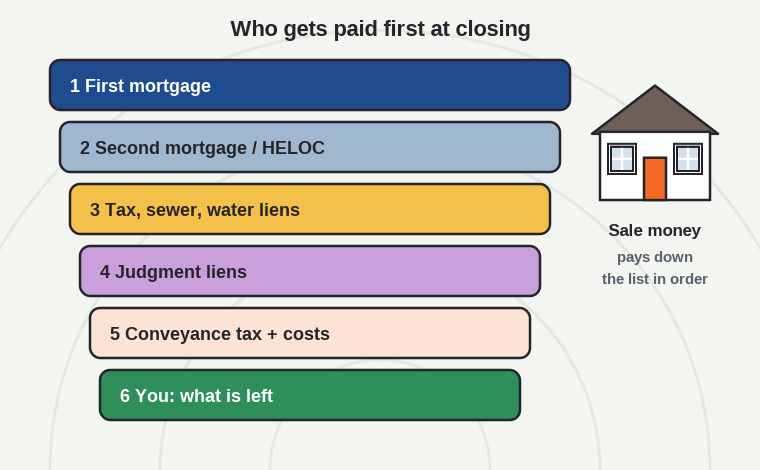
That is the same whether the buyer is a cash buyer or a buyer with a mortgage. What changes with a cash buyer is speed and certainty: no lender on the buyer’s side, no appraisal and usually a closing in about two weeks. For how cash buyers set their price, see our guide to cash home buyers in Connecticut; this page is only about what happens to your loans.
What is a mortgage payoff statement, and how do you read it?
A mortgage payoff statement is a written figure from your lender showing exactly what it takes to pay the loan in full on a given date: the unpaid principal, interest up to that date, a daily (per diem) interest amount for each extra day, and any fees properly charged under your loan. In Connecticut, the lender must provide it by the date requested, if at least seven business days away (CGS 49-10a).
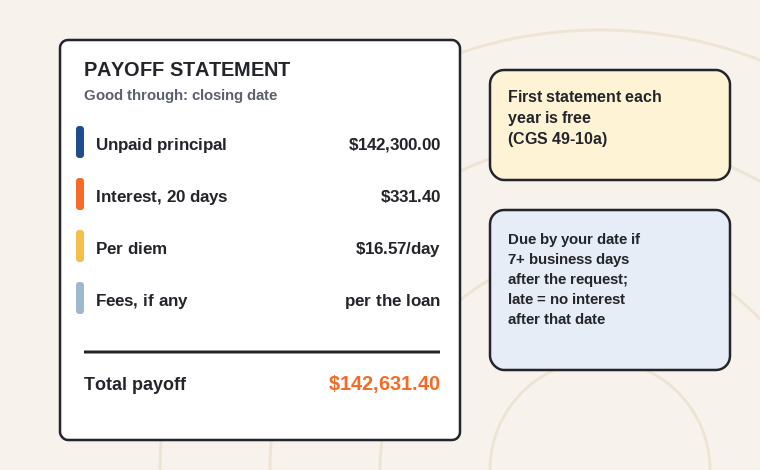
Your mortgage balance on your monthly statement is not your payoff. Mortgage interest in the United States is generally paid in arrears, so your monthly payment covers last month’s interest. On the day you pay off, you owe the principal plus interest from the last payment date up to the payoff date. That is why the payoff is a little higher than the balance you see online.
What to look for on the statement:
- Unpaid principal. What is left of the loan.
- Interest to the payoff date. The interest since your last payment.
- Per diem. One day of interest. If closing moves by three days, add three times this figure.
- Fees. Late charges, recording fees for the release or other charges properly assessed under the loan. Ask your attorney about any you do not recognize. Connecticut bars a fee for the first payoff statement in a calendar year unless you ask for expedited delivery (CGS 49-10a(c)).
- Good-through date and wiring instructions. The attorney confirms these directly with the lender, never from an emailed copy alone.
Federal rules add a second deadline: a servicer must send an accurate payoff statement within seven business days of a written request (12 CFR 1026.36(c)(3)), with a reasonable longer time allowed for reverse mortgages and some other cases. If a Connecticut lender misses the requested date, it cannot collect interest that accrues after that date until it delivers the statement (CGS 49-10a(b)).
What happens to a second mortgage or HELOC when you sell?
A second mortgage or HELOC is paid off at closing when you sell a Connecticut house, the same way as the first mortgage: your attorney gets a separate payoff statement, pays it from the sale proceeds and asks the lender to close the line and record a release. A HELOC with a zero balance still needs a release, because the mortgage is still on the land records.
HELOCs cause more closing surprises than first mortgages, for three reasons:
- The line stays open. A HELOC can be drawn on until it is closed. Your attorney’s payoff request usually asks the lender to freeze or close the line, so the balance cannot change before closing. Do not write a check or use a card linked to it after you sign the contract.
- Forgotten lines. Many owners forget an old HELOC that was paid down to zero. The title search finds it anyway. Tell your attorney about every line you have ever opened on the house.
- Separate releases. Each lender records its own release. If the second lender is slow, CGS 49-8 and the attorney affidavit in CGS 49-8a apply to it too.
If the second loan is from a private lender or a family member, the same rule applies: it is paid from the proceeds if it is recorded, and the lender signs a release. Get the payoff in writing.
How do you sell a house with a reverse mortgage in Connecticut?
You sell a house with a reverse mortgage in Connecticut by getting a payoff from the reverse mortgage servicer and paying it at closing like any other loan; you keep anything above the balance. If heirs inherit a federally insured HECM worth less than the balance, HUD lets them sell for at least 95% of the appraised value, and the lender accepts the net proceeds.
A reverse mortgage works backwards from a normal loan: the balance grows over time, because interest and fees are added instead of paid. Most are HECMs, insured by the Federal Housing Administration. The balance becomes due when the last borrower sells, moves out permanently or dies.
Three situations:
- The borrower is selling. Request the payoff early; reverse mortgage payoffs can take longer, and federal rules allow a reasonable extra time for them. The balance is paid at closing; the rest is the seller’s.
- Heirs are selling and there is equity. The estate sells the house, pays the servicer, and the heirs share the rest after the estate’s other obligations. A probate fiduciary usually needs court authority to sell (CGS 45a-164). Our guide on selling a house in probate in Connecticut explains it.
- Heirs are selling and the house is worth less than the balance. HUD’s guide for heirs says the estate or heirs may sell for at least 95% of the current appraised value and the lender will accept the net proceeds as satisfaction of the loan. HECMs are non-recourse, so heirs do not owe the shortfall.
Example (illustrative): a HECM balance of $310,000 on a house appraised at $300,000. Heirs can sell for at least $285,000 (95% of $300,000), and the servicer accepts the net proceeds.
HUD’s heirs’ guide says the loan must be satisfied within 30 days of the borrower’s death, and that the lender may approve 90-day extensions when the estate or heirs are actively selling or repaying. Property taxes and insurance remain the estate’s responsibility until title transfers. Call the servicer early, tell them you plan to sell, and keep records of your marketing or signed contract. A non-borrowing spouse may have special rights; ask the servicer before anyone sells.
If you inherited the house, our inherited house page explains how we buy with probate open, and our guide to taxes on selling an inherited house covers the stepped-up basis.
What happens to liens and judgments when you sell for cash?
Liens and judgments are paid from the sale proceeds at a Connecticut closing, just like the mortgage: property tax (CGS 12-172), sewer (CGS 7-258), water (CGS 7-239), judgment liens (CGS 52-380a) and mechanic’s liens (CGS 49-34) each need a written payoff and a release. A federal tax lien needs an IRS certificate of discharge, which IRS Publication 783 says to request at least 45 days ahead.
Our full guide to selling a house with a lien in Connecticut covers each lien type, negotiating judgment liens and how the IRS discharge works. Our service page explains how we buy houses with tax liens. Here the point is only that liens join the payoff stack: add them up with your mortgages before you compare offers, because they come out of your side of the closing.
What does a full payoff look like in a Connecticut example?
A full payoff in a Connecticut example looks like this: a $250,000 cash sale in Manchester with a $142,300 first mortgage and an $18,500 HELOC nets the seller about $83,707.60 at closing after both payoffs with 20 days of interest, the 1% conveyance tax, an attorney, a tax adjustment and a final water and sewer bill, plus about $1,850 back later from escrow (illustrative).
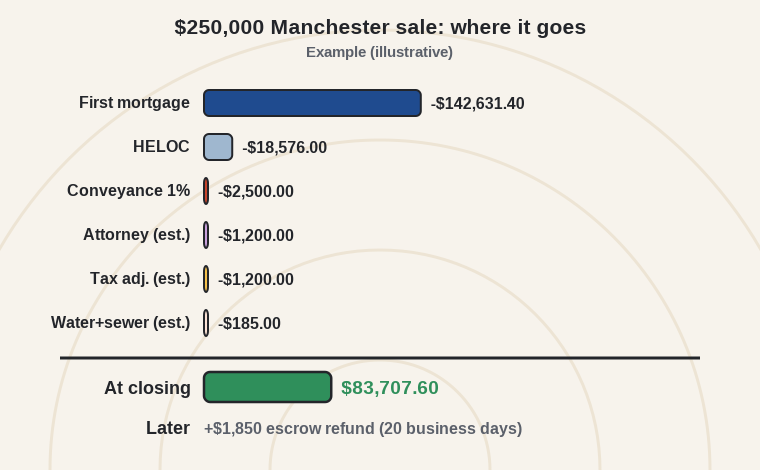
Example (illustrative). Inputs: a house in Manchester (town median sale price $315,000, Oct 2024 to Sep 2025, CT OPM sales data) that needs work, sold for $250,000 cash. The price is an assumption, not an offer. First mortgage: $142,300 principal at 4.25%. HELOC: $18,500 at 7.5%. Closing 20 days after the last payment date. Manchester’s town conveyance rate is 0.25%, so the total is 1%.
| Line | Amount | How it is figured |
|---|---|---|
| Cash price | $250,000.00 | Example |
| First mortgage: principal | -$142,300.00 | From the payoff statement |
| First mortgage: 20 days’ interest | -$331.40 | Per diem $16.57 ($142,300 x 4.25% / 365) x 20 |
| HELOC: balance | -$18,500.00 | Line frozen at payoff request |
| HELOC: 20 days’ interest | -$76.00 | Per diem $3.80 ($18,500 x 7.5% / 365) x 20 |
| Conveyance tax, 0.75% state + 0.25% Manchester | -$2,500.00 | CGS 12-494, Form OP-236 |
| Your attorney | -$1,200.00 (est.) | Typical $1,000 to $1,500 (est.) |
| Property tax adjustment | -$1,200.00 (est.) | Depends on the installments you have paid |
| Final water and sewer | -$185.00 (est.) | From the final readings |
| Paid to you at closing | $83,707.60 | |
| Escrow refund from the old servicer, later | +$1,850.00 (illustrative) | Within 20 business days (12 CFR 1024.34(b)) |
| Total to you | $85,557.60 |
Two things to notice. First, if the closing moves by a week, the two loans add 7 x ($16.57 + $3.80) = $142.59 of interest. Small, but it is why the per diem line matters. Second, the escrow refund is separate money: it is not on the settlement statement, and it comes by check from the old servicer. To run your own numbers, use the calculator.
How much would you walk away with?
Slide the numbers to match your house. It works in your browser; nothing is saved or sent.
Estimates for planning. Conveyance tax per CGS 12-494 (state 0.75% up to $800,000, 1.25% to $2.5M, 2.25% above, plus the town rate). Seller attorney about $1,200 to $1,500; flat-fee MLS about $400; listings include three months of taxes, insurance and utilities, a cash sale about two weeks. Your attorney gives you the final numbers.
What if you owe more than the house is worth?
If you owe more than the house is worth in Connecticut, a normal cash sale cannot close unless you bring the difference to closing, or the lender agrees to accept less than the full payoff in a short sale and release its mortgage. A short sale needs the lender’s written approval, and you should ask it in writing to waive any remaining balance.
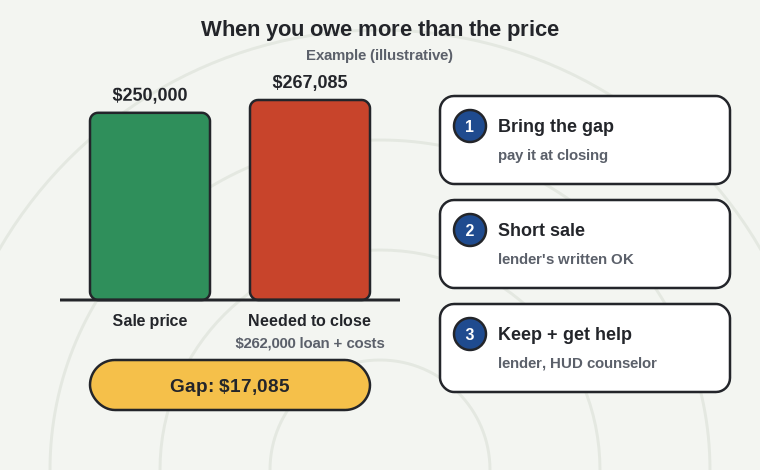
Example (illustrative): the same Manchester house at $250,000, but the mortgage payoff is $262,000. Add the conveyance tax ($2,500), attorney ($1,200 est.), tax adjustment ($1,200 est.) and water and sewer ($185 est.), and $267,085 is needed to close. That is a gap of $17,085.
The paths:
- Bring the gap. If you have savings or family help, you pay the difference at closing and the sale goes through normally.
- A short sale. You ask the lender to accept less than the payoff. The lender will want a hardship letter, financial documents and the signed contract, and will review the price. Short sales take longer than a regular cash sale, often much longer. Ask for written confirmation that the lender waives any deficiency; otherwise it may keep the right to collect the rest. Our guide on short sale vs. foreclosure in Connecticut compares the two.
- A second lien makes it harder. If there is a HELOC behind an underwater first mortgage, both lenders must agree to release their liens. The second lender often wants a small payment to sign.
- Keep the house. If you are behind, a loan modification or Connecticut’s foreclosure mediation program may help. Talk to your lender and a HUD-approved counselor first.
Before any sale, look at the free options: your lender’s loss-mitigation team, a HUD-approved housing counselor and, if a foreclosure has been filed, the Connecticut Judicial Branch foreclosure mediation program. Our guides on being behind on mortgage payments and the Connecticut foreclosure process explain each one. No legitimate buyer will ask you for a fee or for your deed before closing.
Our foreclosure page explains when selling before Law Day keeps your equity.
What happens to your escrow account and prepaid insurance when you sell?
When you sell a Connecticut house and pay off the mortgage, your lender’s escrow account for taxes and insurance closes, and the servicer must refund any balance within 20 business days of the payoff under federal rule 12 CFR 1024.34(b). Prepaid homeowner’s insurance is refunded separately by your insurer once you cancel the policy after closing.
Many sellers forget about escrow money. If your monthly payment included taxes and insurance, the servicer has been holding a cushion. At payoff, that account is closed. The servicer may net it against the loan in some cases, so check the payoff statement for an “escrow balance” line. If it is not netted, a refund check comes by mail.
A few practical points:
- Give your servicer your new mailing address before closing.
- Check whether the servicer is about to pay a tax installment from escrow; your attorney accounts for that in the tax adjustment.
- Cancel homeowner’s insurance only after the deed is recorded, then ask the insurer for the unused premium.
- Keep the payoff statement; it shows whether escrow was netted.
When should you NOT sell for cash to pay off your mortgage?
You should not sell for cash to pay off your mortgage when you have plenty of equity, time and a house in good condition, because listing will usually net more; when you are behind and have not yet tried the free options with your lender; or when heirs with a reverse mortgage can sell on the open market within HUD’s timeline.
- Lots of equity, good house, no deadline. A listing usually wins. See our cash buyer vs. realtor comparison.
- Behind, but the hardship is temporary. A modification or repayment plan may let you keep the house.
- Underwater with no hardship. A lender is unlikely to approve a short sale; waiting or paying down may be better.
- An offer that asks you to sign over the deed before closing or pay a fee. Walk away; read we buy houses scams and red flags and how to check a cash buyer.
A cash sale fits when the house needs work, you need a fixed date, or you want the loans paid off without showings or repairs. Our cash buyer vs. realtor page walks through both routes with the full costs.
Is a cash sale right for you, or should you list?
Seven quick questions. There is no wrong answer, and we will tell you honestly if listing would leave you more.
- Does the house need repairs you would rather not pay for or manage?
- Do you need to close by a certain date, or within the next month or two?
- Would showings be hard: tenants, belongings, privacy, or you live out of state?
- Is there a complication: an estate or probate, a divorce, foreclosure, liens or back taxes?
- Could you comfortably cover the mortgage, taxes and utilities for three or more months?
- Is getting the highest possible price more important to you than speed and certainty?
- Would a buyer's bank lend on the house as it is (no major roof, foundation, oil tank or code issues)?
What are the steps to sell for cash with a mortgage?
The steps to sell a Connecticut house for cash with a mortgage are: list every loan and lien, get a payoff estimate, compare it with the offer, hire your own attorney, sign the contract, have the attorney request written payoffs and freeze any HELOC, close and let the attorney pay everything, then confirm the releases and your escrow refund.
List every loan and lien
First mortgage, second mortgage, HELOC (even at zero), reverse mortgage, private loans, unpaid taxes, sewer and water, judgments. The title search will find them anyway.
Estimate your payoff
Use your latest statements and add a few weeks of interest. Add the conveyance tax for your town and about $1,000 to $1,500 (est.) for your attorney.
Compare it with the offer
Price minus payoffs minus costs is your net. If it is negative, see the underwater section before you sign anything.
Hire your attorney and sign
Only a Connecticut attorney may conduct the closing (CGS 51-88a). Have them read the contract before you sign.
Request written payoffs and freeze the HELOC
Your attorney requests each payoff (CGS 49-10a) and asks the HELOC lender to freeze or close the line. The day-by-day schedule is in our sibling guide on the cash sale closing timeline.
Close and get paid
The attorney pays every loan and lien, the conveyance tax and costs, then pays you the rest.
Confirm releases and refunds
Check that each mortgage release is recorded (CGS 49-8) and watch for the escrow refund within 20 business days.
If something on your title might slow the closing, our sibling guide on what delays a house closing in Connecticut shows how to clear it first.
See the house together.
Pick a time that works.
Choose a time for us to walk through the property with you, or ask for a quick call first. We confirm every request personally.
Tuesday, January 13
No open times in the next few weeks. Please call us.
We will confirm by email. Nothing is booked until we do.
View my requestFrequently asked questions about selling for cash with a mortgage in Connecticut
Can I sell my house for cash if I still owe on the mortgage?
Yes, you can sell your house for cash in Connecticut if you still owe on the mortgage. The closing attorney pays the lender from the sale money using a written payoff statement, and you get the rest. You only need extra money if you owe more than the sale will bring.
Do I have to pay off my mortgage before selling?
No, you do not have to pay off your mortgage before selling in Connecticut. It is paid at closing from the buyer’s funds. The lender then must record a release within 60 days of a written request (CGS 49-8).
How do I get a mortgage payoff statement in Connecticut?
You get a mortgage payoff statement in Connecticut by sending your lender a written request, usually through your attorney. Under CGS 49-10a it must be provided by the date requested if at least seven business days away, and the first statement each calendar year is free.
Why is my payoff higher than my loan balance?
Your payoff is higher than your loan balance because mortgage interest is paid in arrears, so on payoff day you owe interest from your last payment up to that date, plus any fees properly charged. The per diem figure on the statement shows one day’s interest.
What happens to my HELOC when I sell my house?
Your HELOC is paid off at closing when you sell your house, and your attorney asks the lender to freeze or close the line and record a release. A HELOC with a zero balance still needs a release, because the mortgage remains on the land records.
Can I sell a house with a reverse mortgage for cash?
Yes, you can sell a house with a reverse mortgage for cash in Connecticut. The servicer’s payoff is paid at closing and you keep the rest. If heirs inherit a HECM worth less than the balance, HUD lets them sell for at least 95% of the appraised value.
Do heirs have to pay the reverse mortgage shortfall?
No, heirs generally do not have to pay a reverse mortgage shortfall on a federally insured HECM, because it is non-recourse. HUD lets them sell for at least 95% of the current appraised value and the lender accepts the net proceeds.
What if I owe more than my house is worth?
If you owe more than your house is worth, you either bring the difference to closing or ask the lender to approve a short sale and release its lien for less. Get any deficiency waiver in writing, and talk to your lender and a HUD-approved counselor first.
When do I get my escrow money back after selling?
You get your escrow money back after selling within 20 business days of paying the loan in full, under 12 CFR 1024.34(b). The servicer sends it separately from your closing proceeds, unless it was netted against the payoff.
Can a cash buyer pay off my mortgage directly?
The closing attorney, not the buyer personally, pays off your mortgage directly at a Connecticut closing, from the buyer’s funds held in the attorney’s trust account. Never let a buyer “take over” your payments informally or sign your deed before closing.
What if I am behind on payments?
If you are behind on payments, you can still sell for cash in Connecticut; the payoff will include the missed payments, late fees and any foreclosure costs. Ask about modification and mediation first. Selling before Law Day lets you keep any equity.
What if the lender does not release the mortgage after closing?
If the lender does not release the mortgage after closing, your attorney sends a written request; the lender has 60 days under CGS 49-8, then owes damages. An attorney can also record an affidavit of payment under CGS 49-8a after 15 days’ notice.
Related Connecticut guides
Cash buyer guides
Debt and liens
We buy houses with mortgages and liens all over Connecticut; see where we buy, or our pages for Manchester, East Hartford and Vernon. For the full process, read how to sell a house in Connecticut.
Plain-English information, not legal or financial advice. Your loan documents and payoff statement control; talk to a Connecticut attorney and, if you are behind, a HUD-approved housing counselor.
Sources (checked on October 27, 2026)
- CGS §§ 49-8, 49-8a, 49-10a (mortgage releases, attorney affidavit of payment, payoff statements).
- 12 CFR 1026.36(c)(3) (payoff statements within seven business days).
- 12 CFR 1024.34(b) (escrow balance refunded within 20 business days of payoff).
- HUD, Inheriting a Home Secured by an FHA-insured HECM (95% rule, 30 days, 90-day extensions).
- CGS § 45a-164 (probate court authority to sell real property).
- CGS § 12-172 (tax liens); CGS § 7-258 (sewer liens); CGS § 7-239 (water liens).
- CGS § 52-380a (judgment liens) and CGS § 49-34 (mechanic’s liens).
- IRS Publication 783 (certificate of discharge from a federal tax lien).
- CGS § 12-494 (conveyance tax).
- CGS § 51-88a (closings conducted by Connecticut attorneys).
- Connecticut Judicial Branch foreclosure information and mediation.
- Connecticut OPM, Real Estate Sales (data.ct.gov): Manchester median, October 2024 to September 2025.

Who wrote this
Jerryll Noorden
Jerryll has bought and sold Connecticut houses since 2016 and has sat at more closing tables than he can count, on both sides. Before real estate he was a robotics scientist at NASA, IHMC and IIT. He wrote this guide because the national sites that rank for it skip the Connecticut rules that cost sellers money. When listing or selling it yourself would get you more than a cash offer, he says so.
This guide explains Connecticut rules in plain English. It is not legal or tax advice. Laws change; for your sale, talk to a Connecticut real estate attorney and a tax professional.
