
Key facts at a glance
This guide is part of how to sell a house in Connecticut. It answers one question: what delays a house closing in Connecticut, and how do you clear each cause before you sign, so a fast sale stays fast?
| Fact | Number or rule | Source |
|---|---|---|
| Lender must release a paid-off mortgage | Within 60 days of a written request; damages of $200 a week, up to $5,000 or the actual loss if greater | CGS 49-8(c) |
| If the lender never sends the release | An attorney may record an affidavit of payment after 60 days, with 15 days’ written notice to the lender | CGS 49-8a |
| Payoff statement from your lender | Due by the date you ask for, if that date is at least 7 business days after the lender gets your written request; the first one each year is free | CGS 49-10a |
| Condo resale certificate | The association has 10 business days after your request and fee; the buyer may void the contract until 5 business days after delivery | CGS 47-270 |
| Contractor’s mechanic’s lien | Can be recorded up to 90 days after the work stops | CGS 49-34 |
| Sale by an executor or administrator | Needs probate court authority after notice and a hearing | CGS 45a-164 |
| IRS certificate of discharge for a federal tax lien | Apply at least 45 days before the closing date | IRS Publication 783 |
| Property tax on a Hamden single-family at the median | About $1,110 a month for every month of delay (53.67 mills, FY 2027) | CT OPM mill rates; data.ct.gov |
Why does a closing delay feel so frightening?
A closing delay feels frightening because you have usually already planned your life around the date: a move, a new lease, a payoff, a family decision. Sellers who hear “we need to push closing” often feel blindsided, anxious about losing the buyer, embarrassed that the problem is “their” paperwork, angry at whoever caused it, and worn out by one more week of waiting.
Maybe you picked a fast sale for a reason. A job in another state starts on the first of the month. The house has been empty since your father passed and the oil bill keeps coming. You and your spouse agreed to sell and want it finished. Then, a few days before closing, someone mentions a mortgage from 2009 that “never got released,” a lien you did not know about, or a missing signature, and the date slips.
Here is the reassuring part: almost every Connecticut closing delay comes from a short, known list of causes, and nearly all of them can be found before you sign a contract. Most are paperwork, not disasters. The problem is finding them on day 12 instead of day 1.
I am Jerryll Noorden. I have bought houses directly in Connecticut since 2016, about ten a year, and our typical sale takes about two weeks from first call to closing. When one of ours runs late, it is almost always one of the causes on this page. If you want a fast sale to stay fast, this page is for you.
What delays a house closing in Connecticut?
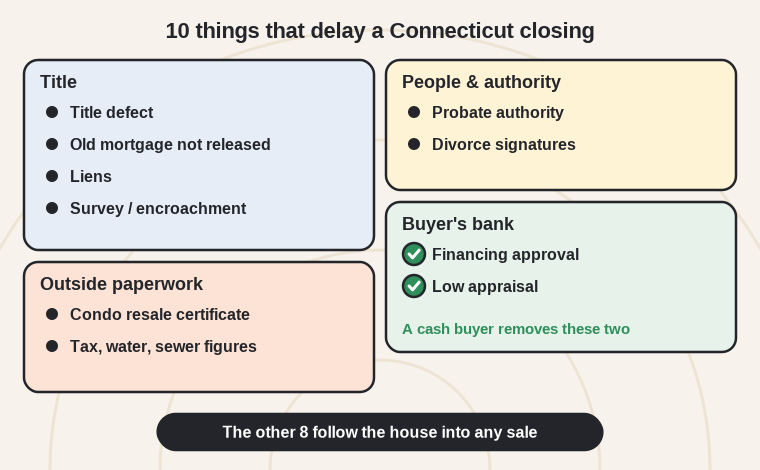
What delays a house closing in Connecticut is usually one of ten things: a title defect, an old mortgage that was paid but never released (CGS 49-8), a lien, missing probate authority, a missing spouse’s signature in a divorce, the buyer’s financing, a low appraisal, a late condo resale certificate, final tax, water and sewer readings, or a survey or encroachment problem. A cash buyer removes two of them.
It helps to sort them by who owns the problem, because that tells you who can fix it:
| Cause | Who it belongs to | Can a cash buyer remove it? | Rule or source |
|---|---|---|---|
| Title defect (gap in the chain, wrong name, old deed error) | The house | No | Title search by the buyer’s attorney |
| Paid mortgage never released | Your old lender | No | CGS 49-8, 49-8a |
| Liens: tax, sewer, water, judgment, mechanic’s, IRS | The house and the seller | No | CGS 12-172, 7-258, 7-239, 52-380a, 49-34 |
| Probate authority for an estate sale | The estate | No | CGS 45a-164 |
| Divorce: both signatures or a court order | The owners | No | CGS 46b-81 |
| Buyer’s mortgage approval | The buyer | Yes | The contract’s financing contingency |
| Low appraisal | The buyer’s lender | Yes | Lender requirement |
| Condo resale certificate | The association | No | CGS 47-270 |
| Final tax, water and sewer figures | The town or utility | No | Town tax collector and utility |
| Survey or encroachment | The land | Partly: a cash buyer may waive a survey | Contract and title insurer |
The pattern matters. A cash buyer takes away the two delays that belong to the buyer’s bank. The other eight travel with the house. They will surface in any sale, cash or financed, so the speed of a “fast” sale depends mostly on how early you find them. How a cash offer is priced is a separate question that our guide to cash home buyers in Connecticut covers in full.
How do title defects delay a Connecticut closing?
Title defects delay a Connecticut closing because the buyer’s attorney will not close, and the title insurer will not insure, until the record shows you can pass clean title. Common defects are a name that does not match, a deed from a deceased owner that never went through probate, a missing release, or an old easement or boundary question that needs a document or affidavit to fix.
The buyer’s attorney or title company searches the town land records for every deed, mortgage, release, lien and easement. The common defects, and the usual cure:
- Name mismatch. You took title as “Mary A. Smith” and now sign as “Mary Smith-Jones.” Usually cured with an affidavit and a copy of the marriage record.
- A co-owner who died. If the deed was joint with survivorship, the survivor records a death certificate and a survivorship affidavit. If the co-owner held a separate share, that share may need probate first.
- A missing or defective old release. Covered in the next section; it is the single most common surprise.
- An old recorded contract or option. A “memorandum of contract” from a past deal that never closed can cloud title until it is released. Our guide on removing a memorandum of contract explains it.
How to clear it before you sign: ask your attorney to pull your deed and a quick rundown of the land records the day you decide to sell, and tell any buyer about known problems on day one.
What if an old mortgage was paid off but never released?
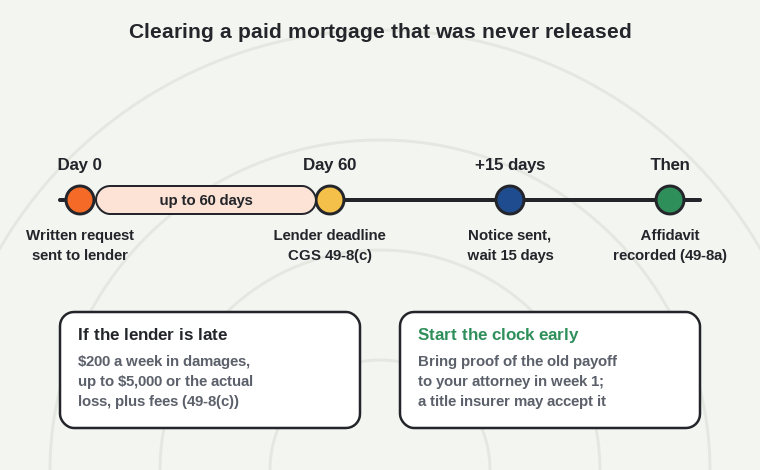
If an old mortgage was paid off but never released, the Connecticut land records still show it as a lien, and the buyer’s attorney will ask for a release before closing. Under CGS 49-8, the lender must deliver the release within 60 days of a written request, or pay damages; under CGS 49-8a, an attorney can record an affidavit of payment if the lender stays silent.
This is common with refinanced houses: the old loan was paid at the refinance, the old lender merged into another bank, and nobody recorded the release.
Connecticut gives you two tools:
- The written request (CGS 49-8). Your attorney sends the lender, or whoever now holds the loan, a written request for a release by certified mail, courier or another method reasonably sure to reach it. The lender then has 60 days. After that, it owes damages of $200 for each week of delay, up to $5,000, or the actual loss caused if that is greater, plus costs and reasonable attorney’s fees.
- The attorney’s affidavit (CGS 49-8a). If the lender was paid but still has not released within 60 days of getting the money, a Connecticut attorney (or a title insurer’s officer) can record an affidavit on the land records stating that the loan was paid. The affiant must first give the lender at least 15 days’ written notice with a copy of the proposed affidavit. Proof of payment, such as the cancelled payoff check or a wire confirmation, is required.
For very old mortgages, CGS 49-13a can also help: a mortgage can become invalid as a lien after long undisturbed possession (20 years after the loan’s due date, or 40 years after recording if no due date appears), with an affidavit recorded. Your attorney decides which tool fits.
The 60 days only start when the written request goes out. Find your old payoff letter, the settlement statement from your refinance, or a bank statement showing the payoff, and give them to your attorney in the first week. In many cases the title insurer will also accept proof of payment and insure over the old mortgage, so the closing does not wait the full 60 days. Whether it will is the insurer’s call, not yours.
Which liens can hold up a closing in Connecticut?
The liens that can hold up a closing in Connecticut are unpaid property taxes (CGS 12-172), unpaid sewer and water charges (CGS 7-258 and 7-239), judgment liens from lawsuits (CGS 52-380a), contractors’ mechanic’s liens (CGS 49-34), and federal or state tax liens. Most are simply paid from your sale proceeds at closing; the delay comes from getting an exact, written payoff figure in time.
A lien does not stop a sale; the creditor is paid from the closing before you are. The delay comes from the paperwork:
- Property tax liens. Taxes are a lien from the assessment date (CGS 12-172). The town tax collector gives the attorneys the amount due, including interest. Usually quick. Delinquent taxes that were sold or assigned to a third party take longer, because the assignee sets the payoff.
- Sewer and water liens. Unpaid municipal sewer charges (CGS 7-258) and municipal water charges (CGS 7-239) become liens too. They are often small, but you need a final figure, which means a final meter reading.
- Judgment liens. If someone won a money judgment against you, they may have recorded a judgment lien certificate on your house (CGS 52-380a). Your attorney needs a payoff letter from the creditor’s attorney and a release after closing.
- Mechanic’s liens. A contractor who was not paid has up to 90 days after finishing work to record a lien (CGS 49-34). If you had work done recently and there is a dispute, settle it in writing before you sign a contract.
- Federal tax liens. The IRS releases its lien from a specific property with a certificate of discharge. IRS Publication 783 asks you to apply at least 45 days before the closing date, so this is the one lien that truly needs lead time.
We wrote a full guide to selling a house with a lien in Connecticut, and our service page explains how we buy houses with tax liens. If the liens plus the mortgage add up to more than the house is worth, read our sibling guide on selling for cash with a mortgage, which covers payoffs and underwater cases with a worked example.
How does probate delay the sale of an inherited house?
Probate delays the sale of an inherited house in Connecticut because the executor or administrator needs authority from the probate court before a buyer’s attorney will accept the deed. Under CGS 45a-164, the court authorizes a sale on the fiduciary’s application, after notice and a hearing. The time that takes, not the buyer, usually sets the closing date.
The usual sequence: someone is appointed executor or administrator; they apply for authority to sell; the court gives notice and holds a hearing; the court issues a decree; then the closing can happen. If the will gives the executor a power of sale, your attorney and the title insurer decide whether a separate court order is still needed. Ask early.
What stalls inherited sales most often is not the court; it is that nobody has been appointed yet, or that heirs disagree. You can sign a contract while probate is open, with the closing date tied to the court’s approval. That gives everyone a firm number to work toward. Our guides on selling a house in probate in Connecticut and on selling an inherited house cover the full process, including when heirs disagree.
How to clear it before you sign: confirm who the fiduciary is, get a certified copy of their appointment, and ask the probate court clerk what the court will need for a sale application. Then choose a closing date that comes after the expected hearing, not before it.
Why do divorce sales stall at closing?
Divorce sales stall at closing because the buyer’s attorney needs every owner’s signature on the deed, or a court order that replaces a missing one. When both spouses own the house and one stops cooperating, the closing stops too. Connecticut courts can order a sale “without any act by either spouse” under CGS 46b-81, but getting that order takes time.
Three things cause most divorce delays:
- A spouse who will not sign. The deed needs both owners. If one refuses, the other’s lawyer may ask the court to order the sale, which can take weeks or months depending on the court’s calendar.
- The automatic orders. Once a Connecticut divorce case starts, standard automatic orders generally stop either spouse from selling or encumbering property without the other’s written consent or a court order. Check with your divorce lawyer before you sign any contract.
- Disagreement about the split. Even with both signatures, the attorneys need written instructions on who gets the proceeds. Without them, the money may be held in escrow until the court decides.
Our guide to selling a house during a divorce in Connecticut walks through each stage, and our divorce service page explains how a neutral buyer works with both sides.
How do buyer financing and appraisals delay a closing?
Buyer financing and appraisals delay a closing because a financed buyer cannot close until the lender approves the loan, the appraisal supports the price and the funds are released. A late underwriting condition, a job change or a low appraisal can push the date or end the deal. A cash buyer removes both delays, because there is no lender and usually no appraisal.
A financed buyer’s contract usually has a mortgage contingency: no loan by a set date, and the buyer can cancel with the deposit back. A low appraisal means you lower the price, the buyer brings more cash, or the deal ends. Our guide to low appraisals in Connecticut explains the options.
Anyone can call an offer cash. Ask for proof of funds and check that the contract has no financing contingency or assignment plan. Our guide on how to check a cash home buyer in Connecticut lists the checks, and we buy houses scams and red flags covers the warning signs.
Why can a condo sale take longer to close?
A condo sale can take longer to close in Connecticut because the seller must give the buyer a resale certificate and the association’s documents before closing (CGS 47-270). The association has 10 business days after your written request and fee to produce it, and the buyer may void the contract until 5 business days after it is delivered.
The resale certificate shows the monthly common charges, any unpaid assessments, special assessments, reserves, the budget, pending lawsuits and rental restrictions, among other items. Its numbers also matter for your payoff: the buyer is not liable for unpaid assessments above what the certificate shows, so the association will want its arrears paid at closing.
How to clear it before you sign: request the certificate the day you decide to sell, not the day you sign. Ask the management company for the exact request form and fee; the statute sets the fee and adjusts it for inflation. If your common charges are behind, ask for a written payoff with the certificate.
What town, water and sewer steps can hold up a closing?
The town, water and sewer steps that can hold up a closing in Connecticut are the tax collector’s figures for taxes due and the proration, and the final water and sewer meter readings with their bills. They are rarely large, but the attorneys need the numbers in writing, and some utilities need several days’ notice to schedule a final reading.
Connecticut property taxes are paid in arrears in installments each town sets, so the attorneys split the year between you and the buyer. Water and sewer may come from the town, a regional authority or a private company; rural homes on well and septic have neither.
How to clear it before you sign: find your last tax bill and your last water and sewer bills. Pay anything overdue, or ask the collector for a written figure. Call the water utility and ask how much notice it needs for a final reading. Write that date into your plan.
Can a survey or encroachment delay a closing?
A survey or encroachment can delay a closing in Connecticut when the buyer or title insurer orders a survey and it shows a problem: a fence, shed, driveway or addition over the line, a neighbor’s structure on your land, or a boundary that does not match the deed. Fixing it can need a boundary agreement, a release or a title exception the buyer accepts.
Many Connecticut sales close without a new survey, and a cash buyer often waives one. When one is ordered, it can take a few weeks (est.), and an encroachment fix may need a neighbor’s signature. Before you sign: find any old survey or plot plan, and tell the buyer about known boundary issues, such as a shared driveway with no written easement.
What does a closing delay cost a Connecticut seller?
A closing delay costs a Connecticut seller every bill the house keeps generating while it waits: property tax, mortgage interest, insurance, utilities and upkeep. On a Hamden single-family at the town’s median, property tax alone runs about $1,110 a month, and an example with a $180,000 mortgage adds up to about $2,485 a month (illustrative).
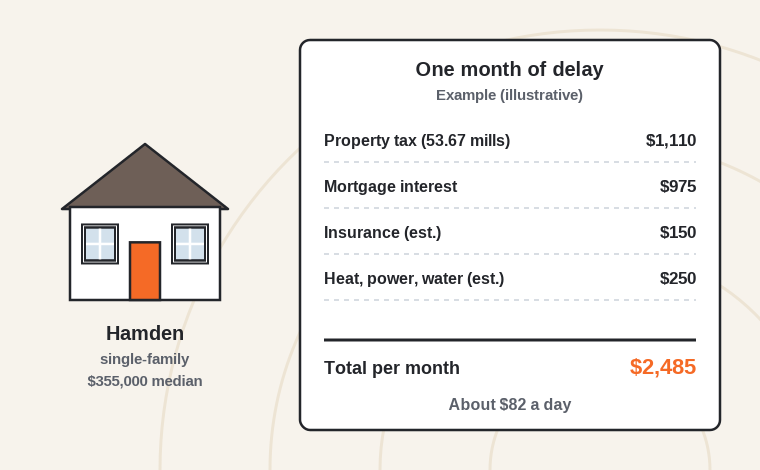
Example (illustrative). Inputs: Hamden, single-family median sale price $355,000 (Oct 2024 to Sep 2025, CT OPM sales data); mill rate 53.67 (FY 2027, CT OPM); a $180,000 mortgage at 6.5%; insurance and utilities are estimates.
| Monthly cost | Amount | How it is figured |
|---|---|---|
| Property tax | $1,110 | $355,000 x 70% assessment x 53.67 mills / 12 |
| Mortgage interest | $975 | $180,000 x 6.5% / 12 |
| Homeowner’s insurance | $150 (est.) | Estimate; vacant-home policies can cost more |
| Heat, electric, water (est.) | $250 (est.) | Estimate; much higher in a Connecticut winter on oil |
| Total per month of delay | $2,485 | About $82 a day |
So a 45-day probate wait or a federal lien discharge costs roughly $3,700 in this example, before you count the move you had to postpone. If you want to see how carrying costs, conveyance tax and fees net out for your own house, the calculator below does the math.
How much would you walk away with?
Slide the numbers to match your house. It works in your browser; nothing is saved or sent.
Estimates for planning. Conveyance tax per CGS 12-494 (state 0.75% up to $800,000, 1.25% to $2.5M, 2.25% above, plus the town rate). Seller attorney about $1,200 to $1,500; flat-fee MLS about $400; listings include three months of taxes, insurance and utilities, a cash sale about two weeks. Your attorney gives you the final numbers.
The full cost picture for a Connecticut sale, including conveyance tax by town, is in our guide to seller closing costs in Connecticut. How a cash buyer arrives at its price is covered on why cash offers are lower; this page does not repeat it.
How do you clear closing delays before you sign a contract?
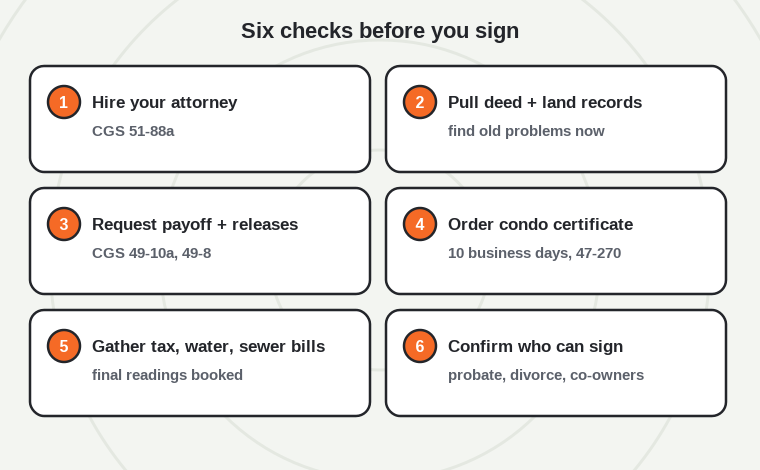
You clear closing delays before you sign a contract by finding them first: hire your attorney early, have them pull your deed and run the land records, request your mortgage payoff and any old releases, order the condo certificate, gather tax and utility bills, confirm who has authority to sign, and tell the buyer about anything unusual on day one.
Hire your own Connecticut attorney first
Only a Connecticut attorney may conduct a real estate closing (CGS 51-88a). Hire yours before you sign anything, so they can look for problems while you are still choosing a buyer. Our guide to the Connecticut closing process for sellers explains what they do.
Pull your deed and a land-records rundown
Ask your attorney to check how you hold title, whether every old mortgage shows a release, and whether any lien, lis pendens or recorded contract appears. Old problems found now cost days; found on day 12 they cost weeks.
Request your payoff and chase old releases
Your attorney requests a payoff statement under CGS 49-10a and, for any old open mortgage, sends the written release request under CGS 49-8. Bring any proof of old payoffs you have.
Order outside documents now
Condo resale certificate (CGS 47-270), probate appointment and authority, an IRS discharge application if there is a federal lien (at least 45 days ahead), and lien payoff letters. These are the slowest pieces because someone else produces them.
Gather bills and the condition report
Last tax bill, water and sewer bills, oil company receipts and your Property Condition Disclosure Report (CGS 20-327b; if you do not give it, the buyer gets a $500 credit at closing under CGS 20-327c). Check your smoke and CO detectors: you will sign an affidavit about them at closing (CGS 29-453).
Confirm who signs, then pick the date
Every owner, or a fiduciary with authority, or a court order. Once you know who signs and when the slowest document arrives, pick the closing date. A realistic date that holds beats an early date that slips.
The documents themselves are listed in our checklist of documents needed to sell a house in Connecticut. If you want to see how our own day-by-day schedule runs once an offer is accepted, read our sibling guide to the cash sale closing timeline in Connecticut.
Does a cash buyer actually close faster?
A cash buyer actually closes faster in Connecticut when the delay would have come from the buyer’s side: no mortgage approval, no appraisal, no lender closing conditions. A cash buyer does not make title defects, liens, probate, divorce signatures or a condo certificate go away. Those take the same time in any sale; what changes is that an experienced buyer works on them in parallel.
Our typical sale takes about two weeks from first call to closing, because we close with our own funds, usually skip the survey and appraisal, and start title work and payoff requests the day the contract is signed. When a probate hearing or an IRS discharge lies ahead, we set the closing after that date and hold the price.
For a fuller comparison of the money and the time on each route, see our cash buyer vs. realtor page. For how long each route takes in Connecticut overall, see how long it takes to sell a house in Connecticut.

The most common late surprise I see is an old mortgage that was paid off in a refinance years ago and never released. It is fixable, but the clock only starts when someone asks. If you refinanced at any point, dig out that old settlement statement before you call anyone, me included.
When should you NOT sell to a cash buyer to avoid delays?
You should not sell to a cash buyer just to avoid delays when the delay is not on the buyer’s side, when you have time, or when the house is move-in ready and would sell well on the open market. If the only hold-up is probate or a lien, a cash buyer cannot shorten it, and listing may net you more for the same wait.
- Your delay is probate, divorce or a federal lien. Those clocks run the same for every buyer. If you have months anyway, a listing may bring a higher price.
- Your house is in good shape and you are not in a hurry. A move-in-ready house usually nets more listed with an agent, even after commission. Our cash buyer vs. realtor comparison shows where the line is.
- You have a strong financed offer already. A buyer with full underwriting approval and a big deposit can close nearly as reliably as cash.
- You are behind on the mortgage. Talk to a HUD-approved counselor and your lender first; our foreclosure page lists free help before any sale.
A cash sale makes sense when the house needs work a financed buyer’s lender would object to, when you need a fixed date, or when you simply want one buyer, no showings and no repairs. If that is you, the self-check below takes a minute.
Is a cash sale right for you, or should you list?
Seven quick questions. There is no wrong answer, and we will tell you honestly if listing would leave you more.
- Does the house need repairs you would rather not pay for or manage?
- Do you need to close by a certain date, or within the next month or two?
- Would showings be hard: tenants, belongings, privacy, or you live out of state?
- Is there a complication: an estate or probate, a divorce, foreclosure, liens or back taxes?
- Could you comfortably cover the mortgage, taxes and utilities for three or more months?
- Is getting the highest possible price more important to you than speed and certainty?
- Would a buyer's bank lend on the house as it is (no major roof, foundation, oil tank or code issues)?
Frequently asked questions about closing delays in Connecticut
What is the most common reason a closing is delayed in Connecticut?
The most common reason a closing is delayed in Connecticut, in a financed sale, is the buyer’s mortgage: late approval, an underwriting condition or a low appraisal. On the seller’s side, the most common delays are an old mortgage that was never released, a lien that needs a written payoff, and missing authority to sign in an estate or divorce.
Can a seller delay closing in Connecticut?
Yes, a seller can delay closing in Connecticut, but only within what the contract allows. Many Connecticut contracts let either side move the date a short time to clear title. A seller who simply refuses to close without a reason may be in breach. Talk to your attorney before you ask for more time.
How long does a lender have to release a mortgage in Connecticut?
A lender has 60 days to release a mortgage in Connecticut after a written request (CGS 49-8). After that it owes damages of $200 a week, up to $5,000 or the actual loss if greater, plus fees. If it was paid but still does not release, an attorney can record an affidavit of payment under CGS 49-8a after 15 days’ notice.
How long does it take to get a mortgage payoff statement in Connecticut?
It takes up to about seven business days to get a mortgage payoff statement in Connecticut: the lender must provide it by the date you request, as long as that date is at least seven business days after it receives your written request (CGS 49-10a). The first statement in a calendar year is free.
Does a lien stop me from selling my house?
No, a lien does not stop you from selling your house in Connecticut. It is paid from your sale proceeds at closing, and the creditor then records a release. A lien only stops a sale when the liens and mortgages together exceed the price, in which case you need the creditors’ agreement.
How long does an IRS lien discharge take before closing?
An IRS lien discharge needs lead time before closing: IRS Publication 783 asks you to apply for a certificate of discharge at least 45 days before the closing date. Start this as soon as you know there is a federal tax lien.
Can I sell an inherited house before probate is finished?
Yes, you can usually sign a contract to sell an inherited house before probate is finished in Connecticut, with the closing tied to the court’s authority. The fiduciary needs probate court approval to sell under CGS 45a-164, after notice and a hearing.
What happens if my spouse will not sign the deed?
If your spouse will not sign the deed and you both own the house, the sale cannot close. In a Connecticut divorce, the court can order the sale “without any act by either spouse” under CGS 46b-81. Ask your divorce lawyer about timing before you sign a contract.
How long does a condo resale certificate take in Connecticut?
A condo resale certificate takes up to 10 business days in Connecticut after the association receives your written request and fee (CGS 47-270). The buyer may void the contract until five business days after delivery, so order it early.
Who pays if the closing is delayed?
Who pays if the closing is delayed depends on the contract and the cause. Usually each side bears its own carrying costs. If one side caused an unreasonable delay, the contract may give the other side remedies. Your attorney can tell you what yours says.
Is a two-week closing realistic in Connecticut?
Yes, a two-week closing is realistic in Connecticut for a cash sale with clean title and no outside approvals. Our typical sale takes about two weeks from first call. Probate, a federal lien discharge or a divorce order can add weeks, and no buyer can skip those.
Related Connecticut guides
Cash buyer guides
Clearing the paperwork
We buy houses in every Connecticut town; see where we buy houses in Connecticut, or our pages for Hamden, New Haven and Hartford. For the whole selling process, start with how to sell a house in Connecticut.
Plain-English information, not legal advice. Every title is different; have a Connecticut real estate attorney review yours before you sign a contract.
See the house together.
Pick a time that works.
Choose a time for us to walk through the property with you, or ask for a quick call first. We confirm every request personally.
Tuesday, January 13
No open times in the next few weeks. Please call us.
We will confirm by email. Nothing is booked until we do.
View my requestSources (checked on October 27, 2026)
- CGS §§ 49-8, 49-8a, 49-10a, 49-13a (release of mortgages, attorney affidavit of payment, payoff statements, invalid old mortgages).
- CGS § 49-34 (mechanic’s lien certificate within 90 days).
- CGS § 12-172 (municipal property tax liens).
- CGS § 7-258 (sewer charges as liens) and CGS § 7-239 (municipal water charges as liens).
- CGS § 52-380a (judgment liens on real property).
- CGS § 45a-164 (probate court authority to sell real property).
- CGS § 46b-81 (court-ordered sale in a dissolution).
- CGS § 47-270 (condominium resale certificate).
- CGS § 51-88a (closings conducted by Connecticut attorneys).
- CGS §§ 20-327b, 20-327c (condition report; $500 credit) and CGS § 29-453 (smoke and CO affidavit at closing).
- IRS Publication 783 (certificate of discharge from a federal tax lien; apply at least 45 days ahead).
- Connecticut OPM mill rates (Hamden FY 2027).
- Connecticut OPM, Real Estate Sales (data.ct.gov): Hamden single-family median, October 2024 to September 2025.

Who wrote this
Jerryll Noorden
Jerryll has bought and sold Connecticut houses since 2016 and has sat at more closing tables than he can count, on both sides. Before real estate he was a robotics scientist at NASA, IHMC and IIT. He wrote this guide because the national sites that rank for it skip the Connecticut rules that cost sellers money. When listing or selling it yourself would get you more than a cash offer, he says so.
This guide explains Connecticut rules in plain English. It is not legal or tax advice. Laws change; for your sale, talk to a Connecticut real estate attorney and a tax professional.
