
Key facts at a glance
This Fairfield guide is part of our series on how to sell a house in Connecticut. It covers one kind of foreclosure: foreclosure by sale, the court-run auction Connecticut judges can order instead of strict foreclosure, which matters most for high-equity houses like many in Fairfield.
| Fact | Number | Source |
|---|---|---|
| Who can ask for a foreclosure by sale | Any party, by written motion; the court decides | CGS 49-24 |
| Court that hears a Fairfield foreclosure | Superior Court, Bridgeport judicial district | CGS 51-344, 51-345(b) |
| Appraisers in a foreclosure by sale | 1 court-appointed; a 2nd on the owner’s motion | CGS 49-25 |
| Bidder deposit at the auction | 10% of the court’s fair market value | Judicial Branch standing orders JD-CV-79 |
| Credit if the auction price is below the appraisal | Half the gap, before any deficiency | CGS 49-28 |
| Fairfield median single-family sale price, Oct 2024 to Sep 2025 | $940,000 (812 residential sales) | CT OPM Real Estate Sales, data.ct.gov |
| Conveyance tax on a $940,000 sale you make yourself | $10,100 (state $7,750 + Fairfield $2,350) | CGS 12-494 |
| Fairfield mill rate, fiscal 2027 | 19.19 mills (about $12,630 a year on $940,000) | CT OPM mill rates |
Why is a foreclosure so frightening when your Fairfield house has a lot of equity?
A foreclosure is frightening when your Fairfield house has a lot of equity because you have more to lose: years of payments and a value that has climbed, now at risk of being sold at a court auction to the highest bidder on one day. Fairfield owners in this spot often feel embarrassed, angry at themselves, protective of what they built, and suspicious of anyone who calls with an offer.
Fairfield’s single-family median sale price was $940,000 in the year to September 2025, and 61% of its single-family homes were built before 1960. Owners who bought years ago often have far more equity than they realize. When a job ends, a business fails, a divorce splits the income or an illness drains savings, a large house with a large tax bill can fall behind fast.
If you are behind on a Fairfield house that is worth far more than you owe, and you have heard the words “foreclosure by sale” or “committee” in a court notice, this page is for you. You probably feel embarrassed that it happened in this town, overwhelmed by the legal terms, protective of the equity, skeptical of buyers who appear the week the papers are filed, and determined to come out of this with what is yours.
I am Jerryll Noorden. I buy houses in Connecticut, about ten a year since 2016. I am going to explain how a foreclosure by sale works, what it costs, and why selling the house yourself first almost always protects more of the equity. On a house like most in Fairfield, that usually means listing it with a good agent, not selling it to me.
What is a foreclosure by sale in Connecticut, and how is it different from strict foreclosure?
A foreclosure by sale in Connecticut is a court-ordered public auction of the house, run by a court-appointed attorney called the committee, with the proceeds paid into court and divided among the lender, other lienholders and you (CGS 49-24 to 49-29). In a strict foreclosure there is no auction: if no one pays the debt by Law Day, title passes to the lender and any equity goes with it.
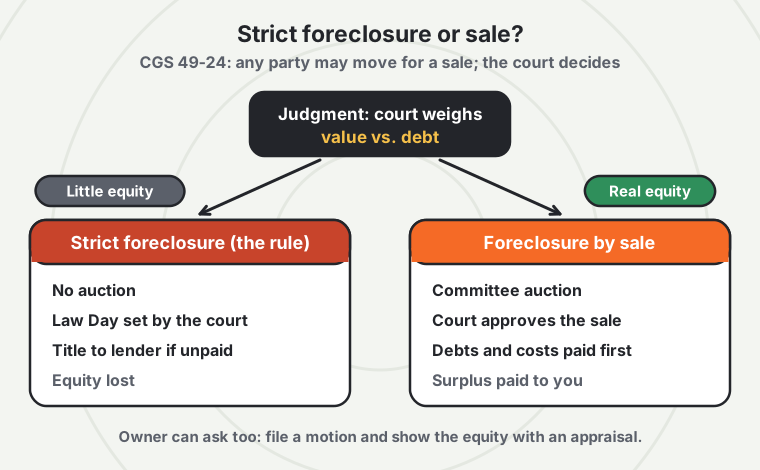
CGS 49-24 says liens and mortgages “may, on the written motion of any party,” be foreclosed by a decree of sale instead of a strict foreclosure, at the court’s discretion. Connecticut’s Appellate Court has summed it up: strict foreclosure is the rule, foreclosure by sale the exception. The statute gives no dollar test. In practice, a judge weighs the fair market value against the debt; when there is real equity, ordering a sale protects the owner and junior lienholders, so a sale is more likely. When there is little or none, strict foreclosure is the usual result.
For the strict-foreclosure path, Law Day and what happens after it, see our explainer on Law Day in Connecticut. This page stays on the sale.
| Strict foreclosure | Foreclosure by sale | |
|---|---|---|
| How it ends | Title passes on Law Day if no one redeems | Auction by a court-appointed committee, then court approval |
| Your equity | Lost if you do not redeem | Surplus after all debts and costs paid to you (CGS 49-27) |
| Price | Court finds a value; no sale | Whatever the highest bidder pays on the sale day |
| Deficiency | Debt minus the court’s valuation (CGS 49-14) | Debt minus the sale price, after a half-the-gap credit if below appraisal (CGS 49-28) |
| Stopping it | Pay or sell before Law Day | Pay the judgment, interest and costs before the sale; redemption is possible until the court approves the sale (CGS 49-25 and case law) |
When do Connecticut courts order foreclosure by sale instead of strict foreclosure?
Connecticut courts order foreclosure by sale instead of strict foreclosure when a party files a written motion and the judge, in its discretion, decides a sale is fairer, most often because the house is worth clearly more than the debt and the owner or a junior lender would lose that equity in a strict foreclosure. The lender, you, or a second mortgage holder can make the motion (CGS 49-24).
Three practical points for a Fairfield owner:
- You can ask. If the lender moves for strict foreclosure on a house with equity, your attorney can file a motion asking for a sale instead and can contest the value the lender’s appraiser gives. A court can also be asked to set a longer Law Day.
- Value is argued at judgment. The judge finds the fair market value and the debt when entering judgment. If you think the lender’s number is low, an independent appraisal matters here.
- Mediation still comes first. If your house is owner-occupied, the free Foreclosure Mediation Program pauses most motions for up to eight months from the return date (CGS 49-31l(f)). Our foreclosure mediation guide explains it, and our foreclosure summons guide covers the 15-day deadline.
How does a committee sale work, step by step, for a Fairfield house?
A committee sale for a Fairfield house works like this: the court enters judgment and appoints a committee and an appraiser, nothing is spent until 45 days before the sale, a sign goes up on the lawn 20 to 30 days before, the auction is held at noon on the property, bidders put down 10% of the court’s value, the court approves the sale, and the buyer closes 21 to 30 days after approval.
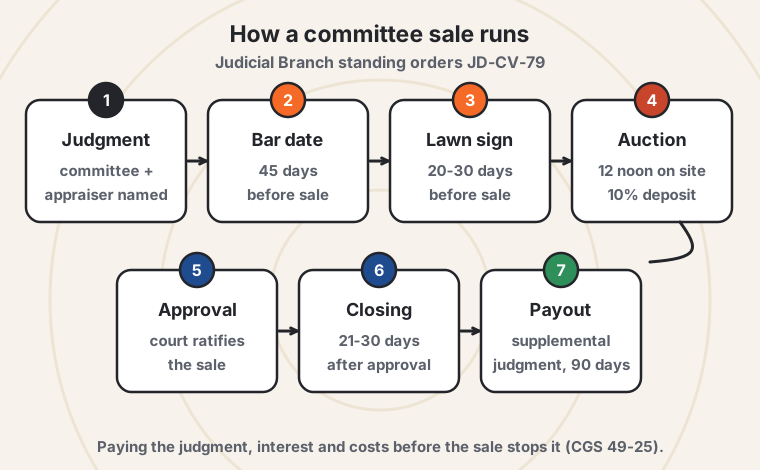
The Judicial Branch’s standing orders (JD-CV-79) set the routine, unless a judge orders otherwise:
- Judgment. The court sets the sale date, appoints a committee from its list of approved attorneys, and appoints a disinterested appraiser (CGS 49-25). You can ask for a second appraiser.
- Bar date, 45 days before the sale. The committee cannot run up fees before this, except for filing an appearance. That is your last cheap window.
- Title search and appraisal. Title search capped at $225; the appraisal is filed at least 10 days before the sale.
- Advertising. A notice on the Judicial Branch website, newspaper ads if ordered, and a 3-by-2-foot sign on the lawn 20 to 30 days before the sale.
- Sale day. Inspection from 10:00 a.m. to noon, auction at 12:00 noon on the premises. Bidders pay a 10% deposit by bank or certified check; the lender does not.
- Approval and closing. The court must approve the sale. The buyer closes no sooner than 21 and no later than 30 days after notice of approval.
- Money out. A motion for supplemental judgment, filed within 90 days of approval, decides who gets paid. The lender’s judgment and costs come first (CGS 49-29), then junior liens, then you.
You can still stop the sale: paying the judgment, interest and costs before the sale stops the proceedings (CGS 49-25), and Connecticut’s Supreme Court has said redemption is possible until the court approves the sale. Selling before the bar date also avoids the lawn sign and the online notice.
What does a committee sale cost a Fairfield owner, and why does selling first protect more equity?
A committee sale costs a Fairfield owner in three ways: an auction price usually set by a few bidders who cannot inspect inside or get normal financing; months of extra interest, the lender’s legal fees and the committee’s fees and expenses, all paid before you; and the time until the surplus is released. Selling yourself first, at a market price, typically protects far more of the equity.
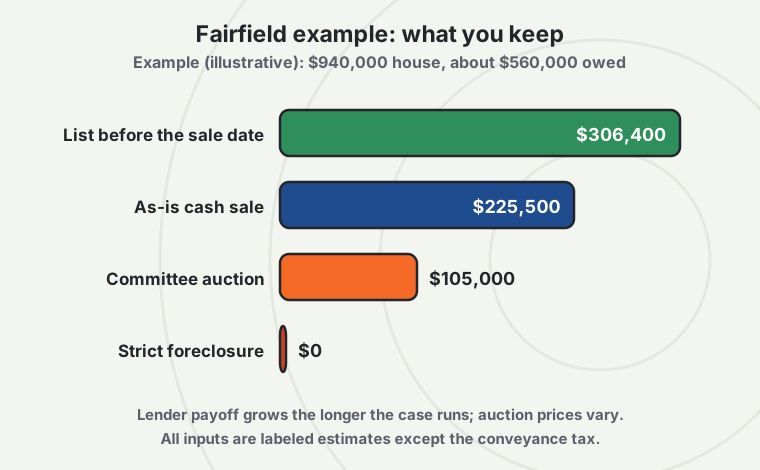
Example (illustrative). A Fairfield house worth the town’s $940,000 single-family median. About $560,000 is owed at judgment once arrears, interest and fees are added. Every input below is an estimate except the conveyance tax.
| Line | List before the sale date | As-is cash sale | Committee sale |
|---|---|---|---|
| Price | $940,000 | $800,000 (est.) | $705,000 winning bid (est.) |
| Commission | -$47,000 (5%, est.) | $0 | $0 |
| Conveyance tax | -$10,100 | -$8,000 | $0 (court-decree deed exempt, CGS 12-498(a)(9)) |
| Attorney, committee, appraisal, ads, sign, insurance | -$1,500 (est.) | -$1,500 (est.) | -$10,000 (est.) |
| Lender payoff (grows with time) | -$575,000 (est.) | -$565,000 (est.) | -$590,000 (est.) |
| Left to you | about $306,400 | about $225,500 | about $105,000, months later |
The conveyance tax on your own sale shows Fairfield’s tiers in action: the state charges 0.75% on the first $800,000 ($6,000) and 1.25% on the next $140,000 ($1,750), and the town adds 0.25% ($2,350). Our Connecticut conveyance tax guide has every town’s rate.
The auction number is the uncertain one. Some sales draw strong bidding and some do not, and if the lender is the only bidder, its bid sets the price. That is why the gap between the first and third columns is the real cost of waiting. If the property sells below the appraisal and you still owe money, CGS 49-28 requires that half the difference between the appraisal and the price be credited before a deficiency judgment, which helps, but only on the debt side.
How much would you walk away with?
Slide the numbers to match your house. It works in your browser; nothing is saved or sent.
Estimates for planning. Conveyance tax per CGS 12-494 (state 0.75% up to $800,000, 1.25% to $2.5M, 2.25% above, plus the town rate). Seller attorney about $1,200 to $1,500; flat-fee MLS about $400; listings include three months of taxes, insurance and utilities, a cash sale about two weeks. Your attorney gives you the final numbers.
What are the honest options for a Fairfield owner, and when should you NOT sell to a cash buyer?
The honest options for a Fairfield owner facing foreclosure by sale are to keep the house through mediation, a modification, reinstatement or a refinance; to list it with an agent before the bar date; to sell it as-is for cash if time or condition rules out a listing; or to let the auction happen. You should NOT sell to a cash buyer if you have equity and at least two or three months, because a listing will usually net more.
When you should NOT sell to a cash buyer
- You have equity and more than a couple of months before the bar date. In the example, listing leaves about $80,900 more than a cash sale.
- A refinance or modification works. Keep the house.
- You owe close to or more than the value. Then the lender decides; see short sale vs. foreclosure or a deed in lieu.
A cash sale earns its discount when the sale date is close, a listing would need repairs you cannot fund, or a buyer’s financing falling through would push you past the auction. For the selling-before-foreclosure process in detail, see our page on selling your house before foreclosure in Connecticut, and for the bigger picture, the Connecticut foreclosure guide.
Where can a Fairfield homeowner get free foreclosure help?
A Fairfield homeowner can get free foreclosure help from the Judicial Branch’s Foreclosure Mediation Program, a HUD-approved housing counselor, the Connecticut Department of Banking foreclosure hotline, CHFA and the Connecticut Fair Housing Center. With a lot of equity on the line, a consultation with a Connecticut foreclosure attorney is also worth the fee.
Call the Connecticut Department of Banking foreclosure hotline at 1-877-472-8313 or a HUD-approved housing counselor at 1-800-569-4287. If you have court papers, the free Foreclosure Mediation Program is open to owner-occupied homes if you file within 15 days of the return date (jud.ct.gov/foreclosure). The Connecticut Fair Housing Center offers short attorney consultations at 1-888-247-4401. Ask CHFA about its Emergency Mortgage Assistance Program at (860) 571-3500. Nobody legitimate charges an upfront fee to stop a foreclosure or asks you to sign your deed over outside a closing with attorneys (CGS 36a-671). See our page on we-buy-houses scams and red flags.
What should a Fairfield owner do now to protect the equity?
To protect the equity, a Fairfield owner should look up the case and any sale date on jud.ct.gov, request mediation if still eligible, get a written payoff, get an independent value, decide by the bar date whether to keep or sell, and if selling, sign with a buyer early enough to close before the sale.
Find your stage and your dates
Look up the case by name or address on the Judicial Branch case look-up. Note the judgment type, the sale date and the committee’s name.
Get the payoff and a value
A written payoff from the lender’s attorney, and an agent’s price opinion or an appraisal. Compare them.
Talk to an attorney about value and timing
If the lender’s value looks low or you need more time, your attorney can contest the value, ask for a second appraiser or ask to move the sale date.
Decide before the bar date
Forty-five days before the sale, committee costs start. Make the keep-or-sell decision before that.
If you sell, close before the auction
List early, or if time is short, get a written as-is offer. If you sell to us, there is no fee, no repairs, no showings, and you pick the closing date, typically about two weeks out.

With a house that has real equity, the enemy is the calendar, not the bank. Every month the case runs, interest and legal fees come out of your equity, and an auction is a bad place to find the price of a nice house. If you have a few months, interview two agents this week. If you have a few weeks, get a firm number and a closing date in writing.
If you want a written number for a Fairfield house, start on our Fairfield page, or read how a sale ends a pending case on our page about selling a house in foreclosure in Connecticut.
See the house together.
Pick a time that works.
Choose a time for us to walk through the property with you, or ask for a quick call first. We confirm every request personally.
Tuesday, January 13
No open times in the next few weeks. Please call us.
We will confirm by email. Nothing is booked until we do.
View my requestQuestions about foreclosure by sale in Fairfield, CT
Does Connecticut use foreclosure by sale or strict foreclosure?
Connecticut uses both, but strict foreclosure is the rule and foreclosure by sale the exception. Under CGS 49-24, any party may move for a sale and the court decides; sales are more likely when the house is worth clearly more than the debt.
Can I ask the court for a foreclosure by sale on my Fairfield house?
Yes, you can ask the court for a foreclosure by sale on your Fairfield house by written motion under CGS 49-24. A court is more likely to grant it if you show real equity, for example with an appraisal.
Where are Fairfield foreclosure cases heard?
Fairfield foreclosure cases are heard in the Superior Court for the Bridgeport judicial district, because foreclosures are filed where the property is (CGS 51-344, 51-345(b)).
Who runs a foreclosure auction in Connecticut?
A foreclosure auction in Connecticut is run by a committee, a Connecticut attorney appointed by the court from an approved list. The committee advertises the sale, posts the sign, holds the auction and reports to the court (JD-CV-79).
Do I get the money left over after a foreclosure auction?
You get the money left over after a foreclosure auction once the lender’s judgment and costs and any junior liens are paid, under a supplemental judgment the court enters after approving the sale (CGS 49-27, 49-29).
Can I stop a foreclosure sale in Connecticut?
You can stop a foreclosure sale in Connecticut by paying the judgment amount, interest and costs before the sale (CGS 49-25), or by selling the house and paying off the lender first. Connecticut courts have held that redemption is possible until the court approves the sale. Ask an attorney quickly; timing is tight.
Is there conveyance tax on a committee deed?
No conveyance tax is due on a deed made under a Superior Court decree in a foreclosure under CGS 49-24; CGS 12-498(a)(9) exempts it. If you sell the house yourself, conveyance tax applies at the usual rates.
Can the lender still come after me if the auction price is low?
The lender can seek a deficiency if the auction price does not cover the debt, but if the property sold for less than the court appraisal, CGS 49-28 requires half the difference to be credited first. With strong equity, a deficiency is unlikely.
Related guides
Foreclosure stages
Other kinds of foreclosure
Near Fairfield
To compare every route for selling, see how to sell a house in Connecticut.
Plain-English information, not legal advice. Talk to a Connecticut foreclosure attorney about your case. The Fairfield example uses public data and labeled estimates.
Sources (checked on October 27, 2026)
- CGS chapter 846: 49-14, 49-24, 49-24a, 49-25, 49-26, 49-27, 49-28, 49-29, 49-31l.
- Judicial Branch, Foreclosure by Sale Standing Orders (JD-CV-79, rev. 7-25).
- CGS 51-344 and 51-345 (judicial districts; foreclosure venue).
- CGS 12-494 and 12-498 (conveyance tax rates; exemption for court-decree deeds).
- CT OPM Real Estate Sales (data.ct.gov): Fairfield sales October 2024 to September 2025.
- CT OPM mill rates (Fairfield fiscal 2027: 19.19).
- Judicial Branch Foreclosure Mediation Program FAQ.
- Connecticut Department of Banking.

Who wrote this
Jerryll Noorden
Jerryll has bought and sold Connecticut houses since 2016 and has sat at more closing tables than he can count, on both sides. Before real estate he was a robotics scientist at NASA, IHMC and IIT. He wrote this guide because the national sites that rank for it skip the Connecticut rules that cost sellers money. When listing or selling it yourself would get you more than a cash offer, he says so.
This guide explains Connecticut rules in plain English. It is not legal or tax advice. Laws change; for your sale, talk to a Connecticut real estate attorney and a tax professional.
