
Key facts at a glance
This West Hartford guide is part of our series on how to sell a house in Connecticut. It covers one kind of foreclosure most owners never expect: a condo association foreclosing on a unit for unpaid common charges, even when the mortgage is current.
| Fact | Number | Source |
|---|---|---|
| Association’s lien for unpaid common charges | Automatic; no filing needed | CGS 47-258(a), (d) |
| Part of that lien ahead of your first mortgage | 9 months of common charges, plus the association’s costs and reasonable attorney’s fees | CGS 47-258(b) |
| Minimum owed before the association can sue to foreclose | At least 2 months of common charges | CGS 47-258(m)(1)(A) |
| Notice to your mortgage lender before suit | At least 60 days | CGS 47-258(m)(2) |
| Court foreclosure mediation for condo-lien cases | Not available | jud.ct.gov homeowner FAQ |
| West Hartford condo sales and median, Oct 2024 to Sep 2025 | 149 sales; median $332,000 | CT OPM Real Estate Sales, data.ct.gov (our query) |
| West Hartford mill rate, fiscal 2027 | 46.77 mills (about $10,870 a year on $332,000) | CT OPM mill rates; CGS 12-62a |
| Resale certificate fee when you sell | $185 (as adjusted), within 10 business days | CGS 47-270(b) |
Why does a letter from your condo association feel worse than a late notice from the bank?
A letter from your condo association feels worse than a bank notice because it comes from neighbors you see in the parking lot, the amount often looks small next to the threat of losing the unit, and attorney’s fees seem to grow faster than the debt. West Hartford owners in this spot often feel embarrassed, angry about a special assessment, isolated, and unsure whether the association can really take their home.
In the year to September 2025, 149 of West Hartford’s 831 residential sales were condos, at a median of $332,000. A job loss, a medical bill, a roof special assessment or a dispute with the board can turn a monthly charge into a collection letter.
If you have a letter from your association or its lawyer, and maybe a writ, summons and complaint with the association’s name as plaintiff, this page is for you. You probably feel embarrassed because the board knows, angry if you are withholding over a repair dispute, afraid that “foreclosure” means you could lose a unit worth hundreds of thousands over a few thousand dollars, confused about how this works when your mortgage is current, and tired of arguing.
I am Jerryll Noorden. I buy houses and condos in Connecticut, about ten a year since 2016. Here is the short, honest truth: yes, the association can foreclose, the law sets real limits on when, and almost every owner can stop it by paying, agreeing a plan or selling. The worst outcome comes from ignoring it.
Can a condo association foreclose in Connecticut for unpaid common charges?
Yes, a condo association can foreclose in Connecticut for unpaid common charges. Under CGS 47-258, the association has an automatic lien on your unit for assessments, fines, late charges and collection costs, and it “may be foreclosed in like manner as a mortgage.” The lien also covers older condominiums created before 1984 (CGS 47-216). The case runs in Superior Court, in West Hartford’s case the Hartford judicial district.
Three points owners usually do not know:
- The lien exists without any filing. Recording the declaration is notice and perfection of the lien (CGS 47-258(d)). There may be nothing new on the land records until a lawsuit.
- Attorney’s fees are added. Reasonable attorney’s fees and costs are enforceable like the charges themselves (CGS 47-258(a)), and a judgment includes them for the winning side (47-258(g)). This is why a $2,000 balance can become $8,000.
- Withholding is risky. Connecticut’s Appellate Court has held that the common-law doctrine of constructive eviction is not a defense to an association’s action under 47-258 (136 Conn. App. 698). Dispute a repair separately; pay the charges.
The court’s free Foreclosure Mediation Program does not cover these cases. The Judicial Branch says plainly that cases filed to foreclose a condominium lien are not eligible. That makes direct negotiation with the association, through its manager or lawyer, the main tool.
How does the condo lien’s priority over your mortgage work in Connecticut?
The condo lien’s priority over your mortgage works like this in Connecticut: up to nine months of regular common charges, plus the association’s costs and reasonable attorney’s fees for enforcing the lien, rank ahead of a first or second mortgage recorded before the charges became delinquent (CGS 47-258(b)). Everything above that amount ranks behind the mortgage. That “super-priority” is why mortgage lenders often pay the charges themselves and add them to your loan.
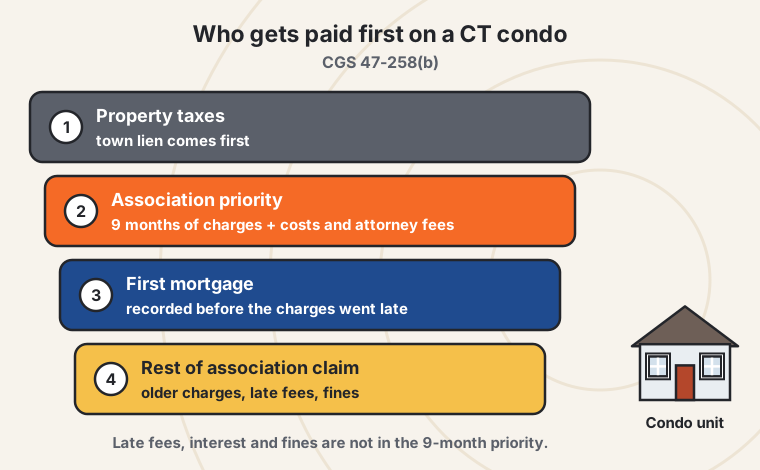
| Rank | Claim on the unit | Rule |
|---|---|---|
| 1 | Property taxes and other government charges | CGS 47-258(b)(3); 12-172 |
| 2 | Association priority: 9 months of budgeted common charges (no late fees, interest or fines) plus enforcement costs and reasonable attorney’s fees | CGS 47-258(b) |
| 3 | First and second mortgages recorded before the charges went delinquent | CGS 47-258(b)(2) |
| 4 | The rest of the association’s claim (older charges, late fees, fines, interest) | CGS 47-258(a), (b) |
In plain terms: if the association forecloses and you do nothing, it can take your ownership interest. Your mortgage stays on the unit, and in general your personal promise to repay that loan does not go away. You can lose the unit and still owe the mortgage. That is the single biggest reason not to let an association case run.
What must a Connecticut condo association do before it can foreclose?
Before it can foreclose, a Connecticut condo association must meet four conditions in CGS 47-258(m): you owe at least two months of common charges under the current budget; it has demanded payment in a record and sent a copy to your mortgage holder; the board has voted to foreclose on your unit or adopted a standard policy that covers it; and it has mailed your mortgage holder a 60-day notice of intent to foreclose.
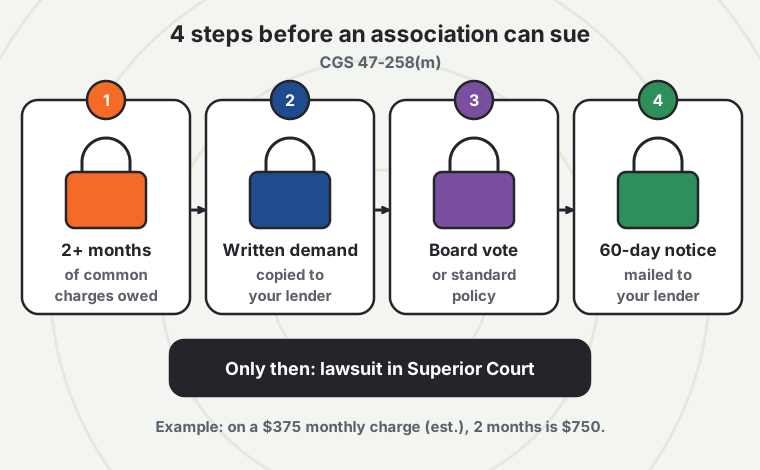
- Two months owed. The balance must equal at least two months of common charges under the last adopted budget. On a $375 monthly charge (est.), that is $750.
- A demand in a record, copied to your lender. A written or electronic demand to you, with a copy sent at the same time to your first or second mortgage holder.
- A specific board decision. Either a vote to foreclose on your unit or a standard policy that provides for it. Connecticut’s Appellate Court has held that authorizing “collections” is not enough.
- A 60-day notice to the mortgage holder. By first-class mail, stating the charges, the attorney’s fees so far, the intent to foreclose if unpaid within 60 days, a contact person, and how to pay.
Two more rules help owners. The lien is extinguished unless the association starts proceedings within three years after the charges become due (CGS 47-258(e)). And every part of a foreclosure, sale or other disposition must be “commercially reasonable” (47-258(n)). If an association skipped a step, an attorney can raise it; Connecticut courts have treated these conditions as requirements the association must strictly meet.
What the statute does not do is give you a right to a payment plan. Associations are not required to accept one, but most would rather be paid than litigate. Ask in writing, early, before attorney’s fees pile up.
What does a condo association foreclosure put at risk on a West Hartford unit?
A condo association foreclosure puts the whole equity at risk on a West Hartford unit, often for a small debt. In our example, an owner about $6,500 behind on charges, fees and the association’s legal costs has about $123,885 of equity in a $332,000 unit after a sale. Paying, agreeing a plan or selling protects that; letting a strict foreclosure run can lose it.
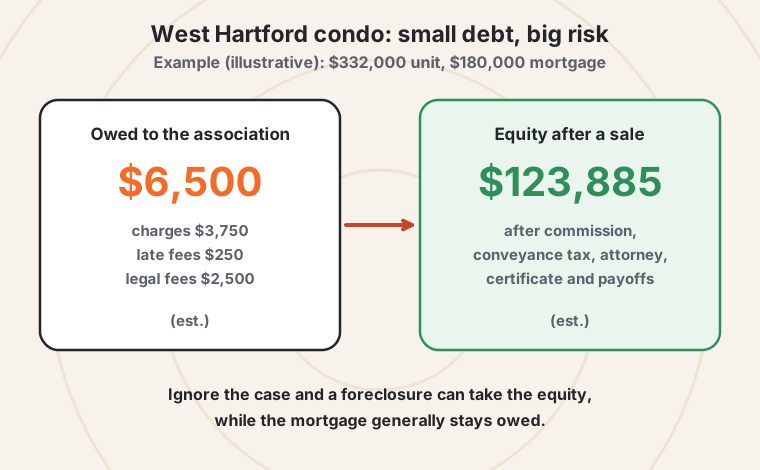
Example (illustrative). A two-bedroom West Hartford condo at the town’s $332,000 condo median, $375 a month in common charges (est.), a $180,000 mortgage (est.), and the owner ten months behind on charges.
| Line | Amount | Basis |
|---|---|---|
| Unpaid charges, 10 months x $375 | $3,750 | Assumption |
| Late fees | $250 (est.) | Per the declaration and rules |
| Association’s attorney’s fees and costs so far | $2,500 (est.) | CGS 47-258(a), (g) |
| Owed to the association | $6,500 (est.) | Grows each month the case runs |
| Of which ahead of the mortgage | $3,375 + costs and fees | 9 x $375 (CGS 47-258(b)) |
| If you sell the unit | ||
| Sale price | $332,000 | West Hartford condo median (CT OPM) |
| Commission at 5% | -$16,600 (est.) | Negotiable |
| Conveyance tax, 0.75% state + 0.25% West Hartford | -$3,320 | CGS 12-494 |
| Seller’s attorney | -$1,500 (est.) | Estimate |
| Resale certificate, electronic copies | -$195 | $185 + $10 (CGS 47-270(b)) |
| Mortgage payoff | -$180,000 (est.) | Assumption |
| Association balance paid at closing | -$6,500 (est.) | From above |
| Left to you | about $123,885 (est.) | Before the tax proration |
Do not forget the town bill. West Hartford’s 46.77 mill rate means about $10,870 a year in property tax on a $332,000 unit (on a 70% assessment), about $906 a month, on top of the common charges. If both are behind, see our guide to property tax foreclosure in Connecticut and our page on selling a house with tax liens.
How much would you walk away with?
Slide the numbers to match your house. It works in your browser; nothing is saved or sent.
Estimates for planning. Conveyance tax per CGS 12-494 (state 0.75% up to $800,000, 1.25% to $2.5M, 2.25% above, plus the town rate). Seller attorney about $1,200 to $1,500; flat-fee MLS about $400; listings include three months of taxes, insurance and utilities, a cash sale about two weeks. Your attorney gives you the final numbers.
How can a West Hartford condo owner stop an association foreclosure?
A West Hartford condo owner can stop an association foreclosure by paying the balance with fees, by agreeing a written payment plan the association accepts before or during the case, by asking the mortgage servicer whether it will advance the charges, or by selling the unit and paying the association at closing. If a judgment is entered, paying the full amount before Law Day still ends it.
- Ask for the exact number. Request, in writing, a statement of unpaid assessments. The association must furnish it within ten business days, and it is binding on the association (CGS 47-258(h)).
- Propose a plan in writing. Offer to pay the current month plus a fixed amount toward arrears, starting now. Keep paying the current charge no matter what; a growing balance weakens any plan.
- Call your mortgage servicer. Because the association’s priority ranks ahead of the mortgage, many lenders pay the charges to protect their loan and add them to your balance or escrow. That is a debt you still owe, but it may stop the lawsuit.
- Get advice if the association skipped a step. The 47-258(m) conditions are strictly enforced.
- If you cannot afford the charges and the taxes going forward, sell. A sale pays the association and the mortgage at closing and keeps the equity. Our page on selling your house before foreclosure in Connecticut explains how a sale ends a pending case.
For the Law Day mechanics if the case reaches judgment, see Law Day in Connecticut. For the bigger foreclosure picture, see the Connecticut foreclosure guide.
What are the honest options for a West Hartford condo owner, and when should you NOT sell to a cash buyer?
The honest options for a West Hartford condo owner behind on common charges are to pay or agree a plan and stay, to list the unit, to sell it as-is for cash, or, if the mortgage exceeds the value, to work out a short sale with the lender. You should NOT sell to a cash buyer if a plan makes the charges affordable, or if the unit shows well and you have time to list.
When you should NOT sell to a cash buyer
- The shortfall is a few months and you can catch up. A plan costs far less than a discount on the unit.
- The unit is updated and the complex is healthy. A listing usually nets more than any cash offer, including mine.
- You owe more than the unit is worth. The lender has to approve a short sale; see short sale vs. foreclosure.
Is a cash sale right for you, or should you list?
Seven quick questions. There is no wrong answer, and we will tell you honestly if listing would leave you more.
- Does the house need repairs you would rather not pay for or manage?
- Do you need to close by a certain date, or within the next month or two?
- Would showings be hard: tenants, belongings, privacy, or you live out of state?
- Is there a complication: an estate or probate, a divorce, foreclosure, liens or back taxes?
- Could you comfortably cover the mortgage, taxes and utilities for three or more months?
- Is getting the highest possible price more important to you than speed and certainty?
- Would a buyer's bank lend on the house as it is (no major roof, foundation, oil tank or code issues)?
Where can a West Hartford condo owner get free help?
A West Hartford condo owner can get free help from a HUD-approved housing counselor, the Connecticut Department of Banking foreclosure hotline, and the Connecticut Fair Housing Center’s attorney consultations. Because court mediation does not cover condo-lien cases, early written contact with the association’s manager or attorney is the most useful first step after that.
Call a HUD-approved housing counselor at 1-800-569-4287 or the Connecticut Department of Banking foreclosure hotline at 1-877-472-8313. The Connecticut Fair Housing Center offers short attorney consultations at 1-888-247-4401. If your mortgage is also behind and a lender has sued, the Judicial Branch’s free Foreclosure Mediation Program covers that mortgage case if you file within 15 days of its return date (jud.ct.gov/foreclosure). Nobody legitimate charges an upfront fee to stop a foreclosure or asks you to sign your deed over outside a closing with attorneys (CGS 36a-671).
What should a West Hartford condo owner do this week?
This week, a West Hartford condo owner behind on common charges should request a written statement of the balance, pay the current month, send a written payment-plan proposal, call the mortgage servicer and a free counselor, and decide honestly whether the unit is affordable with the charges and taxes going forward.
Get the number in writing
Ask the association for a statement of unpaid assessments (CGS 47-258(h)).
Pay the current charge
Even if you cannot pay the arrears, stop the balance growing.
Propose a plan
In writing, with a start date and an amount you can keep paying.
Check the whole budget
Charges, the town tax bill (about $10,870 a year on a $332,000 unit), the mortgage and insurance. If it does not fit for the next year, plan a sale now, not after a judgment.
If you sell, sell before judgment
List, or get a written as-is offer. If you sell to us, there is no fee, no repairs, no showings; the association and the mortgage are paid at closing, and you pick the date, typically about two weeks out.

With condos, the debt is rarely the problem; the legal fees are. A few months of charges is a fixable number. A year of letters, a lawsuit and two sets of attorney’s fees is not. Whatever you decide, decide it while the balance is still small.
If you want a written number for a West Hartford condo or house, start on our West Hartford page. If a mortgage lender has also filed, see selling a house in foreclosure in Connecticut.
See the house together.
Pick a time that works.
Choose a time for us to walk through the property with you, or ask for a quick call first. We confirm every request personally.
Tuesday, January 13
No open times in the next few weeks. Please call us.
We will confirm by email. Nothing is booked until we do.
View my requestQuestions about condo association foreclosure in Connecticut
Can my HOA or condo association take my house in Connecticut?
Yes, your HOA or condo association can take your house in Connecticut by foreclosing its lien for unpaid assessments under CGS 47-258, but only after the conditions in 47-258(m) are met. Paying the full balance before Law Day ends the case.
How much do I have to owe before a Connecticut condo association can foreclose?
You have to owe at least two months of common charges, based on the association’s last adopted budget, before a Connecticut condo association can start a foreclosure (CGS 47-258(m)(1)(A)). It also needs a written demand, a board vote or standard policy, and a 60-day notice to your mortgage holder.
Does the condo lien come before my mortgage?
Part of it does. Nine months of regular common charges plus the association’s costs and reasonable attorney’s fees rank ahead of a mortgage recorded before the charges became delinquent (CGS 47-258(b)). The rest ranks behind the mortgage.
Can I use Connecticut’s foreclosure mediation program against my condo association?
No, Connecticut’s foreclosure mediation program does not cover condo association lien foreclosures; the Judicial Branch says those cases are not eligible. You negotiate directly with the association or its lawyer.
Can the condo association charge me its lawyer’s fees?
Yes, the condo association can charge you its reasonable attorney’s fees and costs; they are enforceable like assessments, and a judgment includes them (CGS 47-258(a), (g)). That is why early payment plans save money.
If the association forecloses, do I still owe my mortgage?
In general, yes. An association foreclosure takes your ownership, but your mortgage lien stays on the unit and your personal obligation on the loan usually remains. Ask a Connecticut attorney about your specific loan.
Can I sell my condo while the association is foreclosing?
Yes, you can sell your condo while the association is foreclosing. The association’s balance, fees included, is paid from the proceeds at closing, which ends the case. You will need a resale certificate (CGS 47-270).
Can I stop paying common charges because the association will not fix a problem?
You should not stop paying common charges over a repair dispute. Connecticut’s Appellate Court has held that constructive eviction is not a defense to an association’s collection action under 47-258, so the fees and the risk keep growing while you argue. Dispute the repair separately.
Related guides
Foreclosure stages
Other kinds of foreclosure
Near West Hartford
To compare every route for selling, see how to sell a house in Connecticut.
Plain-English information, not legal advice. Talk to a Connecticut attorney about your association’s documents and your case. The West Hartford example uses public data and labeled estimates.
Sources (checked on October 27, 2026)
- CGS chapter 828 (Common Interest Ownership Act): 47-216, 47-258 (lien, priority, foreclosure conditions), 47-270 (resale certificate).
- Judicial Branch Foreclosure Mediation Program FAQ (condominium-lien cases not eligible).
- CGS 51-344, 51-345 (Hartford judicial district; foreclosure venue).
- CT OPM Real Estate Sales (data.ct.gov): West Hartford sales October 2024 to September 2025, condo subset (our query).
- CT OPM mill rates (West Hartford fiscal 2027: 46.77).
- CGS 12-494 (conveyance tax).
- CGS 12-62a (70% assessment).
- Connecticut Department of Banking.

Who wrote this
Jerryll Noorden
Jerryll has bought and sold Connecticut houses since 2016 and has sat at more closing tables than he can count, on both sides. Before real estate he was a robotics scientist at NASA, IHMC and IIT. He wrote this guide because the national sites that rank for it skip the Connecticut rules that cost sellers money. When listing or selling it yourself would get you more than a cash offer, he says so.
This guide explains Connecticut rules in plain English. It is not legal or tax advice. Laws change; for your sale, talk to a Connecticut real estate attorney and a tax professional.
