
Key facts at a glance
This Bethany guide is part of our series on how to sell a house in Connecticut. It covers one kind of foreclosure: a reverse mortgage (an FHA-insured HECM) that has become due because the borrower died, moved out, or fell behind on taxes or insurance.
| Fact | Number | Source |
|---|---|---|
| When a HECM becomes due | Last borrower dies or sells; not the principal residence; away more than 12 months in a row for illness; taxes or insurance unpaid | 24 CFR 206.27(c) |
| Time to respond to a due-and-payable notice | 30 days to pay, sell, give a deed in lieu, or fix the problem | 24 CFR 206.125(a)(2) |
| Price that settles an underwater HECM | At least the lesser of the balance or 95% of the appraised value | 24 CFR 206.125(a)(2), (c); HUD heirs flyer |
| Lender must start foreclosure | Within 6 months of the due date, unless HUD approves more time | 24 CFR 206.125(d) |
| Court mediation for heirs of a reverse mortgage borrower | Not eligible | CGS 49-31k(1) |
| Court and probate district for Bethany | New Haven judicial district (Ansonia-Milford also possible); Hamden-Bethany Probate District | CGS 51-344, 51-345(b); ctprobate.gov |
| Bethany median single-family sale price, Oct 2024 to Sep 2025 | $481,450 (67 residential sales) | CT OPM Real Estate Sales, data.ct.gov |
| Bethany mill rate, fiscal 2027 | 29.99 mills (about $10,110 a year on $481,450) | CT OPM mill rates; CGS 12-62a |
Why does a reverse mortgage letter feel so hard to deal with in Bethany?
A reverse mortgage letter feels hard to deal with in Bethany because it usually arrives in the middle of grief or a health crisis, says the whole loan is due, and gives only 30 days to answer. Families in this spot often feel grief-stricken, guilty, rushed, confused about whether they owe the debt personally, and wary of anyone who calls about the house.
Bethany is a small town: 67 residential sales in the year to September 2025, mostly colonials, ranches and capes, about 83% of them heated by oil. Many owners have lived there for decades, which is the profile of a reverse mortgage borrower.
If a parent had a reverse mortgage on a Bethany house and has died or moved to care, or you are the borrower and taxes or insurance are behind, this page is for you. You may feel grief and not want to think about a loan at all, guilt about selling the family home, panic at a 30-day deadline, fear that you will inherit a debt bigger than the house, and skepticism toward the servicer.
I am Jerryll Noorden. I buy houses in Connecticut, about ten a year since 2016, including houses from estates. Here is the most important sentence on this page: with an FHA-insured reverse mortgage, the family does not have to pay more than the house is worth, and the deadlines can usually be extended if you are actively working on a sale or payoff. You have more room than the letter suggests, but you must answer it.
When does a reverse mortgage become due and lead to foreclosure in Connecticut?
A reverse mortgage becomes due in Connecticut when the last borrower dies (unless an eligible non-borrowing spouse qualifies for a deferral), when the borrower sells or gives away the house, when it stops being the borrower’s principal residence, when the borrower is away for more than 12 consecutive months for illness, or when property taxes, insurance or other obligations are not met (24 CFR 206.27(c)). If it is not resolved, the lender forecloses.
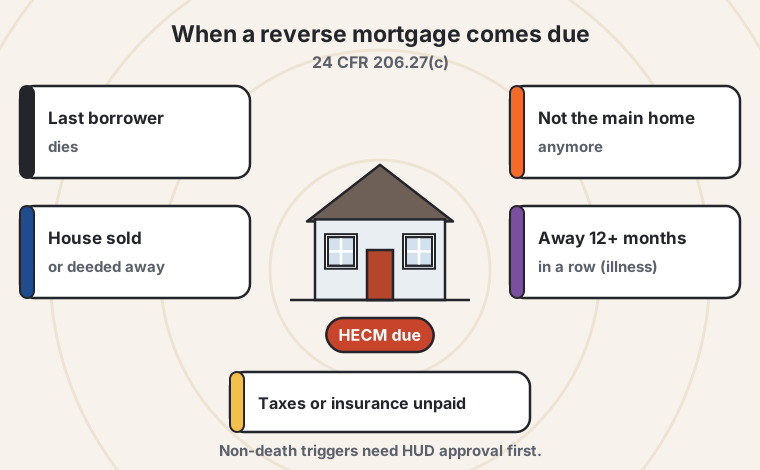
For triggers other than death or a sale, the lender needs HUD approval (24 CFR 206.27(c)(2)). The ones Bethany families meet most:
- Death of the last borrower. The most common. The estate or heirs get a due-and-payable notice.
- A move to assisted living or a nursing home. If the borrower is out of the house for more than 12 consecutive months for health reasons and no other borrower lives there, the loan can be called.
- Unpaid property charges. Bethany’s tax on a median house is about $10,110 a year. If the borrower stops paying it or the homeowners insurance, the servicer may pay them and then seek to call the loan. This trigger can happen while the borrower still lives there.
A spouse who was not on the loan may be able to stay. HUD’s heirs flyer says an eligible non-borrowing spouse must give the lender a Non-Borrowing Spouse Certification within 30 days of the last borrower’s death, among other requirements. If that is you, call the servicer before anything else.
What are the options for heirs when a reverse mortgage on a Bethany house comes due?
When a reverse mortgage on a Bethany house comes due, the heirs or estate can pay off the loan and keep the house, sell the house and pay the loan from the sale, sell for at least 95% of the appraised value if the loan exceeds the value, or give the lender a deed in lieu of foreclosure. Under HUD rules the lender accepts the net proceeds of a qualifying sale as satisfaction of the loan.
| Option | How it works | Best when |
|---|---|---|
| Pay it off and keep the house | Pay the lesser of the full balance or 95% of the current appraised value, often with a new mortgage. HUD treats a transfer after death as a sale for this rule. | Someone in the family wants to live there and can qualify for financing |
| Sell with equity | Sell at market, pay the full balance at closing, the estate keeps the rest | The house is worth more than the balance |
| Sell when underwater | Sell for at least 95% of the appraised value; the lender accepts the net proceeds | The balance is higher than the value |
| Deed in lieu | Sign the house over to the lender | No equity and nobody wants to manage a sale |
Interest and mortgage insurance add up over the years, so after a long life in the house the balance can exceed the value. The 95% rule means the family does not make up the difference.
If the house has equity, it belongs to the estate. Selling it for full value is the way to protect that, and a deed in lieu or foreclosure would throw it away. Our page on selling your house before foreclosure in Connecticut explains how a sale stops the case at closing.
How much time do heirs have before a reverse mortgage foreclosure in Connecticut?
Heirs have 30 days from the lender’s due-and-payable notice to choose an option, and HUD says the lender may approve 90-day extensions when the estate or heirs document that they are actively selling or arranging a payoff. HUD rules also require the lender to start foreclosure within six months of the due date unless HUD approves more time (24 CFR 206.125). In Connecticut, the foreclosure itself then runs through Superior Court.
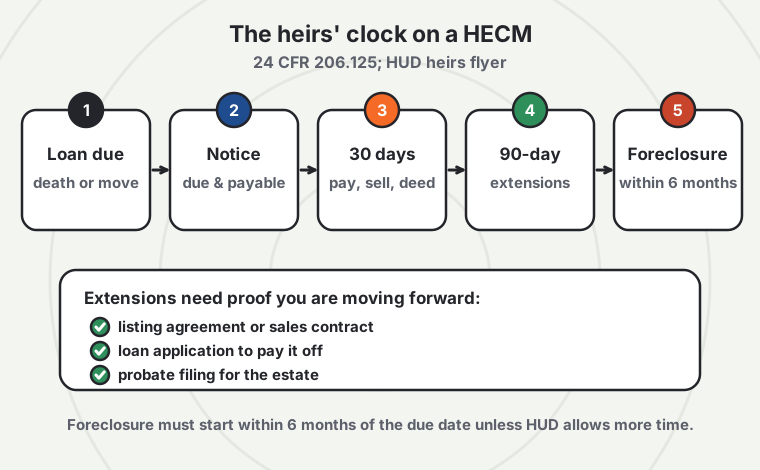
Documentation buys time: a listing agreement, a contract, a loan application or a probate filing is what a servicer needs to approve an extension. Silence leads to a foreclosure filing.
Two Connecticut facts matter here:
- Probate. If the parent owned the Bethany house alone, the estate usually needs a probate case; the small-estate affidavit cannot be used for solely owned real estate (CGS 45a-273). Bethany is in the Hamden-Bethany Probate District (PD-37), which sits in Hamden. A fiduciary can sell during probate with the court’s authority (CGS 45a-164). Start the probate filing early; it is often the slowest part. Our guide to selling a house in probate in Connecticut covers the steps.
- Court. A foreclosure on a Bethany house is filed in Superior Court for the New Haven judicial district, or, when a party lives in Bethany, the lender can choose Ansonia-Milford (CGS 51-345(b)). For what happens once a judgment and Law Day are set, see Law Day in Connecticut.
Is Connecticut foreclosure mediation available for a reverse mortgage?
Connecticut foreclosure mediation is available for a reverse mortgage only in limited cases. A living borrower who still owns and lives in the house as a primary residence can generally request it like any other mortgagor. But the statute excludes an heir or occupying non-owner of a property with a reverse annuity mortgage (CGS 49-31k(1)), so adult children who inherit usually cannot use it.
In plain English:
- Borrower still at home, behind on taxes or insurance: as the owner-occupant borrower, mediation is generally available if you file the forms within 15 days of the return date (CGS 49-31l). Our foreclosure mediation guide explains the forms and what to bring.
- Heirs after a death: excluded as “an heir or occupying nonowner of a property encumbered by a reverse annuity mortgage”; heirs work directly with the servicer under HUD’s rules.
If the trigger is unpaid property taxes and the borrower wants to stay, ask the servicer what repayment options it can offer, and ask Bethany’s assessor about tax relief for older or disabled homeowners (CGS 12-170aa).
What does a reverse mortgage payoff or sale look like with Bethany numbers?
With Bethany numbers, a reverse mortgage payoff or sale looks like this in our example: on a $481,450 house, the town’s single-family median, a $300,000 balance leaves the estate about $151,063 after a listed sale, while a $520,000 balance means the house can be sold or kept for $457,378, 95% of the value, and the family owes nothing more.
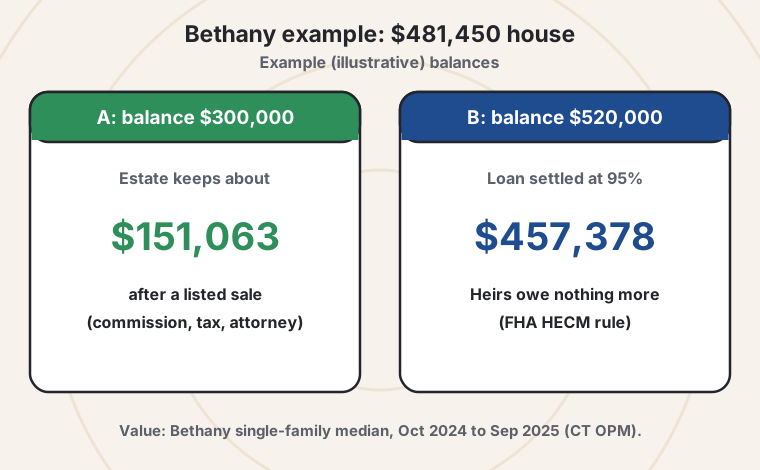
| Line | Case A: balance $300,000 | Case B: balance $520,000 |
|---|---|---|
| Appraised value | $481,450 | $481,450 |
| Price needed to settle the loan | Full balance, $300,000 | 95% of value: $457,378 |
| Commission at 5% (if listed at value) | -$24,073 (est.) | Paid from the sale; the lender takes the net |
| Conveyance tax, 0.75% state + 0.25% Bethany | -$4,815 | Paid from the sale; the lender takes the net |
| Estate’s attorney | -$1,500 (est.) | – |
| To the estate | about $151,063 (est.) | $0, and nothing more owed |
While the family decides, HUD’s flyer says taxes and insurance remain the estate’s responsibility until title is transferred: about $10,110 a year ($840 a month) in Bethany tax on the median house, plus insurance, oil heat and upkeep. Our guide to the carrying costs of a vacant house in Connecticut has a monthly worksheet.
How much would you walk away with?
Slide the numbers to match your house. It works in your browser; nothing is saved or sent.
Estimates for planning. Conveyance tax per CGS 12-494 (state 0.75% up to $800,000, 1.25% to $2.5M, 2.25% above, plus the town rate). Seller attorney about $1,200 to $1,500; flat-fee MLS about $400; listings include three months of taxes, insurance and utilities, a cash sale about two weeks. Your attorney gives you the final numbers.
What are the honest options for a Bethany family, and when should you NOT sell to a cash buyer?
The honest options for a Bethany family with a due reverse mortgage are to refinance and keep the house, list it for full value, sell it as-is for cash, sell at 95% of value if the loan is underwater, or give a deed in lieu. You should NOT sell to a cash buyer if the house has equity, the servicer is granting extensions, and the house can be listed; a listing usually nets more.
When you should NOT sell to a cash buyer
- The house has real equity and you have time. In Case A above, a listing at full value is how the estate keeps the most, not a discounted cash sale, including to me.
- The loan is underwater. The lender sets the minimum (95% of appraised value), so a discount does not help the family; any qualified buyer at that price works.
- A family member wants the house and can finance it. Keep it.
A cash sale fits when the house needs major work, heirs live far away, or the servicer’s patience is running out. See also our guide to an inherited house in Connecticut and selling an inherited house.
Where can a Bethany family get free help with a reverse mortgage?
A Bethany family can get free help with a reverse mortgage from a HUD-approved housing counselor, the FHA Resource Center at (800) 225-5342, the Connecticut Department of Banking, and the Connecticut Fair Housing Center’s attorney consultations. A probate attorney for the estate is also worth the fee, because the estate usually signs the sale.
Call a HUD-approved housing counselor at 1-800-569-4287 or the FHA Resource Center at (800) CALL-FHA, (800) 225-5342, for the HUD rules on your loan. The Connecticut Department of Banking foreclosure hotline is 1-877-472-8313, and the Connecticut Fair Housing Center offers short attorney consultations at 1-888-247-4401. If you are the borrower still living in the house and have been sued, file for the Judicial Branch’s free Foreclosure Mediation Program within 15 days of the return date. Nobody legitimate charges an upfront fee to deal with a reverse mortgage servicer or asks the family to sign over the deed outside a closing with attorneys (CGS 36a-671).
What should a Bethany family do in the first 30 days?
In the first 30 days after a reverse mortgage comes due, a Bethany family should call the servicer to report the situation and ask for the payoff and appraisal, open probate in the Hamden-Bethany Probate District if needed, decide whether to keep or sell, put that decision in writing to the servicer with proof, and keep taxes and insurance current.
Call the servicer and write it down
Report the death or move; ask for the balance, the due date, an appraisal and how to request extensions.
Open probate if needed
In the Hamden-Bethany Probate District; the fiduciary signs for the estate.
Protect the house
Keep insurance (tell the insurer it is vacant), heat and the Bethany tax bill current.
Decide: keep, list, or sell as-is
Compare the balance with the appraisal. Send the servicer your plan and proof: a loan application, a listing agreement or a contract.
Close and settle the loan
The attorneys pay the servicer at closing. If you sell to us, there is no fee, you can leave the contents, and you pick the date, typically about two weeks out or after the probate court authorizes the sale.

Call the servicer in the first week, even if all you can say is “we are opening probate and will decide by next month.” Servicers work with families who communicate.
If you want a written number for a Bethany house, start on our Bethany page. For how a sale works once a foreclosure has been filed, see selling a house in foreclosure in Connecticut.
See the house together.
Pick a time that works.
Choose a time for us to walk through the property with you, or ask for a quick call first. We confirm every request personally.
Tuesday, January 13
No open times in the next few weeks. Please call us.
We will confirm by email. Nothing is booked until we do.
View my requestQuestions about reverse mortgage foreclosure in Connecticut
Do heirs have to pay off a reverse mortgage in Connecticut?
Heirs do not have to pay off a reverse mortgage personally in Connecticut. They can pay it and keep the house, sell, or give a deed in lieu (24 CFR 206.125).
How long do heirs have after a reverse mortgage borrower dies?
Heirs have 30 days from the lender’s due-and-payable notice to respond, and HUD says the lender may approve 90-day extensions with proof that the heirs are actively selling or arranging a payoff. HUD rules require the lender to begin foreclosure within six months of the due date unless HUD approves more time.
Can heirs keep the house with a reverse mortgage?
Yes, heirs can keep a house with a reverse mortgage by paying the loan off, usually with a new mortgage. For an FHA HECM, they can pay the lesser of the full balance or 95% of the current appraised value, because HUD treats a transfer after death as a sale.
Can a reverse mortgage be foreclosed while the borrower is still alive?
Yes, a reverse mortgage can be foreclosed while the borrower is alive if the borrower stops paying property taxes or insurance, moves out, or is away more than 12 consecutive months for illness, with HUD’s approval (24 CFR 206.27(c)).
Can heirs use Connecticut’s foreclosure mediation program on a reverse mortgage?
Usually not. Connecticut’s mediation statute excludes “an heir or occupying nonowner of a property encumbered by a reverse annuity mortgage” (CGS 49-31k(1)). A living borrower who still owns and lives in the house can generally request mediation.
Will I owe the difference if the reverse mortgage is more than the house is worth?
No, with an FHA-insured HECM you will not owe the difference if you sell for at least 95% of the appraised value; HUD says the lender will accept the net proceeds as satisfaction of the loan. Proprietary (non-FHA) reverse mortgages have their own terms.
Does a reverse mortgage house in Bethany have to go through probate?
A reverse mortgage house in Bethany usually has to go through probate if the borrower owned it alone, because Connecticut’s small-estate affidavit cannot be used for solely owned real estate (CGS 45a-273). The case is filed in the Hamden-Bethany Probate District.
Can a surviving spouse stay in the house after the borrower dies?
A surviving spouse who was a borrower can stay. A non-borrowing spouse may be able to stay under HUD’s deferral if eligible, but must give the lender a Non-Borrowing Spouse Certification within 30 days of the last borrower’s death, among other requirements.
Related guides
Foreclosure stages
Other kinds of foreclosure
Near Bethany
To compare every route for selling, see how to sell a house in Connecticut.
Plain-English information, not legal advice. Talk to a Connecticut attorney and a HUD-approved counselor about your loan. The Bethany example uses public data and labeled estimates.
Sources (checked on October 27, 2026)
- 24 CFR part 206: 206.27(c) (when a HECM becomes due), 206.125 (heirs’ options, 95% rule, foreclosure timing).
- HUD, Inheriting a Home Secured by an FHA-insured HECM (2019).
- CGS chapter 846: 49-24a (market sale excludes reverse mortgages), 49-31k, 49-31l (mediation).
- CGS 51-344, 51-345 (New Haven judicial district; Bethany venue option).
- Connecticut Probate Courts directory (Hamden-Bethany Probate District, PD-37).
- CGS 45a-164 and CGS 45a-273 (probate sale; small-estate limits).
- CGS 12-494 (conveyance tax).
- CGS 12-170aa (tax relief for elderly or totally disabled homeowners).
- CT OPM Real Estate Sales (data.ct.gov): Bethany sales October 2024 to September 2025.
- CT OPM mill rates (Bethany fiscal 2027: 29.99).

Who wrote this
Jerryll Noorden
Jerryll has bought and sold Connecticut houses since 2016 and has sat at more closing tables than he can count, on both sides. Before real estate he was a robotics scientist at NASA, IHMC and IIT. He wrote this guide because the national sites that rank for it skip the Connecticut rules that cost sellers money. When listing or selling it yourself would get you more than a cash offer, he says so.
This guide explains Connecticut rules in plain English. It is not legal or tax advice. Laws change; for your sale, talk to a Connecticut real estate attorney and a tax professional.
