
Key facts at a glance
This Windsor guide is part of our series on how to sell a house in Connecticut. It covers one kind of foreclosure: a town, or a company that bought the town’s lien, foreclosing on a house for unpaid property taxes, even when there is no mortgage at all.
| Fact | Number | Source |
|---|---|---|
| Interest on late Connecticut property tax | 18% a year (1.5% a month; any part of a month counts as a month) | CGS 12-146 |
| Windsor tax due date; interest starts | Due July 1; interest if paid after August 1, from the due date | Town of Windsor tax collector FAQ |
| Tax lien rank | Ahead of all transfers and encumbrances, including mortgages | CGS 12-172 |
| Who can foreclose a tax lien | The town’s tax collector, or an assignee that bought the lien | CGS 12-181, 12-195h |
| Earliest an assignee can sue (liens assigned after July 1, 2022) | 1 year after it bought the lien | CGS 12-195h(c)(2) |
| Redemption after a tax sale | Up to 6 months, paying 18% a year on the purchase price | CGS 12-157(f) |
| Windsor median single-family sale price, Oct 2024 to Sep 2025 | $350,000 (393 residential sales) | CT OPM Real Estate Sales, data.ct.gov |
| Windsor mill rate, fiscal 2027 | 28.88 mills (about $7,080 a year on $350,000) | CT OPM mill rates; CGS 12-62a |
Why does a property tax foreclosure notice feel so different from a bank foreclosure?
A property tax foreclosure notice feels different from a bank foreclosure because it comes from your own town, often on a house you own free and clear, and the amount can look small next to the value at risk. Windsor owners in this spot often feel ashamed, shocked that the town would take a house, overwhelmed by interest that keeps growing, and frozen about whom to call.
Many Windsor owners who fall behind on taxes have no mortgage, so no escrow account pays the bill and no servicer sends reminders. It happens after a death, a job loss, a long illness, or when an older owner stops opening mail.
If you have a delinquent tax bill, a letter from Windsor’s tax collector, or a notice from a company saying it now holds your town’s lien, this page is for you. You probably feel ashamed, afraid of losing a paid-off house, trapped by 18% interest, suspicious of the company that bought your lien, and stuck because you do not know what is negotiable.
I am Jerryll Noorden. I buy houses in Connecticut, about ten a year since 2016. Here is the calm version: a tax foreclosure is slow, the town would much rather be paid than own your house, and there are payment and deferral options most people never hear about. If those do not work, a sale pays the taxes at closing and leaves the rest of the equity with you.
How fast does unpaid property tax grow in Windsor, CT?
Unpaid property tax in Windsor, CT grows at 18% a year, charged as 1.5% a month from the original due date, with any part of a month counted as a full month (CGS 12-146). On Windsor’s median single-family tax of about $7,080, one year unpaid adds about $1,274 of interest, and two unpaid years total about $17,983 before lien and collection fees.
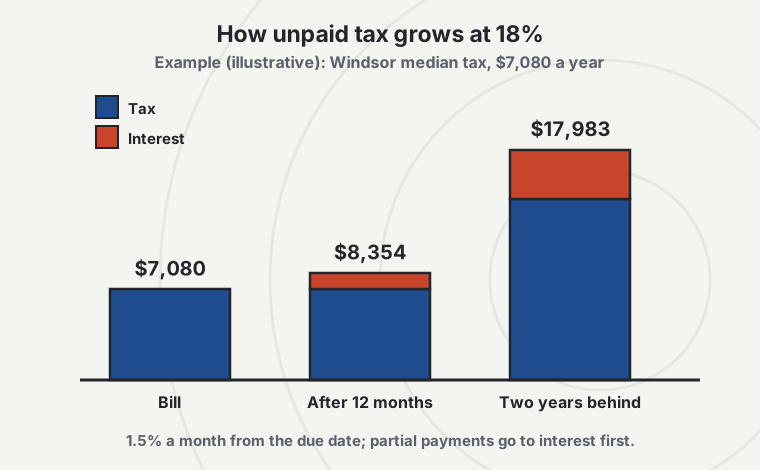
Three rules in CGS 12-146 make this worse than it looks:
- Interest runs from the due date. Windsor’s FAQ says taxes are due July 1 and anything paid after August 1 owes interest from July 1. Pay on August 2 and you owe two months.
- Partial payments go to interest first. The collector must apply each partial payment to interest before principal. Windsor accepts partial payments, but the principal shrinks slowly.
- Interest cannot be waived. Windsor’s FAQ says the state does not allow anyone to waive it. Interest keeps running even after a court judgment.
| Example (illustrative) | Tax | Interest at 1.5% a month | Total |
|---|---|---|---|
| Year 1 bill, unpaid 24 months | $7,080 | $2,548.80 | $9,628.80 |
| Year 2 bill, unpaid 12 months | $7,080 | $1,274.40 | $8,354.40 |
| Two years behind | $14,160 | $3,823.20 | $17,983.20 |
How can Windsor or a lien buyer foreclose for unpaid property taxes?
Windsor or a lien buyer can enforce unpaid property taxes in three main ways: the tax collector can sue to foreclose the tax lien in Superior Court (CGS 12-181); the collector can hold a tax sale at auction, after which you have up to six months to redeem (CGS 12-157); or the town can sell its liens to a private assignee, which then has the same right to foreclose (CGS 12-195h).

| Road | How it works | Your window | Rule |
|---|---|---|---|
| Town tax lien foreclosure | The collector sues in Superior Court (Hartford judicial district for Windsor). The court can set law days, order a sale, or enter another equitable decree. | Until your law day or the sale is approved | CGS 12-181 |
| Tax sale | The collector levies on the property and auctions it after notice. The deed is held unrecorded for six months. | Up to 6 months after the sale (or 60 days for abandoned property, if the town has that ordinance). You repay the taxes, interest and charges, plus 18% a year on the buyer’s full price. | CGS 12-157 |
| Lien assignment | The town sells its liens. The assignee steps into the town’s shoes, including interest, fees and the right to foreclose or sue on the debt. | For liens assigned on or after July 1, 2022, no foreclosure until 1 year after purchase; notice of assignment within 60 days | CGS 12-195h |
Two differences from a mortgage foreclosure: the court’s free mediation program does not cover tax-lien cases, and a tax lien comes ahead of your mortgage (CGS 12-172). If you have a mortgage, the lender will usually pay the taxes to protect itself and then treat it as a default on the loan, which turns this into a mortgage problem; our guide to being behind on mortgage payments covers that.
A tax sale is the harshest road, because the redemption price includes 18% a year on whatever the winning bidder paid. If the sale brings in more than the taxes, interest and costs, the excess is held in escrow and, if the property is not redeemed, can be claimed (CGS 12-157(i)). Under the U.S. Supreme Court’s 2023 Tyler v. Hennepin County decision, a government cannot keep surplus equity beyond the tax debt; ask an attorney how that applies to your case.
What changes if Windsor sold your tax lien to a private company?
If your tax lien was sold to a private company, that assignee has the same lien priority, interest and collection rights the town had, including the right to foreclose and to add fees and attorney’s fees, but for assignments made on or after July 1, 2022 it must follow a written contract with the town, give you notice within 60 days, wait at least a year before suing, and keep every step “commercially reasonable” (CGS 12-195h).
We have not confirmed that Windsor assigns liens. If a company says it holds yours:
- Check it with the town. Call Windsor’s tax office (860-285-1810) to confirm the assignment and the amount. The assignee must provide a payoff statement like a mortgage lender (12-195h(b)).
- Ask for the contract terms. The town’s contract must state the assignee’s contact details, the earliest and latest dates it can sue, and its attorney’s fee structure. You are a third-party beneficiary who can enforce it (12-195h(c)).
- Act before suit. Attorney’s fees in a lien foreclosure can exceed the tax itself.
For selling with any lien, see our guide to selling a house with a lien in Connecticut.
How can a Windsor homeowner stop a property tax foreclosure?
A Windsor homeowner can stop a property tax foreclosure by paying the full balance with interest and fees; by agreeing a payment arrangement with the tax collector or the lien holder and keeping current bills paid; by applying for deferred collection or tax relief where eligible; or by selling the house and paying the lien at closing. Redemption remains possible until the law day passes or the tax sale’s redemption period ends.
- Payment arrangements. Windsor accepts partial payments, though interest still runs. Ask the tax office what written arrangement it will accept that pauses a sale or lawsuit, and get it in writing.
- Deferred collection (CGS 12-174). An owner can file an affidavit showing “unusual financial or other circumstances” within 90 days after the first installment is due. If the town council approves within 60 days, the lien is continued for up to 15 years and that tax is not subject to the 18% interest. Ask early; the deadline is short.
- Tax relief for older or disabled owners. Connecticut’s program for elderly or totally disabled homeowners (CGS 12-170aa) can lower the bill for income-eligible owners. Ask Windsor’s assessor about local programs too.
- Sell. The lien is paid from your proceeds at closing, the town or assignee releases it, and the case ends. Our page on selling a house with tax liens in Connecticut explains how the payoff works.
What does selling to pay off a tax lien look like with Windsor numbers?
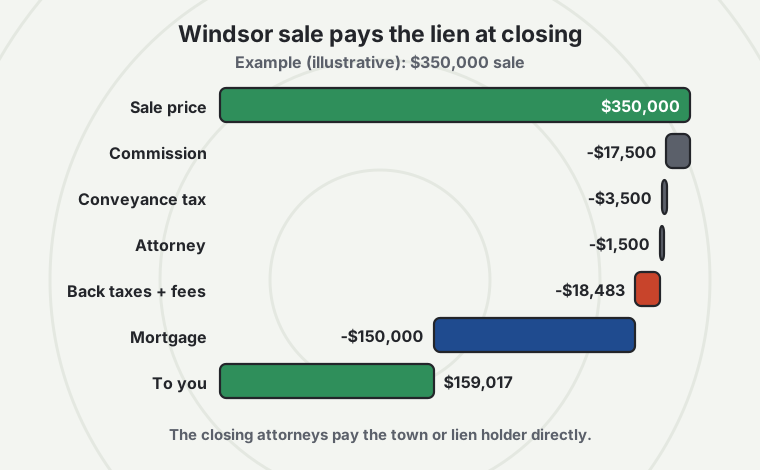
Selling to pay off a tax lien with Windsor numbers looks like this in our example: a $350,000 house, the town’s single-family median, with about $18,483 of back taxes, interest and fees and a $150,000 mortgage would leave the owner about $159,017 after commission, conveyance tax and attorney costs. Losing it to a tax foreclosure could cost far more than the tax owed.
| Line | Amount | Basis |
|---|---|---|
| Sale price | $350,000 | Windsor single-family median (CT OPM) |
| Commission at 5% | -$17,500 (est.) | Negotiable |
| Conveyance tax, 0.75% state + 0.25% Windsor | -$3,500 | CGS 12-494 |
| Seller’s attorney | -$1,500 (est.) | Estimate |
| Back taxes and interest (two years, from above) | -$17,983 | CGS 12-146 |
| Lien and collection fees | -$500 (est.) | Estimate; much more if a lawsuit has started |
| Mortgage payoff | -$150,000 (est.) | Assumption; $0 if the house is paid off |
| Left to you | about $159,017 (est.) | Before the current-year tax proration |
If the house is paid off, about $150,000 more would be left to you. Run your own numbers below.
How much would you walk away with?
Slide the numbers to match your house. It works in your browser; nothing is saved or sent.
Estimates for planning. Conveyance tax per CGS 12-494 (state 0.75% up to $800,000, 1.25% to $2.5M, 2.25% above, plus the town rate). Seller attorney about $1,200 to $1,500; flat-fee MLS about $400; listings include three months of taxes, insurance and utilities, a cash sale about two weeks. Your attorney gives you the final numbers.
What are the honest options for a Windsor owner with back taxes, and when should you NOT sell to a cash buyer?
The honest options for a Windsor owner with back taxes are to pay in full, agree a payment arrangement, apply for deferral or tax relief, refinance, list the house, or sell it as-is for cash. You should NOT sell to a cash buyer if a payment plan, deferral or refinance would let you keep the house, or if the house is in good shape and you have months before a sale or law day.
When you should NOT sell to a cash buyer
- The back taxes are one or two years and you can afford the bills going forward. Pay or arrange; do not sell a house over a fixable tax bill.
- You qualify for deferral or elderly relief. Apply first.
- The house is in good condition and nothing is scheduled. A listing usually nets more than any cash offer, including mine.
A cash sale fits when a tax sale or law day is weeks away, the house needs repairs, it is inherited and empty, or you cannot afford the taxes even after catching up. See our page on selling your house before foreclosure for how a sale ends a pending case.
Where can a Windsor homeowner get free help with back taxes?
A Windsor homeowner can get free help with back taxes from the Windsor tax collector’s office, which handles payment arrangements, the Windsor assessor for tax relief programs, a HUD-approved housing counselor, and the Connecticut Fair Housing Center’s attorney consultations. Talk to at least one of them before signing anything with anyone, including us.
Call Windsor’s tax office at 860-285-1810 to confirm the balance and ask about a payment arrangement, and the assessor about tax relief. A HUD-approved housing counselor (1-800-569-4287) can review your budget for free. The Connecticut Fair Housing Center offers short attorney consultations at 1-888-247-4401. If a mortgage lender has also sued you, the Judicial Branch’s free Foreclosure Mediation Program covers that case if you file within 15 days of its return date. Nobody legitimate charges an upfront fee to “stop” a tax foreclosure or asks you to sign over your deed outside a closing with attorneys.
What should a Windsor owner do this week about back taxes?
This week, a Windsor owner with back taxes should get a written balance from the tax office or lien holder, ask about a payment arrangement and deferral, check eligibility for tax relief, look for any tax sale or court date, and get a realistic sale number in case keeping the house does not work.
Get the exact balance
From Windsor’s tax office, or a payoff statement from the assignee if your lien was sold. Ask whether a tax sale or lawsuit is scheduled.
Ask about a plan and deferral
Ask what arrangement the collector will accept, and whether you can still file a CGS 12-174 deferral affidavit.
If you sell, sell before the sale date or law day
List, or get a written as-is offer (our page on selling a house in foreclosure shows how a sale ends a pending case). If you sell to us, there is no fee, no repairs and no showings; the taxes are paid at closing, and you pick the date, typically about two weeks out.

Tax problems are the most fixable problems I see. The town wants payment, not a house. If you are helping a parent who stopped paying, call the tax office together this week. The worst outcomes come from waiting.
If you want a written number for a Windsor house, start on our Windsor page, or see how we buy houses with tax liens.
See the house together.
Pick a time that works.
Choose a time for us to walk through the property with you, or ask for a quick call first. We confirm every request personally.
Tuesday, January 13
No open times in the next few weeks. Please call us.
We will confirm by email. Nothing is booked until we do.
View my requestQuestions about property tax foreclosure in Windsor, CT
Can the town of Windsor foreclose on my house for unpaid property taxes?
Yes, the town of Windsor can foreclose on your house for unpaid property taxes. Its tax collector can sue to foreclose the tax lien (CGS 12-181) or hold a tax sale after notice (CGS 12-157). Paying the balance, or redeeming in time, ends it.
What is the interest rate on late property taxes in Connecticut?
The interest rate on late property taxes in Connecticut is 18% a year, charged at 1.5% a month from the due date, with any part of a month counted as a whole month (CGS 12-146). Partial payments go to interest first.
How long do I have to redeem after a Connecticut tax sale?
You have up to six months after a Connecticut tax sale to redeem, or 60 days if the property was abandoned and the town has adopted that rule (CGS 12-157(f)). To redeem, you pay the taxes, interest and charges due at the sale, plus 18% a year on the buyer’s full purchase price.
Can my town sell my tax lien to a private company?
Yes, a Connecticut town can sell its tax liens to a private company by resolution of its legislative body (CGS 12-195h). For liens assigned on or after July 1, 2022, the company must notify you within 60 days and wait at least a year before suing to foreclose.
Does a tax lien come before my mortgage?
Yes, a property tax lien comes before your mortgage in Connecticut; it takes precedence over all transfers and encumbrances (CGS 12-172). That is why mortgage lenders often pay delinquent taxes and then treat it as a loan default.
Can I use foreclosure mediation for a tax foreclosure?
No, you cannot use Connecticut’s foreclosure mediation program for a tax foreclosure. The Judicial Branch says tax-lien foreclosures are not eligible. Talk to the tax collector or lien holder about a payment arrangement instead.
Can Windsor waive the interest on my back taxes?
No, Windsor generally cannot waive the interest on back taxes; its tax collector’s FAQ says the state does not allow it. Deferred collection under CGS 12-174, if approved, stops the 18% interest on that tax.
Can I sell my house in Windsor if I owe back property taxes?
Yes, you can sell your house in Windsor if you owe back property taxes. The closing attorneys pay the town or lien holder from your proceeds, and the lien is released. The current year’s tax is also prorated with the buyer.
Related guides
Foreclosure stages
Other kinds of foreclosure
To compare every route for selling, see how to sell a house in Connecticut.
Plain-English information, not legal or tax advice. Ask Windsor’s tax office and a Connecticut attorney about your case. The Windsor example uses public data and labeled estimates.
Sources (checked on October 27, 2026)
- CGS chapter 204: 12-146 (18% interest), 12-157 (tax sales and redemption).
- CGS chapter 205: 12-172 (lien priority), 12-174 (deferred collection), 12-181 (tax lien foreclosure), 12-182 (summary foreclosure), 12-195h (lien assignment).
- CGS 12-170aa (tax relief for elderly or totally disabled homeowners).
- Town of Windsor tax collector FAQ (due date, interest, partial payments).
- Town of Windsor tax collector documents (tax sale notices and rules of sale).
- Judicial Branch Foreclosure Mediation Program FAQ (tax-lien cases not eligible).
- CT OPM Real Estate Sales (data.ct.gov): Windsor sales October 2024 to September 2025.
- CT OPM mill rates (Windsor fiscal 2027: 28.88).
- CGS 12-494 (conveyance tax).
- Tyler v. Hennepin County, 598 U.S. 631 (2023).

Who wrote this
Jerryll Noorden
Jerryll has bought and sold Connecticut houses since 2016 and has sat at more closing tables than he can count, on both sides. Before real estate he was a robotics scientist at NASA, IHMC and IIT. He wrote this guide because the national sites that rank for it skip the Connecticut rules that cost sellers money. When listing or selling it yourself would get you more than a cash offer, he says so.
This guide explains Connecticut rules in plain English. It is not legal or tax advice. Laws change; for your sale, talk to a Connecticut real estate attorney and a tax professional.
