
Key facts at a glance
This is the Bridgeport chapter of our foreclosure guides, for owners of two-, three- and four-family houses who have fallen behind on the mortgage. For the wider picture, see our Connecticut foreclosure guide and our guide to how to sell a house in Connecticut.
| Fact | Number | Source |
|---|---|---|
| Bridgeport homes in two- to four-unit buildings | 34.8% | U.S. Census ACS 2020-2024 |
| Bridgeport homes that are rented | 57.2% | U.S. Census ACS 2020-2024 |
| Median gross rent in Bridgeport | $1,450 a month | U.S. Census ACS 2020-2024 |
| Arm’s-length multi-family sales, Oct 2024 to Sep 2025 (median) | Two-family 158 ($488,450); three-family 107 ($600,000); four-family 11 ($660,000) | data.ct.gov sales dataset (OPM), our query |
| Mill rate, fiscal 2027, after the 2025 revaluation | 27.95 (43.45 the year before) | City of Bridgeport adopted budget |
| Conveyance tax a Bridgeport seller pays | 1.25% (0.75% state + 0.50% city) | CGS 12-494 |
| Court for a Bridgeport foreclosure | Superior Court, Fairfield Judicial District at Bridgeport, 1061 Main Street | jud.ct.gov |
What can you do if you are behind on the mortgage on a Bridgeport multi-family?
If you are behind on the mortgage on a Bridgeport multi-family, first find out which protections you have: if you live in the building, federal and Connecticut rules give you at least 120 days, a CHFA notice and free court mediation. Then compare your real rent roll with the full monthly cost, deal with any tenant who stopped paying through the court, and choose between catching up, a modification, or selling, with or without the tenants.
A two- or three-family is a home and a small business at the same time. When the business side breaks, a tenant stops paying or a unit sits empty, the mortgage on the home side falls behind. This guide is about that specific problem, with Bridgeport’s own numbers. If you want an offer on the building, our Bridgeport page is the place; this page is about understanding your options first.
Why does falling behind on a two- or three-family feel different?
Falling behind on a two- or three-family feels different because the problem is often someone else’s missed rent, yet the mortgage is in your name. Many Bridgeport owners bought the building so the rents would carry it, and when that plan fails, it feels like a personal failure and a betrayal at once. Both feelings are common, and neither changes your options.
Owners in this spot often feel trapped between a lender who wants the full payment and a tenant who pays nothing, angry at the tenant, guilty about their own family’s housing, worn out from being the landlord, the repair crew and the bill payer, and afraid that admitting it to the bank will make things worse. If that is you, this page is for you. You are not the first Bridgeport owner whose rent roll stopped covering the note, and there is a way through this.
Who can help a Bridgeport owner before you decide anything?
Before you decide, a Bridgeport owner can get free help from the Connecticut Department of Banking foreclosure hotline (1-877-472-8313), a HUD-approved housing counselor (1-800-569-4287), legal aid, and the Judicial Branch’s Foreclosure Volunteer Attorney Program at the Bridgeport courthouse, 1061 Main Street, on the 1st and 3rd Wednesday of the month from 2 to 4 p.m.
Department of Banking foreclosure hotline: 1-877-472-8313. HUD-approved housing counselors: 1-800-569-4287. Statewide Legal Services of Connecticut: 1-800-453-3320. Foreclosure Volunteer Attorney Program, Bridgeport Superior Court, 1061 Main Street, Public Information Desk on the first floor (confirm dates at 860-263-2734). If you live in the building and have been served, file the appearance and mediation certificate within 15 days of the return date. Nobody legitimate charges an upfront fee or asks for your deed outside a closing.
Does it matter whether you live in the building?
Yes, whether you live in the building matters a great deal. If it is your principal residence, federal loss mitigation rules, Connecticut’s 60-day CHFA notice and the court’s free foreclosure mediation generally apply. If you live elsewhere and the building is a pure rental, most of those protections do not, and the lender can move faster.
| Protection | You live in one unit | Pure rental | Rule |
|---|---|---|---|
| No first foreclosure filing until more than 120 days behind | Generally yes | Generally no | 12 CFR 1024.41(f), 1024.30(c)(2) |
| 60-day notice to meet the lender or a counselor and contact CHFA | For most owner-occupied loans | Generally no | CGS 8-265ee |
| Free foreclosure mediation with a court mediator | Yes, one-to-four family primary residence | No | CGS 49-31k, 49-31l |
| Court protection from foreclosure if unemployed or underemployed | If your principal residence for 2+ years | No | CGS 49-31d, 49-31f |
| Strict foreclosure, Law Day, and selling before it | Same | Same | CGS 49-24, 49-15 |
If you own the building through an LLC or with a commercial loan, read your note and talk to an attorney early; those loans can follow different rules. Either way, the stage-by-stage options in our decision map for avoiding foreclosure still apply.
Does your rent roll actually cover the mortgage?
Your rent roll covers the mortgage only if the rent you actually collect, not the rent on the leases, is larger than the full monthly cost: principal and interest, property tax, insurance, water and sewer, common utilities and repairs. In Bridgeport, the 2025 revaluation and the new 27.95 mill rate changed many tax bills, so re-run the math with your new bill before deciding anything.
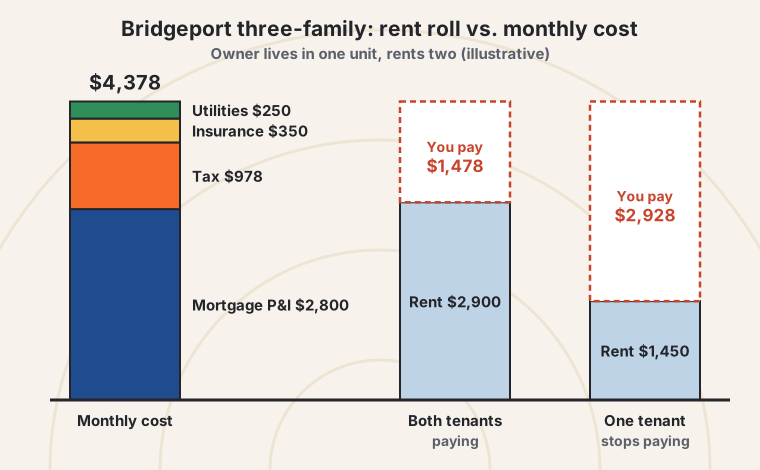
Example (illustrative), Bridgeport three-family. The building is worth $600,000, the median arm’s-length three-family sale in Bridgeport from October 2024 to September 2025. The owner lives on the first floor and rents two units at $1,450 each, the city’s median gross rent. Monthly costs:
| Monthly item | Amount | Basis |
|---|---|---|
| Principal and interest | $2,800 | Assumption |
| Property tax | $978 | $11,739 a year: 27.95 mills on 70% of $600,000 (est.) |
| Insurance | $350 | Assumption (est.) |
| Water, sewer and common electric | $250 | Assumption (est.) |
| Total cost | $4,378 | |
| Rent collected, both tenants paying | $2,900 | 2 x $1,450 |
| Owner pays from wages | $1,478 | Roughly the cost of the owner’s own apartment |
| Owner pays if one tenant stops paying | $2,928 | Only $1,450 collected |
One tenant stopping is enough to double what comes out of your paycheck. If you do not live there, the same building with three units at the median rent brings in $4,350 against a $4,378 cost before any repair or vacancy, which is why many investor-owned buildings run on thin margins. Census rents lag the market, so use your own leases and your own tax bill. Repairs are the other quiet drain on older Bridgeport buildings; our multi-family selling guide covers how buyers price them.
What should you do when tenants stopped paying and you fell behind?
When tenants stopped paying and you fell behind, run two tracks at once: start the legal nonpayment process with the tenant, and tell your servicer about the lost income right away. Never lock a tenant out or shut off utilities; that is illegal in Connecticut. An uncontested nonpayment eviction takes about 5 to 8 weeks (est.), while each missed mortgage payment adds to your arrears.
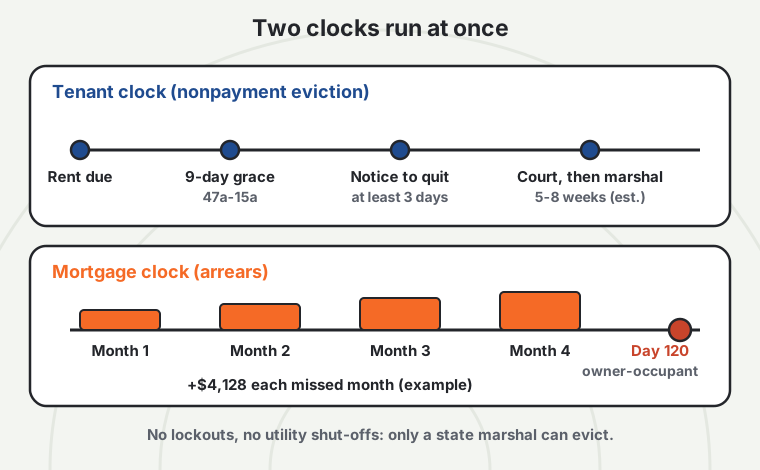
The nonpayment steps in short: wait out the 9-day grace period (CGS 47a-15a), have a state marshal serve a notice to quit giving at least three days (CGS 47a-23), then file summary process in the Housing Session. If the tenant appears, the court can order use-and-occupancy payments while the case is pending (CGS 47a-26b). Our guide on tenants who do not pay rent in Connecticut has every step, form and cost, and dealing with a problem tenant covers the harder cases.
On the mortgage side:
- Call the servicer before the second missed payment. Tell them about the tenant and the expected timeline. A short-term hardship is exactly what forbearance and repayment plans are for.
- Send a complete loss mitigation application if you live there, ideally before day 120. Include the leases, the rent ledger and the court papers; they document the hardship.
- Do not use the security deposit to pay the mortgage. It is the tenant’s money and must be accounted for at move-out or passed to a buyer (CGS 47a-21).
- Consider cash for keys. A written agreement where the tenant leaves by a date in exchange for a payment can be faster and cheaper than a contested case.
What are your options as a Bridgeport landlord who is behind?
As a Bridgeport landlord who is behind, your options are to catch up with a repayment plan or forbearance, modify the loan, refinance if you have the equity and income, sell the building with the tenants in place, list it after the units are stable, or, if you owe more than it is worth, ask for a short sale or deed in lieu. Mediation is added if you live there and are sued.
| Option | Fits when | Watch out for |
|---|---|---|
| Repayment plan or forbearance | The tenant problem is temporary and the eviction is under way | Arrears still have to be paid back |
| Loan modification | The building can carry a lower payment with normal rents | Needs complete paperwork; investor loans may not qualify |
| Mediation (owner-occupant, after the summons) | You live there and want a court mediator at the table | File within 15 days of the return date (CGS 49-31l(c)) |
| List after stabilizing the units | Good equity, paying tenants, time for a financed buyer | Takes months; a non-paying tenant scares off buyers |
| Sell as-is with tenants in place | Equity, but a tenant problem, repairs or a short calendar | Lower price than a stabilized listing |
| Short sale or deed in lieu | You owe more than the building is worth | Lender approval; possible deficiency (see the linked guides) |
Do not sell to a cash buyer, including us, if the tenant problem will be solved in a few weeks and a repayment plan bridges the gap; you would be giving up years of rent and appreciation for a short-term problem. Do not sell for cash if the building is stable, the tenants pay and you have time; a listing to an owner-occupant buyer with an FHA or conventional loan will usually net more. And if you owe more than the building is worth, a cash sale cannot fix that; look at a short sale instead.
If selling with tenants is on the table, our sell a rental with tenants page explains how leases and deposits transfer, and the guide to selling a rental with tenants in Connecticut covers the legal details.
How much would you net selling a Bridgeport three-family now?
Selling the example Bridgeport three-family now would net about $112,988 through a listing at $600,000, if the units are stable and there is time to close with a financed buyer, or about $54,113 through an as-is cash sale at $510,000 with the tenant problem left to the buyer. A strict foreclosure after Law Day would leave $0.
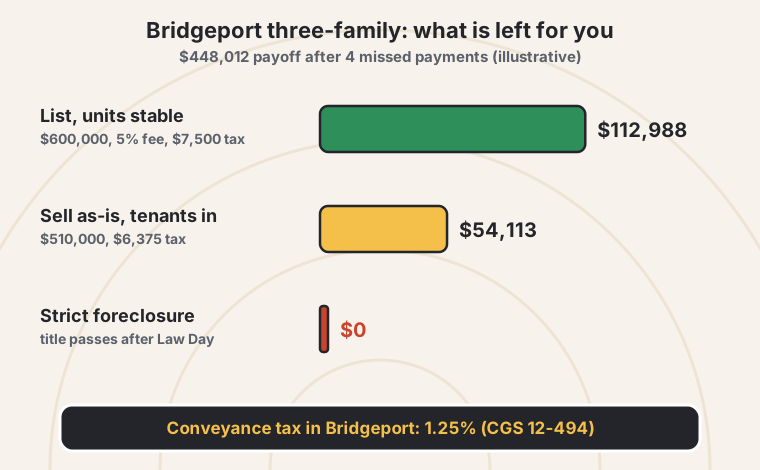
| Route | Price | Selling costs | Payoff (est.) | Left for you (est.) |
|---|---|---|---|---|
| List, units stable | $600,000 | 5% commission $30,000 (est.), conveyance tax $7,500, attorney $1,500 (est.) | $448,012 | $112,988 |
| Sell as-is with tenants | $510,000 (assumption) | Conveyance tax $6,375, attorney $1,500 (est.) | $448,012 | $54,113 |
| Strict foreclosure | None | Title passes after Law Day | Debt | $0 |
The listing route is worth about $59,000 more in this example, and that is real money. The question is whether you can get there: a financed buyer usually needs paying tenants, clean rent records and 30 to 45 days to close (est.), and every month of delay adds about $4,128 to the payoff. The cash route trades price for speed and for taking the tenant problem off your hands. To test your own numbers:
How much would you walk away with?
Slide the numbers to match your house. It works in your browser; nothing is saved or sent.
Estimates for planning. Conveyance tax per CGS 12-494 (state 0.75% up to $800,000, 1.25% to $2.5M, 2.25% above, plus the town rate). Seller attorney about $1,200 to $1,500; flat-fee MLS about $400; listings include three months of taxes, insurance and utilities, a cash sale about two weeks. Your attorney gives you the final numbers.
What should you do this week?
This week, write down your real rent roll and full monthly cost, start the legal process with any tenant who stopped paying, call your servicer and the free help, and get two written numbers if selling is possible: a listing opinion and an as-is offer. Then decide which route your building can actually reach.
Write the real numbers
Rent collected in each of the last three months, your new tax bill after the revaluation, insurance, water, sewer and the mortgage statement.
Start the tenant process correctly
After the 9-day grace period, have a state marshal serve the notice to quit. No lockouts, no utility shut-offs.
Call the servicer and the free help
Explain the lost rent, ask for a loss mitigation application, and call the Department of Banking hotline or a counselor.
Get two numbers in writing
A local agent’s price opinion for the building with stable tenants, and an as-is offer with the tenants in place.
Choose and set a date
If you sell to us, we buy with tenants in place, you leave what you do not want, and we close through Connecticut attorneys, usually in about two weeks, or on the date you pick. The deposits and leases transfer at closing, and our offer does not expire under pressure.
See the house together.
Pick a time that works.
Choose a time for us to walk through the property with you, or ask for a quick call first. We confirm every request personally.
Tuesday, January 13
No open times in the next few weeks. Please call us.
We will confirm by email. Nothing is booked until we do.
View my requestRead how we handle sales during a foreclosure on our sell-before-foreclosure page, or start with our Bridgeport page. We also buy in Stratford, Fairfield and New Haven.
Questions Bridgeport multi-family owners ask about falling behind
Can I get foreclosure mediation on a Bridgeport three-family?
You can get Connecticut foreclosure mediation on a Bridgeport three-family if you live in it as your primary residence and are the borrower; the program covers owner-occupied one-to-four family homes (CGS 49-31k). A pure rental you do not live in does not qualify.
Can I sell my multi-family with a tenant who is not paying?
Yes, you can sell a Connecticut multi-family with a tenant who is not paying. The lease and deposit transfer to the buyer, who takes over the eviction. Financed buyers often hesitate, so these sales usually go to investors or cash buyers at a lower price.
Does the lender care that my tenant stopped paying?
The lender still expects the full payment, but a tenant who stopped paying is a documented hardship. Send the ledger and the court papers with your loss mitigation application; it supports a forbearance or repayment plan while the eviction runs.
How long does it take to evict a non-paying tenant in Bridgeport?
An uncontested nonpayment eviction in Connecticut takes about 5 to 8 weeks from the missed rent (est.), and a contested case often 2 to 4 months. Cases from Bridgeport go to the Housing Session at Bridgeport. Our nonpayment guide has the full timeline.
Can I use the tenant’s security deposit to pay my mortgage?
No, you should not use a tenant’s security deposit to pay your mortgage. It belongs to the tenant, must be accounted for when they leave, and must be passed to the buyer with interest if you sell (CGS 47a-21).
What happens to my tenants if the building is foreclosed?
If a Connecticut building is foreclosed, the new owner generally takes it subject to bona fide tenants’ rights: a lease can run to the end of its term, with limited exceptions, and any notice to vacate must give at least 90 days (CGS 49-31p, 47a-20e). The tenants stay for now; you lose the building and any equity.
Did Bridgeport’s revaluation change my property taxes?
Bridgeport’s 2025 revaluation raised many assessments, and the city cut the mill rate from 43.45 to 27.95 for fiscal 2027. Whether your bill went up or down depends on your new assessment, so check it with the assessor before running your numbers.
How much conveyance tax do I pay selling a Bridgeport multi-family?
A Bridgeport seller pays 1.25% conveyance tax on a residential sale up to $800,000: 0.75% to the state and 0.50% to the city (CGS 12-494). On a $600,000 three-family that is $7,500. Our conveyance tax guide covers the higher tiers.
Should I stop paying the mortgage to pay for repairs?
No, stopping the mortgage to fund repairs usually makes things worse, because arrears, late fees and legal costs grow faster than most repairs pay back. Talk to the servicer and a counselor first, and get an as-is number for the building so you know the alternative.
Related Connecticut guides
Foreclosure, step by step
Landlord problems
Plain-English information, not legal advice. A Connecticut attorney, a HUD-approved counselor or legal aid can tell you how these rules apply to your building.
Sources (checked on October 27, 2026)
- CGS chapter 846: § 49-15, § 49-24, §§ 49-31d to 49-31f (protection from foreclosure), §§ 49-31k to 49-31l (mediation), § 49-31p (tenants after foreclosure)
- CGS chapter 134: § 8-265ee (60-day notice, CHFA)
- CGS chapter 830: §§ 47a-15a, 47a-20e, 47a-21 (grace period, tenants in foreclosed property, security deposits)
- CGS chapter 832: §§ 47a-23, 47a-26b (notice to quit, use and occupancy)
- CGS chapter 223: § 12-494 (conveyance tax)
- 12 CFR 1024.30 and 12 CFR 1024.41 (principal residence scope, 120-day rule)
- Judicial Branch, 2026-2027 Foreclosure Volunteer Attorney Program
- CT Department of Banking, Avoiding Foreclosure
- data.ct.gov Real Estate Sales (Bridgeport, Oct 2024 to Sep 2025)
- U.S. Census ACS 2020-2024 via Census Reporter (tables B25003, B25024, B25064)
- City of Bridgeport, adopted fiscal 2027 mill rate

Who wrote this
Jerryll Noorden
Jerryll has bought and sold Connecticut houses since 2016 and has sat at more closing tables than he can count, on both sides. Before real estate he was a robotics scientist at NASA, IHMC and IIT. He wrote this guide because the national sites that rank for it skip the Connecticut rules that cost sellers money. When listing or selling it yourself would get you more than a cash offer, he says so.
This guide explains Connecticut rules in plain English. It is not legal or tax advice. Laws change; for your sale, talk to a Connecticut real estate attorney and a tax professional.
