
Key facts at a glance
This page is a map, not a lecture. Find the stage you are in, see what you can still do and by when, and jump to the guide that covers that stage in depth. The full rulebook is in our Connecticut foreclosure guide, and if you end up selling, our guide to how to sell a house in Connecticut covers every route.
| Fact | Number | Source |
|---|---|---|
| Earliest a servicer can make the first foreclosure filing on your home | More than 120 days behind | 12 CFR 1024.41(f) |
| Notice before a Connecticut foreclosure can start, to meet the lender or a counselor and contact CHFA | 60 days | CGS 8-265ee |
| Deadline to file the appearance and mediation certificate after the return date | 15 days | CGS 49-31l(c) |
| Deadline to apply for court “protection from foreclosure” if you are unemployed or underemployed | 25 days after the return date | CGS 49-31e, 49-31f |
| Longest pause on most motions while mediation runs | 8 months from the return date | CGS 49-31l(f) |
| A strict foreclosure judgment generally cannot be opened once title becomes absolute after Law Day | Law Day is the last day | CGS 49-15 |
| Free Department of Banking foreclosure hotline | 1-877-472-8313 | portal.ct.gov/dob |
How do you avoid foreclosure in Connecticut?
You avoid foreclosure in Connecticut by acting at the stage you are in, before that stage’s deadline passes. There are six stages: a missed payment, the 120-day line, the summons, mediation, the judgment and Law Day. Each one still leaves you options, but fewer than the stage before, and Law Day is the last date on which you can redeem, sell or get the court to move the date.
Connecticut forecloses through the courts, usually by strict foreclosure: there is no auction, the court sets a Law Day, and if nobody pays the debt by then, title passes to the lender and your equity goes with it (CGS 49-24, 49-15). That is the one outcome to avoid at almost any cost. Everything below is about keeping it from happening, whether you keep the house or not.
Why does it feel impossible to know what to do first?
It feels impossible to know what to do first because foreclosure arrives as a pile of letters from different senders, each with its own deadline, while you are still paying for groceries and trying not to tell anyone. The confusion is normal. One question cuts through it: which stage are you in today? Once you know that, there are only two or three things worth doing this week.
Most people who land on this page feel some mix of ashamed (they have always paid their bills), frozen, suspicious (the mailbox is full of people offering to “save” the house) and exhausted. Some are quietly relieved to finally face it. If that is you, this page is for you. You only have to find your stage and meet the next deadline.
Who should you call first, before anyone selling anything?
Before you call anyone selling anything, including us, call the free help: the Connecticut Department of Banking foreclosure hotline at 1-877-472-8313 or a HUD-approved housing counselor at 1-800-569-4287. They cost nothing, they know the lenders’ programs, and they can tell you which stage you are in. If you have been served, the court’s mediation program is free too.
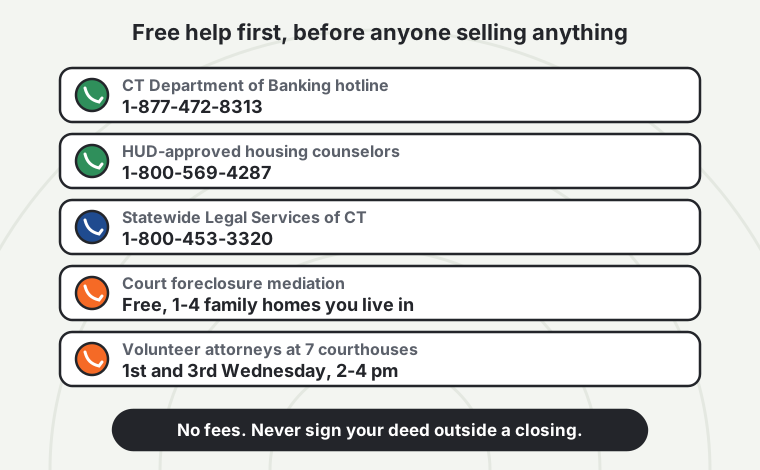
Department of Banking foreclosure hotline: 1-877-472-8313. HUD-approved housing counselors: 1-800-569-4287. Statewide Legal Services of Connecticut: 1-800-453-3320. Connecticut Fair Housing Center foreclosure help: 1-888-247-4401. The Judicial Branch’s Foreclosure Volunteer Attorney Program meets on the 1st and 3rd Wednesday of the month, 2 to 4 p.m., at seven courthouses including Bridgeport, Hartford and New Haven (confirm at 860-263-2734). If your hardship is temporary, ask CHFA about emergency mortgage assistance. None of these should charge you. Nobody legitimate asks you to sign your deed over outside a real closing with attorneys.
A counselor is worth calling even if you think you will sell: you will know you did not leave a keep-the-house option on the table. Our guide to we-buy-houses scams and red flags covers the offers to avoid.
Which foreclosure stage are you in right now?
You can tell which foreclosure stage you are in by the last paper you received. Late notices and calls mean stage 1. A certified letter about a 60-day meeting and CHFA means stage 2. Papers handed to you by a state marshal mean stage 3. A mediator’s schedule means stage 4. A court notice of judgment means stage 5, and a judgment with a Law Day date means stage 6.
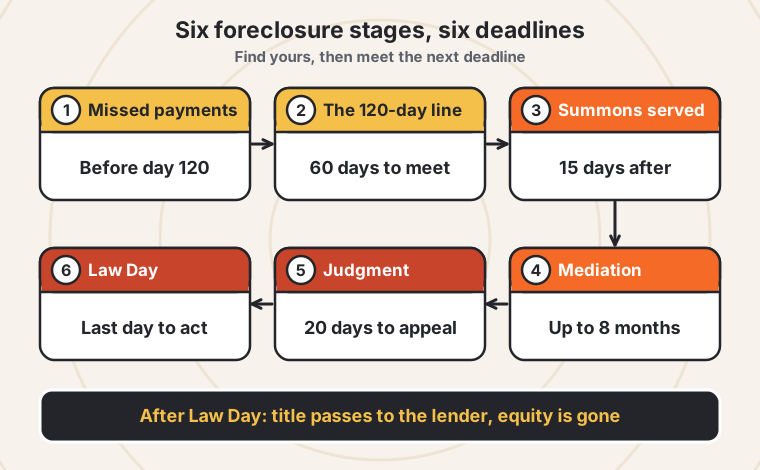
| What you have in hand | Your stage | Hard deadline |
|---|---|---|
| Late notices, calls from the servicer, a letter offering loss mitigation | 1. Missed payments | Complete application before day 120 (12 CFR 1024.41(f)) |
| Certified letter about a 60-day meeting and CHFA emergency help | 2. The 120-day line | 60 days from the notice (CGS 8-265ee) |
| Writ, summons and complaint served by a state marshal, with a mediation notice | 3. Summons | 15 days from the return date (CGS 49-31l(c)) |
| Notice of a mediation session, a document list from the mediator | 4. Mediation | Up to 8 months from the return date (CGS 49-31l(f)) |
| Motion for judgment, appraisal, a hearing date or a judgment notice | 5. Judgment | 20 days to appeal (Practice Book 63-1) |
| A judgment of strict foreclosure with your Law Day date | 6. Law Day | The Law Day itself (CGS 49-15, 49-19) |
What can you still do after one or more missed payments?
After one or more missed payments, you can still do almost everything: catch up, ask for a repayment plan or forbearance, or apply for a loan modification. Federal rules generally bar your servicer from filing a foreclosure until you are more than 120 days behind, and a complete loss mitigation application sent before then generally blocks the first filing while it is reviewed (12 CFR 1024.41).
You can still: reinstate, set up a repayment plan, request forbearance, apply for a modification, list the house with full time to do it well, or sell. Deadline: send a complete loss mitigation application before day 120. Read next: behind on mortgage payments in Connecticut, which walks through days 30, 60, 90 and 120.
This is the cheapest stage to fix: a two-month gap is far easier to close than a ten-month one. Ask for the reinstatement figure in writing (CGS 49-10a).
What can you still do when you reach the 120-day line?
When you reach the 120-day line, you can still meet your lender or a counselor and apply to CHFA for emergency help, because Connecticut requires most lenders to mail a notice giving you 60 days to do that before they can start a foreclosure (CGS 8-265ee). You can also still sell or list, and the lawsuit has not been filed yet.
You can still: meet the lender or a counselor, apply for CHFA emergency mortgage assistance, finish a loss mitigation application, list, or sell. Deadline: 60 days from the date of the notice. Read next: our guide to pre-foreclosure in Connecticut, which covers this window and why investors start mailing you during it.
Nothing is on the land records yet; this is the last stage where catching up or selling happens entirely in private.
What can you still do after you are served with a foreclosure summons?
After you are served with a foreclosure summons, you can still keep the house or sell it, but two deadlines start running from the return date printed on the papers. File an appearance and the foreclosure mediation certificate within 15 days of the return date (CGS 49-31l(c)). If you are unemployed or underemployed, you may also apply for court protection from foreclosure within 25 days (CGS 49-31e).
You can still: request mediation, apply for protection from foreclosure, keep negotiating a modification, list or sell. Deadlines: 15 days from the return date for the appearance (JD-CL-12) and mediation certificate (JD-CV-108); 25 days for protection from foreclosure. Read next: what to do in the first 15 days after a foreclosure summons.
Protection from foreclosure is little known: if the house has been your principal residence for two years and you are unemployed, or earned under $50,000 and less than 75% of your prior average, the court can restructure the arrears and stay the case for up to six months (CGS 49-31d to 49-31i). Ask legal aid quickly whether you qualify.
What can you still do while you are in foreclosure mediation?
While you are in foreclosure mediation, you can still negotiate a modification, a repayment plan, a short sale or a deed in lieu, with a court mediator at the table. Mediation is free for owner-occupied one-to-four family homes, and most motions are paused for up to eight months from the return date while it runs (CGS 49-31k, 49-31l(f)). The mediation period itself ends by the third session or seven months after the return date, unless extended (CGS 49-31n).
You can still: modify, repay, agree a short sale or deed in lieu, ask about a court-supervised market sale if you owe more than the house is worth (CGS 49-24a to 49-24g), list, or sell. Deadline: the mediation period and the eight-month pause; filing other motions can end the pause early. Read next: short sale vs. foreclosure and deed in lieu of foreclosure.
Run a parallel plan. If the modification is denied in month six, you want a price opinion or a written offer already in your folder, not a blank page and a judgment hearing coming up.
What can you still do once the lender asks for a judgment?
Once the lender asks for a judgment, you can still contest the amount claimed and the appraisal, ask the court to order a foreclosure by sale instead of strict foreclosure if you have equity, sell the house, or settle. The court decides strict foreclosure or sale at its discretion (CGS 49-24). After judgment, you generally have 20 days to appeal (Practice Book 63-1).
You can still: show up at the hearing, question the debt and the appraisal, ask for foreclosure by sale, sell, or reach a settlement. Deadline: the hearing date, then about 20 days to appeal. Read next: the consequences of foreclosure in Connecticut, including what happens to your equity and any deficiency.
Why ask for a sale? In a strict foreclosure, equity above the debt is not paid back to you; in a foreclosure by sale, the surplus after the debt and costs goes to the owner and other lienholders.
What can you still do before Law Day?
Before Law Day, you can still redeem by paying the judgment debt, sell and close before the date, or file a motion to open the judgment and extend Law Day for cause (CGS 49-15). Filing bankruptcy before Law Day stops the case automatically for a time (11 U.S.C. 362). Once Law Day passes without redemption, title becomes absolute in the lender and the judgment generally cannot be reopened.
You can still: redeem, sell and close, move to open and extend Law Day, or talk to a bankruptcy attorney. Deadline: your Law Day; the sale must close and the payoff must reach the lender before it. Read next: Law Day in Connecticut, explained.
A buyer with a mortgage usually needs 30 to 45 days after contract (est.), so with three weeks left a listing is rarely realistic. If a signed sale would close just after Law Day, ask your attorney about a motion to extend; a court can weigh it but does not have to grant it.
How much equity can you keep at each stage?
The equity you can keep shrinks at every stage, because interest, taxes, insurance and legal fees are added to what you owe while the case runs, and it drops to zero if a strict foreclosure reaches Law Day. In the Meriden example below, the same house leaves about $66,000 after a sale at stage 1, about $35,000 at Law Day if a listing could still close, and nothing after a strict foreclosure.
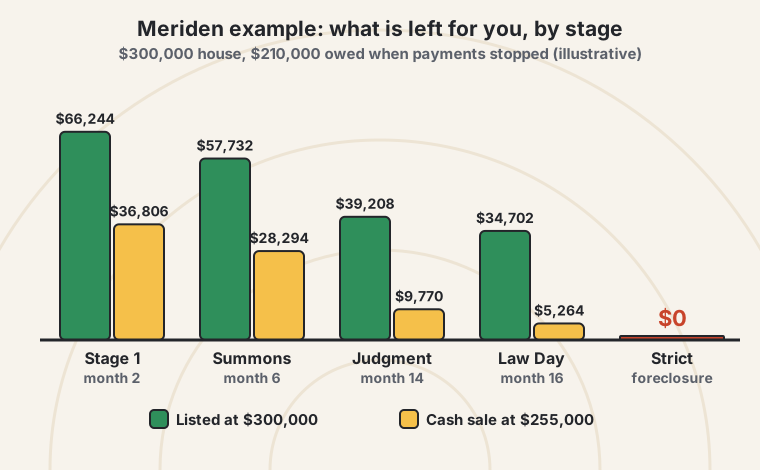
Example (illustrative), Meriden. The house is worth $300,000, Meriden’s median residential sale from October 2024 to September 2025 (749 sales, up 11%). The owner owed $210,000 when payments stopped. Each month adds about $1,753: $1,050 of interest at 6% (est.), $553 of property tax ($6,630 a year at Meriden’s 29.99 mill rate, est.) and $150 of insurance (est.). Legal fees of $1,500 to $7,000 (est.) build up from the summons onward. Selling costs: a 5% commission (est.), Meriden’s 1.25% conveyance tax (0.75% state plus 0.50% town, CGS 12-494) and a $1,500 attorney fee (est.).
| Stage (month) | Owed (est.) | Net if listed at $300,000 | Net if sold for cash at $255,000 |
|---|---|---|---|
| 1. Missed payments (month 2) | $213,506 | $66,244 | $36,806 |
| 3. Summons (month 6) | $222,018 | $57,732 | $28,294 |
| 4. Mediation (month 10) | $230,530 | $49,220 | $19,782 |
| 5. Judgment (month 14) | $240,542 | $39,208 | $9,770 |
| 6. Law Day (month 16) | $245,048 | $34,702 (only if a sale can close in time) | $5,264 |
| Strict foreclosure after Law Day | Debt satisfied up to the value; any deficiency possible (CGS 49-14) | $0 | $0 |
The earlier you act, the more of your money is still yours, whichever route you pick. And a listing beats a cash sale by tens of thousands of dollars when you have the time and the house shows well. Test your own numbers below.
How much would you walk away with?
Slide the numbers to match your house. It works in your browser; nothing is saved or sent.
Estimates for planning. Conveyance tax per CGS 12-494 (state 0.75% up to $800,000, 1.25% to $2.5M, 2.25% above, plus the town rate). Seller attorney about $1,200 to $1,500; flat-fee MLS about $400; listings include three months of taxes, insurance and utilities, a cash sale about two weeks. Your attorney gives you the final numbers.
Which way out is still open at your stage?
Which way out is still open depends on your stage. Catching up, modifying, listing and selling are open from stage 1 through most of the case. Mediation opens at stage 3. A short sale or deed in lieu needs the lender’s agreement at any stage. Close to Law Day, the realistic exits narrow to redeeming, a fast sale that closes before the date, an extension motion or bankruptcy.
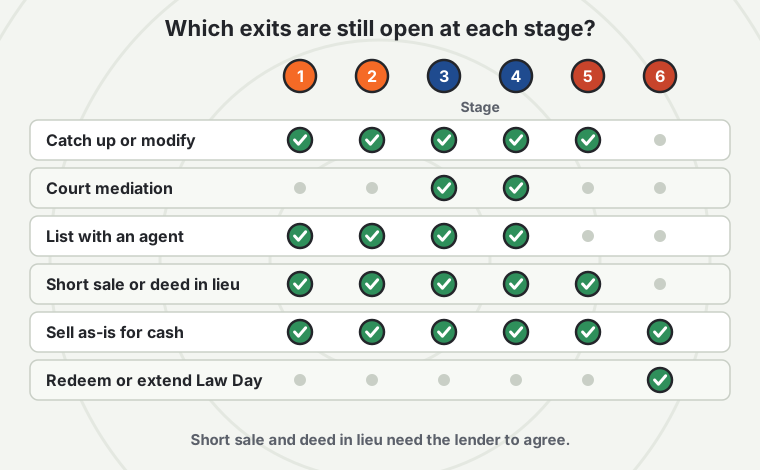
Do not sell to a cash buyer, including us, if a modification or repayment plan gives you a payment you can afford and you want to stay. Do not sell for cash if you have equity, a house that shows well and at least three or four months before any judgment; a listing will usually net more. And if you owe more than the house is worth, no cash buyer can fix that; a short sale or a market sale under CGS 49-24a is the route. A cash sale fits when the house needs work, when showings are not realistic, or when the calendar is too short for a buyer’s mortgage. Our page on why cash offers are lower explains the gap honestly.
What should you do this week to avoid foreclosure?
This week, find your stage, write down its deadline, call the free help, and gather your paperwork. Then decide whether you are trying to keep the house or protect your equity, and start the one route that fits, with a backup. If you are leaning toward selling, get a number in writing early so you are choosing, not reacting.
Find your stage and its deadline
Use the table above and write the deadline where you see it daily. With court papers, the return date anchors everything.
Call the free help
Department of Banking hotline 1-877-472-8313 or a HUD-approved counselor at 1-800-569-4287. If you were served, file the appearance and mediation certificate within 15 days of the return date.
Gather one folder
Mortgage statements, every letter from the lender and court, recent pay stubs, bank statements and your last tax return.
Pick a main plan and a backup
Keep the house (modification, repayment, protection from foreclosure) or sell on your terms (listing, short sale, cash). Running both in parallel costs nothing and protects you if the first one fails late.
If you sell, get it in writing and check who you are dealing with
Ask for a written offer with no fee and no deed signed outside a closing. We buy houses ourselves, close through Connecticut attorneys in about two weeks when needed, and our offers do not expire under pressure. See how to check a cash home buyer first.
See the house together.
Pick a time that works.
Choose a time for us to walk through the property with you, or ask for a quick call first. We confirm every request personally.
Tuesday, January 13
No open times in the next few weeks. Please call us.
We will confirm by email. Nothing is booked until we do.
View my requestIf selling is the route, our sell-before-foreclosure page explains how we work with your lender’s payoff, your Law Day and your attorney. We buy across the state, including Meriden, Bridgeport, Hartford, New Haven and Waterbury.
Questions Connecticut homeowners ask about avoiding foreclosure
Is it too late to avoid foreclosure once I have been served?
No, being served is not too late to avoid foreclosure in Connecticut. You can still request mediation within 15 days of the return date, negotiate a modification, apply for protection from foreclosure within 25 days if your income dropped, or sell. The real deadline is Law Day.
How long does a Connecticut foreclosure take?
A Connecticut foreclosure usually takes many months: at least 120 days before the first filing, up to eight months of mediation after the return date, then a judgment and a Law Day set by the court. Contested cases take longer. Our foreclosure guide has the full timeline.
Does foreclosure mediation stop the foreclosure?
Foreclosure mediation pauses most motions in a Connecticut case for up to eight months from the return date and blocks a judgment while mediation runs (CGS 49-31l(f)). It does not cancel the case. If no agreement is reached, the lender can ask for a judgment once mediation ends.
Can I avoid foreclosure if I owe more than my house is worth?
Yes, you can avoid foreclosure when you owe more than the house is worth through a modification, a short sale, a deed in lieu, or a foreclosure by market sale, which Connecticut allows for underwater owner-occupants when both sides agree (CGS 49-24a to 49-24g). A regular cash sale only works if the price covers the payoff.
What is protection from foreclosure in Connecticut?
Protection from foreclosure is a Connecticut court program for homeowners who are unemployed or underemployed and have lived in the house for at least two years. The court can restructure the arrears and stay the foreclosure for up to six months. You must apply within 25 days after the return date (CGS 49-31d to 49-31i).
Can I sell my house to avoid foreclosure in Connecticut?
Yes, you can sell your house to avoid foreclosure in Connecticut at any stage until Law Day passes. The sale pays off the loan at closing, the case is withdrawn, and any equity left is yours. The closer you are to Law Day, the faster the buyer must be able to close.
Does bankruptcy stop foreclosure in Connecticut?
Filing bankruptcy stops a Connecticut foreclosure automatically for a time under the federal automatic stay (11 U.S.C. 362). Chapter 13 can let you catch up arrears over a plan; Chapter 7 usually only delays. Repeat filings get weaker protection, so talk to a bankruptcy attorney before Law Day.
How do I spot a foreclosure rescue scam?
A foreclosure rescue scam usually asks for an upfront fee, tells you to stop talking to your lender, or wants you to sign your deed over with a promise that you can rent the house back. Legitimate counselors are free, and a real sale closes through Connecticut attorneys. See our scam red flags.
Do these protections apply to a rental property I do not live in?
Mostly no. Free mediation, the CHFA notice and the federal 120-day rule generally apply only to a home you live in. Strict foreclosure and Law Day work the same way. Our Bridgeport multi-family guide covers rentals.
What happens if I just move out and do nothing?
If you move out and do nothing, the Connecticut case continues without you, the lender gets a judgment by default, and title passes after Law Day. You lose any equity, the foreclosure stays on your credit, and a deficiency is possible. Answering the papers costs nothing and keeps your options open.
Related Connecticut guides
Stage by stage
Plain-English information, not legal advice. A Connecticut attorney, a HUD-approved counselor or legal aid can tell you how these rules apply to your case.
Sources (checked on October 27, 2026)
- CGS chapter 846: § 49-10a (payoff statements), § 49-14 (deficiency), § 49-15 (opening judgments), § 49-19 (law days), § 49-24 and §§ 49-24a to 49-24g (sale and market sale), §§ 49-31d to 49-31i (protection from foreclosure), §§ 49-31k to 49-31n (mediation)
- CGS chapter 134: § 8-265ee (60-day notice, CHFA emergency mortgage assistance)
- CGS chapter 223: § 12-494 (conveyance tax)
- 12 CFR 1024.41 (loss mitigation, 120-day rule)
- Connecticut Judicial Branch, foreclosure mediation
- Judicial Branch, 2026-2027 Foreclosure Volunteer Attorney Program schedule
- Connecticut Practice Book (§ 63-1, time to appeal)
- CT Department of Banking, Avoiding Foreclosure
- CHFA Emergency Mortgage Assistance Program
- 11 U.S.C. 362 (automatic stay)
- data.ct.gov Real Estate Sales and CT OPM mill rates (Meriden example)

Who wrote this
Jerryll Noorden
Jerryll has bought and sold Connecticut houses since 2016 and has sat at more closing tables than he can count, on both sides. Before real estate he was a robotics scientist at NASA, IHMC and IIT. He wrote this guide because the national sites that rank for it skip the Connecticut rules that cost sellers money. When listing or selling it yourself would get you more than a cash offer, he says so.
This guide explains Connecticut rules in plain English. It is not legal or tax advice. Laws change; for your sale, talk to a Connecticut real estate attorney and a tax professional.
