
Key facts at a glance
| Fact | Number | Source |
|---|---|---|
| Listing features buyers’ agents rate highly important | Photos 73%, staging 57%, videos 48%, virtual tours 43% | NAR 2025 Profile of Home Staging |
| Credit to the buyer if you do not deliver the condition report before they sign | $500 at closing | CGS 20-327b, 20-327c |
| What the condition report tells buyers to check about permits | Confirm building permits and certificates of occupancy with the town building official | CGS 20-327b (report text) |
| Radon test on the condition report | Seller states whether one was done and attaches the report | CGS 20-327b |
| Who may perform a paid home inspection in Connecticut | A home inspector licensed by the Department of Consumer Protection | CGS 20-490 to 20-495a |
| Smoke and carbon monoxide detector affidavit | Signed by the seller at closing (no cash-credit option since PA 23-164) | CGS 29-453 |
| How heat differs by town (single-family homes) | Simsbury 62% oil; West Hartford 73% gas or propane; Manchester 46% oil, 47% gas | 2025 CT Parcel and CAMA data |
This page is part of our guide to how to sell a house in Connecticut. Staging covers how the house looks (see our staging guide); this page covers what makes a buyer trust it: the paperwork, the numbers, the closing terms and the price. Those are the things that turn a nice showing into an offer that does not fall apart at inspection.
What makes a house stand out to Connecticut buyers beyond staging?
What makes a house stand out to Connecticut buyers beyond staging is proof: a recent pre-listing inspection, a binder of repair receipts and system ages, a year of utility costs, closed permits, a floor plan with accurate square footage, a flexible closing date and a realistic price. Older Connecticut houses raise questions about oil tanks, radon, basements and heat, and the listing that answers them first earns the buyer’s confidence.

Most “make your house stand out” advice is about scented candles and open-house snacks. Buyers do not offer more because of cookies. They offer more, and renegotiate less, when they are sure about what they are buying. Here are the seven differentiators that do that, in the order a buyer meets them:
- Smart pricing, which decides whether they see the listing at all.
- A floor plan and accurate square footage, which decide whether they book a showing.
- A pre-listing inspection summary, which answers the scariest questions before they ask.
- A repair receipts and records binder, which proves maintenance.
- Utility cost history, which turns “what does it cost to live here?” into a number.
- Closed permits, which keep the attorney and lender from stalling.
- A flexible closing date, which can beat a higher price for the right buyer.
Why does it feel so hard to compete with other listings?
It feels hard to compete with other listings because you cannot change your house’s location, size or age, and the house down the street may be newer or freshly renovated. Sellers often feel outmatched, worried that buyers will nitpick an older house, and unsure which of a hundred tips actually matter. The good news is that buyer confidence is something you can build with paperwork.
Maybe your 1950s ranch is listed against a flipped house with a new kitchen. Maybe your house sat for 60 days last year and you are trying again. Maybe you are an executor who barely knows the house and fears every question a buyer’s inspector will ask.
Sellers in this spot usually feel:
- Outmatched by newer or renovated houses nearby.
- Defensive about an older house’s quirks.
- Afraid of the inspection, and of the renegotiation that follows it.
- Confused by contradicting advice.
- Tired, if the house has already been on the market once.
This page is for you if you want to give buyers fewer reasons to hesitate and fewer reasons to renegotiate, without a remodel. If the house needs more than paperwork, our guide to what to fix before selling in Connecticut sorts repairs into fix, credit or skip.
Should you use a pre-listing inspection to set your house apart?
You should use a pre-listing inspection to set your house apart if the house is older, you have not lived in it recently, or it has oil heat, a well or a septic system. A licensed Connecticut home inspector’s report, with the problems either fixed or priced, lets buyers write firmer offers and gives them less to renegotiate. The trade-off is that what you learn, you must disclose.
Our repair guide covers whether to get one. Here is how to turn the report into a selling point once you have it:
- Hire a home inspector licensed by the Connecticut Department of Consumer Protection (required under CGS 20-490 to 20-495a); check the license on the DCP lookup.
- Add the tests your house needs: radon, a water test for a private well, a septic inspection, and an oil tank check if there is or was oil heat. These add cost (est. $150 to $600 each).
- Fix the cheap safety items the report finds, and keep the receipts.
- Write a one-page summary: what was found, what was fixed (with dates), and what was left as-is and priced into the listing.
- Offer the full report to serious buyers on request, and tell them to get their own inspection too.
- Update your condition report answers to match what you now know (CGS 20-327b).
Expect a standard inspection on a typical Connecticut single-family house to cost about $400 to $700 (est.), more for large or multi-family houses. The value is not the report itself; it is that the buyer’s inspection finds nothing new to argue about. If the report comes back with a long, expensive list instead, read selling a house that needs repairs in Connecticut before you spend on anything else.
The Residential Property Condition Disclosure Report is answered from your actual knowledge, and it asks directly whether a radon test was done (attach it) and about heating, water, septic and underground tanks. A pre-listing inspection adds to your knowledge, so your report must reflect it. If you do not give the buyer the report before they sign, you owe a $500 credit at closing (CGS 20-327b, 20-327c). Our disclosure guide walks through it.
What goes in a repair receipts and records binder?
A repair receipts and records binder holds the proof that the house was maintained: receipts and warranties for the roof, heating system, water heater and other big items with their install years, the pre-listing inspection summary, radon, water and septic results, permit records, and manuals for appliances that stay. Put it on the kitchen counter at showings and a scanned copy in the listing’s documents.

Our documents checklist covers the paperwork the closing itself requires: deed, payoff, tax bills, the condition report. The binder is different. It is a marketing tool, and the most useful page in it is a simple table like this:
| System | Installed or last replaced | Proof |
|---|---|---|
| Roof | Year, material | Contractor invoice, warranty, permit |
| Heating system | Year, fuel | Invoice, last service receipt |
| Water heater | Year | Label photo or invoice |
| Oil tank (if any) | Year, above or below ground | Install or removal record |
| Electrical panel | Year, amps | Electrician invoice, permit |
| Septic or well (if any) | Last pump-out or test | Service report, water test |
| Windows, siding, insulation | Year | Invoices |
If you cannot find a receipt, a photo of the equipment label usually shows the date. If you inherited the house, the oil company, town building department and previous contractors often have records you can request.
How do you show buyers what the house costs to run?
You show buyers what the house costs to run with a one-page summary of the last 12 months: electricity, heating oil or gas, water and sewer, and the property tax bill, with totals by month and for the year. Connecticut buyers ask because heating costs swing so much by fuel and by house, and a real number from your own bills beats a guess.
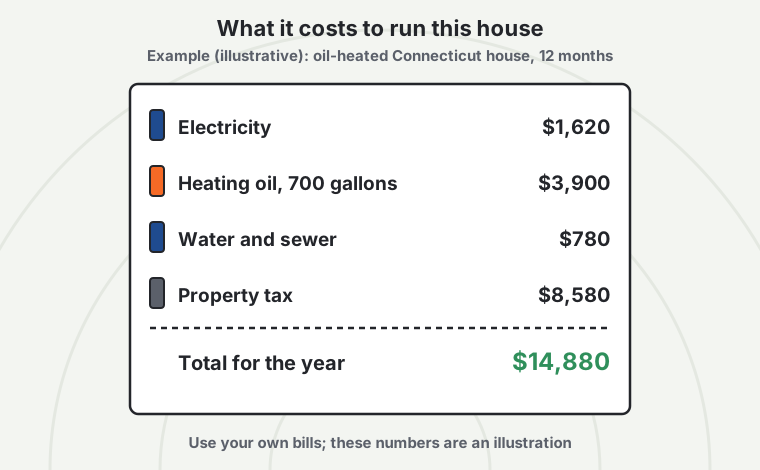
The question matters more in Connecticut than in most states. Heat varies sharply by town: in Simsbury, 62% of single-family homes heat with oil; in West Hartford, 73% use gas or propane (2025 parcel data). Heating oil cost $6.154 a gallon in Connecticut in October 2026 against $3.392 a year earlier (EIA). A buyer moving from an apartment has no idea what an oil-heated Cape costs to heat, and will often assume the worst.
How to build the sheet:
- Electricity and gas: download 12 months of bills or usage from your utility account.
- Heating oil or propane: ask your delivery company for a printout of last year’s deliveries in gallons and dollars.
- Water and sewer: your water utility or town bills; note if the house is on a private well and septic instead.
- Property tax: the current bill and assessment from the town tax collector.
- Context: how many people lived there and the thermostat settings, so buyers can adjust.
- Improvements: if you had an energy assessment through Energize Connecticut’s Home Energy Solutions program, or added insulation or a heat pump, include the report and invoices.
Be accurate. Leaving out the coldest month is a misrepresentation waiting to happen; showing it, with the gallons, builds trust.
Why do closed permits set a Connecticut house apart?
Closed permits set a Connecticut house apart because the condition report tells every buyer to confirm permits and certificates of occupancy with the town building official, and buyers’ attorneys, lenders and title insurers often do. A house where every roof, deck, addition and electrical job has a final inspection on file sails through that check. Open permits can delay a closing or start a renegotiation.
Our repair guide explains how to close out open permits and handle unpermitted work. To use clean permits as a selling point:
- Request your address’s permit history from the building department before you list.
- Close anything open with a final inspection while you still have time.
- Put a printout of the permit history, with final inspection dates, in the binder.
- Mention it in the listing remarks: “All permits closed; history available.”
Where work was done without a permit and you cannot legalize it, disclose it and price it. Our guide to selling a house with code violations covers the harder cases.
Does a floor plan and accurate square footage help a listing?
A floor plan and accurate square footage help a listing because buyers decide from their phones whether a house will fit their furniture and their life, and many shortlist homes before they ever visit. In NAR’s 2025 survey, buyers’ agents rated videos (48%) and virtual tours (43%) as highly important listing features. A simple measured plan answers “will it work for us?” for less than the cost of a staging consult.
Square footage is a common source of disputes. The number in a listing often comes from the town’s assessor card, which may count space differently from how a buyer measures. A measured plan done for the listing, with a note on what is and is not included (finished basement, enclosed porch), avoids that argument. Many listing photographers sell plans as an add-on (about $100 to $300, est.).
Pair the plan with the photos buyers rate highest. NAR’s survey found 73% of buyers’ agents rate photos highly important. Good photos and a plan together tell buyers what fits where, and the showings you get are with people who already know the layout works.
How does a flexible closing date set your house apart?
A flexible closing date sets your house apart because many buyers have a fixed date they must meet: a lease ending, a school year, a job start or their own sale. If you can close fast, close late, or stay a few weeks after closing under a written use-and-occupancy agreement, your house can win against one with a slightly lower price. It costs you nothing in cash, only planning.

Ways to offer flexibility:
- Say it in the listing. “Flexible closing” in the remarks tells buyers with a deadline to call.
- Know your own dates. Decide in advance the earliest and latest closing you can accept.
- Offer a short stay-back if you need it. Your Connecticut attorney writes a use-and-occupancy agreement covering the length, any daily charge, utilities and an escrow for damage. Do not do this on a handshake.
- Leave things buyers want. Appliances, window treatments, a snowblower, the shed contents. List them in the contract.
Our guide to comparing offers on a house in Connecticut shows how to weigh a better date against a better price.
How does pricing set a house apart?
Pricing sets a house apart because buyers search by price range, and a house priced at market value lands in front of the buyers who can afford it and looks like a good deal next to over-priced neighbors. An over-priced house sits, collects days on market and ends up cutting its price, which signals a problem. Every differentiator on this page works better at the right price.
Our guide to pricing your house to sell covers how to set the number. Two points matter here:
- Search brackets. Buyers filter in round numbers. A house at $405,000 does not show for a buyer whose search tops out at $400,000. If your price sits just above a round number, ask your agent whether moving under it widens the pool.
- The appraisal. A financed buyer’s lender orders an appraisal. If the price runs past what comparable sales support, the deal can stall. Read what happens with a low appraisal.
If the house has been listed for a while with few showings, our guide to why a house won’t sell in Connecticut helps you find the reason.
Is a pre-listing inspection and records binder worth the cost?
A pre-listing inspection and records binder are worth the cost when they prevent even one inspection credit or price cut. A typical package of inspection, radon test, binder and floor plan costs roughly $750 to $1,300 (est.). A single renegotiation after a buyer’s inspection, over a furnace, a roof or a radon result, often runs several thousand dollars, and a deal that falls apart costs another month of carrying.
Example (illustrative). A 1960s, oil-heated Colonial in Simsbury at the town’s single-family median of $510,000.
| Line | Amount | Basis |
|---|---|---|
| Pre-listing inspection | $500 to $700 (est.) | Typical Connecticut range |
| Radon test | $150 to $250 (est.) | Typical Connecticut range |
| Floor plan | $100 to $300 (est.) | Photographer add-on |
| Binder and utility sheet | $0 to $50 plus your time | Copies, folder |
| Total spent up front | $750 to $1,300 (est.) | |
| One month of property tax if a deal collapses | About $1,002 | $510,000 x 70% x 33.67 mills / 12 (OPM, fiscal 2027) |
| A typical inspection credit on a found problem | $2,000 to $10,000 (est.) | Depends on the item |
The math is lopsided in favor of preparing on older houses, and less so on a newer, well-kept one where the buyer’s inspection is unlikely to find much. Either way, the binder and utility sheet cost almost nothing.
When should you skip all this and sell another way?
You should skip the differentiators and sell another way when the pre-listing inspection would come back with a long, expensive list, when you cannot reach the house or gather the records, or when you need a certain date more than the best price. Then selling as-is, either listed at an as-is price or to a cash buyer, is the simpler route. If the house is sound and you have time, preparing it and listing it usually nets the most.
Prepare and list
Best netSound house, time to prepare.
- Inspection summary, binder, utility sheet, plan
- Fewer renegotiations
- Financed close, 30 to 45 days
List as-is, priced for condition
MiddleKnown issues, no budget to fix them.
- Disclose and price the issues
- Smaller buyer pool
- Commission still applies
Sell as-is for cash
About 2 weeksMajor repairs, distance or a firm deadline.
- No inspection renegotiation, no showings
- You pick the closing date
- Lower price than a prepared retail sale
We buy houses for cash ourselves, and the honest answer is: do not sell to a cash buyer if your house is in reasonable shape and you can put this page into practice. A well-documented listing usually nets more. A cash sale makes sense when the repair list is long, the house is far away or tied up in an estate, or the date matters most. Our guide to selling a house that needs repairs in Connecticut lays out that choice, and the ways we buy houses explains the terms we can offer.
Is a cash sale right for you, or should you list?
Seven quick questions. There is no wrong answer, and we will tell you honestly if listing would leave you more.
- Does the house need repairs you would rather not pay for or manage?
- Do you need to close by a certain date, or within the next month or two?
- Would showings be hard: tenants, belongings, privacy, or you live out of state?
- Is there a complication: an estate or probate, a divorce, foreclosure, liens or back taxes?
- Could you comfortably cover the mortgage, taxes and utilities for three or more months?
- Is getting the highest possible price more important to you than speed and certainty?
- Would a buyer's bank lend on the house as it is (no major roof, foundation, oil tank or code issues)?
How do you set your house apart, step by step?
To set your house apart, start six weeks before listing: pull permit records and close anything open, order a pre-listing inspection and tests, fix the cheap items, build the records binder and utility sheet, measure and draw a floor plan, set your closing window, price at market, and put “inspection summary and records available” in the listing.
Pull the permit history (6 weeks out)
Ask the building department for your address’s permits; schedule finals for anything open.
Inspect and test (5 weeks out)
Licensed home inspector, plus radon, well, septic or oil tank checks as the house needs.
Fix, credit or disclose (5 to 3 weeks out)
Fix cheap safety items; price the big ones; update your condition report answers.
Build the binder (3 weeks out)
System ages, receipts, warranties, test results, permits and the 12-month utility sheet.
Measure and photograph (2 weeks out)
Floor plan with square footage notes; photos after the staging is done.
Set your dates and price (1 week out)
Earliest and latest closing you can accept; a price at market, checked against search brackets.
List and tell buyers
“Inspection summary, records and utility costs available. Flexible closing.” Keep the binder on the counter.
See the house together.
Pick a time that works.
Choose a time for us to walk through the property with you, or ask for a quick call first. We confirm every request personally.
Tuesday, January 13
No open times in the next few weeks. Please call us.
We will confirm by email. Nothing is booked until we do.
View my requestQuestions about making your house stand out in Connecticut
How can I make my house stand out from others for sale?
You can make your house stand out from others for sale by giving buyers proof, not just looks: a pre-listing inspection summary, a records binder with system ages and receipts, 12 months of utility costs, closed permits, a floor plan, a flexible closing date and a price at market value.
Is a pre-listing inspection worth it in Connecticut?
A pre-listing inspection is usually worth it in Connecticut for older houses, inherited or rental houses you do not know well, and houses with oil heat, a well or septic. It costs about $400 to $700 (est.) and reduces surprises, but anything it finds must be disclosed.
Do I have to share my pre-listing inspection with buyers?
You do not have to hand buyers the full pre-listing inspection report, but you must disclose known problems on the Connecticut condition report, and the inspection adds to what you know (CGS 20-327b). Sharing a summary with what was fixed usually builds trust.
Should I give buyers my utility bills?
You should give serious buyers a 12-month summary of utility costs: electricity, oil or gas, water and sewer, plus the tax bill. It answers a top question for older Connecticut houses and is free to prepare. Leave out account numbers.
What records should I keep for selling my house?
For selling your house, keep receipts and warranties for the roof, heating, water heater, electrical and windows with install years, plus radon, well and septic results, permit records and appliance manuals. The closing documents themselves are a separate list.
Do open permits stop a sale in Connecticut?
Open permits do not automatically stop a sale in Connecticut, but they can delay it, because the condition report tells buyers to check permits with the building official and lenders or attorneys may ask for them to be closed. Close them before listing when you can.
Does a floor plan help sell a house?
A floor plan helps sell a house by showing buyers the layout before they visit, so the showings you get are from people who know it fits. It costs about $100 to $300 (est.) as a photographer add-on and avoids square-footage disputes.
What is a flexible closing and why does it help?
A flexible closing means you can close early, late, or stay briefly after closing under a written agreement. It helps because many buyers have a fixed date, such as a lease end or school start, and will favor a house that fits it.
Can I stay in my house after closing in Connecticut?
You can stay in your house after closing in Connecticut if the buyer agrees and your attorneys write a use-and-occupancy agreement covering the length, any charge, utilities and a damage escrow. Financed buyers’ lenders may limit how long.
Does offering a home warranty help sell a house?
Offering a home warranty can reassure buyers about older systems, but it does not replace records or repairs. A service receipt and the system’s age usually say more about a furnace than a warranty plan does.
What do Connecticut buyers worry about most in older houses?
Connecticut buyers of older houses most often worry about heating costs and the heating system, oil tanks, radon, wet basements, the roof, old wiring and, in some towns, the foundation. Answering those in writing before showings sets a house apart.
Is it worth it if I am selling as-is?
It is still worth gathering records and a utility sheet if you are selling as-is, because they cost almost nothing. A pre-listing inspection matters less when the price already reflects the condition, especially in a cash sale.
Related Connecticut guides
Prepare and present
Paperwork and law
We buy houses across the state, including in Simsbury, West Hartford and Manchester. For every route, cost and step in one place, start with how to sell a house in Connecticut.
Plain-English information, not legal advice. Estimates are labeled (est.). Talk to a Connecticut real estate attorney about disclosures and any post-closing occupancy.
Sources (checked on October 27, 2026)
- NAR 2025 Profile of Home Staging (listing features rated by agents).
- CGS 20-327b to 20-327e, residential condition reports and the $500 credit.
- CGS 20-490 to 20-495a, home inspection licensing.
- CGS 29-453, smoke and carbon monoxide detector affidavit (as amended by PA 23-164).
- Connecticut CAMA and Parcel Layer 2025 (heating fuel by town).
- EIA, Weekly Connecticut No. 2 heating oil residential price (week of October 19, 2026).
- Energize Connecticut, Home Energy Solutions.
- Connecticut OPM real estate sales, data.ct.gov dataset 5mzw-sjtu.
- Connecticut OPM, mill rates (Simsbury, fiscal 2027).
- Connecticut Department of Consumer Protection (license lookup).

Who wrote this
Jerryll Noorden
Jerryll has bought and sold Connecticut houses since 2016 and has sat at more closing tables than he can count, on both sides. Before real estate he was a robotics scientist at NASA, IHMC and IIT. He wrote this guide because the national sites that rank for it skip the Connecticut rules that cost sellers money. When listing or selling it yourself would get you more than a cash offer, he says so.
This guide explains Connecticut rules in plain English. It is not legal or tax advice. Laws change; for your sale, talk to a Connecticut real estate attorney and a tax professional.
