
Key facts at a glance
| Fact | Number | Source |
|---|---|---|
| Daylight in Hartford on December 21 vs. June 21 | About 9 hours 8 minutes (7:14 a.m. to 4:22 p.m.) vs. about 15 hours 13 minutes | NOAA solar calculator, Hartford coordinates |
| Median days on market in Connecticut, December 2025 vs. May 2026 | 57 vs. 28 days | Realtor.com via FRED (MEDDAYONMARCT) |
| Share of the year’s single-family closings in January and February | 6.4% and 5.0% (vs. 10.8% in July) | data.ct.gov sales (OPM), Oct 2022 to Sep 2025 |
| Who answers for ice on a public sidewalk | Towns may shift the duty and liability to the abutting owner by ordinance; injury claims within 2 years | CGS 7-163a |
| Connecticut residential heating oil price | $6.154 a gallon (week of Oct 19, 2026) | U.S. Energy Information Administration |
| Buyers’ agents who rate listing photos highly important | 73% (sellers’ agents: 88%) | NAR 2025 Profile of Home Staging |
| Virtually staged or edited photos in SmartMLS | Must be watermarked; permanent features may not be removed | SmartMLS compliance guidance |
This page is part of our guide to how to sell a house in Connecticut. Staging basics (which rooms first, DIY versus a stager, what it costs) live in our main guide to staging a house to sell in Connecticut. This page covers only what changes between November and March: light, heat, snow, ice, wet boots and a yard you cannot photograph.
Can you stage a house in winter in Connecticut and still sell it well?
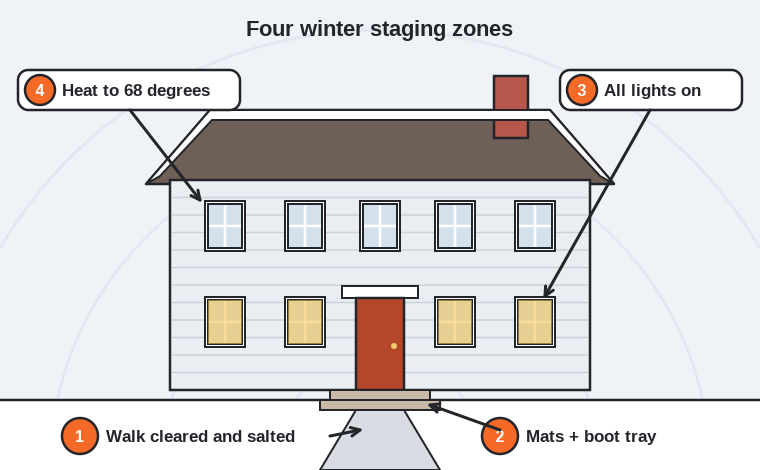
You can stage a house in winter in Connecticut and still sell it well, but winter staging is about different problems than spring staging. The sun sets around 4:22 p.m. in late December, so lighting matters more; the house must be warm; walks must be safe; and snow hides the yard in photos. Houses also take longer to sell: 57 median days on market in December 2025 against 28 in May 2026.
The good news: fewer houses come on the market in winter, so a well-presented listing faces less competition. The buyers who tour in January usually have a reason to move. The rest of this page is how to give them nothing to complain about on a dark, cold afternoon.
Why does a winter listing feel like such a gamble?
A winter listing feels like a gamble because you cannot control the weather, and the weather decides whether buyers show up, whether the walk is safe, and how the house looks in photos. Many sellers also worry they are leaving money on the table by not waiting for spring, and feel exposed letting strangers track snow through the house.
Maybe a job starts in another state in February. Maybe a parent moved into assisted living in the fall and the house is sitting empty in Manchester with the heat on. Maybe you simply cannot face another winter of shoveling. Whatever the reason, the calendar picked winter for you.
Sellers in your spot usually feel:
- Anxious that a storm will wipe out the one showing that mattered.
- Worried about liability if someone slips on the steps.
- Embarrassed by a yard that is brown, muddy or buried.
- Drained by keeping a house spotless while boots and salt come in every day.
- Second-guessing the decision not to wait until April.
This page is for you if you have to sell this winter, or have decided to, and want a plan for each of those worries. We will also say plainly when waiting for spring is the better choice.
How do you make a house look bright when the sun sets at 4:22 p.m.?
You make a house look bright in a Connecticut winter by booking showings and photos in the middle of the day, turning on every light before each showing, opening every blind, using bright warm bulbs in every fixture, and lighting the outside for the late-afternoon tours. Around the winter solstice, Hartford gets only about 9 hours of daylight, from about 7:14 a.m. to 4:22 p.m.
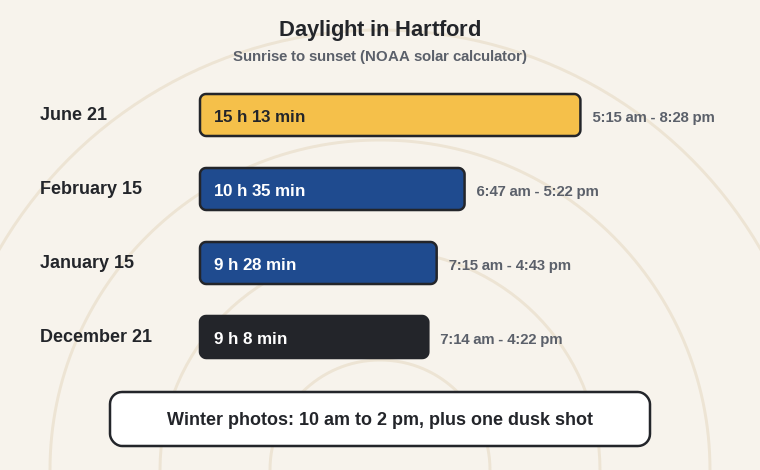
Most buyers tour after work. In June that is broad daylight; in December it is dark by the time they park. So the house has to carry its own light:
- Replace every dead or dim bulb, including closets, the basement stairs and the garage. Match the color in each room so it does not look patchy.
- Add a lamp to any room that relies on a single ceiling light.
- Open every blind and curtain fully, even at night; a dark window reads as a dark room.
- Light the walk, the steps and the front door. A buyer who arrives at 5:30 p.m. sees the house in the porch light first.
- Put lights on timers in a vacant house so it never shows dark, and so it looks lived-in from the street.
- Book listing photos between about 10 a.m. and 2 p.m. on a clear day, and ask the photographer for one dusk exterior shot with every light on, around sunset.
The dusk shot is the one winter advantage in photos. With sunset before 4:30 p.m. in December and January, a photographer can catch the glowing-windows picture without staying until 9 p.m.
How warm should the house be for winter showings?
The house should be comfortably warm for winter showings, around 68 degrees, which is the daytime setting the U.S. Department of Energy suggests for an occupied home. In a vacant house you can hold it lower between showings, commonly 55 degrees or more to protect the pipes, then raise it an hour or two before each visit. Buyers who keep their coats on leave sooner.
Cold is the fastest way to shorten a showing. It also makes buyers wonder about the heating system, the windows and the insulation, all of which they are about to pay for. Practical steps:
- Service the system before you list. A tune-up receipt in the listing folder answers the heating question before it is asked. It is also on our list of low-cost fixes before you sell.
- Keep the tank or account topped up. Most Connecticut towns are split between oil and gas heat, and at $6.154 a gallon for heating oil (EIA, October 2026), running out over a holiday week is an expensive mistake and a burst-pipe risk.
- Use a smart or Wi-Fi thermostat in a vacant house so you or your agent can raise the heat before a showing and get an alert if the temperature drops.
- Check your insurance. Many homeowner’s policies limit coverage once a house is vacant, and some require heat to be maintained or the water shut off and drained. Read the wording and tell your agent.
Frozen pipes in an empty house are the costliest winter problem, and our Southington winter selling guide walks through protecting a vacant house in detail. A fireplace is a nice touch for an occupied showing, but never leave a fire burning while you are out of the house; a clean, empty firebox with a few logs beside it photographs just as well.
Who is responsible if a buyer slips on ice at your house?
You, as the owner, are generally responsible for keeping your own driveway, walks and steps reasonably safe for buyers you invite to a showing. For the public sidewalk, Connecticut lets towns shift the duty and liability for ice and snow to the abutting owner by ordinance (CGS 7-163a), and many towns have done so. An injured person then has two years to sue the owner.
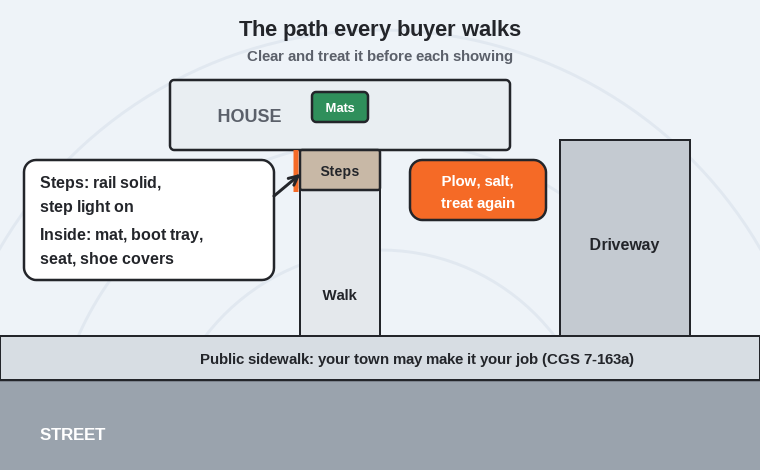
The statute is specific. Under CGS 7-163a, a town that adopts it is no longer liable for ice on public sidewalks it does not own, and the abutting owner takes on the same duty of care the town had, with injury claims allowed for two years. Your town’s own ordinance usually sets how soon after a storm you must clear the walk, and whether there is a fine. Look it up on the town website or call public works.
On your own property the rule is ordinary negligence: you are expected to take reasonable care. For a listing, that means:
- Hire a plow contractor with a trigger depth, and ask the contractor to do the walk and steps too.
- Keep ice melt and a shovel by the front door; treat the steps again the morning of every showing.
- Make sure the handrail is solid and the step lights work.
- Clear a path to the oil fill or gas meter, the bulkhead and any side door the inspector will use.
- Tell your agent to cancel or move a showing during an active storm rather than invite people onto a slick walk.
- Confirm your homeowner’s liability coverage is active, especially if the house is vacant.
For a vacant house, put the snow contract in writing and ask for a photo after each storm. Neighbors notice an unplowed driveway, and so do buyers.
How do you handle boots, salt and slush during winter showings?
You handle boots, salt and slush during winter showings by setting up the entry as a small mudroom: a stiff mat outside, an absorbent mat inside, a boot tray, a bench or chair to sit on, a basket of disposable shoe covers, and a sign asking buyers to remove or cover their shoes. Then check and wipe the entry floor after every showing.
Salt and grit are hard on wood floors and leave white tide marks on rugs. Buyers notice wet footprints in photos and in person, and a slippery tile entry is its own hazard. A good winter entry costs well under $150 (est.) and protects the floors you are selling:
- A heavy rubber or coir mat outside, big enough for two steps.
- A washable, absorbent runner inside, rubber-backed so it does not slide.
- A boot tray and a place to sit down, so people do not hop on one foot.
- Shoe covers in a basket, with a short, polite sign.
- Hooks or a cleared coat closet, so coats do not land on your staged bed.
In an occupied house, move your own boots, coats and salt-stained mats out of sight. A family’s winter gear by the door is normal life, but in photos it reads as clutter.
What photos should a winter listing use when snow covers the yard?
A winter listing should use a fresh exterior photo taken this season, plus clearly labeled photos of the yard, garden or pool taken in an earlier season. Summer photos are fine when they show the house as it is and the caption says when they were taken. Editing in green grass, removing snow from a damaged roof, or hiding permanent features crosses into misrepresentation.
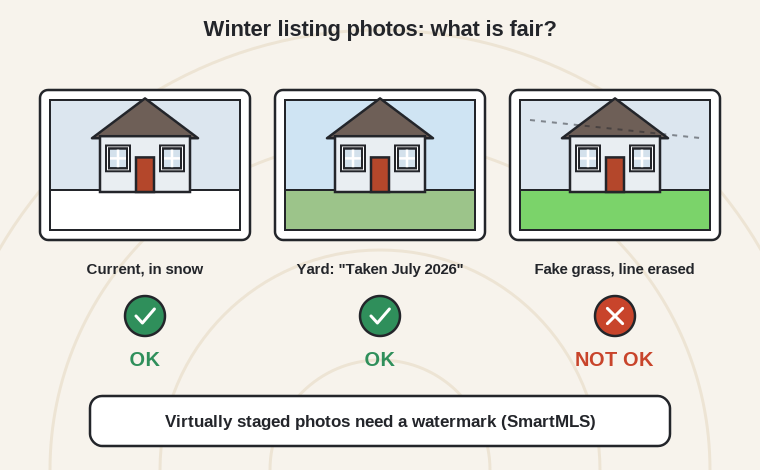
Here is the line, as Connecticut’s rules and the Realtor code draw it:
| Photo practice | OK? | Why |
|---|---|---|
| Current exterior in snow, walk shoveled, lights on | Yes | Accurate and current; it is the house buyers will see. |
| Backyard or garden photo from last summer, captioned “Taken July 2026” | Yes | Shows features snow hides; the date keeps it honest. |
| Twilight shot with every light on | Yes | Real light, real house. |
| Virtually staged room | Yes, if watermarked | SmartMLS requires a stamp or watermark on virtually staged photos. |
| Summer photo used as the main photo with no date | Avoid | Buyers arrive expecting a green yard and feel misled. |
| Snow, stains or cracks edited out; lawn painted green | No | Misrepresents condition; SmartMLS bars removing permanent features, and licensees can be disciplined for material misrepresentation (CGS 20-320). |
If you are listing in winter and own the house now, take yard photos before the first snow: the lawn, the garden, the patio and any view. If you have older photos of your own, look for ones that still match the house; a deck that has since been removed does not belong in the listing.
Should you decorate for the holidays while your house is for sale?
You should decorate lightly and neutrally while your house is for sale: a wreath, white lights on the porch, a small tree that does not block a window or walkway, and nothing that crowds a room. Heavy decorations hide floor space, date your listing photos, and distract from the house. Take photos before decorating or after you take decorations down.
The old advice to stack wrapped boxes under the tree for showings does not hold up. Buyers are trying to see the room’s size and the floor, and a big tree in the living room makes both look smaller. Keep it simple:
- Shoot listing photos before you decorate, so the listing does not look stale in February.
- Choose one spot for a tree where it does not block a window, a fireplace or the main walking path.
- Skip candles while you are out; use battery candles if you want the glow.
- Put away gifts, cards and anything with names on it.
Our guide to selling a house during the holidays in Connecticut covers the timing and tax side of a November or December sale.
What does winter staging cost in Connecticut?
Winter staging in Connecticut costs a few hundred dollars in one-time supplies plus monthly snow and heating costs. Mats, bulbs, ice melt and shoe covers run about $150 to $350 once (est.). Plowing and walk clearing run about $150 to $400 a month (est.). A vacant house adds its heat, often the largest line at current oil prices. Main-room staging, if any, is on top.
Example (illustrative): a vacant, oil-heated Cape in Manchester at the town’s single-family median of $320,500, listed in January.
| Item | Cost | Basis |
|---|---|---|
| Entry mats, boot tray, shoe covers | $80 to $150 once (est.) | Typical retail prices |
| Bulbs, two lamps, light timers | $70 to $200 once (est.) | Typical retail prices |
| Plowing, walk and step clearing | $150 to $400 a month (est.) | Depends on storms and contract |
| Heating oil, held at 55 to 60 degrees and raised for showings | About $615 to $923 a month (est.) | 100 to 150 gallons (est.) at $6.154 a gallon (EIA, Oct 19, 2026) |
| Property tax while it sits | About $767 a month | $320,500 x 70% x 41.0 mills / 12 (OPM, fiscal 2027) |
| Season-labeled yard photos | $0 if you take them before snow |
That is roughly $1,500 to $2,100 a month to hold and show an empty house in deep winter (est.), before insurance, electricity and any mortgage. With winter houses taking about twice as long to go under contract as May houses (57 vs. 28 median days), the carrying cost, not the mats, is the number to watch. Our guide to carrying costs of a vacant house shows how to work out your own. If the house also needs repairs before it can show well, compare that against selling a house that needs repairs as-is.
Should you list in winter, wait for spring, or sell as-is now?
You should list in winter if the house is in good shape, you can keep it warm, lit and cleared, and you have a reason not to wait. You should wait for spring if you live there, nothing forces the date, and the yard is a selling point. You should consider selling as-is for cash if the house is vacant, needs repairs, or the monthly carrying cost outweighs a spring premium.
List this winter, staged
Less competitionGood house, motivated timing, someone to manage snow and heat.
- Fewer competing listings
- Longer market time: 57 median days in December 2025
- Financed buyer, about 30 to 45 days to close
Wait for spring
More buyersYou live there, the yard shows well, no deadline.
- Faster sales: 28 median days in May 2026
- Green yard and long evenings
- Costs another season of carrying
Sell as-is for cash
About 2 weeksVacant, repairs, distance, or no time to manage a winter listing.
- No showings, snow contract or staging
- Leave what you do not want
- Lower price than a staged retail sale
We buy houses for cash, so here is the honest line: do not sell to a cash buyer this winter if the house is in good condition, you live in it, and you can wait until spring or keep it show-ready. Listing will usually net you more. A cash sale fits when the house is empty and costing you every month, needs work buyers will price hard, or you cannot be there to clear the walk before a showing. If repairs are part of the picture, read selling a house that needs repairs in Connecticut and selling a house for cash in winter.
Know where you stand,
on your own time.
Watch what homes around you sell for and how fast, so when you are ready, you already know your options.
Follow your numbers as the market moves, and decide when the timing is right.
How do you stage a house for a winter sale, step by step?
To stage a house for a winter sale, take yard photos before the snow, service the heat, set up a snow contract, fix the lighting, build a winter entry, stage the main rooms, photograph in midday light with one dusk shot, and run a short pre-showing routine every time. Plan about three to four weeks of preparation for a lived-in house.
Photograph the yard before the first snow
Lawn, beds, patio, pool, views. Save the dates so the captions are accurate.
Service the heat and fill the tank
Keep the receipt for the buyer folder. Check your insurance’s vacancy wording if the house is empty.
Line up snow and ice clearing
Driveway, walk, steps and the public sidewalk if your town requires it (CGS 7-163a). Get it in writing for a vacant house.
Fix the light
Every bulb, a lamp for dark rooms, timers, porch and step lights.
Build the winter entry
Two mats, a boot tray, a seat, shoe covers, a cleared coat closet.
Stage the main rooms
Follow our staging guide for the living room, primary bedroom and kitchen. Add throws and warm textiles, not decorations.
Photograph and list
Midday interiors, a current snow exterior, a dusk shot, and labeled season photos of the yard.
Run the pre-showing routine
Heat up, lights on, blinds open, walk salted, entry wiped. About 20 minutes each time.
Questions about staging a house in winter in Connecticut
Is it bad to sell a house in winter in Connecticut?
It is not bad to sell a house in winter in Connecticut, but it is slower. Median days on market were 57 in December 2025 against 28 in May 2026. There are also fewer competing listings, and winter buyers are usually serious.
What temperature should my house be for a showing in winter?
Your house should be about 68 degrees for a winter showing, the daytime setting the U.S. Department of Energy suggests. In a vacant house, hold it lower between showings, commonly 55 degrees or more, and raise it an hour or two before buyers arrive.
Can I use summer photos to sell my house in winter?
You can use summer photos to sell your house in winter if they show the house as it is now and are labeled with when they were taken. Use a current winter photo as well. Do not edit photos to hide snow damage, defects or permanent features.
Am I liable if someone slips on my icy sidewalk during a showing?
You can be liable if someone slips on your icy sidewalk during a showing. Connecticut lets towns shift sidewalk ice liability to the abutting owner by ordinance (CGS 7-163a), and you owe invited visitors reasonable care on your own walk and steps. Clear and treat before every showing and keep liability insurance active.
Should I take my house off the market for the winter?
You should take your house off the market for the winter only if you live there, have no deadline, and showings are rare. If the house is vacant and costing you every month, keeping it listed or selling as-is usually costs less than waiting.
Should I have a fire in the fireplace during a showing?
You should not leave a fire burning during a showing you are not attending. A clean firebox with a few logs and good lighting shows the fireplace just as well, without the safety and smoke risk.
How do I stop buyers tracking salt and snow into my house?
You stop buyers tracking salt and snow into your house with two mats, one outside and one absorbent mat inside, a boot tray, a seat, disposable shoe covers and a short sign. Wipe the entry floor after each showing.
Should I decorate for Christmas if my house is for sale?
You should decorate lightly if your house is for sale: a wreath, porch lights and a small tree that does not block a window or walkway. Take listing photos before you decorate so the listing does not look dated after the holidays.
What is the best time of day for winter listing photos?
The best time of day for winter listing photos is about 10 a.m. to 2 p.m. on a clear day for interiors and the main exterior, plus one dusk shot with every light on near sunset, which falls before 4:30 p.m. in late December in Hartford.
Do I need to keep a vacant house heated while it is for sale?
You need to keep a vacant house heated while it is for sale unless the plumbing has been professionally drained and your insurer agrees. Many policies limit coverage for vacant houses; read the vacancy and freezing wording and tell your agent.
Does winter staging cost more than spring staging?
Winter staging usually costs a little more than spring staging because of snow clearing and heat, about $150 to $400 a month for plowing plus heating a vacant house (est.). The rooms themselves cost the same to stage in any season.
Related Connecticut guides
Staging and prep
Winter and timing
We buy houses across the state, including in Manchester, Hartford and Southington. For every route, cost and step in one place, start with how to sell a house in Connecticut.
Plain-English information, not legal or insurance advice. Estimates are labeled (est.). Check your town’s sidewalk ordinance and your insurance policy, and talk to a Connecticut attorney about liability questions.
Sources (checked on October 27, 2026)
- NOAA Global Monitoring Laboratory, Solar Calculator (Hartford, 41.76 N, 72.68 W; NOAA formulas, our calculation).
- Realtor.com median days on market, Connecticut (FRED MEDDAYONMARCT).
- Connecticut OPM real estate sales, data.ct.gov dataset 5mzw-sjtu.
- CGS 7-163a, municipal liability for ice and snow on public sidewalks.
- CGS 20-320, real estate licensee discipline.
- EIA, Weekly Connecticut No. 2 heating oil residential price (week of October 19, 2026).
- U.S. Department of Energy, Energy Saver: Programmable thermostats (68 degrees while awake).
- NAR 2025 Profile of Home Staging (listing photos rated important).
- SmartMLS compliance, Virtually Staged Photos.
- NAR Code of Ethics, Standard of Practice 12-10.
- Connecticut OPM, mill rates (Manchester, fiscal 2027).

Who wrote this
Jerryll Noorden
Jerryll has bought and sold Connecticut houses since 2016 and has sat at more closing tables than he can count, on both sides. Before real estate he was a robotics scientist at NASA, IHMC and IIT. He wrote this guide because the national sites that rank for it skip the Connecticut rules that cost sellers money. When listing or selling it yourself would get you more than a cash offer, he says so.
This guide explains Connecticut rules in plain English. It is not legal or tax advice. Laws change; for your sale, talk to a Connecticut real estate attorney and a tax professional.
