
Key facts at a glance
This Farmington net sheet is part of our guide to how to sell a house in Connecticut. It walks through every line on a Farmington seller’s closing statement, in the order your attorney will show it to you, on the town’s median single-family price.
| Fact | Number | Source |
|---|---|---|
| Farmington residential sales, Oct 2024 to Sep 2025 | 408 | CT OPM Real Estate Sales, data.ct.gov |
| Farmington median sale price, all residential | $436,000 | CT OPM Real Estate Sales |
| Farmington median single-family sale price | $520,000 | CT OPM Real Estate Sales |
| Farmington mill rate, fiscal 2027 | 27.36 mills | CT OPM mill rates |
| Property tax on a $520,000 Farmington house | About $9,960 a year, two installments of $4,980 | Mill rate × 70% assessment (CGS 12-62a) |
| Farmington tax installments | Due July 1 and January 1 (bills over $100) | Farmington Tax Collector |
| Conveyance tax on a $520,000 Farmington sale | $5,200 (0.75% state + 0.25% town) | CGS 12-494 |
| Farmington single-family sales above $800,000 | 66 of 252 (about 1 in 4) | CT OPM Real Estate Sales (our query) |
Why is it so hard to get a straight answer on what selling in Farmington costs?
It is hard to get a straight answer on what selling in Farmington costs because most answers give a percentage range, not a closing statement. Sellers at this stage often feel cautious, a little suspicious of every “estimate,” worried about a surprise at the closing table, and protective of equity they spent years building. A line-by-line net sheet on Farmington’s own numbers fixes that.
You have heard “6% to 10%” and “it depends.” Neither tells you what check you will leave with. And the line nobody explains well, the property tax adjustment, can swing your number by thousands depending on the month you close.
I am Jerryll Noorden. I have bought houses across Connecticut since 2016, about ten a year, and I have read a lot of seller closing statements. This page gives you every line, where it comes from and what it is on a typical Farmington house.
If you own a house in Farmington and want to know your number before you talk to anyone, this page is for you.
How much does it cost to sell a house in Farmington, CT?
The cost to sell a house in Farmington, CT is about $33,000, or roughly 6.3% of the price, on the $520,000 single-family median in our example: about $26,000 in commission (est.), $5,200 of conveyance tax, $1,250 for your attorney (est.), a small property tax adjustment and about $100 in fees. Prep and carrying costs come on top if you list. Your mortgage payoff is then subtracted from what is left.
The conveyance tax is set by law (CGS 12-494), and a Connecticut attorney must conduct the closing (CGS 51-88a). The commission is negotiable, and the tax adjustment depends on your closing month. The full statewide list of possible costs lives in our guide to seller closing costs in Connecticut; this page applies it to one Farmington house, line by line.
What does a full seller net sheet look like on a Farmington house?
A full seller net sheet on a Farmington house starts with the $520,000 median price, subtracts commission, the 1% conveyance tax, your attorney, the January tax installment and small fees, adds back the buyer’s credit for the tax months you prepaid, and then subtracts your mortgage payoff. In our example that leaves $487,000 before the payoff and $237,000 after a $250,000 loan.
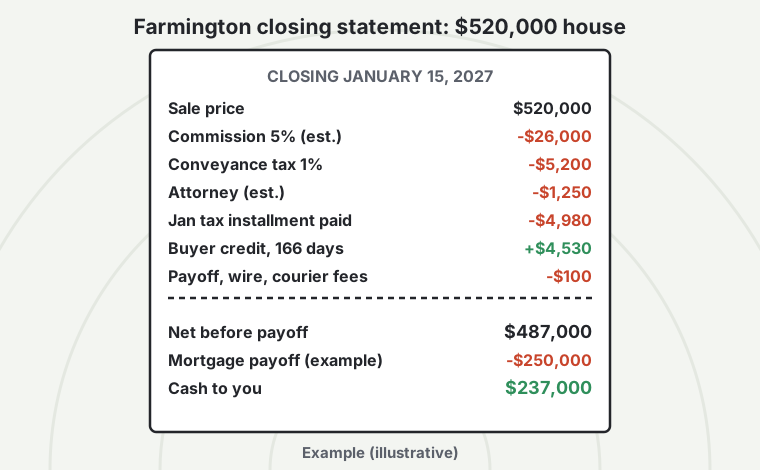
Example (illustrative). A Farmington single-family house sells at the town median of $520,000 and closes on January 15, 2027. The seller still owes $250,000 on the mortgage. The commission rate, attorney fee, fees and payoff are examples, not quotes.
| Line on the closing statement | Amount | Where the number comes from |
|---|---|---|
| Contract sales price | $520,000 | Your signed contract (Farmington single-family median, CT OPM) |
| Real estate commission, 5% total (est.) | -$26,000 | Your listing agreement and any buyer-agent agreement |
| State conveyance tax, 0.75% | -$3,900 | CGS 12-494, filed on Form OP-236 |
| Farmington conveyance tax, 0.25% | -$1,300 | CGS 12-494 (Farmington is a 0.25% town) |
| Seller’s attorney (est.) | -$1,250 | Your attorney’s written fee quote |
| January 2027 tax installment, paid at closing | -$4,980 | Farmington tax bill (half of about $9,960) |
| Buyer’s credit for January 16 to June 30 (166 days) | +$4,530 | $9,960 ÷ 365 = $27.29 a day |
| Overnight payoff, wire and courier fees (est.) | -$100 | Attorney and lender |
| Net before mortgage payoff | $487,000 | |
| Mortgage payoff, with interest to the closing day (example) | -$250,000 | Your lender’s written payoff statement |
| Cash to you at closing | $237,000 |
Without the payoff, the selling costs in this example add up to $33,000: $26,000 + $5,200 + $1,250 + $100, plus the $450 difference between the January installment you pay and the credit you get back. That is about 6.3% of the price. If the house heats with oil (about 45% of Farmington homes do, per the 2025 state parcel data), the buyer usually also pays you for the oil left in the tank, a Connecticut custom that adds a few hundred dollars to your side.
Run it on your own price and payoff:
How much would you walk away with?
Slide the numbers to match your house. It works in your browser; nothing is saved or sent.
Estimates for planning. Conveyance tax per CGS 12-494 (state 0.75% up to $800,000, 1.25% to $2.5M, 2.25% above, plus the town rate). Seller attorney about $1,200 to $1,500; flat-fee MLS about $400; listings include three months of taxes, insurance and utilities, a cash sale about two weeks. Your attorney gives you the final numbers.
If you want a step-by-step method for finding each input yourself (the payoff letter, the tax bill, the conveyance rate), our guide to calculating your net proceeds walks through it on a Seymour house.
How much conveyance tax do you pay when you sell in Farmington?
You pay 1% conveyance tax when you sell a house in Farmington for $800,000 or less: 0.75% to the state and 0.25% to the town under CGS 12-494. On the $520,000 median that is $5,200. Above $800,000 the state rate rises to 1.25% on the part of the price over $800,000, which matters in Farmington, where about one in four single-family sales cleared that line.
Farmington is not one of the 0.50% towns, so the town share stays at 0.25% at every price. Your attorney files the tax on Form OP-236. At three Farmington prices:
| Sale price | State share | Farmington share (0.25%) | Total conveyance tax |
|---|---|---|---|
| $436,000 (all-residential median) | $3,270 | $1,090 | $4,360 |
| $520,000 (single-family median) | $3,900 | $1,300 | $5,200 |
| $900,000 | $6,000 + $1,250 = $7,250 | $2,250 | $9,500 |
For every town’s rate and the exemptions (some transfers owe no conveyance tax at all), see our Connecticut conveyance tax guide.
How does the Farmington property tax adjustment work at closing?
The Farmington property tax adjustment works by splitting the year’s tax between you and the buyer by the day. Farmington bills over $100 come in two installments, due July 1 and January 1. Connecticut attorneys usually treat a paid installment as covering its six months, so if you have prepaid days after closing, the buyer credits you; if an installment is due and unpaid, it is paid from your proceeds first.
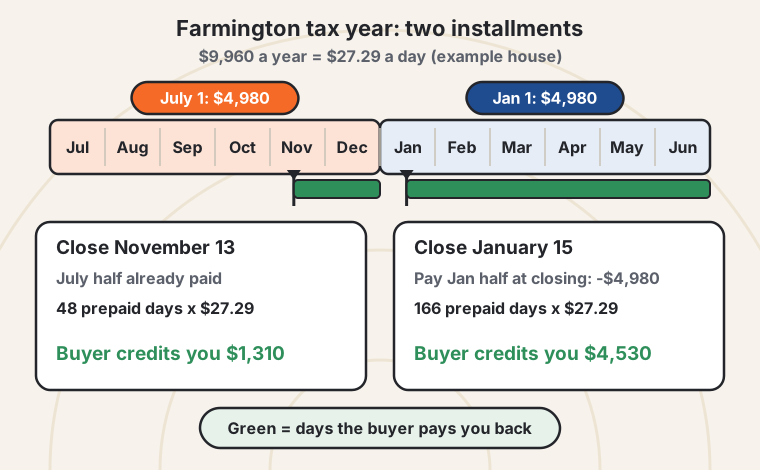
Start with the yearly tax: $520,000 × 70% × 27.36 ÷ 1,000 = about $9,960, or $27.29 a day (CGS 12-62a). Your real bill uses the assessment from Farmington’s last revaluation, so for your own math divide the annual tax on your actual bill by 365.
Then look at your closing date:
- Close in November (example: November 13, 2026). You paid the July installment, which covers July 1 to December 31 for the adjustment. The buyer credits you for November 14 to December 31: 48 days × $27.29 = about $1,310 back to you.
- Close in mid-January (example: January 15, 2027). The January installment of $4,980 is due on January 1 and can be paid through the first business day of February without interest. If you have not paid it, your attorney pays it from your proceeds, and the buyer credits you for January 16 to June 30: 166 days × $27.29 = about $4,530. Your net tax cost is the $450 for the days you owned the house.
- Miss the grace period. Farmington charges interest of 1.5% a month back to the due date once the grace period ends (Farmington Tax Collector). Your attorney will pay any delinquent tax, with interest, from your proceeds.
Practices differ and your contract can set its own rule, so ask your attorney for the tax line in writing a week before closing. Either way, it is not a fee: it is your own tax for the days you owned the house.
What do the attorney fee and mortgage payoff lines include?
The attorney fee line covers your Connecticut seller’s attorney, usually a flat fee of about $1,000 to $1,500 (est.) for a simple sale. The mortgage payoff line is the full amount your lender says will release the mortgage on closing day: the principal balance plus daily interest to that date and any small lender fees. It is usually larger than the balance on your last statement.
Your attorney orders the payoff statement from your lender. It shows a “good through” date and a per-day interest amount, the per diem, added for each day closing slips. Because mortgage interest is charged in arrears, the payoff includes interest for the days before closing, even if you made this month’s payment. Sellers who look only at the principal balance often overestimate their check.
Other lines appear only if they apply: a home equity line or second mortgage, any lien or judgment (see selling a house with a lien), final water or sewer charges, a condo resale certificate fee, and the $500 credit to the buyer if you did not deliver the property condition report (CGS 20-327c).
The smoke and carbon monoxide affidavit (CGS 29-453) is not a cost line: since Public Act 23-164 you simply sign it at closing. There is no longer a credit you can pay instead.
Which Farmington selling costs never show up on the closing statement?
The Farmington selling costs that never show up on the closing statement are the ones you pay before closing: cleaning, paint and small repairs, staging, storage, and the months of property tax, insurance and utilities while the house is for sale. At $27.29 a day in property tax alone, three months listed adds about $2,490 in Farmington tax before insurance, utilities and mortgage interest.
These costs vary the most: a move-in-ready colonial may need a deep clean, while a house with a 1980s kitchen and an original roof can need far more. Our guide to what listing really costs beyond the commission prices these items on a Woodbridge house, including staging, inspections and carrying months, and our what to fix before selling guide tells you which repairs are worth making.
Income tax on your gain comes later, if at all: most owners who lived in the house two of the last five years exclude up to $250,000 of gain ($500,000 for a married couple) under IRS Publication 523. See taxes when selling a house in Connecticut.
How does a cash sale change the Farmington net sheet?
A cash sale changes the Farmington net sheet by removing the commission, prep and most of the carrying months, but the price is lower, so on a move-in-ready Farmington house listing almost always nets more. The conveyance tax, attorney fee, tax adjustment and payoff lines stay. A cash sale wins on the net sheet mainly when the house needs work you cannot fund or when time costs you money.
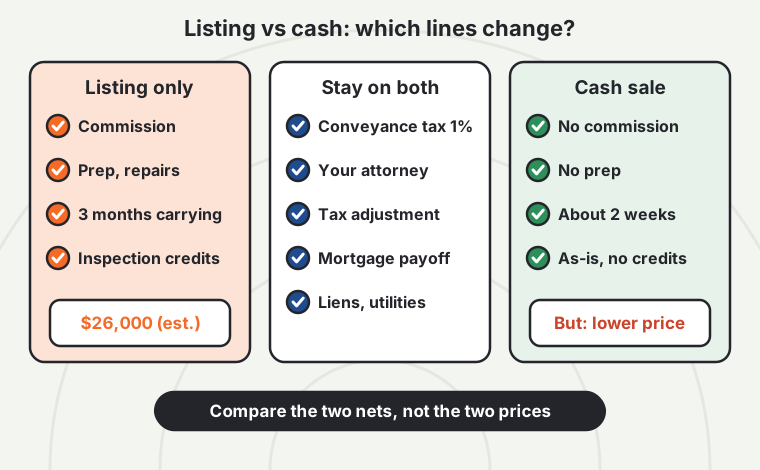
On a cash sale the conveyance tax is still 1%, charged on the lower price, and the attorney and tax lines work the same way. What disappears is the $26,000 commission and the costs before closing. The honest comparison, with the break-even math, is on our cash buyer vs. realtor page, and our page on why cash offers are lower explains how buyers like me get to our number.
When should you NOT sell your Farmington house to a cash buyer?
You should not sell your Farmington house to a cash buyer when it is in good shape, you have about three months, and nothing forces your timing. With a $487,000 net before payoff on a $520,000 listing, a cash offer would need to come within a few percent of full price to match it, which buyers who renovate and resell rarely pay for a house that needs nothing.
Interview two or three agents, ask each for a written net sheet like the one above, and negotiate the commission. Our real estate commission guide shows how. A cash sale fits better when the house needs repairs you cannot fund, sits vacant, is part of an estate, or has a hard deadline. See selling a house that needs repairs if that is you.

Ask your attorney for a draft settlement statement before closing day, not at the table. Check three lines yourself: the payoff against your lender’s letter, the tax adjustment against your tax bill, and the conveyance tax against 1% of the price. Those three are where surprises hide.
How do you build your own Farmington net sheet, step by step?
To build your own Farmington net sheet, start from a realistic price based on recent Farmington sales, subtract the commission you negotiate and the 1% conveyance tax, add your attorney’s quote, work out the tax adjustment from your actual bill and closing month, and subtract the lender’s written payoff. It takes about an hour once you have the documents.
Price it from recent Farmington sales
Use sales of the last three to six months matched on style, size and condition, not the town median. A dated colonial and an updated one are different markets.
Subtract commission and conveyance tax
Commission at the rate in your agreement; conveyance tax at 1% up to $800,000 (CGS 12-494).
Get your attorney’s fee in writing
Ask what is included and what is extra, such as courier or wire fees.
Work out the tax line
Annual tax from your bill ÷ 365 = your daily rate. Count the prepaid or unpaid days from your closing date to June 30 or December 31.
Request a payoff estimate
Your lender’s figure, with the per-diem interest, replaces your guess. Then subtract any second mortgage or lien.
If you would like a cash number to compare, our Farmington page is where to request one. It costs nothing and expires only when you say so.
Questions about selling costs in Farmington, CT
How much does it cost to sell a house in Farmington, CT?
It costs about $33,000 to sell a $520,000 house in Farmington, CT in our example, roughly 6.3% of the price: commission (est.), $5,200 of conveyance tax, an attorney fee (est.), a small tax adjustment and fees. Prep and carrying costs come on top if you list.
What is the conveyance tax in Farmington, CT?
The conveyance tax in Farmington, CT is 1% of the price up to $800,000: 0.75% state and 0.25% town (CGS 12-494). The state rate rises to 1.25% on the part above $800,000. The seller pays it at closing.
When are Farmington property taxes due?
Farmington property taxes over $100 are due in two installments, July 1 and January 1, payable without interest through the first business day of August and February. Late payments carry 1.5% interest a month back to the due date (Farmington Tax Collector).
Will I owe property tax at closing in Farmington?
You may owe property tax at closing in Farmington if an installment is due and unpaid; it is paid from your proceeds. If you have prepaid days after the closing date, the buyer credits you for them. Your attorney applies the town’s installment periods.
What is the property tax on a $520,000 house in Farmington?
The property tax on a $520,000 house in Farmington is about $9,960 a year at the fiscal 2027 mill rate of 27.36, assuming a 70% assessment. Your real bill uses your assessment from the last revaluation, so check your own bill.
How much does a seller’s attorney cost in Farmington?
A seller’s attorney in Farmington typically costs about $1,000 to $1,500 for a simple sale (est.), usually a flat fee. Estate sales, title problems and short sales cost more. Connecticut requires an attorney to conduct the closing (CGS 51-88a).
Why is my mortgage payoff higher than my statement balance?
Your mortgage payoff is higher than your statement balance because it adds interest up to the closing day, charged in arrears, plus any small lender fees. The payoff letter shows a per-day amount for each day closing slips.
How much do I need to sell a Farmington condo?
Selling a Farmington condo costs the same kinds of lines, plus the association’s resale certificate fee and any unpaid dues or special assessments. At the $300,000 condo median, 1% conveyance tax is $3,000.
Related guides
The cost series
The lines in detail
Near Farmington
For every step from first decision to closing, see how to sell a house in Connecticut.
Plain-English information, not legal or tax advice. The Farmington example uses public data and labelled estimates; your attorney’s statement is the final word on your numbers.
Sources (checked on October 27, 2026)
- Connecticut OPM, Real Estate Sales (data.ct.gov dataset 5mzw-sjtu): Farmington residential sales recorded October 2024 to September 2025.
- Connecticut OPM mill rates (Farmington, fiscal 2027: 27.36).
- Town of Farmington Tax Collector, real estate taxes (installments, grace periods, interest).
- CGS § 12-62a (assessment at 70% of market value).
- CGS § 12-494 (conveyance tax).
- CGS §§ 20-327b, 20-327c (condition report; $500 credit).
- CGS § 29-453 (smoke and carbon monoxide affidavit).
- CGS § 51-88a (closings conducted by Connecticut attorneys).
- IRS Publication 523, Selling Your Home.

Who wrote this
Jerryll Noorden
Jerryll has bought and sold Connecticut houses since 2016 and has sat at more closing tables than he can count, on both sides. Before real estate he was a robotics scientist at NASA, IHMC and IIT. He wrote this guide because the national sites that rank for it skip the Connecticut rules that cost sellers money. When listing or selling it yourself would get you more than a cash offer, he says so.
This guide explains Connecticut rules in plain English. It is not legal or tax advice. Laws change; for your sale, talk to a Connecticut real estate attorney and a tax professional.
