
Key facts at a glance
This guide is for owners selling an older New Britain house, especially a two-, three- or four-family with tenants, who want to know what they must tell a buyer about lead paint, oil tanks, flooding and the leases. It is the New Britain chapter of our guide on how to sell a house in Connecticut. The state disclosure form itself, question by question, is explained in our Connecticut property condition disclosure guide; this page covers what New Britain’s housing stock adds to it.
| Fact | Number | Source |
|---|---|---|
| Two-, three- and four-family parcels in New Britain | 4,399 (2,729 two-family, 1,562 three-family, 108 four-family) | 2025 CT Parcel and CAMA Data |
| 2-4 family buildings built before 1978 | 92%; median year built 1921 | 2025 CT Parcel and CAMA Data, our count |
| Single-family homes built before 1978 | 90% | 2025 CT Parcel and CAMA Data, our count |
| Median sale price, Oct 2024 to Sep 2025 | Two-family $340,000 (81 sales); three-family $425,000 (83); single-family $280,000 (242) | data.ct.gov sales dataset (OPM), our count |
| Mill rate | 39.18 (fiscal 2027) | CT OPM mill rates |
| Conveyance tax a New Britain seller pays | 0.75% state + 0.50% city = 1.25% | CGS 12-494 |
| No condition report before the buyer signs | $500 credit at closing; known defects must still be disclosed | CGS 20-327b, 20-327c |
| Child blood lead level that triggers a health department investigation | 5 micrograms per deciliter, from January 1, 2025 | CGS 19a-111 |
What does a seller have to disclose in New Britain, CT?
A seller in New Britain, CT has to give the buyer Connecticut’s Residential Property Condition Disclosure Report before the buyer signs (CGS 20-327b), and for a house built before 1978, which is 92% of New Britain’s 2-4 families, the federal lead paint disclosure. One- and two-family sellers also sign a smoke and carbon monoxide affidavit at closing (CGS 29-453). With tenants, the leases and deposits pass to the buyer.
New Britain’s homes are old. The median two-, three- or four-family was built in 1921, and nine in ten homes of every kind predate the 1978 federal ban on lead paint in housing. That puts three subjects at the center of most New Britain disclosures: lead paint, heating oil tanks and the tenants. Since July 1, 2025, flood questions have been added too.
We buy houses ourselves, including occupied New Britain multi-families, and we still ask for the disclosure report. Selling for cash or as-is does not change what you must disclose; it changes who will act on it.
Why does the disclosure form make New Britain sellers so nervous?
The disclosure form makes New Britain sellers nervous because it asks about things many owners do not know and cannot easily find out, like lead paint under layers of newer paint or a tank buried before they bought the house, and because a wrong answer feels like it could lead to a lawsuit. The rule is simpler than it feels: disclose what you actually know, and say so when you do not know.
Owners tell us they feel afraid of being sued later, embarrassed about problems they never fixed, confused about which rules apply to a rented three-family, overwhelmed by paperwork for a building they inherited, and tempted to leave a question blank. Landlords add a worry of their own: guilt about tenants who may be affected by the sale.
This page is for you. It explains each disclosure in plain English, shows which ones apply to your building, and lists what to gather so the paperwork protects you instead of exposing you.
Which disclosures apply to a New Britain house or multi-family?
The disclosures that apply to a New Britain house or multi-family are the state condition report for one- to four-unit homes, the federal lead paint disclosure for homes built before 1978, the smoke and CO affidavit for one- and two-family homes and condo units, and, if the building is rented, the leases, rent roll and security deposits the buyer takes over. Which ones apply depends on the building’s age, size and tenants.
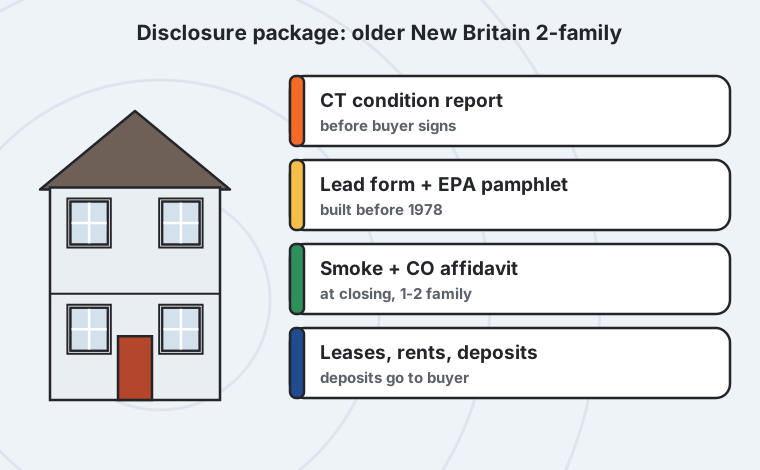
| Disclosure | Applies to | When | Rule |
|---|---|---|---|
| Residential Property Condition Disclosure Report | Most sales of 1-4 unit homes and condos | Before the buyer signs a binder, contract or option | CGS 20-327b; $500 credit if not given (20-327c) |
| Lead-based paint disclosure, EPA pamphlet, 10-day test opportunity | Homes built before 1978 | Before the buyer is bound by the contract | 42 U.S.C. 4852d; EPA/HUD rule |
| Smoke and carbon monoxide affidavit | 1-2 family homes and condo units | Signed at closing; no credit alternative since PA 23-164 | CGS 29-453 |
| Flood questions on the condition report | Same as the report | Same as the report | Public Act 25-33, from July 1, 2025 |
| Leases, rent roll, security deposits | Rented units | Before contract (copies); deposits transfer at closing | CGS 47a-21(c) |
A three- or four-family is still covered by the state condition report, which applies to one to four units. The smoke and CO affidavit in CGS 29-453 is written for one- and two-family buildings and condo units; for a three- or four-family, ask your attorney what the buyer’s lender and the city’s fire marshal will expect, and make sure every unit has working detectors whatever the paperwork says.
What do you have to disclose about lead paint in a New Britain house?
For a New Britain house built before 1978, you have to disclose any lead-based paint and lead hazards you know about, hand over every lead report or record you have, give the buyer the EPA pamphlet, include the federal lead warning in the contract and allow a 10-day opportunity to test unless the buyer waives it. The state report also asks directly: “Is lead paint present?”
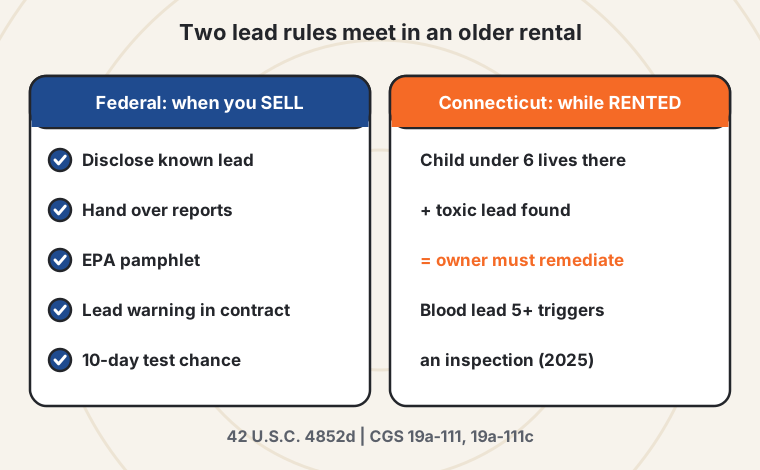
Two separate rules meet in an older New Britain rental:
- The federal sale rule. It is about disclosure, not repair. You do not have to test or remove lead paint to sell. You must not hide what you know, and you must give the buyer the reports, the pamphlet and the testing opportunity. Keep a copy of the signed disclosure for three years. Landlords have a parallel federal duty to give tenants the lead disclosure and pamphlet when they lease a pre-1978 unit.
- Connecticut’s lead law for dwellings. When paint, plaster or other material in a dwelling is found to contain toxic levels of lead and children under six live there, the owner must remediate it under state regulations (CGS 19a-111c). Since January 1, 2025, a child’s blood lead level of 5 micrograms per deciliter or more requires the local director of health to investigate the source and order action (CGS 19a-111).
What that means for your disclosure: if the New Britain health department has ever inspected your building, issued an abatement order, or sent you a report, that is something you know. Disclose it, attach the paperwork, and say whether the work was finished and cleared. An open order is a material fact a buyer and their lender will want to see.
If you have never tested, the honest answer on the state report is that you do not know, not that there is no lead. On a building from the 1920s, a buyer’s inspector will assume lead paint is present under newer layers. “Unknown, never tested” protects you; a confident “no” can be used against you later.
What do you have to disclose about an oil tank?
You have to disclose whether there is an underground storage tank on the property, its age and location, any problems you know of, and whether a tank was ever removed, when and by whom. Connecticut’s condition report asks each of these questions (CGS 20-327b), and it also asks you to list the fuel types that heat the house.
Many New Britain houses that now heat with gas once burned oil or coal, and an old tank can still be buried in the yard or sitting abandoned in the basement. Disclose what you know, and look for:
- Fill or vent pipes sticking out of the foundation or the ground with no tank in the basement
- Old oil delivery bills, or a gas conversion permit from the city
- A tank removal or closure certificate, or soil test results
- Notes in the papers from when you bought the house
Buyers’ lenders and insurers often ask about tanks, and a leaking underground tank can be expensive to clean up, so the question tends to come up whether or not you raise it. Our guide to oil tanks, septic, wells and radon when selling in Connecticut covers testing, removal and how buyers price a tank.
What are the new flood questions on the Connecticut disclosure?
The new flood questions on the Connecticut disclosure, added by Public Act 25-33 from July 1, 2025, ask whether the property is in a FEMA flood zone and which one, whether you received federal flood disaster aid, whether you carry flood insurance, whether there is an elevation certificate, whether you filed flood claims, and whether water has entered the house. The form also carries a statement about flood insurance and maps.
New Britain is an inland city, but that does not make the answers automatic. Look up your address on FEMA’s flood map service center, check your insurance papers for any flood policy or claim, and answer from what you know. Water in the basement after heavy rain counts as water penetration even if you are nowhere near a mapped flood zone. Our disclosure guide walks through the wording of each flood question.
What do you have to share about tenants when you sell a rented New Britain building?
When you sell a rented New Britain building, you share the leases, a rent roll with each unit’s rent, lease dates, deposit and any arrears, and you transfer every tenant’s security deposit with interest to the buyer at closing, because Connecticut treats a sale as an assignment of the deposits to the new landlord (CGS 47a-21(c)). Tenants’ leases stay in force after the sale.
The condition report does not ask about tenants, but the buyer, their lender and your attorney will. Tell the truth about:
- Rents and arrears. Which tenants pay, which do not, and any payment plans.
- Lease terms. End dates, month-to-month units, side agreements about parking, utilities or repairs.
- Deposits. Amounts, dates received and interest owed; the buyer becomes responsible for returning them.
- Open matters. Pending evictions in the Housing Session at New Britain, code complaints, or lead orders.
For showings, a tenant may not unreasonably refuse entry to prospective buyers, but you must give reasonable written or oral notice and come at reasonable times (CGS 47a-16). A short, honest note to your tenants about the sale usually makes everything easier. The full landlord’s checklist is in selling a rental with tenants in Connecticut.
What does disclosure mean in dollars on a New Britain three-family?
On a New Britain three-family at the $425,000 median, disclosure itself costs little: skipping the report costs a $500 credit, the conveyance tax is $5,313 either way, and each month of delay costs about $971 in property tax alone (est.). The expensive outcomes come from what is not disclosed: a lead order or a leaking tank that surfaces in the buyer’s inspection and becomes a price cut, a lost buyer or a claim after closing.
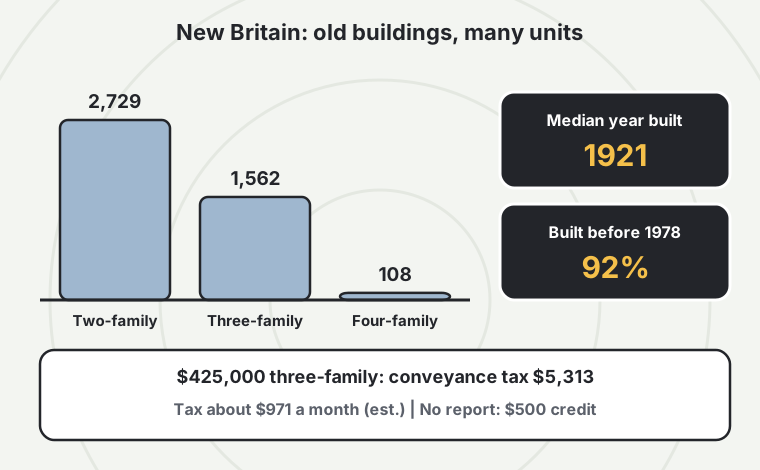
| Line on a $425,000 New Britain three-family | Amount |
|---|---|
| Conveyance tax (1.25%, CGS 12-494) | $5,313 |
| Credit if no condition report before signing (CGS 20-327c) | $500 |
| Property tax while you own it: 70% of $425,000 x 39.18 mills / 12 (est.) | about $971 a month |
| Tenant deposits credited to the buyer, e.g. three units at $1,500 (illustrative) | $4,500 plus interest owed (the tenants’ money, not a cost) |
| Your attorney (est.) | about $1,200 |
The full list of seller costs, with a calculator, is in the cost to sell a house in Connecticut.
Do you still have to disclose if you sell as-is or for cash?
Yes, you still have to disclose if you sell as-is or for cash. The condition report and the lead disclosure apply to the sale, not to the buyer’s financing, and paying the $500 credit does not excuse you from disclosing known defects the report covers (CGS 20-327c). “As-is” means the buyer accepts the condition; it does not mean you can hide it.
What changes with a cash or as-is buyer is what happens next. A lender’s appraiser will not flag the peeling paint, and an investor will usually price a known tank or lead order into the offer instead of asking you to fix it. That is often why owners of older New Britain buildings with open issues sell that way. Compare the two routes in cash buyer vs realtor in Connecticut.
When should you NOT sell your New Britain house to a cash buyer?
You should not sell your New Britain house to a cash buyer when it is in good repair, your disclosures are clean (no open lead order, no unknown tank, documented rents), and you can give a listing 60 to 90 days. Then financed buyers, including owner-occupants who want a two-family to live in, will usually pay more than a cash buyer, even after commissions.
A cash sale makes more sense when disclosure itself would scare off financed buyers: an open lead abatement order, an underground tank of unknown age, units that fail a lender’s inspection, tenants far behind on rent, or a building you inherited and cannot get into easily. In those cases a buyer who prices the problem and takes it on can be worth the lower number. Cash buyer vs realtor shows the trade-off in dollars. If you want a written cash number to compare, our New Britain page starts with the address. We buy occupied buildings, there are no repairs, and the offer does not expire while you decide.
What are the steps to prepare your New Britain disclosures?
The steps to prepare your New Britain disclosures are: find the building’s year built, collect every lead, tank, insurance and code record, fill in the condition report honestly with “unknown” where you do not know, prepare the federal lead form and pamphlet, build the rent roll and deposit list, and have your attorney review the package before the buyer signs anything.
Confirm the year built
Check the assessor’s card. Before 1978 means the federal lead disclosure applies.
Gather records
Lead inspections or health department letters, tank removal or conversion papers, insurance claims, code notices, repair invoices.
Fill in the condition report
Answer from what you know, including the flood questions. “Unknown” is a valid answer; a guess is not.
Prepare the lead form
The federal disclosure, the EPA pamphlet, and copies of any lead reports. Keep a signed copy for three years.
Build the tenant file
Leases, rent roll, deposits with interest, arrears and any open housing matters.
Have your attorney review
Before the buyer signs a binder or contract. Your attorney also prepares the smoke and CO affidavit for closing on a one- or two-family (CGS 29-453).
See the house together.
Pick a time that works.
Choose a time for us to walk through the property with you, or ask for a quick call first. We confirm every request personally.
Tuesday, January 13
No open times in the next few weeks. Please call us.
We will confirm by email. Nothing is booked until we do.
View my requestQuestions New Britain sellers ask about disclosure
Do I have to fill out the disclosure form to sell my New Britain house?
Yes, in most sales you have to give the buyer Connecticut’s Residential Property Condition Disclosure Report before they sign a binder or contract (CGS 20-327b). If you do not, you credit the buyer $500 at closing, and you still cannot hide known defects.
Do I have to test for lead paint before selling?
No, you do not have to test for lead paint before selling. Federal rules require you to disclose what you know, give the buyer any reports and the EPA pamphlet, and allow a 10-day opportunity to test on a pre-1978 home unless the buyer waives it.
Does the disclosure form apply to a three-family?
Yes, Connecticut’s property condition report applies to one- to four-unit residential property, so a New Britain three- or four-family seller fills it out too. The smoke and CO affidavit statute is written for one- and two-family homes and condo units.
What if I do not know whether there is an oil tank?
If you do not know whether there is an oil tank, say so on the report and share any clues you have, such as fill pipes or old oil bills. The buyer can then test or scan for a tank during the inspection period.
Do I have to disclose a lead abatement order?
Yes, you should disclose a lead abatement order or health department report you know of, and attach the paperwork. Federal rules require you to share known lead hazards and any records, and an open order is a material fact for any buyer.
What happens to my tenants’ security deposits when I sell?
Your tenants’ security deposits transfer to the buyer when you sell. Connecticut treats the sale as an assignment of the deposits to the new landlord (CGS 47a-21(c)), and your attorney credits the buyer with each deposit plus the interest owed.
Can a buyer sue me after closing for something I did not disclose?
A buyer can bring a claim after closing if you knew of a defect and hid it or misstated it. The Connecticut report covers your actual knowledge, so honest answers, including “unknown,” are your best protection. Talk to a Connecticut attorney about any specific risk.
What is the conveyance tax in New Britain?
The conveyance tax in New Britain is 1.25% of the price up to $800,000: 0.75% to the state and 0.50% to the city (CGS 12-494). On a $425,000 three-family that is $5,313, paid by the seller at closing.
Do I still disclose if I sell to a cash buyer?
Yes, you still disclose if you sell to a cash buyer. The condition report and lead disclosure apply to the sale itself. A cash buyer usually prices known problems into the offer instead of asking you to repair them.
Related guides
- The Connecticut property condition disclosure, question by question
- Comparing offers on a multi-family with tenants: the New Haven example
- Negotiating the sale of your house in Connecticut
- Choosing the best offer: contingencies vs price
- Selling a multi-family house in Connecticut
- Selling a house as-is in Connecticut
For how a sale with us works from first call to closing, see how selling your house in Connecticut works.
Plain-English information, not legal advice. For a lead order, a tank or a tenant question, talk to a Connecticut attorney.
Sources (checked on October 27, 2026)
- 2025 Connecticut Parcel and CAMA Data (data.ct.gov): New Britain parcel types and year built (our query).
- Connecticut OPM Real Estate Sales dataset (data.ct.gov): New Britain sales by type, Oct 2024 to Sep 2025 (our query).
- Connecticut OPM mill rates (data.ct.gov).
- CGS 20-327b and 20-327c (property condition report, including lead and underground tank questions; $500 credit).
- Public Act 25-33 (flood disclosure questions, effective July 1, 2025).
- CGS 29-453 (smoke and carbon monoxide affidavit).
- CGS 19a-111 and 19a-111c (lead poisoning investigations; abatement in dwellings).
- CGS 47a-21 (security deposits; transfer to a successor landlord).
- CGS 47a-16 (landlord entry to show the unit).
- CGS 12-494 (conveyance tax).
- EPA: lead-based paint disclosure rule for sales and leases.
- FEMA Flood Map Service Center.

Who wrote this
Jerryll Noorden
Jerryll has bought and sold Connecticut houses since 2016 and has sat at more closing tables than he can count, on both sides. Before real estate he was a robotics scientist at NASA, IHMC and IIT. He wrote this guide because the national sites that rank for it skip the Connecticut rules that cost sellers money. When listing or selling it yourself would get you more than a cash offer, he says so.
This guide explains Connecticut rules in plain English. It is not legal or tax advice. Laws change; for your sale, talk to a Connecticut real estate attorney and a tax professional.
