
Key facts at a glance
| Fact | Number | Source |
|---|---|---|
| Deadline to sue on a note payable at set dates | 6 years after each due date, or after the accelerated due date | CGS 42a-3-118(a) |
| Deadline on a demand note | 6 years after demand; barred after 10 years with no payment and no demand | CGS 42a-3-118(b) |
| Deadline on other written contracts | 6 years after the right to sue arises | CGS 52-576(a) |
| Interest cap on most private loans | 12% a year; a loan above it cannot be enforced in court | CGS 37-4; 37-8 |
| Exemption from the cap | Bona fide mortgage of real property for more than $5,000 | CGS 37-9(3) |
| Small claims limit | $5,000 in money damages | CGS 51-15(d) |
| Lien on the debtor’s real estate after you win | Judgment lien certificate recorded with the town clerk | CGS 52-380a |
| Who must be licensed to collect or buy consumer debt | Consumer collection agencies, including debt buyers (Department of Banking) | CGS 36a-800; 36a-801 |
An unsecured promissory note is a written promise to pay you money with nothing pledged behind it: no mortgage on a house, no lien on a car. This guide, part of our guide to how to sell a house in Connecticut, explains whether and how you can sell an unsecured promissory note in Connecticut, why buyers discount these notes so heavily, how to turn an unsecured note into a secured one, how collection works under Connecticut law, and what to do instead. To be clear from the start: our company buys houses, not notes. We cover this because home sellers sometimes take an unsecured note for part of the price, and the lesson is worth knowing before you sign one.
Is this page for you if someone owes you money on an unsecured note?
This page is for you if you hold a promissory note in Connecticut with no collateral behind it, from a loan to a relative or friend, the sale of a business, a buyer who could not cover the full down payment on your house, or a settlement, and you want cash instead of waiting. You may feel frustrated, embarrassed that you trusted someone, or worried that the money is gone. Some of it usually is not.
Maybe you sold your house a few years ago and the buyer was $20,000 short at closing, so you took a handwritten note for the rest. Maybe you lent your brother-in-law money for a truck. Maybe you sold your landscaping business and the buyer is paying you over five years. The checks were steady for a while; now they are late, or you just need the money for something else. People in this spot often feel betrayed, embarrassed that it was not secured, anxious about family fallout, doubtful that the paper is worth anything, and tempted to take whatever someone offers just to be done.
Take a breath before you take any offer. An unsecured note is harder to sell than a mortgage note, but you have real choices: sell it, secure it, collect it or settle it. The rest of this page walks through each one with Connecticut law.
Can you sell an unsecured promissory note in Connecticut?
Yes, you can sell an unsecured promissory note in Connecticut, because a note is property you can transfer: a transfer gives the buyer your right to enforce it (CGS 42a-3-203(b)). But the market is thin. Few buyers want unsecured private notes, those who do demand high returns, and a note that is in default or past its limitation period may draw no real offer at all.
Who buys these notes? Mostly private investors who know the payer or the business, investors who specialize in business notes, and, for consumer debts that are in default, debt buyers. In Connecticut, a person in the business of buying or collecting consumer debts must hold a consumer collection agency license from the Department of Banking (CGS 36a-800, 36a-801), so any buyer of a consumer debt should be able to show you that license. Sometimes the best buyer is the payer: a payer who wants to clear the debt may pay a discounted lump sum to retire it.
A secured note is a different product with a deeper market. If your note is backed by a recorded mortgage, read our guides to selling a whole mortgage note and selling part of a mortgage note instead.
Why are unsecured notes so hard to sell and so heavily discounted?
Unsecured notes are hard to sell and heavily discounted because the buyer’s only protection is the payer’s willingness and ability to pay. If the payer stops, there is no house or car to foreclose on: the buyer must sue, win a judgment and then find assets to collect from. Buyers price that risk by demanding a much higher return, which shrinks what they pay you.
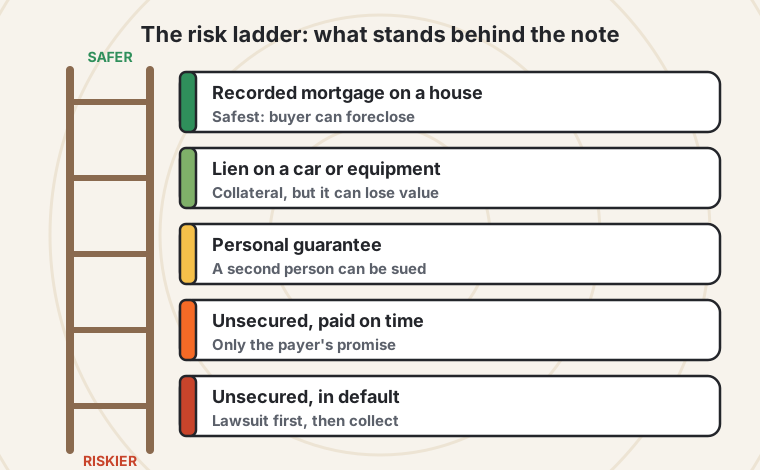
Compare the two kinds of note when the payer stops paying:
- Mortgage note. The holder forecloses on the house in Superior Court. Even a slow foreclosure ends with either the debt paid or the house in the holder’s name. The house caps the loss.
- Unsecured note. The holder sues on the note, wins a money judgment, and then has to find something to collect from: a bank account, wages, real estate. If the payer has nothing, or files bankruptcy, the judgment may be worth little.
Other things push the price down further: a short or spotty payment history; a payer with weak credit or no steady income; a note with no clear due dates; a note signed between family members that looks more like a gift; a missing original; and an interest rate above Connecticut’s 12% cap, which can make the loan unenforceable (CGS 37-4, 37-8). Things that help: a long record of on-time payments, a payer with good credit and income, a clear written note with a fixed schedule, an acceleration clause, a clause making the payer pay collection costs and attorney fees, and a personal guarantee from someone with assets.
What is an unsecured promissory note worth? A worked example
An unsecured promissory note is worth the present value of its remaining payments at the high yield a buyer demands. In an illustrative example, a $25,000 note at 8% over five years has a balance of about $20,764 after 12 payments. At a 12% buyer yield it would be worth about $19,249; at 20%, about $16,658; at 30%, about $14,078; at 40%, about $12,056.
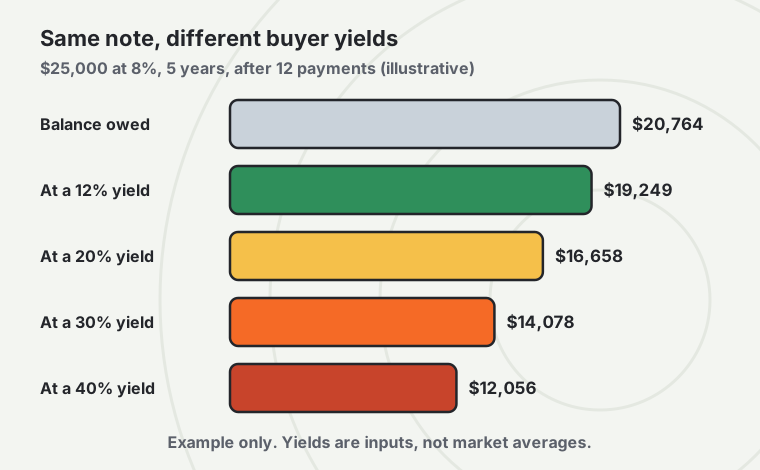
Example (illustrative). Built from simple loan math, not a real deal or market survey. A Connecticut seller lent $25,000 at 8% interest, repaid in 60 monthly payments of $506.91. The payer has made 12 payments on time. The balance is about $20,764, and the 48 remaining payments add up to $24,332.
| Buyer’s required yield | Price for the 48 remaining payments | As % of the balance |
|---|---|---|
| 12% (close to what a well-secured note might need) | about $19,249 | 92.7% |
| 20% | about $16,658 | 80.2% |
| 30% | about $14,078 | 67.8% |
| 40% | about $12,056 | 58.1% |
The lesson: the same stream of $506.91 payments can be worth anywhere from about $12,000 to $19,000 depending on how risky the buyer thinks it is. Everything you can do to lower that risk (proof of payments, the payer’s credit, a guarantee, collateral) moves you up the table. A buyer who will not tell you the yield and payments they priced is a buyer to walk away from.
How can you secure an unsecured note before you sell or collect it?
You can secure an unsecured note by getting the payer to sign a mortgage on real estate they own, recorded on the town land records, or a security agreement on a car, equipment or other property, perfected by a UCC filing with the Connecticut Secretary of the State or a lien on the vehicle title. A personal guarantee from someone with assets also helps. Each step needs the payer’s or guarantor’s signature, and an attorney.
| Way to secure it | What it takes | Connecticut rule |
|---|---|---|
| Mortgage on real estate | The payer signs a mortgage deed on property they own, acknowledged like a deed and recorded on that town’s land records. Check what mortgages are already ahead of yours. | Recording: CGS 47-10; a mortgage over $5,000 is exempt from the 12% cap (CGS 37-9) |
| Security interest in personal property | A signed security agreement describing the collateral, plus a financing statement (UCC-1) filed with the Secretary of the State | CGS 42a-9-203; 42a-9-501 |
| Lien on a vehicle | Your lien noted on the certificate of title through the DMV | Certificate-of-title rules (CGS chapter 247) |
| Personal guarantee | A signed guarantee from a person or business with assets | Contract; 6-year limit for written contracts (CGS 52-576) |
| After a lawsuit | A prejudgment attachment with court approval, or a judgment lien once you win | CGS 52-278a and following; 52-380a |
Why would a payer agree to secure a debt they already owe? Because you can offer something in return: a lower rate, a longer schedule, forgiving late fees, or simply not suing. A payer who owns a house with plenty of equity and wants to keep the peace will often sign a mortgage. Once the note is secured and the mortgage is recorded, it can be sold like a mortgage note, at a much better price.
If a buyer of your house is short on cash and asks you to “carry” part of the price, insist on a promissory note backed by a mortgage on the house, prepared by your attorney and recorded at closing. An unsecured note for part of the price leaves you behind every lender and with nothing to foreclose on. Our owner financing guide explains the safe structure, and the owner financing tips list the protections to ask for.
What is the statute of limitations on a promissory note in Connecticut?
The statute of limitations on a promissory note in Connecticut is generally six years. For a note payable at set dates, a lawsuit must start within six years after each due date, or within six years after the accelerated due date if the whole balance was called due (CGS 42a-3-118(a)). For a demand note it is six years after demand, and a note with no demand and no payment for ten years is barred (CGS 42a-3-118(b)).
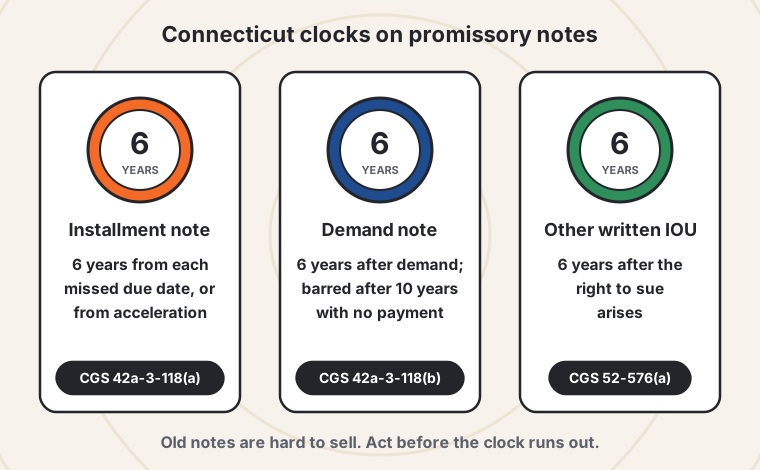
Some practical points about the clock:
- Installment notes. Each missed payment starts its own six-year clock. If you accelerate (call the whole balance due under an acceleration clause), the clock for the whole balance starts on the accelerated due date.
- Demand notes. If the note says “payable on demand”, the clock starts when you make the demand. Put your demand in writing and keep proof of delivery.
- Non-negotiable notes and IOUs. A written promise that does not qualify as a negotiable note is still a written contract, with a six-year limit (CGS 52-576(a)).
- Payments and acknowledgments. A later payment or a written acknowledgment of the debt can affect when the clock runs out. The rules are technical; ask an attorney before you rely on them.
The deadline matters for selling too. Buyers check the dates, and a note close to or past its limitation period is worth very little, because it may not be collectible in court. If your note is getting old, act now.
How do you collect an unsecured note in Connecticut instead of selling it?
To collect an unsecured note in Connecticut, start with a written demand, then sue if needed: small claims for $5,000 or less (CGS 51-15(d)), or the regular Superior Court docket for more, often with an attorney. Once you have a judgment, you can record a judgment lien on the payer’s real estate (CGS 52-380a) and ask the court for bank or wage executions (CGS 52-367b, 52-361a).
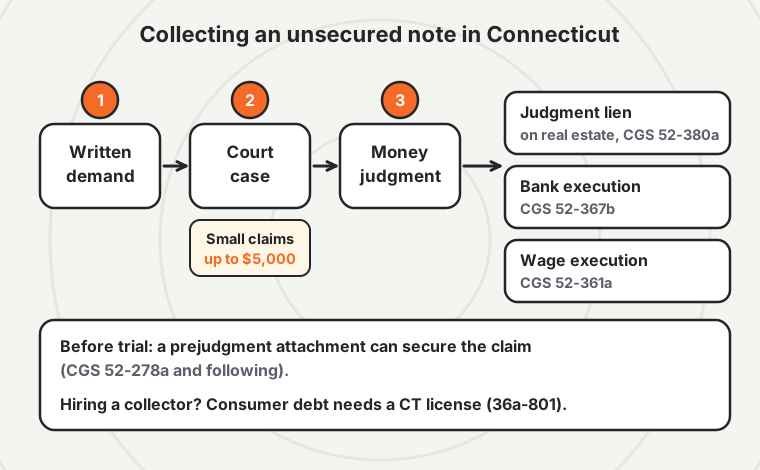
Send a written demand
State the amount owed, the missed dates and a deadline to pay. Offer a payment plan if that is realistic. Keep a copy and proof of mailing.
Pick the right court
Small claims handles money claims up to $5,000 (CGS 51-15(d)) with simpler procedures. Larger claims go on the regular civil docket of the Superior Court, where an attorney is usually worth the cost. The Judicial Branch website has the forms and fees.
Consider a prejudgment remedy
If the payer owns real estate or has money in the bank, a court can allow an attachment before trial if you show probable cause (CGS 52-278a and following). It secures your claim while the case runs.
Get the judgment
Many cases settle once the payer is served. If not, the court enters a money judgment, often including interest and costs the note allows.
Collect on the judgment
Record a judgment lien certificate on the payer’s real estate (CGS 52-380a), and ask the court for a bank execution (CGS 52-367b) or a wage execution (CGS 52-361a). Connecticut law protects some income and property from collection, so not every dollar is reachable.
If the debt is a consumer debt and you hire a collection agency, it must be licensed by the Connecticut Department of Banking (CGS 36a-801). Agencies usually work for a percentage of what they collect, which can be cheaper than selling the note at a deep discount if the payer has income or assets.
A judgment lien on the payer’s house deserves a special mention. It does not force a sale on its own, but when the payer sells or refinances, the lien normally has to be paid off at closing. If the payer later wants to sell that house, you will be paid from the proceeds; our guide to selling a house with a lien in Connecticut explains how liens are handled at closing.
What are the alternatives to selling an unsecured note at a deep discount?
The alternatives to selling an unsecured note at a deep discount are to keep collecting and wait, offer the payer a discount for an early lump-sum payoff, renegotiate and secure the note with a mortgage or lien, hire a licensed collection agency or attorney, or, if the debt is uncollectible, write it off and take the tax deduction for a bad debt (IRS Topic 453).
Sell the note
Cash nowFastest exit, deepest discount.
- Works best with an on-time payer
- Thin market
Secure it, then decide
Better priceA recorded mortgage changes everything.
- Needs the payer’s signature
- Opens the mortgage-note market
Collect it
Full balanceDemand, court, judgment, lien.
- Takes months
- Costs fees and effort
Discounted payoff from the payer. The payer often values a clean slate more than any outside buyer does. Offering the payer, say, the same price a buyer would pay, for a lump sum within 30 days, can work for both of you. Get it in writing, and mark the note paid only when the money clears.
Bad debt deduction. If the debt truly cannot be collected, the IRS lets you deduct a nonbusiness bad debt as a short-term capital loss in the year it becomes totally worthless (IRS Topic 453). It must have been a real loan, not a gift. A CPA can tell you what records you need.
When you should NOT sell your unsecured note. Do not sell when the payer is paying on time and you do not need the money; the discount is the most expensive way to get cash. Do not sell before you have asked the payer about a mortgage or a discounted payoff. Do not sell to anyone who asks for an upfront fee, will not put the yield in writing, or cannot show a Connecticut license when one is required. Our page on red flags and scams lists the warning signs that apply to note buyers as well as house buyers.
How can a house sale help settle an unsecured note?
A house sale can settle an unsecured note in two ways: if the payer owns a house, a judgment lien or a voluntary mortgage gets you paid from their sale or refinance; and if you are the one who owes on a note and own a house, selling the house can raise the money to pay it off. Either way, the note gets paid at the closing table, at full value.
We buy houses in Connecticut, as they are, usually closing in about two weeks. We do not buy notes and never claim to. But we do see houses sold to clear debts: a payer who owes several people and wants a fresh start, or an heir who inherited a house and an unpaid family loan in the same estate. If you, or the person who owes you, need to sell a Connecticut house to settle up, our page on the ways we buy houses in Connecticut explains how a direct sale works, and where we buy lists the towns. A cash offer on the house is not a substitute for legal advice on the note; talk to an attorney about the debt itself.
See the house together.
Pick a time that works.
Choose a time for us to walk through the property with you, or ask for a quick call first. We confirm every request personally.
Tuesday, January 13
No open times in the next few weeks. Please call us.
We will confirm by email. Nothing is booked until we do.
View my requestHow do you sell or resolve an unsecured promissory note, step by step?
To sell or resolve an unsecured promissory note in Connecticut, gather the original note and payment proof, check the interest rate and the six-year limitation dates, ask the payer about a mortgage or a discounted payoff, get written quotes from buyers who disclose their yield and licensing, compare each against collecting yourself, and have a Connecticut attorney review any sale or settlement.
Gather the paper
The original signed note, any guarantee, and proof of every payment (bank records, receipts, texts confirming payment).
Check the two danger points
Is the interest rate above 12% (CGS 37-4)? Are any missed payments close to six years old (CGS 42a-3-118)? Either one changes your plan.
Talk to the payer first
Ask for a mortgage or lien in exchange for better terms, or offer a discount for a lump-sum payoff.
Get two or three written quotes
From buyers who state the yield and the payments priced, charge no upfront fees and show a license where Connecticut requires one.
Compare with collecting
Weigh the best quote against the full balance minus collection costs, time and the chance of collecting nothing.
Get legal and tax advice, then sign
Have a Connecticut attorney review the sale or settlement, assign the note in writing, notify the payer of the new holder, and keep records for your CPA.
Frequently asked questions about selling an unsecured promissory note in Connecticut
These are the questions Connecticut note holders ask most about selling an unsecured promissory note, from what it is worth and who buys it to the statute of limitations, usury and taxes. Each answer is short, with the statute where one applies.
Can I sell an unsecured promissory note in Connecticut?
Yes, you can sell an unsecured promissory note in Connecticut; a transfer gives the buyer your right to enforce it (CGS 42a-3-203(b)). Expect few buyers and a large discount, because there is no collateral behind the note.
How much is an unsecured promissory note worth?
An unsecured promissory note is worth the present value of its remaining payments at the buyer’s required yield. In our illustrative example, a note with a $20,764 balance is worth about $19,249 at a 12% yield and about $12,056 at 40%. A note in default can be worth far less.
Who buys unsecured promissory notes?
Unsecured promissory notes are bought by private investors, investors who specialize in business notes, and, for defaulted consumer debts, debt buyers, who in Connecticut must hold a consumer collection agency license (CGS 36a-800, 36a-801). Often the best buyer is the payer, through a discounted payoff.
What is the statute of limitations on a promissory note in Connecticut?
The statute of limitations on a promissory note in Connecticut is generally six years after each due date, or after the accelerated due date (CGS 42a-3-118(a)). For a demand note it is six years after demand, and ten years without payment or demand bars it (CGS 42a-3-118(b)).
Is a promissory note without collateral legally binding?
A promissory note without collateral is legally binding in Connecticut if it is a real loan on lawful terms. Being unsecured only means there is no property to foreclose on; you can still sue on the note and collect from a judgment.
What interest can a private note charge in Connecticut?
A private loan in Connecticut generally cannot charge more than 12% a year (CGS 37-4), and a court will not enforce a loan that breaks the cap (CGS 37-8). A bona fide mortgage of real property for more than $5,000 is exempt (CGS 37-9).
How do I turn an unsecured note into a secured one?
You turn an unsecured note into a secured one by having the payer sign a mortgage on their real estate, recorded on the land records, or a security agreement on personal property with a UCC filing at the Secretary of the State (CGS 42a-9-501). A guarantee from someone with assets also helps.
Can I take someone to small claims court over a promissory note?
You can take someone to small claims court over a promissory note in Connecticut if you claim $5,000 or less (CGS 51-15(d)). Larger claims go on the regular Superior Court civil docket.
What happens after I win a judgment on a note?
After you win a judgment on a note, you can record a judgment lien on the payer’s Connecticut real estate (CGS 52-380a) and ask the court for bank or wage executions (CGS 52-367b, 52-361a). Some income and property is protected from collection.
Can I sell a note that is already in default?
You can sell a note that is already in default, but buyers pay very little, especially for an unsecured note, and a note near or past its six-year limitation date may draw no offer. Collecting it, or settling with the payer, often nets more.
Can I deduct an unpaid promissory note on my taxes?
You can deduct a promissory note that has become totally worthless as a nonbusiness bad debt, treated as a short-term capital loss, if it was a real loan and not a gift (IRS Topic 453). A CPA can confirm the year and the records you need.
Does your company buy promissory notes?
No. We Buy Houses In Connecticut buys houses, not notes. If a house sale would pay off a note, either yours or the payer’s, we can make a cash offer on the house.
Related guides
- Owner financing in Connecticut: is it good for the seller? (the pillar for this topic)
- How to sell a whole mortgage note in Connecticut
- Selling part of a mortgage note: partial sales
- Wholesaler myths in Connecticut
- Selling a house with a lien in Connecticut
- Red flags and scams to watch for
- The ways we buy houses in Connecticut
- How to sell a house in Connecticut: every route
Sources (checked on October 27, 2026)
- CGS 42a-3-118 and 42a-3-203 (UCC Article 3: limitations and transfer of notes)
- CGS 42a-9-203 and 42a-9-501 (UCC Article 9: security interests and filing)
- CGS 52-576 (six-year limit on written contracts)
- CGS 37-4, 37-8 and 37-9 (interest cap and exemptions)
- CGS 51-15 (small claims limit)
- CGS 52-278a and following (prejudgment remedies)
- CGS 52-361a, 52-367b and 52-380a (wage and bank executions, judgment liens)
- CGS 36a-800 and 36a-801 (consumer collection agency and debt buyer licensing)
- Connecticut Judicial Branch (small claims and civil forms)
- IRS Topic 453, Bad debt deduction
This guide is general information, not legal, tax or financial advice. Talk to a Connecticut attorney before you sell, secure or sue on a promissory note.

Who wrote this
Jerryll Noorden
Jerryll has bought and sold Connecticut houses since 2016 and has sat at more closing tables than he can count, on both sides. Before real estate he was a robotics scientist at NASA, IHMC and IIT. He wrote this guide because the national sites that rank for it skip the Connecticut rules that cost sellers money. When listing or selling it yourself would get you more than a cash offer, he says so.
This guide explains Connecticut rules in plain English. It is not legal or tax advice. Laws change; for your sale, talk to a Connecticut real estate attorney and a tax professional.
