
Key facts at a glance
This Norwich page is part of our guide to how to sell a house in Connecticut. It takes our monthly carrying-cost worksheet and fills it in with Norwich’s own numbers: its two tax districts, its city-owned utilities and its older two- and three-family houses.
| Fact | Number | Source |
|---|---|---|
| Norwich residential sales, Oct 2024 to Sep 2025 | 712; median $261,000 (single-family $273,220) | CT OPM Real Estate Sales, data.ct.gov |
| Norwich mill rate, fiscal 2026-27 | 39.38 (City Consolidation District) or 34.44 (Town Consolidation District) | City of Norwich, Mill Rates page |
| Property tax on a $273,220 Norwich house | $628 a month (City district) or $549 a month (Town district) | Mill rate × 70% assessment (CGS 12-62a) |
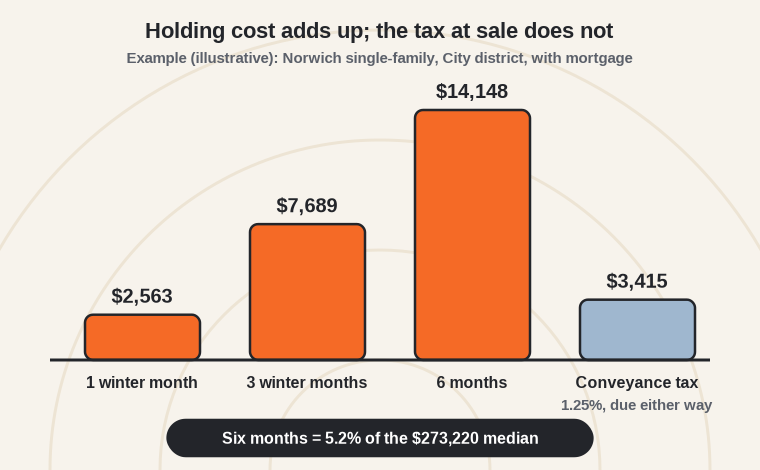
| Conveyance tax when you sell in Norwich | 1.25% (0.75% state + 0.50% Norwich): $3,415 on $273,220 | CGS 12-494 |
| Two- to four-family share of Norwich sales | 152 of 724 recorded residential sales, Oct 2024 to Sep 2025 | CT OPM Real Estate Sales (our query) |
| Age of Norwich houses | Median year built 1953; 37% built before 1940 | Norwich assessor parcel data (CAMA) |
| Norwich Public Utilities rate increases | From Nov 1, 2026, phased to 2028: gas 2.8%, electric 3.3%, water 5.1%, wastewater over 15% | NPU, as reported by WFSB, Sep 2026 |
Why does holding a house in Norwich feel so expensive?
Holding a house in Norwich feels so expensive because the bills keep coming from three directions at once: the City tax bill, the Norwich Public Utilities bill and the oil or insurance bill, while the house earns nothing. Owners at this point often feel drained, guilty about the empty house, unsure what the real number is, and wary of anyone who says “just sell”.
Maybe it is your parents’ cape off Washington Street, empty since the funeral. Maybe it is a two-family in Greeneville where the downstairs tenant moved out. Maybe you bought a new place and the old one has not sold. Every month you pay for a house nobody sleeps in.
I am Jerryll Noorden. I have bought Connecticut houses for cash since 2016, about ten a year. I will not tell you to sell. I will show you what the house costs each month with Norwich’s own tax rates and utilities, so you can decide with a real number.
If you own a house in Norwich you are not living in, and you want to know what it is really costing you, this page is for you.
How much does it cost to hold a house in Norwich, CT?
Holding a vacant house in Norwich costs about $2,563 in a winter month and $1,948 in a mild month in our example: a $273,220 single-family house in the City Consolidation District, oil heat and a $150,000 mortgage. Without a mortgage it is about $2,063 and $1,448. Six months over a winter come to about $14,148 (est.). In the Town district, take off about $79 a month.
The formula and the reasons behind each line are in our carrying-cost worksheet, so this page does not repeat them. Here we fill it in for Norwich. The one-time costs of selling (commission, attorney, conveyance tax) are not carrying costs; they are in our guide to closing costs in Connecticut.
Which Norwich tax district are you in, and why does it change your monthly cost?
Which Norwich tax district you are in changes your monthly cost because Norwich has two real estate mill rates. For fiscal 2026-27, the City Consolidation District pays 39.38 mills and the Town Consolidation District pays 34.44. Both include the 34.15 general fund rate; the rest is the district charge. On a $273,220 house that is $628 or $549 a month, about $950 a year apart.

Here is the math, with the City’s own fiscal 2026-27 rates:
| Line | City Consolidation District | Town Consolidation District |
|---|---|---|
| Market value (single-family median) | $273,220 | $273,220 |
| Assessment at 70% (CGS 12-62a) | $191,254 | $191,254 |
| General fund rate | 34.15 mills | 34.15 mills |
| District rate | 5.23 mills | 0.29 mills |
| Total mill rate | 39.38 | 34.44 |
| Tax per year | $7,532 | $6,587 |
| Tax per month | $628 | $549 |
Two practical points. First, your tax bill or the assessor’s field card says which district you are in; do not guess from the address. Second, Norwich revalued for the October 1, 2023 grand list, and the general fund rate fell from 41.85 to 32.99 mills that year because assessments rose. A lower mill rate after a revaluation does not mean a lower bill. Our guide to market value vs. assessed value explains how to check your assessment.
What do Norwich Public Utilities bills add while the house sits empty?
Norwich Public Utilities bills add electricity, and often natural gas, water and wastewater, to the cost of holding a Norwich house, because NPU is the city-owned utility for all four services. Those bills do not stop when the house is empty: you need power for the heat and sump pump, and service charges continue. NPU rates rise from November 1, 2026, phased in through 2028.
In Norwich, one city-owned utility, NPU, provides electricity, natural gas, water and wastewater service: one account to manage for an empty house, but one rate change touches several lines of your worksheet.
The increases NPU announced in September 2026 phase in over 2026, 2027 and 2028, starting November 1, 2026: natural gas 2.8%, electric 3.3%, water 5.1% and wastewater more than 15%, about $20 a month more for an average customer once fully in place (as reported by WFSB). For a vacant house the water and wastewater lines are mostly fixed charges, so you pay them even when nobody runs a tap.
- Keep the account on, in the owner’s or the estate’s name. The heating system, sump pump and any alarm need power. Shutting off electricity in winter is how an empty house floods.
- Decide about the water. Shutting the main and draining the lines protects an unheated house, but your insurer may require either heat or a professional winterization. Ask before you choose.
- Gas or oil? About 41% of Norwich single-family houses are heated with gas and 55% with oil (assessor data). Gas through NPU arrives on a monthly bill; oil comes in deliveries of $600 or more at today’s prices.
- Read your own bills. We could not confirm a current official NPU per-kilowatt-hour rate, so use your last three NPU bills as the input.
What does the carrying-cost worksheet look like filled in for a Norwich house?
The carrying-cost worksheet filled in for a vacant Norwich single-family house shows about $2,563 for a winter month: $628 property tax, $500 mortgage interest, $250 vacant-house insurance, $615 of heating oil, $70 NPU electricity, $80 NPU water and wastewater, $120 lawn and snow, $100 checks and $200 repair reserve. Every line except the tax is a labelled input or estimate.
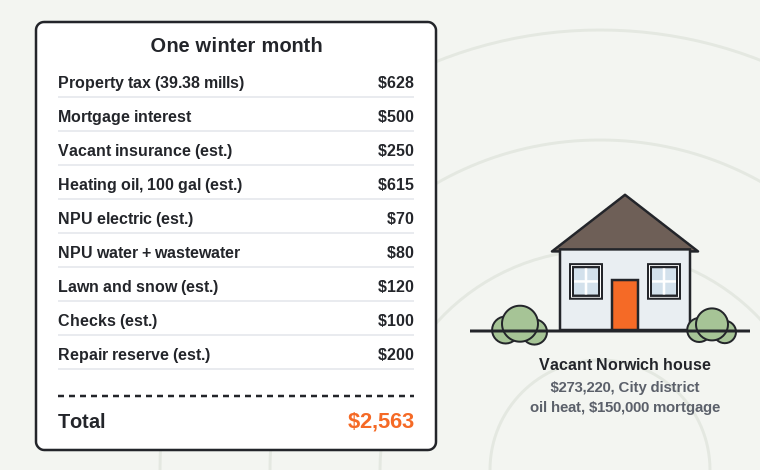
Example (illustrative). A vacant 1950s Norwich cape or ranch priced at the town’s single-family median of $273,220, in the City Consolidation District, oil heat, a $150,000 mortgage balance at 4%.
| Line | Input | Winter month | Mild month |
|---|---|---|---|
| Property tax | $273,220 × 70% × 39.38 ÷ 1,000 ÷ 12 (town data) | $628 | $628 |
| Mortgage interest | $150,000 × 4% ÷ 12 (input) | $500 | $500 |
| Vacant-house insurance | Get a quote (est.) | $250 | $250 |
| Heating oil | 100 gallons × $6.154 (EIA CT price, week of Oct 19, 2026; usage est.) | $615 | $0 |
| NPU electricity | Heat, sump, lights on timers (est.) | $70 | $70 |
| NPU water and wastewater | Mostly fixed charges (est.) | $80 | $80 |
| Lawn and snow | Averaged (est.) | $120 | $120 |
| Checks and security | Weekly visit or monitoring (est.) | $100 | $100 |
| Repair reserve | Older house (est.) | $200 | $200 |
| Total per month | $2,563 | $1,948 | |
| Without the mortgage | Total minus $500 | $2,063 | $1,448 |
| Town Consolidation District | Total minus $79 | $2,484 | $1,869 |
Over a typical wait, with four cold months and two mild ones, the example adds up like this:
| Wait | City district, with mortgage | City district, no mortgage |
|---|---|---|
| One winter month | $2,563 | $2,063 |
| Three winter months | $7,689 | $6,189 |
| Six months (4 cold + 2 mild) | $14,148 | $11,148 |
If the house heats with NPU gas, replace the oil line with last winter’s gas bill. If the boiler is cracked or the roof leaks, the repair reserve is too low. To see what a sale would leave you, put in your own numbers, including your mortgage payoff:
How much would you walk away with?
Slide the numbers to match your house. It works in your browser; nothing is saved or sent.
Estimates for planning. Conveyance tax per CGS 12-494 (state 0.75% up to $800,000, 1.25% to $2.5M, 2.25% above, plus the town rate). Seller attorney about $1,200 to $1,500; flat-fee MLS about $400; listings include three months of taxes, insurance and utilities, a cash sale about two weeks. Your attorney gives you the final numbers.
What does it cost to hold an empty Norwich two- or three-family house?
Holding an empty Norwich two- or three-family house costs more than a single-family because you heat, insure and maintain several units and also give up their rent. In our example, a vacant two-family at Norwich’s $260,500 two-family median costs about $2,633 a month in winter in cash, and about $5,633 once you count $3,000 of rent the two units are not earning (est.).
Norwich has a lot of these houses. In our query of the state’s sales records, 152 of the 724 residential sales recorded from October 2024 to September 2025 were two-, three- or four-family houses, about one in five. Median prices in that year were $260,500 for a two-family, $307,500 for a three-family and $383,333 for a four-family. Many were built before 1940, when wood frames, old boilers and original plumbing were normal.
Example (illustrative). A vacant Norwich two-family at $260,500 in the City Consolidation District, owned free and clear, both units empty after an estate.
| Line | Input | Winter month |
|---|---|---|
| Property tax | $260,500 × 70% × 39.38 ÷ 1,000 ÷ 12 | $598 |
| Vacant two-family insurance | Get a quote (est.) | $350 |
| Heat for two units | 160 gallons × $6.154, heat set low (est.) | $985 |
| NPU electricity, common and heat | (est.) | $60 |
| NPU water and wastewater | (est.) | $120 |
| Lawn and snow | (est.) | $120 |
| Checks and security | (est.) | $100 |
| Repair reserve | Older multifamily (est.) | $300 |
| Cash out per month | $2,633 | |
| Rent not collected | 2 units × $1,500 (est.; use your old leases) | $3,000 |
| Total cost of holding | $5,633 |
The lost rent is not money leaving your account, but it is real. If you want to fill the units instead, Connecticut landlord rules apply from the first lease; our guide to being a landlord in Connecticut lays them out. If one unit is still rented, selling with the tenant in place is possible; see selling a rental with tenants and our multi-family selling guide.
Older Norwich houses add three holding risks: pipes on outside walls and old steam systems freeze first when an oil delivery is missed; houses built before 1978 need the federal lead paint disclosure, and peeling paint on an empty porch gets worse every winter; and Norwich enforces blight and housing code through its Department of Planning and Development, so a neglected empty house draws complaints and, after the notice deadline, fines.
Is it cheaper to keep holding a Norwich house or to sell it now?
Whether it is cheaper to keep holding a Norwich house or to sell it now depends on whether the price you expect to gain by waiting is bigger than what the wait costs. In our single-family example, six months cost about $14,148 (est.), which is 5.2% of the $273,220 median. A wait pays only if you realistically expect more than that.
Norwich prices did rise: the single-family median went from $220,000 (October 2022 to September 2023) to $270,000 (October 2024 to September 2025) in our query of the state’s records. But past gains are not a promise, and a house that needs work adds repair money and months to the bill.
For a full wait-or-sell test with break-even months, price scenarios and the risks to price in, see our companion guide, the real cost of waiting to sell your house in Connecticut. If you could sell without paying for repairs or prep first, our guide to selling without spending money upfront walks through the routes.
When should you NOT sell your Norwich house to a cash buyer?
You should not sell your Norwich house to a cash buyer when it is in good condition, you can comfortably carry about $2,000 to $2,600 a month for the few months a listing takes, and nothing forces your timing. A financed buyer will usually pay more than a cash buyer for a house that needs nothing. Also walk away from any buyer who charges a fee or rushes you.
That is what I tell Norwich owners who call with a house in good shape: list it, keep the heat on and the insurance right, and compare the agent’s written net sheet with any offer. Our cash buyer vs. realtor guide shows the comparison line by line, and why cash offers are lower explains the gap.
A direct sale makes sense when the holding cost, repairs, belongings, tenants or distance are worth more to you than that gap; the clock stops in about two weeks, on a date you choose. Our page on selling a vacant house in Connecticut explains how that works.

With an empty house, the most expensive month is the one where nobody checks it. Before you decide anything, get the insurance right and have someone walk through every week. A burst pipe in January turns a pricing decision into a repair project.
How do you cut the cost of holding a Norwich house, step by step?
To cut the cost of holding a Norwich house, find out your tax district and real tax, call your insurer about the vacancy, set the heat and NPU services on purpose, protect the house cheaply, and pick a decision date. To end the cost, sell, rent the units legally, or move in. Each step takes a day or less.
Find your real tax number
Look at your last bill or the assessor’s field card for your assessment and district (City or Town Consolidation). Multiply by 39.38 or 34.44 and divide by 1,000.
Fix the insurance before a claim
Tell your insurer the house is empty and get the vacancy endorsement or a vacant-dwelling policy. Write down their conditions: heat, water off, weekly checks.
Set NPU and heat on purpose
Keep electricity on. Decide between heating at a low setting and a professional winterization. Get an automatic oil delivery or a gas budget plan so a missed fill does not freeze the pipes.
Protect the house for little money
Leak sensors, a smart thermostat, lamp timers, mail forwarded, lawn and walks kept up so the house does not look empty or draw blight complaints.
Pick a decision date and get two written numbers
An agent’s net sheet and a written direct offer. A typical direct closing takes about two weeks; our offers do not expire while you decide. If you want one, our Norwich page is where to ask.
Questions about the cost to hold a house in Norwich, CT
How much does it cost to hold a house in Norwich, CT each month?
Holding a vacant house in Norwich costs about $2,563 in a winter month and $1,948 in a mild month in our example of a $273,220 house with a $150,000 mortgage and oil heat in the City Consolidation District. Without a mortgage it is about $2,063 and $1,448 (est.).
What is the mill rate in Norwich, CT?
The mill rate in Norwich, CT for fiscal 2026-27 is 39.38 in the City Consolidation District and 34.44 in the Town Consolidation District. Both include the 34.15 general fund rate plus a district rate of 5.23 or 0.29 mills (City of Norwich).
How do I know which Norwich tax district my house is in?
You know which Norwich tax district your house is in from your real estate tax bill or the assessor’s field card, which list the district. If in doubt, call the Norwich assessor or tax collector rather than guessing from the street.
How much property tax will I pay on a $273,220 house in Norwich?
You will pay about $7,532 a year ($628 a month) on a $273,220 house in Norwich’s City Consolidation District, or $6,587 a year ($549 a month) in the Town Consolidation District, using a 70% assessment (CGS 12-62a) and fiscal 2026-27 rates.
Do I still pay Norwich Public Utilities bills if the house is empty?
Yes, you still pay Norwich Public Utilities bills if the house is empty. Electricity should stay on for heat and the sump pump, and water and wastewater carry service charges even with little use. NPU rates rise from November 1, 2026, phased through 2028.
What is the conveyance tax when I sell a house in Norwich?
The conveyance tax when you sell a house in Norwich is 1.25% of the price on most homes: 0.75% to the state and 0.50% to Norwich, one of the towns with the higher local rate (CGS 12-494). On $273,220 that is $3,415, paid at closing.
Does an empty two-family in Norwich cost more to hold?
An empty two-family in Norwich costs more to hold because you heat and insure two units and lose their rent. In our example it is about $2,633 a month in winter in cash, or $5,633 counting $3,000 of rent not collected (est.).
Should I wait for spring to sell my Norwich house?
You should wait for spring to sell your Norwich house only if the higher price you expect is larger than the months of holding cost. In our example six months cost about $14,148, so spring would need to add more than about 5% to come out ahead.
Related guides
Costs of holding and selling
If the house is empty
For the whole process from first step to closing, see how to sell a house in Connecticut.
Plain-English information, not legal, tax or insurance advice. The Norwich examples use public data and labelled estimates; your house and your bills will differ.
Sources (checked on October 27, 2026)
- Connecticut OPM, Real Estate Sales (data.ct.gov dataset 5mzw-sjtu): Norwich residential sales recorded October 2022 to September 2025.
- City of Norwich, Mill Rates (fiscal 2026-27: general fund 34.15; City Consolidation District 39.38; Town Consolidation District 34.44).
- City of Norwich, Public Utilities (NPU electric, gas, water and wastewater).
- WFSB, September 14, 2026: Norwich Public Utilities rate increases (news report of NPU’s announced increases).
- City of Norwich, Blight and Housing Code Enforcement.
- U.S. EIA, weekly Connecticut residential heating oil price ($6.154, week of October 19, 2026).
- CGS § 12-62a (assessment at 70% of market value).
- CGS § 12-494 (conveyance tax; Norwich’s 0.50% local rate).
- U.S. EPA, lead-based paint disclosure for homes built before 1978.

Who wrote this
Jerryll Noorden
Jerryll has bought and sold Connecticut houses since 2016 and has sat at more closing tables than he can count, on both sides. Before real estate he was a robotics scientist at NASA, IHMC and IIT. He wrote this guide because the national sites that rank for it skip the Connecticut rules that cost sellers money. When listing or selling it yourself would get you more than a cash offer, he says so.
This guide explains Connecticut rules in plain English. It is not legal or tax advice. Laws change; for your sale, talk to a Connecticut real estate attorney and a tax professional.
