
Key facts at a glance
| Fact | Number | Source |
|---|---|---|
| Homes sold in Meriden, Oct 2024 to Sep 2025 | 749, median $300,000 (single-family $316,000) | CT OPM real estate sales, data.ct.gov |
| Change in Meriden median price from the year before | up 11% | CT OPM real estate sales, data.ct.gov |
| Meriden mill rate, fiscal 2027 | 29.99 | CT OPM mill rates, data.ct.gov |
| Conveyance tax if you ever sell the house itself | 1.25% (0.75% state + 0.50% Meriden) | CGS 12-494 |
| How a partial buyer gets rights in the mortgage | Written assignment, acknowledged like a deed, recorded on the Meriden land records | CGS 49-10(b) |
| Who the payer pays until told otherwise | You; recording is not notice to the payer | CGS 49-10(d), (g) |
| Court if the payer defaults | Superior Court, New Haven Judicial District | CGS 51-344 |
Yes, you can sell a private mortgage in Meriden, and you do not have to sell all of it. This guide, part of our guide to how to sell a house in Connecticut, explains a partial sale of a mortgage note in Connecticut: selling a block of the payments for cash now while you keep the rest. It shows the math on a Meriden example, the contract terms that matter, and the risks. A clear note first: our company buys houses, not notes. We wrote this for Meriden owners who once offered owner financing and now want some of their money back.
Is this page for you if you hold a private mortgage on a Meriden house?
This page is for you if you sold a Meriden house and took a private mortgage, the payments come in, and you need a chunk of cash without giving up the whole note. You may need money for a new home, medical bills or a child’s tuition, but hate the idea of handing a stranger a big discount on payments you have earned. A partial sale is built for that tension.
Maybe you sold a two-family on the east side and carried the financing because the buyer could not get a bank loan. The checks have come every month for three years. Now a roof on your own house, a parent’s care or a down payment needs money today, and the note still has 27 years to run. People here often feel stuck between cash now and income later, protective of a note they built, wary of anyone who calls offering to “cash out” their payments, overwhelmed by present-value math, and guilty about selling at a discount.
That is a normal place to be. A partial lets you take only what you need, and the rest of this page shows what it costs in dollars.
What is a partial sale of a mortgage note in Connecticut?
A partial sale of a mortgage note in Connecticut is the sale of only some of the payments on a note you hold, usually the next 36, 60 or 84 monthly payments, for a lump sum today. The buyer collects those payments; when they end, the remaining payments and the balance come back to you. The buyer is usually given a recorded assignment of the mortgage for the term (CGS 49-10(b)).
There are three common shapes. A front-end partial sells the next set number of payments; it is the most common and the one used in our example. A split partial sells a slice of every payment for the full term, for example $600 of each $1,637 payment. A balloon or back-end partial sells a future lump sum, such as the balloon, while you keep the monthly checks.
Whatever the shape, the payer’s deal does not change: same payment, same rate, same due dates. Only who receives the money changes, and for how long. If you would rather sell the whole note in one go, our guide to selling a whole mortgage note covers that, with a Groton example.
How much is a partial worth compared with selling the whole note?
A partial is worth less cash today than selling the whole note, but you give up far less. In an illustrative Meriden example, a $240,000 note at 7.25% with 324 payments of $1,637.22 left would sell whole for about $183,115 at a 10% buyer yield. Selling only the next 60 payments at the same yield brings about $77,057, and you still own every payment after that.
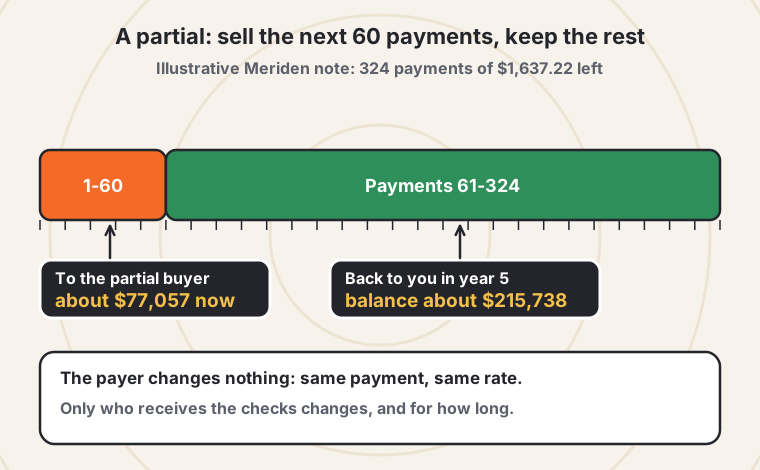
Example (illustrative). Built from Meriden’s public median and simple loan math, not from a real deal. A Meriden house sold for $300,000, the town’s median sale price. The buyer put 20% down ($60,000), and the seller took a $240,000 note at 7.25% over 30 years. The payment is $1,637.22 a month. After 36 on-time payments, the balance is about $232,496 and 324 payments remain.
| Option | Cash to you now | What you keep | Face value of what you give up |
|---|---|---|---|
| Keep the note | $0 | All 324 payments (about $530,459 face) | $0 |
| Sell the whole note at a 10% yield | about $183,115 (78.8% of the balance) | Nothing | All 324 payments |
| Sell the next 60 payments at 10% | about $77,057 | Payments 61 to 324, starting in year five, on a balance of about $215,738 | 60 payments, $98,233 face |
| Sell the next 84 payments at 10% | about $98,621 | Payments 85 to 324 | 84 payments, $137,527 face |
| Sell the next 60 payments at 11% | about $75,301 | Payments 61 to 324 | 60 payments, $98,233 face |
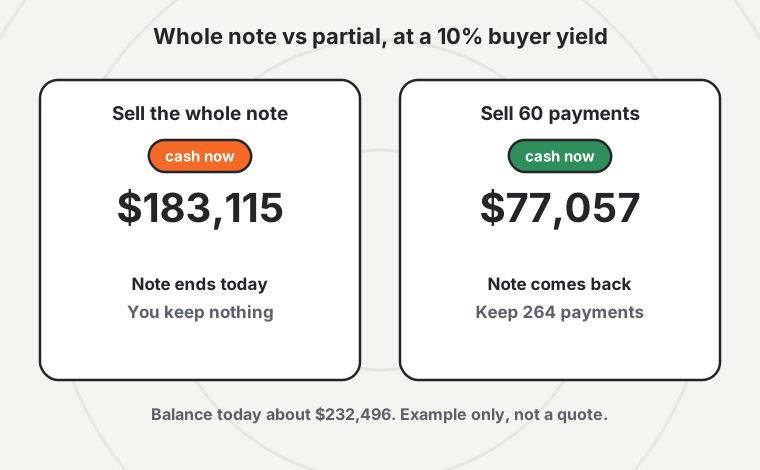
Why is the whole note discounted so heavily? It has no balloon and 27 years left, so at a 10% yield the far-off payments are worth little today. A partial buyer prices only the near payments, and you keep the long tail the whole-note buyer was paying so little for.
The trade-off is honest and simple: the partial gives you about $77,057 now instead of $183,115, but five years from now you still hold a note with a balance of about $215,738. If you need less than the whole-note price, a partial usually leaves you better off over time. If you need every dollar now, only the whole sale does that.
What should a partial purchase agreement say?
A partial purchase agreement should say exactly which payments are sold, who services the loan and holds the escrow, what the buyer gets if the payer pays off early, what happens if the payer defaults, who decides on a foreclosure, and how and when the mortgage is assigned back to you when the partial ends. Have a Connecticut attorney read it before you sign.
| Term | What to look for | Why it matters |
|---|---|---|
| Payments sold | Exact number and dates, for example “payments due June 1, 2027 through May 1, 2032” | No arguments later about who owns which check |
| Assignment and reassignment | The recorded assignment to the buyer, and a signed reassignment back to you held in escrow or required within a set number of days after the last payment | Title under the mortgage vests in whoever holds the assignment (CGS 49-10(b)) |
| Early payoff | A written formula, usually the buyer gets enough to reach their yield on the unpaid part, and you get the rest | Refinances happen; this clause decides how a payoff is split |
| Default | Who must cure, who can foreclose, who pays legal costs, and whether you can buy the buyer out | A default can wipe out the value of your back-end payments |
| Recourse | Whether you must refund the buyer if the payer stops paying | Recourse shifts the risk back to you; avoid it or price it |
| Servicing | A named servicer, monthly statements to both of you, and escrow for taxes and insurance | You need to know your back end is being protected |
| Notice to the payer | A written notice of the new payee, and another when payments return to you | Payments to you still count until the payer gets notice (CGS 49-10(d), (f)) |
What happens if the Meriden payer refinances during the partial?
If the Meriden payer refinances or sells during the partial, the payoff is split under the agreement. In the illustrative example, if the payer pays off after 24 of the 60 sold payments, the balance due is about $226,509. A typical yield-based formula gives the partial buyer about $50,740, the value of their 36 remaining payments at 10%, and gives you about $175,769.
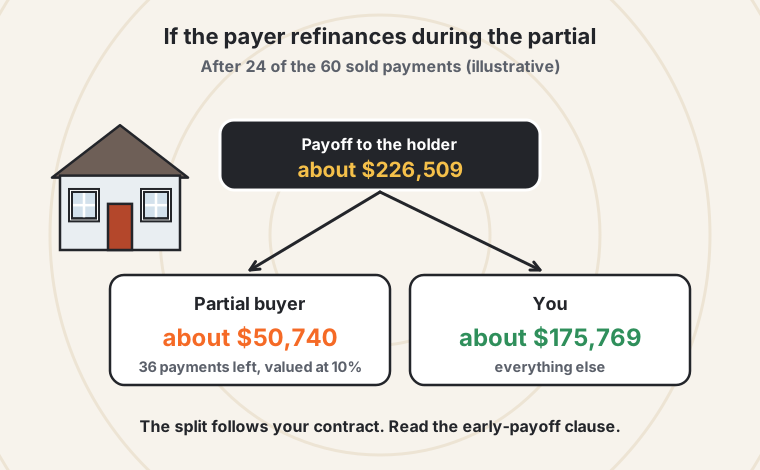
An early payoff is common: Meriden prices rose about 11% in the latest year of state data, and a payer with more equity may refinance into a bank loan. Most partial agreements protect the buyer’s yield, not their full face amount, so a payoff tends to work in your favor. Some agreements are less fair, for example giving the buyer all remaining sold payments at face value. Read this clause twice.
If the payer defaults instead, the picture reverses. The partial buyer usually controls the note during the partial, may need to foreclose in Superior Court (for a Meriden house, the New Haven Judicial District), and is repaid first from any recovery. Your back end is exposed. That is why the default clause, and your right to step in and cure or buy out the buyer, matters so much.
What are the risks of selling part of a mortgage note?
The risks of selling part of a mortgage note are that the payer defaults while the buyer controls the loan, that the agreement splits an early payoff unfairly, that the mortgage is not reassigned to you when the partial ends, that a recourse clause makes you repay the buyer, and that you deal with a buyer who is unlicensed, disappears or charges upfront fees.
- Control. While the buyer holds the assignment, they decide how to handle late payments. Ask for a right to be told within a set time when a payment is late, and a right to cure.
- Reassignment. Ask for the reassignment to be signed at closing and held by your attorney, so you do not have to chase a buyer five years from now.
- Servicing. Connecticut licenses mortgage servicers (CGS 36a-715 and following). If the buyer will collect the payments, ask whether they or their servicer are licensed; NMLS Consumer Access lists licensees.
- Taxes. Selling part of an installment obligation can bring part of your deferred gain into the year of sale (IRS Publication 537). Ask a CPA before you sign.
- Usury. Connecticut caps most loan interest at 12% (CGS 37-4), but a bona fide mortgage of real property over $5,000 is exempt (CGS 37-9). If your note was unusual, have an attorney confirm it is sound before you try to sell.
- Scams. Never pay an upfront fee to “lock” an offer. A real buyer gives you a written quote first.
Is a partial sale, a whole-note sale or keeping the note best for you?
A partial sale is usually best when you need a specific amount of cash that is well below the whole-note price and you trust the payer; a whole-note sale is best when you want out completely; keeping the note is best when you do not need the money and the payer is reliable. Compare all three by cash now, total value kept and risk.
Keep the note
$0 nowAll 324 payments stay yours.
- No discount
- All the risk and paperwork
Sell 60 payments
about $77,057Note returns to you in five years.
- Keeps most long-term value
- More contract to negotiate
Sell the whole note
about $183,115Clean break today.
- Largest discount
- No back end left
When you should NOT sell any of it. If the payer is close to refinancing, wait; a payoff gives you the full balance with no discount. If you only need a small sum, a personal loan or a home equity line on your own house may cost less than the discount. And if the payer is already behind, sort that out with an attorney first; a partial buyer will price that risk hard.
Where we fit, honestly. We buy houses, not notes or payments, so we will not make you an offer on this note. If the payer wants to sell the Meriden house to pay you off, or you get the house back, we can make a cash offer on the house as it is. Our page on the ways we buy houses in Connecticut explains what we do, and the Meriden house buying page has the town’s numbers.
See the house together.
Pick a time that works.
Choose a time for us to walk through the property with you, or ask for a quick call first. We confirm every request personally.
Tuesday, January 13
No open times in the next few weeks. Please call us.
We will confirm by email. Nothing is booked until we do.
View my requestHow do you sell part of a private mortgage in Meriden, step by step?
To sell part of a private mortgage in Meriden, work out how much cash you need, gather the original note, recorded mortgage and payment history, ask two or three buyers to quote both a partial and a whole purchase in writing, have a Connecticut attorney negotiate the payoff, default and reassignment terms, then close with a recorded assignment and a written notice to the payer.
Name your number
Decide how much cash you need and when. That decides how many payments to sell.
Build the note file
Original note, recorded mortgage with its Meriden book and page, closing statement, payment history, insurance and tax proof.
Ask for both quotes
Ask each buyer to quote the whole note and a partial for your cash target, with the yield and the payments priced. Compare in writing.
Negotiate the hard clauses
Early payoff split, default control, no recourse, servicing, reassignment signed at closing.
Close and record
Sign the agreement and the assignment; make sure it is recorded on the Meriden land records.
Notify the payer, then calendar the end
Send the notice of the new payee. Put the date the partial ends on your calendar, with a reminder to confirm the reassignment and send the payer a second notice.
Frequently asked questions about partial note sales in Connecticut
These are the questions Meriden and other Connecticut note holders ask most about a partial sale of a mortgage note, from how many payments to sell to taxes and early payoffs. The short answers below point back to the sections and statutes above.
Can I sell part of my mortgage note in Connecticut?
Yes, you can sell part of a mortgage note in Connecticut by selling a set number of upcoming payments or a slice of each payment. The buyer usually receives a recorded assignment of the mortgage for the term (CGS 49-10(b)), and the payments and mortgage come back to you when the partial ends.
How many payments should I sell in a partial?
Sell only as many payments as you need to raise the cash you need. In the illustrative Meriden example, 60 payments bring about $77,057 and 84 payments about $98,621 at a 10% yield. Fewer payments means a smaller discount in dollars and the note returns to you sooner.
Is a partial better than selling the whole note?
A partial is better than selling the whole note when you need less cash than the whole-note price and want to keep long-term value. Selling the whole note is better when you want no further risk or bookkeeping. Compare both quotes from the same buyer.
What happens if the payer pays off the loan early?
If the payer pays off early, the payoff is split under the agreement. Under a typical yield-based formula the buyer gets enough to reach their yield on the unpaid part of what they bought and you get the rest, about $175,769 of a $226,509 payoff in our illustrative example.
What happens if the payer stops paying during the partial?
If the payer stops paying during the partial, the buyer usually controls collection and any foreclosure, which for Meriden is filed in the New Haven Judicial District, and is repaid first from what is recovered. Negotiate a right to be told and to cure or buy the buyer out.
Does the payer have to agree to a partial sale?
The payer usually does not have to agree, unless the note says so, because their terms do not change. They must get written notice of where to pay; until then, payments to you still count (CGS 49-10(d)).
Who services the loan in a partial?
The buyer or a servicer they hire usually collects payments during the partial. Connecticut licenses mortgage servicers (CGS 36a-715 and following), so ask who will service the loan, whether they are licensed, and how you will see statements.
Is a partial note sale taxable?
A partial note sale can be taxable, because it disposes of part of an installment obligation and can bring part of your deferred gain into the year of sale (IRS Publication 537). Connecticut taxes gains as income. Ask a CPA before you sign.
Will your company buy my mortgage payments?
No. We Buy Houses In Connecticut buys houses, not notes or payments. If the payer wants to sell the house to pay you off, or the house comes back to you, we can make a cash offer on the house.
Related guides
- Owner financing in Connecticut: is it good for the seller? (the pillar for this topic)
- How to sell a whole mortgage note in Connecticut, with a Groton example
- Selling an unsecured promissory note in Connecticut
- Wholesaler myths in Connecticut, with a Norwich example
- Owner financing when you still have a mortgage
- The ways we buy houses in Connecticut
- Selling a house in Meriden, CT
- How to sell a house in Connecticut: every route
Sources (checked on October 27, 2026)
- CGS 49-10 (assignment of mortgage debt and notice to the payer), chapter 846
- CGS 37-4 and 37-9 (12% interest cap and the mortgage exemption)
- CGS 36a-715 and following (mortgage servicer licensing)
- CGS 51-344 (judicial districts)
- CGS 12-494 (real estate conveyance tax)
- IRS Publication 537, Installment Sales
- CT OPM Real Estate Sales, data.ct.gov
- CT OPM mill rates, data.ct.gov
This guide is general information, not legal, tax or financial advice. Talk to a Connecticut attorney and a tax professional before you sell any part of a note.

Who wrote this
Jerryll Noorden
Jerryll has bought and sold Connecticut houses since 2016 and has sat at more closing tables than he can count, on both sides. Before real estate he was a robotics scientist at NASA, IHMC and IIT. He wrote this guide because the national sites that rank for it skip the Connecticut rules that cost sellers money. When listing or selling it yourself would get you more than a cash offer, he says so.
This guide explains Connecticut rules in plain English. It is not legal or tax advice. Laws change; for your sale, talk to a Connecticut real estate attorney and a tax professional.
