
Key facts at a glance
This page is one chapter of our guide on how to sell a house in Connecticut. The numbers below are local and each one is sourced.
| Fact | Number | Source |
|---|---|---|
| Monroe single-family sales, Oct 2023 to Sep 2024 | 175, median $575,000 | data.ct.gov sales file |
| Of those, sold for $700,000 or more | 43 (25%) | data.ct.gov sales file |
| All Monroe home sales, same year | 234 (325 two years earlier) | data.ct.gov sales file |
| Median single-family lot | 1.06 acres; 83% of lots 1 acre or more | 2025 parcel (CAMA) data |
| Houses heated with oil | 68% | 2025 parcel (CAMA) data |
| Mill rate, fiscal 2027 | 29.88 (about $1,002 a month on $575,000) | OPM via data.ct.gov |
| Fairfield County median days on market, 2024 | 22 in May, 64 in January | Realtor.com via FRED |
It answers one question: why a Monroe house sits when others sell. The general causes are in why won’t my house sell in Connecticut. Monroe has its own set: bigger houses on bigger lots, private systems, an upper price range with fewer buyers, and a high tax bill that makes every extra month expensive.
Why is it so stressful when a Monroe house sits on the market?
It is stressful when a Monroe house sits on the market because the stakes are large and the costs keep running: a $575,000 house carries about $1,002 a month in property tax alone. Owners in this spot often feel frustrated, anxious about the next move, doubtful of their agent and a little defensive about a house they raised a family in. This page is for them.
Maybe you have already bought in another state and are paying two housing bills. Maybe the kids are gone and the colonial on two acres off Route 111 is more house than you want to heat. Maybe the house belonged to your parents, you live an hour away, and every visit means mowing, checking the boiler and wondering why nobody has made an offer.
Monroe recorded 234 home sales in the year to September 2024, so buyers are there. But a Monroe house is a bigger, more complex purchase, and its buyers inspect more and commit more slowly.
I am Jerryll Noorden. I have bought houses in Connecticut since 2016, about ten a year. I am not a lawyer or your agent; below I check Monroe’s causes in order, using the town’s own data.
Why isn’t my house selling in Monroe, CT?
Your house usually isn’t selling in Monroe because it is priced in an upper band where Monroe has few buyers, because the well, septic, oil tank or an older system worries buyers and their lenders, or because the house does not suit the family buyers who drive Monroe’s market. Price is still the most common cause, but in Monroe it interacts with lot, systems and commute more than in denser towns.
Monroe is a different market from the towns around Route 15 and I-91 we cover in our Wallingford guide. The median single-family house sold for $575,000, on a median lot of just over an acre, with 44% of houses built as colonials. At that price, many buyers are families trading up, and most commute by car. Buyers at this level usually already own a home or rent comfortably, so they can wait for the right house.
Check four Monroe-specific causes in order: the price band, the private systems and fuel, fit for family buyers, and the season.
Is my Monroe house priced where too few buyers are looking?
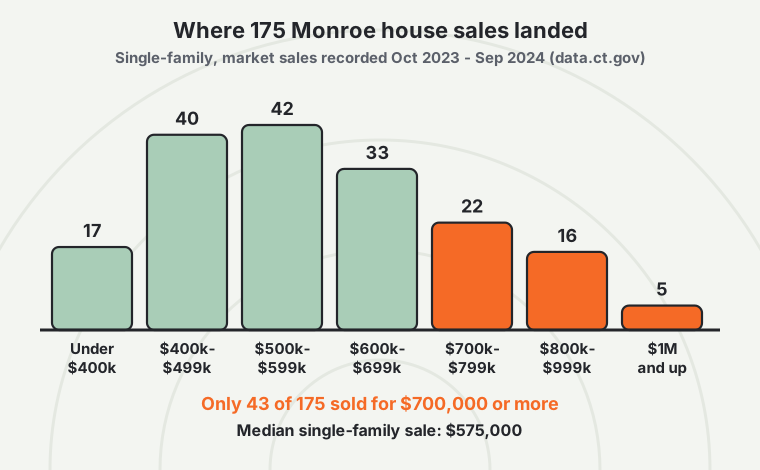
Your Monroe house may be priced where too few buyers are looking if it is listed above about $700,000. Of the 175 Monroe single-family houses sold in the year to September 2024, 115 sold between $400,000 and $699,999, while only 43 sold for $700,000 or more and just 21 for $800,000 or more. Above that line, each buyer has more choice and less urgency.
| Sale price | Sales | Share |
|---|---|---|
| Under $400,000 | 17 | 10% |
| $400,000 to $499,999 | 40 | 23% |
| $500,000 to $599,999 | 42 | 24% |
| $600,000 to $699,999 | 33 | 19% |
| $700,000 to $799,999 | 22 | 13% |
| $800,000 to $999,999 | 16 | 9% |
| $1,000,000 and up | 5 | 3% |
Read this as a buyer count. At $849,900, Monroe produced 16 sales in that range all year, about one a month. At $749,900 the same house competes in a band with more activity.
Rising prices, falling volume. The single-family median rose from $477,250 in the year to September 2022 to $575,000 two years later, while total sales fell from 325 to 234. Owners see the higher prices; fewer of them notice there are fewer sales to support them.
Paying for the land twice. Monroe buyers expect an acre. Most lots (83%) are an acre or more, so extra land is a smaller premium here than owners think. Price the house, its condition and its systems first, then the land.
For the pricing method itself, see how to price a house to sell in Connecticut.
Are the well, septic or oil tank stopping my Monroe house from selling?
The well, septic or oil tank can stop a Monroe house from selling when a buyer’s inspection or lender raises a question you cannot answer quickly. With a median lot of 1.06 acres and 68% of houses heated by oil, many Monroe sales involve a water test, a septic inspection and an oil tank check, and a buried tank or a failed septic report is one of the most common reasons a deal dies.

Connecticut does not require a septic inspection or a well test before every sale. But buyers usually test both, and lenders often ask for a water test and for an underground oil tank to be tested or removed. If the house has a private well, Connecticut law requires the seller to tell the buyer, before the sale, that the Department of Public Health’s material on private well testing is available online (CGS 19a-37). Not every Monroe house is on a well and septic, so check your own property records or ask the town.
What to do before or during a listing:
- Find the septic as-built and the last pumping receipt; pump and inspect if it has been more than three years
- Run a water test (bacteria, nitrates and the common metals) and keep the lab report
- Know where your oil tank is, how old it is and whether it is underground
- If heat is propane, know whether you own or lease the tank
- Gather receipts for the boiler, roof and well pump
Our full guide to oil tanks, septic, wells and radon when selling in Connecticut covers costs and disclosure.
Does my Monroe house fit what Monroe buyers want?
Your Monroe house may not fit what Monroe buyers want if it is dated inside, has a layout that does not work for a family, or makes the daily drive harder than the houses competing with it. Monroe buyers are mostly families paying a premium for space and schools, and they compare a house’s updates, layout and location within town against a small set of alternatives.
Monroe has no Metro-North station of its own, so most buyers who work in Bridgeport, Stamford, New Haven or Danbury drive, at least to a station in a neighboring town. Your listing should make the drive easy to judge: name the roads, the distances, and anything that shortens a commute. For a house deep on a back road, show what the buyer gets for the extra minutes: privacy, land, quiet.
Inside, Monroe’s stock is mostly colonials (2,510 of 5,761 single-family houses) with a median build year of 1970. Buyers paying $575,000 compare kitchens and baths with recently redone houses, so an untouched 1990s interior has to be priced for the work.
A smaller ranch also competes with Monroe’s condos: 59 sold in the same year at a median of $355,000, often to downsizers.
Is the season the reason my Monroe house isn’t selling?
The season can be part of the reason your Monroe house isn’t selling, more than in most towns. Over the three years to September 2024, February and March held only 8.9% of Monroe’s 763 closings, and Fairfield County’s median listing took 64 days to sell in January 2024 against 22 days in May. A Monroe house listed in late fall can sit through winter for reasons that have nothing to do with the house.
Family buyers time moves around the school year. They sign in spring, close in summer and settle in before September. Monroe’s closings peaked in July (86) and October (88), and the median closing price was highest in August ($560,000) and lowest in December ($410,000). Part of that gap is which houses sell when, so treat it as a pattern, not a discount.
What that means for a stale listing:
- Listed October to January: the slow season may be most of the story. Relaunch with new photos in March.
- Listed March to June and unsold by August: season is not the problem. Go back to price band and systems.
- Price cuts in Fairfield County are common: in September 2024, 410 of 1,499 active listings (27%) showed a price cut, so a cut must be meaningful to get noticed.
For the statewide pattern, see the best time to sell a house in Connecticut, and our sibling posts on selling for cash in winter and why summer is not always ideal.
Should I wait or cut the price on my Monroe house?
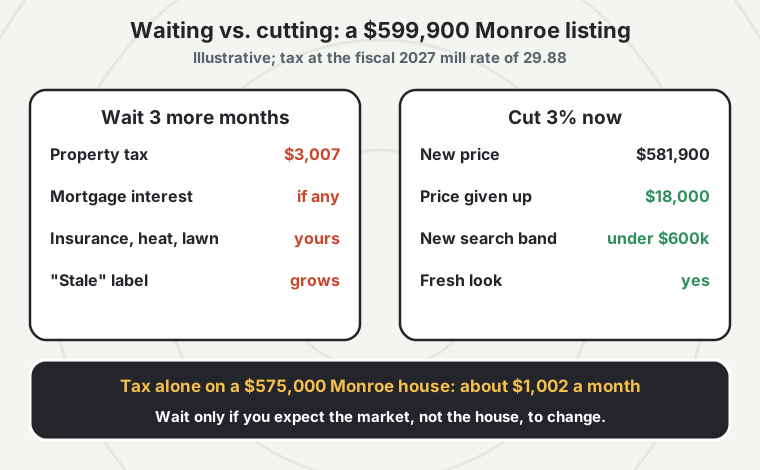
You should cut the price on your Monroe house rather than wait if the house has already been through a spring market, because each month of waiting costs about $1,002 in property tax alone on a $575,000 house at Monroe’s fiscal 2027 mill rate of 29.88. Wait only if you listed in the slow season and expect the market, not the house, to change.
| Item | Monroe example | How it is figured |
|---|---|---|
| Market value | $575,000 | Single-family median, Oct 2023 to Sep 2024 |
| Assessment | $402,500 | 70% of value (CGS 12-62a) |
| Property tax per year | $12,027 | $402,500 x 29.88 / 1,000 |
| Property tax per month | $1,002 | Year / 12 |
| Three more months (tax only) | $3,007 | Year / 4 |
| Conveyance tax at sale | $5,750 | 1% of $575,000 (0.75% state + 0.25% town, CGS 12-494) |
Monroe’s fiscal 2027 mill rate of 29.88 sits between Shelton’s 15.51 and Trumbull’s 37.42, but on Monroe’s larger, pricier houses the monthly bill is still big. Our worksheet for the monthly cost of holding a vacant house adds the rest. To compare your net at different prices, use the calculator:
How much would you walk away with?
Slide the numbers to match your house. It works in your browser; nothing is saved or sent.
Estimates for planning. Conveyance tax per CGS 12-494 (state 0.75% up to $800,000, 1.25% to $2.5M, 2.25% above, plus the town rate). Seller attorney about $1,200 to $1,500; flat-fee MLS about $400; listings include three months of taxes, insurance and utilities, a cash sale about two weeks. Your attorney gives you the final numbers.
What are my options if my Monroe house still won’t sell?
Your options if your Monroe house still won’t sell are to reprice into a busier band, solve or document the well, septic and tank questions and relaunch in spring, rent it, or sell it as-is to a cash buyer. The right choice depends on condition, time and how much the carrying costs hurt, and an honest comparison of the net from each route is the best way to decide.
Reprice and stay listed
One real cutBest for a sound house priced in a thin band.
- Moves you to more buyers
- Keeps the full retail market
- Each month still costs about $1,002 in tax
Fix systems, relaunch
Spring restartBest when a well, septic or tank question killed a deal.
- Removes the reason buyers walk
- Up-front cost and time
- Fresh photos and a fresh listing date
Sell as-is for cash
About 2 weeksBest for an estate, a big repair list or a double housing payment.
- No repairs, no showings, no commission
- You choose the closing date
- Lower price than a fixed-up retail sale
If the house is inherited, the estate runs through the Trumbull Probate District, which serves Easton, Monroe and Trumbull (CGS 45a-2). Our guides on selling an inherited house in Connecticut and on when heirs disagree about selling cover that path. For the side-by-side numbers on listing versus selling for cash, read cash buyer vs. realtor in Connecticut.
When should you NOT sell your Monroe house to a cash buyer?
You should not sell your Monroe house to a cash buyer when it is in good condition, its systems check out, you can carry it a few more months, and the only issue is price band or presentation. In that case one meaningful price cut with a good agent will almost always net more than a cash offer, because a cash buyer has to price in repairs, carrying costs and resale risk.
I buy houses, and a well-kept Monroe colonial with a clean septic report does not need me; it needs a price where Monroe’s buyers are. Our article why cash offers are lower explains the math behind every investor offer, so you can judge one when you see it.
Cash makes sense when the honest answer is different: the house needs a new septic system, roof or boiler you cannot fund; a lender will not finance it; the heirs want one number and no showings; or you are paying for two houses and every month hurts. Before you sign with anyone, run the checks in we buy houses scams and red flags.
What should I do next if my Monroe house isn’t selling?
What you should do next if your Monroe house isn’t selling is check your price band against Monroe sales, gather your well, septic, tank and system records, read your showing feedback for the real objection, make one clear price or relaunch decision, and get a written as-is number so you know your floor before you choose.
Find your band
Count Monroe sales in your price band over the last 12 months. If there were fewer than about two a month, consider the band below.
Answer the system questions
Septic report, water test, oil tank status, boiler and roof ages: have them ready to hand to any buyer.
Read the feedback
Ask your agent for every buyer comment. Repeated mentions of the same issue (kitchen, drive, tank) are your answer.
Decide once
One meaningful cut now, or a full relaunch in March. Avoid small monthly cuts.
Know your floor
A written as-is cash number costs nothing and has no deadline. Our Monroe page explains how we make one.
Know where you stand,
on your own time.
Watch what homes around you sell for and how fast, so when you are ready, you already know your options.
Follow your numbers as the market moves, and decide when the timing is right.
Questions Monroe owners ask when a house isn’t selling
What is the median home price in Monroe, CT?
The median price of a single-family home in Monroe was $575,000 for market sales recorded October 2023 to September 2024 (175 sales, data.ct.gov). Condos sold for a median of $355,000.
How long does it take to sell a house in Monroe, CT?
It takes about three to eight weeks to sell a well-priced house in Monroe in spring, based on Fairfield County’s 2024 median of 22 days on market in May, plus 30 to 60 days to close. In winter it takes longer: the county median was 64 days on market in January 2024.
Why do Monroe houses above $700,000 sit longer?
Monroe houses above $700,000 sit longer because there are fewer buyers: only 43 of 175 single-family sales in the year to September 2024 were $700,000 or more, and 21 were $800,000 or more. With fewer buyers and more choice, each one takes longer to commit.
Do I need a septic inspection to sell my house in Monroe?
No state law requires a septic inspection to sell a house in Monroe, but most buyers order one and a failed report can end a deal. Pumping and inspecting before you list, and keeping the report, removes one of the most common reasons a Monroe sale falls apart.
Do I have to test my well before selling in Monroe?
You do not have to test your well before selling in Monroe, but Connecticut requires the seller of a house with a private well to tell the buyer that the state’s well testing information is available (CGS 19a-37), and buyers and lenders usually test the water.
Is it better to sell my Monroe house in spring?
It is usually better to list a Monroe house in March to May, because family buyers sign in spring to move before school. February and March held only 8.9% of Monroe closings over three years. If waiting costs more than about $1,002 a month in tax, selling now can still win.
What property tax will I pay while my Monroe house is for sale?
You will pay about $12,027 a year, or $1,002 a month, in property tax on a $575,000 Monroe house at the fiscal 2027 mill rate of 29.88, figured on a 70% assessment. Your own bill depends on your assessment, which is on your town property card.
What probate court handles an inherited house in Monroe?
The probate court that handles an inherited house in Monroe is the Trumbull Probate District court, which serves Easton, Monroe and Trumbull (CGS 45a-2). An executor or administrator can sell the house with court approval, often before the estate is closed.
Will a cash buyer take my Monroe house with a bad septic or old oil tank?
Yes, a cash buyer will usually take a Monroe house with a failing septic or an old oil tank as-is, because there is no lender to require a fix before closing. The offer will reflect the cost of the repair, so compare it with what fixing and listing would net.
Related guides
- Why won’t my house sell? Connecticut causes and fixes
- Best time to sell a house in Connecticut (state data)
- Cash buyer vs. realtor in Connecticut
- Why won’t my house sell in Wallingford?
- Selling a house in rural eastern Connecticut
- Oil tank, septic, well and radon: selling a CT house
- We buy houses in Monroe, CT
For every route, cost and step in one place, start with our guide on how to sell a house in Connecticut.
Sources (checked on October 27, 2026)
- CT Office of Policy and Management, Real Estate Sales (data.ct.gov dataset 5mzw-sjtu)
- 2025 Connecticut Parcel and CAMA Data (data.ct.gov)
- Mill Rates for FY 2014-2027, OPM (data.ct.gov)
- Realtor.com: median days on market, Fairfield County (FRED)
- Realtor.com: price reduced count, Fairfield County (FRED)
- CGS 19a-37, private well testing notice
- CT Department of Public Health, private well testing
- CGS 12-494, real estate conveyance tax
- CGS 12-62a, assessment at 70% of value
- CGS 45a-2, probate districts
This guide is general information, not legal or tax advice. For your own sale, talk to a Connecticut real estate attorney.

Who wrote this
Jerryll Noorden
Jerryll has bought and sold Connecticut houses since 2016 and has sat at more closing tables than he can count, on both sides. Before real estate he was a robotics scientist at NASA, IHMC and IIT. He wrote this guide because the national sites that rank for it skip the Connecticut rules that cost sellers money. When listing or selling it yourself would get you more than a cash offer, he says so.
This guide explains Connecticut rules in plain English. It is not legal or tax advice. Laws change; for your sale, talk to a Connecticut real estate attorney and a tax professional.
