
Key facts at a glance
This page is one chapter of our guide on how to sell a house in Connecticut. The numbers below are local and each one is sourced.
| Fact | Number | Source |
|---|---|---|
| Sterling home sales, Oct 2024 to Sep 2025 | 35, median $365,000 | data.ct.gov sales file |
| Windham County active listings per month, 2024 | 86 to 154 | Realtor.com via FRED |
| Fewest closings in 5 northeast towns (5 years) | February, 6.3% of 3,276 | data.ct.gov sales file |
| Sterling houses heated with oil; median lot | 81%; 2.1 acres | 2025 parcel (CAMA) data |
| Killingly houses on a private well; on septic | 60%; 48% | 2025 parcel (CAMA) data |
| Sterling mill rate, fiscal 2027 | 21.94 | OPM via data.ct.gov |
| Sterling probate court; Superior Court | Plainfield-Killingly Probate District; Windham Judicial District | CGS 45a-2; jud.ct.gov |
It covers selling a house in rural eastern Connecticut, in Sterling and its Windham County neighbors Plainfield, Killingly, Putnam and Thompson: when to sell, how small the buyer pool really is, and what a rural buyer will check. For the statewide calendar, see the best time to sell a house in Connecticut.
Why does selling a house in rural eastern Connecticut feel uncertain?
Selling a house in rural eastern Connecticut feels uncertain because there are few sales to compare with, few buyers looking at any one time, and a long list of things a buyer can question, from the well to the oil tank. Owners here often feel isolated from the market, worried about pricing, protective of a place they built or kept up for years, and unsure who to trust.
Maybe you are in a raised ranch on a few acres off Route 14 in Sterling and the plowing is getting old. Maybe it is your father’s place in Thompson or Killingly, and you live in another state.
The worry is reasonable. Sterling, a town of about 3,600 people, recorded 35 market sales in the year to September 2025. That is about three a month. You cannot price your house off last week’s sale down the street, because there usually was not one. But houses here do sell, at solid prices, when they are priced off the right comparables, listed in the right months, and ready for the questions rural buyers ask.
I am Jerryll Noorden. I have bought houses in Connecticut since 2016, about ten a year. I am not a lawyer or an agent; everything below is from public data.
What is different about selling a house in rural eastern Connecticut?
What is different about selling a house in rural eastern Connecticut is the size of the market. In 2024 Windham County had only 86 to 154 homes for sale in any month, against 663 to 1,164 in New Haven County. Fewer buyers and fewer listings mean prices move on few sales, houses take longer to match with the right buyer, and the well, septic and heating system matter more.
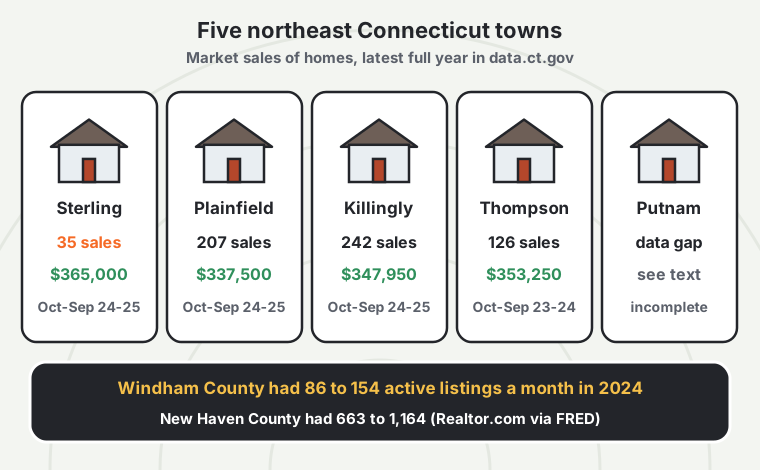
| Town | Period | Sales | Median price | Mill rate |
|---|---|---|---|---|
| Sterling | Oct 2024 to Sep 2025 | 35 | $365,000 | 21.94 |
| Plainfield | Oct 2024 to Sep 2025 | 207 | $337,500 | 20.56 |
| Killingly | Oct 2024 to Sep 2025 | 242 | $347,950 | 21.86 |
| Thompson | Oct 2023 to Sep 2024 | 126 | $353,250 | 19.68 |
| Putnam | Oct 2021 to Sep 2022 | 146 | $256,950 | 18.50 |
Putnam’s later years are incomplete in the state file, so its row is older and lower than today’s market. Plainfield and Killingly mill rates are the town rates; some villages and fire districts add their own tax.
Three practical consequences follow:
- Your comparables cross town lines. A Sterling buyer is also looking in Plainfield, Voluntown, Killingly and across the line in Rhode Island. Price against all of them.
- One overpriced month is expensive. With 86 to 154 listings in the whole county, buyers see every one. A house that sits gets noticed as stale quickly.
- Price cuts are common. In August 2024, 56 of 142 Windham County listings (39%) showed a price cut, the highest share of the year.
When is the best time to sell a house in Sterling and Windham County?
The best time to sell a house in Sterling and Windham County is to list in March through May so it closes in early summer, when the county’s houses sold fastest: the Windham County median was 25 days on market in June 2024 against 54 in December. Across five northeast towns, February had the fewest closings (6.3%) and July the highest median closing price ($300,000) over five years.
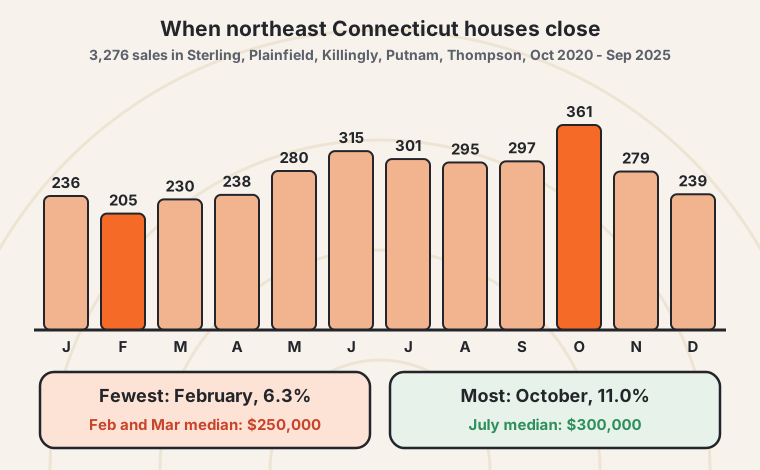
Sterling alone has too few sales for a reliable monthly pattern, so we pooled it with its four neighbors. Over October 2020 to September 2025, the five towns recorded 3,276 market sales:
| Months recorded | Closings | Share | Median price range |
|---|---|---|---|
| January to April | 909 | 27.7% | $250,000 to $275,000 |
| May to August | 1,191 | 36.4% | $285,000 to $300,000 |
| September to December | 1,176 | 35.9% | $260,000 to $290,000 |
Rural timing matters more than in a city: snow hides the land and the driveway, early spring mud makes them look their worst, and septic work is easier when the ground is not frozen. Late spring shows a rural house at its best.
Two exceptions. Fall is strong here too: October had the most closings of any month (361, or 11.0%), from buyers who signed in late summer. And if you have a reason to sell now, the season matters less than you think; see the section on when not to wait below. Our sibling posts on why summer is not always ideal and selling for cash in winter cover the off-season.
How do you price a house when there are so few sales nearby?
You price a house when there are so few sales nearby by widening the search: use the last 12 to 24 months of sales in Sterling and the neighboring towns, match on house size, age, land and systems rather than on town, and adjust for big differences such as acreage, a newer septic or a garage. With only 35 Sterling sales a year, three good comparables from Plainfield or Killingly beat one stale sale on your road.
A simple method that works in thin markets:
- Pull sales from the state file (data.ct.gov, dataset 5mzw-sjtu) for Sterling, Plainfield, Killingly, Voluntown and Thompson over the last two years.
- Keep only houses within about 20% of your square footage and a similar style.
- Look up each sale’s town property card for lot size, year built, heat and condition notes.
- Rank them from most to least like your house, and price within the range of the closest three.
- Look at every competing listing yourself; in this county there are few enough to do it.
Expect land to matter less per acre than owners hope. Sterling’s median house sits on 2.1 acres and most neighbors have plenty of land too, so buyers pay for the house first. Our guide on pricing a house to sell in Connecticut goes deeper on the method.
What will a buyer check on a rural house in eastern Connecticut?
A buyer will check the private well, the septic system and the heating system on a rural house in eastern Connecticut, along with the roof, the driveway and the land. In Sterling 81% of houses heat with oil, and in Killingly, the one town that records it, 60% of houses are on a private well and 48% on an on-site septic system. Having test results ready keeps a sale from stalling.
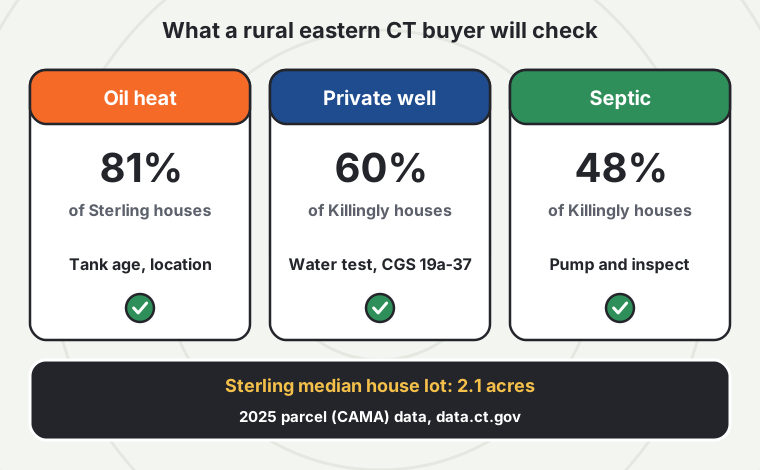
No state law requires a septic inspection or a well test before every sale, but buyers usually order both and many lenders ask for a water test. If the house has a private well, the seller must tell the buyer, before the sale, that the Department of Public Health’s material on private well testing is available online (CGS 19a-37). Most sellers of a one- to four-family house also owe the buyer the Residential Property Condition Disclosure Report, or a $500 credit (CGS 20-327b and 20-327c).
All five towns are served by the Northeast District Department of Health, based in Brooklyn, which keeps septic records and permits for its member towns. Ask it for your system’s records before you list.
- Septic as-built drawing and pumping receipts; pump and inspect if it has been three years or more
- A recent well water test from a certified lab, plus the well’s depth and yield if you know them
- Oil tank location, age and whether it is buried; boiler or furnace age and service records
- Survey or plot plan showing the boundaries, rights of way and any shared driveway
Our guide to oil tanks, septic, wells and radon when selling in Connecticut explains costs and options for each, and our Monroe guide shows how the same systems stall sales in a pricier rural town.
Which probate court, Superior Court and offices handle a Sterling sale?
A Sterling sale involves the Plainfield-Killingly Probate District if the house is in an estate, the Windham Judicial District Superior Court for court matters such as a foreclosure, the Sterling town clerk where the deed is recorded, and a Connecticut attorney for the closing. Putnam and Thompson estates go to the Northeast Probate District instead.
| Office | Sterling | Neighbors | Source |
|---|---|---|---|
| Probate district | Plainfield-Killingly (with Canterbury, Killingly, Plainfield) | Putnam and Thompson: Northeast Probate District | CGS 45a-2 |
| Superior Court | Windham Judicial District | Same for Plainfield, Killingly, Putnam and Thompson | jud.ct.gov |
| Health district | Northeast District Department of Health | Same for all five towns | CT DPH health district list |
| Closing | Connecticut attorney | Same statewide | CGS 51-88a |
If you inherited the house, the executor or administrator can usually sell with the probate court’s approval before the estate closes. Our guide to selling an inherited house in Connecticut walks through it, and the timing question becomes “when will the court allow it” more than “which month is best”.
What does it cost to hold and sell a house in Sterling?
Holding a house in Sterling costs about $467 a month in property tax on a $365,000 house at the fiscal 2027 mill rate of 21.94, plus heat, insurance and upkeep. Selling it costs 1% in conveyance tax ($3,650 on $365,000, under CGS 12-494), attorney fees and, if you list, a commission. A winter of oil in an empty rural house adds a real bill too.
| Item | Sterling example | How it is figured |
|---|---|---|
| Market value | $365,000 | Sterling median, Oct 2024 to Sep 2025 |
| Assessment | $255,500 | 70% of value (CGS 12-62a) |
| Property tax per year | $5,606 | $255,500 x 21.94 / 1,000 |
| Property tax per month | $467 | Year / 12 |
| Waiting December to April (tax only) | $1,868 | 4 x $467 |
| Conveyance tax at sale | $3,650 | 1% (0.75% state + 0.25% town) |
The buyer usually reimburses you for heating oil left in the tank at closing, a Connecticut custom your attorney handles. To compare your net from listing versus selling as-is, use the calculator:
How much would you walk away with?
Slide the numbers to match your house. It works in your browser; nothing is saved or sent.
Estimates for planning. Conveyance tax per CGS 12-494 (state 0.75% up to $800,000, 1.25% to $2.5M, 2.25% above, plus the town rate). Seller attorney about $1,200 to $1,500; flat-fee MLS about $400; listings include three months of taxes, insurance and utilities, a cash sale about two weeks. Your attorney gives you the final numbers.
What are your options for selling a rural house in Windham County?
Your options for selling a rural house in Windham County are to list in spring with an agent who knows the quiet corner, to list now at a price that stands out in a small market, to sell by owner if you can handle showings and paperwork, or to sell as-is to a cash buyer. The thin buyer pool makes the trade-off between price and certainty sharper here than in a city.
List in spring
March to MayBest for a sound house when you can wait.
- Most buyers, land looks its best
- Well and septic tests are easier
- Months of tax, oil and upkeep until then
List now, priced to stand out
Off-seasonBest when you need to move but have some time.
- Fewer competing listings
- Slower showings in snow and mud
- Needs a sharp price
Sell as-is for cash
About 2 weeksBest for estates, big repairs, failed septic or distance.
- No repairs, no showings, no commission
- Any season, your closing date
- Lower price than a fixed-up retail sale
For a full side-by-side of listing and selling for cash, read cash buyer vs. realtor in Connecticut. We do not have a separate Sterling page; our Putnam page covers the nearby towns and our statewide page lists every town we buy in.
When should you NOT sell your rural eastern Connecticut house to a cash buyer?
You should not sell your rural eastern Connecticut house to a cash buyer when it is in good shape, the well and septic test clean, you can carry it until spring, and you have time to let a good agent find the right buyer. In that case a spring listing will almost always net more, because a cash buyer must price in repairs, holding costs and the same thin resale market you face.
I buy houses, and I would tell a Sterling owner with a well-kept ranch, a clean water test and no deadline to list it in March. Cash fits when time, distance or condition is the real problem: an estate heir living out of state, a septic that failed its inspection, a house with a roof, boiler and tank all due, or an owner who simply cannot face months of showings. Read why cash offers are lower before you compare one, and check any buyer against these red flags.
How do you get a rural eastern Connecticut house ready to sell?
You get a rural eastern Connecticut house ready to sell by gathering the well, septic and heating records, pricing it against two years of sales in Sterling and the neighboring towns, choosing a listing month (ideally March to May), and getting a written as-is number as a backstop. Start eight to twelve weeks before you want to list.
Gather the system records
Septic records from the Northeast District Department of Health, a fresh water test, oil tank and boiler details, and the roof age.
Find your comparables
Two years of sales in Sterling, Plainfield, Killingly, Voluntown and Thompson, matched on size, age and land.
Pick the month
List in March to May if you can; avoid launching in December, when Windham County’s median was 54 days on market in 2024.
Show the land
Mow, clear the drive and the paths, mark the boundaries, and take photos in good light.
Know your floor
A free written as-is number, with no deadline, tells you what plan B is worth before you decide.
See the house together.
Pick a time that works.
Choose a time for us to walk through the property with you, or ask for a quick call first. We confirm every request personally.
Tuesday, January 13
No open times in the next few weeks. Please call us.
We will confirm by email. Nothing is booked until we do.
View my requestQuestions about selling a house in rural eastern Connecticut
What is the best month to sell a house in Sterling, CT?
The best month to list a house in Sterling, CT is usually April or May, so it closes in early summer. Windham County’s median was 25 days on market in June 2024 against 54 in December, and across five nearby towns July had the highest median closing price, $300,000, over five years.
How many houses sell in Sterling each year?
About 35 houses sell in Sterling each year. The state recorded 35 market sales of homes from October 2024 to September 2025, with a median of $365,000 (data.ct.gov). That is about three a month, so nearby towns supply most of the comparables.
How long does it take to sell a house in Windham County?
It takes about one to two months to find a buyer for a well-priced house in Windham County, plus 30 to 60 days to close. The county’s median was 25 days on market in June 2024 and 54 days in December 2024 (Realtor.com via FRED).
Do I need a well test to sell my house in eastern Connecticut?
You do not need a well test to sell your house in eastern Connecticut, but the seller of a house with a private well must tell the buyer that the state’s well testing information is available (CGS 19a-37), and buyers and lenders usually test the water. A recent lab report helps the sale.
Do I need a septic inspection to sell a house in Sterling?
No state law requires a septic inspection to sell a house in Sterling, but most buyers order one. Pumping and inspecting before you list, and getting your records from the Northeast District Department of Health, avoids a surprise in the middle of the deal.
Which probate court handles an estate in Sterling, CT?
The probate court for an estate in Sterling, CT is the Plainfield-Killingly Probate District, which serves Canterbury, Killingly, Plainfield and Sterling (CGS 45a-2). Estates in Putnam and Thompson go to the Northeast Probate District.
Which court district is Sterling, CT in?
Sterling, CT is in the Windham Judicial District of the Connecticut Superior Court, along with Plainfield, Killingly, Putnam, Thompson and the other Windham County towns (jud.ct.gov). Foreclosure and other civil cases for Sterling properties are heard there.
What conveyance tax does a Sterling seller pay?
A Sterling seller pays 1% conveyance tax on a sale up to $800,000: 0.75% to the state and 0.25% to the town (CGS 12-494). On a $365,000 sale that is $3,650. The city of Windham is different, at 0.50% for the town share.
Can I sell my rural Connecticut house as-is?
Yes, you can sell your rural Connecticut house as-is, with no repairs and with the well, septic and tank as they are, to a cash buyer who does not need a lender. You still owe the buyer the disclosure report or a $500 credit in most sales, and the price will reflect the condition.
Related guides
- Best time to sell a house in Connecticut (state data)
- Cash buyer vs. realtor in Connecticut
- The worst times to sell a house in Meriden
- Disadvantages of selling during the holiday season
- Oil tank, septic, well and radon: selling a CT house
- We buy houses in Putnam, CT
- Where we buy houses in Connecticut
For every route, cost and step in one place, start with our guide on how to sell a house in Connecticut.
Sources (checked on October 27, 2026)
- CT Office of Policy and Management, Real Estate Sales (data.ct.gov dataset 5mzw-sjtu)
- 2025 Connecticut Parcel and CAMA Data (data.ct.gov)
- Mill Rates for FY 2014-2027, OPM (data.ct.gov)
- Realtor.com: active listings, Windham County (FRED)
- Realtor.com: median days on market, Windham County (FRED)
- Realtor.com: price reduced count, Windham County (FRED)
- CGS 45a-2, probate districts
- Connecticut Judicial Branch, Windham Judicial District
- CT Department of Public Health, health districts in Connecticut (April 2024)
- CGS 19a-37, private well testing notice
- CGS 20-327b and 20-327c, property condition disclosure
- CGS 12-494, real estate conveyance tax
- CGS 12-62a, assessment at 70% of value
- CGS 51-88a, practice of law
This guide is general information, not legal or tax advice. For your own sale, talk to a Connecticut real estate attorney.

Who wrote this
Jerryll Noorden
Jerryll has bought and sold Connecticut houses since 2016 and has sat at more closing tables than he can count, on both sides. Before real estate he was a robotics scientist at NASA, IHMC and IIT. He wrote this guide because the national sites that rank for it skip the Connecticut rules that cost sellers money. When listing or selling it yourself would get you more than a cash offer, he says so.
This guide explains Connecticut rules in plain English. It is not legal or tax advice. Laws change; for your sale, talk to a Connecticut real estate attorney and a tax professional.
