
Key facts at a glance
| Fact | Number | Source |
|---|---|---|
| Connecticut residential heating oil price | $6.154 a gallon (Oct 19, 2026) vs. $3.392 a year earlier | U.S. Energy Information Administration |
| CT median days on market, Jan vs. May 2026 | 61 vs. 28 days | Realtor.com via FRED (MEDDAYONMARCT) |
| CT single-family closings in February | 5.0% of the year (July: 10.8%) | data.ct.gov, OPM real estate sales (5mzw-sjtu) |
| Interest on a late property tax installment | 18% a year from the due date | CGS 12-146 |
| Conveyance tax a seller pays at closing | 0.75% state (up to $800,000) + 0.25% or 0.50% town | CGS 12-494 |
| Credit for a missing condition report (the smoke and CO affidavit has no credit option) | $500 | CGS 20-327c; CGS 29-453 |
| Our typical first call to cash closing | About 2 weeks | Our practice since 2016 |
This is part of our guide to how to sell a house in Connecticut. Whether winter is a good season to list in general is covered in the best time to sell a house in Connecticut. This page answers a narrower question: when does selling for cash in winter make sense, what does it cost to wait, how does a winter cash closing work, and when should you wait for spring instead?
Can you sell a house for cash in winter in Connecticut?
You can sell a house for cash in winter in Connecticut, and winter is when a cash sale makes the most sense for some owners. A cash buyer does not need a lender, an appraisal or a snow-free roof, so the season barely changes the timeline: about two weeks is typical. It makes sense for an empty, inherited or worn house that costs money every month; it rarely makes sense for a ready house you live in.
The trade is the same in every season. A cash offer is lower than what a well-prepared listing can bring in a strong market. What winter changes is the other side of the scale: fewer buyers, slower listings, and higher costs to keep an empty house warm. This winter, Connecticut heating oil started the season at $6.154 a gallon, up 81% from a year earlier.
Why does a winter house sale feel so urgent and so risky?
A winter house sale feels urgent because the bills keep coming while the market slows, and risky because you fear selling too cheap to the first buyer who calls. Many owners in this spot are holding a house they did not plan to hold, often an inherited or vacant one, and every cold night brings a new worry about the furnace, the pipes or the oil level.
Maybe your mother’s house in the Naugatuck Valley has sat empty since the funeral in September, and you live two states away. Maybe you moved for a job and the old house did not sell in the fall. Maybe the house needs a roof, a boiler or a cleanout, and you know a buyer with a mortgage will ask for all three. Owners in those spots tell us they feel:
- Drained, paying for two homes and a third set of worries.
- Afraid of a burst pipe or a break-in at a house nobody visits daily.
- Suspicious of cash buyers, because the offers seem low and the mailers seem pushy.
- Guilty about selling a family house “cheap” or in a rush.
- Paralyzed, because “wait for spring” sounds safe even when the numbers say otherwise.
This page is for you if you want to make that decision with real numbers. We are a cash buyer, so read it with that in mind. That is also why we show the cases where waiting for spring and listing will put more money in your pocket.
Why does winter favor a certain-close sale for some owners?
Winter favors a certain-close sale for owners whose house costs them money every month and whose buyer pool shrinks in winter: vacant houses, inherited houses, houses that need repairs a lender would flag, and owners with a fixed deadline. For them, a cash closing in about two weeks replaces three to five months of heating, insuring and plowing an empty house while waiting for spring buyers.
Four things happen at once in a Connecticut winter:
- Fewer buyers. February holds only 5.0% of the state’s single-family closings, against 10.8% in July (data.ct.gov). A house listed in December or January usually closes in February or March.
- Slower sales. Connecticut’s median days on market was 61 in January 2026 and 28 in May 2026 (Realtor.com).
- Higher costs to wait. An empty house must stay heated, and oil cost $6.154 a gallon in October 2026. Insurance on a vacant house usually costs more or covers less.
- Harder inspections and appraisals. Snow hides roofs, frozen ground slows septic tests, and a lender’s appraiser may flag a broken furnace or a failing roof as a condition of the loan.
A cash buyer removes the last two problems and shortens the first two. There is no lender, so there is no appraisal condition, no mortgage underwriting over the holidays, and no requirement that the house be in “lendable” shape. That is the whole value. If none of those four problems applies to you, the cash sale is just a lower price.
Who this usually fits
- Heirs and executors of an empty house. In Connecticut, a fiduciary can sell real estate during probate with the court’s approval (CGS 45a-164); a cash buyer can wait for that approval. See selling an inherited house.
- Owners who already moved and are paying for an empty house. See selling a vacant house.
- Owners of a house that needs work: an old roof, a dead boiler, an oil tank, a foundation issue.
- Owners with a hard date: a job start, a divorce settlement, a tax-year choice or a payoff deadline.
What does it cost to hold a Connecticut house through the winter?
Holding a Connecticut house through the winter costs property tax, heat, insurance, utilities, plowing and upkeep every month, plus mortgage interest if there is a loan. For an empty, paid-off house at Southington’s single-family median, that is about $1,980 a month in our illustrative example, or about $7,920 from December through March. Heat is the line that has changed most: oil prices rose 81% in a year.
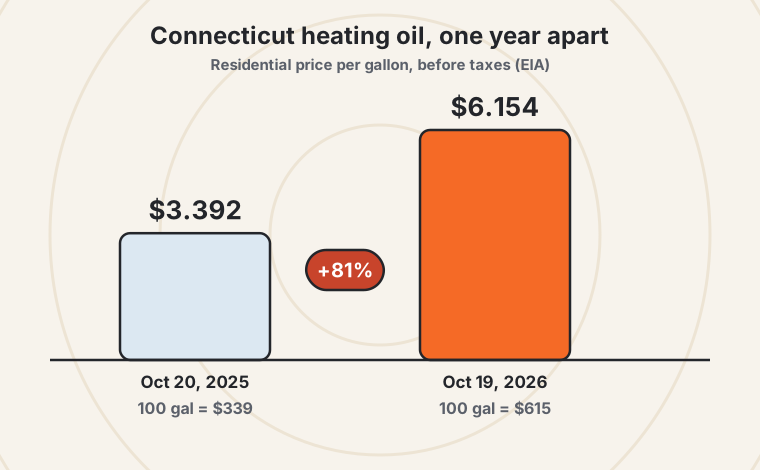
EIA surveys Connecticut heating oil dealers every week during the heating season. The residential price was $3.392 a gallon the week of October 20, 2025 and $6.154 the week of October 19, 2026. If you heat with oil, every 100 gallons now costs about $615 before taxes. How many gallons an empty house burns depends on its size, insulation and thermostat setting, so check your own delivery history.
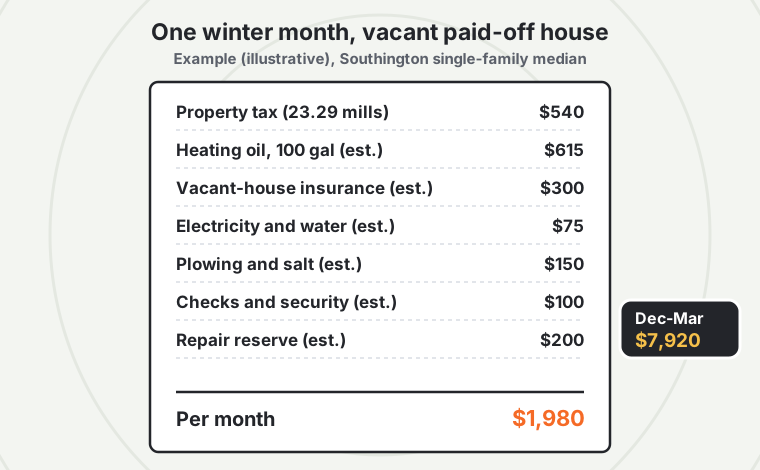
| Monthly line | Example | Where the number comes from |
|---|---|---|
| Property tax | $540 | $400,250 × 70% × 23.29 mills ÷ 1,000 ÷ 12 (Southington, fiscal 2027; CGS 12-62a) |
| Heating oil, 100 gallons | $615 (est. usage) | EIA price, week of Oct 19, 2026 |
| Vacant-house insurance | $300 (est.) | Varies by insurer and vacancy terms |
| Electricity and water | $75 (est.) | Minimum use in an empty house |
| Plowing and salt | $150 (est.) | Varies with storms |
| Checks and security | $100 (est.) | Visits, alarm or camera |
| Repair reserve | $200 (est.) | Small winter surprises |
| Per month | $1,980 | Add mortgage interest if there is a loan |
| December through March | $7,920 | 4 months |
We built the full line-by-line worksheet, with a worked Monroe example and the Connecticut rules behind each line, in our guide to the carrying costs of a vacant house in Connecticut. Use it with your own bills. If your house is in a different town, our town pages show the local mill rate.
The January tax installment. Many towns bill twice a year, July 1 and January 1. A missed installment on an empty house carries 18% yearly interest from the due date (CGS 12-146). Vacancy terms in your policy. Many homeowners policies limit coverage once a house is empty for a set period, often 30 to 60 days, and freeze damage may be excluded unless the heat was kept on or the water drained. Call your insurer.
How does a winter cash closing work in Connecticut?
A winter cash closing in Connecticut works the same as in any season: you call, the buyer walks through the house once, you get a written offer, both sides’ attorneys handle title, payoff and the conveyance tax return, and you close, usually in about two weeks. Winter adds only a few details: the heat stays on until closing, the buyer credits you for oil in the tank, and the holiday weeks have fewer working days.
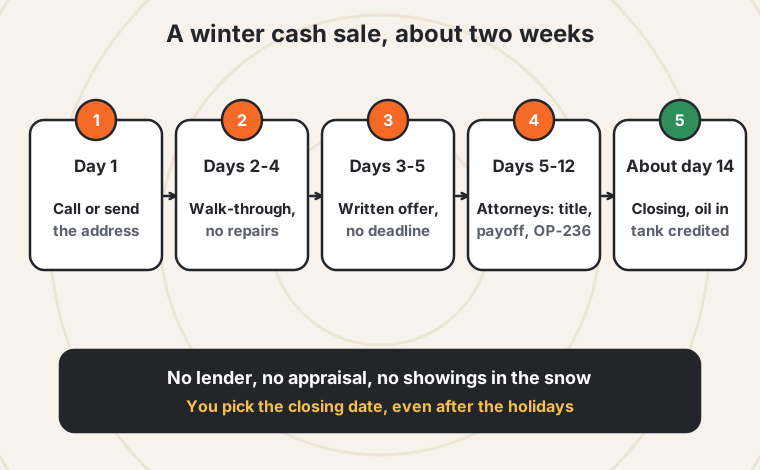
What happens at each stage
| Stage | What happens | Connecticut rule or custom |
|---|---|---|
| Walk-through | One visit, any weather. No repairs, no cleanout, no staging. | None required; it is a private sale |
| Written offer and contract | A price, a closing date you choose and what you can leave behind | Attorneys review; Connecticut closings are attorney-handled |
| Disclosures | Residential Property Condition Report, or a $500 credit to the buyer; the signed smoke and CO affidavit (no credit option); lead paint disclosure for pre-1978 homes | CGS 20-327b, 20-327c; CGS 29-453; federal lead rule |
| Title and payoff | Buyer’s attorney searches the land records at the town clerk; your attorney orders the mortgage payoff | Town land records |
| Probate (if an estate) | The fiduciary asks the probate court to approve the sale; the closing waits for the order | CGS 45a-164 |
| Closing day | Deed signed; conveyance tax paid with Form OP-236; property tax and oil prorated; you get the net proceeds | CGS 12-494; oil credit by Connecticut custom |
Winter details that matter
- Keep the heat on until closing. The house is still yours, and so is a burst pipe.
- Oil in the tank is credited. By Connecticut custom, the buyer reimburses you for the oil left in the tank at the current price. Fill it if you need to; you get the oil back as a credit.
- Leave what you do not want. Furniture, tools and boxes can stay. You do not need to rent a dumpster in January.
- Pick the date around the holidays. December 25 and January 1 are holidays, and both fall on a Friday in 2026. If the tax year matters, our guide to selling during the holidays in Connecticut explains why a December or January closing can change which year a gain is taxed.
- Sign from out of state. If you live elsewhere, attorneys can arrange signing by mail with a notary, so you do not have to drive in on icy roads.
For the closing itself, step by step, see the Connecticut closing process for sellers.
Is a winter cash offer worth taking, and how do you compare it?
A winter cash offer is worth taking only when it beats your realistic listing net after commission, repairs, concessions and the months you would carry the house until a spring or summer closing. The simplest test is a break-even number: subtract those costs from the price you expect to list for. A cash offer above that number nets more; below it, listing nets more.
Here is the method with an illustrative house. Every input is labelled; swap in your own.
| Listing in spring (example) | Amount |
|---|---|
| Expected sale price after repairs, closing in June (est.) | $400,000 |
| Commission, 5% (est.; negotiable) | −$20,000 |
| Repairs a buyer’s lender or inspector would require (est.) | −$15,000 |
| Carrying costs, mid-December to a mid-June closing: about 6 months × $1,980 | −$11,880 |
| Break-even cash offer | $353,120 |
In this example, a cash offer above about $353,000 nets more than the spring listing, and one below it nets less. Change the inputs and the answer moves. If the house needs no repairs and you live there, the break-even rises to about $380,000 or more, and few cash offers reach it. That is when you should list.
Cash offers are lower than retail for real reasons: the buyer pays for repairs, holding costs, resale costs and risk. Our page on why cash offers are lower walks through how buyers build the number. To put your own listing net and cash net side by side, use our cash buyer vs. realtor comparison and the calculator below.
How much would you walk away with?
Slide the numbers to match your house. It works in your browser; nothing is saved or sent.
Estimates for planning. Conveyance tax per CGS 12-494 (state 0.75% up to $800,000, 1.25% to $2.5M, 2.25% above, plus the town rate). Seller attorney about $1,200 to $1,500; flat-fee MLS about $400; listings include three months of taxes, insurance and utilities, a cash sale about two weeks. Your attorney gives you the final numbers.
When should you wait for spring instead of selling for cash in winter?
You should wait for spring instead of selling for cash in winter when you live in the house, it is in good shape, nothing forces the date and the carrying costs are small. In that case the spring market, with about twice the closings of February and faster sales, will usually net you more than any cash offer. Waiting is also right when the cash offers you get are below your break-even number.
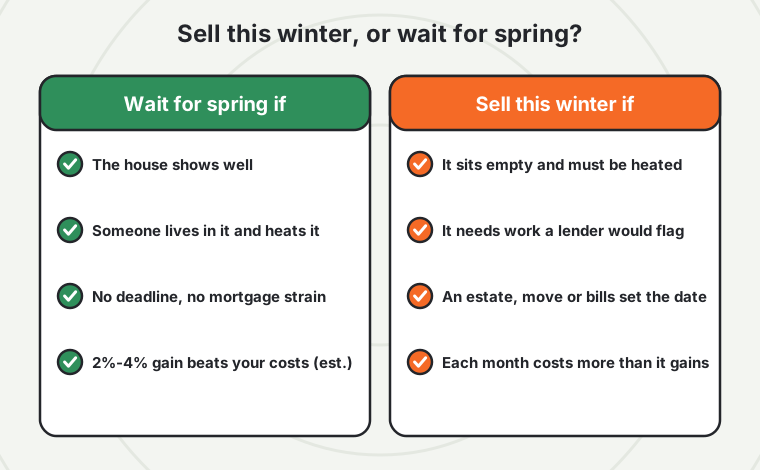
Do not sell for cash if your house is updated, you live there, and you can list in March or April. Do not sell for cash if you are behind on the mortgage and have not yet talked to a HUD-approved housing counselor or looked at the court’s foreclosure mediation program; those may save the house. Do not sign with anyone who asks for an upfront fee or wants your deed before closing. Our guide to we-buy-houses scams and red flags lists the warning signs.
Selling for cash in winter is also not an all-or-nothing choice. You can list in the spring and keep a written cash offer as a backup. If the listing stalls, you already know your floor and how fast it can close.
Is a cash sale right for you, or should you list?
Seven quick questions. There is no wrong answer, and we will tell you honestly if listing would leave you more.
- Does the house need repairs you would rather not pay for or manage?
- Do you need to close by a certain date, or within the next month or two?
- Would showings be hard: tenants, belongings, privacy, or you live out of state?
- Is there a complication: an estate or probate, a divorce, foreclosure, liens or back taxes?
- Could you comfortably cover the mortgage, taxes and utilities for three or more months?
- Is getting the highest possible price more important to you than speed and certainty?
- Would a buyer's bank lend on the house as it is (no major roof, foundation, oil tank or code issues)?
How do you check a cash buyer before a winter closing?
You check a cash buyer before a winter closing the same way at any time of year: confirm the company is registered with the Connecticut Secretary of the State, ask for proof of funds, insist that a Connecticut attorney handles the closing, pay no fees, and read the contract for assignment clauses and long inspection periods that let the buyer walk away. A real buyer will close on the date in the contract.
- The company name matches a business registered in Connecticut.
- Proof of funds, or a lender letter for a cash-equivalent loan, before you sign.
- A Connecticut attorney for you and for the buyer; no “we handle everything” closings at a kitchen table.
- No application fee, no “processing” fee, no request for your deed before closing.
- A firm closing date and a short or no inspection period.
- If the contract says “and/or assigns”, ask whether the buyer is buying the house itself or selling the contract to someone else.
More detail is in our guide to how to check a cash home buyer in Connecticut. We buy houses ourselves and close through Connecticut attorneys.
How do you sell your house for cash in winter, step by step?
You sell your house for cash in winter in six steps: protect the house, gather what you know about it, get one or two written cash offers, compare them with your listing net, pick a closing date that fits the holidays and your taxes, and close through Connecticut attorneys. About two weeks from first call to closing is typical, and you can choose later.
Protect the house first
Heat on, oil or gas account secure, a temperature alarm, a plow service, and a call to your insurer about vacancy.
Gather what you know
The deed, your mortgage statement, roof and heating records, and any known problems. You do not need to fix anything.
Get written offers
Ask for a written number with a closing date, and for enough time to compare it. One walk-through should be enough.
Compare with your listing net
Work out the break-even number above. If the cash offer is below it and you can wait, list in spring.
Pick the closing date
Before or after January 1, after probate approval if it is an estate, or after your move. You choose.
Close through attorneys
Sign the deed, pay the conveyance tax from the proceeds, get credited for the oil in the tank, and hand over the keys.
Get your cash offer
without anyone coming over.
Want your offer faster, or rather not talk to anyone yet? Send a few phone photos of each room. We price the repairs from them, line by line, and send your cash offer back, so you see a real number before you ever meet us or pick up the phone.
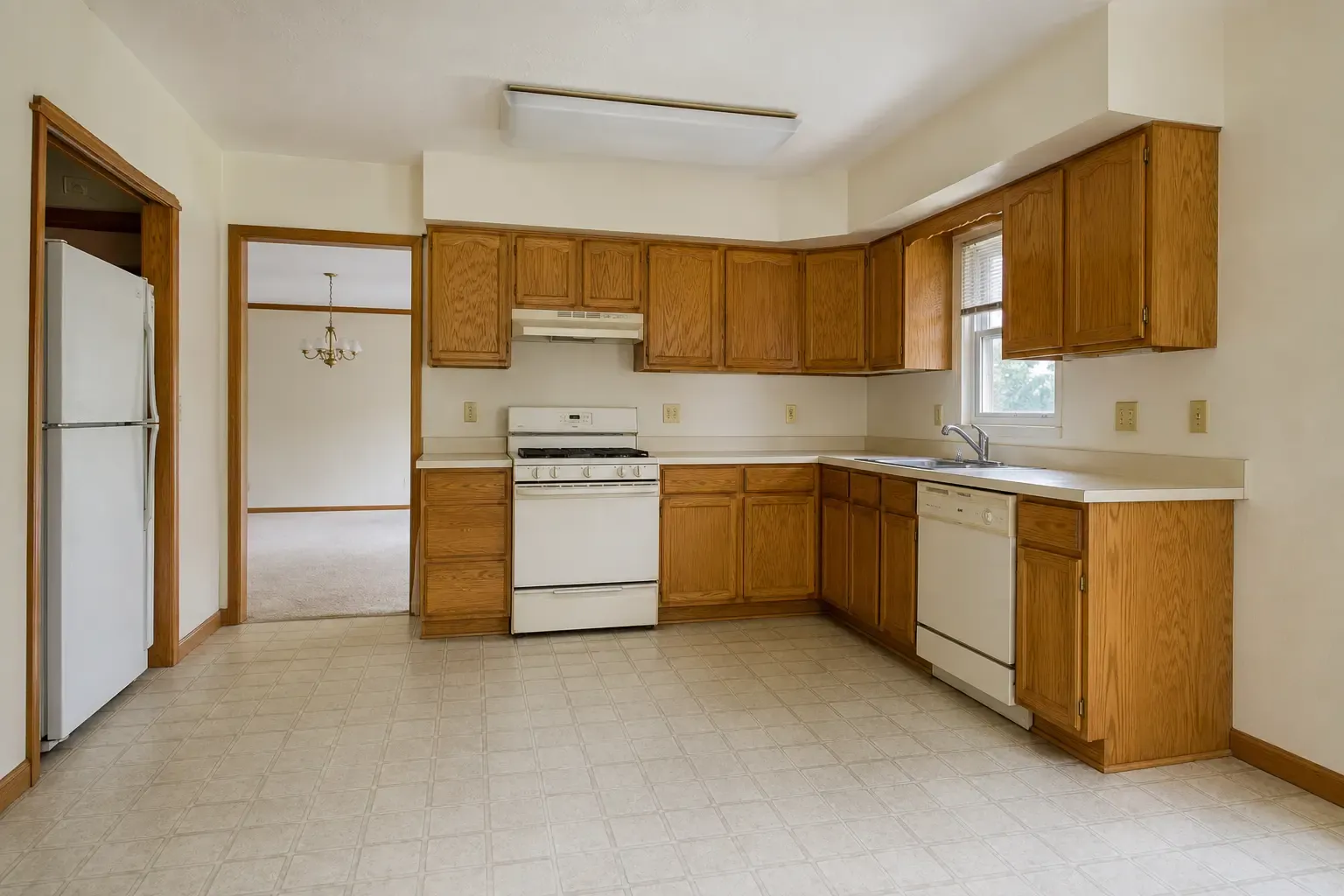 CabinetsFlooring
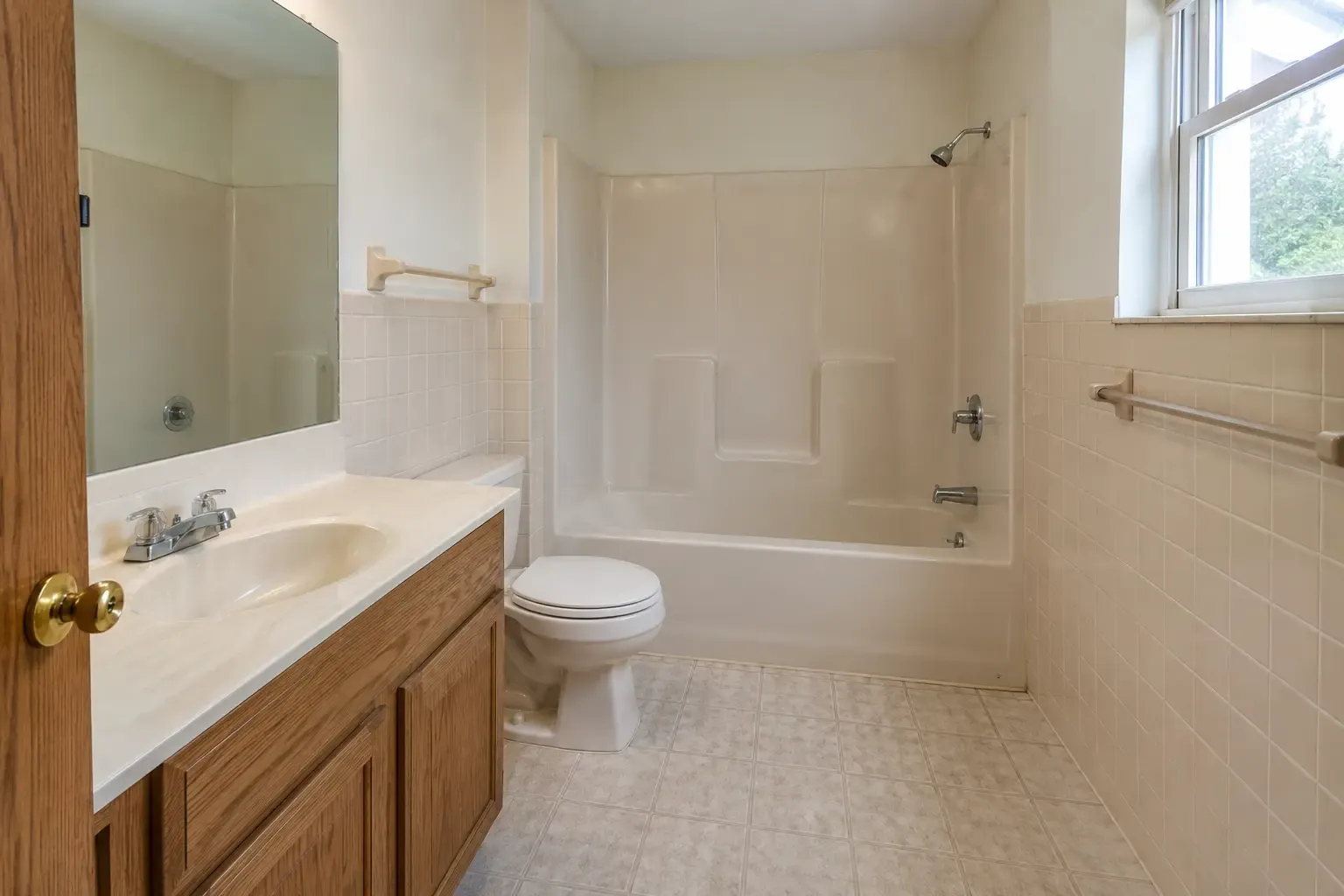 Tub & tile
 Floors
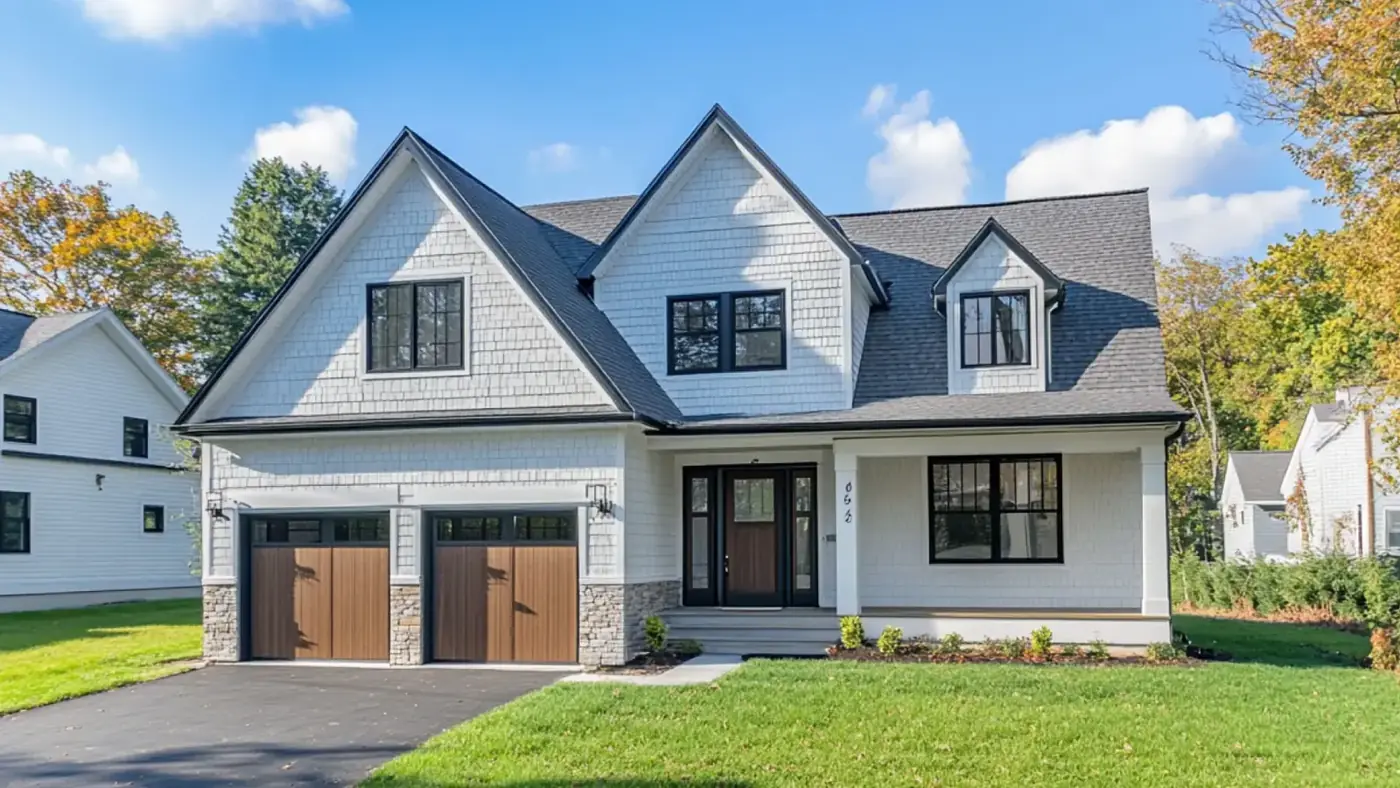 Roof
We may bring in a partner buyer to close. Your price and terms don't change.
We buy houses in every part of the state; see where we buy houses in Connecticut.
Questions about selling a house for cash in winter in Connecticut
Do cash buyers buy houses in the winter in Connecticut?
Cash buyers do buy houses in the winter in Connecticut, because their timing is not tied to school years or mortgage underwriting. Snow does not stop a walk-through, and with no lender there is no appraisal to schedule. About two weeks from first call to closing is typical.
Do cash buyers pay less in winter?
Cash buyers do not usually pay much less in winter than in summer, because their offer is built from repair costs, holding costs and resale value, not from the month. Winter mainly changes the listing side: fewer buyers and slower sales.
How fast can I close a cash sale in December?
You can close a cash sale in December in about two weeks if the title is clear and no probate approval is needed. Book the closing before December 24 if you need it done this year, because the holiday weeks have fewer working days for attorneys and town clerks.
Do I need to keep the heat on until a cash closing?
You need to keep the heat on until a cash closing, because the house is yours until the deed is signed. A burst pipe before closing is your loss and can change the deal. Keep the tank above a quarter or the gas account current.
Who gets the heating oil left in the tank when I sell?
The heating oil left in the tank stays with the house when you sell, and by Connecticut custom the buyer reimburses you for it at closing, at the current price per gallon. Your attorney adds the credit to the settlement statement.
Can I sell an inherited house for cash in winter during probate?
You can sign a contract to sell an inherited house for cash in winter during probate, and close once the probate court approves the sale under CGS 45a-164. A cash buyer can wait for the court’s order without a lender’s rate lock running out.
Do I have to fix the furnace or roof before a winter cash sale?
You do not have to fix the furnace or roof before a winter cash sale. A cash buyer prices the repair into the offer. You still must disclose problems you know about on the property condition report or give the buyer the $500 credit.
What does it cost to keep an empty house through a Connecticut winter?
Keeping an empty house through a Connecticut winter costs about $1,980 a month for a paid-off house at Southington’s median in our illustrative example, or $7,920 from December through March. Oil at $6.154 a gallon is the biggest variable; add mortgage interest if you have a loan.
Is it better to sell for cash now or list in the spring?
It is better to list in the spring if you live in the house, it is in good shape and you can wait. It is often better to sell for cash now if the house is empty, needs repairs a lender would flag, or a date is fixed. Compare a break-even number, not a feeling.
Are there fees when you sell to a cash buyer?
A legitimate cash buyer should not charge you fees to make an offer or buy your house. You still pay your own attorney, the conveyance tax, any mortgage payoff and the property tax for your days of ownership, as in any Connecticut sale.
Can I sell my house for cash in winter if I live out of state?
You can sell your house for cash in winter from out of state. The walk-through can happen with a neighbor, a relative or a lockbox, and attorneys can arrange for you to sign the deed with a notary where you live.
Will snow delay a cash home sale?
Snow rarely delays a cash home sale, because there is no lender’s appraisal or inspection deadline to meet. A storm may move the walk-through by a day. The closing date is set by the attorneys and by you.
Related Connecticut guides
Timing
For every route, step and cost in one place, see how to sell a house in Connecticut.
Plain-English information, not legal, tax or insurance advice. Estimates are labelled (est.).
Sources (checked on October 27, 2026)
- EIA, Weekly Connecticut No. 2 heating oil residential price (weeks of October 20, 2025 and October 19, 2026).
- Realtor.com median days on market, Connecticut (FRED MEDDAYONMARCT).
- Connecticut OPM, Real Estate Sales 2001-2024 GL, data.ct.gov dataset 5mzw-sjtu (queried October 2026).
- CGS 12-142 and 12-146 (tax installments; 18% interest on delinquent tax).
- CGS 12-62a (assessment at 70% of value).
- CGS 12-494 (conveyance tax).
- CGS 20-327b and 20-327c (property condition report; $500 credit).
- CGS 29-453 (smoke and carbon monoxide affidavit; as amended by PA 23-164).
- CGS 45a-164 (probate court approval of a fiduciary’s sale of real property).
- Connecticut OPM, mill rates (Southington fiscal 2027).
- EPA, Lead-based paint disclosure for home sales.
- Connecticut Judicial Branch, Foreclosure mediation.
- Connecticut Insurance Department.

Who wrote this
Jerryll Noorden
Jerryll has bought and sold Connecticut houses since 2016 and has sat at more closing tables than he can count, on both sides. Before real estate he was a robotics scientist at NASA, IHMC and IIT. He wrote this guide because the national sites that rank for it skip the Connecticut rules that cost sellers money. When listing or selling it yourself would get you more than a cash offer, he says so.
This guide explains Connecticut rules in plain English. It is not legal or tax advice. Laws change; for your sale, talk to a Connecticut real estate attorney and a tax professional.
