
Key facts at a glance
| Fact | Number | Source |
|---|---|---|
| Homes sold in Norwich, Oct 2024 to Sep 2025 | 712, median $261,000 | CT OPM real estate sales, data.ct.gov |
| Median single-family sale | $273,220 | CT OPM real estate sales, data.ct.gov |
| Middle half of Norwich residential sales | $190,000 to $325,000 | CT OPM real estate sales (our calculation) |
| Conveyance tax on a normal Norwich sale | 1.25% (0.75% state + 0.50% city): $3,415 on $273,220 | CGS 12-494 |
| Conveyance tax on a qualifying short sale of your home | $0, when the price cannot pay the mortgages and priority town liens | CGS 12-498(a)(20) |
| Court for a Norwich foreclosure | New London Judicial District, at Norwich (1 Courthouse Square) or New London, as the lender elects | CGS 51-344(9), 51-346(a)(9); jud.ct.gov |
| Mill rate, fiscal 2027 | 34.15 (about $6,530 a year on a $273,220 house, est.) | CT OPM mill rates, data.ct.gov |
A short sale is a sale of your house for less than you owe, with your lender’s written agreement to accept the smaller amount. In Norwich, where the typical home sells for $261,000, it is the route for owners who are underwater: selling would not pay the mortgage. This guide covers when a short sale fits on Norwich prices, the underwater math, the lender approval steps and how long they take, the conveyance tax exemption, and how it works with a foreclosure case in the New London Judicial District. For the broader comparison, see our short sale vs. foreclosure guide and our guide on how to sell a house in Connecticut.
What is a short sale in Norwich, CT, and when does it fit?
A short sale in Norwich, CT is a sale where the price, after selling costs, is not enough to pay off your mortgage, so your lender agrees in writing to accept less. It fits when you owe more than about 94% of what the house will sell for, minus a few thousand dollars of costs (est.), cannot keep paying, and want to avoid a foreclosure. It needs every lienholder’s approval.
Maybe you bought near the top, or took a home equity line for a roof or a car, and then the job at the casino or the base changed. Maybe the house is a two-family off Laurel Hill or near downtown that needs more than it is worth. Owners in this spot tell us they feel stuck, embarrassed that they owe more than the house is worth, afraid the bank will still come after them, skeptical that a lender will ever say yes, and exhausted by paperwork that seems to go nowhere.
A short sale is slower and more paper-heavy than a normal sale, but lenders approve them because they often lose less than in a foreclosure. This page is for you if the numbers do not work and you want to know whether a short sale can.
Call the Connecticut Department of Banking foreclosure hotline at 1-877-472-8313, or a HUD-approved housing counselor at 1-800-569-4287; a counselor can help you prepare the lender’s hardship package for free. Statewide Legal Services of Connecticut is at 1-800-453-3320. If you have been served with a foreclosure, the court’s free mediation program (CGS 49-31l) can be the place to raise a short sale. In Connecticut, anyone who charges a fee to negotiate a short sale for you needs a Department of Banking license unless they are your attorney (CGS 36a-671).
If a loan modification or forbearance can keep you in the house, try that first. If you have equity, you do not need a short sale at all; a normal sale before foreclosure works. Our page on selling a house before foreclosure in Connecticut explains that route.
How do you know if you are underwater on Norwich prices?
You know you are underwater on Norwich prices when the realistic sale price, minus about 5% commission, the 1.25% conveyance tax and a few thousand dollars of closing costs (est.), is less than the total of every mortgage and lien on the house. At the Norwich single-family median of $273,220, that line falls at about $253,100 of debt (est.).
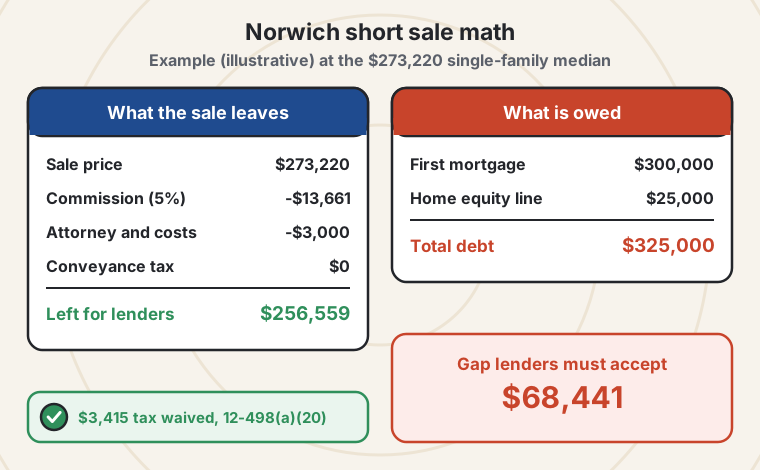
Example (illustrative). A Norwich Ranch worth about the single-family median of $273,220. The owner owes $300,000 on the first mortgage, including missed payments and fees, and $25,000 on a home equity line.
| Line | Amount |
|---|---|
| Sale price | $273,220 |
| Commission (5%, est.) | -$13,661 |
| Your attorney (est.) | -$1,500 |
| Other closing costs and tax proration (est.) | -$1,500 |
| Conveyance tax (normally $3,415.25) | $0, exempt under CGS 12-498(a)(20) |
| Left for the lenders | $256,559 |
| Paid to the home equity line for its release (illustrative) | -$3,000 |
| Paid to the first mortgage | $253,559 |
| First mortgage shortfall | $46,441 |
| Home equity line shortfall | $22,000 |
Both lenders must agree to accept less: $253,559 for a $300,000 first mortgage, and $3,000 to release a $25,000 line. If either says no, the sale cannot close as written.
The gray zone. Some sellers owe a bit less than the price but still cannot cover commission and costs. Say you owe $265,000 on a $273,220 sale: the price covers the mortgage, so the conveyance tax exemption does not apply and you would owe the $3,415 tax, yet after commission there is still not enough to pay everything. That is still a short sale (the lender has to agree to take less), just without the tax break. Your attorney can tell you which side of the line you are on.
Run your own numbers, with your real payoffs:
How much would you walk away with?
Slide the numbers to match your house. It works in your browser; nothing is saved or sent.
Estimates for planning. Conveyance tax per CGS 12-494 (state 0.75% up to $800,000, 1.25% to $2.5M, 2.25% above, plus the town rate). Seller attorney about $1,200 to $1,500; flat-fee MLS about $400; listings include three months of taxes, insurance and utilities, a cash sale about two weeks. Your attorney gives you the final numbers.
At which Norwich price levels does a short sale usually fit?
A short sale usually fits at Norwich price levels when your debt is above about 94% of the likely price minus $3,000 (est.): roughly $175,100 of debt on a $190,000 house, $241,700 on a $261,000 house, and $301,700 on a $325,000 house. Those three prices are the lower quartile, median and upper quartile of Norwich residential sales in the year to September 2025.
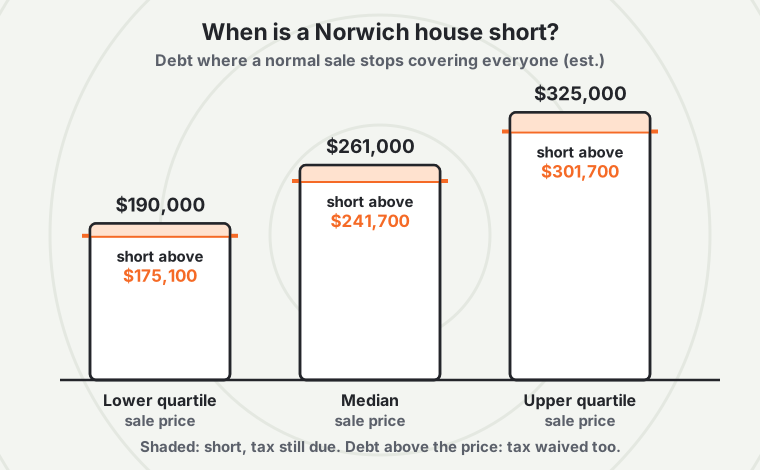
Norwich’s housing stock shapes this: about 64% of single-family homes were built before 1960 and 37% before 1940, and about one in five residential sales is a two- to four-family. Older houses needing work fetch less from buyers with mortgages, which pushes more owners toward the line. Use today’s realistic as-is price, not the assessment.
How to estimate your own:
- Get a written broker price opinion or comparative market analysis from a local agent, as is.
- Add up every payoff: the first mortgage, any home equity line or second mortgage, judgment liens, and unpaid Norwich taxes or utility charges.
- Multiply the price by 0.9375 (5% commission plus 1.25% conveyance tax, est.) and subtract about $3,000. If your debt is higher, you are short.
What are the lender approval steps for a short sale, and how long do they take?
The lender approval steps for a short sale are: ask the servicer for its short sale package, list or find a buyer, sign a contract subject to approval, submit the contract with your hardship file, let the lender value the house, negotiate with every lienholder, and close by the deadline in the approval letter. It commonly takes about 30 to 120 days (est.), depending on the lender and the number of liens.
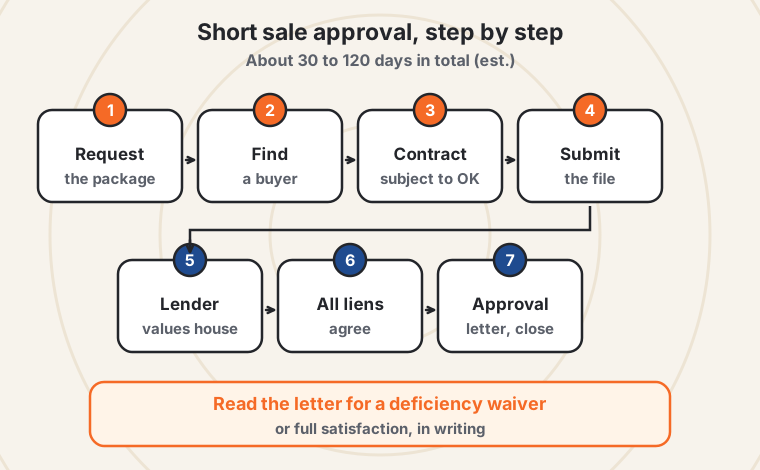
- Ask for the package. The servicer’s loss mitigation department sends its application: hardship letter, income and expenses, tax returns, pay stubs, bank statements. A HUD-approved counselor can help for free.
- Find a buyer. List at real market value with an agent who has closed short sales, or get a written cash offer.
- Sign subject to approval. Many lenders also want an arm’s-length affidavit (the buyer is not a relative or partner).
- Submit the file. Contract, estimated closing statement and hardship file. Incomplete files are the main cause of delay.
- Lender values the house. An appraisal or broker price opinion; a low offer against a high value brings a counteroffer.
- Every lienholder agrees. The first lender sets what a second mortgage or line may get; the junior lender must agree to release for it.
- Approval letter and closing. The letter states the net the lender accepts, the closing deadline and what happens to the rest of the debt.
Read the approval letter for one sentence. Look for wording that the payment is accepted in full satisfaction of the debt, or that the lender waives any deficiency. Connecticut lenders can pursue a deficiency, and a short sale does not erase the unpaid balance unless the lender agrees in writing. If the letter says the balance remains due, or offers a promissory note, talk to your attorney before you sign.
How does a short sale work when a Norwich foreclosure has already been filed?
A short sale works during a Norwich foreclosure the same way, but against the court’s calendar: the case is in the New London Judicial District, and you must close before your Law Day or get it extended. Tell the lender’s attorney a short sale is in process, use the court’s mediation program if you are eligible, and have your attorney ask for more time with the contract and the approval status attached (CGS 49-15, 49-31l).
Norwich foreclosures are filed in the New London Judicial District, and the lender chooses whether the case is returnable to the courthouse at Norwich (1 Courthouse Square) or at New London (CGS 51-346(a)(9)). Your summons shows which. The court timeline is set out in our guide to the first 15 days after a foreclosure summons and our guide to Law Day.
- Mediation. During the court’s mediation period, a short sale can be discussed with the lender in front of a court mediator. Ask for mediation within the deadline on your summons.
- Before and after judgment. Lenders often hold off while a contract is under review (get that in writing); after judgment, your attorney can move to extend Law Day with the contract attached, granted before Law Day.
- A Connecticut-only option. Connecticut law also lets an underwater owner and the lender sign a transfer agreement and ask the court for a “judgment of loss mitigation” approving a sale to a third party, which can deal with junior liens that are parties to the case. It needs both sides’ written consent and is not commonly used; ask your attorney if a second lienholder is the obstacle (CGS 49-30p, 49-30s, 49-30u).
Do you pay the 1.25% Norwich conveyance tax on a short sale?
You do not pay the 1.25% Norwich conveyance tax on a short sale of your principal residence when the price is not enough to pay the mortgages on the house plus any town taxes and charges that have priority over them (CGS 12-498(a)(20)). On a $273,220 sale that saves $3,415.25: $2,049.15 state and $1,366.10 city.
Three conditions must all be true: it is your principal residence; the deed transfers it; and the gross price is less than the mortgages plus priority municipal liens. A rental property or a second home does not qualify under this line. Your closing attorney claims the exemption on the conveyance tax return. The same chapter exempts a deed in lieu of foreclosure of your principal residence (CGS 12-498(a)(19)); our deed in lieu guide covers that route.
Income tax is a separate question. Forgiven mortgage debt is generally reported to you on a Form 1099-C and can be taxable income unless an exclusion applies, such as insolvency. The federal exclusion for forgiven debt on a main home covered discharges before January 1, 2026, so check its current status with a tax preparer. Our guide to taxes when selling a house in Connecticut has more.
How does a short sale benefit you compared with a foreclosure?
A short sale benefits you compared with a foreclosure by ending the mortgage with a negotiated sale instead of a court judgment, often with a written deficiency waiver, by saving the conveyance tax on your home, by letting you choose a moving date, and usually by shortening the wait for a future mortgage. It does not keep equity, because there is none, and it takes more paperwork and time.
Short sale
Negotiated- You pick the buyer and the moving date
- Deficiency can be waived in writing
- Conveyance tax waived on your home (12-498(a)(20))
- Needs every lienholder’s approval; 30 to 120 days (est.)
Strict foreclosure
Court-ordered- Title passes on Law Day
- Lender can move for a deficiency within 30 days (CGS 49-14)
- Removal by a state marshal (CGS 49-22)
- Longer waiting periods for a new mortgage
The credit and mortgage-waiting differences are laid out with sources in our consequences of foreclosure guide; we do not repeat them here.
When should you NOT do a short sale, or sell to a cash buyer?
You should not do a short sale if you have equity, because a normal sale keeps it; if a modification or forbearance would keep you in the house; or if the lender will not waive the deficiency and you would be better off with another option your attorney recommends. You should not sell to a cash buyer if a listing at full market value is what your lender needs to approve.
Lenders approve the offer that nets them the most, so an open-market listing is often the best short sale route; a cash offer works when the house needs work a financed buyer’s lender would reject. If listing is the better path for you, we will say so. If you owe less than the price after costs, you do not need a short sale; see our guide to selling during an open foreclosure and, for the listing-or-cash question by weeks left, our Haddam guide. Already past Law Day? Our guide to what happens after Law Day covers the next steps.

The short sales that close are the ones with a complete file on day one. Before you call the lender, put the hardship letter, two years of tax returns, recent pay stubs and bank statements in one folder. Every missing page restarts somebody’s clock.
How do you start a short sale in Norwich, step by step?
To start a short sale in Norwich, get free counseling, add up every payoff, get an honest as-is price, ask your servicer for its short sale package, line up a buyer, and keep your attorney and the court calendar in the loop if a foreclosure is filed. Expect weeks to months for approval.
Talk to a counselor
A HUD-approved counselor or the Department of Banking hotline, free, to check whether a modification is possible.
Add up what you owe
Every mortgage, line and lien, plus unpaid Norwich taxes and utility charges.
Price it honestly
An as-is opinion from a local agent, or a written offer. For a no-obligation number, use our Norwich page; we never charge fees.
Open the file with the lender
Request the package, send it complete, and keep copies and dates of everything.
Protect the calendar
If a foreclosure is filed, your attorney keeps the lender’s attorney and the court informed and moves to extend Law Day if needed.
Frequently asked questions
What is a short sale in Norwich, CT?
A short sale in Norwich, CT is a sale for less than what is owed on the mortgages, approved in writing by each lender, who agrees to take the sale proceeds instead of the full balance.
How long does a short sale take in Connecticut?
A short sale in Connecticut commonly takes about 30 to 120 days from a signed contract to closing (est.), mostly for the lender’s review and valuation. A complete file and a single lender shorten it.
Do I pay conveyance tax on a short sale in Norwich?
You do not pay conveyance tax on a short sale of your principal residence in Norwich when the price is less than the mortgages plus priority town liens (CGS 12-498(a)(20)). Otherwise the 1.25% applies.
Can the bank still sue me after a short sale in Connecticut?
The bank can still pursue the unpaid balance after a short sale in Connecticut unless it agrees in writing to accept the sale in full satisfaction or to waive the deficiency. Read the approval letter before closing.
Which court handles a Norwich foreclosure?
A Norwich foreclosure is handled by the Superior Court for the New London Judicial District, at the Norwich courthouse at 1 Courthouse Square or at New London, as the lender elects (CGS 51-346).
What happens to a second mortgage in a short sale?
In a short sale, a second mortgage or home equity line must agree to release its lien, usually for a small payment the first lender allows. Ask the second lender for its own written deficiency waiver.
Is a short sale taxable?
A short sale can create taxable canceled debt, reported on Form 1099-C, unless an exclusion such as insolvency applies. Check the current federal rules with a tax preparer.
Can a cash buyer do a short sale?
Yes, a cash buyer can do a short sale; the lender reviews a cash offer like any other, against its own valuation. A cash buyer can help when the house needs work that a financed buyer’s lender would reject.
Do I need a short sale if I owe less than my house is worth?
No, you do not need a short sale if the price will pay off everything you owe plus selling costs. A normal sale before foreclosure lets you keep the difference.
Related guides
The foreclosure case
Other ways out
For the full selling process, see how to sell a house in Connecticut, and for how a sale before foreclosure works with us, our foreclosure sale page. To talk through your numbers, call me, Jerryll Noorden, at (203) 529-4712. I have bought Connecticut houses since 2016, about ten a year.
Plain-English information, not legal or tax advice. Talk to a Connecticut attorney and a tax preparer about your own sale.
Sources (checked on October 27, 2026)
- CGS 12-494 and 12-498 (conveyance tax rates; exemptions (a)(19) and (a)(20)).
- CGS chapter 846: 49-14 (deficiency), 49-15 (opening judgments), 49-22 (ejectment), 49-30p to 49-30w (underwater mortgages and judgments of loss mitigation), 49-31l (mediation).
- CGS 51-344 and 51-346 (judicial districts and court locations) and Judicial District at Norwich location.
- CGS 36a-671 (licensing of debt negotiation, including short sales).
- CT Department of Banking: avoiding foreclosure and Judicial Branch foreclosure resources.
- IRS Form 982 and IRS Publication 4681 (canceled debt).
- CT OPM Real Estate Sales (Norwich, Oct 2024 to Sep 2025) and OPM mill rates, fiscal 2027.
See the house together.
Pick a time that works.
Choose a time for us to walk through the property with you, or ask for a quick call first. We confirm every request personally.
Tuesday, January 13
No open times in the next few weeks. Please call us.
We will confirm by email. Nothing is booked until we do.
View my request
Who wrote this
Jerryll Noorden
Jerryll has bought and sold Connecticut houses since 2016 and has sat at more closing tables than he can count, on both sides. Before real estate he was a robotics scientist at NASA, IHMC and IIT. He wrote this guide because the national sites that rank for it skip the Connecticut rules that cost sellers money. When listing or selling it yourself would get you more than a cash offer, he says so.
This guide explains Connecticut rules in plain English. It is not legal or tax advice. Laws change; for your sale, talk to a Connecticut real estate attorney and a tax professional.
