
Key facts at a glance
| Fact | Number | Source |
|---|---|---|
| Homes sold in Manchester, Oct 2024 to Sep 2025 | 724, median $315,000 | CT OPM real estate sales, data.ct.gov |
| Median single-family sale | $320,500 | CT OPM real estate sales, data.ct.gov |
| Mill rate, fiscal 2027 | 41.0 (about $9,200 a year on a $320,500 house, est.) | CT OPM mill rates, data.ct.gov |
| Conveyance tax the seller pays | 1.00% (0.75% state + 0.25% town) | CGS 12-494 |
| Court that hears a Manchester foreclosure | Hartford Judicial District, 95 Washington Street, Hartford | CGS 51-344(4), 51-346(a)(4); jud.ct.gov |
| Time the lender has to give a written payoff | The date you ask for, if at least 7 business days after it gets your written request | CGS 49-10a |
| Last day you can sell or redeem | Your Law Day; after title becomes absolute, the judgment cannot be opened except by narrow agreement | CGS 49-15 |
You can sell a Manchester house while a foreclosure is open, right up until your Law Day. The hard part is not whether you may sell; it is the mechanics: getting the real payoff number, paying the lender’s attorney’s fees and costs, closing in time, and making sure the case is withdrawn afterward. This guide walks through each step with Manchester numbers. For the whole selling process outside foreclosure, start with our guide on how to sell a house in Connecticut; for every way to stop a foreclosure, see our Connecticut foreclosure guide.
Can you still sell your Manchester house once the foreclosure has started?
Yes, you can still sell your Manchester house after the foreclosure has started. Until your Law Day passes you own it, so you can sign a contract and close. At closing the lender’s payoff is paid from the price, other liens are paid in order, the lender withdraws the case, and the rest is yours (CGS 49-15, 49-10a). The sale must close before Law Day, or the court must move Law Day first.
Maybe the summons arrived months ago and you have been hoping the mediation would fix it. Maybe the judgment just entered at the courthouse on Washington Street in Hartford and you have a date on a piece of paper that feels like a countdown. People in this spot tell us they feel ashamed that it got this far, trapped between the lender and the calendar, confused by numbers that keep changing, suspicious of every letter offering to “save” the house, and worn out from carrying it alone.
None of that means you did something wrong. Foreclosure in Connecticut is a court case with rules, and the rules leave you a real window. This page is for you if you want to sell before Law Day and need to know how the money and paperwork work.
Call the Connecticut Department of Banking foreclosure hotline at 1-877-472-8313, or a HUD-approved housing counselor at 1-800-569-4287. Statewide Legal Services of Connecticut is at 1-800-453-3320, and the Connecticut Fair Housing Center offers foreclosure advice at 1-888-247-4401. If your case is new, the court’s free foreclosure mediation program may still be open to you (CGS 49-31l); forms are on jud.ct.gov. None of these should charge you. Paid foreclosure or short sale negotiation in Connecticut requires a Department of Banking license unless your own attorney does it (CGS 36a-671).
If a modification or refinance will keep you in the house, do that. Selling makes sense when keeping it no longer adds up and there is equity to protect; our page on selling a house before foreclosure in Connecticut covers when.
What is the difference between the judgment amount and your payoff?
The judgment amount is the debt the court found due on the day it entered judgment; your payoff is what the lender needs on the day you close. The payoff is almost always higher, because interest keeps running every day after judgment and the lender adds later fees and costs. You get the exact payoff in writing by asking for it (CGS 49-10a).
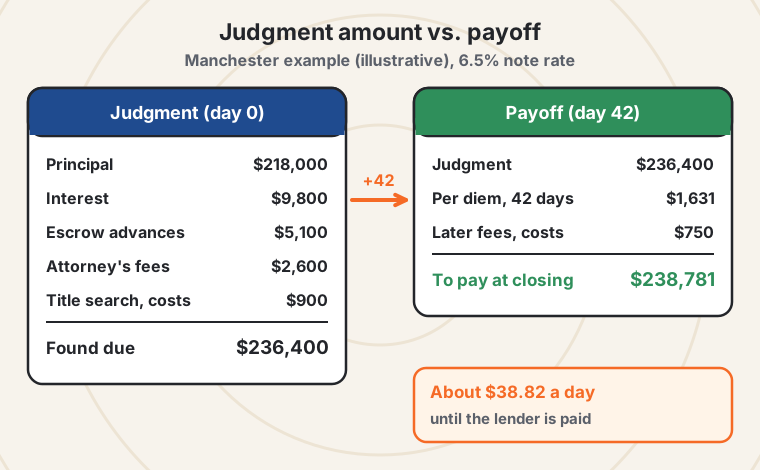
The judgment of strict foreclosure finds the debt on one day: principal, interest to date, escrow advances for taxes and insurance, and the costs and attorney’s fees the court allows. It is a snapshot.
From the next day, the debt keeps growing: per diem interest at the note rate, any Manchester tax bill or insurance premium the lender pays for you, and later fees for things like a payoff letter or a motion to extend Law Day.
How to get the real number. Your attorney sends a written request for a payoff statement, usually through the lender’s attorney (the “plaintiff’s attorney” on your papers). The lender must answer in writing by the date named, if that date is at least seven business days after it receives the request; if it is late, it loses interest that accrues after that date until it delivers (CGS 49-10a).
One when you sign, to confirm the sale works, and an update good through the closing date. Wire instructions are confirmed by phone, never by email alone.
What lender’s attorney’s fees and costs will you pay at closing?
At closing you pay the lender’s attorney’s fees and costs that the court allowed in the judgment, plus reasonable fees and costs the lender’s attorney adds after judgment. Connecticut lets the court award a reasonable attorney’s fee and a fee for the title search as part of a foreclosure judgment (CGS 52-249). All of it is paid from the sale price, not from your pocket, as long as the price covers it.
The foreclosure side of the payoff typically includes the attorney’s fee the court found reasonable, the title search fee (CGS 52-249), court costs such as the filing fee, the marshal’s service fee and any appraisal, and fees for work after judgment. Ask for an itemized breakdown. Every motion and every extra month adds to it, which is one more reason to move early; if a fee looks wrong, your attorney raises it with the lender’s attorney without moving the closing date.
Your own costs come on top: the 1.00% Manchester conveyance tax (CGS 12-494), your attorney, the tax proration and any commission; see the cost to sell a house in Connecticut.
How does the foreclosure case get withdrawn after you sell?
After you sell, the foreclosure case gets withdrawn because the lender has been paid in full. Your closing attorney wires the payoff to the lender’s attorney, the lender’s attorney files a withdrawal of the action with the court, and the mortgage and the lis pendens are released on the Manchester land records. The lender must deliver a release once the mortgage is satisfied (CGS 49-8).
This is the step sellers worry about least and should check most. After the payoff is wired, the lender’s attorney files the withdrawal in the Hartford Judicial District; check it on the Judicial Branch case lookup by docket number. The lender must deliver a release of the satisfied mortgage to the town clerk (CGS 49-8(a)), and if it does not, a written request by certified mail starts a 60-day deadline with damages for missing it (CGS 49-8(c)). The recorded lis pendens is released too (CGS 49-8(b)).
Because the lender is paid in full, there is no deficiency (CGS 49-14). What happens when a foreclosure runs its course is in our guide to the consequences of foreclosure in Connecticut.
Can you get Law Day extended for a pending sale?
You can ask the court to extend Law Day for a pending sale with a written motion to open the judgment and reset Law Day. The court may grant it for cause, but never after title has become absolute, and the motion has to be granted before Law Day; filing it does not move the date (CGS 49-15(a)(1)). A signed contract with a near closing date is the strongest cause you can show.
The motion itself, the timing rules and how appeals and bankruptcy affect Law Day are covered in depth in our guide to Law Day in Connecticut. For a sale, the practical checklist is short:
- A signed purchase contract with a closing date before the new Law Day you ask for.
- Proof the buyer can close: proof of funds, or a written mortgage commitment.
- A current payoff showing the price covers the debt.
- Ideally, the lender’s attorney’s agreement, so the motion is filed as agreed.
How long does a sale take from contract to closing in a Manchester foreclosure?
A sale during a Manchester foreclosure takes about two weeks from contract to closing with a cash buyer, once the payoff and title are in hand, and usually 30 to 60 days or more with a buyer who needs a mortgage (est.). The payoff request alone needs at least seven business days of notice (CGS 49-10a), so order it the day you sign.
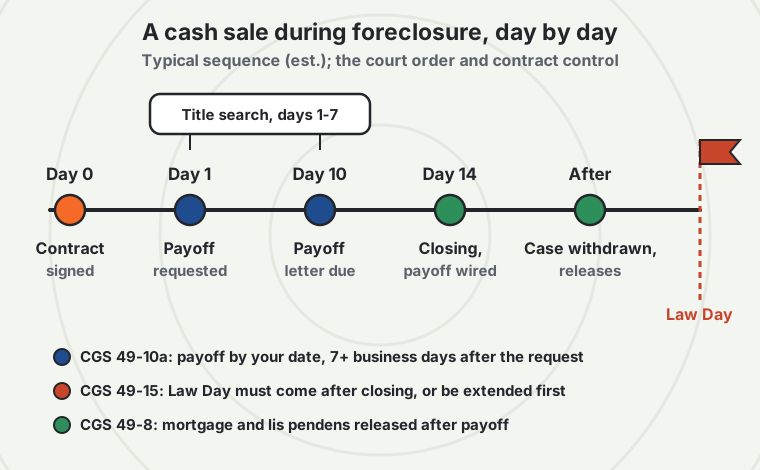
The buyer’s attorney searches title in the first week and will find the mortgage, the lis pendens and any second mortgage, judgment lien or unpaid Manchester taxes or sewer charges, all of which are paid at closing. With a financed buyer, add the appraisal and loan approval; that is where foreclosure sales usually fail, because Law Day arrives first. Our guide on how long it takes to sell a house in Connecticut has the stage-by-stage numbers.
How much would you keep? A Manchester example
How much you keep from a sale before Law Day is the price minus the payoff on the closing date and your selling costs. In the illustrative Manchester example below, a cash sale two weeks out keeps about $41,869, a listing at the town’s single-family median keeps about $51,211 if the court extends Law Day and the buyer’s loan holds, and a strict foreclosure keeps nothing.
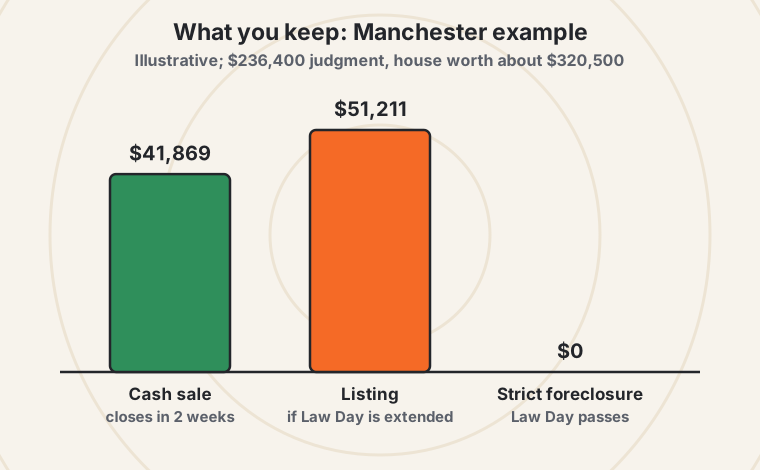
Example (illustrative). A Manchester Cape worth about the town’s single-family median of $320,500. The judgment, entered six weeks before the planned closing, found $236,400 due: $218,000 principal, $9,800 interest, $5,100 escrow advances for taxes and insurance, $2,600 attorney’s fees and $900 title search and costs. The note rate is 6.5%, so interest runs at about $38.82 a day.
| Line | Cash sale, closes in 2 weeks | Listing, closes in about 4 months |
|---|---|---|
| Price | $285,000 (illustrative offer) | $320,500 (single-family median) |
| Judgment amount | -$236,400 | -$236,400 |
| Per diem interest after judgment | -$1,631 (42 days) | -$4,659 (120 days) |
| Later fees and costs (est.) | -$750 | -$1,500 (incl. a motion to extend) |
| Commission (5%, est.) | $0 | -$16,025 |
| Conveyance tax, 1.00% | -$2,850 | -$3,205 |
| Your attorney (est.) | -$1,500 | -$1,500 |
| Repairs and prep (est.) | $0 | -$6,000 |
| You keep | $41,869 | $51,211, if Law Day is extended and the loan closes |
If Law Day passes with no sale, the owner keeps $0 of the roughly $84,000 gap between the median value and the judgment. The two sale routes differ by about $9,342; selling versus not selling differs by everything. Run your own numbers:
How much would you walk away with?
Slide the numbers to match your house. It works in your browser; nothing is saved or sent.
Estimates for planning. Conveyance tax per CGS 12-494 (state 0.75% up to $800,000, 1.25% to $2.5M, 2.25% above, plus the town rate). Seller attorney about $1,200 to $1,500; flat-fee MLS about $400; listings include three months of taxes, insurance and utilities, a cash sale about two weeks. Your attorney gives you the final numbers.
What can go wrong with a sale during foreclosure, and how do you protect it?
What can go wrong with a sale during foreclosure is mostly timing and liens: the buyer’s loan or appraisal fails, a second mortgage or judgment lien appears in the title search, or the payoff is higher than expected. You protect the sale by ordering the payoff and title search early, choosing a buyer who can close before Law Day, and keeping a backup plan.
- Junior liens. A second mortgage, judgment lien or unpaid town charges are paid at closing. If everything adds up to more than the price, it becomes a short sale needing each lender’s approval; see our short sale vs. foreclosure guide and our Norwich short sale guide.
- A failed buyer. If a loan is denied two weeks before Law Day, there may be no time for another buyer. Keep a written backup offer.
- Scams. A fee up front, a request to deed the house outside a closing, or a promise to “stop” the foreclosure for money are red flags; see our guide to we-buy-houses scams.

In foreclosure sales, the date that matters is not the closing date in the contract; it is the date the payoff letter is good through. Ask your attorney to line those two up the day you sign, and keep a copy of the court’s Law Day order next to the contract.
When should you NOT sell your Manchester house to a cash buyer?
You should not sell your Manchester house to a cash buyer if you can keep it through a modification, reinstatement or refinance, if you have three or more months before Law Day and a house that will pass a buyer’s appraisal, or if the cash offer does not leave you meaningfully more than a listing after the real costs. In those cases, keeping the house or listing it is usually better.
Manchester’s Capes, Colonials and Ranches (median year built 1953) often sell well to buyers with mortgages, and a listing can net more, as the example shows. A cash sale earns its discount when time is short, the house needs work a lender will flag, or you cannot carry it through a listing. If listing nets you more and you have time, we will tell you so. More in our cash buyer vs. realtor comparison.How do you sell a house in foreclosure in Manchester, step by step?
To sell a house in foreclosure in Manchester, get free advice first, find your Law Day and current payoff, choose a buyer who can close before Law Day, sign with your own Connecticut attorney, extend Law Day if the closing needs it, and close with the payoff wired to the lender. A cash sale typically closes in about two weeks.
Get free advice
The Department of Banking hotline or a HUD-approved counselor, so you do not give up a workable way to keep the house.
Know your dates and numbers
Find your Law Day on the judgment, and have your attorney request a written payoff (CGS 49-10a).
Compare offers in writing
A listing estimate and a cash offer, run against your real payoff. For a no-obligation number, use our Manchester page; no fees, and the offer does not expire while you compare.
Sign and protect the date
Sign a contract with a closing date before Law Day. If it lands after, your attorney files a motion to extend with the contract attached (CGS 49-15).
Close and confirm the withdrawal
The lender is paid in full; then confirm the withdrawal and the releases.
Frequently asked questions
Can I sell my house in foreclosure in Manchester, CT?
Yes, you can sell your house in foreclosure in Manchester, CT, up until your Law Day. The lender is paid at closing, the case is withdrawn, and you keep what is left.
Why is my payoff higher than the judgment amount?
Your payoff is higher than the judgment amount because interest keeps running every day after judgment, and the lender adds later advances, fees and costs. Ask for a written payoff good through your closing date (CGS 49-10a).
How long does the lender have to send a payoff statement?
The lender has to send a written payoff statement by the date you specify, as long as that date is at least seven business days after it receives your written request. If it is late, it loses interest that accrues after that date until it delivers the statement (CGS 49-10a).
Do I have to pay the bank’s attorney’s fees if I sell?
Yes, if you sell you pay the lender’s attorney’s fees and costs that are part of the payoff, out of the sale price. The court can award a reasonable attorney’s fee and a title search fee in the judgment (CGS 52-249).
Which court handles a Manchester foreclosure?
A Manchester foreclosure is handled by the Superior Court for the Hartford Judicial District, at 95 Washington Street in Hartford, because Manchester is one of the district’s towns (CGS 51-344).
Will the foreclosure be dismissed after I sell?
After you sell and the lender is paid in full, the lender’s attorney withdraws the foreclosure, and the mortgage and lis pendens are released on the Manchester land records (CGS 49-8). Confirm the withdrawal on the court’s case lookup.
Can the court move my Law Day so I can close?
The court can move your Law Day if your attorney files a motion to open and extend and the court grants it before Law Day passes (CGS 49-15). A signed contract with a near closing date is the strongest reason to give.
Will I owe anything after the sale?
If the sale pays the lender in full, you will not owe anything after the sale. If the price cannot pay everything, you need a short sale with the lenders’ written approval.
Related guides
The foreclosure case
Other foreclosure questions, town by town
For the full selling process, see how to sell a house in Connecticut. If you would like a written number to compare against your payoff, call me, Jerryll Noorden, at (203) 529-4712, or start on our Manchester page. I have bought Connecticut houses since 2016, about ten a year.
Plain-English information, not legal advice. Talk to a Connecticut attorney about your own case.
Sources (checked on October 27, 2026)
- CGS chapter 846: 49-8 (release of mortgage and lis pendens), 49-10a (payoff statements), 49-14 (deficiency), 49-15 (opening strict foreclosure judgments), 49-31l (mediation).
- CGS 52-249 (costs and attorney’s fees in foreclosure).
- CGS 51-344 and 51-346 (judicial districts and court locations).
- CGS 12-494 (conveyance tax).
- CGS 36a-671 (licensing of foreclosure consultants and short sale negotiators).
- Connecticut Judicial Branch foreclosure resources and Hartford Judicial District location.
- Connecticut Department of Banking (foreclosure assistance hotline).
- CT OPM Real Estate Sales (Manchester, Oct 2024 to Sep 2025) and OPM mill rates, fiscal 2027, data.ct.gov.
See the house together.
Pick a time that works.
Choose a time for us to walk through the property with you, or ask for a quick call first. We confirm every request personally.
Tuesday, January 13
No open times in the next few weeks. Please call us.
We will confirm by email. Nothing is booked until we do.
View my request
Who wrote this
Jerryll Noorden
Jerryll has bought and sold Connecticut houses since 2016 and has sat at more closing tables than he can count, on both sides. Before real estate he was a robotics scientist at NASA, IHMC and IIT. He wrote this guide because the national sites that rank for it skip the Connecticut rules that cost sellers money. When listing or selling it yourself would get you more than a cash offer, he says so.
This guide explains Connecticut rules in plain English. It is not legal or tax advice. Laws change; for your sale, talk to a Connecticut real estate attorney and a tax professional.
