
Key facts at a glance
| Fact | Number | Source |
|---|---|---|
| Hartford residential sales, Oct 2024 to Sep 2025 | 830, median $290,000 | CT OPM real estate sales, data.ct.gov |
| Of those, two- to four-family houses | 288 (about 35%); three-family median $410,000 | CT OPM real estate sales, data.ct.gov |
| Earliest a state marshal can remove you after serving the ejectment | 5 business days | CGS 49-22(a) |
| Belongings held in town storage before auction | 15 days, at the owner’s expense | CGS 49-22(c) |
| Notice to vacate a bona fide tenant must get after foreclosure | At least 90 days | CGS 49-31p; federal Protecting Tenants at Foreclosure Act |
| Lender’s deadline to ask for a deficiency judgment | 30 days after Law Day passes | CGS 49-14 |
| Courts | Foreclosure: Hartford Judicial District, 95 Washington St. Evictions: Housing Session at Hartford, 80 Washington St. | CGS 51-344, 47a-70; jud.ct.gov |
This guide is for the morning after: Law Day has passed, or is about to, on a Hartford house. It covers what happens next, in order: title, the state marshal, your belongings, money for staying, and what happens to tenants in the city’s many two- and three-families. It does not repeat the whole foreclosure process; for that, see our Connecticut foreclosure guide, and for selling in general our guide on how to sell a house in Connecticut.
What happens after foreclosure in Hartford, CT?
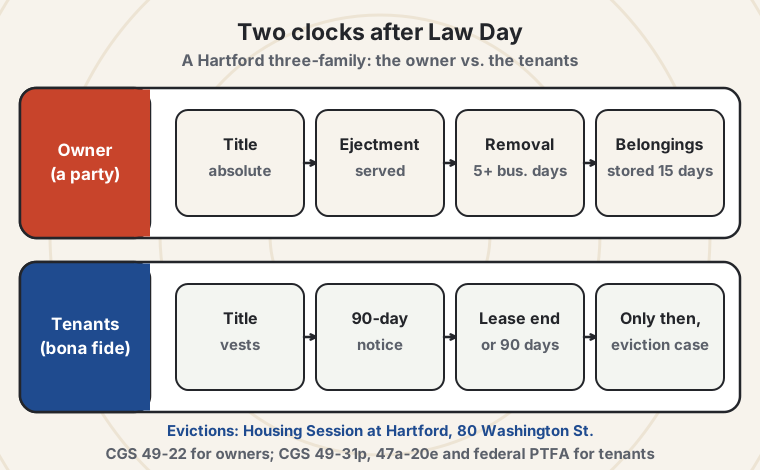
After foreclosure in Hartford, once Law Day passes without redemption, title becomes absolute in the lender, a certificate of foreclosure is recorded, and the lender can have a state marshal serve an execution of ejectment and remove anyone who was a party no fewer than five business days later (CGS 49-15, 49-16, 49-22). Bona fide tenants get separate protection, including at least 90 days’ notice (CGS 49-31p).
If you are reading this, you may have stopped opening the mail. You may be sitting in a three-family on Park Street or in the North End wondering whether a marshal will knock tomorrow, and what to tell the families upstairs. People in this place feel numb, ashamed in front of neighbors and tenants, scared of being put out with nowhere to go, angry at the bank or at themselves, and responsible for tenants who did nothing wrong.
The honest part first: after Law Day, the house is almost certainly gone. But there are still steps, deadlines and rights, for you and your tenants, and knowing them lets you move with dignity instead of in a rush. If your Law Day has not passed yet, jump to what to do if Law Day is still ahead.
Call Statewide Legal Services of Connecticut at 1-800-453-3320, or the Connecticut Fair Housing Center at 1-888-247-4401 for foreclosure and tenant advice. The Connecticut Department of Banking foreclosure hotline is 1-877-472-8313, and a HUD-approved housing counselor is at 1-800-569-4287. Tenants can use the Judicial Branch’s housing resources at jud.ct.gov. None should charge you. Be wary of anyone who asks for money to “undo” a foreclosure after Law Day; in almost every case it cannot be done.
When does title pass to the lender, and can anything still be undone?
Title passes to the lender when your Law Day ends without anyone redeeming, and in a strict foreclosure it then becomes absolute. After that, the judgment cannot be opened by a motion; the only exception is an agreement of every party who appeared, made within four months of the judgment or 30 days after title vested, whichever is later (CGS 49-15(a)(2)).
The lender’s attorney then records a certificate of foreclosure on the Hartford land records (CGS 49-16). A bankruptcy filed before title becomes absolute reopens the judgment automatically, but not one filed after (CGS 49-15(b)); appeals and the other edge cases are in our guide to Law Day in Connecticut. If you think something went wrong in your case, call a lawyer the same day.
How does ejectment work in Hartford, and when does the state marshal come?
Ejectment in Hartford works through an execution of ejectment issued by the Hartford Judicial District and carried out by a state marshal. The marshal serves the execution and can remove the people in possession no fewer than five business days after service. Before removal, the marshal must give the mayor’s office 24 hours’ notice, and use reasonable efforts to tell you the date at least five business days before that (CGS 49-22).
The key points in plain English:
- Who it covers. The execution runs against people who were parties to the foreclosure, usually the owners, and people bound by the lis pendens. It does not run against someone in possession who was not a party, which is why tenants are handled differently (CGS 49-22(a)).
- The notice to you. The marshal must try to tell you the date and time, warn that unclaimed belongings may be sold, and give a phone number for getting them back (CGS 49-22(b)).
- The day itself. After 24 hours’ notice to the mayor’s office, the marshal removes the occupants and takes belongings to the city’s designated storage (CGS 49-22).
Many lenders’ attorneys first contact the former owner about a move-out date, sometimes offering money to leave by a date (“cash for keys”). For a former owner that is a negotiation, not a right; get any deal in writing.
What happens to your belongings, and how do you get them back?
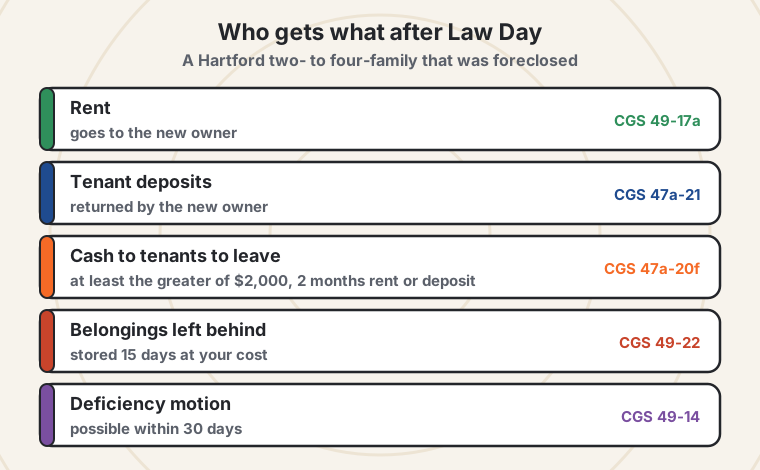
Your belongings, if they are still in the house on ejectment day, are taken by the state marshal to a storage place the city of Hartford designates, at your expense. If you do not reclaim them and pay the storage within 15 days, the city may sell them at public auction after posting notice for a week, and holds any net proceeds for you for 30 days (CGS 49-22(c)).
Storage is a safety net, not a plan. Move what matters before the marshal’s date:
- IDs, birth certificates, tax, insurance, medical and school records.
- Medicines, glasses, chargers and keys.
- Photos, heirlooms, pets and anything you cannot replace.
- Photos of each room and the meters on the day you leave.
If you cannot move everything, call the number on the marshal’s notice right away. The 15-day clock starts on ejectment day, not when you find out where your things went.
Do you owe use and occupancy or rent if you stay after Law Day?
If you stay after Law Day, you are living in a house you no longer own, and the new owner can ask to be paid for that time; in a court eviction, judges can order occupants to deposit use and occupancy payments while the case is pending (CGS 47a-26b). Just as important, if you are a landlord, rent from your tenants stops being yours: collecting it after Law Day with no right to it is treated as larceny (CGS 49-17a).
“Use and occupancy” is rent paid by someone in a property without a lease. Whether a lender pursues a former owner for it depends on the case, so ask a lawyer rather than assume; the safer course is a written move-out date you keep. For owner-landlords: up to Law Day the rent is yours, after it a former owner who keeps collecting faces the larceny penalties (CGS 49-17a).
What happens to tenants in a Hartford two- to four-family after foreclosure?
Tenants in a Hartford two- to four-family after foreclosure keep their homes for a while: the new owner takes the property subject to a bona fide tenant’s lease, must give at least 90 days’ written notice to vacate, and cannot use the foreclosure ejectment against them. A tenant with a lease can usually stay to the end of the term, unless the house is sold to someone who will live in it (CGS 49-31p; federal Protecting Tenants at Foreclosure Act).
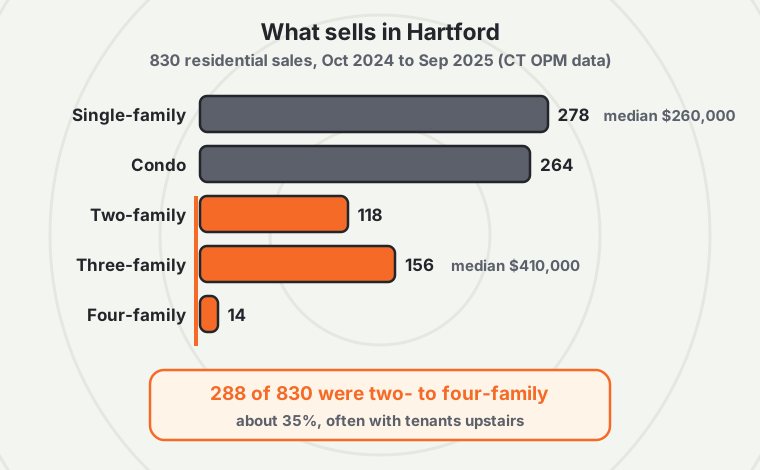
This matters in Hartford more than almost anywhere: 288 of the city’s 830 residential sales in the year to September 2025 were two- to four-family houses (CT OPM sales data). Behind many foreclosures are families renting the other floors. Their protections:
| Protection | What it means | Source |
|---|---|---|
| 90-day notice | The new owner must give a bona fide tenant at least 90 days’ notice to vacate | CGS 49-31p(a)(1); federal PTFA |
| Lease honored | A bona fide lease runs to its end, unless the unit is sold to a buyer who will live there (who must still give 90 days) | CGS 49-31p(a)(2) |
| No ejectment of tenants | The foreclosure execution against a bona fide tenant is stayed; a new eviction case must wait 30 or 60 days after title, depending on the lease | CGS 47a-20e, 49-22(a) |
| Section 8 tenants | The new owner takes the property subject to the lease and the housing assistance payments contract | CGS 49-31q(b) |
| Cash for keys floor | Any money offered to a tenant to leave must be at least the greater of the deposit plus interest owed, two months’ rent, or $2,000 | CGS 47a-20f |
| Security deposit | Whoever owns the building when the tenant moves out must return the deposit, even if it was paid to the old owner | CGS 47a-21; CT Department of Banking |
| Repairs and utilities | A lender that takes title becomes the landlord, with the same repair and utility duties | CGS 47a-7; CT Department of Banking |
If the new owner wants the units empty, it must use regular eviction (summary process), which for Hartford properties goes to the Housing Session at Hartford, 80 Washington Street, the court’s housing docket (CGS 47a-70; jud.ct.gov). Tenants should get advice from Statewide Legal Services before signing anything. For how tenants affect a sale, see selling a rental with tenants in Connecticut.
What should a Hartford owner-landlord do for tenants before and after Law Day?
A Hartford owner-landlord should, before Law Day, keep the building safe and running, keep collecting and recording rent, and gather the leases and security deposit records; after Law Day, stop collecting rent, tell tenants in writing who the new owner’s attorney is, and hand the lease and deposit records over. Rent after Law Day is not yours (CGS 49-17a).
A short, calm letter beats a notice taped to the door: the house was foreclosed, you are no longer the landlord after Law Day, their lease and deposit rights continue, and here is the new owner’s attorney. Keep a copy. Under CGS 47a-21 a “successor” includes one who takes by foreclosure, and the owner when the tenant leaves returns the deposit, so send the lender’s attorney a list of each unit’s deposit and date paid.
Can the lender still come after you for money after Law Day?
The lender can still come after you for money after Law Day if the house was worth less than the debt: it has 30 days after Law Day passes to move for a deficiency judgment, and the court then values the house and enters judgment for the difference, if any (CGS 49-14). If the house was worth more than the debt, there is no deficiency, but the extra value is lost to you.
Watch your mail and the case for 30 days; if a motion is filed, go to the valuation hearing, because the value the court sets decides the number. The credit, tax and future-mortgage effects of a completed foreclosure are laid out in our guide to the consequences of foreclosure in Connecticut.
What if your Law Day in Hartford has not passed yet?
If your Law Day in Hartford has not passed yet, you still own the house and still control the outcome: you can redeem, ask the court to extend Law Day for cause, or sell and keep the equity. With Hartford’s two- and three-family prices, that equity can be large; in the illustrative example below it is about $123,375 before interest, all of it lost if Law Day passes.
Example (illustrative). A Hartford three-family worth the city’s three-family median of $410,000, with a $280,000 judgment. Sold before Law Day: the 1.25% Hartford conveyance tax is $5,125 (0.75% state plus 0.50% city, CGS 12-494) and the seller’s attorney is about $1,500 (est.), so about $123,375 is left before per diem interest and any later fees. After Law Day: $0. Tenants can stay in place through a sale; a buyer of an occupied building takes over the leases and deposits.
Waiting costs money too: Hartford assesses one- to three-family homes at 36.75% of value, so at the fiscal 2027 mill rate of 69.95 a $410,000 three-family pays about $10,540 a year in tax (est.).
The mechanics of selling during an open case are in our Manchester guide to selling in foreclosure, listing versus cash by weeks left is in our Haddam guide, and if you owe more than the house is worth, see short sales. Our page on selling a house before foreclosure in Connecticut explains how a sale works.
When you should NOT sell to a cash buyer: if a modification or reinstatement will keep you in the house, or if you have months before Law Day and the building would sell well on the open market. A cash sale fits when the clock is short, the building needs work or has difficult tenancies. If listing nets you more and you have time, we will say so.
What should you do in the first week after Law Day in Hartford?
In the first week after Law Day in Hartford, confirm on the court’s website that title has passed, call legal aid, contact the lender’s attorney to agree a move-out date in writing, move your important belongings, tell your tenants where things stand, and watch for a deficiency motion within 30 days. Acting early keeps the marshal’s visit from being the first conversation.
Confirm where the case stands
Look up the case on the Judicial Branch website by docket number and check whether title has vested or anything is still pending.
Get free legal advice
Statewide Legal Services (1-800-453-3320) or the Connecticut Fair Housing Center (1-888-247-4401), today, not after the marshal comes.
Agree a date in writing
Call the lender’s attorney named on your papers about a move-out date and any cash for keys; get it in writing.
Move what matters
Documents, medicines, photos, pets, then furniture; forward your mail.
Tell your tenants
A short written note with the new owner’s attorney’s name, and the lease and deposit list sent to that attorney. Stop collecting rent.
Watch for 30 days
Check your mail and the case for a deficiency motion (CGS 49-14), and go to the hearing if one is filed.
Frequently asked questions
What happens after foreclosure in Hartford, CT?
After foreclosure in Hartford, title becomes absolute in the lender, a certificate is recorded, and a state marshal can remove the former owners no fewer than five business days after serving an execution of ejectment (CGS 49-22).
How long can I stay in my house after Law Day in Connecticut?
How long you can stay after Law Day depends on when the lender serves an execution of ejectment; the marshal can remove you no fewer than five business days after service (CGS 49-22).
What happens to my things if the marshal removes them?
If the marshal removes your things, they go to a storage place the city designates, at your expense. If you do not reclaim them and pay within 15 days, the city may auction them and hold any net proceeds for you for 30 days (CGS 49-22(c)).
Do tenants have to leave when a Hartford house is foreclosed?
No, tenants do not have to leave right away when a Hartford house is foreclosed. A bona fide tenant must get at least 90 days’ notice to vacate, and a lease generally runs to its end unless the unit is sold to an owner-occupant (CGS 49-31p).
Where are evictions heard for Hartford properties?
Evictions for Hartford properties are heard at the Housing Session at Hartford, 80 Washington Street, the Superior Court’s housing docket for the Hartford Judicial District (CGS 47a-70; jud.ct.gov).
Can I keep collecting rent after Law Day?
No, you cannot keep collecting rent after Law Day if you no longer have a legal right to it. A former owner who does is subject to the larceny penalties, by the amount involved (CGS 49-17a).
Who returns my tenants’ security deposits after foreclosure?
The owner of the building when the tenant moves out returns the security deposit after foreclosure, even though it was paid to the old owner (CGS 47a-21; Connecticut Department of Banking).
Can a foreclosure be undone after Law Day?
A foreclosure can rarely be undone after Law Day. The judgment can be opened only by agreement of every party who appeared, within four months of judgment or 30 days after title vested, whichever is later (CGS 49-15(a)(2)).
Will I owe the bank money after foreclosure in Hartford?
You may owe the bank money after foreclosure in Hartford if the court values the house below the debt; the lender has 30 days after Law Day to ask for a deficiency judgment (CGS 49-14).
Related guides
The foreclosure case
Before Law Day
For the whole selling process, see how to sell a house in Connecticut. If your Law Day is still ahead and you want a written number to compare, call me, Jerryll Noorden, at (203) 529-4712, or start on our Hartford page. We buy occupied two- and three-families with tenants in place, and we never charge fees; our page on selling before foreclosure explains how it works.
Plain-English information, not legal advice. Talk to a Connecticut attorney or legal aid about your own case.
Sources (checked on October 27, 2026)
- CGS chapter 846: 49-14 (deficiency), 49-15 (opening judgments), 49-16 (certificate of foreclosure), 49-17a (rent after Law Day), 49-22 (ejectment and storage), 49-31p and 49-31q (tenants after foreclosure).
- CGS chapter 830: 47a-7, 47a-20e (stay for tenants), 47a-20f (incentives to vacate); chapter 831: 47a-21 (security deposits).
- CGS 47a-26b (use and occupancy payments) and CGS 47a-68 and 47a-70 (housing docket).
- CGS 51-344 (judicial districts) and CGS 12-494 (conveyance tax).
- CT Department of Banking: landlord and tenant rights in foreclosed properties.
- Housing Session at Hartford and Hartford Judicial District (jud.ct.gov).
- Economic Growth, Regulatory Relief, and Consumer Protection Act (2018), section 304 (restored the Protecting Tenants at Foreclosure Act).
- CT OPM Real Estate Sales (Hartford, Oct 2024 to Sep 2025) and OPM mill rates, fiscal 2027.
See the house together.
Pick a time that works.
Choose a time for us to walk through the property with you, or ask for a quick call first. We confirm every request personally.
Tuesday, January 13
No open times in the next few weeks. Please call us.
We will confirm by email. Nothing is booked until we do.
View my request
Who wrote this
Jerryll Noorden
Jerryll has bought and sold Connecticut houses since 2016 and has sat at more closing tables than he can count, on both sides. Before real estate he was a robotics scientist at NASA, IHMC and IIT. He wrote this guide because the national sites that rank for it skip the Connecticut rules that cost sellers money. When listing or selling it yourself would get you more than a cash offer, he says so.
This guide explains Connecticut rules in plain English. It is not legal or tax advice. Laws change; for your sale, talk to a Connecticut real estate attorney and a tax professional.
