
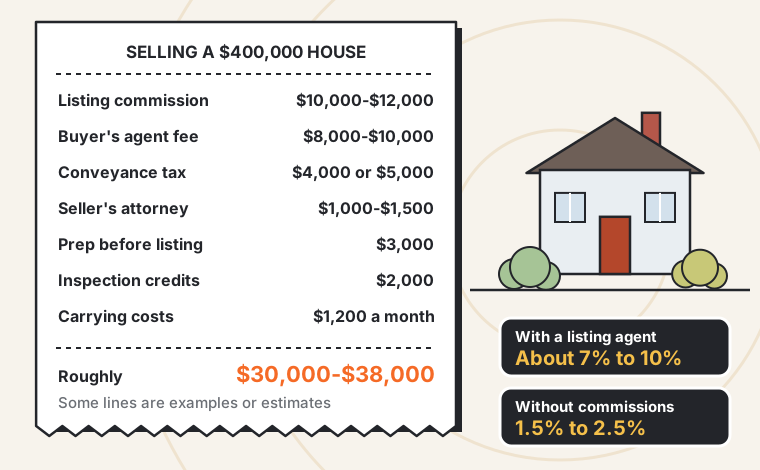
- Budget about 7% to 10% of the price to sell a Connecticut house with an agent, once you count commissions, the conveyance tax, your attorney, prep, buyer credits and a few months of carrying costs (est.). Without commissions, the fixed costs are closer to 1.5% to 2.5%.
- Commission is the biggest line, often 5% to 6% for both agents (est.). It is negotiable, and since August 2024 the buyer’s agent fee is negotiated separately.
- The conveyance tax is the biggest fixed cost: 1% of the price in most towns, 1.25% in 16 cities, more above $800,000. By law the seller pays it (CGS 12-495).
- Property taxes usually cost you at closing. Connecticut towns bill in arrears, so the seller typically credits the buyer for days already lived in the house.
- Two small credits are avoidable: $500 if you skip the property condition report and $250 if you skip the smoke and carbon monoxide affidavit.
- A cash sale cuts the costs but also the price. Compare what you walk away with, not the fees.
How much does it cost to sell a house in Connecticut?
It costs about 7% to 10% of the sale price to sell a house in Connecticut with a listing agent, counting commissions, the state and town conveyance tax, your attorney, pre-sale prep, buyer credits and carrying costs (est.). On a $400,000 house that is roughly $30,000 to $38,000. Selling by owner or to a cash buyer removes most of the commission, but each route has trade-offs in price and time.
This guide is part of our full guide to how to sell a house in Connecticut. Here we take every cost a Connecticut seller can face, say who pays it under Connecticut law or custom, put a number on it, and then run three complete examples so you can see your own bottom line.
Online estimates of seller costs in Connecticut are all over the place. Some quote “2% to 4%”, others “6% to 10%”, others above 15%. The difference is almost always what they include. Here is the breakdown we use, from the biggest cost to the smallest:
| Cost | Typical amount | On a $400,000 sale | Can you lower it? |
|---|---|---|---|
| Listing agent commission | About 2.5% to 3% (est.) | $10,000 to $12,000 | Yes: negotiable, or sell by owner |
| Buyer’s agent fee (if you agree to pay it) | About 2% to 2.5% (est.) | $8,000 to $10,000 | Yes: negotiable since August 2024 |
| Conveyance tax (state + town) | 1% in most towns; 1.25% in 16 cities | $4,000 or $5,000 | Only through an exemption |
| Seller’s attorney | About $1,000 to $1,500 for a simple sale (est.) | $1,000 to $1,500 | Shop flat fees |
| Repairs, cleaning, staging before listing | Varies; often $1,000 to $5,000 (est.) | $3,000 (example) | Yes: fix only what pays back |
| Credits after the buyer’s inspection | Varies; often 0.5% to 1% (est.) | $2,000 (example) | Partly: pre-inspect and disclose |
| Carrying costs while listed (tax, insurance, utilities) | Your monthly costs × months on market | About $1,200 a month (example) | Yes: price right, sell faster |
| Prorated property tax | Your share of the year not yet paid | Depends on closing date | No: it is your tax |
| Mortgage payoff | Your loan balance plus interest to the payoff date | Not a cost of selling | No |
| Small items: release recording, final water and sewer, HOA resale certificate | Usually under a few hundred dollars (est.) | $100 to $400 | No |
Who pays closing costs in Connecticut, the buyer or the seller?
In Connecticut, the seller pays the conveyance tax, the listing commission, their own attorney, the mortgage payoff and their share of property taxes, and usually agrees to pay the buyer’s agent. The buyer pays lender fees, the title search, title insurance, recording the deed and mortgage, and reimburses the seller for heating oil left in the tank. Some of this is state law; most of it is custom you can negotiate.

That distinction matters. If a cost is set by law, no contract clause changes who owes it to the state. If it is custom, it is just a starting point in the negotiation.
| Item | Who usually pays | Law or custom? |
|---|---|---|
| Conveyance tax (state and town) | Seller | Law: payable by the person conveying the property (CGS 12-495) |
| Listing agent commission | Seller | Contract with your agent |
| Buyer’s agent fee | Buyer, or the seller if agreed in the offer | Negotiated; buyers sign their own agent agreement since August 17, 2024 |
| Seller’s attorney | Seller | Your own choice; a Connecticut attorney must conduct the closing by law (CGS 51-88a) |
| Buyer’s attorney, title search, title insurance | Buyer | Custom |
| Lender fees, appraisal, deed and mortgage recording | Buyer | Custom and loan terms |
| Mortgage payoff and release | Seller | Your loan contract; lender must release within 60 days of a written request (CGS 49-8) |
| Property tax for your time in the house | Seller (usually as a credit to the buyer) | Custom proration; taxes are billed in arrears |
| Heating oil left in the tank | Buyer reimburses the seller | Connecticut custom |
| Property condition report not delivered | Seller credits buyer $500 | Law (CGS 20-327c) |
| Smoke and CO affidavit not delivered | Seller credits buyer $250 | Law (CGS 29-453) |
| Condo resale certificate | Seller pays the association | Law: fee set at $185, adjusted for inflation (CGS 47-270) |
How much is the real estate commission in Connecticut?
The real estate commission in Connecticut is negotiable, and in practice sellers often pay a total of about 5% to 6% of the price when they cover both the listing agent and the buyer’s agent (est.). Since the National Association of Realtors settlement took effect on August 17, 2024, the buyer’s agent fee is no longer offered on the MLS and is negotiated in each deal.
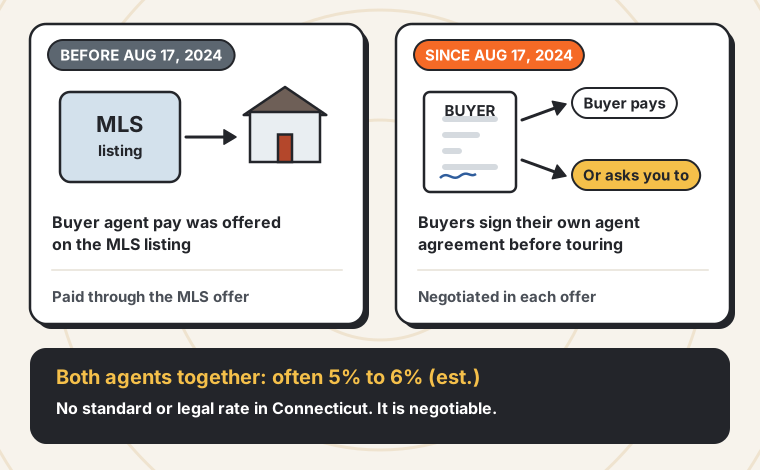
There is no standard or legal commission rate in Connecticut. What changed in 2024 is the mechanics:
- Listing side. You sign a listing agreement with your agent that sets their fee. It can be a percentage, a flat fee or a mix.
- Buyer side. Buyers now sign a written agreement with their own agent before touring homes. Their agent’s pay is agreed there. A buyer can pay it, or ask you to cover all or part of it in the offer as a concession.
- Reality check. Most buyers still ask the seller to cover their agent, because buyers are short on cash at closing. Refusing is your right, but it can reduce your pool of buyers.
Commission is also where your choice of route matters most. A listing agent earns their fee by pricing, marketing, negotiating and managing the deal. If you have the time and the house is easy to sell, you can save the listing side by selling yourself; our guide to selling a house without a realtor in Connecticut shows the real savings. More on agent costs: the costs of listing with an agent in Connecticut.
How much is the conveyance tax when you sell in Connecticut?
The conveyance tax when you sell a house in Connecticut is 0.75% of the price to the state on the first $800,000, plus 0.25% to the town in most towns, for a total of 1%. In 16 cities the town rate is 0.50%, for 1.25%. Above $800,000 the state rate is 1.25% on the part over $800,000 and 2.25% on any part over $2.5 million. The seller pays it at closing.
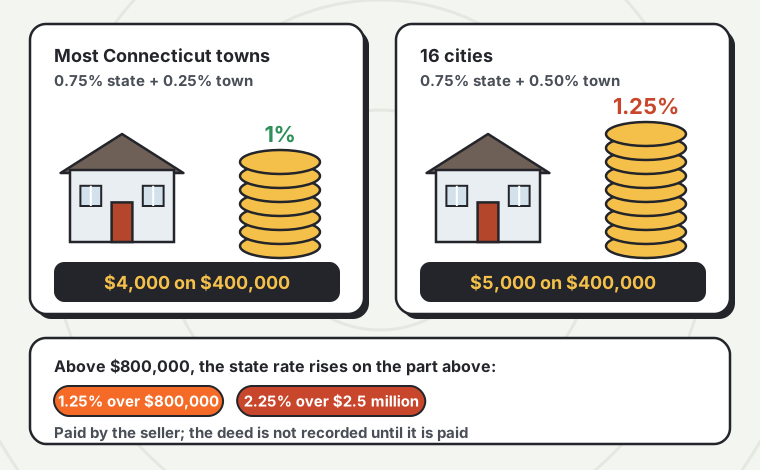
The 16 cities at 0.50% are Bloomfield, Bridgeport, Bristol, East Hartford, Hamden, Hartford, Meriden, Middletown, New Britain, New Haven, New London, Norwalk, Norwich, Southington, Waterbury and Windham; Stamford charges 0.35% up to $1 million and 0.50% above (OLR 2020-R-0020). The tax is reported on Form OP-236 and the deed cannot be recorded until it is paid (CGS 12-497).
| Example | Price | Town rate | Conveyance tax |
|---|---|---|---|
| Glastonbury median single-family sale | $615,000 | 0.25% | $6,150 |
| Bridgeport median single-family sale | $383,500 | 0.50% | $4,794 |
| Bristol median single-family sale | $330,000 | 0.50% | $4,125 |
| New Britain median single-family sale | $285,000 | 0.50% | $3,562 |
| Waterbury median single-family sale | $280,000 | 0.50% | $3,500 |
| Fairfield median single-family sale | $940,000 | 0.25% | $10,100 |
Some sales are exempt, including a short sale of your principal residence, a deed in lieu of foreclosure, and transfers between spouses or under a divorce decree (CGS 12-498). The full rate table for every town we cover, worked examples up to $3 million, and every exemption are in our guide to the Connecticut conveyance tax.
How much does a real estate attorney cost to sell a house in Connecticut?
A real estate attorney typically costs about $1,000 to $1,500 to represent a seller in a straightforward Connecticut sale (est.), usually as a flat fee. Expect more for an estate sale, a short sale, a title problem, or a by-owner sale where the attorney also drafts the contract. Connecticut law requires a Connecticut attorney to conduct the closing itself.
Since October 1, 2019, no one may conduct a real estate closing in Connecticut unless they are a Connecticut-admitted attorney in good standing (CGS 51-88a, from Public Act 19-88). In practice the buyer’s attorney (often also the lender’s closing attorney) runs the closing, and the seller hires their own attorney to protect the seller’s side. That separate seller’s attorney is custom, not a legal requirement, but almost every Connecticut seller has one. Here is what the fee usually covers:
- Reviewing or drafting the purchase contract
- Ordering your mortgage payoff and making sure the lender releases the mortgage
- Checking your title and clearing problems (old unreleased mortgages, liens, estate paperwork)
- Preparing the deed, the conveyance tax return (OP-236) and the seller affidavits
- Reviewing the settlement statement, including the tax proration and oil adjustment
- Holding and disbursing your proceeds
Ask for the fee in writing before you sign anything, and ask what is extra (courier, wire fees, an extra trip for a power of attorney). The Connecticut closing process for sellers explains what the attorney does step by step.
Why do Connecticut sellers usually owe property tax at closing?
Connecticut sellers usually owe property tax at closing because Connecticut towns bill property taxes in arrears. Your town’s tax is based on the October 1 grand list and is billed months later, so on closing day part of the time you owned the house usually has not been billed yet. The attorneys split the tax by the day, and the seller typically credits the buyer for the unpaid days.
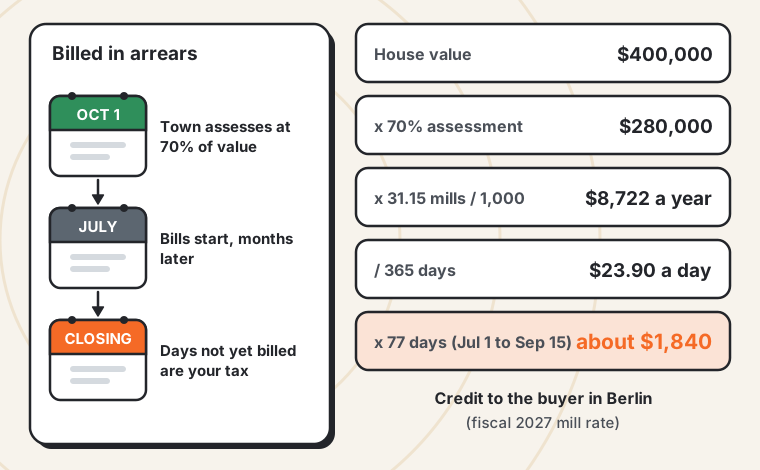
Every Connecticut town assesses property as of October 1 at 70% of market value (CGS 12-62a), and its legislative body sets the installment due dates, typically one, two or four installments starting in July (CGS 12-142). Exactly which bill covers which months is a local question, and attorneys follow the town’s convention. Here is a simplified example of how the credit is figured:
| Step | Example: a $400,000 house in Berlin |
|---|---|
| Assessment (70% of value) | $280,000 |
| Annual tax at Berlin’s 31.15 mill rate | $280,000 × 31.15 ÷ 1,000 = $8,722 |
| Tax per day | $8,722 ÷ 365 = $23.90 |
| Assume your paid bills covered you through June 30, and you close September 15 | 77 days not yet paid (July 1 to September 15) |
| Credit to the buyer on your settlement statement | 77 × $23.90 = about $1,840 |
If you already paid a bill that covers days after closing, it works the other way and the buyer credits you. Either way this is not an extra fee: it is your own property tax for the time you owned the house. Ask your attorney to show you this line early so it is not a surprise. Unpaid municipal water and sewer charges can become liens and are settled at closing too.
The heating oil adjustment
If the house heats with oil, the buyer normally pays you for the oil left in the tank at closing, at the current price per gallon. It is a Connecticut custom, not a statute. Get a reading or a receipt from your oil company before closing. On a half-full 275-gallon tank, that can put a few hundred dollars back in your pocket (est.).
Which seller credits can you avoid in Connecticut?
The seller credits you can avoid in Connecticut are the $500 credit for not delivering the Residential Property Condition Report before the buyer signs (CGS 20-327c) and the $250 credit for not providing the smoke and carbon monoxide detector affidavit at closing (CGS 29-453). Both are small, but both are easy to avoid, and skipping the report makes buyers nervous.
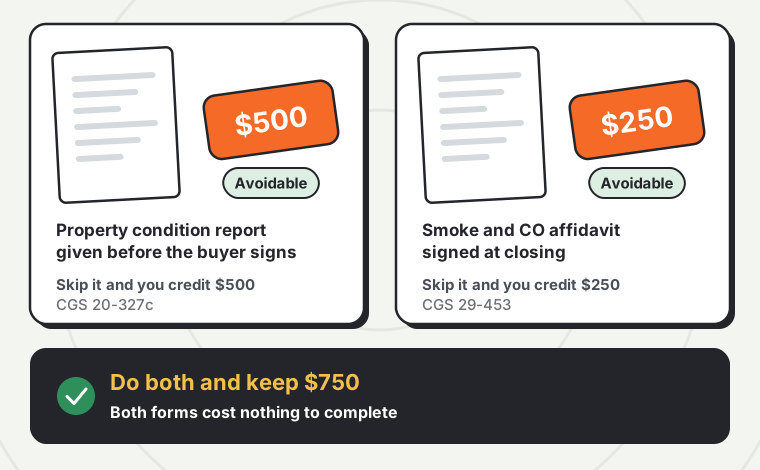
- Property condition report: $500. Fill in the Department of Consumer Protection’s form honestly and give it to the buyer before they sign the contract. It covers one- to four-family homes and condos. See our guide to the Connecticut property condition disclosure.
- Smoke and CO affidavit: $250. One- and two-family homes and condo units. Working detectors cost little; the affidavit is signed at closing.
- Lead paint disclosure (homes built before 1978). Federal law; there is no fixed credit, but skipping it exposes you to federal penalties and lawsuits.
Inspection credits: the cost most sellers forget
After the buyer’s inspection, most buyers come back with a list. In Connecticut the common items are the oil tank (especially buried tanks), the septic system, well water, radon, an old electrical panel and, in the north-central and eastern towns, the foundation. Sellers usually give a credit rather than doing the work. You can shrink this line by fixing small safety items before listing and disclosing known issues up front, so the price already reflects them. See oil tanks, septic, wells and radon when selling in Connecticut.
What hidden costs do Connecticut sellers forget?
The hidden costs Connecticut sellers forget are the months of mortgage, property tax, insurance and utilities while the house is for sale, the prorated property tax credit at closing, repairs and credits after the buyer’s inspection, moving, and condo resale certificate fees. Together they can add 1% to 3% of the price to a listing (est.).
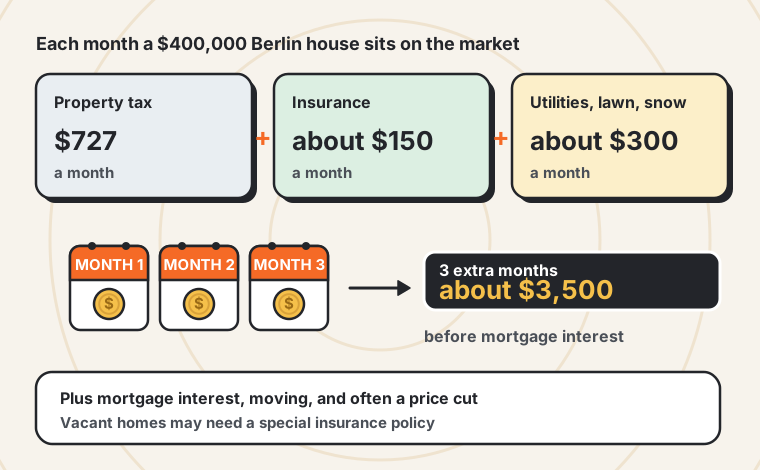
| Hidden cost | How to estimate it | Example: $400,000 house in Berlin |
|---|---|---|
| Property tax while listed | Annual tax ÷ 12 × months | $727 a month |
| Homeowners insurance | Annual premium ÷ 12 (vacant homes may need a special policy) | About $150 a month (est.) |
| Utilities, lawn, snow | Your bills | About $300 a month (est.) |
| Mortgage interest | Your monthly interest | Varies |
| Moving | Quotes | Varies |
| Condo resale certificate | $185, adjusted for inflation, plus copies (CGS 47-270) | n/a for a house |
| Home warranty for the buyer (optional) | Quote | Only if you offer one |
Carrying costs are why time is money in a house sale. A house that sits three extra months costs about $3,500 in this example before mortgage interest, and price cuts often follow.
What does a seller actually walk away with? Three Connecticut examples
What a Connecticut seller actually walks away with depends on the route. On a move-in-ready $400,000 house in a 0.25% town, our example nets about $365,000 with a listing agent, about $376,000 selling by owner, and about $335,000 from an illustrative $340,000 cash offer, before paying off any mortgage. The listing routes win on price when the house is ready and time is not an issue.
Here are the assumptions, so you can swap in your own numbers in the calculator below.
| Listing agent | Selling by owner | Cash offer (illustrative) | |
|---|---|---|---|
| Sale price | $400,000 | $400,000 | $340,000 |
| Commissions | $21,000 (2.75% + 2.5%) | $10,000 buyer’s agent + $400 flat-fee MLS | $0 |
| Conveyance tax (1%) | $4,000 | $4,000 | $3,400 |
| Seller’s attorney (est.) | $1,200 | $1,200 | $1,200 |
| Prep and repairs (est.) | $3,000 | $3,000 | $0, sold as-is |
| Inspection credits (est.) | $2,000 | $2,000 | $0 |
| Carrying costs | $3,531 (3 months) | $3,531 (3 months) | $560 (2 weeks) |
| You walk away with (before your mortgage payoff) | $365,269 | $375,869 | $334,840 |
| Total selling cost as % of the price | 8.7% | 6.0% | 1.5% of the cash price |
Bars are shown as a share of the $400,000 retail price. Read the example honestly: for a ready house with time to sell, listing nets about $30,000 more than this cash offer. A cash sale only comes out ahead when the house needs work the retail buyer will charge you for, when months of carrying costs pile up, or when a deadline (a Law Day, a probate timeline, a job move) makes time the scarce thing. Run your own numbers:
How much would you walk away with?
Slide the numbers to match your house. It works in your browser; nothing is saved or sent.
Estimates for planning. Conveyance tax per CGS 12-494 (state 0.75% up to $800,000, 1.25% to $2.5M, 2.25% above, plus the town rate). Seller attorney about $1,200 to $1,500; flat-fee MLS about $400; listings include three months of taxes, insurance and utilities, a cash sale about two weeks. Your attorney gives you the final numbers.
Two more Connecticut examples
A $330,000 house in Bristol (0.50% city)
$299,961with a listing agent (est.)
- Commissions 5.25%: $17,325
- Conveyance tax 1.25%: $4,125
- Attorney $1,200, prep $2,500, credits $1,500 (est.)
- 3 months carrying: $2,039 tax at 35.3 mills plus $1,350 insurance and utilities (est.)
A $940,000 house in Fairfield (above $800,000)
$865,543with a listing agent (est.)
- Commissions 5.25%: $49,350
- Conveyance tax: $10,100 (1.07% of the price)
- Attorney $1,500, prep $5,000, credits $4,000 (est.)
- 3 months carrying: $3,157 tax at 19.19 mills plus $1,350 insurance and utilities (est.)
Tax math: Bristol, $330,000 × 70% = $231,000 assessment × 35.3 mills = $8,154 a year. Fairfield, $940,000 × 70% = $658,000 × 19.19 mills = $12,627 a year. Mill rates are fiscal 2027 (Connecticut OPM). In Bristol the higher city conveyance rate adds $825 compared with a 0.25% town; in Fairfield the 1.25% slice above $800,000 adds $700 compared with the base state rate. Use the calculator above for exact numbers on your house.
How can you lower the cost of selling a house in Connecticut?
You can lower the cost of selling a house in Connecticut by negotiating commissions, deciding in advance how much of the buyer’s agent fee you will cover, getting a flat attorney fee, completing the state disclosures to avoid the $500 and $250 credits, fixing only cheap items that inspectors flag, pricing right so the house sells fast, and claiming any conveyance tax exemption you qualify for.
Negotiate the commission
Interview two or three agents and ask each what they charge and what you get. A lower rate is only a saving if the agent still prices and markets well.
Decide on the buyer’s agent fee before offers arrive
Know what you will offer toward the buyer’s agent and treat any request in an offer as part of the price.
Get your attorney’s fee in writing
Most Connecticut seller representation is a flat fee. Ask what is included.
Do the disclosures
The property condition report and the smoke and CO affidavit cost nothing to complete and save $750 in credits.
Fix the small things inspectors flag
Leaks, missing detectors, broken fixtures, an obviously failing water heater. Skip remodels. Our list of cheap upgrades before selling has ideas.
Price it to sell in weeks, not months
Every month on the market costs carrying costs and often a price cut. Price from recent sales near you.
Check the conveyance tax exemptions
Short sales, deeds in lieu, divorce transfers, crumbling-foundation homes, and a state-tax exemption for older and disabled homeowners on town tax relief programs (CGS 12-498).

The costs that hurt Connecticut sellers are rarely the ones on the listing agreement. They are the property tax credit nobody explained, the $6,000 credit for a buried oil tank the buyer’s inspector found, and the fourth month of a mortgage on an empty house. Ask your attorney for a draft net sheet before you list, and update it after every offer.
Do you owe income tax when you sell a house in Connecticut?
You usually do not owe income tax when you sell your main home in Connecticut. If you owned and lived in it for 2 of the last 5 years, up to $250,000 of gain ($500,000 for a married couple filing jointly) is excluded from federal income tax (IRS Publication 523), and Connecticut income tax starts from your federal adjusted gross income. Gains above that, and gains on rentals and second homes, are taxed federally and by Connecticut at rates up to 6.99%.
The conveyance tax, commissions and attorney fees are selling expenses that reduce your gain. Foreign sellers face federal FIRPTA withholding at closing. The details, including nonresident owners and inherited houses, are in taxes when selling a house in Connecticut.
How much does it cost to sell a house for cash in Connecticut?
Selling a house for cash in Connecticut usually costs only the conveyance tax, your attorney and your prorated property tax, because there is no commission and the house is sold as-is. Many cash buyers also pay the other closing costs. The real cost is the price: a cash offer is below retail because the buyer takes on repairs, holding costs and resale risk.
We buy houses for cash, so here is our honest take. For a house that is updated and easy to finance, listing it usually nets more, and we will say so if that is your situation. A cash sale makes sense when the repairs, months of carrying costs, showings or a deadline would cost more than the gap in price. The way to know is to compare a written cash offer against a realistic listing net sheet, line by line, like the example above. Our cash buyer vs. realtor comparison and what makes a fair cash offer walk through it.
A few things you should expect from any cash buyer, including us:
- No fees to you. We never charge a fee, and a legitimate buyer never asks you to pay upfront or to sign your deed outside a closing.
- A Connecticut attorney closing. Connecticut law requires an attorney to conduct the closing; your own attorney can review everything.
- No pressure. Our offers do not expire while you compare. Show it to your family, your attorney or an agent.
- A real person. You talk to me, Jerryll Noorden, at (203) 529-4712. I have bought houses in Connecticut since 2016, about ten a year.
- A small first step. Send a few photos and the address for a ballpark range; a walkthrough comes later, only if you want one. Nothing about the condition of the house will surprise us.
Is a cash sale right for you, or should you list?
Seven quick questions. There is no wrong answer, and we will tell you honestly if listing would leave you more.
- Does the house need repairs you would rather not pay for or manage?
- Do you need to close by a certain date, or within the next month or two?
- Would showings be hard: tenants, belongings, privacy, or you live out of state?
- Is there a complication: an estate or probate, a divorce, foreclosure, liens or back taxes?
- Could you comfortably cover the mortgage, taxes and utilities for three or more months?
- Is getting the highest possible price more important to you than speed and certainty?
- Would a buyer's bank lend on the house as it is (no major roof, foundation, oil tank or code issues)?
Get your cash offer
without anyone coming over.
Want your offer faster, or rather not talk to anyone yet? Send a few phone photos of each room. We price the repairs from them, line by line, and send your cash offer back, so you see a real number before you ever meet us or pick up the phone.
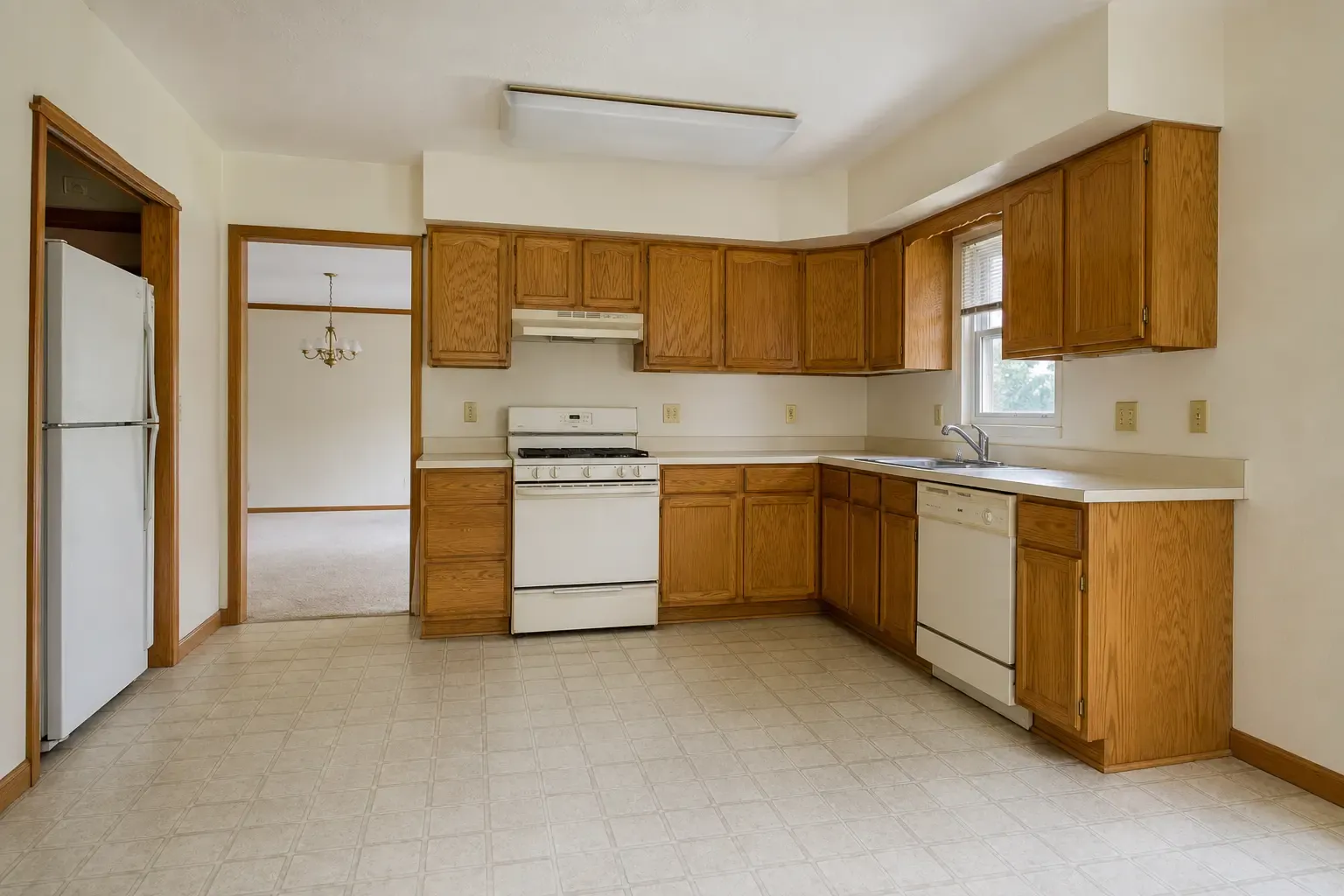 CabinetsFlooring
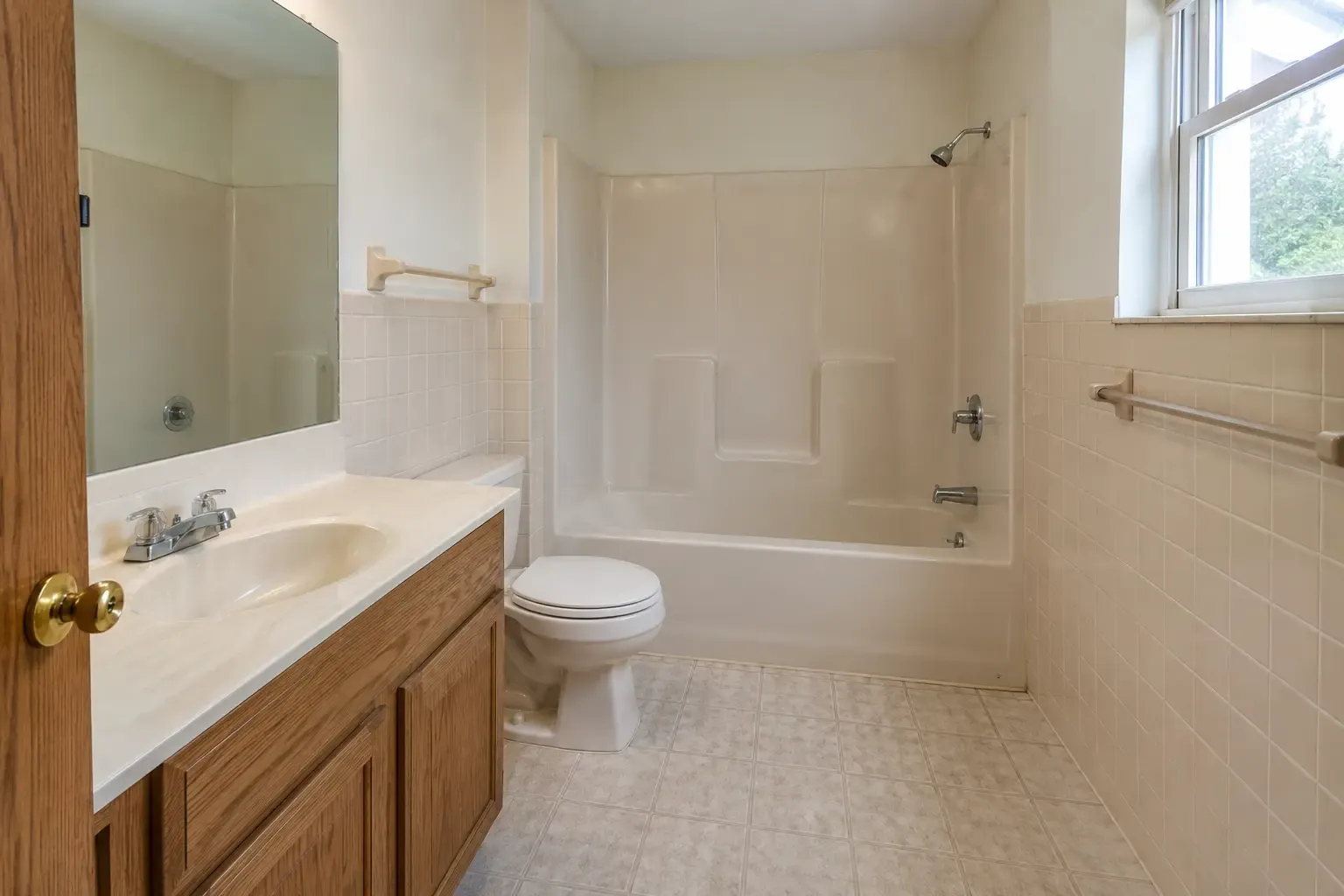 Tub & tile
 Floors
 Roof
We may bring in a partner buyer to close. Your price and terms don't change.
What should you ask for before you sign a listing or an offer?
Before you sign a listing or an offer in Connecticut, ask for your mortgage payoff estimate, your town’s tax bill dates, the conveyance tax at your town’s rate, a written attorney fee, the commission terms for both agents, and a draft net sheet. Tick them off as you go; your progress is saved on this device.
- Mortgage payoff estimate from your lender (and any home equity line)
- Your town’s tax bill: assessment, mill rate and installment dates
- Conveyance tax at your town’s rate (1% or 1.25% under $800,000)
- Attorney’s flat fee in writing
- Listing agreement: commission, term, and what you will offer the buyer’s agent
- Residential Property Condition Report completed
- Lead paint disclosure if built before 1978
- Working smoke and CO detectors for the closing affidavit
- Oil tank, septic, well and radon status known
- Condo: resale certificate ordered from the association
- Draft net sheet for each offer you receive
- Oil company reading for the closing adjustment
Questions Connecticut sellers ask about closing costs
What are seller closing costs in Connecticut?
Seller closing costs in Connecticut are the costs deducted from your proceeds at closing: the state and town conveyance tax, commissions, your attorney’s fee, your share of property taxes, any credits to the buyer, and small items such as final water and sewer bills. Your mortgage payoff also comes out but is not a cost of selling.
How much are closing costs for a seller in Connecticut?
Closing costs for a seller in Connecticut, not counting commissions, are usually about 1.5% to 2.5% of the price: about 1% to 1.25% conveyance tax, $1,000 to $1,500 for an attorney (est.), and small fees. With both agents’ commissions, total selling costs are often 7% to 10% (est.).
Does the seller pay closing costs in Connecticut?
Yes, the seller pays some closing costs in Connecticut: the conveyance tax by law, the listing commission, their own attorney and their share of property taxes. The buyer pays their own lender, title and recording costs. Either side can agree to cover some of the other’s costs in the contract.
Who pays the conveyance tax in Connecticut?
The seller pays the conveyance tax in Connecticut. CGS 12-495 makes it payable by the person conveying the property when the deed is recorded. It is 1% of the price in most towns and 1.25% in 16 cities for homes under $800,000.
Does the seller pay the buyer’s agent in Connecticut?
The seller does not have to pay the buyer’s agent in Connecticut, but many still agree to. Since August 17, 2024, buyers sign their own agreement with their agent, and any seller contribution is negotiated in the offer.
Do I need an attorney to sell my house in Connecticut?
Connecticut law requires that the closing be conducted by a Connecticut-admitted attorney (CGS 51-88a). The law does not require you to hire your own, but almost every Connecticut seller does, because the closing attorney usually represents the buyer or the lender.
Why do I owe property taxes at closing?
You owe property taxes at closing because Connecticut towns bill in arrears, so part of the time you owned the house usually has not been billed yet. The attorneys prorate by the day, and you typically credit the buyer for your unpaid share.
Who pays for title insurance in Connecticut?
The buyer usually pays for title insurance in Connecticut, both the lender’s policy and any owner’s policy. The seller’s attorney’s job is to deliver clear title, which can mean paying off liens or fixing recording problems at the seller’s cost.
Can I negotiate closing costs as a seller?
Yes, you can negotiate most closing costs as a seller: commissions, the buyer’s agent fee, your attorney’s fee, repair credits and who pays small items. You cannot negotiate the conveyance tax itself, which the law puts on the seller.
What is the cheapest way to sell a house in Connecticut?
The cheapest way to sell a house in Connecticut, in fees, is selling by owner to a buyer without an agent: you pay only the conveyance tax, your attorney and your prorated taxes. The cheapest in fees is not always the most profitable; price, time and repairs decide the real result.
Are closing costs tax-deductible when selling a house?
Closing costs are not deductible on their own when you sell a house, but the IRS lets you treat the conveyance tax, commissions and legal fees as selling expenses that reduce your gain (IRS Publication 523). Your share of property tax up to the sale date is treated as property tax you paid.
What happens if I do not have enough equity to cover the costs?
If you do not have enough equity to cover the costs, you have to bring money to closing or arrange a short sale with your lender. A short sale of your principal residence is exempt from the conveyance tax (CGS 12-498(a)(20)). Talk to your attorney and your lender before you list.
Does the buyer pay me for heating oil in Connecticut?
Yes, by Connecticut custom the buyer pays you for the heating oil left in the tank at closing, at the current price per gallon. It shows as a credit to you on the settlement statement.
What does a condo seller pay that a house seller does not?
A Connecticut condo seller pays the association for a resale certificate and copies of the documents, which the law sets at $185 adjusted for inflation plus copying fees (CGS 47-270), and settles any unpaid common charges or special assessments at closing.
Do cash buyers pay closing costs in Connecticut?
Many cash buyers in Connecticut pay their own closing costs and some of the seller’s, such as the seller’s attorney fee. The conveyance tax is still legally the seller’s. Get the costs in writing in the offer.
How long after closing do I get my money in Connecticut?
You usually get your money on the day of closing or the next business day in Connecticut, by wire or check from your attorney’s trust account, once the deed and funds are in order. Confirm wire instructions by phone with your attorney; never trust emailed changes.
Related Connecticut guides
Costs and taxes
The process
Costs are one part of the decision. For pricing, timing, paperwork and closing in one place, read our guide to how to sell a house in Connecticut.
Plain-English information, not legal or tax advice. Estimates marked (est.) are typical ranges, not quotes.
Sources
- CGS chapter 223: § 12-494 (conveyance tax rates), § 12-495 (payable by the seller upon recording), § 12-497 (return before recording), § 12-498 (exemptions); OLR Report 2020-R-0020 (town rates).
- CGS § 51-88a (real estate closings must be conducted by a Connecticut attorney; Public Act 19-88) and OLR Report 2021-R-0222.
- CGS § 20-327b and § 20-327c (property condition report; $500 credit).
- CGS § 29-453 (smoke and carbon monoxide affidavit; $250 credit).
- CGS § 12-62a (October 1 assessment date, 70% assessment) and CGS § 12-142 (tax installments and due dates).
- CGS § 49-8 (mortgage release within 60 days of a written request).
- CGS § 47-270 (condo resale certificate and fee).
- National Association of Realtors, settlement practice changes effective August 17, 2024.
- IRS Publication 523, Selling Your Home (home sale exclusion; selling expenses).
- Town sales and mill rates: Connecticut Office of Policy and Management, published on data.ct.gov (sales Oct 2024–Sep 2025; fiscal 2027 mill rates).
See the house together.
Pick a time that works.
Choose a time for us to walk through the property with you, or ask for a quick call first. We confirm every request personally.
Tuesday, January 13
No open times in the next few weeks. Please call us.
We will confirm by email. Nothing is booked until we do.
View my request
Who wrote this
Jerryll Noorden
Jerryll has bought and sold Connecticut houses since 2016 and has sat at more closing tables than he can count, on both sides. Before real estate he was a robotics scientist at NASA, IHMC and IIT. He wrote this guide because the national sites that rank for it skip the Connecticut rules that cost sellers money. When listing or selling it yourself would get you more than a cash offer, he says so.
This guide explains Connecticut rules in plain English. It is not legal or tax advice. Laws change; for your sale, talk to a Connecticut real estate attorney and a tax professional.
