
Key facts at a glance
| Fact | Number | Source |
|---|---|---|
| Homes sold in Hartland, Oct 2024 to Sep 2025 | 21 (all single-family) | CT OPM real estate sales, data.ct.gov |
| Median sale price | $371,000 | CT OPM real estate sales, data.ct.gov |
| Single-family homes in town | 815, so about 2.6% sold in a year | 2025 CT parcel (CAMA) data, data.ct.gov |
| Homes heated with oil | 80% (62% oil hot water, 18% oil forced air) | 2025 CT parcel (CAMA) data |
| Median year built | 1974 | 2025 CT parcel (CAMA) data |
| Mill rate, fiscal 2027 | 23.75 (about $6,170 a year on the median house) | CT OPM mill rates, data.ct.gov |
| Conveyance tax the seller pays | 1.00% (0.75% state + 0.25% town), $3,710 on $371,000 | CGS 12-494 |
| Probate court and Superior Court | Torrington Area Probate District (No. 23); Litchfield Judicial District | CGS 45a-2; CGS 51-344 |
If you own a house in East Hartland or West Hartland, the usual advice about selling does not quite fit. This guide is the Hartland chapter of our guide to how to sell a house in Connecticut: it weighs the pros and cons of a direct buyer against Hartland’s own facts, which are a small buyer pool, private wells and septic, oil heat and long winter driveways. For the statewide comparison of the two routes, see cash buyer vs. realtor in Connecticut.
Why does selling a house in Hartland feel harder than selling in a bigger town?
Selling a house in Hartland feels harder than in a bigger town because there are so few sales to go by. Only 21 homes sold in the 12 months to September 2025, so the price is harder to pin down, buyers are fewer, and every well test, septic inspection and oil tank question lands on one house instead of being spread across a busy market.
Maybe you are tired of plowing a long driveway and splitting wood. Maybe the house was a parent’s, and you live two hours away and visit only to check the furnace. Maybe a cash buyer sent you a letter and you are wondering whether it is fair or a trap. You may feel uncertain about what the house is worth, wary of anyone who offers cash, worn down by the upkeep, a little guilty about letting the place go, and stuck because every option seems to have a catch.
Those are reasonable feelings. A rural house is a different sale, and you deserve an honest list of trade-offs, not a sales pitch. This page is for you. It gives both sides, with Hartland numbers, and tells you plainly when a direct buyer is the wrong choice.
What are the pros and cons of selling to a direct buyer in Hartland, CT?
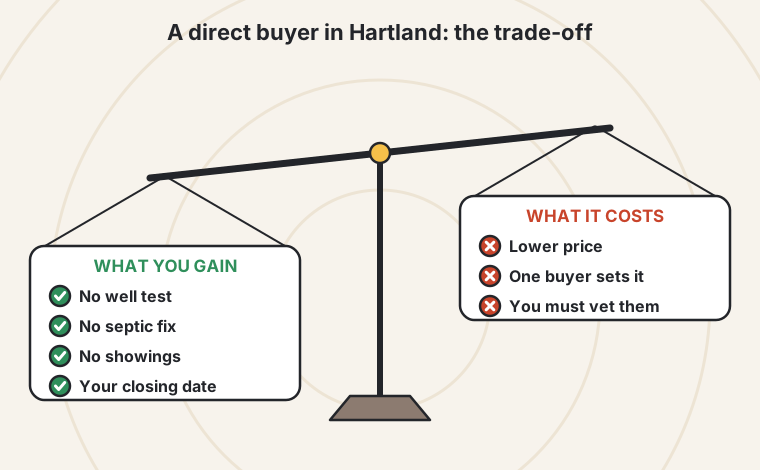
The pros of selling a Hartland house to a direct buyer are no well, septic or oil tank work before the sale, no lender appraisal that depends on scarce comparable sales, no showings on a winter driveway, and a closing date you choose. The cons are a lower price than a well-prepared listing can bring, one buyer setting the price instead of competition, and the need to check who you are dealing with.
| Hartland issue | Listing with a financed buyer | Selling to a direct buyer |
|---|---|---|
| Private well | The buyer’s lender usually wants a water test; a bacteria or other result can delay or reopen the deal | No lender, so no lender water test; the buyer takes the well as it is |
| Septic system | Buyers almost always order a septic inspection; a failed field can end the sale | Priced in up front; no repair before closing |
| Oil heat and tanks (80% of Hartland homes heat with oil) | Buried or old tanks worry lenders and insurers; removal often requested | Tank stays; no removal, no soil test required by the buyer |
| Few comparable sales (21 in a year) | The appraisal can come in low when the appraiser has to reach to other towns | No appraisal contingency |
| Long driveway, winter access | Showings, plowing and a show-ready house for months | One walkthrough |
| Price | Usually the highest gross price for a house in good shape | Lower, because the buyer pays for repairs, risk and resale |
| Competition | Many buyers can bid against each other | One buyer sets the price unless you get several offers |
| Trust | Agents are licensed and supervised | You must check the buyer yourself |
The table is not a scorecard where the longer column wins. If your house has a newer septic, a clean well test from last year and a furnace you replaced, most of the “con” column for listing disappears, and listing will likely leave you more money. The direct sale earns its place when the left column describes your house.
Why does Hartland’s small buyer pool change the decision?
Hartland’s small buyer pool changes the decision because only about 21 of the town’s 815 single-family homes sell in a year, roughly 2.6%. With so few sales, each listing waits for the right buyer, appraisers have few nearby comparables, and a house with a well, septic or oil question competes for a small group of people willing to take it on.
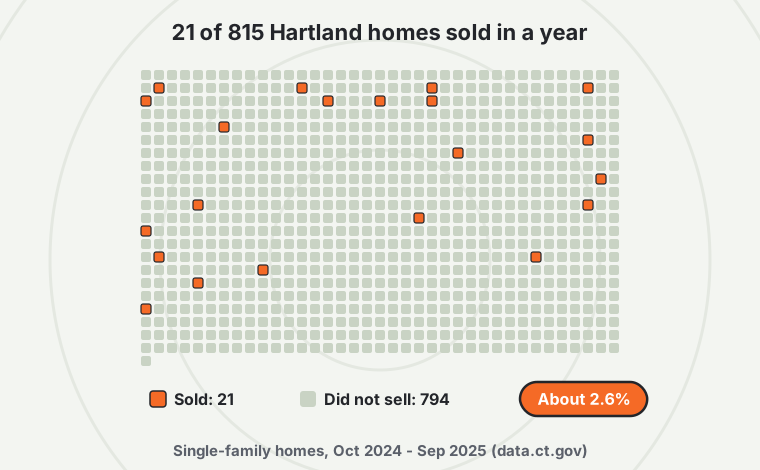
A thin market cuts both ways. Hartland sales prices rose about 6% year over year in the state data, and a well-kept house on a few acres can draw buyers from Granby, Simsbury and the Massachusetts line. But the sale prices ranged from $120,000 to $745,000 last year, a wide spread for 21 homes, so the price of your particular house is a judgment call, not a lookup. That is why a low appraisal is a real risk here; our guide to how a low appraisal affects a Connecticut sale explains what happens when it comes in under the contract price.
The practical consequence: if you list, plan for time. If you cannot carry the house through a slow season, that is the strongest argument for a direct sale in a town this size.
How do wells, septic and oil heat affect a Hartland sale?
Wells, septic and oil heat affect a Hartland sale because they are what a financed buyer’s inspector and lender look at hardest. Connecticut law does not require a well test, a septic inspection or oil tank removal at sale, but you must tell the buyer about the state’s private well testing information (CGS 19a-37), answer the property condition report honestly, and expect the buyer’s side to test.
The state data show that 80% of Hartland’s single-family homes heat with oil and the median one was built in 1974. Most homes outside town centers in the Northwest Hills rely on private wells and septic systems; check your own house’s records to confirm which you have. Here is what each item means for each route:
- Well: no state test is required at sale, but a lender usually requires one. If you list, test early so a bad result does not surface two weeks before closing.
- Septic: no state inspection is required at sale, but buyers almost always order one. Find your pumping receipts and the town health file.
- Oil tank: no law forces removal, but insurers and lenders often ask. Know where the tank is, how old it is, and whether one was ever buried.
- Radon: the state estimates about 1 in 4 Connecticut homes test high; buyers usually test.
- Disclosure: whichever route you choose, you fill in the Residential Property Condition Report (CGS 20-327b) or credit the buyer $500 (CGS 20-327c).
Our guide to oil tanks, septic, wells and radon when selling a Connecticut house covers each item in depth. The short version for this decision: if you already know a system is failing, a listing will price it in anyway, and a direct buyer saves you from paying for the repair first.
A direct buyer who takes the house “as-is” still gets the condition report, and you still answer it truthfully. Selling as-is means the buyer will not ask you to fix what you disclose; it does not excuse leaving it out.
What does the math look like on a $371,000 Hartland house?
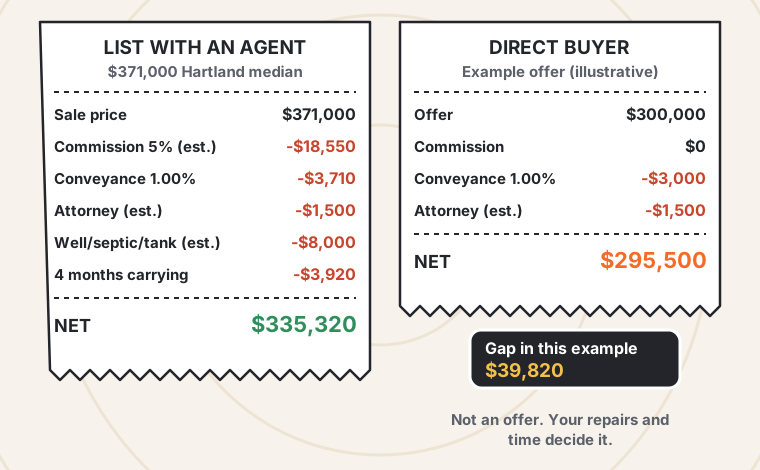
On a $371,000 Hartland house, a listing that needs $8,000 of well, septic or tank work and four extra months of carrying costs leaves roughly $335,320 after a 5% commission, the $3,710 conveyance tax and a lawyer (est.). An illustrative $300,000 direct offer leaves about $295,500, so in this example certainty costs about $39,820. Your own numbers decide it.
| Line | List with an agent | Direct buyer (illustrative offer) |
|---|---|---|
| Sale price | $371,000 (Hartland median) | $300,000 |
| Commission, 5% (est.) | -$18,550 | $0 |
| Conveyance tax, 1.00% | -$3,710 | -$3,000 |
| Your attorney (est.) | -$1,500 | -$1,500 |
| Well, septic or tank work before listing (est.) | -$8,000 | $0 |
| Four more months of tax, insurance and heat at $980 a month (est.) | -$3,920 | $0 |
| Approximate net | $335,320 | $295,500 |
Three things move this math more than anything else. First, the real repair bill: if the septic field has failed, $8,000 becomes a much larger number and the gap shrinks or flips. Second, time: in a 21-sale town, four months is a hopeful number, not a guarantee. Third, the commission you negotiate, which our Connecticut commission guide explains. If you want the reasoning behind a cash buyer’s number, read why cash offers are lower.
How much would you walk away with?
Slide the numbers to match your house. It works in your browser; nothing is saved or sent.
Estimates for planning. Conveyance tax per CGS 12-494 (state 0.75% up to $800,000, 1.25% to $2.5M, 2.25% above, plus the town rate). Seller attorney about $1,200 to $1,500; flat-fee MLS about $400; listings include three months of taxes, insurance and utilities, a cash sale about two weeks. Your attorney gives you the final numbers.
When should you not sell your Hartland house to a direct buyer?
You should not sell your Hartland house to a direct buyer when it is in good condition, the well, septic and heating are documented and working, you can wait for spring and a slow sale, and the gap between the listing net and the cash offer is larger than what time and risk are worth to you. In that case, list it with a local agent.
- The house is ready. A recent septic pumping, a clean water test and a newer boiler take away most of a financed buyer’s objections.
- You can carry it. If the taxes, insurance and oil are not a strain and you have no deadline, the market’s patience costs you little.
- The gap is big. If a direct offer is $60,000 under a realistic listing net, the speed is probably not worth it.
- The land is the value. Large acreage or a building lot may draw buyers a cash-for-houses buyer does not represent; ask a land-savvy agent.
We say this on every page because it is true: if listing will clearly net you more and you have the time, list. A good direct buyer will tell you so.
How do you sell a Hartland house to a direct buyer, step by step?
To sell a Hartland house to a direct buyer, get a written number first, check the buyer, have your own Connecticut attorney review the contract, schedule one walkthrough, and pick a closing date. A typical direct sale takes about two weeks from first call to closing, longer if an estate or a lien has to be cleared first.
Get a number before anyone visits
Share the address, the heating type, whether there is a well and septic, and what you know is wrong. A serious buyer can give a range from that.
Check the buyer
Look up the company on the Connecticut business registry, ask for proof of funds, and look at real closed purchases. Our checklist on how to check a cash home buyer in Connecticut takes ten minutes.
One walkthrough, no cleanup
The buyer sees the house as it is, including the basement, tank and well head. Leave everything you do not want.
Your attorney reviews the contract
Connecticut closings are handled by attorneys. Yours reviews the price, deposit, closing date and any “as-is” language, and orders the payoff.
Close on your date
About two weeks is typical. If you live out of state, ask your attorney about signing by mail. You pay the 1.00% conveyance tax and your attorney from the proceeds.
What if the Hartland house is in an estate or you live far away?
If the Hartland house is in an estate, the executor or administrator sells it through the Torrington Area Probate District (No. 23), which serves Hartland under CGS 45a-2; the court can authorize a sale of real property (CGS 45a-164). If you live far away, a direct sale with a mail-away signing avoids months of managing showings, plowing and heat from out of town.
A vacant rural house in winter is a worry: a failed furnace can freeze pipes in a weekend. If you are managing from a distance, read our guide to selling a house during probate in Connecticut, and count the monthly cost honestly with the carrying-cost worksheet. Any lawsuit about the property, such as a foreclosure or a partition between heirs, would be filed in the Litchfield Judicial District, not Hartford, even though Hartland is in Hartford County (CGS 51-344).
When you want a number, our East Hartland page is the place to ask for one. There is no fee and no obligation, and we will tell you if listing looks better.
Frequently asked questions
Is it a good idea to sell to a direct buyer in Hartland, CT?
Selling to a direct buyer in Hartland is a good idea when the house has well, septic, oil tank or repair issues, when you need a set closing date, or when you cannot carry the house through a slow sale. It is a poor idea when the house is in good shape and you have time to list.
How many homes sell in Hartland each year?
About 21 homes sold in Hartland between October 2024 and September 2025, all single-family, at a median of $371,000, according to Connecticut’s real estate sales data on data.ct.gov.
Do I have to test my well before selling in Hartland?
No, Connecticut does not require a well test to sell a house, but you must tell the buyer that private well testing information is on the Department of Public Health website (CGS 19a-37). A buyer with a mortgage will usually test anyway because the lender asks for it.
Do I need a septic inspection to sell?
No state law requires a septic inspection to sell a Connecticut house. Buyers almost always order one, so a direct buyer who takes the system as-is removes that risk from the sale.
Will a direct buyer take a house with an old oil tank?
Yes, a direct buyer will usually take a house with an old or buried oil tank and price it in. You still disclose what you know about the tank on the property condition report.
What does it cost to sell a house in Hartland?
Selling a $371,000 Hartland house costs about $3,710 in conveyance tax (1.00%), an attorney fee, and a commission if you list. Repairs and carrying costs come on top. A direct sale removes the commission and repairs but usually means a lower price.
Is East Hartland a separate town?
No, East Hartland is a village in the town of Hartland, so its sales, taxes, probate court and land records are Hartland’s.
Which probate court handles a Hartland estate?
A Hartland estate is handled by the Torrington Area Probate District, district 23 under CGS 45a-2, which also serves Barkhamsted, Colebrook, Goshen, New Hartford, Torrington and Winchester.
How fast can a direct sale close in Hartland?
A direct sale of a Hartland house typically closes in about two weeks once both attorneys have the contract, title is clear and the payoff is in hand. An estate, a lien or a missing heir can add time.
Related guides
The decision
The house
For the full process from first call to closing, see how to sell a house in Connecticut, or ask for a no-obligation number on our East Hartland page.
Plain-English information, not legal advice. Talk to a Connecticut attorney about your own sale.
Sources (checked on October 27, 2026)
- Connecticut OPM Real Estate Sales (Hartland, recorded Oct 2024 to Sep 2025), data.ct.gov.
- OPM mill rates, fiscal 2027, data.ct.gov.
- 2025 Connecticut parcel (CAMA) data for Hartland (year built, heating fuel, parcel count), data.ct.gov.
- CGS 12-494 (real estate conveyance tax).
- CGS 20-327b and 20-327c (property condition report; $500 credit).
- CGS 19a-37 (private well testing notice).
- CGS 45a-2 (probate districts) and CGS 45a-164 (sale of real property by a fiduciary).
- CGS 51-344 (judicial districts).
- Connecticut Department of Public Health radon program.
- NAIC Homeowners Insurance Report (Connecticut average premium).
See the house together.
Pick a time that works.
Choose a time for us to walk through the property with you, or ask for a quick call first. We confirm every request personally.
Tuesday, January 13
No open times in the next few weeks. Please call us.
We will confirm by email. Nothing is booked until we do.
View my request
Who wrote this
Jerryll Noorden
Jerryll has bought and sold Connecticut houses since 2016 and has sat at more closing tables than he can count, on both sides. Before real estate he was a robotics scientist at NASA, IHMC and IIT. He wrote this guide because the national sites that rank for it skip the Connecticut rules that cost sellers money. When listing or selling it yourself would get you more than a cash offer, he says so.
This guide explains Connecticut rules in plain English. It is not legal or tax advice. Laws change; for your sale, talk to a Connecticut real estate attorney and a tax professional.
