
Key facts at a glance
| Fact | Number | Source |
|---|---|---|
| Homes sold in Putnam, Oct 2022 to Sep 2023 (last full year in the state data) | 140, median $280,000 | CT OPM real estate sales, data.ct.gov |
| Median single-family sale | $295,000 (73 sales) | CT OPM real estate sales, data.ct.gov |
| Two- to four-family sales | 47 of 140 (about 34%) | CT OPM real estate sales, data.ct.gov |
| One- to three-family homes built before 1978 | 74% (median year built 1955) | 2025 CT parcel (CAMA) data, data.ct.gov |
| Those homes heated with oil | 67% | 2025 CT parcel (CAMA) data |
| Mill rate, fiscal 2027 | 18.5 (about $3,820 a year on a $295,000 house, est.) | CT OPM mill rates, data.ct.gov |
| Conveyance tax the seller pays | 1.00% (0.75% state + 0.25% town) | CGS 12-494 |
| Probate court and Superior Court | Northeast Probate District (No. 26); Windham Judicial District | CGS 45a-2; CGS 51-344 |
A traditional sale means listing with an agent and selling to a buyer with a mortgage. It is the right route for most houses, but not for all of them. This guide, part of our guide to how to sell a house in Connecticut, lists the five signs that a traditional sale is not right for a Putnam house, built on the town’s own numbers: old housing stock, a large share of two- to four-families, oil heat and modest prices.
How do you know if a traditional sale is wrong for your Putnam house?
You know a traditional sale may be wrong for your Putnam house when the house is unlikely to pass a mortgage buyer’s appraisal and inspection, when your deadline is shorter than a listing takes, when the house is sitting empty, when you cannot pay for repairs up front, or when tenants make showings hard. One sign is a caution; two or three usually mean another route will serve you better.
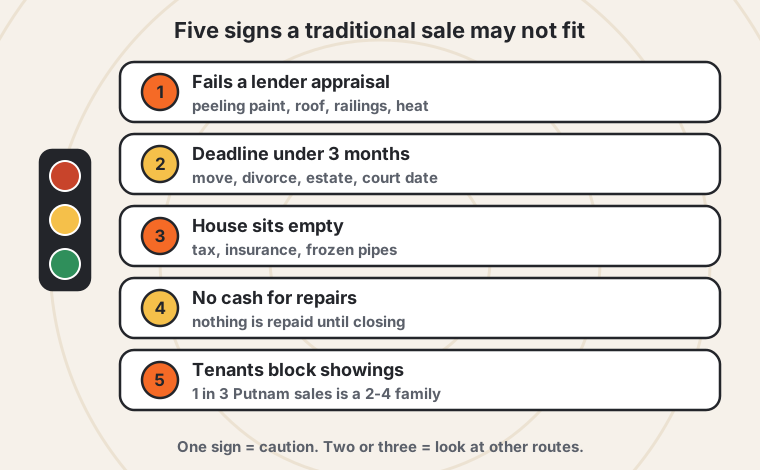
Maybe the house is a mill-era two-family near downtown with peeling paint and a tired porch. Maybe it was your mother’s Cape off Route 44 and it has sat empty since spring. Maybe you have a job starting in another state in six weeks. People in these spots often feel pressured by the clock, embarrassed by what an inspector will find, drained by the bills on an empty house, doubtful that anyone will pay a fair price, and afraid of making an expensive mistake.
Those feelings are signals, not weaknesses. This page is for you. Go through the five signs honestly; if none fit, list the house. If several fit, the rest of this page shows your options with Putnam numbers.
Is a cash sale right for you, or should you list?
Seven quick questions. There is no wrong answer, and we will tell you honestly if listing would leave you more.
- Does the house need repairs you would rather not pay for or manage?
- Do you need to close by a certain date, or within the next month or two?
- Would showings be hard: tenants, belongings, privacy, or you live out of state?
- Is there a complication: an estate or probate, a divorce, foreclosure, liens or back taxes?
- Could you comfortably cover the mortgage, taxes and utilities for three or more months?
- Is getting the highest possible price more important to you than speed and certainty?
- Would a buyer's bank lend on the house as it is (no major roof, foundation, oil tank or code issues)?
Sign 1: Will your Putnam house pass an FHA or lender appraisal?
Whether your Putnam house will pass an FHA or lender appraisal depends mostly on its condition, and that matters because many buyers at Putnam’s price level use FHA or other low-down-payment loans. FHA appraisers must note defective paint on homes built before 1978 and require it repaired (24 CFR 200.810), and 74% of Putnam’s one- to three-family homes were built before 1978.
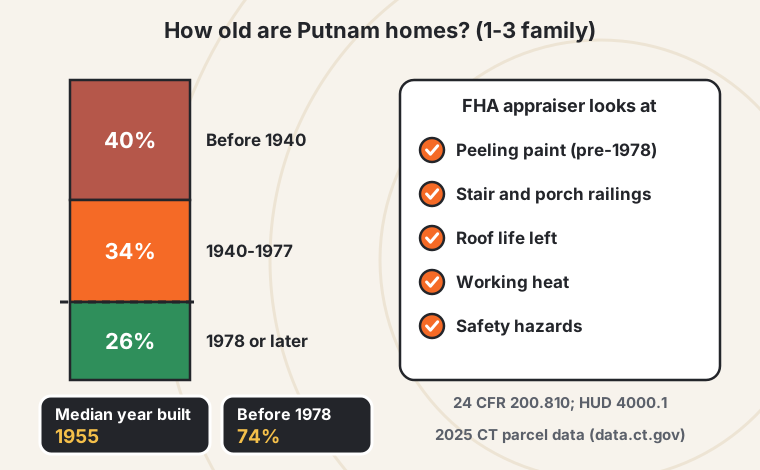
A buyer with a mortgage brings a lender, and the lender sends an appraiser. If the appraiser finds peeling paint on an older house, missing stair railings, a roof near the end of its life, no working heat, or other safety problems, the loan can be conditioned on repairs before closing. On a house with a lot of deferred work, that means you either pay for the repairs before closing, give a credit the lender may not allow, or lose the buyer.
Putnam’s numbers make this sign more common than in newer suburbs: the median one- to three-family home in town was built in 1955, about 40% predate 1940, and two-thirds heat with oil. If you know the house needs paint, porch, roof or heating work you cannot fund, a buyer who does not need a mortgage removes the problem. Our guide to selling a house that needs repairs in Connecticut covers the as-is route in more depth.
Sign 2: Is your deadline shorter than a listing takes?
Your deadline is shorter than a listing takes if you must be out or paid in less than about three months. A traditional sale needs time to prepare, list, find a buyer, and then usually 30 to 60 days for the buyer’s mortgage, appraisal and inspection, plus the risk that the buyer’s loan fails and you start over. A direct sale typically closes in about two weeks.
Common Putnam deadlines: a job move, a divorce agreement with a sale date, a parent moving into care, a tax collector’s notice, or a foreclosure case in the Windham Judicial District. If your deadline is legal (a court date, a probate order, a lender’s sale), talk to a Connecticut attorney first. For foreclosure, the free state mediation program and a HUD-approved counselor come before any sale; see our foreclosure options page.
If the house is in an estate, the Northeast Probate District (No. 26) handles it; it serves Ashford, Brooklyn, Eastford, Pomfret, Putnam, Thompson and Woodstock (CGS 45a-2). An executor can sell during probate with the court’s authority (CGS 45a-164), and a cash buyer can wait for that approval.
Sign 3: Is the house sitting empty?
A house sitting empty is a sign a traditional sale may not fit because every month on the market costs real money and adds risk. On a $295,000 Putnam house, property tax alone is about $318 a month at the fiscal 2027 mill rate (est.), before insurance, heat and upkeep, and a vacant house can lose standard insurance coverage, freeze in winter or draw break-ins.
Count the monthly cost honestly: tax, insurance (the Connecticut average homeowners premium is about $2,036 a year, and a vacant-home policy usually costs more), oil or electric to keep pipes from freezing, lawn and snow. Our carrying-cost worksheet walks through it line by line, and our vacant house page explains how a sale works when you are not there. A traditional listing can still work for a vacant house in good shape; it is the combination of empty, older and needing work that tips the balance.
Sign 4: Can you pay for repairs and preparation up front?
If you cannot pay for repairs and preparation up front, a traditional sale may not be right, because a listing usually needs cleaning, a cleanout, paint and the repairs a buyer’s lender will ask for before you are paid anything. A direct buyer takes the house as it is, with the contents, and the costs come out of the price instead of your pocket.
For an older Putnam house, preparation can include a dumpster and cleanout, exterior paint on a pre-1978 house, an oil tank question, a septic or sewer issue, and small code items. None of it is paid back until closing. If you have the cash and the time, preparation usually earns more than it costs; our guide on what to fix before selling in Connecticut shows which fixes pay. If you do not, that is a sign.
Sign 5: Do tenants make showings and inspections hard?
Tenants make a traditional sale hard when they will not keep units show-ready, when a buyer wants the house empty, or when an owner-occupant’s lender needs to see every unit. In Putnam about one in three recorded home sales is a two- to four-family house, so this sign is common, and a buyer who purchases with tenants in place avoids it.
You cannot simply ask tenants to leave so you can sell; Connecticut requires notice and, if they do not go, a court eviction case. Many investors and direct buyers will buy a Putnam two- or three-family with the leases and deposits transferring at closing. Our guide to selling a rental with tenants in Connecticut explains the rules for leases and security deposits.
What does the math look like on a $295,000 Putnam house?
On a $295,000 Putnam house that needs $10,000 of lender-required repairs and three months of carrying costs, a traditional sale leaves roughly $263,736 after a 5% commission, the $2,950 conveyance tax and an attorney (est.). An illustrative $235,000 direct offer leaves about $231,150. In this example the traditional sale nets about $32,586 more, if it closes.
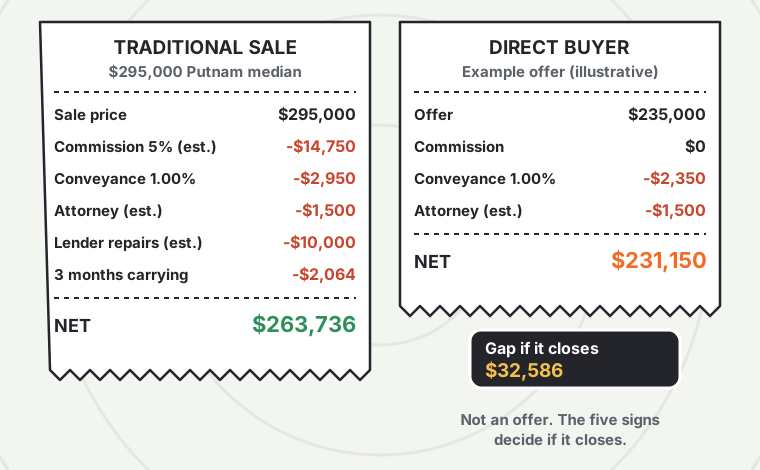
| Line | Traditional sale | Direct buyer (illustrative offer) |
|---|---|---|
| Sale price | $295,000 (Putnam single-family median) | $235,000 |
| Commission, 5% (est.) | -$14,750 | $0 |
| Conveyance tax, 1.00% | -$2,950 | -$2,350 |
| Your attorney (est.) | -$1,500 | -$1,500 |
| Lender-required repairs (est.) | -$10,000 | $0 |
| Three months of tax, insurance and utilities at $688 a month (est.) | -$2,064 | $0 |
| Approximate net | $263,736 | $231,150 |
If the signs above do not apply, take the higher number and list. If two or three apply, the real comparison is not $263,736 against $231,150; it is $231,150 against the chance that the traditional sale fails, the repairs cost more, or the wait runs into winter. Our guide to why cash offers are lower explains how a buyer builds the number.
How much would you walk away with?
Slide the numbers to match your house. It works in your browser; nothing is saved or sent.
Estimates for planning. Conveyance tax per CGS 12-494 (state 0.75% up to $800,000, 1.25% to $2.5M, 2.25% above, plus the town rate). Seller attorney about $1,200 to $1,500; flat-fee MLS about $400; listings include three months of taxes, insurance and utilities, a cash sale about two weeks. Your attorney gives you the final numbers.
When is a traditional sale the right choice in Putnam?
A traditional sale is the right choice in Putnam when the house is in sound condition and likely to pass a lender’s appraisal, you have three months or more, you can carry the costs, and the house is empty or the tenants cooperate. In that case listing usually nets more, and you should not sell to a cash buyer.
Plenty of Putnam houses fit that description. A well-kept Cape or ranch with a newer roof and boiler will draw financed buyers, and a fairly priced listing gives you competition a single cash buyer cannot. If that is your house, list it, and use our pricing guide to set the price.
What are the options if a traditional sale is not right?
If a traditional sale is not right, your main options are a direct sale to a cash buyer, a listing marketed to investors as-is (still with an agent, but priced for cash buyers), selling to a tenant or neighbor, or holding and renting the house. Our cluster guide on how to sell a house in Connecticut compares every route.
For the full map, see the pillar on how to sell a house in Connecticut and the comparison of a cash buyer vs. a realtor. If you are leaning toward a direct sale, read how an investor sale works step by step and check any buyer with our cash buyer checklist.
Count your signs
Go through the five above. Write down which ones fit.
Get a listing estimate
Ask a local agent what the house would sell for as it is, and what repairs a lender would likely require.
Get a direct offer
Ask for a written cash number on our Putnam page. No fee, no obligation, and it does not expire on you.
Compare the nets
Use the calculator above, with your real repair bids and your real monthly costs.
Close on your date
A direct sale typically closes in about two weeks through Connecticut attorneys; you pay the 1.00% conveyance tax and your attorney from the proceeds.
Frequently asked questions
What are the signs a traditional sale is not right for my Putnam house?
The signs a traditional sale is not right for a Putnam house are a house that will not pass a lender’s appraisal, a deadline shorter than about three months, a vacant house, no money for repairs up front, and tenants who make showings hard.
What will an FHA appraiser flag on an older Putnam house?
On an older Putnam house an FHA appraiser will flag defective paint on homes built before 1978, safety hazards such as missing railings, a roof near the end of its life, and systems that do not work. The loan can be conditioned on repairs before closing.
How many homes sell in Putnam each year?
In the last full year in the state data, October 2022 to September 2023, 140 homes sold in Putnam at a median of $280,000; single-family homes had a median of $295,000.
What is the conveyance tax in Putnam?
The conveyance tax in Putnam is 1.00% for most homes: 0.75% to the state and 0.25% to the town, paid by the seller. On a $295,000 sale that is $2,950 (CGS 12-494).
Can I sell a Putnam house with tenants in it?
Yes, you can sell a Putnam house with tenants in it. Leases and security deposits transfer to the buyer at closing, and many cash buyers buy with tenants in place.
How fast can I sell my Putnam house without listing?
A direct sale of a Putnam house typically closes in about two weeks once title is clear. An estate, a lien or a foreclosure case can add time.
Do I have to fix the house before selling it as-is?
No, you do not have to fix a house before selling it as-is in Connecticut, but you must still give the buyer the property condition report or a $500 credit (CGS 20-327c), and the lead paint disclosure for a home built before 1978.
Which probate court handles a Putnam estate?
A Putnam estate is handled by the Northeast Probate District, district 26 under CGS 45a-2, which also serves Ashford, Brooklyn, Eastford, Pomfret, Thompson and Woodstock.
Is a cash buyer always the answer if my house needs work?
No. If the work is cheap and you have time, fixing it and listing usually nets more. A cash buyer makes sense when the repairs are large or uncertain, or when time and cash are short.
Related guides
The decision
Your situation
For the full process, see how to sell a house in Connecticut, or get a no-obligation number on our Putnam page.
Plain-English information, not legal advice. Talk to a Connecticut attorney about your own sale.
Sources (checked on October 27, 2026)
- Connecticut OPM Real Estate Sales (Putnam, recorded Oct 2022 to Sep 2023), data.ct.gov.
- 2025 Connecticut Parcel and CAMA Data (Putnam year built and heating fuel), data.ct.gov.
- OPM mill rates, fiscal 2027, data.ct.gov.
- 24 CFR 200.810 (HUD lead-based paint requirements for FHA-insured properties) and HUD Handbook 4000.1.
- EPA and HUD lead-based paint disclosure rule.
- CGS 12-494 (conveyance tax).
- CGS 20-327b and 20-327c (property condition report).
- CGS 45a-2 (probate districts), CGS 45a-164 (fiduciary sale) and CGS 51-344 (judicial districts).
- NAIC Homeowners Insurance Report (Connecticut average premium).
See the house together.
Pick a time that works.
Choose a time for us to walk through the property with you, or ask for a quick call first. We confirm every request personally.
Tuesday, January 13
No open times in the next few weeks. Please call us.
We will confirm by email. Nothing is booked until we do.
View my request
Who wrote this
Jerryll Noorden
Jerryll has bought and sold Connecticut houses since 2016 and has sat at more closing tables than he can count, on both sides. Before real estate he was a robotics scientist at NASA, IHMC and IIT. He wrote this guide because the national sites that rank for it skip the Connecticut rules that cost sellers money. When listing or selling it yourself would get you more than a cash offer, he says so.
This guide explains Connecticut rules in plain English. It is not legal or tax advice. Laws change; for your sale, talk to a Connecticut real estate attorney and a tax professional.
