
Key facts at a glance
This guide covers the negotiation itself: what you can bargain over, when, and how to say it, from the first offer to the closing table. It is part of our guide on how to sell a house in Connecticut. How to rank several offers against each other is covered in how to compare offers on a house in Connecticut, and every seller cost is listed in the cost to sell a house in Connecticut; this page links to them rather than repeating them.
| Fact | Number or rule | Source |
|---|---|---|
| Property condition report | Due before the buyer signs a binder or contract; $500 credit at closing if not given | CGS 20-327b, 20-327c |
| Smoke and carbon monoxide affidavit | Signed by the seller and handed over at closing (1-2 family homes and condo units); there is no cash-credit alternative | CGS 29-453, as amended by PA 23-164 |
| Who conducts the closing | A Connecticut attorney | CGS 51-88a |
| Conveyance tax the seller pays | 0.75% state up to $800,000, plus 0.25% town (0.50% in 16 towns) | CGS 12-494 |
| Buyer’s agent fee | Negotiable; buyers sign their own agent agreement since Aug 17, 2024 | NAR settlement practice changes |
| Seller credit limits on a Fannie Mae loan | 3%, 6% or 9% of the price by down payment; 2% on investment property | Fannie Mae Selling Guide B3-4.1-02 |
| Lead paint, homes built before 1978 | Buyer gets a 10-day opportunity to test unless waived | EPA/HUD lead disclosure rule |
How do you negotiate the sale of your house in Connecticut?
You negotiate the sale of your house in Connecticut in four rounds: the offer and counteroffers on price and terms, the contract that the attorneys finalize, the inspection requests, and the appraisal and loan stage, followed by the closing adjustments. Before round one, know your walk-away net. In each round, trade on terms, not only price, answer in writing, and let your Connecticut attorney review every change before you sign.
Most sellers think of negotiation as haggling over the price. In Connecticut, the price is usually settled in a day. The money you keep or lose is decided over the next four to six weeks: the credit the buyer asks for, the inspection list, the appraisal, the closing date, the oil in the tank and the tax adjustment. This guide walks through each round with the Connecticut rules and plain scripts you can adapt.
We buy houses ourselves, so we are on the other side of the table in some negotiations. This guide is written for sellers who list, sell by owner or sell to a buyer like us, and it tells you where you have leverage in each case.
Why does negotiating the sale of your home feel so uncomfortable?
Negotiating the sale of your home feels uncomfortable because it mixes money with memories, and because the other side does this more often than you do. Buyers’ agents negotiate every week; most sellers do it a few times in their lives. Feeling exposed, rushed or second-guessed is normal, and preparation is the cure.
Sellers describe feeling insulted by a low first offer on a house they raised children in, anxious that pushing back will scare the buyer away, pressured by deadlines they did not set, suspicious that the inspection list is a price cut in disguise, and worn down by weeks of back-and-forth. Some feel alone, especially when selling by owner or settling a parent’s estate.
This page is for you. Every round below comes with the Connecticut rule that applies, the numbers, and words you can use. You do not need to be a tough negotiator. You need to know your number and your options.
What should you decide before you negotiate?
Before you negotiate, decide your walk-away number: the lowest price that still leaves you the cash you need after commissions, the conveyance tax, your attorney and your mortgage payoff. Also decide your best alternative if no deal is reached: wait, rent the house, relist later or sell for cash. A seller with a number and a plan B negotiates calmly.
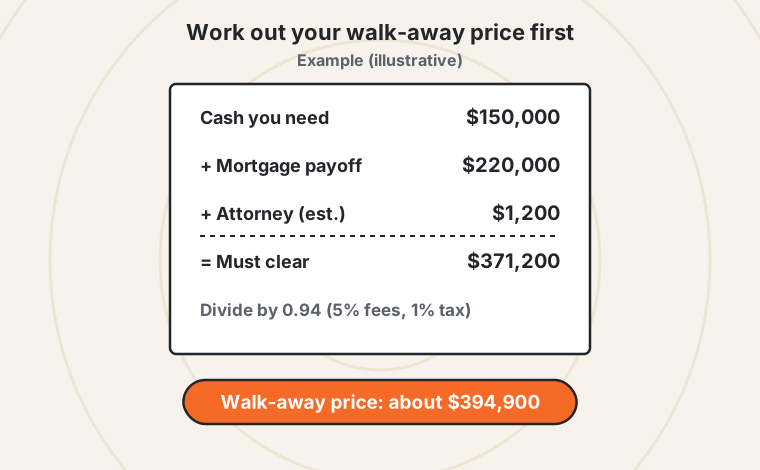
Example (illustrative). You owe $220,000 on your mortgage and need $150,000 in hand for your next home. You expect to pay 5% in commissions (both agents), the 1% conveyance tax of a 0.25% town (CGS 12-494) and about $1,200 for your attorney (est.). Every dollar of price leaves you 94 cents after the percentage costs, so:
| Line | Amount |
|---|---|
| Cash you need | $150,000 |
| Plus mortgage payoff | $220,000 |
| Plus attorney (est.) | $1,200 |
| Total you must clear | $371,200 |
| Divided by 0.94 (after 5% commissions and 1% conveyance tax) | about $394,900 walk-away price |
Write the number down. When a counteroffer arrives at 9 p.m., you will not have to work it out under pressure. The full list of seller costs, with a calculator, is in the cost to sell a house in Connecticut.
Then name your plan B, what negotiators call your best alternative to a negotiated agreement. For some sellers it is staying put another year. For a landlord it may be renting another year. For an estate it may be a cash sale. Knowing it keeps you from accepting a bad deal out of fear, and from refusing a good one out of pride.
Give buyers the Connecticut property condition report before they sign anything (CGS 20-327b). Consider a pre-listing inspection, fix or price the obvious items, and gather records for the oil tank, septic, roof and heating. Every surprise you remove before the offer is one less thing to negotiate after it. Our guide on what to fix before selling in Connecticut shows which repairs pay.
What are the stages of negotiation when selling a house in Connecticut?
The stages of negotiation when selling a house in Connecticut are: offer and counteroffer, the binder or purchase agreement that the attorneys finalize, the inspection period, the appraisal and mortgage commitment, and the closing adjustments. Each stage has its own deadline and its own leverage, and most of the money changes hands after the price is agreed.
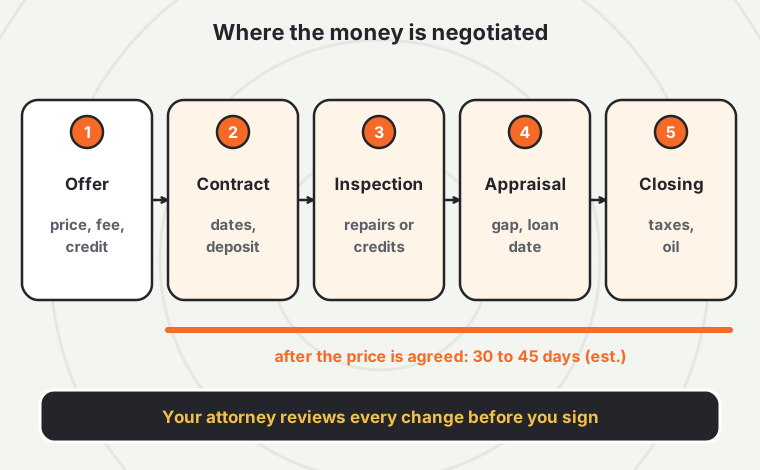
| Stage | What is negotiated | Connecticut detail |
|---|---|---|
| 1. Offer and counteroffers | Price, buyer’s agent fee, credits, deposit, contingencies, dates, what stays with the house | The buyer should have your condition report before signing an offer or binder (CGS 20-327b) |
| 2. Contract | Exact wording of contingencies and deadlines, deposit escrow, possession | Practice varies by region: some deals use a full agents’ form contract, others a short binder followed by an attorney-drafted contract; either way, attorneys review |
| 3. Inspection | Repairs, credits or a price change after the buyer’s inspection | Window set by the contract, often about 7 to 14 days (est.); 10-day lead test right on pre-1978 homes unless waived |
| 4. Appraisal and loan | Appraisal shortfall, extension of the mortgage commitment date, lender-required repairs | Set by the contract’s mortgage contingency |
| 5. Closing adjustments | Property tax proration, oil in the tank, final water and sewer, any post-closing occupancy | Taxes are paid in arrears, so the seller usually credits the buyer; the buyer usually pays for oil left in the tank (custom) |
How should you counter an offer on your Connecticut house?
You should counter an offer on your Connecticut house in writing, on the one or two terms that matter most to your net or your timing, and you should give a short deadline to reply. A good counter changes price and terms together: a slightly higher price for a smaller credit, or the buyer’s price in exchange for a shorter inspection window or no home-sale contingency.
What you can put in a counter:
- Price. The obvious one. Moving by small, decreasing steps signals you are near your limit.
- The buyer’s agent fee. Since August 17, 2024, buyers sign their own agreement with their agent, and many ask the seller to pay that fee in the offer. You can accept, reduce or decline it like any other term.
- Closing-cost credits. A credit is a price cut by another name. On a Fannie Mae loan it is capped at 3%, 6% or 9% of the price depending on the down payment (2% on investment property).
- Deposit. A larger deposit, held in escrow by an attorney or broker, shows commitment.
- Contingency windows. Shorter inspection and mortgage commitment periods reduce your risk.
- Dates and possession. The closing date, or a short stay after closing if you need time to move.
- What stays. Appliances, a shed, a generator, furniture you do not want to move.
Scripts you can adapt.
- Low first offer: “Thank you for the offer. The seller has reviewed recent sales nearby and is countering at $___. The seller is flexible on the closing date.”
- Price fine, credit too big: “The seller accepts $___ with a closing-cost credit of $___ instead of $___.”
- Trading price for certainty: “The seller will accept your price if the inspection period is seven days and the home-sale contingency is removed.”
- Holding firm: “The seller has priced the home to the market and is not able to move on price. The seller can offer a June closing to suit your lease.”
Two habits protect you. Put every counter in writing and give it a deadline, for example “this counteroffer expires at 6 p.m. tomorrow.” And never sign the final agreement until your Connecticut attorney has read it; after that, changes are much harder.
From the old version of this guide, one tip still holds: learn what the buyer needs. A buyer whose lease ends June 30 may trade money for that date. A buyer relocating for a job may value a quick close over a credit. Ask the buyer’s agent what matters to their client besides price.
What happens at the contract and attorney stage in Connecticut?
At the contract stage in Connecticut, the accepted terms become a written purchase agreement that each side’s attorney reviews, and sometimes drafts, before it is final. Connecticut has no statutory attorney review period like some states; how the contract is formed varies by region and by the forms the agents use. Either way, this is the last easy moment to fix wording, deadlines and the deposit terms.
What to ask your attorney to check at this stage:
- The mortgage contingency: the loan amount, the commitment date and what happens if it passes
- The inspection contingency: how long, and whether the buyer can cancel or only ask for repairs
- Any appraisal clause or gap coverage
- The deposit: amount, when it is due, and whose escrow account holds it
- Possession: keys at closing, or a written use-and-occupancy agreement if you stay a few days
- Assignment: whether the buyer can assign the contract to someone else (see “and/or assigns” in a contract)
- That the condition report and, for pre-1978 homes, the federal lead disclosure are attached
Connecticut closings must be conducted by a Connecticut attorney (CGS 51-88a). Most sellers hire their own, typically about $1,000 to $1,500 for a straightforward sale (est.). The Connecticut closing process for sellers covers what your attorney does from contract to closing.
How do you handle the buyer’s inspection repair requests?
You handle the buyer’s inspection repair requests by sorting them into safety or lender items, real defects you did not know about, and wish-list items, then answering with a credit or a price adjustment rather than doing repairs yourself where you can. Get a contractor’s quote for anything large, answer in writing within the contract’s window, and decline the wish list politely.
Sort the list into three piles:
- Safety and lender items. Missing smoke or carbon monoxide detectors, exposed wiring, no handrail, a furnace that does not work. These usually have to be solved, by you or with a credit. Note that you must give the buyer a signed smoke and CO affidavit at closing on a one- or two-family home (CGS 29-453); since PA 23-164 there is no option to pay a credit instead, so working detectors are not negotiable.
- Real defects. A roof at the end of its life, an active leak, an oil tank that fails a test. Negotiate these on a contractor’s quote, not the buyer’s guess.
- Wish-list items. Old but working windows, dated bathrooms, cosmetic cracks. You can decline: “The seller has priced the home to reflect its age and condition.”
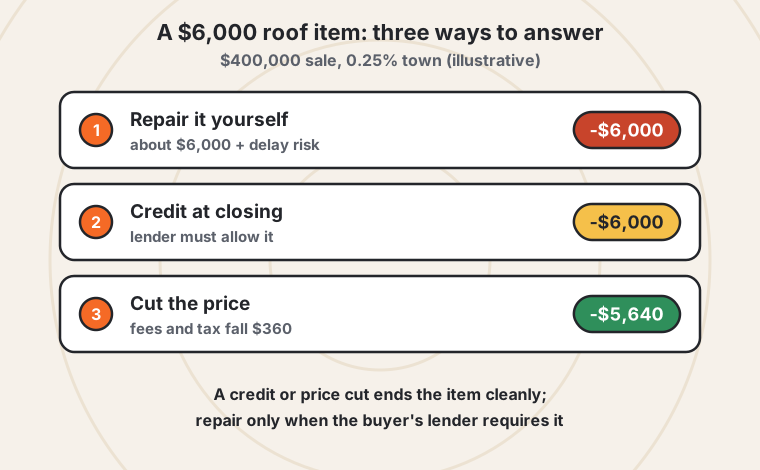
Repair, credit or price cut? On an illustrative $400,000 sale in a 0.25% town, say the buyer’s inspector finds a roof problem a contractor quotes at $6,000:
| Your answer | What it costs your net | Watch out for |
|---|---|---|
| Do the repair before closing | About $6,000, plus your time | Scheduling, a buyer who disputes the quality, a delayed closing |
| Credit $6,000 at closing | $6,000 | The buyer’s loan limits credits and they cannot exceed the buyer’s actual closing costs; the lender must approve it |
| Reduce the price by $6,000 | About $5,640 | Lowers the commissions (5%, $300) and conveyance tax (1%, $60) you pay; also helps if the appraisal is tight |
A credit or price cut ends the item cleanly: the buyer fixes it their way after closing, and you are not on the hook for a contractor’s work. A repair makes sense mainly when the buyer’s lender requires it before it will lend.
Script: “The seller has reviewed the inspection report. The seller will credit $___ at closing toward the roof, based on the attached contractor’s quote. The seller declines the remaining items, which reflect the age of the home and were considered in the price.”
For a home built before 1978, federal rules require you to disclose known lead-based paint and hazards, give the buyer the EPA pamphlet and any reports, and allow a 10-day opportunity to test before the buyer is bound, unless they waive it. That window can run alongside the inspection period, so plan for it in your dates.
How do you negotiate a low appraisal?
You negotiate a low appraisal by first checking the contract: whether the buyer promised to cover a gap and whether their mortgage contingency lets them cancel. Then you choose among the buyer paying the difference, splitting it, cutting the price to the appraised value, asking the lender for a reconsideration with better comparable sales, or cancelling and relisting. The right answer depends on how strong your market is.
A short version of the options, from strongest to weakest for you:
- Hold the price if the buyer signed a gap clause or has the cash and wants the house.
- Ask for a reconsideration of value with two or three recent nearby sales the appraiser missed.
- Split the difference when both sides want to close.
- Meet the appraisal when your next buyer’s lender would likely find the same value.
Script: “The seller is disappointed in the appraisal and has asked the lender to reconsider, with the attached sales. In the meantime, the seller proposes to split the $___ difference.”
Our guide to low appraisals when selling a house in Connecticut works through the gap math for conventional and FHA buyers.
What closing adjustments are customary in Connecticut?
The closing adjustments customary in Connecticut are the property tax proration, where the seller usually credits the buyer because taxes are paid in arrears, and the oil adjustment, where the buyer reimburses the seller for heating oil left in the tank. Final water and sewer use, any prepaid fees and rent for occupied homes are also split. These are custom and contract, not price, but they still move money.
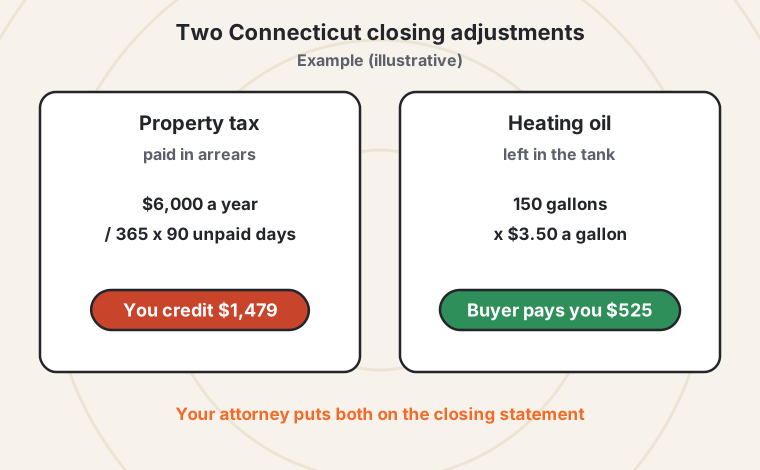
Property tax. Connecticut towns bill taxes in arrears, so at closing you usually owe the buyer for the part of the tax period you owned the house that has not yet been paid. On an illustrative $6,000 annual tax bill, 90 unpaid days come to about $1,479 ($6,000 / 365 x 90). The amount is the same whichever buyer you pick, so it is rarely worth fighting over; just expect it.
Heating oil. By Connecticut custom, the buyer pays you for oil left in the tank. At an illustrative 150 gallons and $3.50 a gallon, that is $525. Ask your attorney how the gallons will be measured, often a tank reading or the last delivery receipt. Some buyers ask for the oil in the counteroffer; it is a small item you can trade.
Staying after closing. If you need a few days to move, ask for a written use-and-occupancy agreement with a daily fee and a holdback from your proceeds as security. Buyers’ lenders sometimes limit this, so raise it in the offer stage, not on the closing day.
How do you negotiate with a cash buyer or investor?
You negotiate with a cash buyer or investor by asking how they built the number, comparing it to a realistic listing net, and negotiating on terms as well as price: the closing date, what you can leave behind, who pays which closing costs, the deposit and whether the contract can be assigned. A serious cash buyer can explain the repairs and sales behind the offer and shows proof of funds.
Questions to ask any cash buyer, including us:
- What repairs did you price, and which recent sales did you compare?
- Can I see proof of funds, and will my attorney hold the deposit or confirm it?
- Will you close in your own name, or can the contract be assigned to someone else?
- Can I choose the closing date and leave what I do not want?
- Are there any fees to me? (There should be none.)
- Does the offer expire? (Pressure to sign today is a red flag.)
Our page on we buy houses scams and red flags lists what regulators have found, and why cash offers are lower shows the formula most buyers use. For a direct comparison of the two routes, read cash buyer vs realtor in Connecticut.
When should you NOT sell to a cash buyer instead of negotiating with a financed buyer?
You should not sell to a cash buyer instead of negotiating with a financed buyer when your house is in good shape, your market is active and you have the time to work through inspection and appraisal. Then the extra rounds of negotiation are worth thousands of dollars, and a good agent or attorney can carry most of the load for you.
A cash sale is the better trade when the negotiation itself is the problem: a house with defects financed buyers will not accept, a deal that has already fallen apart, an estate or divorce where every round needs several signatures, or a deadline you cannot miss. In those cases, one number, no inspection list, no appraisal and a closing date you choose can be worth the lower price. Cash buyer vs realtor lays out the comparison in dollars.
What negotiation mistakes do Connecticut sellers make?
The negotiation mistakes Connecticut sellers make are negotiating without a walk-away number, fighting over price while giving away credits and dates, doing repairs instead of offering credits, answering inspection requests without a contractor’s quote, missing contract deadlines, and signing changes before their Connecticut attorney has read them.
- Taking the first offer personally. A low offer is information, not an insult. Counter it.
- Winning the price and losing the credit. A $5,000 higher price with an $8,000 credit is a loss.
- Repairing instead of crediting. You take on contractor risk and delay.
- Forgetting the smoke and CO affidavit. It is required at closing on a one- or two-family home; there is no credit option any more.
- Skipping the condition report. It costs a $500 credit and does not excuse known defects (CGS 20-327c).
- Letting deadlines slide. Contingency dates protect you only if someone watches them.
What are the steps to negotiate the sale of your house in Connecticut?
The steps to negotiate the sale of your house in Connecticut are: set your walk-away number and plan B, prepare disclosures and records, counter in writing on price and terms, have your attorney finalize the contract, answer inspection requests with quotes and credits, handle the appraisal, and check the closing adjustments. Most of it happens within 30 to 45 days of an accepted offer with a mortgage buyer (est.).
Know your number
Work out your walk-away price and your best alternative before you list or answer any offer.
Prepare
Condition report, lead disclosure for pre-1978 homes, oil tank and septic records, working smoke and CO detectors.
Counter in writing
Trade price and terms together, with a deadline.
Finalize the contract with your attorney
Check contingencies, dates, deposit, possession and assignment.
Answer the inspection
Sort the list, get quotes, offer credits, decline the wish list.
Handle the appraisal
Check the contract, request a reconsideration if warranted, then decide.
Review the closing statement
Tax proration, oil, final readings, credits. Your attorney conducts the closing (CGS 51-88a).
See the house together.
Pick a time that works.
Choose a time for us to walk through the property with you, or ask for a quick call first. We confirm every request personally.
Tuesday, January 13
No open times in the next few weeks. Please call us.
We will confirm by email. Nothing is booked until we do.
View my requestQuestions Connecticut sellers ask about negotiating a sale
How do I counter a low offer on my house?
To counter a low offer on your house, answer in writing with a price backed by recent nearby sales, and add a term the buyer values, such as a flexible closing date. Give a short deadline. A low offer is a starting point, not an insult.
Should I offer a credit or make repairs after the inspection?
You should usually offer a credit or a small price reduction rather than make repairs after the inspection. A credit ends the item cleanly and avoids contractor delays, as long as the buyer’s lender allows it. Repairs make sense mainly when the lender requires them.
Is there an attorney review period in Connecticut?
Connecticut has no statutory attorney review period like some other states. Contracts are formed in different ways by region, but each side’s attorney normally reviews the agreement, and Connecticut closings must be conducted by an attorney (CGS 51-88a).
Do I have to pay the buyer’s agent in Connecticut?
You do not have to pay the buyer’s agent in Connecticut. Since August 17, 2024, buyers sign their own agreement with their agent, and many ask the seller to pay that fee in the offer. You can accept, reduce or decline the request.
Who pays for the oil in the tank when selling a house in Connecticut?
By Connecticut custom, the buyer pays the seller for heating oil left in the tank at closing. The attorneys add it to the closing statement, usually based on a tank reading or the last delivery receipt.
Why do I owe the buyer property taxes at closing?
You usually owe the buyer property taxes at closing because Connecticut towns bill taxes in arrears. Your attorney credits the buyer for the days you owned the house that the buyer’s next bill will cover.
Can I pay a credit instead of giving the smoke and CO affidavit?
No, you can no longer pay a credit instead of giving the smoke and carbon monoxide affidavit. Under CGS 29-453, as amended by PA 23-164, the seller of a one- or two-family home or condo unit must sign and present the affidavit at closing.
What happens if I do not give the buyer the property condition report?
If you do not give the buyer the property condition report before they sign, you must credit them $500 at closing (CGS 20-327c), and the credit does not excuse you from disclosing known defects the report would have covered.
How much can a buyer ask me to pay in closing costs?
A buyer can ask you to pay closing costs up to their loan’s limit: on a Fannie Mae loan, 3%, 6% or 9% of the price depending on the down payment, and 2% on investment property. Every dollar of credit comes off your net.
Can I stay in the house after closing?
You can stay in the house after closing only if the buyer agrees in writing, usually through a use-and-occupancy agreement with a daily fee and a holdback from your proceeds. Raise it early; the buyer’s lender may limit it.
Can I negotiate with a cash buyer?
Yes, you can negotiate with a cash buyer. Ask how the offer was built, then negotiate price and terms: the closing date, what you leave behind, the deposit and whether the contract can be assigned. You should never pay a fee to a buyer.
What is a walk-away price?
A walk-away price is the lowest price you will accept: the amount that still leaves you the cash you need after commissions, the conveyance tax, your attorney and your mortgage payoff. Work it out before you see the first offer.
Related guides
- How to compare offers on a house in Connecticut
- Choosing the best offer in Cheshire: contingencies vs price and the best-and-final round
- Comparing offers on a New Haven multi-family with tenants
- Seller disclosure in New Britain’s older multi-families
- The Connecticut property condition disclosure, question by question
- The Connecticut closing process for sellers
- Real estate commission in Connecticut
Ready to see a cash number to hold next to your offers? Start on our page to sell your house in Connecticut, or read how selling your house to us works.
Plain-English information, not legal advice. Have a Connecticut attorney review any offer, counteroffer or contract before you sign.
Sources (checked on October 27, 2026)
- CGS 20-327b and 20-327c (property condition report; $500 credit).
- CGS 29-453 (smoke and carbon monoxide affidavit at closing).
- CGS 12-494 (conveyance tax).
- CGS 51-88a (closings conducted by attorneys).
- Fannie Mae Selling Guide B3-4.1-02 (interested-party contributions).
- EPA: lead-based paint disclosure rule for sales and leases.
- National Association of Realtors: settlement FAQs (practice changes effective Aug 17, 2024).

Who wrote this
Jerryll Noorden
Jerryll has bought and sold Connecticut houses since 2016 and has sat at more closing tables than he can count, on both sides. Before real estate he was a robotics scientist at NASA, IHMC and IIT. He wrote this guide because the national sites that rank for it skip the Connecticut rules that cost sellers money. When listing or selling it yourself would get you more than a cash offer, he says so.
This guide explains Connecticut rules in plain English. It is not legal or tax advice. Laws change; for your sale, talk to a Connecticut real estate attorney and a tax professional.
