
Key facts at a glance
For New Haven owners of a rented two- to four-family with offers in hand. It is the multi-family chapter of our guide on how to sell a house in Connecticut; the general method is in how to compare offers on a house in Connecticut.
| Fact | Number | Source |
|---|---|---|
| New Haven market home sales that were 2-4 families, Oct 2024 to Sep 2025 | 355 of 875 | data.ct.gov sales dataset (OPM), our count |
| Two-family median sale price | $375,000 (183 sales), up from $310,000 the year before | data.ct.gov, our count |
| Three-family and four-family median sale price | $454,500 (151 sales) and $640,000 (21 sales) | data.ct.gov, our count |
| Two- and three-family parcels in the city | 4,643 two-families and 2,929 three-families; median year built 1900 | 2025 CT Parcel and CAMA Data |
| Mill rate | 39.962 (fiscal 2027) | CT OPM mill rates |
| Conveyance tax a New Haven seller pays | 0.75% state + 0.50% city = 1.25% ($4,688 on $375,000) | CGS 12-494 |
| Tenant security deposits when you sell | Transfer to the buyer with the building | CGS 47a-21(c) |
How do you compare offers on a multi-family in New Haven, CT?
To compare offers on a multi-family in New Haven, CT, turn each offer into a net figure after commissions, credits, the 1.25% conveyance tax, lender-required repairs and any rent you lose to deliver a vacant unit, then rank the offers by how likely they are to close with your tenants in place. On a typical two-family, the highest price is often an FHA owner-occupant, and it is often not the best offer.
Three kinds of buyers show up for New Haven two- to four-families: an owner-occupant with an FHA loan, an investor who keeps the tenants, and a cash buyer. Each needs something different from your tenants and your building, which is why a $15,000 price lead can turn into a deficit once you run the numbers.
We buy houses ourselves, including occupied New Haven multi-families, so read the cash section with that in mind. In the worked example on this page, the cash offer is not the winner on paper, and we say so.
Why is choosing between offers on a rented New Haven building so stressful?
Choosing between offers on a rented New Haven building is stressful because the decision is not only yours: your tenants’ homes, their leases and their deposits travel with the sale, and each buyer wants something different from them. You also carry the building’s risk until the day of closing, so a deal that falls apart costs you rent, time and goodwill with the people living upstairs.
Owners feel responsible for long-time tenants and guilty that a sale might make one move. They feel suspicious of offer letters that all claim to be strongest, worn out from running an old building, torn when the best price wants the first floor empty, and cautiously hopeful, because New Haven two-family prices rose about 21% in a year.
This page is for you. It does not tell you which buyer to pick. It shows you how each offer works on a New Haven building with tenants, in dollars, so you can pick with your eyes open.
Who makes offers on New Haven 2-4 families, and what does each one need?
Offers on New Haven 2-4 families come from three kinds of buyers: owner-occupants using FHA or low-down-payment conventional loans, investors using conventional loans with 25% down, and cash buyers. Owner-occupants need a unit to live in and a building that passes their lender’s appraisal; investors need leases, rents and a rent roll they can verify; cash buyers need neither and buy the building as it stands.
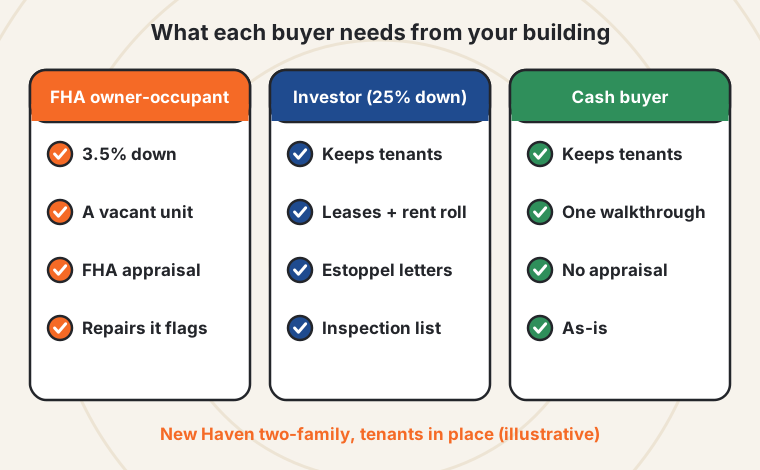
The loan rules behind this: since November 2023, Fannie Mae has allowed owner-occupants to buy a two- to four-unit home with as little as 5% down, FHA allows 3.5%, and an investor buying a 2-4 unit rental with a conventional loan usually needs 25% down (Fannie Mae Eligibility Matrix; HUD Handbook 4000.1). That is why owner-occupants can outbid investors on price in New Haven, and why their offers carry the most conditions, which land on your tenants.
What do three real-world-style offers on a New Haven two-family net?
Three real-world-style offers on a New Haven two-family listed at $375,000 net very differently: an FHA owner-occupant at $385,000 nets about $336,787, a conventional investor at $370,000 nets about $343,525, and a cash buyer at $330,000 nets about $316,425 through the listing, or $324,675 if you sold to that buyer directly. Example (illustrative), before your mortgage payoff.
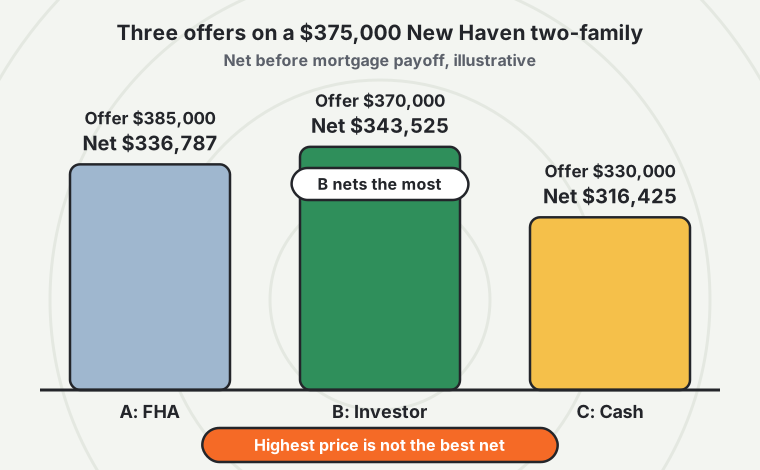
The setup (illustrative). A New Haven two-family listed at $375,000, the city’s two-family median for the year to September 2025. Built around 1900, like the median New Haven two-family. Both units are rented: the first floor at $1,700 a month and the second at $1,600, on one-year leases. You have a listing agent at 2.5%. Three offers come in:
- Offer A: $385,000, FHA, 3.5% down. The buyer will live on the first floor, so that unit must be empty at closing. Asks you to pay the buyer’s agent 2.5% and credit 3% toward closing costs. Inspection, appraisal and mortgage contingencies. Closing in 45 days.
- Offer B: $370,000, conventional investor, 25% down. Keeps both tenants. Asks you to pay the buyer’s agent 2%. No credit. Wants copies of the leases and signed tenant estoppel letters. Inspection and mortgage contingencies. Closing in 35 days.
- Offer C: $330,000, cash, as-is. Buys with both tenants in place. No buyer’s agent, no inspection or financing contingency, proof of funds attached. Closing in about two weeks.
| Line | A: FHA owner-occupant | B: Conventional investor | C: Cash, as-is |
|---|---|---|---|
| Price | $385,000 | $370,000 | $330,000 |
| Your listing agent (2.5%) | -$9,625 | -$9,250 | -$8,250 |
| Buyer’s agent fee requested | -$9,625 (2.5%) | -$7,400 (2%) | $0 |
| Closing-cost credit | -$11,550 (3%) | $0 | $0 |
| Conveyance tax (1.25%, New Haven) | -$4,813 | -$4,625 | -$4,125 |
| Your attorney (est.) | -$1,200 | -$1,200 | -$1,200 |
| FHA-required repairs, e.g. peeling paint, handrails (est.) | -$5,000 | $0 | $0 |
| Inspection credit (est.) | -$3,000 | -$4,000 | $0 (as-is) |
| Rent lost to deliver the first floor vacant (2 months at $1,700) | -$3,400 | $0 | $0 |
| Net before your mortgage payoff | $336,787 | $343,525 | $316,425 |
| If A appraises at $375,000 and you meet it | $327,712 | n/a | No appraisal |
- The highest price came second. A’s $15,000 price lead is eaten by a 3% credit, a bigger buyer’s agent fee, FHA repairs and two months of lost rent: about $21,700.
- The vacant unit is a real cost, and if the deal fails you have an empty unit and no buyer.
- The appraisal can move A down again: at $375,000, A nets about $327,712, about $15,800 below B.
- Cash is the most certain and the lowest: about $27,100 below B through the listing, or about $18,850 below B ($324,675) if the cash buyer came to you directly.
Run your own building in the calculator below. Put in each offer’s price, fees and credits and New Haven’s 1.25% conveyance tax.
How much would you walk away with?
Slide the numbers to match your house. It works in your browser; nothing is saved or sent.
Estimates for planning. Conveyance tax per CGS 12-494 (state 0.75% up to $800,000, 1.25% to $2.5M, 2.25% above, plus the town rate). Seller attorney about $1,200 to $1,500; flat-fee MLS about $400; listings include three months of taxes, insurance and utilities, a cash sale about two weeks. Your attorney gives you the final numbers.
Is an FHA owner-occupant offer a good offer on a New Haven multi-family?
An FHA owner-occupant offer can be a good offer on a New Haven multi-family when the building is in decent shape, the price is close to recent sales and you can deliver an empty unit without hardship. It is a weaker offer on an older building with peeling paint, on a three- or four-family whose rents may not pass FHA’s self-sufficiency test, or when emptying a unit means asking a long-term tenant to leave.
Three things decide whether an FHA offer on your building will close:
- The appraisal. The FHA appraiser checks condition as well as value. On a building from around 1900, expect flags for peeling paint (a lead concern in any pre-1978 home), missing handrails, roof leaks and heat that does not work. You pay for or negotiate the repairs.
- The empty unit. One unit must be vacant at closing. A tenant who does not leave can only be removed through Connecticut’s summary process (CGS 47a-23 and following), which takes weeks to months, so never sign a contract promising a vacant unit you cannot deliver.
- The self-sufficiency test on three- and four-families, explained next.
What is FHA’s self-sufficiency test, and can your New Haven three-family pass it?
FHA’s self-sufficiency test applies only to three- and four-unit homes: roughly 75% of the appraiser’s market rent for all the units, including the one the buyer will live in, must cover the buyer’s full monthly payment of principal, interest, taxes, insurance and mortgage insurance. At New Haven’s three-family median of $454,500 and a 39.962 mill rate, many buildings fail it unless rents are high or the buyer puts more down.
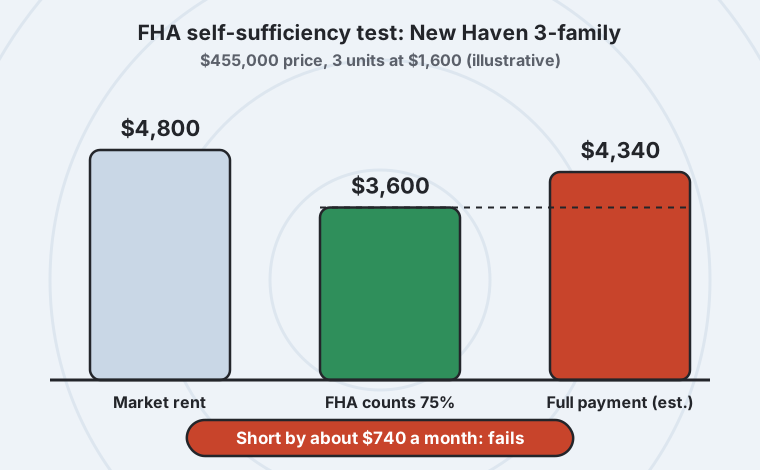
Here is the test on an illustrative New Haven three-family priced at $455,000, close to the city’s three-family median, with three units renting at $1,600 each:
| Line | Amount |
|---|---|
| Market rent, three units at $1,600 (illustrative) | $4,800 a month |
| Rent FHA counts (75%) | $3,600 a month |
| Principal and interest: $439,075 loan (3.5% down) plus 1.75% upfront mortgage insurance, 30 years at 6.5% (est.) | about $2,824 |
| Property tax: 70% of $455,000 x 39.962 mills / 12 | about $1,061 |
| Insurance (est.) and annual FHA mortgage insurance (0.55%, est.) | about $451 |
| Full monthly payment (est.) | about $4,340 |
| Result | Fails by about $740 a month |
If an FHA buyer offers on your three- or four-family, ask the lender before you accept whether the deal passes. Finding out on day 30 costs you a month and the buyers who moved on.
What makes a conventional investor offer strong on a rented building?
A conventional investor offer is strong on a rented New Haven building because the investor keeps your tenants, puts 25% down (the usual Fannie Mae minimum for a 2-4 unit investment purchase) and is valued on the rents, so the deal does not depend on an empty unit or a thin down payment. Its weak points are the rent verification and the inspection list.
An investor will want to see that the rents on paper are the rents in the bank. Expect requests for:
- Every lease, and which units are month-to-month
- A rent roll: unit, rent, lease end, deposit held, arrears
- Deposit records with the interest Connecticut law requires
- Tenant estoppel letters confirming rent, deposit and lease terms
Expect a long inspection list on an old building, used to renegotiate; our guide on negotiating the sale of your house in Connecticut shows how to answer it with credits rather than repairs. If a tenant is behind, say so in writing before the contract, not after. And because a Fannie Mae investment purchase caps seller contributions at 2% of the price, an investor cannot ask for the large credits an owner-occupant can, one reason offer B nets more despite the lower price.
What happens to your New Haven tenants and their deposits when you sell?
When you sell a New Haven multi-family, your tenants’ leases stay in force for the new owner, and their security deposits transfer to the buyer: Connecticut law treats a transfer of the building as an assignment of the deposits to the new landlord (CGS 47a-21(c)). At closing, your attorney credits the buyer with each deposit plus interest owed and prorates the month’s rent.
Showings need notice: a tenant may not unreasonably refuse entry to show the unit to buyers, but you must give reasonable written or oral notice and come at reasonable times (CGS 47a-16). Investors usually need one walkthrough; owner-occupants often want several visits and an appraiser inside. A short, honest note to your tenants about who is buying and that their lease stays in force makes all of it easier.
The full checklist for selling an occupied building, with Connecticut’s eviction timeline, is in our guide to selling a rental with tenants in Connecticut. For how 2-4 families are valued on their rents, see selling a multi-family house in Connecticut.
How do you rank the three offers by risk, not just by net?
You rank offers on a New Haven multi-family by risk by asking, for each one, what has to go right before closing and what it costs you if it goes wrong. An FHA offer needs a vacant unit, an appraisal and possibly repairs; an investor offer needs verified rents and a loan; a cash offer needs only verified funds. The fewer conditions, the more of the net reaches your bank account.
| What has to go right | A: FHA owner-occupant | B: Investor | C: Cash |
|---|---|---|---|
| A unit vacant by closing | Yes | No | No |
| Appraisal at the price | Yes, FHA standards | Yes | No |
| Lender-required repairs | Likely on a 1900 building | Rare | No |
| Typical close (est.) | 45 days or more | 35 to 45 days | About 2 weeks |
| If it fails | Empty unit, back on market | Back on market, tenants in place | Verify funds first to avoid this |
On this example, B is the best offer on both counts. A wins only if its buyer has strong reserves, the building is in good shape and the first-floor unit is already empty. C wins when B’s risks are real for your building, or when two weeks matters more to you than about $18,850 to $27,100.
For a wider look at when each route nets more, see cash buyer vs realtor in Connecticut.
When should you NOT sell your New Haven multi-family to a cash buyer?
You should not sell your New Haven multi-family to a cash buyer when the building is in good condition, the rents are documented and current, and you can give a listing 60 to 90 days. Then a financed buyer will usually net you more, as in our example, where the investor offer beats the cash offer by about $18,850 even with no listing agent on the cash side.
A cash sale makes more sense when the building needs work a lender will not finance, a tenant is far behind or the leases are informal, financed deals have already fallen through, or you are an estate or a tired landlord for whom a certain two-week closing is worth the difference.
Cash offers are built from the after-repair value minus repairs, the buyer’s costs and a margin; our page on why cash offers are lower shows the math, and cash buyer vs realtor compares the two routes side by side. If you want a written cash number to hold next to your listing offers, our New Haven page starts with just the address. We buy with tenants in place, there are no repairs, and the offer does not expire while you decide.
What are the steps to review offers on a New Haven multi-family?
The steps to review offers on a New Haven multi-family are: build your rent and deposit file, collect every offer in writing, net each one in a table, check the loan type against your building, rank by risk, counter on the weak term, and let your attorney review the contract before you sign. Done well, it takes a day or two, not weeks.
Build your rent file
Leases, a rent roll, deposits with interest and any arrears. A clean file draws cleaner offers.
Get every offer in writing
Price, loan type, down payment, deposit, contingency dates, credits, fees, closing date, and whether the buyer will occupy a unit.
Net each offer and match the loan to the building
Use the table above. FHA on a three- or four-family: ask about the self-sufficiency test. Investor: be ready for estoppels.
Rank by risk and counter the weak term
A smaller credit from the FHA buyer, a shorter inspection window from the investor, a larger deposit from the cash buyer.
Have your attorney review
Connecticut closings are conducted by attorneys (CGS 51-88a). Yours should read any promise about a vacant unit before you sign.
The seller costs that every offer shares are explained in the cost to sell a house in Connecticut.
See the house together.
Pick a time that works.
Choose a time for us to walk through the property with you, or ask for a quick call first. We confirm every request personally.
Tuesday, January 13
No open times in the next few weeks. Please call us.
We will confirm by email. Nothing is booked until we do.
View my requestQuestions New Haven owners ask about comparing offers on a multi-family
Can an FHA buyer purchase a New Haven two-family?
Yes, an FHA buyer can purchase a New Haven two-family with 3.5% down if they will live in one of the units. The building must meet FHA property standards at the appraisal, and one unit must be available for the buyer to move into.
Does the FHA self-sufficiency test apply to a two-family?
No, the FHA self-sufficiency test does not apply to a two-family. It applies to three- and four-unit homes, where roughly 75% of the market rent for all units must cover the buyer’s full monthly payment (HUD Handbook 4000.1).
How much down does an investor need for a New Haven multi-family?
An investor buying a New Haven multi-family with a conventional loan usually needs 25% down, the Fannie Mae maximum of 75% loan-to-value for a 2-4 unit investment purchase. Owner-occupants can put as little as 5% down on a 2-4 unit conventional loan.
Do I have to empty a unit to sell my multi-family?
You do not have to empty a unit to sell your multi-family. Investors and cash buyers buy with tenants in place. Only an owner-occupant needs a vacant unit, and you should never promise one you cannot legally deliver by the closing date.
What happens to my tenants’ security deposits when I sell?
Your tenants’ security deposits transfer to the buyer when you sell. Connecticut law treats the sale as an assignment of the deposits to the new landlord (CGS 47a-21(c)), and your attorney credits the buyer with each deposit plus interest at closing.
What is a tenant estoppel letter?
A tenant estoppel letter is a short signed statement in which a tenant confirms their rent, deposit, lease dates and any agreements with the landlord. Investors and their lenders use it to check that the rent roll is accurate.
What are New Haven multi-families selling for?
New Haven multi-families sold for a median of $375,000 for two-families (183 sales), $454,500 for three-families (151 sales) and $640,000 for four-families (21 sales) from October 2024 to September 2025, based on our count of the state’s data.ct.gov sales file.
Is the highest offer on my multi-family the best one?
The highest offer on your multi-family is not always the best one. After credits, fees, lender repairs and the rent you lose to deliver a vacant unit, a lower investor offer can net more and carry less risk, as in our New Haven example.
Related guides
- How to compare offers on a house in Connecticut: net, risk and a worked example
- Choosing the best offer in Cheshire: contingencies vs price, and how to run a best and final
- Negotiating the sale of your house in Connecticut, from offer to closing
- Seller disclosure for older multi-families: the New Britain guide
- How a cash offer for a New Haven multi-family is built
- Low appraisal when selling a house in Connecticut
For how a sale with us works from first call to closing, see how selling your house in Connecticut works.
Plain-English information, not legal, tax or lending advice. Loan rules change; confirm with the buyer’s lender and have a Connecticut attorney review any contract.
Sources (checked on October 27, 2026)
- Connecticut OPM Real Estate Sales dataset (data.ct.gov): New Haven sales by property type, Oct 2023 to Sep 2025 (our query).
- 2025 Connecticut Parcel and CAMA Data (data.ct.gov): parcel counts and year built.
- Connecticut OPM mill rates (data.ct.gov).
- CGS 12-494 (conveyance tax).
- CGS 47a-21 (security deposits; transfer to a successor landlord).
- CGS 47a-16 (landlord entry to show the unit to purchasers).
- CGS 47a-23 (summary process).
- CGS 51-88a (closings conducted by attorneys).
- Fannie Mae Eligibility Matrix (2-4 unit loan-to-value limits).
- Fannie Mae Selling Guide B3-4.1-02 (interested-party contributions).
- HUD Single Family Housing Policy Handbook 4000.1 (FHA property standards, self-sufficiency test).

Who wrote this
Jerryll Noorden
Jerryll has bought and sold Connecticut houses since 2016 and has sat at more closing tables than he can count, on both sides. Before real estate he was a robotics scientist at NASA, IHMC and IIT. He wrote this guide because the national sites that rank for it skip the Connecticut rules that cost sellers money. When listing or selling it yourself would get you more than a cash offer, he says so.
This guide explains Connecticut rules in plain English. It is not legal or tax advice. Laws change; for your sale, talk to a Connecticut real estate attorney and a tax professional.
